

A comparison of all-cause and cause-specific mortality by household socioeconomic status across seven INDEPTH network health and demographic surveillance systems in sub-Saharan Africa
Open accessThe DOI matches its Crossref record; 53 of the 53 references it cites were found in a registry or an index.
Abstract
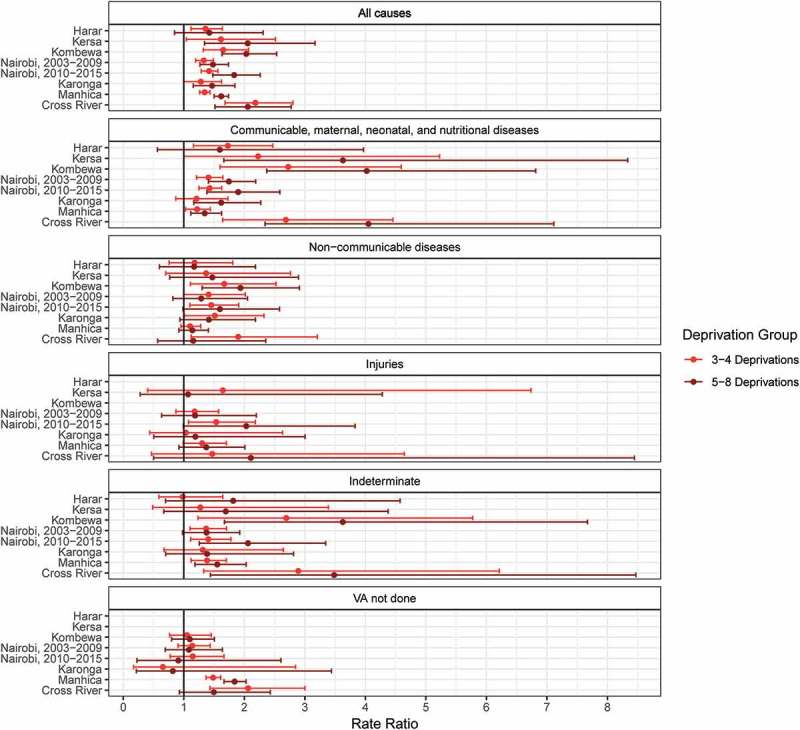
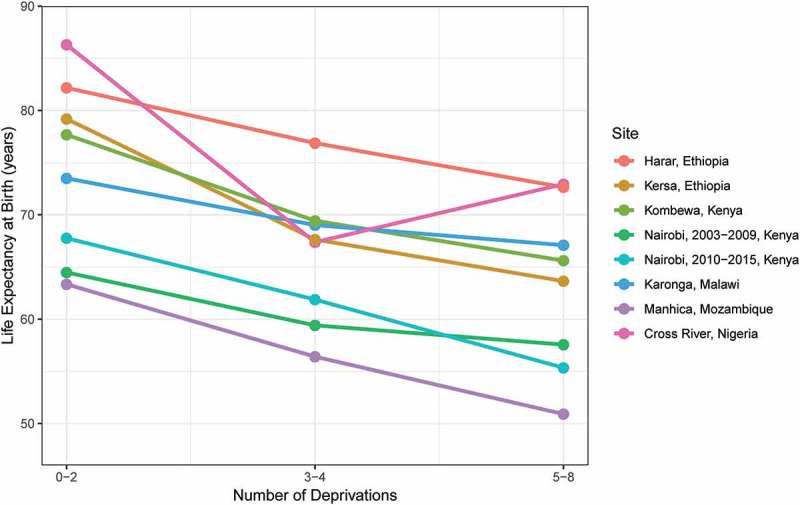
BACKGROUND: Understanding socioeconomic disparities in all-cause and cause-specific mortality can help inform prevention and treatment strategies. OBJECTIVES: To quantify cause-specific mortality rates by socioeconomic status across seven health and demographic surveillance systems (HDSS) in five countries (Ethiopia, Kenya, Malawi, Mozambique, and Nigeria) in the INDEPTH Network in sub-Saharan Africa. METHODS: We linked demographic residence data with household survey data containing living standards and education information we used to create a poverty index. Person-years lived and deaths between 2003 and 2016 (periods varied by HDSS) were stratified in each HDSS by age, sex, year, and number of deprivations on the poverty index (0-8). Causes of death were assigned to each death using the InterVA-4 model based on responses to verbal autopsy questionnaires. We estimated rate ratios between socioeconomic groups (2-4 and 5-8 deprivations on our poverty index compared to 0-2 deprivations) for specific causes of death and calculated life expectancy for the deprivation groups. RESULTS: Our pooled data contained almost 3.5 million person-years of observation and 25,038 deaths. All-cause mortality rates were higher among people in households with 5-8 deprivations on our poverty index compared to 0-2 deprivations, controlling for age, sex, and year (rate ratios ranged 1.42 to 2.06 across HDSS sites). The poorest group had consistently higher death rates in communicable, maternal, neonatal, and nutritional conditions (rate ratios ranged 1.34-4.05) and for non-communicable diseases in several sites (1.14-1.93). The disparities in mortality between 5-8 deprivation groups and 0-2 deprivation groups led to lower life expectancy in the higher-deprivation groups by six years in all sites and more than 10 years in five sites. CONCLUSIONS: We show large disparities in mortality on the basis of socioeconomic status across seven HDSS in sub-Saharan Africa due to disparities in communicable disease mortality and from non-communicable diseases in some sites. Life expectancy gaps between socioeconomic groups within sites were similar to the gaps between high-income and lower-middle-income countries. Prevention and treatment efforts can benefit from understanding subpopulations facing higher mortality from specific conditions.
Overview
The claims and statistics of this paper haven’t been checked yet.
Free: it reads the open-access text and checks the first 5 claims that cite a source we can check. Create a free account to check every claim.
Integrity signals
Registry
Cites
Statistics
Figures
Verification
Claims the paper makes
The claims and statistics of this paper haven’t been checked yet.
Free: it reads the open-access text and checks the first 5 claims that cite a source we can check. Create a free account to check every claim.
Self-check
Percentages, sums and reported differences re-computed from the paper’s own numbers.
The self-check needs the paper’s full text.
Citations
Cites
Transforming our world: the 2030 Agenda for Sustainable Development
(2022) · Sustainable Development Goals · doi:10.5040/9781509934058.0025 · Cited by 6,562
Naghavi, M., Abajobir, A. A., Abbafati, C., Abbas, K. M., Abd-Allah, F., Abera, S. F., Aboyans, V., Adetokunboh, O., Afshin, A., Agrawal, A., et al. (2017) · The Lancet · doi:10.1016/s0140-6736(17)32152-9 · Cited by 4,821
Kyu, H. H., Abate, D., Abate, K. H., Abay, S. M., Abbafati, C., Abbasi, N., Abbastabar, H., Abd-Allah, F., Abdela, J., Abdelalim, A., et al. (2018) · The Lancet · doi:10.1016/s0140-6736(18)32335-3 · Cited by 4,081
Mortality by cause for eight regions of the world: Global Burden of Disease Study
Murray, C. J., & Lopez, A. D. (1997) · The Lancet · doi:10.1016/s0140-6736(96)07493-4 · Cited by 4,043 · cited 1×
“tion of deaths from NCDs is lower [44].”
BackgroundAmelia II: A Program for Missing Data
Honaker, J., King, G., & Blackwell, M. (2011) · Journal of Statistical Software · doi:10.18637/jss.v045.i07 · Cited by 2,552
Hay, S. I., Abajobir, A. A., Abate, K. H., Abbafati, C., Abbas, K. M., Abd-Allah, F., Abdulkader, R. S., Abdulle, A. M., Abebo, T. A., Abera, S. F., et al. (2017) · The Lancet · doi:10.1016/s0140-6736(17)32130-x · Cited by 2,083
Self-citationDemography, Measuring and Modeling Population Processes
Veron, J., Preston, S. H., Heuveline, P., & Guillot, M. (2002) · Population (French Edition) · doi:10.2307/1535065 · Cited by 1,709
Socioeconomic Status and Health: What We Know and What We Don't
ADLER, N. E., & OSTROVE, J. M. (1999) · Annals of the New York Academy of Sciences · doi:10.1111/j.1749-6632.1999.tb08101.x · Cited by 1,643
Acute Multidimensional Poverty: A New Index for Developing CountriesPreprint
Alkire, S., & Santos, M. E. (2010) · RePEc: Research Papers in Economics · Cited by 1,106
The Relationship between Socioeconomic Status and Health: A Review of the Literature
Feinstein, J. S. (1993) · The Milbank Quarterly · doi:10.2307/3350401 · Cited by 1,062
Using the outcome for imputation of missing predictor values was preferred
Moons, K. G. M., Donders, R. A. R. T., Stijnen, T., & Harrell, F. E. (2006) · Journal of Clinical Epidemiology · doi:10.1016/j.jclinepi.2006.01.009 · Cited by 994
Acute Multidimensional Poverty: A New Index for Developing Countries
Alkire, S., & Santos, M. E. (2010) · SSRN Electronic Journal · doi:10.2139/ssrn.1815243 · Cited by 982
Allen, L., Williams, J., Townsend, N., Mikkelsen, B., Roberts, N., Foster, C., & Wickramasinghe, K. (2017) · The Lancet Global Health · doi:10.1016/s2214-109x(17)30058-x · Cited by 752 · cited 13×
“Compared to the highest socioeconomic group, mortality rates were greater in poorer groups, not only for communicable, maternal, nutritional, and neonatal conditions but also for NCDs in several HDSS sites.”
BackgroundInfluentialArifeen, S., Black, R. E., Antelman, G., Baqui, A., Caulfield, L., & Becker, S. (2001) · Pediatrics · doi:10.1542/peds.108.4.e67 · Cited by 582
Epidemiological Transition and the Double Burden of Disease in Accra, Ghana
Agyei-Mensah, S., & de-Graft Aikins, A. (2010) · Journal of Urban Health · doi:10.1007/s11524-010-9492-y · Cited by 411
Niessen, L. W., Mohan, D., Akuoku, J. K., Mirelman, A. J., Ahmed, S., Koehlmoos, T. P., Trujillo, A., Khan, J., & Peters, D. H. (2018) · The Lancet · doi:10.1016/s0140-6736(18)30482-3 · Cited by 394
Health transition in middle-income countries: new challenges for health care
FRENK, J., BOBADILLA, J. L., SEPUúLVEDA, J., & CERVANTES, M. L. (1989) · Health Policy and Planning · doi:10.1093/heapol/4.1.29 · Cited by 341
The INDEPTH Network: filling vital gaps in global epidemiology
Sankoh, O., & Byass, P. (2012) · International Journal of Epidemiology · doi:10.1093/ije/dys081 · Cited by 301 · cited 2×
“HDSS sites of which 75% are located inAfrica, has pooled verbal autopsy data frommember HDSS sites to describe patterns in COD across Africa and Asia [14,15].”
BackgroundSelf-citationSocial inequalities in health within countries: not only an issue for affluent nations
Braveman, P., & Tarimo, E. (2002) · Social Science & Medicine · doi:10.1016/s0277-9536(01)00331-8 · Cited by 262 · cited 1×
“Efforts to increase evidence on inequalities within low- and lowermiddle-income countries (LLMICs) are growing [4].”
BackgroundAction to address the household economic burden of non-communicable diseases
Jan, S., Laba, T.-L., Essue, B. M., Gheorghe, A., Muhunthan, J., Engelgau, M., Mahal, A., Griffiths, U., McIntyre, D., Meng, Q., et al. (2018) · The Lancet · doi:10.1016/s0140-6736(18)30323-4 · Cited by 249 · cited 1×
“understanding of the drivers of existing disparities – such as low availability of NCD services, the pathways between NCDs and poverty [45,46], and various risk”
BackgroundStrengthening standardised interpretation of verbal autopsy data: the new InterVA-4 tool
Byass, P., Chandramohan, D., Clark, S. J., D'Ambruoso, L., Fottrell, E., Graham, W. J., Herbst, A. J., Hodgson, A., Hounton, S., Kahn, K., et al. (2012) · Global Health Action · doi:10.3402/gha.v5i0.19281 · Cited by 221 · cited 2×
“In a study of this kind, a high priority is to secure methodologically comparable results across sites and over time, for which we used InterVA-4, a commonly used probabilistic model for VA questionnaires relating to World Health Organization standards [50] as used across INDEPTH sites [14,36].”
Self-citationHouweling, T. A. J., & Kunst, A. E. (2010) · British Medical Bulletin · doi:10.1093/bmb/ldp048 · Cited by 209
Determinants of child mortality in LDCs
Wang, L. (2003) · Health Policy · doi:10.1016/s0168-8510(03)00039-3 · Cited by 208 · cited 1×
“Large SES differences between these sites likely played an important role, but this disparity also echoes other studies showing gaps between urban and rural child mortality [40].”
ResultBeguy, D., Elung'ata, P., Mberu, B., Oduor, C., Wamukoya, M., Nganyi, B., & Ezeh, A. (2015) · International Journal of Epidemiology · doi:10.1093/ije/dyu251 · Cited by 200 · cited 1×
“It is possible that some of this difference in mortality is related to risks associated with the location of the Nairobi HDSS in two slum communities [27].”
BackgroundSelf-citationNichols, E. K., Byass, P., Chandramohan, D., Clark, S. J., Flaxman, A. D., Jakob, R., Leitao, J., Maire, N., Rao, C., Riley, I., et al. (2018) · PLOS Medicine · doi:10.1371/journal.pmed.1002486 · Cited by 174 · cited 1×
“In a study of this kind, a high priority is to secure methodologically comparable results across sites and over time, for which we used InterVA-4, a commonly used probabilistic model for VA questionnaires relating to World Health Organization standards [50] as used across INDEPTH sites [14,36].”
MethodSelf-citationUsing verbal autopsy to measure causes of death: the comparative performance of existing methods
Murray, C. J., Lozano, R., Flaxman, A. D., Serina, P., Phillips, D., Stewart, A., James, S. L., Vahdatpour, A., Atkinson, C., Freeman, M. K., et al. (2014) · BMC Medicine · doi:10.1186/1741-7015-12-5 · Cited by 168 · cited 2×
“COD assigned using verbal autopsy has inherent limitations, although methods are continuously evolving [49].”
BackgroundMethodProfile: Manhica Health Research Centre (Manhica HDSS)
Sacoor, C., Nhacolo, A., Nhalungo, D., Aponte, J. J., Bassat, Q., Augusto, O., Mandomando, I., Sacarlal, J., Lauchande, N., Sigauque, B., et al. (2013) · International Journal of Epidemiology · doi:10.1093/ije/dyt148 · Cited by 156
Self-citationProfile: The Karonga Health and Demographic Surveillance System
Crampin, A. C., Dube, A. L. N., Mboma, S. M., Price, A., Chihana, M. L., Jahn, A., Baschieri, A., Molesworth, A. M., Mwaiyeghele, E., Branson, K., et al. (2012) · International Journal of Epidemiology · doi:10.1093/ije/dys088 · Cited by 141
Self-citationMcKinnon, B., Harper, S., Kaufman, J. S., & Bergevin, Y. (2014) · The Lancet Global Health · doi:10.1016/s2214-109x(14)70008-7 · Cited by 133
Streatfield, P. K., Khan, W. A., Bhuiya, A., Alam, N., Sié, A., Soura, A. B., Bonfoh, B., Ngoran, E. K., Weldearegawi, B., Jasseh, M., et al. (2014) · Global Health Action · doi:10.3402/gha.v7.25362 · Cited by 107
Self-citationKabudula, C. W., Houle, B., Collinson, M. A., Kahn, K., Gómez-Olivé, F. X., Clark, S. J., & Tollman, S. (2017) · BMC Public Health · doi:10.1186/s12889-017-4312-x · Cited by 107
HDSS Profile: The Kersa Health and Demographic Surveillance System
Assefa, N., Oljira, L., Baraki, N., Demena, M., Zelalem, D., Ashenafi, W., & Gishu, M. D. (2015) · International Journal of Epidemiology · doi:10.1093/ije/dyv284 · Cited by 105
Self-citationReframing NCDs and injuries for the poorest billion: a Lancet Commission
Bukhman, G., Mocumbi, A. O., & Horton, R. C. (2015) · The Lancet · doi:10.1016/s0140-6736(15)00278-0 · Cited by 87 · cited 3×
“Our study contributes to this effort as part of the Lancet NCDI Poverty Commission to establish evidence about the burden of NCDIs among the poorest.”
BackgroundMethodInfluentialSelf-citationThe INDEPTH standard population for low- and middle-income countries, 2013
Sankoh, O., Sharrow, D., Herbst, K., Whiteson Kabudula, C., Alam, N., Kant, S., Ravn, H., Bhuiya, A., Thi Vui, L., Darikwa, T., et al. (2014) · Global Health Action · doi:10.3402/gha.v7.23286 · Cited by 83
Self-citationOgoina, D., & Onyemelukwe, G. C. (2009) · Journal of Infection and Public Health · doi:10.1016/j.jiph.2009.02.001 · Cited by 68 · cited 13×
“Compared to the highest socioeconomic group, mortality rates were greater in poorer groups, not only for communicable, maternal, nutritional, and neonatal conditions but also for NCDs in several HDSS sites.”
BackgroundInfluentialKabudula, C. W., Houle, B. C., Collinson, M., Kahn, K., Gómez-Olivé, F. X., Tollman, S. M., & Clark, S. J. (2017) · The Lancet Global Health · doi:10.1016/s2214-109x(17)30297-8 · Cited by 68
Mortality Burden and Socioeconomic Status in India
Po, J. Y. T., & Subramanian, S. V. (2011) · PLoS ONE · doi:10.1371/journal.pone.0016844 · Cited by 63
Monitoring inequality: an emerging priority for health post-2015
Hosseinpoor, A. R., Bergen, N., & Magar, V. (2015) · Bulletin of the World Health Organization · doi:10.2471/blt.15.162081 · Cited by 60 · cited 1×
“(SDGs), there have been increasing calls for more geographically specific data and data that can be stratified by subpopulations to address health equity [11,12].”
BackgroundSifuna, P., Oyugi, M., Ogutu, B. R., Andagalu, B., Otieno, A., Owira, V., Otsyula, N., Oyieko, J. N., Cowden, J., Otieno, L., et al. (2014) · International Journal of Epidemiology · doi:10.1093/ije/dyu139 · Cited by 47
Self-citationSantosa, A., & Byass, P. (2016) · PLoS ONE · doi:10.1371/journal.pone.0155753 · Cited by 44
Self-citationBawah, A., Houle, B., Alam, N., Razzaque, A., Streatfield, P. K., Debpuur, C., Welaga, P., Oduro, A., Hodgson, A., Tollman, S., et al. (2016) · PLOS ONE · doi:10.1371/journal.pone.0157281 · Cited by 43
Self-citationNyaguara, A., van Eijk, A. M., Lindblade, K. A., Hamel, M. J., Bayoh, N. M., Gimnig, J. E., Laserson, K. F., Slutsker, L., Smith, T. A., & Vounatsou, P. (2018) · Malaria Journal · doi:10.1186/s12936-018-2184-x · Cited by 40
The epidemiology of pregnancy outcomes in rural Burkina Faso
Bell, J. S., Ouédraogo, M., Ganaba, R., Sombié, I., Byass, P., Baggaley, R. F., Filippi, V., Fitzmaurice, A. E., & Graham, W. J. (2008) · Tropical Medicine & International Health · doi:10.1111/j.1365-3156.2008.02085.x · Cited by 37
Self-citationArea-based units of analysis for strengthening health inequality monitoring
Hosseinpoor, A. R., & Bergen, N. (2016) · Bulletin of the World Health Organization · doi:10.2471/blt.15.165266 · Cited by 35 · cited 1×
“Using available data from smaller area-based units, such as HDSS sites, provides locally relevant insights into health inequality, alignment with administrative units of government, and greater ability to reach communities [52].”
MethodMee, P., Collinson, M., Madhavan, S., Kabudula, C. W., Gómez-Olivé, F. X., Kahn, K., Tollman, S. M., Hargreaves, J., & Byass, P. (2014) · Global Health Action · doi:10.3402/gha.v7.24826 · Cited by 34
Self-citationCause-specific mortality and socioeconomic status in Chakaria, Bangladesh
Hanifi, S. M. A., Mahmood, S. S., & Bhuiya, A. (2014) · Global Health Action · doi:10.3402/gha.v7.25473 · Cited by 30
Abera, S. F., Gebru, A. A., Biesalski, H. K., Ejeta, G., Wienke, A., Scherbaum, V., & Kantelhardt, E. J. (2017) · PLoS ONE · doi:10.1371/journal.pone.0188968 · Cited by 27
Rossier, C., Soura, A., Duthé, G., & Findley, S. E. (2014) · PLoS ONE · doi:10.1371/journal.pone.0113780 · Cited by 25
Child Mortality in Rural Malawi: HIV Closes the Survival Gap between the Socio-Economic Strata
Jahn, A., Floyd, S., McGrath, N. M., Crampin, A. C., Kachiwanda, L., Mwinuka, V., Żaba, B., Fine, P., & Glynn, J. R. (2010) · PLoS ONE · doi:10.1371/journal.pone.0011320 · Cited by 23 · cited 1×
“Nonetheless, other studies report conflicting or inconclusive evidence about the same causes [8,25,26].”
BackgroundSelf-citationMortality in women of reproductive age in rural South Africa
Nabukalu, D., Klipstein‐Grobusch, K., Herbst, K., & Newell, M. (2013) · Global Health Action · doi:10.3402/gha.v6i0.22834 · Cited by 20
Childhood mortality and its association with household wealth in rural and semi-urban Burkina Faso
Schoeps, A., Souares, A., Niamba, L., Diboulo, E., Kynast‐Wolf, G., Müller, O., Sié, A., & Becher, H. (2014) · Transactions of the Royal Society of Tropical Medicine and Hygiene · doi:10.1093/trstmh/tru124 · Cited by 20 · cited 1×
“Some studies have suggested that urban or semi-urban areas may show higher inequality, at least in under-5 mortality, because of greater heterogeneity in factors like piped water or electricity (while most rural households in certain areas are not likely to have these resources at all) [41].”
BackgroundCause-specific mortality findings from the Global Burden of Disease project and the INDEPTH Network
Byass, P. (2016) · The Lancet Global Health · doi:10.1016/s2214-109x(16)30203-0 · Cited by 19 · cited 1×
“similarities across a range of countries, suggesting that HDSS data may be more generalizable than is sometimes assumed [51].”
BackgroundSelf-citationMeasuring Health Equity in Small Areas — Findings from Demographic Surveillance Systems
Indepth Network (2022) · Routledge eBooks · doi:10.4324/9781351126595 · Cited by 16
Research works printed but not linked: 1
- Auerbach JA, Krimgold BK, editors. Income, socioeconomic status, and health: exploring the relationships. Washington, D.C: Academy for Health Services Research and Health Policy; 2001.
Cited by
Bukhman, G., Mocumbi, A. O., Atun, R., Becker, A. E., Bhutta, Z., Binagwaho, A., Clinton, C., Coates, M. M., Dain, K., Ezzati, M., et al. (2020) · The Lancet · doi:10.1016/s0140-6736(20)31907-3 · Cited by 285
Self-citationGlobal health 2050: the path to halving premature death by mid-century
Jamison, D. T., Summers, L. H., Chang, A. Y., Karlsson, O., Mao, W., Norheim, O. F., Ogbuoji, O., Schäferhoff, M., Watkins, D., Adeyi, O., et al. (2024) · The Lancet · doi:10.1016/s0140-6736(24)01439-9 · Cited by 125
Coates, M. M., Ezzati, M., Aguilar, G. R., Kwan, G. F., Vigo, D., Mocumbi, A. O., Becker, A. E., Makani, J., Hyder, A. A., Jain, Y. K., et al. (2021) · PLoS ONE · doi:10.1371/journal.pone.0253073 · Cited by 105
Self-citationBerrueta, M., Ciapponi, A., Bardach, A., Cairoli, F. R., Castellano, F. J., Xiong, X., Stergachis, A. S., Zaraa, S., Meulen, A. S.-T., Buekens, P. M., et al. (2021) · BMC Pregnancy and Childbirth · doi:10.1186/s12884-021-03686-9 · Cited by 32
Gupta, N., Mocumbi, A. O., Arwal, S. H., Jain, Y. K., Haileamlak, A., Memirie, S. T., Larco, N. C., Kwan, G. F., Amuyunzu–Nyamongo, M., Gathecha, G. K., et al. (2021) · Global Health Science and Practice · doi:10.9745/ghsp-d-21-00035 · Cited by 33
Self-citation
Metadata
- Authors
- Coates, M. M., Kamanda, M., Kintu, A., Arikpo, I., Chauque, A., Mengesha, M. M., Price, A. J., Sifuna, P., Wamukoya, M., Sacoor, C. N., Ogwang, S., Assefa, N., Crampin, A. C., Macete, E. V., Kyobutungi, C., Meremikwu, M. M., Otieno, W., Adjaye-Gbewonyo, K., Marx, A., Byass, P., Sankoh, O., & Bukhman, G.
- Affiliations
- Harvard University (US)
- Indepth Network (GH)
- University of Calabar (NG)
- INDEPTH Network, Accra, Ghana
- Haramaya University (ET)
- London School of Hygiene & Tropical Medicine (GB)
- United States Army Medical Research Directorate - Africa (KE)
- Manhiça Health Research Centre (MZ)
- Maseno University (KE)
- University College London (GB)
- University of the Witwatersrand (ZA)
- University of Sierra Leone (SL)
- Brigham and Women's Hospital (US)
- Corresponding author
- Bukhman, Gene
- ORCID
- Venue
- Global Health Action
- Publisher
- Informa UK Limited
- Published
- 2019-01-01
- Volume
- 12
- Issue
- 1
- Pages
- 1608013
- ISSN
- 1654-9716 (ISSN-L)
- 1654-9880
- PMC
- PMC6534200
- OpenAlex
- W2945400622
- Cited by
- 25
- References
- 53
- Citations by year
- 2026: 2 · 2025: 2 · 2024: 2 · 2023: 1 · 2022: 4 · 2021: 7 · 2020: 7
- FWCI
- 4.37
- Type
- journal article
- Language
- en
- Open access
- gold
- doi.org
- Licence
- Locations
- Global Health Action (publishedVersion, cc-by)
- PubMed Central (publishedVersion, cc-by)
- PubMed (publishedVersion)
- ENLIGHTEN (Jurnal Bimbingan dan Konseling Islam) (acceptedVersion, cc-by-sa)
- Greenwich Academic Literature Archive (University of Greenwich) (acceptedVersion)
- LSHTM Research Online (London School of Hygiene and Tropical Medicine) (acceptedVersion)
- KTH Publication Database DiVA (KTH Royal Institute of Technology) (submittedVersion, other-oa)
- DOAJ (DOAJ: Directory of Open Access Journals) (submittedVersion, cc-by-sa)
- UCL Discovery (University College London) (submittedVersion)
- Funders
- Leona M. and Harry B. Helmsley Charitable Trust
- Topics
- Social Sciences › Health › Health disparities and outcomes
- Health Sciences › Medicine › Pediatrics, Perinatology and Child Health › Global Maternal and Child Health
- Social Sciences › Health › Public Health and Social Inequalities
- Keywords
- socioeconomic status, household poverty, cause-specific mortality, all-cause mortality, mortality disparities, poverty indicators, life expectancy, infectious diseases, non-communicable diseases, verbal autopsy, sub-Saharan Africa
- MeSH terms
- Adolescent, Adult, Cause of Death, Demography, Ethiopia, Female, Humans, Kenya, Life Expectancy, Malawi, Male, Middle Aged, Mozambique, Nigeria, Population Surveillance, Poverty, Surveys and Questionnaires, Social Class, Socioeconomic Factors, Global Health
About these checks
Registry, retraction, Cites and statistics results are computed, not judged, with one exception: a printed reference that no index lists is read once by a model before it counts as a citation error. Claims are extracted by a model and kept only when their quote appears verbatim in the text; each cited source is then checked, with a model’s help, for whether it says what the claim relies on. Those verdicts can be wrong — read the claim’s quote and the cited source before relying on one.
Statistics and arithmetic are recomputed, not judged.
Confidence bands are shown only for fields calibrated on our annotated test set. None is calibrated yet, so no band is shown.
What counts as a claim ›How we measure confidence ›How we check this ›
Are you an author, or do you see a problem with this page? Request a review
Data sources
Bibliographic data: Semantic Scholar, OpenAlex, Crossref.
Contains information from the Semantic Scholar Academic Graph Datasets, made available under the ODC Attribution License (ODC-BY 1.0).
Semantic Scholar’s data is described in: Kinney, R., et al. (2023). The Semantic Scholar Open Data Platform. arXiv:2301.10140.
