

Addressing the migrant gap: maternal healthcare perspectives on utilising prevention of mother to child transmission (PMTCT) services during the COVID-19 pandemic, South Africa
Open accessThe DOI matches its Crossref record; 33 of the 33 references it cites were found in a registry or an index.
Abstract
BACKGROUND: The COVID-19 pandemic has interrupted the prevention of mother-to-child transmission of HIV (PMTCT) programming in South Africa. In 2020, it was estimated that there were 4 million cross-border migrants in South Africa, some of whom are women living with HIV (WLWH), who are highly mobile and located within peripheral and urban areas of Johannesburg. Little is known about the mobility typologies of these women associated with different movement patterns, the impact of the COVID-19 pandemic on mobility typologies of women utilising PMTCT services and on how changes to services might have affected adherence. OBJECTIVE: To qualitatively explore experiences of different mobility typologies of migrant women utilising PMTCT services in a high mobility context of Johannesburg and how belonging to a specific typology might have affected the health care received and their overall experiences during the COVID-19 pandemic. METHODS: Qualitative semi-structured interviews with 40 pregnant migrant WLWH were conducted from June 2020-June 2021. Participants were recruited through purposive sampling at a public hospital in Johannesburg. A thematic approach was used to analyse interviews. RESULTS: Forty interviews were conducted with 22 cross-border and 18 internal migrants. Women in cross-border migration patterns compared to interprovincial and intraregional mobility experienced barriers of documentation, language availability, mistreatment, education and counselling. Due to border closures, they were unable to receive ART interrupting adherence and relied on SMS reminders to adhere to ART during the pandemic. All 40 women struggled to understand the importance of adherence because of the lack of infrastructure to support social distancing protocols and to provide PMTCT education. CONCLUSIONS: COVID-19 amplified existing challenges for cross-border migrant women to utilise PMTCT services. Future pandemic preparedness should be addressed with differentiated service delivery including multi-month dispensing of ARVs, virtual educational care, and language-sensitive information, responsive to the needs of mobile women to alleviate the burden on the healthcare system.
Overview
The claims and statistics of this paper haven’t been checked yet.
Free: it reads the open-access text and checks the first 5 claims that cite a source we can check. Create a free account to check every claim.
Integrity signals
Registry
Cites
Statistics
Figures
Verification
Claims the paper makes
The claims and statistics of this paper haven’t been checked yet.
Free: it reads the open-access text and checks the first 5 claims that cite a source we can check. Create a free account to check every claim.
Claims other papers make about this one
Each is checked against this paper’s own text: does it say what the citing paper says it does?
In the citing paper
“Low-, middle- and high-income countries reported more disruption in migrant health care than health care for non-migrants during COVID-19 [22–24].”
From COVID-19 pandemic, pregnancy care, perinatal outcomes in Eastern Myanmar and North-Western Thailand: a retrospective marginalised population cohort (2024) · doi:10.1186/s12884-024-06841-0 · cites this paper as [23]
Self-check
Percentages, sums and reported differences re-computed from the paper’s own numbers.
The self-check needs the paper’s full text.
Citations
Cites
Using thematic analysis in psychology
Braun, V., & Clarke, V. (2006) · Qualitative Research in Psychology · doi:10.1191/1478088706qp063oa · Cited by 194,414 · cited 1×
“A person-directed care approach could supply healthcare services on a virtual platform, including language-sensitive information, educational materials with visuals for communication and MMD for long-term supply of ART, to reduce the number of visits for highly mobile migrants [30].”
BackgroundQualitative data analysis: the framework approach
Smith, J., & Firth, J. (2011) · Nurse Researcher · doi:10.7748/nr2011.01.18.2.52.c8284 · Cited by 1,206 · cited 2×
“authenticity and learn from past experiences of the research process and findings [27,31].”
BackgroundInternational Organization for Migration (IOM)
Turner, B. (2006) · The Statesman’s Yearbook 2007 · doi:10.1057/9780230271357_40 · Cited by 768
Women and HIV in Sub-Saharan Africa
Ramjee, G., & Daniels, B. (2013) · AIDS Research and Therapy · doi:10.1186/1742-6405-10-30 · Cited by 341 · cited 5×
“In the early 1990s, Coronationville experienced rapid urbanisation, resulting in the establishment of informal settlements [25,26].”
BackgroundInfluentialSuphanchaimat, R., Kantamaturapoj, K., Putthasri, W., & Prakongsai, P. (2015) · BMC Health Services Research · doi:10.1186/s12913-015-1065-z · Cited by 322 · cited 2×
“This could help build the service users’ capacity to be in ultimate charge of choosing health services in line with their values, beliefs, and needs [33,35,42,43].”
BackgroundAccess as a policy-relevant concept in low- and middle-income countries
MCINTYRE, D., THIEDE, M., & BIRCH, S. (2009) · Health Economics, Policy and Law · doi:10.1017/s1744133109004836 · Cited by 321 · cited 9×
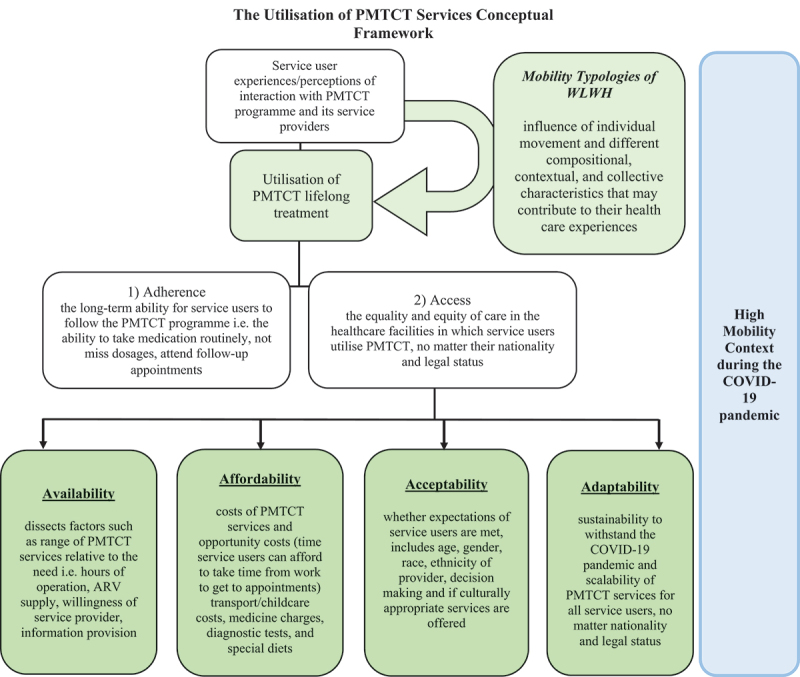
“The concept of utilisation is made up of 1) adherence issues to the programme and 2) access composed of four dimensions: availability, affordability, acceptability, and adaptability [6,28].”
BackgroundInfluentialDorward, J., Khubone, T., Gate, K., Ngobese, H., Sookrajh, Y., Mkhize, S., Jeewa, A., Bottomley, C., Lewis, L., Baisley, K., et al. (2021) · The Lancet HIV · doi:10.1016/s2352-3018(20)30359-3 · Cited by 300 · cited 5×
“For service responsiveness to better integrate PMTCT care on a larger scale, adherence support groups should be available in different languages where mothers can connect with a community they identify with [35,36,37,39,38].”
BackgroundInfluentialMigration and health: a global public health research priority
Wickramage, K., Vearey, J., Zwi, A. B., Robinson, C., & Knipper, M. (2018) · BMC Public Health · doi:10.1186/s12889-018-5932-5 · Cited by 273 · cited 5×
“movement on healthcare systems should consider the complexities of migration [24].”
BackgroundInfluentialSelf-citationCOVID-19 Among People Living with HIV: A Systematic Review
Mirzaei, H., McFarland, W., Karamouzian, M., & Sharifi, H. (2021) · AIDS and Behavior · doi:10.1007/s10461-020-02983-2 · Cited by 260 · cited 1×
“A greater concern remains about the impact of COVID-19 on PLWHIV due to ‘immunosuppression’, ‘multi-morbidities’, and ‘higher mortality’ risks [3], especially for vulnerable populations including pregnant women living with HIV (WLWH).”
BackgroundRefugees’ experiences of healthcare in the host country: a scoping review
Mangrio, E., & Sjögren Forss, K. (2017) · BMC Health Services Research · doi:10.1186/s12913-017-2731-0 · Cited by 245 · cited 2×
“The vulnerability must be acknowledged when looking at risk factors of acquiring HIV both as a highly mobile migrant and as a woman [19,21].”
BackgroundThe Dark Side of Democracy: Migration, Xenophobia and Human Rights in South Africa
Crush, J. (2001) · International Migration · doi:10.1111/1468-2435.00145 · Cited by 234 · cited 3×
“Crossborder migrant women utilising PMTCT services face many of these barriers that disrupt their ability to adhere to medication and treatment for chronic diseases such as HIV, which requires long-term discipline [13,16,17,21].”
BackgroundCramer, G. R., Young, G. J., Singh, S., McGuire, J., & Kim, D. (2021) · BMC Health Services Research · doi:10.1186/s12913-020-05996-8 · Cited by 179
Medical Xenophobia and Zimbabwean Migrant Access to Public Health Services in South Africa
Crush, J., & Tawodzera, G. (2014) · Journal of Ethnic and Migration Studies · doi:10.1080/1369183x.2013.830504 · Cited by 174 · cited 2×
“Research suggests that mistreatment including xenophobic attitudes and practices by healthcare workers (HCWs) can impact provision and access to care for individuals based purely on their identity as a ‘non-national,’ also known as a non-South African citizen [17,18].”
BackgroundCoker, M., Folayan, M. O., Michelow, I. C., Oladokun, R. E., Torbunde, N., & Sam-Agudu, N. A. (2021) · Pediatric Research · doi:10.1038/s41390-020-01174-y · Cited by 107
The time is now: expedited HIV differentiated service delivery during the COVID‐19 pandemic
Wilkinson, L., & Grimsrud, A. (2020) · Journal of the International AIDS Society · doi:10.1002/jia2.25503 · Cited by 96 · cited 3×
“This could reduce the risk of exposure to COVID-19 where vulnerabilities are amplified for individuals who are often turned away at facilities [35,36,37,39,38].”
BackgroundData Management and Security in Qualitative Research
Lin, L.-C. (2009) · Dimensions of Critical Care Nursing · doi:10.1097/dcc.0b013e31819aeff6 · Cited by 57 · cited 5×
“authenticity and learn from past experiences of the research process and findings [28,32].”
BackgroundMethodInfluentialConceptual Framework and Research Methods for Migration and HIV Transmission Dynamics
Cassels, S. L., Jenness, S. M., & Khanna, A. S. (2013) · AIDS and Behavior · doi:10.1007/s10461-013-0665-z · Cited by 55
Iroezi, N. D., Mindry, D. L., Kawale, P., Chikowi, G., Jansen, P., & Hoffman, R. M. (2013) · African Journal of Reproductive Health · Cited by 54
Liu, L., Christie, S., Munsamy, M., Roberts, P., Pillay, M., Shenoi, S., Desai, M. M., & Linnander, E. L. (2021) · BMC Health Services Research · doi:10.1186/s12913-021-06450-z · Cited by 54
Bisnauth, M. A., Davies, N., Monareng, S., Buthelezi, F., Struthers, H. E., McIntyre, J. A., & Rees, K. (2021) · PLoS ONE · doi:10.1371/journal.pone.0256540 · Cited by 51 · cited 3×
“The vulnerability must be acknowledged when looking at risk factors of acquiring HIV both as a highly mobile migrant and as a woman [19,21].”
BackgroundSelf-citationHealthy migration: A public health and development imperative for south(ern) Africa
Vearey, J. (2014) · South African Medical Journal · doi:10.7196/samj.8569 · Cited by 49
Self-citationVearey, J. (2018) · Journal of the International AIDS Society · doi:10.1002/jia2.25137 · Cited by 45 · cited 10×
“without documentation such as no form of identification (ID), including a passport and/or ID card [14,22].”
BackgroundMethodInfluentialSelf-citationVrazo, A. C., Golin, R., Fernando, N. B., Killam, W. P., Sharifi, S., Phelps, B. R., Gleason, M. M., Wolf, H. T., Siberry, G. K., & Srivastava, M. (2020) · Journal of the International AIDS Society · doi:10.1002/jia2.25622 · Cited by 40 · cited 3×
“This could reduce the risk of exposure to COVID-19 where vulnerabilities are amplified for individuals who are often turned away at facilities [35,36,37,39,38].”
BackgroundWhite, J. A., Blaauw, D., & Rispel, L. C. (2020) · PLoS ONE · doi:10.1371/journal.pone.0244080 · Cited by 40
The risks and benefits of providing HIV services during the COVID-19 pandemic
Stover, J., Kelly, S. L., Mudimu, E., Green, D., Smith, T. E., Taramusi, I., Bansi‐Matharu, L., Martin‐Hughes, R., Phillips, A. N., & Bershteyn, A. (2021) · PLoS ONE · doi:10.1371/journal.pone.0260820 · Cited by 39 · cited 3×
“The hospital's decisions to continue to tailor specific PMTCT services are embedded in a larger healthcare referral system [32,37,39,40].”
BackgroundMunyewende, P. O., Rispel, L. C., Harris, B., & Chersich, M. (2011) · Journal of Public Health Policy · doi:10.1057/jphp.2011.36 · Cited by 32 · cited 4×
“PMTCT using ART is a proven, effective intervention and can reduce vertical HIV transmission to less than 2% [5,6].”
BackgroundMethodInfluentialExploring The Migration Profiles of Primary Healthcare Users in South Africa
Vearey, J., de Gruchy, T., Kamndaya, M. S., Walls, H., Chetty-Makkan, C. M., & Hanefeld, J. (2016) · Journal of Immigrant and Minority Health · doi:10.1007/s10903-016-0535-7 · Cited by 31 · cited 8×
“without documentation such as no form of identification (ID), including a passport and/or ID card [14,22].”
BackgroundInfluentialSelf-citationThe Priest's Soldiers: HIV Therapies, Health Identities, and Forced Encampment in Northern Uganda
Wilhelm‐Solomon, M. (2013) · Medical Anthropology · doi:10.1080/01459740.2012.709891 · Cited by 28 · cited 3×
“a biological condition and shared therapeutic practice’ [39].”
BackgroundSiziba, G. (2015) · African Identities · doi:10.1080/14725843.2015.1087303 · Cited by 19 · cited 1×
“The hospital's decisions to continue to tailor specific PMTCT services are embedded in a larger healthcare referral system [32,37,39,40].”
BackgroundHembah-Hilekaan, S. K., Swende, T. Z., & Bito, T. T. (2012) · PubMed · Cited by 18
Bisnauth, M. A., Coovadia, A. H., Kawonga, M., & Vearey, J. (2022) · Health Services Insights · doi:10.1177/11786329211073386 · Cited by 15 · cited 10×
“The concept of utilisation is made up of 1) adherence issues to the programme and 2) access composed of four dimensions: availability, affordability, acceptability, and adaptability [6,16,29].”
BackgroundInfluentialSelf-citationBisnauth, M. A., Coovadia, A. H., Mbuagbaw, L. C. E., Wilson, M. G., & Birch, S. (2020) · Frontiers in Public Health · doi:10.3389/fpubh.2020.533534 · Cited by 10
Self-citationvan Rensburg, G. H. J., Feucht, U. D., Makin, J. D., le Clus, N., & Avenant, T. (2021) · PLoS Medicine · doi:10.1371/journal.pmed.1003565 · Cited by 7 · cited 4×
“There is a failure to ensure access to preventative and treatment interventions for all in SA, undermining any single nation’s sovereign response to both HIV and COVID-19 care [12,14,15,40].”
BackgroundInfluential
Research works printed but not linked: 6
- Vearey J, Modisenyane M, and Hunter-Adams J. Towards a migration-aware health system in South Africa: a strategic opportunity to address health inequity. South Afr Health Rev. 2017; 27: 1: 89– 98.
- South Africa. Department of home affairs. White Paper on International Migration for South Africa, July 2017. Gauteng: DoH; 2017.
- Bisnauth MA, Coovadia A, Kawonga M, et al. Providing HIV prevention of mother to child transmission (PMTCT) services to migrants during the COVID-19 pandemic in South Africa: insights of healthcare providers. Health Serv Insights. 2022 Jan; 15: 1– 11. PMC8793379 35095278
- Klug N The more things change, the more they stay the same: a case study of Westbury, Coronationville and Slovo Park Informal Settlement: research report 5 in the series spatial transformation through transit-oriented development in Johannesburg, South Africa [Internet]. National Mental Health Commission [ cited 2019 Dec 21]. Available from 2019 Dec 21: https://www.researchgate.net/figure/Spatial-distribution-of-employment-and-unemployment-in-Westbury-Coronationville-and_fig4_328065988.
- Van Der Laat C. Improving access to HIV services by migrant communities. Presented at IAPAC Fast-Track Cities; 2021, October 20-22; Lisbon, Portugal.
- Sipula N Optimizing health service delivery through innovation and technology: facilitating differentiated health service delivery to maximize engagement in care. Presented at IAPAC Fast-Track Cities; 2021. October 20-22; Lisbon, Portugal.
Cited by
Mathenjwa, T., Malila, B., Knight, L., Tanser, F. C., Makwambeni, P. R., & Phillips, T. K. (2025) · Systematic Reviews · doi:10.1186/s13643-024-02747-2 · Cited by 7
“Other research has shown how lack of patient record linkage [8] and additional administrative requirements such as transfer cards lead to interruptions in HIV treatment supply at travel destinations [14] as mobile people are refused HIV treatment at non-home facilities.”
Kothari, R., Baran, R. V., Rudziak, P., Shah, V., & Nouvet, É. (2024) · PLOS Global Public Health · doi:10.1371/journal.pgph.0002975 · Cited by 6
The hidden effects of COVID-19 on HIV services in Zanzibar: country report
Mshenga, M. M., Khalid, F. J., Haji, S. H., Ali, T. B., Mohamed, K., & Damian, D. J. (2023) · AIDS Research and Therapy · doi:10.1186/s12981-023-00570-8 · Cited by 4
(2024) · doi:10.1186/s12884-024-06841-0 · Cited by 2
Fu, W., McClymont, E., Av‐Gay, G., Dorling, M., Atkinson, A., Azampanah, A., Elwood, C. N., Sauve, L. J., van Schalkwyk, J., Sotindjo, T., et al. (2024) · JAIDS Journal of Acquired Immune Deficiency Syndromes · doi:10.1097/qai.0000000000003384
Metadata
- Authors
- Bisnauth, M. A., Coovadia, A., Kawonga, M., & Vearey, J.
- Affiliations
- University of the Witwatersrand (ZA)
- Corresponding author
- Bisnauth, Melanie A.
- Venue
- Global Health Action
- Publisher
- Informa UK Limited
- Published
- 2022-08-15
- Volume
- 15
- Issue
- 1
- Pages
- 2100602-2100602
- ISSN
- 1654-9716 (ISSN-L)
- 1654-9880
- PMC
- PMC9389928
- OpenAlex
- W4291605232
- Cited by
- 9
- References
- 33
- Citations by year
- 2026: 3 · 2025: 2 · 2024: 3 · 2023: 1
- FWCI
- 0.73
- Type
- journal article
- Language
- en
- Open access
- gold
- doi.org
- Locations
- Global Health Action (publishedVersion, cc-by)
- PubMed Central (publishedVersion, cc-by)
- PubMed (publishedVersion)
- DOAJ (DOAJ: Directory of Open Access Journals) (submittedVersion)
- Funders
- University of Witwatersrand, School of Governance, and The Life in the City grant and the School of Clinical Medicine
- Topics
- Health Sciences › Medicine › Infectious Diseases › HIV/AIDS Research and Interventions
- Social Sciences › Law › Migration, Racism, and Human Rights
- Social Sciences › Health › Venezuelan Migration and Society
- Keywords
- prevention of mother-to-child transmission, HIV, migrant women, cross-border migration, internal migration, COVID-19 pandemic, antiretroviral therapy adherence, obstetric care, health care utilization, border closures, language barriers, social distancing, differentiated service delivery, virtual health education
- MeSH terms
- COVID-19, Delivery of Health Care, Female, Humans, Male, Pregnancy, Pregnancy Complications, Infectious, Prenatal Care, South Africa, Transients and Migrants, HIV Infections, Infectious Disease Transmission, Vertical, Pandemics
About these checks
Registry, retraction, Cites and statistics results are computed, not judged, with one exception: a printed reference that no index lists is read once by a model before it counts as a citation error. Claims are extracted by a model and kept only when their quote appears verbatim in the text; each cited source is then checked, with a model’s help, for whether it says what the claim relies on. Those verdicts can be wrong — read the claim’s quote and the cited source before relying on one.
Statistics and arithmetic are recomputed, not judged.
Confidence bands are shown only for fields calibrated on our annotated test set. None is calibrated yet, so no band is shown.
What counts as a claim ›How we measure confidence ›How we check this ›
Are you an author, or do you see a problem with this page? Request a review
Data sources
Bibliographic data: Semantic Scholar, OpenAlex, Crossref.
Contains information from the Semantic Scholar Academic Graph Datasets, made available under the ODC Attribution License (ODC-BY 1.0).
Semantic Scholar’s data is described in: Kinney, R., et al. (2023). The Semantic Scholar Open Data Platform. arXiv:2301.10140.
