

Glycan analysis of therapeutic glycoproteins
Open accessThe DOI matches its Crossref record; 116 of the 116 references it cites were found in a registry or an index.
Abstract
Therapeutic monoclonal antibodies (mAbs) are glycoproteins produced by living cell systems. The glycan moieties attached to the proteins can directly affect protein stability, bioactivity, and immunogenicity. Therefore, glycan variants of a glycoprotein product must be adequately analyzed and controlled to ensure product quality. However, the inherent complexity of protein glycosylation poses a daunting analytical challenge. This review provides an update of recent advances in glycan analysis, including the potential utility of lectin-based microarray for high throughput glycan profiling. Emphasis is placed on comparison of the major types of analytics for use in determining unique glycan features such as glycosylation site, glycan structure, and content.
Overview
The claims and statistics of this paper haven’t been checked yet.
Free: it reads the open-access text and checks the first 5 claims that cite a source we can check. Create a free account to check every claim.
Integrity signals
Registry
Cites
Statistics
Figures
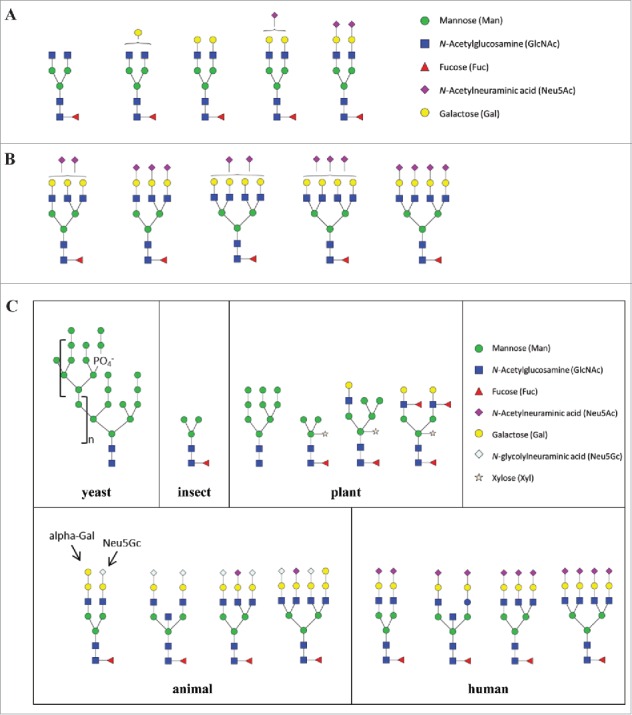
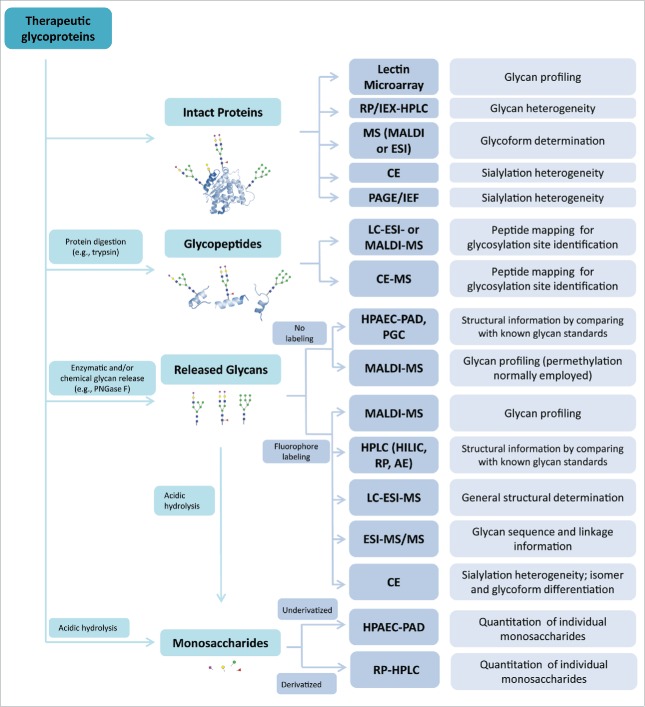
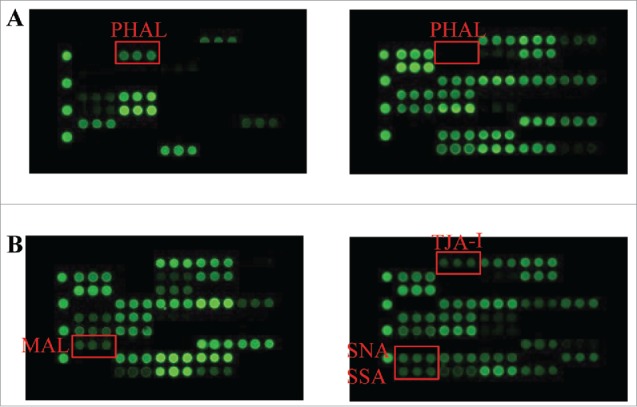
Verification
Claims the paper makes
The claims and statistics of this paper haven’t been checked yet.
Free: it reads the open-access text and checks the first 5 claims that cite a source we can check. Create a free account to check every claim.
Claims other papers make about this one
Each is checked against this paper’s own text: does it say what the citing paper says it does?
The cited source says what the claim attributes to it.
In the citing paper
“We know why partially glycosylated proteins have a shorter lifetime than fully glycosylated ones, due to the binding of galactose with hepatic asialoglycoprotein receptors expressed on hepatocytes, which promotes hepatic clearance of the partially glycosylated proteins [217].”
From GANAB and N-Glycans Substrates Are Relevant in Human Physiology, Polycystic Pathology and Multiple Sclerosis: A Review (2022) · cites this paper as [217]
Self-check
Percentages, sums and reported differences re-computed from the paper’s own numbers.
The self-check needs the paper’s full text.
Citations
Cites
ASSEMBLY OF ASPARAGINE-LINKED OLIGOSACCHARIDES
Kornfeld, R., & Kornfeld, S. (1985) · Annual Review of Biochemistry · doi:10.1146/annurev.bi.54.070185.003215 · Cited by 4,906
The role of sialic acid in determining the survival of glycoproteins in the circulation
Morell, A. G., Gregoriadis, G., Scheinberg, I. H., Hickman, J., & Ashwell, G. (1971) · Journal of Biological Chemistry · doi:10.1016/s0021-9258(19)76994-4 · Cited by 1,072
The production of recombinant pharmaceutical proteins in plants
Ma, J. K.-C., Drake, P. M. W., & Christou, P. (2003) · Nature Reviews Genetics · doi:10.1038/nrg1177 · Cited by 960
Structure and Function of the Cell Surface (Tethered) Mucins
Hattrup, C. L., & Gendler, S. J. (2008) · Annual Review of Physiology · doi:10.1146/annurev.physiol.70.113006.100659 · Cited by 779
Optimal and consistent protein glycosylation in mammalian cell culture
Hossler, P., Khattak, S. F., & Li, Z. J. (2009) · Glycobiology · doi:10.1093/glycob/cwp079 · Cited by 669
Effects of glycosylation on the stability of protein pharmaceuticals
Solá, R. J., & Griebenow, K. (2009) · Journal of Pharmaceutical Sciences · doi:10.1002/jps.21504 · Cited by 646
A systematic approach to protein glycosylation analysis: a path through the maze
Mariño, K., Bones, J., Kattla, J. J., & Rudd, P. M. (2010) · Nature Chemical Biology · doi:10.1038/nchembio.437 · Cited by 628
Human uptake and incorporation of an immunogenic nonhuman dietary sialic acid
Tangvoranuntakul, P., Gagneux, P., Diaz, S., Bardor, M., Varki, N., Varki, A., & Muchmore, E. (2003) · Proceedings of the National Academy of Sciences · doi:10.1073/pnas.2131556100 · Cited by 625
Characterization of Therapeutic Antibodies and Related Products
Beck, A., Wagner-Rousset, E., Ayoub, D., Van Dorsselaer, A., & Sanglier-Cianférani, S. (2013) · Analytical Chemistry · doi:10.1021/ac3032355 · Cited by 587
Evanescent-field fluorescence-assisted lectin microarray: a new strategy for glycan profiling
Kuno, A., Uchiyama, N., Koseki-Kuno, S., Ebe, Y., Takashima, S., Yamada, M., & Hirabayashi, J. (2005) · Nature Methods · doi:10.1038/nmeth803 · Cited by 513
Cited by
Items 201–228 of 228
Xie, Y., & Butler, M. (2024) · Methods in molecular biology · doi:10.1007/978-1-0716-4104-0_16
Gautam, P., & Verma, N. (2025) · International Journal of Scientific Research in Science and Technology · doi:10.32628/ijsrst2512138
Сергеевна, Т. С., Polupanova, A. A., Kirik, I. A., Karpunina, O. A., Fedorov, A. A., Zubareva, E. V., Myagkova, V. V., Piskunov, A. A., & Авгатович, Х. Р. (2025) · Journal Biomed · doi:10.33647/2074-5982-21-2-37-48
Reinders, L. M. H. (2023) · DuEPublico (University of Duisburg-Essen) · doi:10.17185/duepublico/78419
Schwartz, C. C. (2021) · Purdue e-Pubs (Purdue University System) · doi:10.25394/pgs.15081966
Astria, E., M., T., R., R., W., L., A., C., Tarzia, A., K., A., C.E., H., J., R., H., S., et al. (2021) · Figshare · doi:10.6084/m9.figshare.14695242
Investigating the rules governing N-linked glycosylation of Biologics
Ayre, J. E. (2023) · White Rose eTheses Online (University of Leeds, The University of Sheffield, University of York)
Identifikacija in ločba nezaželenih izooblik pri proizvodnji monoklonskih protiteles
Petrič, A. (2024) · Repository of the University of Ljubljana (University of Ljubljana)
Optimization of Lectin Biotinylation for the Assessment of Therapeutic Protein Glycosylation
Serafin, B. (2024) · PolyPublie (École Polytechnique de Montréal)
N-glycosylation changes of plasma proteins and immunoglobulin G in bariatric surgery
Orehovački, H. (2019) · Repozitorij Farmaceutsko-biokemijskog fakulteta (Sveučilišta u Zagrebu)
Development and Application of Ligation and Labelling Techniques in Glycobiology
Rapp, M. A. (2021) · KOPS (University of Konstanz)
Hsieh, M.-C., Li, C. R., Velardo, M. A., Zhang, J., & Parekh, B. S. (2026) · Antibodies · doi:10.3390/antib15010009
Dadouch, M. (2020) · theses.fr (ABES) · doi:10.70675/f003c2c2z07e0z4998zbd14zada08cd1ae13
Mechanisms of retrograde transport from Golgi apparatus to endoplasmic reticulum
Lian, Y.-L. (2022) · theses.fr (ABES) · doi:10.70675/be042a3bz852bz4f07zab3cz04fdff603123
Wei, W., Chen, L., Baumeister, J., Meudt, M., Altemus, A., Teitelbaum, A. M., & Higel, F. (2026) · Analytical Chemistry · doi:10.1021/acs.analchem.6c00484
Bouguerba-Collin, A. (2025) · theses.fr (ABES) · doi:10.70675/9088c249zeb37z4826zbcc2ze3898a07d32f
Online Deglycosylation of Monomeric Intact Proteins Using the PNGase Rc Immobilized-Enzyme Reactor
Molnárová, K., Novák, P., Nováková, J., & Pompach, P. (2026) · ACS Omega · doi:10.1021/acsomega.6c00577
Huang, C., Liu, H., & Ming, J. (2026) · Biochimica et Biophysica Acta (BBA) - Reviews on Cancer · doi:10.1016/j.bbcan.2026.189603
Establishment of an N-Glycan Profiling Method for Three ERT Enzymes Used in Gaucher Disease Therapy
Chen, J., Hu, X., Wang, L., Xu, K., Li, J. L., Wang, Y., & Liang, C. (2026) · Molecules · doi:10.3390/molecules31111904
Second-generation lectin microarray for high throughput glycan profiling of therapeutic antibodies
Hess, K., Yun, H., Luo, S., Ortega‐Rodriguez, U., Lunde, G. H., Rogstad, S., Wang, L., & Zhang, B. (2026) · AAPS Open · doi:10.1186/s41120-026-00172-4
Self-citationPost-Search Validation and Curation of Site-Resolved N-Glycoproteomics Data
Urminsky, A., Echeverri, J. C. R., Hernychová, L., & de Haan, N. (2026) · JACS Au · doi:10.1021/jacsau.6c00875
Feathered bioreactor: transforming a chicken egg into a recombinant protein biomanufacturing foundry
Naim, A., Sharma, A., Ray, S. K., & Nayak, D. (2026) · Poultry Science · doi:10.1016/j.psj.2026.107751
GlycoViz: a glycoproteomics tool for validating and visualizing glycopeptide identifications
Li, W., Olsson, N., & McAllister, F. E. (2026) · Bioinformatics · doi:10.1093/bioinformatics/btag691
Kim, H., Bang, G., Park, Y. E., Park, M., Choi, J. H., Oh, M. J., An, H. J., Yoo, J. S., Park, Y. H., Kim, J. Y., et al. (2022) · doi:10.3389/fmolb.2022.1006866.s004
Metadata
- Authors
- Zhang, L., Luo, S., & Zhang, B.
- Affiliations
- United States Food and Drug Administration (US)
- Corresponding author
- Zhang, Baolin
- Venue
- mAbs
- Publisher
- Informa UK Limited
- Published
- 2015-11-24
- Volume
- 8
- Issue
- 2
- Pages
- 205-215
- ISSN
- 1942-0862 (ISSN-L)
- 1942-0870
- PMC
- PMC4966609
- OpenAlex
- W2181199764
- Cited by
- 207
- References
- 116
- Citations by year
- 2026: 12 · 2025: 18 · 2024: 15 · 2023: 19 · 2022: 28 · 2021: 24 · 2020: 29 · 2019: 25 · 2018: 17 · 2017: 18 · 2016: 2
- FWCI
- 1.20
- Type
- journal article
- Language
- en
- Open access
- gold
- doi.org
- Licence
- Locations
- mAbs (publishedVersion, cc-by-nc)
- Europe PMC (PubMed Central) (publishedVersion, cc-by-nc)
- PubMed Central (publishedVersion, cc-by-nc)
- PubMed (publishedVersion)
- Funders
- National Institutes of Health (FD999999)
- Topics
- Life Sciences › Biochemistry, Genetics and Molecular Biology › Molecular Biology › Glycosylation and Glycoproteins Research
- Life Sciences › Biochemistry, Genetics and Molecular Biology › Molecular Biology › Viral Infectious Diseases and Gene Expression in Insects
- Life Sciences › Biochemistry, Genetics and Molecular Biology › Molecular Biology › Protein purification and stability
- Keywords
- glycan analysis, therapeutic monoclonal antibodies, glycoproteins, protein glycosylation, glycan profiling, glycosylation site mapping, glycan structure, product quality control, immunogenicity
- MeSH terms
- Animals, Antibodies, Monoclonal, Humans, Polysaccharides, Lectins, Protein Array Analysis
About these checks
Registry, retraction, Cites and statistics results are computed, not judged, with one exception: a printed reference that no index lists is read once by a model before it counts as a citation error. Claims are extracted by a model and kept only when their quote appears verbatim in the text; each cited source is then checked, with a model’s help, for whether it says what the claim relies on. Those verdicts can be wrong — read the claim’s quote and the cited source before relying on one.
Statistics and arithmetic are recomputed, not judged.
Confidence bands are shown only for fields calibrated on our annotated test set. None is calibrated yet, so no band is shown.
What counts as a claim ›How we measure confidence ›How we check this ›
Are you an author, or do you see a problem with this page? Request a review
Data sources
Bibliographic data: Semantic Scholar, OpenAlex, Crossref.
Contains information from the Semantic Scholar Academic Graph Datasets, made available under the ODC Attribution License (ODC-BY 1.0).
Semantic Scholar’s data is described in: Kinney, R., et al. (2023). The Semantic Scholar Open Data Platform. arXiv:2301.10140.
