

Lactobacillus rhamnosus CNCM I-3690 decreases subjective academic stress in healthy adults: a randomized placebo-controlled trial
Open accessThe DOI matches its Crossref record; 41 of the 41 references it cites were found in a registry or an index.
Abstract
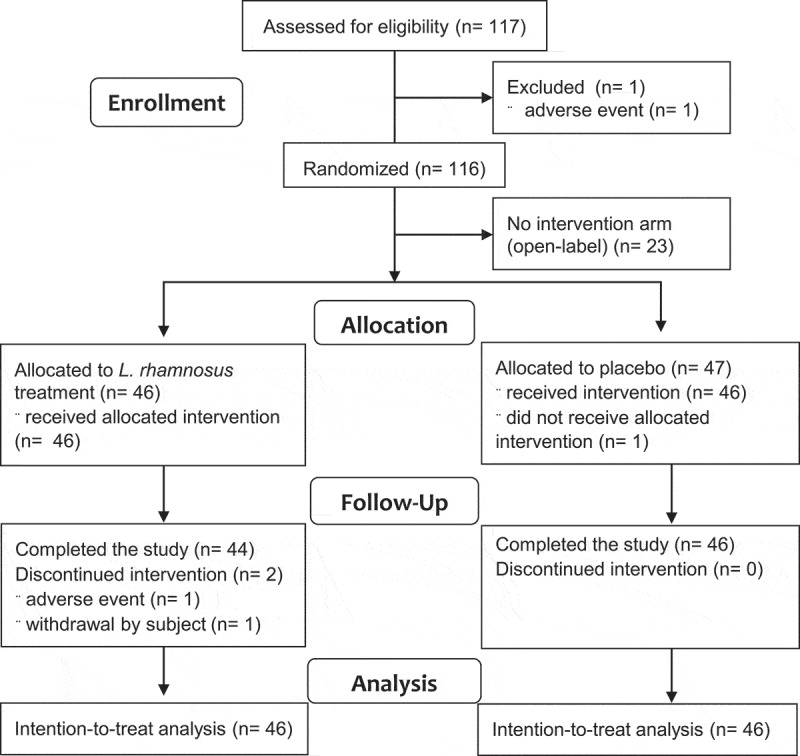
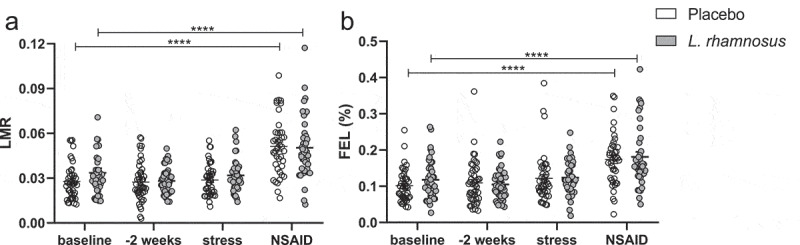
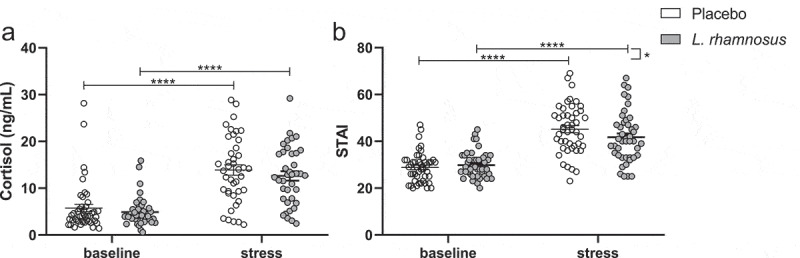
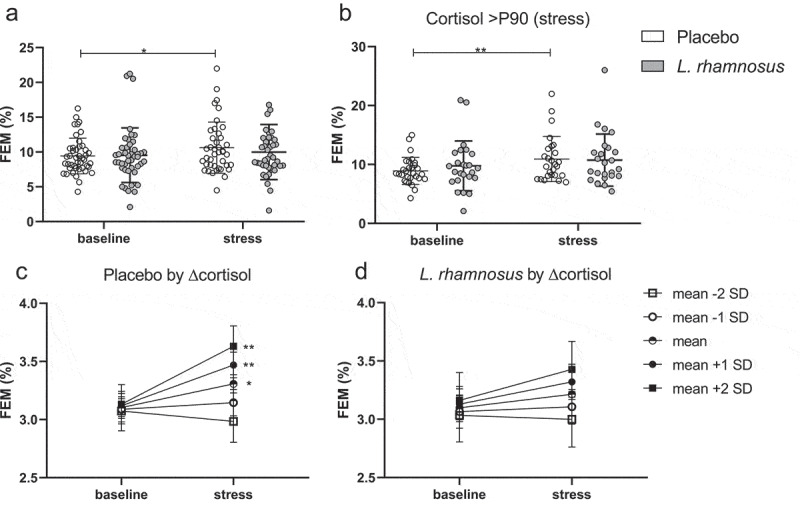
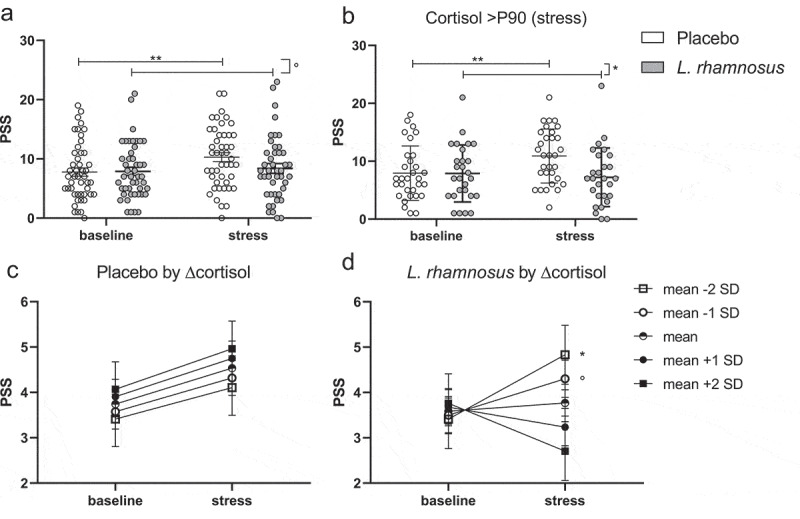
Psychological stress negatively affects the intestinal barrier function in animals and humans. We aimed to study the effect of Lactobacillus rhamnosus CNCM I-3690 on intestinal permeability and stress-markers during public speech. Healthy students were randomized to L. rhamnosus-containing (test) or acidified (placebo) milk consumed twice daily for 4 weeks, with 46 subjects per treatment group. Small intestinal permeability was quantified by a 2 h urinary lactulose–mannitol ratio (LMR, primary outcome), fractional excretion of lactulose (FEL) and mannitol (FEM). Salivary cortisol, State-Trait Anxiety Inventory (STAI) and Perceived Stress scores (PSS) were collected. No between-treatment differences were found for LMR (p = .71), FEL or FEM. Within-treatment analyses showed similar LMR and FEL but a stress-induced increase of FEM with the placebo (p < .05) but not test product. Despite a similar increase in salivary cortisol, the stress-induced increase in STAI was significantly lower with the test product vs. placebo (p = .01). Moreover, a stress-preventative effect of the probiotic was found for PSS and more pronounced in subjects with high stress-induced cortisol (p = .01). While increased FEM was mediated by salivary cortisol levels, the effect of the test product on subjective stress was not mediated by changes in FEM. No serious adverse events occurred. In conclusion, we demonstrated that L. rhamnosus CNCM I-3690 prevented stress-induced hyperpermeability to mannitol. Subjective but not objective stress-markers were reduced with L. rhamnosus vs. placebo, suggesting anxiolytic effects, which were independent of barrier stabilization and attractive for the reduction of stress in both health and disease. Clinicaltrials.gov, number NCT03408691.
Overview
The claims and statistics of this paper haven’t been checked yet.
Free: it reads the open-access text and checks the first 5 claims that cite a source we can check. Create a free account to check every claim.
Integrity signals
Registry
Cites
Statistics
Figures
Verification
Claims the paper makes
The claims and statistics of this paper haven’t been checked yet.
Free: it reads the open-access text and checks the first 5 claims that cite a source we can check. Create a free account to check every claim.
Claims other papers make about this one
Each is checked against this paper’s own text: does it say what the citing paper says it does?
The source backs part of the claim, not all of it — or backs it for a different population, condition or comparison.
In the citing paper
“Wauters et al. [10] found significant decreases in subjective anxiety after 4-weeks of supplementation with Lactobacillus rhamnosus CNC I-3690 in students exposed to an academic stressor, but the protective effect of the probiotic over subjective stress was restricted only to a subpopulation with a stress-induced cortisol response higher than the average.”
From Psychobiotic effects on anxiety are modulated by lifestyle behaviors: a randomized placebo-controlled trial on healthy adults (2023) · cites this paper as [10]
Experimental — accuracy not yet measuredThe source backs part of the claim, not all of it — or backs it for a different population, condition or comparison.
In the citing paper
“Our findings are also in agreement with previous interventional research showing a high level of inter-individual variability in the response to probiotics [10,78].”
From Psychobiotic effects on anxiety are modulated by lifestyle behaviors: a randomized placebo-controlled trial on healthy adults (2023) · cites this paper as [10]
Experimental — accuracy not yet measuredIn the citing paper
“In fact, human trials have linked the microbiome with specific processes that are expected to contribute to well-being, such as emotional regulation [8], motivation [9], stress and anxiety [10], and vitality [11], among others.”
From Psychobiotic effects on anxiety are modulated by lifestyle behaviors: a randomized placebo-controlled trial on healthy adults (2023) · cites this paper as [10]
Self-check
Percentages, sums and reported differences re-computed from the paper’s own numbers.
The self-check needs the paper’s full text.
Citations
Cites
The PHQ-9: Validity of a brief depression severity measure
Kroenke, K., Spitzer, R. L., & Williams, J. B. W. (2001) · Journal of General Internal Medicine · doi:10.1046/j.1525-1497.2001.016009606.x · Cited by 44,910
A Brief Measure for Assessing Generalized Anxiety Disorder: The GAD-7
Spitzer, R. L., Kroenke, K., Williams, J. B. W., & Löwe, B. (2006) · Archives of Internal Medicine · doi:10.1001/archinte.166.10.1092 · Cited by 31,765
Hill (2014) · doi:10.1038/nrgastro.2014.66 · Cited by 9,592
CONSORT 2010 Statement: updated guidelines for reporting parallel group randomised trials
Schulz, K. F., Altman, D. G., Moher, D., & for the CONSORT Group (2010) · BMJ · doi:10.1136/bmj.c332 · Cited by 9,329
Mind-altering microorganisms: the impact of the gut microbiota on brain and behaviour
Cryan, J. F., & Dinan, T. G. (2012) · Nature Reviews Neuroscience · doi:10.1038/nrn3346 · Cited by 4,572
Bravo, J. A., Forsythe, P., Chew, M. V., Escaravage, E., Savignac, H. M., Dinan, T. G., Bienenstock, J., & Cryan, J. F. (2011) · Proceedings of the National Academy of Sciences · doi:10.1073/pnas.1102999108 · Cited by 3,888 · cited 1×
“reuteri, reduced depressive-like behavior in mice,(7,8) which was abolished after vagotomy.(7) However, these promising preclinical findings were not reproduced with L.”
BackgroundThe role of short-chain fatty acids in microbiota–gut–brain communication
Dalile, B., Van Oudenhove, L., Vervliet, B., & Verbeke, K. (2019) · Nature Reviews Gastroenterology & Hepatology · doi:10.1038/s41575-019-0157-3 · Cited by 3,357 · cited 1×
“Moreover, gut-brain signaling of short-chain fatty acids (SCFA), neurohumoral signaling molecules produced by different probiotic strains, may be independent of gut barrier function.(30) The association between particular bacterial genera and quality of life or depression was also explained by decreased butyrate-produ…”
BackgroundSelf-citationSudo, N., Chida, Y., Aiba, Y., Sonoda, J., Oyama, N., Yu, X., Kubo, C., & Koga, Y. (2004) · The Journal of Physiology · doi:10.1113/jphysiol.2004.063388 · Cited by 2,735 · cited 1×
“Gut microbes may play an important role as germ-free mice showed exaggerated responses to stress compared to specific pathogen-free mice, which were reversible through re-colonization with Bifidobacterium infantis.(3) Probiotics are live microorganisms that, when ingested in adequate amounts, exert a health benefit on…”
BackgroundManual for the state-trait anxiety inventory (form Y) : "self-evaluation questionnaire"
Spielberger, C. D., Gorsuch, R. L., & Lushene, R. E. (1970) · Consulting Psychologists Press eBooks · Cited by 2,352
CONSORT 2010 statement: Updated guidelines for reporting parallel group randomised trials
Schulz, K. F., Altman, D. G., & Moher, D. (2010) · Journal of Pharmacology and Pharmacotherapeutics · doi:10.4103/0976-500x.72352 · Cited by 2,165
Cited by
Leigh, S., Uhlig, F., Wilmes, L., Sanchez‐Diaz, P., Gheorghe, C. E., Goodson, M. S., Kelley‐Loughnane, N., Hyland, N. P., Cryan, J. F., & Clarke, G. (2023) · The Journal of Physiology · doi:10.1113/jp281951 · Cited by 167
Boehme, M., Rémond-Derbez, N., Lerond, C., Lavalle, L., Keddani, S., Steinmann, M., Rytz, A., Dalile, B., Verbeke, K., Oudenhove, L. V., et al. (2023) · Nutrients · doi:10.3390/nu15143122 · Cited by 80
“Some studies showed that higher doses of probiotics [26,30,50] or longer supplementation periods [28,51] may be needed to see significant improvements in mood, sleep, and stress reduction in healthy subjects.”
BackgroundSelf-citationMadison, A. A., & Bailey, M. T. (2023) · Biological Psychiatry · doi:10.1016/j.biopsych.2023.10.014 · Cited by 75
Preclinical Safety Assessment of Bacillus subtilis BS50 for Probiotic and Food Applications
Brutscher, L. M., Borgmeier, C., Garvey, S. M., & Spears, J. L. (2022) · Microorganisms · doi:10.3390/microorganisms10051038 · Cited by 61
Psychosocial stress-induced intestinal permeability in healthy humans: What is the evidence?
Torre, D. L., Oudenhove, L. V., Vanuytsel, T., & Verbeke, K. (2023) · Neurobiology of Stress · doi:10.1016/j.ynstr.2023.100579 · Cited by 64
“Wauters et al. (2022) note that the higher inter-and intra-individual test variability for the stress response, FEL, and LMR may potentially explain the discrepant results on LMR with the study of Vanuytsel et al. (2014) and suggest that a strong protracted cortisol response may be needed for…”
Self-citationLactobacillus rhamnosus: An emerging probiotic with therapeutic potential for depression
Feng, J. B., Cen, Q., Cui, Y., Hu, X., Li, M., Wang, L., Wei, J., Sun, N., Wang, J., & Zhang, A. (2024) · Pharmacological Research · doi:10.1016/j.phrs.2024.107541 · Cited by 56
Morales-Torres, R., Carrasco-Gubernatis, C., Grasso-Cladera, A., Cosmelli, D., Parada, F. J., & Palacios-García, I. (2023) · Nutrients · doi:10.3390/nu15071706 · Cited by 44
“[10] found significant decreases in subjective anxiety after 4-weeks of supplementation with Lactobacillus rhamnosus CNC I-3690 in students exposed to an academic stressor, but the protective effect of the probiotic over subjective stress was restricted only to a subpopulation with a stress-induced cortisol response h…”
BackgroundResultChen, C., Yu, L., Tian, F., Zhao, J., & Zhai, Q. (2022) · Microorganisms · doi:10.3390/microorganisms10122371 · Cited by 47
“Currently, commercially-available lactobacilli have specific health-promoting properties [1,2].”
BackgroundWang, X., Hu, R., Lin, F. H., Yang, T., Lu, Y., Sun, Z., Li, T., & Chen, J. (2024) · Food Research International · doi:10.1016/j.foodres.2024.115212 · Cited by 50
Marć, M. A., Jastrząb, R., & Mytych, J. (2022) · Nutrients · doi:10.3390/nu14193967 · Cited by 36
The Impact of Gut Microbiota on the Development of Anxiety Symptoms—A Narrative Review
Nikel, K., Stojko, M., Smolarczyk, J., & Piegza, M. J. (2025) · Nutrients · doi:10.3390/nu17060933 · Cited by 28
“Psychological assessments, including the State-Trait Anxiety Inventory (STAI) and salivary cortisol measurements, revealed that the probiotic group exhibited a significantly lower increase in stress-induced anxiety compared to placebo, despite no observed changes in gut barrier permeability [23].”
Tzikos, G., Chamalidou, E., Christopoulou, D., Apostolopoulou, A., Gkarmiri, S., Pertsikapa, M., Menni, A.-E., Theodorou, I. M., Stavrou, G., Doutsini, N.-D., et al. (2025) · Nutrients · doi:10.3390/nu17050857 · Cited by 19
“…substances such as gamma-aminobutyric acid and serotonin, which act on the brain–gut axis [42,43], and they generally exert beneficial effects on stress, anxiety, depression, insomnia, and other psychopathological disorders [44–46] by modifying the disturbed microbiome abundance [41,47].”
Wang, H., Chen, Y., Zhao, A., Shen, Z., & Zhang, Y. (2026) · Frontiers in Pharmacology · doi:10.3389/fphar.2025.1709060 · Cited by 21
Mollova, D., Gozmanova, M., Apostolova, E., Yahubyan, G. T., Iliev, I. N., & Baev, V. (2023) · Microorganisms · doi:10.3390/microorganisms11102440 · Cited by 18
“We Presently, commercially available lactobacilli possess speci fi c health ‐ enhancing char ‐ acteristics [77].”
BackgroundSharma, S., Bashir, B., Kolekar, K. A., Acharya, A., Gupta, M., Jena, R., Vishwas, S., Kaur, J., Gupta, G., Kumbhar, P., et al. (2025) · Ageing Research Reviews · doi:10.1016/j.arr.2025.102888 · Cited by 16
L. rhamnosus CNCM I-3690 survival, adaptation, and small bowel microbiome impact in human
Zaccaria, E., Klaassen, T., Alleleyn, A. M. E., Boekhorst, J., Chervaux, C., Smokvina, T., Troost, F. J., & Kleerebezem, M. (2023) · Gut Microbes · doi:10.1080/19490976.2023.2244720 · Cited by 12
“Finally, in a clinical study that explored the effects of this strain on the gut-brain axis it was reported to significantly reduce subjective stress levels in healthy adults in an academic stress model.(13) These studies underline the broad range of health benefits associated with the consumption of this candidate pr…”
BackgroundResultSelf-citationMenni, A.-E., Theodorou, H., Tzikos, G., Theodorou, I. M., Semertzidou, E., Stelmach, V., Shrewsbury, A. D., Stavrou, G., & Kotzampassi, K. E. (2025) · Nutrients · doi:10.3390/nu17122022 · Cited by 14
Yang, Y., Sui, J., Liao, W., Wang, S., Pan, D., Sun, G., Gao, P., Xiang, X., & Xia, H. (2025) · Probiotics and Antimicrobial Proteins · doi:10.1007/s12602-025-10646-8 · Cited by 19
Change in the Gut Microbiome and Immunity by Lacticaseibacillusrhamnosus Probio-M9
Zhang, M., Zheng, Y., Sun, Z., Cao, C., Zhao, W., Liu, Y., Zhang, W., & Zhang, H. (2023) · Microbiology Spectrum · doi:10.1128/spectrum.03609-22 · Cited by 16
“reducing subjective stress (21), improving immunity (22), preventing oxidative stress and”
BackgroundCeliac disease: Hope for new treatments beyond a gluten-free diet
D’heedene, M., Vanuytsel, T., & Wauters, L. I. (2024) · Clinical Nutrition · doi:10.1016/j.clnu.2024.04.014 · Cited by 11
Self-citationUnraveling the complexity of bladder-centric chronic pain by intravesical contrast enhanced MRI
Tyagi, P., Maranchie, J. K., Dhir, R., Moon, C., Sholosh, B., Balasubramani, G. K., Yoshimura, N., Fitzgerald, J. J., Chermansky, C., Kaufman, J., et al. (2023) · Continence · doi:10.1016/j.cont.2023.101041 · Cited by 9
Liu, X., Zhou, H., Zhang, J., Li, R., & Liang, J. (2025) · Nutritional Neuroscience · doi:10.1080/1028415x.2025.2527224 · Cited by 7
Vázquez-Castellanos, J. F., Maciel, L. F., Wauters, L. I., Gregory, A., Oudenhove, L. V., Geboers, K., Verbeke, K., Smokvina, T., Tack, J. F., Vanuytsel, T., et al. (2025) · npj Biofilms and Microbiomes · doi:10.1038/s41522-025-00776-w · Cited by 11
Self-citationLetenneur, V., Monnoye, M., Philippe, C., Holowacz, S., Rabot, S., Lepage, P., Jacouton, E., & Naudon, L. (2023) · Nutrients · doi:10.3390/nu15214635 · Cited by 7
“…reported beneficial effects of probiotics in students undergoing the stress of an academic examination or in adults suffering from chronic stress [20–25], although recent meta-analyses have suggested an effect of probiotics on more sensitive individuals (suffering from depressive symptoms) than on…”
Storr, M., Andresen, V., Frieling, T., Gschossmann, J. M., Keller, J., Langhorst, J., Pehl, C., Stengel, A., Tebbe, J. J., Wiemer, K., et al. (2025) · Zeitschrift für Gastroenterologie · doi:10.1055/a-2518-1430 · Cited by 6
“Unter der Vorstellung, dass Mikrobiom-assoziierte Faktoren bei Pathophysiologie und Therapie der FD eine Rolle haben könnten, wurden Therapiestudien mit Probiotika, probiotischen Lebens-mitteln und Postbiotika verschiedenster Art bei FD durchgeführt [172, 173].”
The Role of Microbiota Pattern in Anxiety and Stress Disorders—A Review of the State of Knowledge
Krupa-Kotara, K. H., Gwioździk, W., Nandzik, S., & Grajek, M. K. (2023) · Psych · doi:10.3390/psych5030038 · Cited by 8
“Anti-anxiety effects have also been attributed to the Lactobacillus rhamnosus CNCM I-3690 strain [51].”
BackgroundKurinna, O. G., & Chernova, V. M. (2023) · Modern Gastroenterology · doi:10.30978/mg-2023-4-77 · Cited by 1
“Фактично дослідження на людях пов’язали мікробіом і такі ментальні процеси, як контроль емоцій [5], мотивація [16], стрес і тривога [57].”
Lifestyle and the Gut-Brain Axis Insights into Mental Health and Microbiome Interactions
Sharma, S. (2024) · International Journal of Innovative Science and Research Technology (IJISRT) · doi:10.38124/ijisrt/ijisrt24nov235 · Cited by 2
Role of Probiotic Supplements in Decreasing Anxiety: A Systematic Review
Hakimi, S. M. J., & Movahedi, A. (2025) · Nutrition And Food In Health And Disease · doi:10.61186/nfsr.12.2.7 · Cited by 1
Exploring the Microbiome through Probiotics and Psychobiotics: Deciphering the Gut-Brain Link
Pathak, R., Tirumalai, P. S., & Kashyap, S. (2023) · ACTA SCIENTIFIC MICROBIOLOGY · doi:10.31080/asmi.2023.06.1315 · Cited by 1
Torre, D. L., Dalile, B., Vanuytsel, T., Oudenhove, L. V., & Verbeke, K. (2024) · Psychoneuroendocrinology · doi:10.1016/j.psyneuen.2024.107047 · Cited by 1
Self-citationZhang, Z., Liu, Y., Zhao, J., Chen, W., & Wang, G. (2025) · Trends in Food Science & Technology · doi:10.1016/j.tifs.2025.105416
Storr, M., Andresen, V., Frieling, T., Gschossmann, J., Keller, J., Langhorst, J., Pehl, C., Stengel, A., Tebbe, J., Wiemer, K., et al. (2026) · Gastroenterology Research and Practice · doi:10.1155/grp/2610765 · Cited by 1
Balancing inflammation under stress: glucocorticoid regulation of innate immune pathways
Kenney, K. M., & Burgener, S. S. (2026) · Bioscience Reports · doi:10.1042/bsr20250146
Metadata
- Authors
- Wauters, L., Van Oudenhove, L., Accarie, A., Geboers, K., Geysen, H., Toth, J., Luypaerts, A., Verbeke, K., Smokvina, T., Raes, J., Tack, J., & Vanuytsel, T.
- Affiliations
- Universitair Ziekenhuis Leuven (BE)
- Translational Research in Gastrointestinal Disorders Ku Leuven
- KU Leuven (BE)
- Danone (France) (FR)
- Rega Institute for Medical Research (BE)
- Corresponding author
- Vanuytsel, Tim
- ORCID
- Venue
- Gut Microbes
- Publisher
- Informa UK Limited
- Published
- 2022-02-07
- Volume
- 14
- Issue
- 1
- Pages
- 2031695-2031695
- ISSN
- 1949-0976 (ISSN-L)
- 1949-0984
- PMC
- PMC8824214
- OpenAlex
- W4210747958
- Cited by
- 34
- References
- 41
- Citations by year
- 2026: 3 · 2025: 10 · 2024: 5 · 2023: 13 · 2022: 3
- FWCI
- 4.12
- Type
- journal article
- Language
- en
- Open access
- gold
- doi.org
- Licence
- cc-by
- doi.org/10.1080/policies-text-data-mining (tdm)
- Locations
- Gut Microbes (publishedVersion, cc-by)
- PubMed Central (publishedVersion, cc-by)
- PubMed (publishedVersion)
- Lirias (submittedVersion, cc-by)
- DOAJ (DOAJ: Directory of Open Access Journals) (submittedVersion, cc-by-sa)
- Funders
- Flanders Research Foundation (1190619N)
- Fonds Wetenschappelijk Onderzoe (1830517N)
- Onderzoeksraad, KU Leuven
- Topics
- Life Sciences › Agricultural and Biological Sciences › Food Science › Probiotics and Fermented Foods
- Health Sciences › Medicine › Gastroenterology › Gastrointestinal motility and disorders
- Life Sciences › Neuroscience › Behavioral Neuroscience › Stress Responses and Cortisol
- Keywords
- probiotics, academic stress, psychological stress, intestinal permeability, lactulose/mannitol ratio, salivary cortisol, anxiety, perceived stress, acidified milk, gut-brain axis
- MeSH terms
- Academic Performance, Adult, Humans, Hydrocortisone, Male, Stress, Psychological, Students, Probiotics, Lacticaseibacillus rhamnosus, Young Adult, Healthy Volunteers
About these checks
Registry, retraction, Cites and statistics results are computed, not judged, with one exception: a printed reference that no index lists is read once by a model before it counts as a citation error. Claims are extracted by a model and kept only when their quote appears verbatim in the text; each cited source is then checked, with a model’s help, for whether it says what the claim relies on. Those verdicts can be wrong — read the claim’s quote and the cited source before relying on one.
Statistics and arithmetic are recomputed, not judged.
Confidence bands are shown only for fields calibrated on our annotated test set. None is calibrated yet, so no band is shown.
What counts as a claim ›How we measure confidence ›How we check this ›
Are you an author, or do you see a problem with this page? Request a review
Data sources
Bibliographic data: Semantic Scholar, OpenAlex, Crossref.
Contains information from the Semantic Scholar Academic Graph Datasets, made available under the ODC Attribution License (ODC-BY 1.0).
Semantic Scholar’s data is described in: Kinney, R., et al. (2023). The Semantic Scholar Open Data Platform. arXiv:2301.10140.
