

The DOI matches its Crossref record; 115 of the 115 references it cites were found in a registry or an index.
Good microbes, bad genes? The dissemination of antimicrobial resistance in the human microbiome
Open accessAbstract
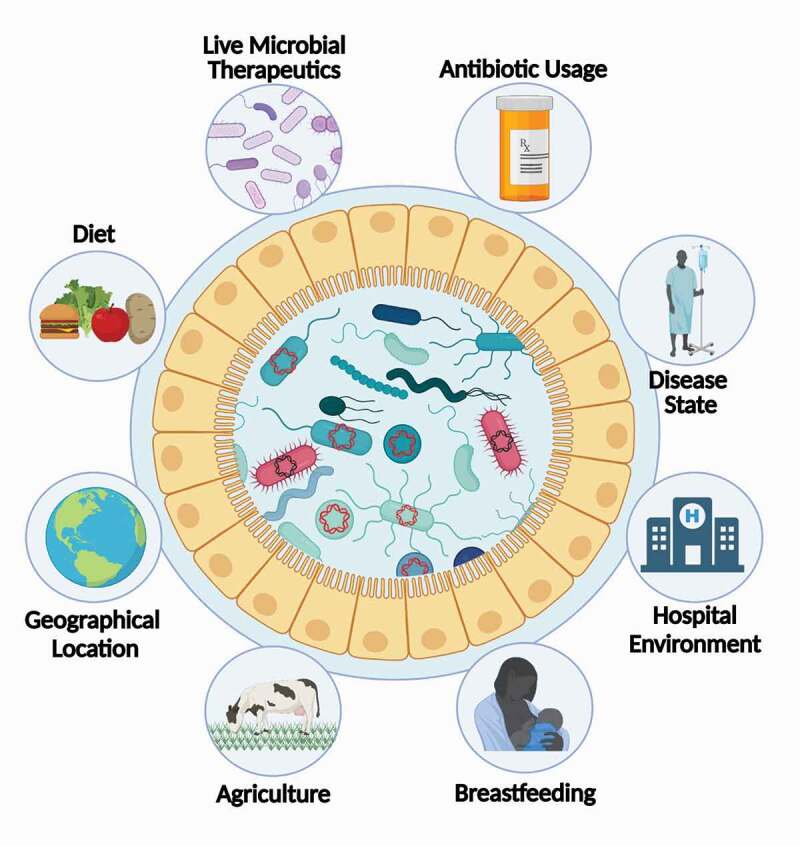
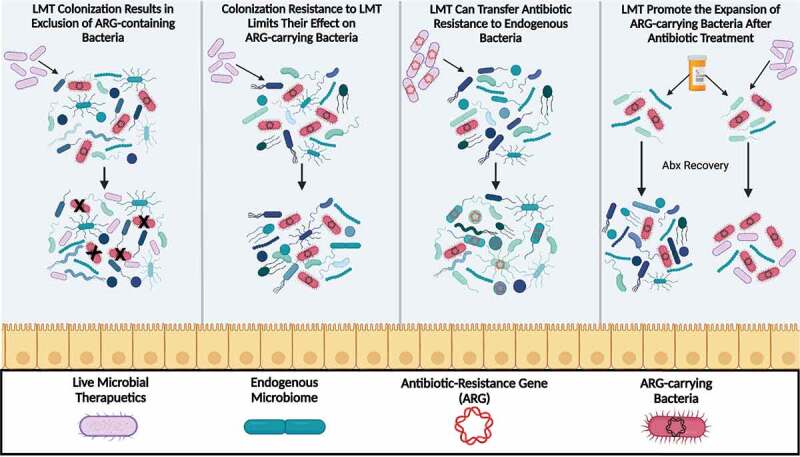
A global rise in antimicrobial resistance among pathogenic bacteria has proved to be a major public health threat, with the rate of multidrug-resistant bacterial infections increasing over time. The gut microbiome has been studied as a reservoir of antibiotic resistance genes (ARGs) that can be transferred to bacterial pathogens via horizontal gene transfer (HGT) of conjugative plasmids and mobile genetic elements (the gut resistome). Advances in metagenomic sequencing have facilitated the identification of resistome modulators, including live microbial therapeutics such as probiotics and fecal microbiome transplantation that can either expand or reduce the abundances of ARG-carrying bacteria in the gut. While many different gut microbes encode for ARGs, they are not uniformly distributed across, or transmitted by, various members of the microbiome, and not all are of equal clinical relevance. Both experimental and theoretical approaches in microbial ecology have been applied to understand differing frequencies of ARG horizontal transfer between commensal microbes as well as between commensals and pathogens. In this commentary, we assess the evidence for the role of commensal gut microbes in encoding antimicrobial resistance genes, the degree to which they are shared both with other commensals and with pathogens, and the host and environmental factors that can impact resistome dynamics. We further discuss novel sequencing-based approaches for identifying ARGs and predicting future transfer events of clinically relevant ARGs from commensals to pathogens.
Overview
The claims and statistics of this paper haven’t been checked yet.
Run the check — free, no account needed. It reads the open-access text and checks the sources it cites.
Integrity signals
Registry
Cites
Statistics
Figures
Verification
Claims the paper makes
The claims and statistics of this paper haven’t been checked yet.
Run the check — free, no account needed. It reads the open-access text and checks the sources it cites.
Claims other papers make about this one
Each is checked against this paper’s own text: does it say what the citing paper says it does?
In the citing paper
“In vivo transfer via conjugation of AR genes from viable probiotic bacteria acting as donors was documented in 199833 and several papers since have confirmed the transferability of AR genes within the gut for a recent review see.34”
From Emerging issues in probiotic safety: 2023 perspectives (2023) · cites this paper as [34]
Self-check
Percentages, sums and reported differences re-computed from the paper’s own numbers.
The self-check needs the paper’s full text.
Citations
Cites
Global burden of bacterial antimicrobial resistance in 2019: a systematic analysis
Murray, C. J. L., Ikuta, K. S., Sharara, F., Swetschinski, L., Robles Aguilar, G., Gray, A., Han, C., Bisignano, C., Rao, P., Wool, E., et al. (2022) · The Lancet · doi:10.1016/s0140-6736(21)02724-0 · Cited by 16,316
ResFinder 4.0 for predictions of phenotypes from genotypes
Bortolaia, V., Kaas, R. S., Ruppe, E., Roberts, M. C., Schwarz, S., Cattoir, V., Philippon, A., Allesoe, R. L., Rebelo, A. R., Florensa, A. F., et al. (2020) · Journal of Antimicrobial Chemotherapy · doi:10.1093/jac/dkaa345 · Cited by 3,373
CARD 2020: Antibiotic Resistome Surveillance with the Comprehensive Antibiotic Resistance Database
Alcock, B. P., Raphenya, A. R., Lau, T. T. Y., Tsang, K. K., Bouchard, M., Edalatmand, A., Huynh, W., Nguyen, A.-L. V., Cheng, A. A., Liu, S., et al. (2019) · Nucleic Acids Research · doi:10.1093/nar/gkz935 · Cited by 3,202
The shared antibiotic resistome of soil bacteria and human pathogens
Forsberg, K. J., Reyes, A., Wang, B., Selleck, E. M., Sommer, M. O. A., & Dantas, G. (2012) · Science · doi:10.1126/science.1220761 · Cited by 1,650
Long-term ecological impacts of antibiotic administration on the human intestinal microbiota
Jernberg, C., Löfmark, S., Edlund, C., & Jansson, J. K. (2007) · The ISME Journal · doi:10.1038/ismej.2007.3 · Cited by 1,134
Yassour, M., Vatanen, T., Siljander, H., Hämäläinen, A.-M., Härkönen, T., Ryhänen, S. J., Franzosa, E. A., Vlamakis, H., Huttenhower, C., Gevers, D., et al. (2016) · Science Translational Medicine · doi:10.1126/scitranslmed.aad0917 · Cited by 1,043
DeepARG: a deep learning approach for predicting antibiotic resistance genes from metagenomic data
Arango-Argoty, G., Garner, E., Pruden, A. J., Heath, L. S., Vikesland, P. J., & Zhang, L. (2018) · Microbiome · doi:10.1186/s40168-018-0401-z · Cited by 1,010
Ecology drives a global network of gene exchange connecting the human microbiome
Smillie, C. S., Smith, M. B., Friedman, J., Cordero, O. X., David, L. A., & Alm, E. J. (2011) · Nature · doi:10.1038/nature10571 · Cited by 992
An omics-based framework for assessing the health risk of antimicrobial resistance genes
Zhang, A., Gaston, J. M., Dai, C. L., Zhao, S., Poyet, M., Groussin, M., Yin, X., Li, L.-G., van Loosdrecht, M. C. M., Topp, E., et al. (2021) · Nature Communications · doi:10.1038/s41467-021-25096-3 · Cited by 977
Role of Mobile DNA in the Evolution of Vancomycin-Resistant Enterococcus faecalis
Paulsen, I. T., Banerjei, L., Myers, G. S. A., Nelson, W. C., Seshadri, R., Read, T. D., Fouts, D. E., Eisen, J. A., Gill, S. R., Heidelberg, J. F., et al. (2003) · Science · doi:10.1126/science.1080613 · Cited by 930
Cited by
Sorted by citations
Items 101–160 of 160
Is 'quorum quenching' a promising tool to combat antibiotic-resistant bacteria?
Maddela, N. R. (2023) · Universa Medicina · doi:10.18051/univmed.2023.v42.249-250 · Cited by 1
Exploring alterations in the gut resistome in medically treated inflammatory bowel disease patients
Lindstrøm, J. C., Vollan, H. S., Brynildsrud, O. B., Tannæs, T. M., Kristoffersen, A. B., Ricanek, P., Leegaard, T. M., Bjørnholt, J. V., Jørgensen, S. B., Tunsjø, H. S., et al. (2026) · BMC Microbiology · doi:10.1186/s12866-026-05101-9 · Cited by 1
Daly, S. W., Foster, T., Willetts, J., Putri, G. L., Priadi, C. R., & Harris, A. (2024) · ACS ES&T Water · doi:10.1021/acsestwater.4c00381 · Cited by 2
Antibiotic resistance and development of alternative therapies
Thakur, D., Kaniska, & Kumar, L. (2025) · Elsevier eBooks · doi:10.1016/b978-0-443-22300-6.00030-9 · Cited by 1
Liu, Q., Yu, M., Wen, Y., Zeng, H., Chen, Q., Lyu, W., Yang, H., Jin, Y., & Xiao, Y. (2025) · Environmental Technology & Innovation · doi:10.1016/j.eti.2025.104554 · Cited by 1
Gupta, M., Patanvadia, D., Bhavsar, R. A., & Rajak, V. S. (2025) · Cureus · doi:10.7759/cureus.97542 · Cited by 1
Githii, S. M., Ndungu, C., Maingi, J. M., & Musyoki, A. M. (2026) · Scientific Reports · doi:10.1038/s41598-026-43265-6 · Cited by 1
Ngwese, M. M., Loum, S., Berg, L. I. T., Tyakht, A., Youngblut, N. D., Adegnika, A. A., Kremsner, P. G., Ley, R. E., & Marsh, J. W. (2026) · Future Microbiology · doi:10.1080/17460913.2026.2645510 · Cited by 1
Antimicrobial resistance and the human gut microbiome—a food safety perspective
Diaz‐Amigo, C., Pino, L. E. B. D., Lejeune, J., Ferreira, J. P., & Bessy, C. (2026) · Critical Reviews in Food Science and Nutrition · doi:10.1080/10408398.2026.2629533 · Cited by 4
Optimisation and validation of capture mNGS for predicting antimicrobial resistance
Lin, Q., Mei, X., Zheng, H., Meng, J., He, F., Yang, B., Ru, X., Su, M., Wang, D., Tan, N., et al. (2026) · EBioMedicine · doi:10.1016/j.ebiom.2026.106319 · Cited by 1
Plaku, F., Kusi, I., Dushku, E., Paraskeva, A., Giantzi, V., Lika, E., Sallaku, F., Papadopoulos, T., Tsavea, E., & Kotzamanidis, C. (2026) · Pathogens · doi:10.3390/pathogens15070737 · Cited by 1
Islam, S. M. S., Chowdhury, M. N., Supty, S. I., Tanoy, N. M., Yadav, D. N., Roy, S., Riea, A. T. M., Obaydullah, M., Tasnim, Z., Zaman, M. S., et al. (2026) · Archives of Microbiology · doi:10.1007/s00203-026-05107-x · Cited by 2
Influence of Gut Resistome on Humans with Autism Spectrum Disorder
Abuljadayel, D. A., Bahieldin, A., Alotaibi, B., Aresh, W. M., & Farsi, R. M. (2024) · Journal of Pharmaceutical Research International · doi:10.9734/jpri/2024/v36i47510 · Cited by 1
Coltro, E. P., Beltrame, L. C., da Cunha, C. R., Zamparette, C. P., Feltrin, C., Filho, V. B., Vanny, P. D. A., Filho, S. B., Klein, T. C. R., Scheffer, M. C., et al. (2025) · Frontiers in Antibiotics · doi:10.3389/frabi.2024.1489356 · Cited by 1
Li, Y., Li, J., Zhu, Y., Wang, J., & Zhu, B. (2025) · Food Bioscience · doi:10.1016/j.fbio.2025.107132 · Cited by 1
Zhang, K., Gong, X., Wang, X., & Sui, J. (2022) · Research Square · doi:10.21203/rs.3.rs-1857423/v1 · Cited by 1
The piglet tonsillar microbiome and Streptococcus suis disease
Fredriksen, S. (2023) · doi:10.18174/582380
Shen, Y., Qu, W., Yu, F., Zhang, D., Zou, Q., Han, D., Xie, M., Chen, X., Yuan, L., Lou, B., et al. (2023) · Research Square · doi:10.21203/rs.3.rs-2612412/v1
Wang, L., Wang, H., Li, X., Zhu, M., Gao, D., Hu, D., Xiong, Z., Li, X., & Qian, P. (2024) · eLife · doi:10.7554/elife.93423.1
Resistom Streptomyces rimosus - a reservoir of resistance genes to aminoglycoside antibiotics
Алексеева, М. Г., Rudakova, N. N., Ratkin, A. V., Мавлетова, Д. А., & Даниленко, В. Н. (2023) · Biochemistry (Moscow) · doi:10.31857/s0320972523060015
Wang, L., Wang, H., Li, X., Zhu, M., Gao, D., Hu, D., Xiong, Z., Li, X., & Qian, P. (2024) · eLife · doi:10.7554/elife.93423.2
Wang, L., Wang, H., Li, X., Zhu, M., Gao, D., Hu, D., Xiong, Z., Li, X., & Qian, P. (2024) · eLife · doi:10.7554/elife.93423.3
Understanding the resistome of the human microbiome: A metagenomic approach
Barik, S., Kannoth, S., Deepthi, M., José, M., Prabhu, D. C., Sadanandan, S., & Grace, T. (2024) · Elsevier eBooks · doi:10.1016/b978-0-323-91631-8.00016-0
Rojas, J. D. C., Díaz, A. B., Ramírez, H., & Fernández-Moreira, E. (2025) · Journal of Essential Oil Bearing Plants · doi:10.1080/0972060x.2025.2476551
Sun, Y., Yang, J., Zhao, Z., Liu, S., Li, M., & Yu, Q. (2025) · Asian Journal of Pharmaceutical Sciences · doi:10.1016/j.ajps.2025.101094
Probióticos: Seguros e Eficazes?
Gomes, A. R. D., Gonçalves, C. A. F., Santos, N. M. D. S., Costa, C. D. S., & Calou, I. B. F. (2025) · Cuadernos de Educación y Desarrollo · doi:10.55905/cuadv17n11-013
Pawale, A. V., Alaguthevar, R., Murugesan, B., Subburamu, K., Alagarsamy, S., & Rhim, J. (2025) · Journal of Food Process Engineering · doi:10.1111/jfpe.70282
Glycosides in cancer treatment
Rojas-Vera, J. D. C., & Buitrago, A. (2025) · Elsevier eBooks · doi:10.1016/b978-0-443-40511-2.00027-9
Anthropogenic land use exerts selection pressures on the resistome of a wild rodentPreprint
Gicquel, M., Planillo, A., Heitlinger, E. G., Forslund, S. K., Kramer‐Schadt, S., Ferreira, S. C. M., & Jarquín‐Díaz, V. H. (2025) · bioRxiv (Cold Spring Harbor Laboratory) · doi:10.64898/2025.12.12.693898
Additional file 10 of Resistome expansion in disease-associated human gut microbiomes
Fredriksen, S., de Warle, S., van Baarlen, P., Boekhorst, J., & Wells, J. M. (2024) · Figshare · doi:10.6084/m9.figshare.26607337
Additional file 7 of Resistome expansion in disease-associated human gut microbiomes
Fredriksen, S., de Warle, S., van Baarlen, P., Boekhorst, J., & Wells, J. M. (2024) · Figshare · doi:10.6084/m9.figshare.26607328
Additional file 4 of Resistome expansion in disease-associated human gut microbiomes
Fredriksen, S., de Warle, S., van Baarlen, P., Boekhorst, J., & Wells, J. M. (2024) · Figshare · doi:10.6084/m9.figshare.26607319
Additional file 1 of Resistome expansion in disease-associated human gut microbiomes
Fredriksen, S., de Warle, S., van Baarlen, P., Boekhorst, J., & Wells, J. M. (2024) · Figshare · doi:10.6084/m9.figshare.26607310
Additional file 5 of Resistome expansion in disease-associated human gut microbiomes
Fredriksen, S., de Warle, S., van Baarlen, P., Boekhorst, J., & Wells, J. M. (2024) · Figshare · doi:10.6084/m9.figshare.26607322
Additional file 2 of Resistome expansion in disease-associated human gut microbiomes
Fredriksen, S., de Warle, S., van Baarlen, P., Boekhorst, J., & Wells, J. M. (2024) · Figshare · doi:10.6084/m9.figshare.26607313
Nooij, S., Vendrik, K. E. W., Zwittink, R. D., Ducarmon, Q. R., Keller, J. J., Kuijper, E. J., & Terveer, E. M. (2024) · Figshare · doi:10.6084/m9.figshare.26686896
Additional file 9 of Resistome expansion in disease-associated human gut microbiomes
Fredriksen, S., de Warle, S., van Baarlen, P., Boekhorst, J., & Wells, J. M. (2024) · Figshare · doi:10.6084/m9.figshare.26607334
Additional file 3 of Resistome expansion in disease-associated human gut microbiomes
Fredriksen, S., de Warle, S., van Baarlen, P., Boekhorst, J., & Wells, J. M. (2024) · Figshare · doi:10.6084/m9.figshare.26607316
Nooij, S., Vendrik, K. E. W., Zwittink, R. D., Ducarmon, Q. R., Keller, J. J., Kuijper, E. J., & Terveer, E. M. (2024) · Figshare · doi:10.6084/m9.figshare.26686899
Additional file 6 of Resistome expansion in disease-associated human gut microbiomes
Fredriksen, S., de Warle, S., van Baarlen, P., Boekhorst, J., & Wells, J. M. (2024) · Figshare · doi:10.6084/m9.figshare.26607325
Additional file 8 of Resistome expansion in disease-associated human gut microbiomes
Fredriksen, S., de Warle, S., van Baarlen, P., Boekhorst, J., & Wells, J. M. (2024) · Figshare · doi:10.6084/m9.figshare.26607331
Gut microbiome and bacterial resistance to antibiotics: Reservoir or defence?
Vuković, D. (2025) · Medicinski podmladak · doi:10.5937/mp76-60542
Zhang, L., Adyari, B., Li, L., Wang, H., & Hu, A. (2026) · Journal of Environmental Sciences · doi:10.1016/j.jes.2026.02.052
Jones, D. H., Banerjee, G., Xiaojuan, Z., Sulaiman, I. M., Ghosh, S., Reza, S., & Banerjee, P. (2026) · LWT · doi:10.1016/j.lwt.2026.119234
Sy, M., Ndiaye, T., Thakur, R., Gaye, A., Levine, Z. C., Ngom, B., Bellavia, K., Firer, D., Touré, M., Ndiaye, I., et al. (2026) · medRxiv · doi:10.64898/2026.04.16.26351042
Cheng, J., Cao, X., Jiang, G., Qiao, Y., Fan, X., Fu, K., & Shen, H. (2026) · Aquaculture Environment Interactions · doi:10.3354/aei00526
Li, Y., Hou, X., Geng, J., Long, J., Liu, F., Yan, H., Chen, S., & Zhu, J. (2026) · Environmental Pollution · doi:10.1016/j.envpol.2026.128297
Astragalus polysaccharides reshape gut resistome of postpartum dairy cows
Luo, Z., Zhang, K., Wang, L., ZHANG, J., Huang, Y., Lu, X., Zhao, F., Cao, S., & Li, J. H. (2026) · Bioresource Technology · doi:10.1016/j.biortech.2026.135399
Audu, H. J., Byonanebye, M., Allen, N., Alabi, O. S., & Ayeni, F. A. (2026) · PeerJ · doi:10.7717/peerj.21495
Yunusbaeva, M. M., Borodinа, L. Y., Ryakhovsky, S. S., Yunusbayeva, A. B., Altinbaev, R., Sabirova, D., & Yunusbayev, B. (2026) · Tuberculosis and lung diseases · doi:10.58838/2075-1230-2026-104-3-26-38
Nappo, A., Abbasi, A. M., Berno, G., Rueca, M., Smoquina, F., Gruber, C. E. M., Fabeni, L., Spezia, P. G., Carletti, F., Pietrucci, D., et al. (2026) · International Journal of Molecular Sciences · doi:10.3390/ijms27146430
Farming practices exert selection pressures on the resistome of natural populations of house mice
Gicquel, M., Planillo, A., Heitlinger, E. G., Forslund, S. K., Kramer‐Schadt, S., Ferreira, S. C. M., & Jarquín‐Díaz, V. H. (2026) · Nature Communications · doi:10.1038/s41467-026-76403-9 · Cited by 1
Beyond ARG abundance: Genome-resolved metagenomics redefines Resistome dynamics in manure composting
Ahmad, H., Rauf, F., Ullah, I., Khan, S., & Korai, S. K. (2026) · Gene Reports · doi:10.1016/j.genrep.2026.102602
Bartrop, L., Beauchemin-Lauzon, E., Grenier, F., Rodrigue, S., & Haraoui, L. (2026) · Microbiome · doi:10.1186/s40168-026-02487-6 · Cited by 1
Menasria, T., & Zaatout, N. (2026) · Water · doi:10.3390/w18172148
Pateriya, D., Tanwar, A., & Sharma, V. K. (2026) · Gut Pathogens · doi:10.1186/s13099-026-00860-2
Zhang, J., Zhang, Z.-H., Wang, Z., Jiang, Y., Wang, K., & Wang, J. (2026) · One Health · doi:10.1016/j.onehlt.2026.101594
Xu, J., Fan, Y., Qu, G., Li, J., Peng, Y., Wang, M., Zhang, J., Feng, Y., Liu, X., Hu, Y., et al. (2026) · mSystems · doi:10.1128/msystems.00198-26
Vliex, L. M. M., Mimoso, I. F. G., Le, N. G., Blaak, E. E., & Penders, J. (2026) · Gut Microbes · doi:10.1080/19490976.2026.2746814
Arafath, Y., Mannil, M., Fathima, A., Bharathan, A., Gokila, S., Kiran, G. S., Hassan, S., & Selvin, J. (2026) · Research Square · doi:10.21203/rs.3.rs-11115569/v1
Metadata
- Authors
- Crits-Christoph, A., Hallowell, H. A., Koutouvalis, K., & Suez, J.
- Affiliations
- Johns Hopkins Bloomberg School of Public Health
- Johns Hopkins University (US)
- Corresponding author
- Suez, Jotham
- Venue
- Gut Microbes
- Publisher
- Informa UK Limited
- Published
- 2022-03-25
- Volume
- 14
- Issue
- 1
- Pages
- 2055944-2055944
- ISSN
- 1949-0976 (ISSN-L)
- 1949-0984
- PMC
- PMC8959533
- OpenAlex
- W4221117022
- Cited by
- 156
- References
- 115
- Citations by year
- 2026: 34 · 2025: 36 · 2024: 45 · 2023: 35 · 2022: 6
- FWCI
- 2.33
- Type
- journal article
- Language
- en
- Open access
- gold
- doi.org
- Locations
- Gut Microbes (publishedVersion)
- PubMed Central (publishedVersion, cc-by)
- PubMed (publishedVersion)
- DOAJ (DOAJ: Directory of Open Access Journals) (submittedVersion, cc-by-sa)
- Funders
- article
- Topics
- Health Sciences › Medicine › Microbiology (medical) › Antibiotic Resistance in Bacteria
- Physical Sciences › Environmental Science › Pollution › Pharmaceutical and Antibiotic Environmental Impacts
- Life Sciences › Biochemistry, Genetics and Molecular Biology › Molecular Biology › Gut microbiota and health
- Keywords
- antimicrobial resistance genes, gut microbiota, horizontal gene transfer, commensal bacteria, gut resistome, probiotics, conjugative plasmids, mobile genetic elements, multidrug resistance
- MeSH terms
- Gastrointestinal Microbiome, Anti-Bacterial Agents, Bacteria, Genes, Bacterial, Humans, Drug Resistance, Bacterial, Metagenomics, Microbiota
About these checks
Registry, retraction, Cites and statistics results are computed, not judged, with one exception: a printed reference that no index lists is read once by a model before it counts as a citation error. Claims are extracted by a model and kept only when their quote appears verbatim in the text; each cited source is then checked, with a model’s help, for whether it says what the claim relies on. Those verdicts can be wrong — read the claim’s quote and the cited source before relying on one.
Statistics and arithmetic are recomputed, not judged.
Confidence bands are shown only for fields calibrated on our annotated test set. None is calibrated yet, so no band is shown.
What counts as a claim ›How we measure confidence ›How we check this ›
Are you an author, or do you see a problem with this page? Request a review
