

The role of human rhinovirus in COPD exacerbations in Abu Dhabi: molecular epidemiology and clinical significance
Open accessThe DOI matches its Crossref record; 31 of the 33 references it cites were found in a registry or an index.
Abstract
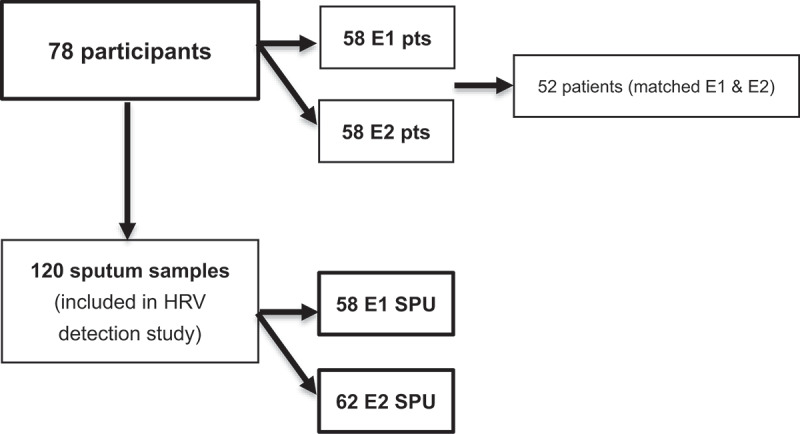
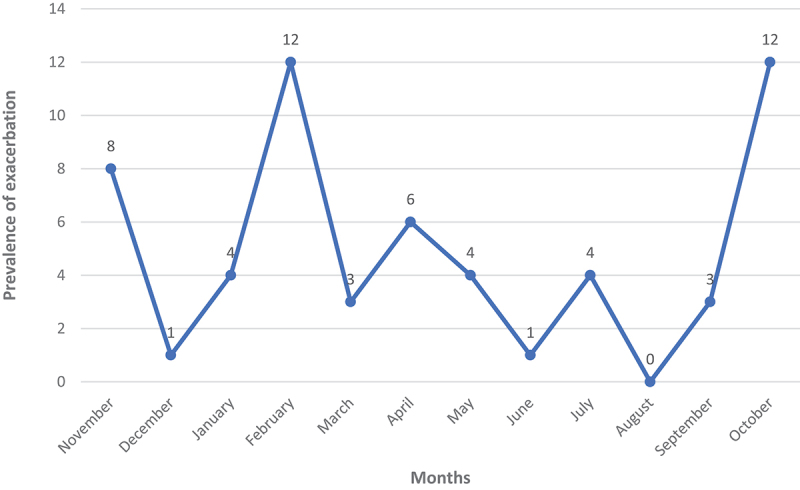
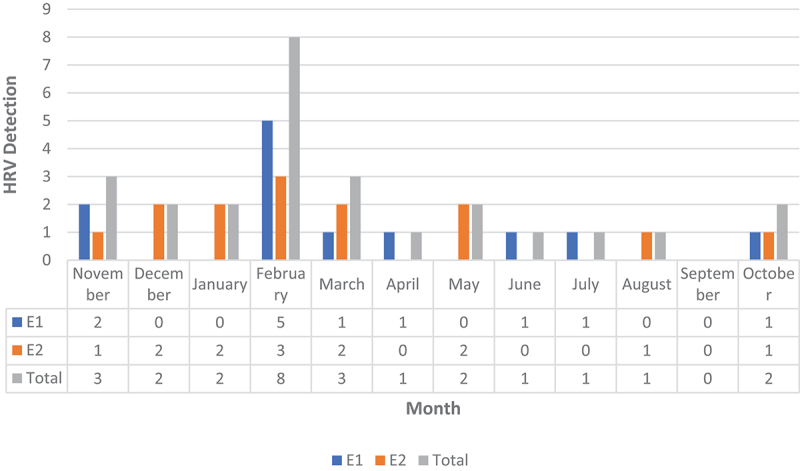
This study aimed to describe the molecular epidemiology and seasonality of human rhinovirus (HRV) in chronic obstructive pulmonary disease (COPD) and its association with COPD exacerbations in Abu Dhabi, the United Arab Emirates (UAE). Sputum specimens were collected for analysis from all COPD patients who visited a medical center from November 2021 to October 2022. The real-time quantitative polymerase chain reaction (qPCR) test was used to detect HRV. Of the 78 COPD patients included in the study, 58 (74%) patients presented with one or more exacerbation episodes. The incidence of COPD exacerbation peaked over the winter and substantially decreased during the summer. HRV positivity in patients during exacerbation (E1) was 11/58 (19%) and 15/58 (26%) two weeks after the exacerbation episode (E2). There was no significant difference in the HRV load in these patients. No statistically significant difference was observed in the detection of HRV during exacerbation compared to patients with stable COPD. This is the first study to assess the association between HRV detection by qPCR and COPD exacerbations in the UAE. The high sensitivity of the detection technology helped collect reliable epidemiologic data. Few studies have provided similar Middle East data. This study's pattern of COPD exacerbations and HRV detection parallels that of temperate countries. This information can help with future, more extensive surveillance of respiratory viruses in the UAE and the Middle East and their association with COPD exacerbations.
Overview
The claims and statistics of this paper haven’t been checked yet.
Free: it reads the open-access text and checks the first 5 claims that cite a source we can check. Create a free account to check every claim.
Integrity signals
Registry
Cites
Statistics
Figures
Verification
Claims the paper makes
The claims and statistics of this paper haven’t been checked yet.
Free: it reads the open-access text and checks the first 5 claims that cite a source we can check. Create a free account to check every claim.
Claims other papers make about this one
Each is checked against this paper’s own text: does it say what the citing paper says it does?
The source backs part of the claim, not all of it — or backs it for a different population, condition or comparison.
In the citing paper
“Eosinophilic phenotypes, obesity-associated COPD, psychological symptom burden, and viral-associated exacerbations were increasingly recognized as clinically important contributors that may be associated with disease progression and acute-care utilization [19,20,21].”
From Chronic Obstructive Pulmonary Disease in the Gulf Cooperation Council: Acute-Care Utilization and Medication Adherence: A PRISMA-ScR Scoping Review (2026) · cites this paper as [20]
Experimental — accuracy not yet measuredThe cited source says what the claim attributes to it.
In the citing paper
“Additional evidence from Abu Dhabi demonstrated the potential role of human rhinovirus in COPD exacerbations”
From Chronic Obstructive Pulmonary Disease in the Gulf Cooperation Council: Acute-Care Utilization and Medication Adherence: A PRISMA-ScR Scoping Review (2026) · cites this paper as [20]
Self-check
Percentages, sums and reported differences re-computed from the paper’s own numbers.
The self-check needs the paper’s full text.
Citations
Cites
Global Initiative for Chronic Obstructive Lung Disease
Gerald, L. B., & Bailey, W. C. (2002) · Journal of Cardiopulmonary Rehabilitation · doi:10.1097/00008483-200207000-00004 · Cited by 5,830 · cited 4×
“COPD exacerbations were defined as deterioration beyond typical daily respiratory symptoms leading to accelerated lung function decline, increased morbidity and mortality requiring antibiotics or systemic steroids or both, and healthcare facility visits [1,19].”
BackgroundMethodInfluentialEffect of Exacerbation on Quality of Life in Patients with Chronic Obstructive Pulmonary Disease
SEEMUNGAL, T. A. R., DONALDSON, G. C., PAUL, E. A., BESTALL, J. C., JEFFRIES, D. J., & WEDZICHA, J. A. (1998) · American Journal of Respiratory and Critical Care Medicine · doi:10.1164/ajrccm.157.5.9709032 · Cited by 2,312 · cited 1×
“Deterioration of the respiratory symptoms beyond normal daily symptoms, called COPD exacerbation, increases morbidity [2,3] and mortality [4].”
BackgroundSevere acute exacerbations and mortality in patients with chronic obstructive pulmonary disease
Soler-Cataluna, J. J. (2005) · Thorax · doi:10.1136/thx.2005.040527 · Cited by 1,931
COPD exacerbations: Defining their cause and prevention
Wedzicha, J. A., & Seemungal, T. A. (2007) · The Lancet · doi:10.1016/s0140-6736(07)61382-8 · Cited by 1,370 · cited 1×
“Deterioration of the respiratory symptoms beyond normal daily symptoms, called COPD exacerbation, increases morbidity [2,3] and mortality [4].”
BackgroundInfection in the Pathogenesis and Course of Chronic Obstructive Pulmonary Disease
Sethi, S., & Murphy, T. F. (2008) · New England Journal of Medicine · doi:10.1056/nejmra0800353 · Cited by 1,234
COPD exacerbations: definitions and classifications
Burge, S., & Wedzicha, J. A. (2003) · European Respiratory Journal · doi:10.1183/09031936.03.00078002 · Cited by 664 · cited 1×
“COPD exacerbations were defined as deterioration beyond typical daily respiratory symptoms leading to accelerated lung function decline, increased morbidity and mortality requiring antibiotics or systemic steroids or both, and healthcare facility visits [1,19].”
BackgroundEnvironmental Predictors of Seasonal Influenza Epidemics across Temperate and Tropical Climates
Tamerius, J. D., Shaman, J., Alonso, W. J., Bloom-Feshbach, K., Uejio, C. K., Comrie, A., & Viboud, C. (2013) · PLoS Pathogens · doi:10.1371/journal.ppat.1003194 · Cited by 574 · cited 1×
“However, epidemiological research on respiratory virus detection in tropical and subtropical regions is scarce, but the epidemiological variety according to local climate and latitude has been well explored [8–10].”
BackgroundAirborne spread of infectious agents in the indoor environment
Wei, J., & Li, Y. (2016) · American Journal of Infection Control · doi:10.1016/j.ajic.2016.06.003 · Cited by 519 · cited 1×
“Despite this relatively controlled environment, the summer peak of influenza in the UAE could be explained by prolonged effective contact rates due to increased indoor activity and decreased relative humidity, which has been linked to viral illnesses [30,31].”
BackgroundRole of viral infections in the development and exacerbation of asthma in children
Jartti, T., & Gern, J. E. (2017) · Journal of Allergy and Clinical Immunology · doi:10.1016/j.jaci.2017.08.003 · Cited by 474 · cited 1×
“Unlike COPD, HRV is documented as a factor in asthma exacerbations [17,25].”
BackgroundWilkinson, T. M. A., Hurst, J. R., Perera, W. R., Wilks, M., Donaldson, G. C., & Wedzicha, J. A. (2006) · Chest · doi:10.1378/chest.129.2.317 · Cited by 317 · cited 1×
“It is not clear whether HRV infections can be associated with COPD exacerbations or whether they pre-dispose to secondary bacterial infection [29].”
Background
Cited by
Hidden in plain sight: the impact of human rhinovirus infection in adults
Morelli, T., Freeman, A. T., Staples, K. J., & Wilkinson, T. M. A. (2025) · Respiratory Research · doi:10.1186/s12931-025-03178-w · Cited by 55
“Many other studies have consistently identified HRV as one of the most common pathogens in AECOPD [152, 163, 165, 167–174].”
Mao, J., Li, Y., & Lv, D. (2025) · Therapeutic Advances in Respiratory Disease · doi:10.1177/17534666251363307 · Cited by 12
Molecular Detection of Antibiotic Resistance Genes Using Respiratory Sample from Pneumonia Patients
Alsuof, E. A., Alsayed, A. R., Zraikat, M. S., Khader, H. A., Hasoun, L., Zihlif, M., Ata, O. A., Zihlif, M. A., Abu‐Samak, M., & Maqbali, M. A. H. A. (2025) · Antibiotics · doi:10.3390/antibiotics14050502 · Cited by 9
“The process aims to efficiently extract high-quality DNA suitable for downstream applications, including PCR [12,13].”
Self-citationZhang, Y., Gu, C., Sun, L., & Hai, H. (2024) · Medicine · doi:10.1097/md.0000000000040067 · Cited by 4
“[3] COPD has become the third leading cause of death worldwide, [4] and projections suggest that by 2030, over 4.5 million people will die from COPD or its complications, further increasing its contribution to global mortality.”
BackgroundInfluentialKhadija, L. H. A., Omari, S. M. A., Alsayed, A. R., Khader, H. A., Permana, A. D., Hasoun, L., Zraikat, M. S., Ashran, W., & Zihlif, M. (2025) · Antibiotics · doi:10.3390/antibiotics14090937 · Cited by 3
Self-citation
Metadata
- Authors
- Alsayed, A. R., Abed, A., Khader, H. A., Hasoun, L., Al Maqbali, M., & Al Shawabkeh, M. J.
- Affiliations
- Applied Science Private University (JO)
- Al-Ahliyya Amman University (JO)
- Hashemite University (JO)
- Fatima College of Health Sciences, Al Ain, United Arab Emirates
- Department of Basic Dental Sciences, Faculty of Dentistry, Applied Science Private University, Amman, Jordan
- Corresponding author
- Alsayed, Ahmad R.
- Venue
- Libyan Journal of Medicine
- Publisher
- Informa UK Limited
- Published
- 2024-01-30
- Volume
- 19
- Issue
- 1
- Pages
- 2307679-2307679
- ISSN
- 1819-6357 (ISSN-L)
- 1993-2820
- PMC
- PMC10829809
- OpenAlex
- W4391340156
- Semantic Scholar
- 2554f15f686dab2e036bd5e6d743b032d2c1ee12
- Cited by
- 12
- References
- 33
- Citations by year
- 2026: 4 · 2025: 6 · 2024: 2
- FWCI
- 3.47
- Type
- journal article
- Language
- en
- Open access
- gold
- doi.org
- Licence
- Locations
- Libyan Journal of Medicine (publishedVersion, cc-by-nc)
- PubMed Central (publishedVersion, cc-by-nc)
- PubMed (publishedVersion)
- DOAJ (DOAJ: Directory of Open Access Journals) (submittedVersion, cc-by-sa)
- Funders
- no funding
- Topics
- Health Sciences › Medicine › Pulmonary and Respiratory Medicine › Chronic Obstructive Pulmonary Disease (COPD) Research
- Health Sciences › Medicine › Epidemiology › Respiratory viral infections research
- Health Sciences › Medicine › Pulmonary and Respiratory Medicine › Asthma and respiratory diseases
- Keywords
- human rhinovirus, COPD exacerbations, chronic obstructive pulmonary disease, molecular epidemiology, seasonal variation, respiratory viruses, Abu Dhabi, Middle East
- MeSH terms
- Clinical Relevance, Humans, Rhinovirus, United Arab Emirates, Molecular Epidemiology, Pulmonary Disease, Chronic Obstructive
About these checks
Registry, retraction, Cites and statistics results are computed, not judged, with one exception: a printed reference that no index lists is read once by a model before it counts as a citation error. Claims are extracted by a model and kept only when their quote appears verbatim in the text; each cited source is then checked, with a model’s help, for whether it says what the claim relies on. Those verdicts can be wrong — read the claim’s quote and the cited source before relying on one.
Statistics and arithmetic are recomputed, not judged.
Confidence bands are shown only for fields calibrated on our annotated test set. None is calibrated yet, so no band is shown.
What counts as a claim ›How we measure confidence ›How we check this ›
Are you an author, or do you see a problem with this page? Request a review
Data sources
Bibliographic data: Semantic Scholar, OpenAlex, Crossref.
Contains information from the Semantic Scholar Academic Graph Datasets, made available under the ODC Attribution License (ODC-BY 1.0).
Semantic Scholar’s data is described in: Kinney, R., et al. (2023). The Semantic Scholar Open Data Platform. arXiv:2301.10140.
