

Relationship between hair cortisol concentrations and cognitive functioning in adolescents with ADHD
Open accessThe DOI matches its Crossref record; 54 of the 54 references it cites were found in a registry or an index.
Abstract
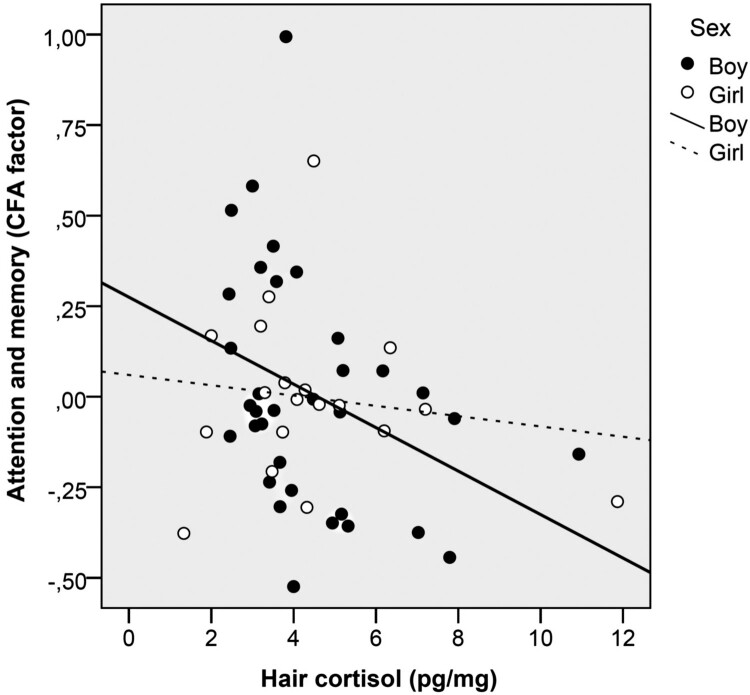
Background: Our study aimed to explore whether the hair cortisol concentration (HCC), a measure of long-term cortisol output, is associated with poorer cognitive functioning in adolescents with attention deficit and hyperactivity disorder (ADHD). We further aimed to test the potential moderating effects of sex and childhood maltreatment.Methods: In this cross-sectional study, fifty-three adolescents with ADHD were studied. The ADHD Rating Scale (ADHD-RS) and Childhood Trauma Questionnaire (CTQ) were administered. Seven cognitive tasks from the Cambridge Neuropsychological Test Automated Battery (CANTAB) were administered, and two cognitive factors (attention and memory and executive functioning) were identified by confirmatory factor analysis. A 3-cm hair sample from the posterior vertex region of the head was obtained. HCCs were determined by a high-sensitivity enzyme immunoassay kit. Multiple linear regression analyses were used to explore the association between HCCs and either cognitive performance or ADHD severity while adjusting for sex, childhood maltreatment and the ADHD-RS total score.Results: Sex moderated the relationship between HCCs and attention/memory confirmatory factor analysis (CFA) scores, with better performance in boys with higher HCCs. HCCs were not associated with executive functioning or ADHD symptoms. Childhood maltreatment was associated with inattention symptoms in adolescents with ADHD.Conclusions: Our study suggests that HCCs are positively associated with attention and memory performance in adolescents with ADHD, with a moderating effect of sex (the relationship is strongest in boys).
Overview
The claims and statistics of this paper haven’t been checked yet.
Free: it reads the open-access text and checks the first 5 claims that cite a source we can check. Create a free account to check every claim.
Integrity signals
Registry
Cites
Statistics
Figures
Verification
Claims the paper makes
The claims and statistics of this paper haven’t been checked yet.
Free: it reads the open-access text and checks the first 5 claims that cite a source we can check. Create a free account to check every claim.
Self-check
Percentages, sums and reported differences re-computed from the paper’s own numbers.
The self-check needs the paper’s full text.
Citations
Cites
Development and validation of a brief screening version of the Childhood Trauma Questionnaire
Bernstein, D. P., Stein, J. A., Newcomb, M. D., Walker, E., Pogge, D., Ahluvalia, T., Stokes, J., Handelsman, L., Medrano, M., Desmond, D., et al. (2003) · Child Abuse & Neglect · doi:10.1016/s0145-2134(02)00541-0 · Cited by 6,419 · cited 1×
“Childhood maltreatment was assessed with the Childhood Trauma Questionnaire (CTQ) (Bernstein et al., 2003).”
MethodEffects of stress throughout the lifespan on the brain, behaviour and cognition
Lupien, S. J., McEwen, B. S., Gunnar, M. R., & Heim, C. (2009) · Nature Reviews Neuroscience · doi:10.1038/nrn2639 · Cited by 6,256
Prevalence of attention-deficit/hyperactivity disorder: a systematic review and meta-analysis
Thomas, R., Sanders, S., Doust, J., Beller, E., & Glasziou, P. (2015) · Pediatrics · doi:10.1542/peds.2014-3482 · Cited by 1,976 · cited 1×
“…cognitive performance, behaviour and emotion regulation, must be accounted for (Anand et al., 2020) ADHD is a prevalent neurodevelopmental disorder (Thomas et al., 2015) with core cognitive alterations, including impairment in sustained attention, executive functioning, working memory and…”
BackgroundAttention-deficit/hyperactivity disorder
Faraone, S. V., Asherson, P., Banaschewski, T., Biederman, J., Buitelaar, J. K., Ramos-Quiroga, J. A., Rohde, L. A., Sonuga-Barke, E. J. S., Tannock, R., & Franke, B. (2015) · Nature Reviews Disease Primers · doi:10.1038/nrdp.2015.20 · Cited by 1,479
Annual research review: enduring neurobiological effects of childhood abuse and neglect
Teicher, M. H., & Samson, J. A. (2016) · Journal of Child Psychology and Psychiatry · doi:10.1111/jcpp.12507 · Cited by 1,473
Teicher, M. H., & Samson, J. A. (2013) · American Journal of Psychiatry · doi:10.1176/appi.ajp.2013.12070957 · Cited by 1,050 · cited 1×
“An abnormal HPA axis response to stressors will also reprogram the response to later stressors (Teicher & Samson, 2013).”
BackgroundAssessment of the cortisol awakening response: Expert consensus guidelines
Stalder, T., Kirschbaum, C., Kudielka, B. M., Adam, E. K., Pruessner, J. C., Wüst, S., Dockray, S., Smyth, N., Evans, P., Hellhammer, D. H., et al. (2016) · Psychoneuroendocrinology · doi:10.1016/j.psyneuen.2015.10.010 · Cited by 967 · cited 2×
“The fi rst proximal 3-cm segment was used for the determination of the HCC, which is thought to re fl ect the cumulative cortisol secretion over the past 3 months (Stalder et al., 2016).”
BackgroundMethodGUNNAR, M. R., & VAZQUEZ, D. M. (2001) · Development and Psychopathology · doi:10.1017/s0954579401003066 · Cited by 900 · cited 1×
“Childhood trauma has been associated with hypoactivation of the HPA axis (Gunnar & Vazquez, 2001; Kumsta et al., 2017; Leneman et al., 2018).”
BackgroundStress effects on memory: An update and integration
Schwabe, L., Joëls, M., Roozendaal, B., Wolf, O. T., & Oitzl, M. S. (2012) · Neuroscience & Biobehavioral Reviews · doi:10.1016/j.neubiorev.2011.07.002 · Cited by 714
Barkley, R. A. (1997) · Psychological Bulletin · doi:10.1037//0033-2909.121.1.65 · Cited by 580 · cited 1×
“…behaviour and emotion regulation, must be accounted for (Anand et al., 2020) ADHD is a prevalent neurodevelopmental disorder (Thomas et al., 2015) with core cognitive alterations, including impairment in sustained attention, executive functioning, working memory and self-regulation (Barkley, 1997).”
Background
Cited by
Sex and gender in psychotrauma research
Langeland, W., & Olff, M. (2024) · European Journal of Psychotraumatology · doi:10.1080/20008066.2024.2358702 · Cited by 33
“Llorens et al. (2023) examined the relationship between hair cortisol concentrations (HCCs) and cognitive factors (i.e. attention and memory, and executive functioning) in adolescents with attention de fi cit and hyperactivity disorder (ADHD), and the moderating e ff ects of sex and childhood trauma.”
BackgroundLi, F., Yanan, L., Bing, G., Li, Q., Aishu, L., Liu, X., Qian, W., & Qianlong, Z. (2025) · Psychoneuroendocrinology · doi:10.1016/j.psyneuen.2025.107605 · Cited by 10
Tovo‐Rodrigues, L., Goularte, L. M., Bierhals, I. O., Santos, I. S., Martins‐Silva, T., Rohde, L. A., Oliveira, I. O., Gonzalez, A., Matijasevich, A., & Murray, J. (2025) · European Child & Adolescent Psychiatry · doi:10.1007/s00787-025-02693-x · Cited by 3
“The resultant findings, mostly cross-sec - tional, are often contradictory and may include associations that are positive [33, 36 ] or negative [33, 37 ], as well as null results [38].”
Association Between Hair Cortisol and Psychopathology in Children With a Chronic Physical Illness
Littler, E. A. L., Butt, Z. A., González, A., & Ferro, M. A. (2025) · Stress and Health · doi:10.1002/smi.70087 · Cited by 4
The effect of methylphenidate on the reproductive function of female rats
Çim, N., Çim, B., Çim, E. F. A., Bulut, S., Mammadov, R., Süleyman, B., Yucel, N., Mendĭl, A. S., Çoban, T. A., & Süleyman, H. (2024) · Journal of obstetrics and gynaecology research · doi:10.1111/jog.16145 · Cited by 3
“34 HPA axis function is evaluated by measuring cortisol levels in body fluids (saliva and blood).”
Yanan, L., Li, F., Wei, Q., Li, Q., Gu, B., Liu, X., & Qianlong, Z. (2026) · Gene Reports · doi:10.1016/j.genrep.2026.102516 · Cited by 2
Capdevila, M. L. (2024) · Tesis Doctorals en Xarxa (Consorci de Serveis Universitaris de Catalunya) · Cited by 2
Book of abstracts III International Congress - CIEQV
Santos, F. J., Torres, J., & Zymbal, V. (2025) · Portuguese National Funding Agency for Science, Research and Technology (RCAAP Project by FCT) · doi:10.60546/3erx-7x68
Toukhy, N., Jia-Richards, M., Goodfriend, E., Hecmanczsuk, V., Riston, S., Novacich, I., Meade, N., Thoma, B. C., Sakolsky, D. J., Douaihy, A., et al. (2026) · Translational Psychiatry · doi:10.1038/s41398-026-04365-z
He, J., Hamatani, S., Shou, Q., & Mizuno, Y. (2026) · Frontiers in Psychiatry · doi:10.3389/fpsyt.2026.1917984
Törnhage, C., Robertz, A.-C., Kantzer, A., & Nilsson, S. (2026) · International Journal of Pediatrics · doi:10.1155/ijpe/5891199
Metadata
- Authors
- Llorens, M., Barba, M., Torralbas-Ortega, J., Nadal, R., Armario, A., Gagliano, H., Urraca, L., Pujol, S., Montalvo, I., Gracia, R., Polo, D., González-Riesco, L., Matalí, J. L., Palao, D., Pàmias, M., & Labad, J.
- Affiliations
- Universitat Autònoma de Barcelona (ES)
- Corporació Sanitària Parc Taulí (ES)
- Nursing Care Research Group, Sant Pau Biomedical Research Institute (IIB SANTPAU). Hospital de la Santa Creu i Sant Pau, Barcelona, Spain
- Hospital Sant Joan de Déu Barcelona (ES)
- Corresponding author
- Labad, Javier
- ORCID
- Venue
- European Journal of Psychotraumatology
- Publisher
- Informa UK Limited
- Published
- 2023-11-21
- Volume
- 14
- Issue
- 2
- Pages
- 2281752-2281752
- ISSN
- 2000-8066 (ISSN-L)
- PMC
- PMC10990442
- OpenAlex
- W4388845288
- Cited by
- 8
- References
- 54
- Citations by year
- 2026: 3 · 2025: 3 · 2024: 2
- FWCI
- 1.63
- Type
- journal article
- Language
- en
- Open access
- gold
- doi.org
- Licence
- Locations
- European Journal of Psychotraumatology (publishedVersion, cc-by-nc)
- PubMed Central (publishedVersion, cc-by-nc)
- PubMed (publishedVersion)
- Dipòsit Digital de Documents de la UAB (Universitat Autònoma de Barcelona) (submittedVersion, cc-by-nc)
- DOAJ (DOAJ: Directory of Open Access Journals) (submittedVersion, cc-by-sa)
- Funders
- CIBER -Consorcio Centro de Investigación Biomédica en Red-
- Spanish Ministry of Science and Innovation
- Topics
- Health Sciences › Medicine › Psychiatry and Mental health › Attention Deficit Hyperactivity Disorder
- Life Sciences › Neuroscience › Behavioral Neuroscience › Stress Responses and Cortisol
- Health Sciences › Medicine › Endocrinology, Diabetes and Metabolism › Adrenal Hormones and Disorders
- Keywords
- hair cortisol, attention deficit hyperactivity disorder, adolescents, cognitive function, attention, memory, executive function, sex differences, child abuse, inattentive symptoms, chronic stress biomarkers
- MeSH terms
- Adolescent, Attention Deficit Disorder with Hyperactivity, Cognition, Cross-Sectional Studies, Hair, Humans, Hydrocortisone, Male, Psychological Tests, Self Report
About these checks
Registry, retraction, Cites and statistics results are computed, not judged, with one exception: a printed reference that no index lists is read once by a model before it counts as a citation error. Claims are extracted by a model and kept only when their quote appears verbatim in the text; each cited source is then checked, with a model’s help, for whether it says what the claim relies on. Those verdicts can be wrong — read the claim’s quote and the cited source before relying on one.
Statistics and arithmetic are recomputed, not judged.
Confidence bands are shown only for fields calibrated on our annotated test set. None is calibrated yet, so no band is shown.
What counts as a claim ›How we measure confidence ›How we check this ›
Are you an author, or do you see a problem with this page? Request a review
Data sources
Bibliographic data: Semantic Scholar, OpenAlex, Crossref.
Contains information from the Semantic Scholar Academic Graph Datasets, made available under the ODC Attribution License (ODC-BY 1.0).
Semantic Scholar’s data is described in: Kinney, R., et al. (2023). The Semantic Scholar Open Data Platform. arXiv:2301.10140.
