

Intensive prolonged exposure therapy for chronic PTSD patients following multiple trauma and multiple treatment attempts
Open accessThe DOI matches its Crossref record; 80 of the 80 references it cites were found in a registry or an index.
Abstract
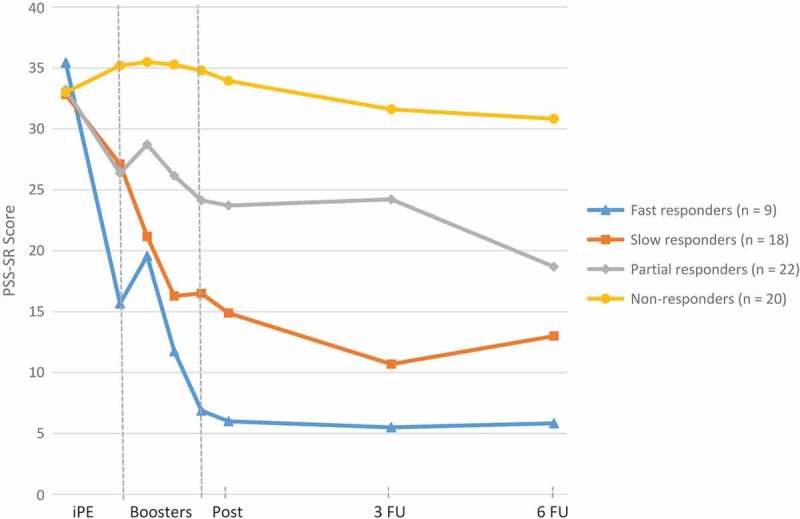
Background: Suboptimal response and high dropout rates leave room for improvement of trauma-focused treatment (TFT) effectiveness in ameliorating posttraumatic stress disorder (PTSD) symptoms.Objective: To explore the effectiveness and safety of intensive prolonged exposure (iPE) targeting chronic PTSD patients with a likely diagnosis of ICD-11 Complex PTSD following multiple interpersonal trauma and a history of multiple treatment attempts.Method: Participants (N = 73) received iPE in 12 × 90-minute sessions over four days (intensive phase) followed by four weekly 90-minute booster prolonged exposure (PE) sessions (booster phase). The primary outcomes, clinician-rated severity of PTSD symptoms, and diagnostic status (Clinician-Administered PTSD Scale; CAPS-IV) were assessed at baseline, post-treatment, and at three and six months. Treatment response trajectories were identified and predictors of these trajectories explored.Results: Mixed model repeated measures analysis of CAPS-IV scores showed a baseline-to-posttreatment decrease in PTSD symptom severity (p < .001) that persisted during the three- and six-month follow-ups with large effect sizes (Cohen’s d > 1.2); 71% of the participants responded. None of the participants dropped out during the intensive phase and only 5% during the booster phase. Adverse events were extremely low and only a minority showed symptom exacerbation. Cluster analysis demonstrated four treatment response trajectories: Fast responders (13%), Slow responders (26%), Partial responders (32%), and Non-responders (29%). Living condition and between-session fear habituation were found to predict outcome. Participants living alone were more likely to belong to the Partial responders than to the Non-responders cluster, and participants showing more between-session fear habituation were more likely to belong to the Fast responders than to the Non-responders cluster.Conclusions: The results of this open study suggest that iPE can be effective in PTSD patients with multiple interpersonal trauma and after multiple previous treatment attempts. In addition, in this chronic PTSD population iPE was safe.
Overview
The claims and statistics of this paper haven’t been checked yet.
Free: it reads the open-access text and checks the first 5 claims that cite a source we can check. Create a free account to check every claim.
Integrity signals
Registry
Cites
Statistics
Figures
Verification
Claims the paper makes
The claims and statistics of this paper haven’t been checked yet.
Free: it reads the open-access text and checks the first 5 claims that cite a source we can check. Create a free account to check every claim.
Claims other papers make about this one
Each is checked against this paper’s own text: does it say what the citing paper says it does?
The cited source says what the claim attributes to it.
In the citing paper
“intensive outpatient programs in which PTSD patients are seen daily may increase retention rates to over 90% 115,116 , with associated decreases in both PTSD symptoms and suicidal ideation 117”
From The clinical characterization of the adult patient with an anxiety or related disorder aimed at personalization of management (2021) · cites this paper as [115]
Self-check
Percentages, sums and reported differences re-computed from the paper’s own numbers.
The self-check needs the paper’s full text.
Citations
Cites
Diagnostic and Statistical Manual of Mental Disorders
American Psychiatric Association (2013) · doi:10.1176/appi.books.9780890425596 · Cited by 116,369
Diagnostic and Statistical Manual of Mental Disorders
Williams, J. B. W., & First, M. (2013) · Encyclopedia of Social Work · doi:10.1093/acrefore/9780199975839.013.104 · Cited by 109,519
Statistical Power Analysis for the Behavioral Sciences
Muller, K. (1989) · Technometrics · doi:10.1080/00401706.1989.10488618 · Cited by 99,167
An inventory for measuring depression
BECK, A. T. (1961) · Archives of General Psychiatry · doi:10.1001/archpsyc.1961.01710120031004 · Cited by 38,032
Statistical Power Analysis for the Behavioral Sciences (2nd ed.).
Lachenbruch, P. A., & Cohen, J. (1989) · Journal of the American Statistical Association · doi:10.2307/2290095 · Cited by 37,395
(1998) · The Journal of Clinical Psychiatry · Cited by 19,139
Diagnostic and Statistical Manual of Mental Disorders, 5th ed.
Carter, M. J. (2014) · Therapeutic Recreation Journal · Cited by 15,169
Diagnostic and Statistical Manual of Mental Disorders, Fourth Edition, Text Revision (DSM-IV-TR)
American Psychiatric Association (2000) · doi:10.1176/appi.books.9780890423349 · Cited by 11,069
(1998) · PubMed · Cited by 10,216
Scoville, W. B. (1949) · Journal of neurosurgery · doi:10.3171/jns.1949.6.1.0065 · Cited by 7,381
Cited by
Treating PTSD: A Review of Evidence-Based Psychotherapy Interventions
Watkins, L. E., Sprang, K. R., & Rothbaum, B. O. (2018) · Frontiers in Behavioral Neuroscience · doi:10.3389/fnbeh.2018.00258 · Cited by 563
“These types of programs are beginning to be evaluated with promising results (e.g., Harvey et al., 2017; Foa et al., 2018; Hendriks et al., 2018) and report excellent retention rates (90%–100%).”
BackgroundTreatment of Posttraumatic Stress Disorder: A State-of-the-art Review
Burback, L., Brémault-Phillips, S., Nijdam, M. J., McFarlane, A., & Vermetten, E. (2024) · Current Neuropharmacology · doi:10.2174/1570159x21666230428091433 · Cited by 208
Eshuis, L. V., van Gelderen, M. J., van Zuiden, M., Nijdam, M. J., Vermetten, E., Olff, M., & Bakker, A. (2021) · Journal of Psychiatric Research · doi:10.1016/j.jpsychires.2020.11.030 · Cited by 167
van Woudenberg, C., Voorendonk, E. M., Bongaerts, H., Zoet, H. A., Verhagen, M., Lee, C. W., van Minnen, A., & de Jongh, A. (2018) · European Journal of Psychotraumatology · doi:10.1080/20008198.2018.1487225 · Cited by 186
“These findings are in accordance with a wide array of previous studies on massed treatment showing the feasibility, safety, and effectiveness of such an approach (e.g. Ehlers et al., 2014; Hendriks et al., 2018, 2016; Zepeda Méndez et al., 2018; Zoellner et al., 2017).”
ResultSelf-citationA Systematic Review of Intensive Empirically Supported Treatments for Posttraumatic Stress Disorder
Sciarrino, N. A., Warnecke, A. J., & Teng, E. J. (2020) · Journal of Traumatic Stress · doi:10.1002/jts.22556 · Cited by 109
Oprel, D. A. C., Hoeboer, C. M., Schoorl, M., Kleine, R. A. D., Cloitre, M., Wigard, I. G., van Minnen, A., & van der Does, W. (2021) · European Journal of Psychotraumatology · doi:10.1080/20008198.2020.1851511 · Cited by 106
Self-citationComplex post-traumatic stress disorder: a new diagnosis in ICD-11
Brewin, C. R. (2020) · BJPsych Advances · doi:10.1192/bja.2019.48 · Cited by 102
“For example, an intensive form of trauma-focused treatment that involved twelve 90-minute sessions of prolonged exposure over 4 days, followed by four weekly 90-minute booster sessions, achieved large treatment effects that persisted over 6 months (Hendriks 2018).”
BackgroundA decennial review of psychotraumatology: what did we learn and where are we going?
Olff, M., Amstadter, A., Armour, C., Birkeland, M. S., Bui, E., Cloitre, M., Ehlers, A., Ford, J. D., Greene, T., Hansen, M., et al. (2019) · European Journal of Psychotraumatology · doi:10.1080/20008198.2019.1672948 · Cited by 78
van Minnen, A., Hendriks, L., de Kleine, R. A., Hendriks, G., Verhagen, M., & de Jongh, A. (2018) · European Journal of Psychotraumatology · doi:10.1080/20008198.2018.1492836 · Cited by 107
Self-citationStein, D. J., Craske, M. G., Rothbaum, B. O., Chamberlain, S. R., Fineberg, N. A., Choi, K. W., de Jonge, P., Baldwin, D. S., & Maj, M. (2021) · World Psychiatry · doi:10.1002/wps.20919 · Cited by 60
de Jongh, A., Groenland, G. N., Sanches, S. A., Bongaerts, H., Voorendonk, E. M., & van Minnen, A. (2020) · European Journal of Psychotraumatology · doi:10.1080/20008198.2020.1721142 · Cited by 67
“…psychopathological symptoms improve as a result of successful trauma- focused therapy (Van Minnen, Zoellner, Harned, & Mills, 2015) and with studies, showing that direct trauma-focused treatment is a feasible option for individuals with symptoms of BPD (Hendriks et al., 2018; Meyers et al., 2017).”
BackgroundSelf-citationAddressing Loneliness in Complex PTSD
Dagan, Y., & Yager, J. (2019) · The Journal of Nervous and Mental Disease · doi:10.1097/nmd.0000000000000992 · Cited by 73
“, 2014), existentially oriented psychotherapies (Popescu, 2015; Stolorow, 2015) and, as tolerated, PTSD-oriented prolonged exposure therapies (Hendriks et al., 2018), eye movement desensitization and reprocessing (Chen et al.”
BackgroundRagsdale, K. A., Watkins, L. E., Sherrill, A. M., Zwiebach, L. C., & ROTHBAUM, B. O. (2020) · Current Treatment Options in Psychiatry · doi:10.1007/s40501-020-00219-7 · Cited by 95
Held, P., Zalta, A. K., Smith, D. L., Bagley, J. M., Steigerwald, V. L., Boley, R. A., Miller, M. L., Brennan, M. B., Horn, R. V., & Pollack, M. H. (2020) · European Journal of Psychotraumatology · doi:10.1080/20008198.2020.1789324 · Cited by 42
“Large effect sizes have been found for treatment gains maintained at 3- and 6-month follow-up (Beidel et al., 2017; Hendriks et al., 2018) and up to 40 weeks (Ehlers et al., 2014).”
BackgroundHeld, P., Kovacevic, M., Petrey, K., Meade, E. A., Pridgen, S., Montes, M., Werner, B., Miller, M. L., Smith, D. L., Kaysen, D. L., et al. (2022) · Journal of Traumatic Stress · doi:10.1002/jts.22831 · Cited by 45
PTSD: Past, present and future implications for China
Zhou, Y., Shang, Z., Zhang, F., Wu, L., Sun, L., Jia, Y., Yu, H., & Liu, W. (2021) · Chinese Journal of Traumatology · doi:10.1016/j.cjtee.2021.04.011 · Cited by 45
Adjusting the Timeframe of Evidence-Based Therapies for PTSD-Massed Treatments
Wachen, J. S., Dondanville, K. A., Evans, W. R., Morris, K. L., & Cole, A. (2019) · Current Treatment Options in Psychiatry · doi:10.1007/s40501-019-00169-9 · Cited by 43
de Kleine, R. A., Hutschemaekers, M. H. M., Hendriks, G., Kampman, M., Papalini, S., van Minnen, A., & Vervliet, B. (2023) · Journal of Anxiety Disorders · doi:10.1016/j.janxdis.2023.102698 · Cited by 44
Self-citationStoic Wisdom: Ancient Lessons for Modern Resilience
Sherman, N. (2021) · doi:10.1093/oso/9780197501832.001.0001 · Cited by 38
Oprel, D. A. C., Hoeboer, C. M., Schoorl, M., de Kleine, R. A., Wigard, I. G., Cloître, M., van Minnen, A., & van der Does, W. A. J. (2018) · BMC Psychiatry · doi:10.1186/s12888-018-1967-5 · Cited by 39
“Furthermore, results of two open studies in patients with chronic PTSD following multiple traumas, including CA, [21, 25] show that intensive TFT was effective and patient retention high (less than 5% drop-out).”
ResultSelf-citationKolthof, K. A., Voorendonk, E. M., van Minnen, A., & de Jongh, A. (2022) · European Journal of Psychotraumatology · doi:10.1080/20008066.2022.2143076 · Cited by 70
“2015), and that trauma-focused treatment is a viable option for individuals with symptoms of BPD (Hafkemeijer et al., 2020; Hendriks et al., 2018).”
BackgroundSelf-citationHeld, P., Bagley, J. M., Klassen, B. J., & Pollack, M. H. (2019) · Psychiatric Annals · doi:10.3928/00485713-20190711-01 · Cited by 33
Auren, T. J. B., Klæth, J. R., Jensen, A. G., & Solem, S. (2022) · European Journal of Psychotraumatology · doi:10.1080/20008066.2022.2128048 · Cited by 40
“Furthermore, a study on intensive PE for chronic PTSD patients following multiple trauma and multiple treatment attempts showed a reduction in PTSD symptom scores with large e ff ect sizes at three-month follow-up ( d = 1.2 – 1.3; Hendriks et al., 2018).”
BackgroundInfluentialHoppen, T. H., Kip, A., & Morina, N. (2023) · Journal of Anxiety Disorders · doi:10.1016/j.janxdis.2023.102684 · Cited by 37
Voorendonk, E. M., Sanches, S. A., Tollenaar, M. S., Hoogendoorn, E. A., de Jongh, A., & van Minnen, A. (2023) · Frontiers in Psychology · doi:10.3389/fpsyg.2023.1215250 · Cited by 37
Self-citationvan Pelt, Y. T., Fokkema, P., de Roos, C., & de Jongh, A. (2021) · European Journal of Psychotraumatology · doi:10.1080/20008198.2021.1917876 · Cited by 65
“Similar to previous studies (Hendriks et al., 2018; van Woudenberg et al., 2018) in the present study, no adverse events occurred during the course of treatment.”
ResultTreatment response trajectories in a three-week CPT-Based intensive treatment for veterans with PTSD
Held, P., Smith, D. L., Bagley, J. M., Kovacevic, M., Steigerwald, V. L., Horn, R. V., & Karnik, N. S. (2021) · Journal of Psychiatric Research · doi:10.1016/j.jpsychires.2021.07.004 · Cited by 29
Flanagan, J. C., Sippel, L. M., Maria, M. M. M., Hartwell, K. J., Brady, K. T., & Joseph, J. E. (2019) · European Journal of Psychotraumatology · doi:10.1080/20008198.2019.1606626 · Cited by 30
Wright, E. C., Wachen, J. S., Yamokoski, C., Galovski, T. E., Morris, K. L., Goetter, E. M., Klassen, B. J., Jacoby, V. M., Zwiebach, L. C., Sornborger, J., et al. (2022) · Cognitive and Behavioral Practice · doi:10.1016/j.cbpra.2022.06.005 · Cited by 27
Personalization of Treatment for Patients with Childhood-Abuse-Related Posttraumatic Stress Disorder
Hoeboer, C. M., Oprel, D. A. C., de Kleine, R. A., Schwartz, B., Deisenhofer, A., Schoorl, M., van der Does, W. A. J., van Minnen, A., & Lutz, W. (2021) · Journal of Clinical Medicine · doi:10.3390/jcm10194522 · Cited by 27
Self-citationYasinski, C. W., Watkins, L. E., Maples‐Keller, J. L., Ragsdale, K. A., Sherrill, A. M., Burton, M. S., Rauch, S. A. M., & ROTHBAUM, B. O. (2022) · Journal of Psychiatric Research · doi:10.1016/j.jpsychires.2022.06.029 · Cited by 21
Zhou, Y., Sun, L., Wang, Y., Wu, L., Sun, Z., Zhang, F., & Liu, W. (2020) · Clinical Psychology & Psychotherapy · doi:10.1002/cpp.2443 · Cited by 24
Ooms-Evers, M., van der Graaf-Loman, S., van Duijvenbode, N., Mevissen, L., & Didden, R. (2021) · Research in Developmental Disabilities · doi:10.1016/j.ridd.2021.104030 · Cited by 49
Dell, L., Sbisa, A. M., Forbes, A. B., O'Donnell, M. L., Bryant, R. A., Hodson, S., Morton, D., Battersby, M., Tuerk, P. W., Elliott, P., et al. (2023) · Psychological Medicine · doi:10.1017/s0033291723000405 · Cited by 20
“Results of the current study are consistent with previous studies finding a reduction in anxiety and depression following MPE treatment (Hendriks, de Kleine, Broekman, Hendriks, & van Minnen, 2018; Zwetzig et al., 2022); however, the current study has also demonstrated for the first time, a…”
ResultWibbelink, C. J. M., Lee, C. W., Bachrach, N., Dominguez, S. K., Ehring, T. W., van Es, S. M., Faßbinder, E., Köhne, S., Mascini, M., Meewisse, M., et al. (2021) · Trials · doi:10.1186/s13063-021-05712-9 · Cited by 20
“A more intensive treatment format may reduce the opportunity for anticipatory fear or anxiety and avoidance behavior between sessions, which might, in turn, reduce resistance and increase the motivation of patients [26, 35, 36].”
Hutschemaekers, M. H. M., de Kleine, R. A., Davis, M. L., Kampman, M., Smits, J. A. J., & Roelofs, K. (2020) · Psychoneuroendocrinology · doi:10.1016/j.psyneuen.2020.104612 · Cited by 20
“…2005; Foa and Kozak, 1986) have found no relation between reductions in subjective reported distress during an exposure session and exposure outcomes in different anxiety disorders (Baker et al., 2010; Hendriks et al., 2018; Kozak et al., 1988; Meuret et al., 2012; Van Minnen and Hagenaars, 2002).”
BackgroundSelf-citationPhilipps, A., Silbermann, A., Morawa, E., Stemmler, M., & Erim, Y. (2019) · Frontiers in Psychiatry · doi:10.3389/fpsyt.2019.00800 · Cited by 26
“However, other studies also demonstrated that exposure treatment can be delivered to patients following multiple trauma and multiple treatment attempts (67).”
BackgroundBurton, M. S., Rothbaum, B. O., & Rauch, S. A. M. (2022) · Depression and Anxiety · doi:10.1002/da.23240 · Cited by 18
Maples‐Keller, J. L., Watkins, L. E., Hellman, N. M., Phillips, N. L., & ROTHBAUM, B. O. (2024) · Biological Psychiatry · doi:10.1016/j.biopsych.2024.07.010 · Cited by 20
McLean, C. P., & Foa, E. B. (2022) · Springer eBooks · doi:10.1007/978-3-030-97802-0_8 · Cited by 24
Impact of hazardous alcohol use on intensive PTSD treatment outcomes among veterans
Held, P., Steigerwald, V. L., Smith, D. L., Kaysen, D. L., Horn, R. V., & Karnik, N. S. (2021) · European Journal of Psychotraumatology · doi:10.1080/20008198.2021.1888541 · Cited by 13
Rhodes, J. R., Tedeschi, R. G., Moore, B. A., Alldredge, C. T., & Elkins, G. R. (2024) · Frontiers in Psychology · doi:10.3389/fpsyg.2023.1322837 · Cited by 26
The effects of an intensive outpatient treatment for PTSD
Matthijssen, S. J. M. A., Menses, S. D. F., & Dijk, H. M. H. (2024) · European Journal of Psychotraumatology · doi:10.1080/20008066.2024.2341548 · Cited by 13
“%) is consistent with previous fi ndings in intensive trauma treatment programmes (Hendriks et al., 2018; Wagenmans et al., 2018).”
InfluentialPagel, J. F. (2020) · Springer eBooks · doi:10.1007/978-3-030-55909-0_11 · Cited by 12
Finley, E. P., Garcia, H. A., Ramirez, V., Haro, E. K., Mignogna, J., DeBeer, B. B., & Stirman, S. W. (2019) · Psychological Trauma Theory Research Practice and Policy · doi:10.1037/tra0000477 · Cited by 15
Hoeboer, C. M., Oprel, D. A. C., Kooistra, M. J., Schoorl, M., van der Does, W. A. J., van Minnen, A., & de Kleine, R. A. (2021) · Behavior Therapy · doi:10.1016/j.beth.2021.06.007 · Cited by 12
Self-citationVersluis, A., de Jongh, A., Mevissen, L., Schuengel, C., Bakkum, L., & Didden, R. (2025) · European Journal of Psychotraumatology · doi:10.1080/20008066.2025.2495642 · Cited by 11
Trauma focused psychotherapy in patients with suicidal ideation: A scoping review
Burback, L., Dhaliwal, R., Reeson, M., Erick, T., Hartle, K. D., Chow, E., Vouronikos, G., Antunes, N., Marshall, T., Kennedy, M., et al. (2023) · Current Research in Behavioral Sciences · doi:10.1016/j.crbeha.2023.100102 · Cited by 14
King, S., Stapert, S. Z., Winkens, I., van der Naalt, J., van Heugten, C. M., & Rijkeboer, M. M. (2024) · Journal of Head Trauma Rehabilitation · doi:10.1097/htr.0000000000000942 · Cited by 9
Goetter, E. M., Tanev, K. S., Lynch, E. A., Lento, R. M., Blackburn, A. M., Mamon, D., Pique, T., & Spencer, T. (2021) · Journal of Behavioral and Cognitive Therapy · doi:10.1016/j.jbct.2021.02.001 · Cited by 9
Pierce, Z. P., Johnson, E. R., Kim, I. A., Lear, B. E., Mast, A. M., & Black, J. M. (2023) · Frontiers in Psychology · doi:10.3389/fpsyg.2023.1074972 · Cited by 13
“This process of exposure allows individuals to cognitively restructure beliefs about their sense of safety as well as power and control with respect to encountering a traumatizing stimulus in the environment (Hendriks et al., 2018; Rossouw et al., 2018).”
BackgroundRetractedHeld, P., Coleman, J. A., Petrey, K., Klassen, B. J., Pridgen, S., Bravo, K., Smith, D. L., & Horn, R. V. (2021) · Psychological Trauma Theory Research Practice and Policy · doi:10.1037/tra0001106 · Cited by 9
Olff, M. (2019) · European Journal of Psychotraumatology · doi:10.1080/20008198.2019.1578524 · Cited by 9
Flanagan, J. C., Mitchell, J., Baker, N. L., Woolley, J. D., Wangelin, B. C., Back, S. E., McQuaid, J. R., Neylan, T. C., Wolfe, W. R., & Brady, K. T. (2020) · Contemporary Clinical Trials · doi:10.1016/j.cct.2020.106074 · Cited by 11
Can the PCL-5 be used as a potential indicator of probable Complex PTSD?
Hendrikx, L. J., Biscoe, N., & Murphy, D. (2024) · European Journal of Trauma & Dissociation · doi:10.1016/j.ejtd.2024.100387 · Cited by 7
Hagerty, S. L., Wielgosz, J., Kraemer, J., Nguyen, H. V., Loew, D. E., & Kaysen, D. L. (2020) · Journal of Traumatic Stress · doi:10.1002/jts.22583 · Cited by 8
Predicting Outcome in an Intensive Outpatient PTSD Treatment Program Using Daily Measures
van Geusau, V. A., Mulder, J. D., & Matthijssen, S. J. M. A. (2021) · Journal of Clinical Medicine · doi:10.3390/jcm10184152 · Cited by 5
“Between-session habituation has been identified as a predictor for treatment outcomes in PE treatment programs, with patients who showed more betweensession habituation being more likely to show better treatment outcomes [20,21].”
BackgroundWillis, N., Dowling, A. P. C., Deehan, T., & O'Reilly, G. (2022) · European Journal of Trauma & Dissociation · doi:10.1016/j.ejtd.2022.100308 · Cited by 13
Sherman, N. (2023) · Conatus · doi:10.12681/cjp.35405 · Cited by 7
Yasinski, C. W., Maples‐Keller, J. L., Trautner, H., Job, G. P., Rauch, S. A. M., McDonald, W. M., & ROTHBAUM, B. O. (2020) · American Journal of Geriatric Psychiatry · doi:10.1016/j.jagp.2020.06.022 · Cited by 6
Wesseling, F. A. M., Voorendonk, E. M., Rozendaal, L., & de Jongh, A. (2025) · European Journal of Psychotraumatology · doi:10.1080/20008066.2025.2537546 · Cited by 6
“…emerged as the most frequent residual symptoms in the present study suggests that extended interventions or periodic booster sessions, designed to consolidate therapeutic gains and manage emergent difficulties (Hendriks et al., 2018; Wesner et al., 2014), may be critical for sustained recovery.”
Vaage-Kowalzik, V., Engeset, J., Jakobsen, M., & Evensen, J. H. (2025) · Frontiers in Psychology · doi:10.3389/fpsyg.2025.1581055 · Cited by 5
Strijk, P. J. M., Nijdam, M. J., Klaassens, E. R., Bedawi, V., de la Rie, S. M., & Jongedijk, R. A. (2025) · Frontiers in Psychology · doi:10.3389/fpsyg.2025.1516144 · Cited by 6
Evaluating Effective Pediatric Psychological Trauma Treatments Post-Traumatic Natural Disasters
Jayaprakasam, S. (2022) · Open Journal of Psychiatry · doi:10.4236/ojpsych.2022.123019 · Cited by 4
Kullberg, M. J., Schoorl, M., Oprel, D. A. C., Hoeboer, C. M., Smit, F., van der Does, W. A. J., de Kleine, R. A., van Minnen, A., & van den Hout, W. B. (2023) · European Journal of Psychotraumatology · doi:10.1080/20008066.2023.2171752 · Cited by 8
“…these adaptations improve treatment outcomes (IMPACT study) (Oprel et al., 2018). i-PE has previously been found to lead to fast symptom reduction and low dropout rates in PTSD (Foa et al., 2018; Hendriks et al., 2018), but has not yet been tested in a controlled trial in patients with CA-PTSD.”
BackgroundSelf-citationBryan, C. J., Lynch, J. H., Bryan, A. O., Mulvaney, S. W., Treangen, N., Concelmo, K., Rooney, E., Baker, J. C., Khazem, L. R., Ammendola, E., et al. (2025) · Psychotherapy and Psychosomatics · doi:10.1159/000550014 · Cited by 3
van Ee, E., de Beijer, D., Florisson, D., & Geuskens, F. (2024) · Child and Adolescent Psychiatry and Mental Health · doi:10.1186/s13034-024-00781-5 · Cited by 35
“Intensive trauma treatment targeting adults has shown promising results in reducing PTSD symptoms and overcoming avoidance behaviors [21–24].”
BackgroundTait, J., Kellett, S., & Delgadillo, J. (2025) · Journal of Anxiety Disorders · doi:10.1016/j.janxdis.2025.103003 · Cited by 4
Memory Modification as Treatment for PTSD: Neuroscientific Reality and Ethical Concerns
Liivoja, R., & Kroes, M. C. W. (2020) · Military and humanitarian health ethics · doi:10.1007/978-3-030-36319-2_13 · Cited by 3
Murray, H., Wild, J., & Ehlers, A. (2021) · Elsevier eBooks · doi:10.1016/b978-0-12-818697-8.00229-6 · Cited by 3
Price, M. M., Timpano, K. R., Freund, B., & Ironson, G. H. (2024) · Clinical Case Studies · doi:10.1177/15346501241293473 · Cited by 4
“Sessions last 1.5 – 2 hours and occur over 8 – 15 weeks, though longer treatment durations are noted for more complex symptom presentations (Hendriks et al., 2018).”
InfluentialGuineau, M. G., Voshaar, R. C. O., & Hendriks, G. (2023) · Clinical Case Studies · doi:10.1177/15346501231209334 · Cited by 3
“…anxiety-related disorders, such as panic disorder, social anxiety disorder, and PTSD. In-asmuch In-asmuch as earlier studies with younger populations have yielded positive results (Hendriks et al., 2018; Pittig et al., 2021), it would be fruitful to extend these studies to include older adults.”
BackgroundResultSelf-citationPopolo, R., Errico, D., Boldrini, M. P., & Centonze, A. (2026) · European Journal of Trauma & Dissociation · doi:10.1016/j.ejtd.2026.100660 · Cited by 2
A new treatment approach for PTSD: High-Intensive Narrative Exposure Therapy (HI-NET)
Strijk, P. J. M., Bedawi, V., & Jongedijk, R. A. (2021) · MALTRATTAMENTO E ABUSO ALL INFANZIA · doi:10.3280/mal2020-003005 · Cited by 2
Smith‐MacDonald, L., VanderLaan, A., Kaneva, Z., Voth, M., Pike, A., Jones, C., & Brémault‐Phillips, S. (2022) · Trauma Care · doi:10.3390/traumacare2020009 · Cited by 4
“Similar findings have also been observed in the use of intensive models for traditional trauma modalities such as Prolonged Exposure [32], Eye Movement Desensitization Reprocessing [33,34], Cognitive Processing Therapy [35,36], and, more recently, Accelerated Resolution Therapy [37,38].”
ResultPierce, Z. P., & Black, J. M. (2024) · Advances in Social Work · doi:10.18060/26331 · Cited by 4
“These interventions, among others, help individuals manage the sense of overwhelm associated with traumatic stress symptoms and rebuild their sense of self after a traumatic event has occurred (Gallagher & Resick, 2012; Hendriks et al., 2018; Pierce et al., 2023; Valiente-Gomez et al., 2017).”
BackgroundSzoke, D. R., Walker, E. K., Christ, N. M., Smith, D. L., & Held, P. (2024) · Cognitive Behaviour Therapy · doi:10.1080/16506073.2024.2329246 · Cited by 2
“…(i.e. higher baseline NPC was related to higher endpoint NPC), which is in line with previous reports of PTSD change trajectories (Held et al., 2021; Hendriks et al., 2018), and suggests that baseline NPC severity is an important indicator for an individual’s NPC rating at the end of treatment.”
BackgroundResultInfluentialTijsseling, I., Noordende, A. T. V. ‘., Zijlstra, B. J. H., Merbis, M. A. E., & van Veen, S. C. (2024) · Journal of EMDR Practice and Research · doi:10.1891/emdr-2023-0051 · Cited by 2
Distress variability during exposure therapy and its relationship with PTSD symptom decline
Kooistra, M. J., Hoeboer, C. M., Oprel, D. A. C., Schoorl, M., van der Does, W. A. J., van Minnen, A., & de Kleine, R. A. (2024) · Journal of Behavior Therapy and Experimental Psychiatry · doi:10.1016/j.jbtep.2024.101983 · Cited by 3
Self-citationHaft, S. M., Fiskeaux, M., Jones, K. R. S., & Rauch, S. A. M. (2024) · CBT: science into practice · doi:10.1007/978-3-031-72720-7_2 · Cited by 2
Peeters, M., van Passel, B., Peeters, N., & Krans, J. (2024) · SSRN Electronic Journal · doi:10.2139/ssrn.5056895 · Cited by 1
Sherman, N. (2021) · Oxford University Press eBooks · doi:10.1093/oso/9780197501832.003.0009 · Cited by 1
Rubinstein, D., Abargil, M., Duek, O. A., & Harpaz‐Rotem, I. (2025) · European Journal of Psychotraumatology · doi:10.1080/20008066.2025.2540141 · Cited by 3
“PE emerged as a structured approach that leverages both imaginal and real-life (‘in-vivo’) exposure to facilitate fear extinction and emotional processing (Hendriks et al., 2018; McLean & Foa, 2024).”
InfluentialKing, S., Rijkeboer, M. M., Winkens, I., Tuts, N., Ford, M. E., Frankenmolen, N. L., Tanious, R., van der Naalt, J., & Heugten, C. M. V. (2025) · Behaviour Research and Therapy · doi:10.1016/j.brat.2025.104941 · Cited by 1
Stöfsel, M. (2020) · Bohn Stafleu van Loghum eBooks · doi:10.1007/978-90-368-2501-6_7 · Cited by 1
Sherman, N. (2021) · Oxford University Press eBooks · doi:10.1093/oso/9780197501832.003.0004 · Cited by 1
Lohse, L., Rolvien, L., Borsutzky, S., Kühn, S., Miegel, F. S., & Jelinek, L. (2025) · Neuropsychiatrie · doi:10.1007/s40211-025-00518-6 · Cited by 5
Gore, K. L., Cherney, S., Weilant, S., Hummer, J. F., Cottrell, L., & Farris, C. A. (2023) · Rand health quarterly · doi:10.7249/rhq-10-04-08 · Cited by 1
Leong, F. T. L. (2008) · Sage eBooks · doi:10.4135/9781412963978.n131 · Cited by 1
Kitamura, H. (2021) · Queensland University of Technology · doi:10.5204/thesis.eprints.207826 · Cited by 1
Sherman, N. (2021) · Oxford University Press eBooks · doi:10.1093/oso/9780197501832.002.0004 · Cited by 1
A Single Dose of Methylprednisolone Improves Aversive Memory Consolidation and Extinction in Rats
Gonçalves, R., de Vargas, L. D. S., & Mello‐Carpes, P. B. (2019) · Frontiers in Neuroscience · doi:10.3389/fnins.2019.01167 · Cited by 1
Advances in Psychotherapy for Posttraumatic Stress Disorder
Krauss, A., Begović, E., Harper, K. L., & Teng, E. J. (2021) · Advances in Psychiatry and Behavioral Health · doi:10.1016/j.ypsc.2021.05.005
Sherman, N. (2021) · Oxford University Press eBooks · doi:10.1093/oso/9780197501832.003.0008
Sherman, N. (2021) · Oxford University Press eBooks · doi:10.1093/oso/9780197501832.003.0005
Sherman, N. (2021) · Oxford University Press eBooks · doi:10.1093/oso/9780197501832.003.0001
The Influence of Anger and Imagery on the Maintenance and Treatment of PTSD
McHugh, T., & Bates, G. W. (2022) · IntechOpen eBooks · doi:10.5772/intechopen.105083
Sherman, N. (2021) · Oxford University Press eBooks · doi:10.1093/oso/9780197501832.003.0003
Sherman, N. (2021) · Oxford University Press eBooks · doi:10.1093/oso/9780197501832.003.0002
Metadata
- Authors
- Hendriks, L., Kleine, R. A. D., Broekman, T. G., Hendriks, G.-J., & Minnen, A. V.
- Affiliations
- Radboud University Nijmegen (NL)
- Leiden University (NL)
- Bureau Bêta, Nijmegen, The Netherlands
- Corresponding author
- Hendriks, Lotte
- Venue
- European Journal of Psychotraumatology
- Publisher
- Informa UK Limited
- Published
- 2018-01-01
- Volume
- 9
- Issue
- 1
- Pages
- 1425574-1425574
- ISSN
- 2000-8066 (ISSN-L)
- PMC
- PMC5795659
- OpenAlex
- W2791650891
- Cited by
- 121
- References
- 80
- Citations by year
- 2026: 10 · 2025: 11 · 2024: 16 · 2023: 12 · 2022: 11 · 2021: 32 · 2020: 14 · 2019: 10 · 2018: 4
- FWCI
- 17.63
- Type
- journal article
- Language
- en
- Open access
- gold
- doi.org
- Licence
- Locations
- European Journal of Psychotraumatology (publishedVersion, cc-by)
- PubMed Central (publishedVersion, cc-by)
- PubMed (publishedVersion)
- Leiden Repository (Leiden University) (submittedVersion)
- DOAJ (DOAJ: Directory of Open Access Journals) (submittedVersion, cc-by-sa)
- Radboud Repository (Radboud University) (submittedVersion)
- Radboud Repository (Radboud University) (submittedVersion, other-oa)
- Data Archiving and Networked Services (DANS) (submittedVersion, other-oa)
- Funders
- Innovatiefonds Zorgverzekeraars (2335)
- Topics
- Social Sciences › Psychology › Clinical Psychology › Posttraumatic Stress Disorder Research
- Social Sciences › Psychology › Clinical Psychology › Psychotherapy Techniques and Applications
- Social Sciences › Psychology › Clinical Psychology › Psychoanalysis and Psychopathology Research
- Keywords
- chronic posttraumatic stress disorder, complex PTSD, treatment response trajectories, living alone, treatment safety, trauma-focused psychotherapy
About these checks
Registry, retraction, Cites and statistics results are computed, not judged, with one exception: a printed reference that no index lists is read once by a model before it counts as a citation error. Claims are extracted by a model and kept only when their quote appears verbatim in the text; each cited source is then checked, with a model’s help, for whether it says what the claim relies on. Those verdicts can be wrong — read the claim’s quote and the cited source before relying on one.
Statistics and arithmetic are recomputed, not judged.
Confidence bands are shown only for fields calibrated on our annotated test set. None is calibrated yet, so no band is shown.
What counts as a claim ›How we measure confidence ›How we check this ›
Are you an author, or do you see a problem with this page? Request a review
Data sources
Bibliographic data: Semantic Scholar, OpenAlex, Crossref.
Contains information from the Semantic Scholar Academic Graph Datasets, made available under the ODC Attribution License (ODC-BY 1.0).
Semantic Scholar’s data is described in: Kinney, R., et al. (2023). The Semantic Scholar Open Data Platform. arXiv:2301.10140.
