

Intensive prolonged exposure therapy for chronic PTSD patients following multiple trauma and multiple treatment attempts
Open accessThe DOI matches its Crossref record; 80 of the 80 references it cites were found in a registry or an index.
Abstract
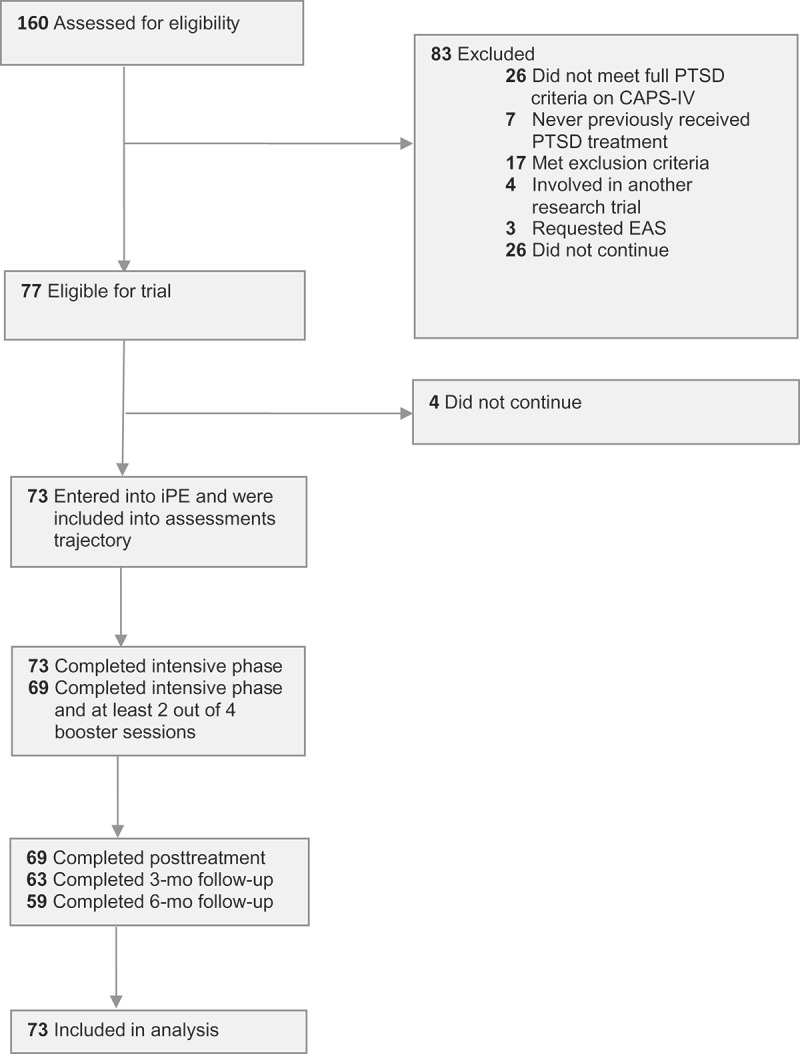
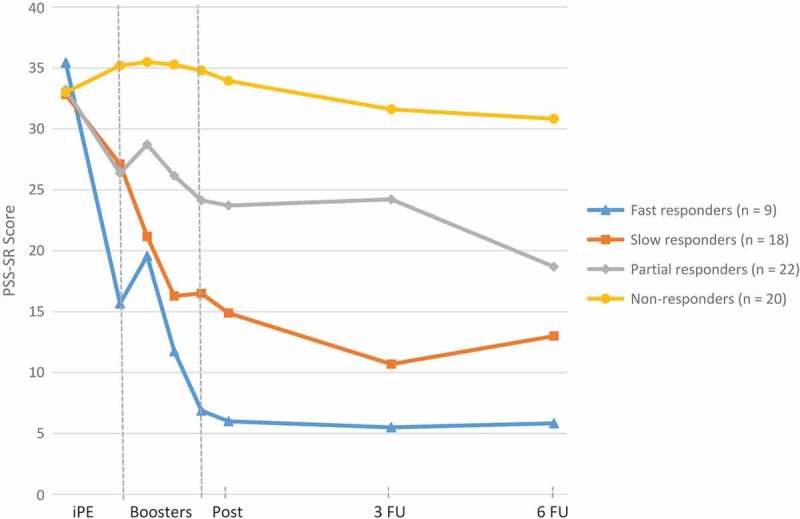
Background: Suboptimal response and high dropout rates leave room for improvement of trauma-focused treatment (TFT) effectiveness in ameliorating posttraumatic stress disorder (PTSD) symptoms.Objective: To explore the effectiveness and safety of intensive prolonged exposure (iPE) targeting chronic PTSD patients with a likely diagnosis of ICD-11 Complex PTSD following multiple interpersonal trauma and a history of multiple treatment attempts.Method: Participants (N = 73) received iPE in 12 × 90-minute sessions over four days (intensive phase) followed by four weekly 90-minute booster prolonged exposure (PE) sessions (booster phase). The primary outcomes, clinician-rated severity of PTSD symptoms, and diagnostic status (Clinician-Administered PTSD Scale; CAPS-IV) were assessed at baseline, post-treatment, and at three and six months. Treatment response trajectories were identified and predictors of these trajectories explored.Results: Mixed model repeated measures analysis of CAPS-IV scores showed a baseline-to-posttreatment decrease in PTSD symptom severity (p < .001) that persisted during the three- and six-month follow-ups with large effect sizes (Cohen’s d > 1.2); 71% of the participants responded. None of the participants dropped out during the intensive phase and only 5% during the booster phase. Adverse events were extremely low and only a minority showed symptom exacerbation. Cluster analysis demonstrated four treatment response trajectories: Fast responders (13%), Slow responders (26%), Partial responders (32%), and Non-responders (29%). Living condition and between-session fear habituation were found to predict outcome. Participants living alone were more likely to belong to the Partial responders than to the Non-responders cluster, and participants showing more between-session fear habituation were more likely to belong to the Fast responders than to the Non-responders cluster.Conclusions: The results of this open study suggest that iPE can be effective in PTSD patients with multiple interpersonal trauma and after multiple previous treatment attempts. In addition, in this chronic PTSD population iPE was safe.
Overview
The claims and statistics of this paper haven’t been checked yet.
Free: it reads the open-access text and checks the first 5 claims that cite a source we can check. Create a free account to check every claim.
Integrity signals
Registry
Cites
Statistics
Figures
Verification
Claims the paper makes
The claims and statistics of this paper haven’t been checked yet.
Free: it reads the open-access text and checks the first 5 claims that cite a source we can check. Create a free account to check every claim.
Claims other papers make about this one
Each is checked against this paper’s own text: does it say what the citing paper says it does?
The cited source says what the claim attributes to it.
In the citing paper
“intensive outpatient programs in which PTSD patients are seen daily may increase retention rates to over 90% 115,116 , with associated decreases in both PTSD symptoms and suicidal ideation 117”
From The clinical characterization of the adult patient with an anxiety or related disorder aimed at personalization of management (2021) · cites this paper as [115]
Self-check
Percentages, sums and reported differences re-computed from the paper’s own numbers.
The self-check needs the paper’s full text.
Citations
Cites
Diagnostic and Statistical Manual of Mental Disorders
American Psychiatric Association (2013) · doi:10.1176/appi.books.9780890425596 · Cited by 116,369
Diagnostic and Statistical Manual of Mental Disorders
Williams, J. B. W., & First, M. (2013) · Encyclopedia of Social Work · doi:10.1093/acrefore/9780199975839.013.104 · Cited by 109,519
Statistical Power Analysis for the Behavioral Sciences
Muller, K. (1989) · Technometrics · doi:10.1080/00401706.1989.10488618 · Cited by 99,167
An inventory for measuring depression
BECK, A. T. (1961) · Archives of General Psychiatry · doi:10.1001/archpsyc.1961.01710120031004 · Cited by 38,032
Statistical Power Analysis for the Behavioral Sciences (2nd ed.).
Lachenbruch, P. A., & Cohen, J. (1989) · Journal of the American Statistical Association · doi:10.2307/2290095 · Cited by 37,395
(1998) · The Journal of Clinical Psychiatry · Cited by 19,139
Diagnostic and Statistical Manual of Mental Disorders, 5th ed.
Carter, M. J. (2014) · Therapeutic Recreation Journal · Cited by 15,169
Diagnostic and Statistical Manual of Mental Disorders, Fourth Edition, Text Revision (DSM-IV-TR)
American Psychiatric Association (2000) · doi:10.1176/appi.books.9780890423349 · Cited by 11,069
(1998) · PubMed · Cited by 10,216
Scoville, W. B. (1949) · Journal of neurosurgery · doi:10.3171/jns.1949.6.1.0065 · Cited by 7,381
Cited by
Items 101–121 of 121
Healing through Self-Compassion: Stoic Warriors
Sherman, N. (2021) · Oxford University Press eBooks · doi:10.1093/oso/9780197501832.003.0006
Sherman, N. (2021) · Oxford University Press eBooks · doi:10.1093/oso/9780197501832.003.0007
Sherman, N. (2021) · Oxford University Press eBooks · doi:10.1093/oso/9780197501832.002.0006
Sherman, N. (2021) · Oxford University Press eBooks · doi:10.1093/oso/9780197501832.002.0010
Sherman, N. (2021) · Oxford University Press eBooks · doi:10.1093/oso/9780197501832.002.0011
Sherman, N. (2021) · Oxford University Press eBooks · doi:10.1093/oso/9780197501832.002.0005
Trauma, memory and the impact of redecision therapy
White, T. (2023) · International Journal of Transactional Analysis Research & Practice · doi:10.29044/v14i1p24
van Ee, E., de Beijer, D., Florisson, D., & Geuskens, F. (2024) · Research Square · doi:10.21203/rs.3.rs-3981761/v1
What Happens Next? Maintenance of Gains After Discharge From VA Residential PTSD Treatment
Grau, P. P., Harpaz‐Rotem, I., Ilgen, M. A., Ganoczy, D. A., & Sripada, R. K. (2024) · The Journal of Nervous and Mental Disease · doi:10.1097/nmd.0000000000001749
The Long Road Toward Equitable MDMA Treatment in the United States
Kozak, Z., & Aaronson, S. T. (2024) · The Journal of Clinical Psychiatry · doi:10.4088/jcp.23com15224
Facing Fear with Stoic Courage
Sherman, N. (2025) · Oxford University Press eBooks · doi:10.1093/9780197660058.003.0004
Marks, M. R., Bowers, C. A., Flynn, A., & Beidel, D. C. (2026) · Military Psychology · doi:10.1080/08995605.2025.2605926
“That said, numerous studies demonstrate the effectiveness of exposure therapy among individuals exposed to MTEs (Foa et al., 2007; Hendriks et al., 2018; Jerud et al., 2017; Stein et al., 2012).”
Astafyeva, D. S., Чаплыгин, С. С., Berezhnaya, K., Dobrynina, A. A., Izmailova, O. V., Strelnik, A. I., Zubova, M. A., Zakharova, N. V., Sofyin, N. D., Isaev, D. S., et al. (2025) · Vestnik nevrologii psihiatrii i nejrohirurgii (Bulletin of Neurology Psychiatry and Neurosurgery) · doi:10.33920/med-01-2512-09
Zhu, L., Zhu, H., Yang, W., Zhang, W., Xie, B., Wang, F., & Bian, C. (2026) · European Journal of Psychotraumatology · doi:10.1080/20008066.2025.2604993
“…adapted psychotherapy into more condensed treatment formats, such as intensive and massive treatment programmes, and found that it remains effective (Hendriks et al., 2018; Holliday et al., 2025; Peterson et al., 2023) with significantly lower dropout rates (Goetter, Tanev, et al., 2021).”
King, S., Tuts, N., Winkens, I., van der Naalt, J., Rijkeboer, M. M., & Heugten, C. M. V. (2026) · Journal of Behavioral and Cognitive Therapy · doi:10.1016/j.jbct.2026.100584
Zeinstra, L. T., Post, W. J., Knot‐Dickscheit, J., Huyghen, A.-M. N., Akeredolu, A. A., Wanders, F., & Harder, A. T. (2026) · Journal of Child & Adolescent Trauma · doi:10.1007/s40653-025-00789-9
“%) is comparable to other inten - sive trauma treatments (Hendriks et al., 2018; Rentinck et al., 2025; Van Woudenberg et al., 2018) and lower than the 15–22% typically observed in weekly trauma therapy (Imel et al., 2013).”
Hallucinogen-Assisted Psychotherapy for Trauma Disorders: A Bionian Lens
Miller, C. W. T., & Kozak, Z. (2026) · Psychodynamic Psychiatry · doi:10.1521/pdps.2026.54.2.308 · Cited by 1
Prolonged Exposure Therapy for Posttraumatic Stress Disorder
Peck, K. R., Giannini, J., & Heil, S. H. (2026) · Elsevier eBooks · doi:10.1016/b978-0-443-29009-1.00085-8
Therapeutic intensification in post-traumatic stress disorder worldwide: where do we stand?
Leroy, A., Bui, É., Verkest, E., Warembourg, F., de Jongh, A., & Vaïva, G. (2026) · European Journal of Psychotraumatology · doi:10.1080/20008066.2026.2697553 · Cited by 1
“Impor-tantly, these effects appear to be sustained over time, with benefits maintained up to 12 months after treat-ment (Hendriks et al., 2018), with large effect size on PTSD symptoms (Cohen’s d > 1.2) and depression (Cohen’s d > 1).”
InfluentialShapiro, M. O., Raines, A. M., Ennis, C. R., Bender, A. M., Gleason, E. E., & Belardo-DeFelice, A. (2026) · Psychiatric Clinics of North America · doi:10.1016/j.psc.2026.06.004
Beidel, D. C., Tuerk, P. W., Bowers, C. A., Newins, A. R., Seaver, C., Grover, S. G., & Franks, M. J. (2026) · Journal of Anxiety Disorders · doi:10.1016/j.janxdis.2026.103246
Metadata
- Authors
- Hendriks, L., Kleine, R. A. D., Broekman, T. G., Hendriks, G.-J., & Minnen, A. V.
- Affiliations
- Radboud University Nijmegen (NL)
- Leiden University (NL)
- Bureau Bêta, Nijmegen, The Netherlands
- Corresponding author
- Hendriks, Lotte
- Venue
- European Journal of Psychotraumatology
- Publisher
- Informa UK Limited
- Published
- 2018-01-01
- Volume
- 9
- Issue
- 1
- Pages
- 1425574-1425574
- ISSN
- 2000-8066 (ISSN-L)
- PMC
- PMC5795659
- OpenAlex
- W2791650891
- Cited by
- 121
- References
- 80
- Citations by year
- 2026: 10 · 2025: 11 · 2024: 16 · 2023: 12 · 2022: 11 · 2021: 32 · 2020: 14 · 2019: 10 · 2018: 4
- FWCI
- 17.63
- Type
- journal article
- Language
- en
- Open access
- gold
- doi.org
- Licence
- Locations
- European Journal of Psychotraumatology (publishedVersion, cc-by)
- PubMed Central (publishedVersion, cc-by)
- PubMed (publishedVersion)
- Leiden Repository (Leiden University) (submittedVersion)
- DOAJ (DOAJ: Directory of Open Access Journals) (submittedVersion, cc-by-sa)
- Radboud Repository (Radboud University) (submittedVersion)
- Radboud Repository (Radboud University) (submittedVersion, other-oa)
- Data Archiving and Networked Services (DANS) (submittedVersion, other-oa)
- Funders
- Innovatiefonds Zorgverzekeraars (2335)
- Topics
- Social Sciences › Psychology › Clinical Psychology › Posttraumatic Stress Disorder Research
- Social Sciences › Psychology › Clinical Psychology › Psychotherapy Techniques and Applications
- Social Sciences › Psychology › Clinical Psychology › Psychoanalysis and Psychopathology Research
- Keywords
- chronic posttraumatic stress disorder, complex PTSD, treatment response trajectories, living alone, treatment safety, trauma-focused psychotherapy
About these checks
Registry, retraction, Cites and statistics results are computed, not judged, with one exception: a printed reference that no index lists is read once by a model before it counts as a citation error. Claims are extracted by a model and kept only when their quote appears verbatim in the text; each cited source is then checked, with a model’s help, for whether it says what the claim relies on. Those verdicts can be wrong — read the claim’s quote and the cited source before relying on one.
Statistics and arithmetic are recomputed, not judged.
Confidence bands are shown only for fields calibrated on our annotated test set. None is calibrated yet, so no band is shown.
What counts as a claim ›How we measure confidence ›How we check this ›
Are you an author, or do you see a problem with this page? Request a review
Data sources
Bibliographic data: Semantic Scholar, OpenAlex, Crossref.
Contains information from the Semantic Scholar Academic Graph Datasets, made available under the ODC Attribution License (ODC-BY 1.0).
Semantic Scholar’s data is described in: Kinney, R., et al. (2023). The Semantic Scholar Open Data Platform. arXiv:2301.10140.
