

Secondary traumatization in first responders: a systematic review
Open accessThe DOI matches its Crossref record; 71 of the 73 references it cites were found in a registry or an index.
Abstract
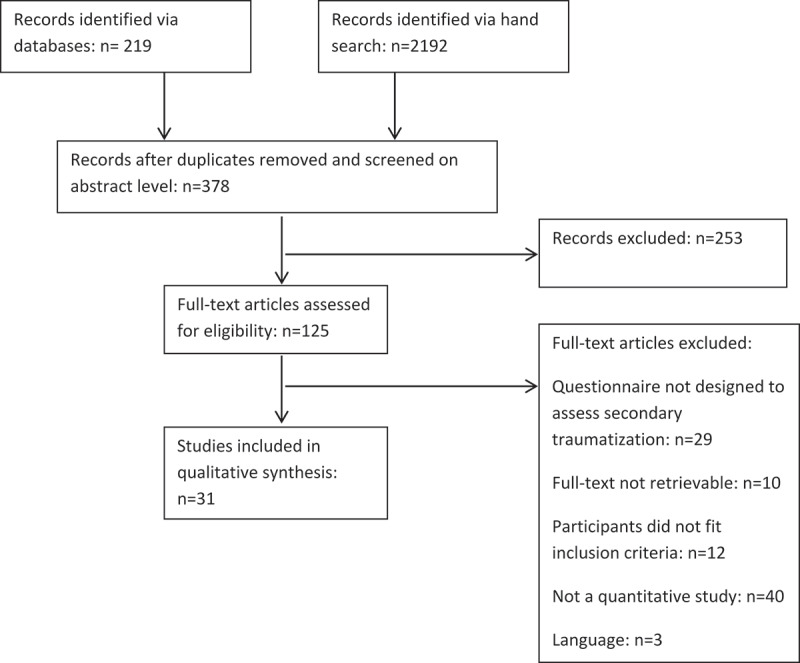
Background: Finding precise definitions of secondary traumatic stress, vicarious traumatization, and compassion fatigue is not easy. While some researchers define these terms differentially, others use them interchangeably. In the present review, we refer to all three phenomena as secondary traumatization.Objectives: This systematic review aims to provide an overview of prevalence rates of secondary traumatization in first responders and to shed light on corresponding resilience and risk factors.Methods: After identifying 219 studies within the searched databases and 2192 references via hand searching, 31 studies were included in this review. We systematically searched the electronic databases PubMed, PsychINFO, and PSYNDEX (German database). The following inclusion criteria were applied: (1) participants had to be first responders working on-site: police officers, firefighters, search and rescue personnel, or emergency and paramedic team members; (2) secondary traumatization (secondary traumatic stress/vicarious traumatization/compassion fatigue) was assessed quantitatively with a validated questionnaire or subscale explicitly measuring secondary traumatization; and (3) English or German language original papers.Results: We found low levels of secondary traumatization in first responders. Several studies describe protective and risk factors for secondary traumatization, including pretraumatic (e.g. age, gender), peritraumatic (e.g. exposure, emotional exhaustion), and post-traumatic factors (e.g. social support, alcohol and tobacco use).Conclusion: Next to an immunizing effect, the low prevalence of secondary traumatization in first responders could be explained by social desirability and job-loss concerns. Therefore, we may be underestimating the prevalence of secondary traumatization in first responders. Some resilience (social support) and risk factors (female gender) are consistent with previous research in other populations. However, owing to the cross-sectional study designs, we must interpret resilience and risk factors with caution. Future research should focus on longitudinal study designs and preventive as well as curative interventions.
Overview
The claims and statistics of this paper haven’t been checked yet.
Free: it reads the open-access text and checks the first 5 claims that cite a source we can check. Create a free account to check every claim.
Integrity signals
Registry
Cites
Statistics
Figures
Verification
Claims the paper makes
The claims and statistics of this paper haven’t been checked yet.
Free: it reads the open-access text and checks the first 5 claims that cite a source we can check. Create a free account to check every claim.
Claims other papers make about this one
Each is checked against this paper’s own text: does it say what the citing paper says it does?
The cited source says what the claim attributes to it.
In the citing paper
“Exposure to other people’s trauma at work can be detrimental to employees (Greinacher et al., 2019; Lee et al., 2018) and to the efficient fulfilment of their work.”
From The psychological impacts of content moderation on content moderators: A qualitative study (2023) · cites this paper as Greinacher et al., 2019
The cited source says what the claim attributes to it.
In the citing paper
“Nevertheless, this study suggests the psychological impacts experienced by commercial CMs are comparable to those experienced by professionals such as first responders and police tasked with analysing child exploitation material (Greinacher et al., 2019; Bourke & Craun, 2014).”
From The psychological impacts of content moderation on content moderators: A qualitative study (2023) · cites this paper as Greinacher et al., 2019
The check wasn’t confident either way, so it gives no verdict — never disputed.
In the citing paper
“Importantly for our purposes, Google Scholar also includes whitepapers, technical reports, and other gray literature published by civil society organizations [78], who have also conducted important research on content reviewer mental health.”
From Measuring the Mental Health of Content Reviewers, a Systematic Review (2025) · cites this paper as [78]
Experimental — accuracy not yet measured
Self-check
Percentages, sums and reported differences re-computed from the paper’s own numbers.
The self-check needs the paper’s full text.
Citations
Cites
Diagnostic and Statistical Manual of Mental Disorders
American Psychiatric Association (2013) · doi:10.1176/appi.books.9780890425596 · Cited by 116,369
Diagnostic and Statistical Manual of Mental Disorders(DSM)
(2008) · Encyclopedia of Counseling · doi:10.4135/9781412963978.n182 · Cited by 10,830
Diagnostic and Statistical Manual of Mental Disorders (DSM-IV)
Hu, R. J. (2003) · Encyclopedia of the Neurological Sciences · doi:10.1016/b0-12-226870-9/01070-4 · Cited by 9,117 · cited 12×
“American Psychiatric Association. (1994). Diagnostic and statistical manual of mental disorders: DSM-IV. Washington, DC: American Psychiatric Association Publishing. American Psychiatric Association. (2013). Diagnostic and statistical manual of mental disorders (DSM-5®). Washington, DC: American Psychiatric Associatio…”
BackgroundMethodInfluentialMeta-analysis of risk factors for posttraumatic stress disorder in trauma-exposed adults
Brewin, C. R., Andrews, B., & Valentine, J. D. (2000) · Journal of Consulting and Clinical Psychology · doi:10.1037/0022-006x.68.5.748 · Cited by 5,243
(1992) · Cited by 5,228
Figley, C. R. (1995) · Cited by 1,466
Deering, D. (1996) · Journal of Psychosocial Nursing and Mental Health Services · doi:10.3928/0279-3695-19961101-26 · Cited by 1,349
Prevalence of Secondary Traumatic Stress among Social Workers
Bride, B. E. (2007) · Social Work · doi:10.1093/sw/52.1.63 · Cited by 937 · cited 2×
“Two studies (Bourke & Craun, 2014; Turgoose et al., 2017) categorized scores into no/little, mild, moderate, high, and severe levels of secondary trauma, as suggested by Bride (2007).”
Background(1995) · Medical Entomology and Zoology · Cited by 927
Development and Validation of the Secondary Traumatic Stress Scale
Bride, B. E., Robinson, M. M., Yegidis, B., & Figley, C. R. (2004) · Research on Social Work Practice · doi:10.1177/1049731503254106 · Cited by 874
Research works printed but not linked: 11
- Crampton D. J. (2014). Comparison of PTSD and compassion fatigue between urban and rural paramedics. (Doctoral dissertation). The University of the Rockies, Denver, CO Retrieved from https://search.proquest.com/docview/1350627026?pq-origsite=gscholar
- Daniels J. (2006). Sekundäre Traumatisierung: Kritische Prüfung eines Konstruktes. (Doctoral dissertation). Retrieved from http://www.sekundaertraumatisierung.de/sfSimpleBlog/show/stripped_title/materialien-und-artikel.html
- Figley C. R. (1999). Compassion fatigue: Toward a new understanding of the cost of caring In Stamm B. H. (Ed.), Secondary traumatic stress (pp. 3– 28). Towson, MD: Sidran Institute.
- Hofmann P. (2009). Addressing compassion fatigue. Healthcare Executive, 24(5), 40– 41. 19764288
- Krieger C. N. III (2017). Understanding the impact of secondary traumatic stress on crimes against children investigators. (Master's thesis). Tarleton State University, Stephenville, Texas Retrieved from https://search.proquest.com/docview/1904391507?pq-origsite=gscholar
- Krutolewitsch A., Horn A. B., & Maercker A. (2015). Trauma-Ausmaß und ausgewählte Prädiktoren in einer Studie mit Feuerwehr- und Rettungskräften. [ Extent of trauma and some selected predictors in a study of rescue workers] Trauma. Zeitschrift für Psychotraumatologie und ihre Anwendungen, 13(3), 78– 91.
- Schmidt J. (2012). Feuerwehr. In C. Neitzel & K. Ladehof (Eds.), Taktische Medizin (pp. 307–311) Springer, Berlin: Heidelberg.
- Scott S. R. (2016). Prevalence of vicarious trauma in parole officers working with client specific caseloads. Ann Arbor, MI: ProQuest Information & Learning.
- Setti I., & Argentero P. (2012). Vicarious trauma: A contribution to the Italian adaptation of the secondary traumatic stress scale. Bollettino Di Psicologia Applicata, 264, 58– 64.
- Stamm B. H. (2005). The ProQol manual: The professional quality of life scale. Lutherville, MD: Sidran Press. Retrieved from http://compassionfatigue.org/pages/ProQOLManualOct05.pdf.
- Stamm B. H. (2010). The concise ProQOL manual. Pocatello, ID: Proqol.org.
Cited by
Gruber, J., Prinstein, M. J., Clark, L. A., Rottenberg, J., Abramowitz, J. S., Albano, A. M., Aldao, A., Borelli, J. L., Chung, T., Davila, J., et al. (2021) · American Psychologist · doi:10.1037/amp0000707 · Cited by 697
Raudenská, J., Steinerová, V., Javůrková, A., Urits, I., Kaye, A. D., Viswanath, O., & Varrassi, G. (2020) · Best Practice & Research Clinical Anaesthesiology · doi:10.1016/j.bpa.2020.07.008 · Cited by 452
Secondary Traumatic Stress and Burnout in Healthcare Workers during COVID-19 Outbreak
Orrù, G., Marzetti, F., Conversano, C., Vagheggini, G., Miccoli, M., Ciacchini, R., Panait, E., & Gemignani, A. (2021) · International Journal of Environmental Research and Public Health · doi:10.3390/ijerph18010337 · Cited by 251
“Additionally, frontline HCWs took care of patients who were both physically and psychologically suffering from the emergency (vicarious traumatization), and, as a consequence, they were exposed to the risk of developing secondary traumatic stress disorder [9,10].”
BackgroundOgińska-Bulik, N. J., Gurowiec, P. J., Michalska, P., & Kędra, E. (2021) · PLoS ONE · doi:10.1371/journal.pone.0247596 · Cited by 166
Henderson, A., Jewell, T., Huang, X., & Simpson, A. (2024) · Journal of Psychiatric and Mental Health Nursing · doi:10.1111/jpm.13082 · Cited by 126
“While it commonly conceptualized by having two dimensions Secondary Traumatic stress and Burnout (Rauvola et al., 2019), it is often used interchangeably with Secondary Traumatic stress (Greninacher et al., 2019), with the latter deemed a more user-friendly term (Figley, 1995).”
Metadata
- Authors
- Greinacher, A., Derezza-Greeven, C., Herzog, W., & Nikendei, C.
- Affiliations
- University Hospital Heidelberg (DE)
- Corresponding author
- Greinacher, Anja
- Venue
- European Journal of Psychotraumatology
- Publisher
- Informa UK Limited
- Published
- 2019-01-22
- Volume
- 10
- Issue
- 1
- Pages
- 1562840-1562840
- ISSN
- 2000-8066 (ISSN-L)
- PMC
- PMC6346705
- OpenAlex
- W2914918627
- Semantic Scholar
- baa0cd28e14a73f61f007357831892f44e3f18a0
- Cited by
- 227
- References
- 73
- Citations by year
- 2026: 37 · 2025: 23 · 2024: 33 · 2023: 33 · 2022: 35 · 2021: 37 · 2020: 26 · 2019: 3
- FWCI
- 4.00
- Type
- journal article
- Language
- en
- Open access
- gold
- doi.org
- Licence
- Locations
- European Journal of Psychotraumatology (publishedVersion, cc-by-nc)
- Europe PMC (PubMed Central) (publishedVersion, cc-by-nc)
- PubMed Central (publishedVersion, cc-by-nc)
- PubMed (publishedVersion)
- DOAJ (DOAJ: Directory of Open Access Journals) (submittedVersion)
- Funders
- No funding was received for this study
- Topics
- Social Sciences › Psychology › Clinical Psychology › Posttraumatic Stress Disorder Research
- Social Sciences › Psychology › Social Psychology › Stress and Burnout Research
- Health Sciences › Medicine › Public Health, Environmental and Occupational Health › Occupational Health and Performance
- Keywords
- secondary traumatic stress, vicarious trauma, compassion fatigue, first responders, police officers, firefighters, paramedics, emergency workers, resilience, risk factors, social support, emotional exhaustion, prevalence, gender differences
About these checks
Registry, retraction, Cites and statistics results are computed, not judged, with one exception: a printed reference that no index lists is read once by a model before it counts as a citation error. Claims are extracted by a model and kept only when their quote appears verbatim in the text; each cited source is then checked, with a model’s help, for whether it says what the claim relies on. Those verdicts can be wrong — read the claim’s quote and the cited source before relying on one.
Statistics and arithmetic are recomputed, not judged.
Confidence bands are shown only for fields calibrated on our annotated test set. None is calibrated yet, so no band is shown.
What counts as a claim ›How we measure confidence ›How we check this ›
Are you an author, or do you see a problem with this page? Request a review
How to cite
Cite CoChat for the checks on this page, and the paper for its own findings.
- This page
- CoChat. (2026). Citation check: Secondary traumatization in first responders: a systematic review. https://app.cochat.ai/papers/10.1080/20008198.2018.1562840
- The paper
- Greinacher, A., Derezza-Greeven, C., Herzog, W., & Nikendei, C. (2019). Secondary traumatization in first responders: a systematic review. European Journal of Psychotraumatology. https://doi.org/10.1080/20008198.2018.1562840
Data sources
Bibliographic data: Semantic Scholar, OpenAlex, Crossref.
Contains information from the Semantic Scholar Academic Graph Datasets, made available under the ODC Attribution License (ODC-BY 1.0).
Semantic Scholar’s data is described in: Kinney, R., et al. (2023). The Semantic Scholar Open Data Platform. arXiv:2301.10140.
