

Secondary traumatization in first responders: a systematic review
Open accessThe DOI matches its Crossref record; 71 of the 73 references it cites were found in a registry or an index.
Abstract
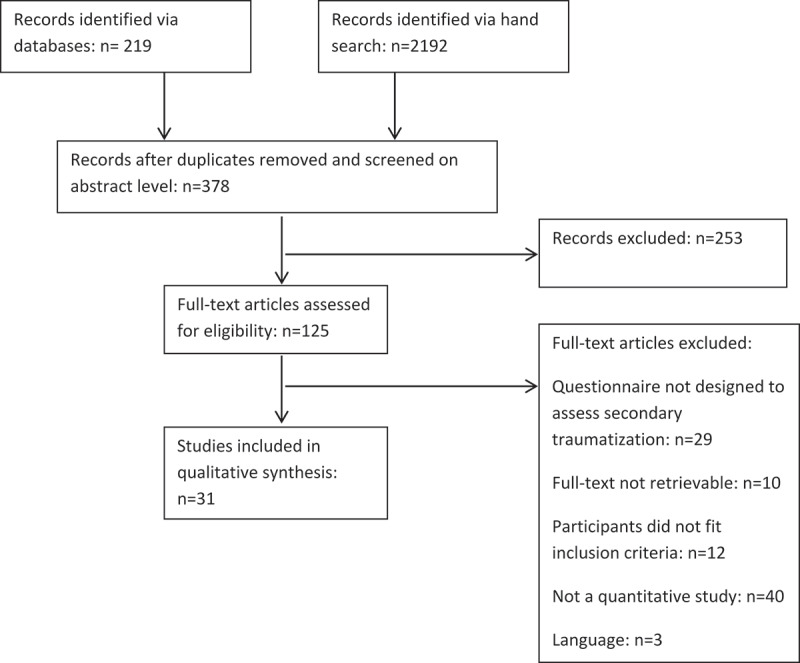
Background: Finding precise definitions of secondary traumatic stress, vicarious traumatization, and compassion fatigue is not easy. While some researchers define these terms differentially, others use them interchangeably. In the present review, we refer to all three phenomena as secondary traumatization.Objectives: This systematic review aims to provide an overview of prevalence rates of secondary traumatization in first responders and to shed light on corresponding resilience and risk factors.Methods: After identifying 219 studies within the searched databases and 2192 references via hand searching, 31 studies were included in this review. We systematically searched the electronic databases PubMed, PsychINFO, and PSYNDEX (German database). The following inclusion criteria were applied: (1) participants had to be first responders working on-site: police officers, firefighters, search and rescue personnel, or emergency and paramedic team members; (2) secondary traumatization (secondary traumatic stress/vicarious traumatization/compassion fatigue) was assessed quantitatively with a validated questionnaire or subscale explicitly measuring secondary traumatization; and (3) English or German language original papers.Results: We found low levels of secondary traumatization in first responders. Several studies describe protective and risk factors for secondary traumatization, including pretraumatic (e.g. age, gender), peritraumatic (e.g. exposure, emotional exhaustion), and post-traumatic factors (e.g. social support, alcohol and tobacco use).Conclusion: Next to an immunizing effect, the low prevalence of secondary traumatization in first responders could be explained by social desirability and job-loss concerns. Therefore, we may be underestimating the prevalence of secondary traumatization in first responders. Some resilience (social support) and risk factors (female gender) are consistent with previous research in other populations. However, owing to the cross-sectional study designs, we must interpret resilience and risk factors with caution. Future research should focus on longitudinal study designs and preventive as well as curative interventions.
Overview
The claims and statistics of this paper haven’t been checked yet.
Free: it reads the open-access text and checks the first 5 claims that cite a source we can check. Create a free account to check every claim.
Integrity signals
Registry
Cites
Statistics
Figures
Verification
Claims the paper makes
The claims and statistics of this paper haven’t been checked yet.
Free: it reads the open-access text and checks the first 5 claims that cite a source we can check. Create a free account to check every claim.
Claims other papers make about this one
Each is checked against this paper’s own text: does it say what the citing paper says it does?
The cited source says what the claim attributes to it.
In the citing paper
“Exposure to other people’s trauma at work can be detrimental to employees (Greinacher et al., 2019; Lee et al., 2018) and to the efficient fulfilment of their work.”
From The psychological impacts of content moderation on content moderators: A qualitative study (2023) · cites this paper as Greinacher et al., 2019
The cited source says what the claim attributes to it.
In the citing paper
“Nevertheless, this study suggests the psychological impacts experienced by commercial CMs are comparable to those experienced by professionals such as first responders and police tasked with analysing child exploitation material (Greinacher et al., 2019; Bourke & Craun, 2014).”
From The psychological impacts of content moderation on content moderators: A qualitative study (2023) · cites this paper as Greinacher et al., 2019
The check wasn’t confident either way, so it gives no verdict — never disputed.
In the citing paper
“Importantly for our purposes, Google Scholar also includes whitepapers, technical reports, and other gray literature published by civil society organizations [78], who have also conducted important research on content reviewer mental health.”
From Measuring the Mental Health of Content Reviewers, a Systematic Review (2025) · cites this paper as [78]
Experimental — accuracy not yet measured
Self-check
Percentages, sums and reported differences re-computed from the paper’s own numbers.
The self-check needs the paper’s full text.
Citations
Cites
Diagnostic and Statistical Manual of Mental Disorders
American Psychiatric Association (2013) · doi:10.1176/appi.books.9780890425596 · Cited by 116,369
Diagnostic and Statistical Manual of Mental Disorders(DSM)
(2008) · Encyclopedia of Counseling · doi:10.4135/9781412963978.n182 · Cited by 10,830
Diagnostic and Statistical Manual of Mental Disorders (DSM-IV)
Hu, R. J. (2003) · Encyclopedia of the Neurological Sciences · doi:10.1016/b0-12-226870-9/01070-4 · Cited by 9,117 · cited 12×
“American Psychiatric Association. (1994). Diagnostic and statistical manual of mental disorders: DSM-IV. Washington, DC: American Psychiatric Association Publishing. American Psychiatric Association. (2013). Diagnostic and statistical manual of mental disorders (DSM-5®). Washington, DC: American Psychiatric Associatio…”
BackgroundMethodInfluentialMeta-analysis of risk factors for posttraumatic stress disorder in trauma-exposed adults
Brewin, C. R., Andrews, B., & Valentine, J. D. (2000) · Journal of Consulting and Clinical Psychology · doi:10.1037/0022-006x.68.5.748 · Cited by 5,243
(1992) · Cited by 5,228
Figley, C. R. (1995) · Cited by 1,466
Deering, D. (1996) · Journal of Psychosocial Nursing and Mental Health Services · doi:10.3928/0279-3695-19961101-26 · Cited by 1,349
Prevalence of Secondary Traumatic Stress among Social Workers
Bride, B. E. (2007) · Social Work · doi:10.1093/sw/52.1.63 · Cited by 937 · cited 2×
“Two studies (Bourke & Craun, 2014; Turgoose et al., 2017) categorized scores into no/little, mild, moderate, high, and severe levels of secondary trauma, as suggested by Bride (2007).”
Background(1995) · Medical Entomology and Zoology · Cited by 927
Development and Validation of the Secondary Traumatic Stress Scale
Bride, B. E., Robinson, M. M., Yegidis, B., & Figley, C. R. (2004) · Research on Social Work Practice · doi:10.1177/1049731503254106 · Cited by 874
Research works printed but not linked: 11
- Crampton D. J. (2014). Comparison of PTSD and compassion fatigue between urban and rural paramedics. (Doctoral dissertation). The University of the Rockies, Denver, CO Retrieved from https://search.proquest.com/docview/1350627026?pq-origsite=gscholar
- Daniels J. (2006). Sekundäre Traumatisierung: Kritische Prüfung eines Konstruktes. (Doctoral dissertation). Retrieved from http://www.sekundaertraumatisierung.de/sfSimpleBlog/show/stripped_title/materialien-und-artikel.html
- Figley C. R. (1999). Compassion fatigue: Toward a new understanding of the cost of caring In Stamm B. H. (Ed.), Secondary traumatic stress (pp. 3– 28). Towson, MD: Sidran Institute.
- Hofmann P. (2009). Addressing compassion fatigue. Healthcare Executive, 24(5), 40– 41. 19764288
- Krieger C. N. III (2017). Understanding the impact of secondary traumatic stress on crimes against children investigators. (Master's thesis). Tarleton State University, Stephenville, Texas Retrieved from https://search.proquest.com/docview/1904391507?pq-origsite=gscholar
- Krutolewitsch A., Horn A. B., & Maercker A. (2015). Trauma-Ausmaß und ausgewählte Prädiktoren in einer Studie mit Feuerwehr- und Rettungskräften. [ Extent of trauma and some selected predictors in a study of rescue workers] Trauma. Zeitschrift für Psychotraumatologie und ihre Anwendungen, 13(3), 78– 91.
- Schmidt J. (2012). Feuerwehr. In C. Neitzel & K. Ladehof (Eds.), Taktische Medizin (pp. 307–311) Springer, Berlin: Heidelberg.
- Scott S. R. (2016). Prevalence of vicarious trauma in parole officers working with client specific caseloads. Ann Arbor, MI: ProQuest Information & Learning.
- Setti I., & Argentero P. (2012). Vicarious trauma: A contribution to the Italian adaptation of the secondary traumatic stress scale. Bollettino Di Psicologia Applicata, 264, 58– 64.
- Stamm B. H. (2005). The ProQol manual: The professional quality of life scale. Lutherville, MD: Sidran Press. Retrieved from http://compassionfatigue.org/pages/ProQOLManualOct05.pdf.
- Stamm B. H. (2010). The concise ProQOL manual. Pocatello, ID: Proqol.org.
Cited by
Gruber, J., Prinstein, M. J., Clark, L. A., Rottenberg, J., Abramowitz, J. S., Albano, A. M., Aldao, A., Borelli, J. L., Chung, T., Davila, J., et al. (2021) · American Psychologist · doi:10.1037/amp0000707 · Cited by 697
Raudenská, J., Steinerová, V., Javůrková, A., Urits, I., Kaye, A. D., Viswanath, O., & Varrassi, G. (2020) · Best Practice & Research Clinical Anaesthesiology · doi:10.1016/j.bpa.2020.07.008 · Cited by 452
Secondary Traumatic Stress and Burnout in Healthcare Workers during COVID-19 Outbreak
Orrù, G., Marzetti, F., Conversano, C., Vagheggini, G., Miccoli, M., Ciacchini, R., Panait, E., & Gemignani, A. (2021) · International Journal of Environmental Research and Public Health · doi:10.3390/ijerph18010337 · Cited by 251
“Additionally, frontline HCWs took care of patients who were both physically and psychologically suffering from the emergency (vicarious traumatization), and, as a consequence, they were exposed to the risk of developing secondary traumatic stress disorder [9,10].”
BackgroundOgińska-Bulik, N. J., Gurowiec, P. J., Michalska, P., & Kędra, E. (2021) · PLoS ONE · doi:10.1371/journal.pone.0247596 · Cited by 166
Henderson, A., Jewell, T., Huang, X., & Simpson, A. (2024) · Journal of Psychiatric and Mental Health Nursing · doi:10.1111/jpm.13082 · Cited by 126
“While it commonly conceptualized by having two dimensions Secondary Traumatic stress and Burnout (Rauvola et al., 2019), it is often used interchangeably with Secondary Traumatic stress (Greninacher et al., 2019), with the latter deemed a more user-friendly term (Figley, 1995).”
Gruber, J., Prinstein, M. J., Abramowitz, J. S., Albano, A. M., Aldao, A., Borelli, J., Clark, L. A., Davila, J., Forbes, E. E., Gee, D. G., et al. (2020) · doi:10.31234/osf.io/desg9 · Cited by 92
A decennial review of psychotraumatology: what did we learn and where are we going?
Olff, M., Amstadter, A., Armour, C., Birkeland, M. S., Bui, E., Cloitre, M., Ehlers, A., Ford, J. D., Greene, T., Hansen, M., et al. (2019) · European Journal of Psychotraumatology · doi:10.1080/20008198.2019.1672948 · Cited by 78
“…care professionals, journalists, first responders, industrial disasters, and therapists (Backholm & Björkqvist, 2012; Christiansen & Hansen, 2015; Greinacher et al., 2019; Hansen & Elklit, 2011; Koch et al., 2017; Nissen, Hansen, Nielsen, Knardahl, & Heir, 2019; Ponce de León, Andersen,…”
Rushforth, A., Durk, M., Rothwell-Blake, G. A. A., Kirkman, A., Ng, F., & Kotera, Y. (2023) · International Journal of Environmental Research and Public Health · doi:10.3390/ijerph20126109 · Cited by 91
Alshahrani, K. M., Johnson, J., Prudenzi, A., & O'Connor, D. B. (2022) · PLoS ONE · doi:10.1371/journal.pone.0272732 · Cited by 94
“These professions are considered by many as the ‘traditional’ first responders [4, 5].”
BackgroundPolice stress and depressive symptoms: role of coping and hardiness
Allison, P., Mnatsakanova, A., McCanlies, E. C., Fekedulegn, D. B., Hartley, T. A., Andrew, M. E., & Violanti, J. M. (2019) · Policing An International Journal · doi:10.1108/pijpsm-04-2019-0055 · Cited by 80
Conversano (2020) · PubMed · doi:10.36131/cn20200212 · Cited by 64
Climate Change Related Depression, Anxiety and Stress Symptoms Perceived by Medical Students
Schwaab, L., Gebhardt, N., Friederich, H.-C., & Nikendei, C. (2022) · International Journal of Environmental Research and Public Health · doi:10.3390/ijerph19159142 · Cited by 59
“However, from trauma research, there do exist well-known resilience factors on an individual psychological level that are preventive for the development of trauma-related symptoms, namely a secure attachment style [24,25], structural personality functioning [26], and a pronounced sense of coherence [24,27].”
BackgroundSelf-citationPrevalence of burnout syndrome among Italian volunteers of the Red Cross: a cross-sectional study
Chirico, F., Crescenzo, P., Sacco, A., Riccò, M., Ripa, S., Nucera, G., & Magnavita, N. (2021) · Industrial Health · doi:10.2486/indhealth.2020-0246 · Cited by 63
Serrano‐Ibáñez, E. R., Corrás, T., del Prado, M., Diz, J., & Varela, C. (2022) · Trauma Violence & Abuse · doi:10.1177/15248380221082944 · Cited by 58
“These results could confirm the negative effect of vicarious trauma or secondary traumatic stress, as shown in the literature (see Greinacher et al., 2019).”
Greinacher, A., Nikendei, A., Kottke, R., Wiesbeck, J., Herzog, W., & Nikendei, C. (2019) · International Journal of Environmental Research and Public Health · doi:10.3390/ijerph16173213 · Cited by 52
“Apart from primary traumatization, first responders are also prone to secondary traumatization [3].”
BackgroundResultSelf-citationThe psychological impacts of content moderation on content moderators: A qualitative study
Spence, R., Bifulco, A., Bradbury, P., Martellozzo, E., & DeMarco, J. (2023) · Cyberpsychology: Journal of Psychosocial Research on Cyberspace · doi:10.5817/cp2023-4-8 · Cited by 48
“Exposure to other people ’ s trauma at work can be detrimental to employees (Greinacher et al., 2019; Lee et al., 2018) and to the efficient fulfilment of their work.”
BackgroundInfluentialKindermann, D., Sanzenbacher, M., Nagy, E., Greinacher, A., Cranz, A., Nikendei, A., Friederich, H., & Nikendei, C. (2020) · European Journal of Psychotraumatology · doi:10.1080/20008198.2020.1799478 · Cited by 50
“In general, our finding is in line with the results of a systematic review by Greinacher et al. (2019) that reported prevalence rates of 4–13% for STS in rescue service personnel, firefighters and police officers (Greinacher et al., 2019).”
ResultSelf-citationPrevalence and predictors of secondary trauma in the legal profession: a systematic review
Iversen, S., & Robertson, N. (2021) · Psychiatry Psychology and Law · doi:10.1080/13218719.2020.1855270 · Cited by 53
“The reported criterion related to indirect exposure specifies possible at-risk professions, such as first responders and health professionals (Greinacher et al., 2019).”
BackgroundResultInfluentialDuchesne, E., Nathoo, A., Walker, M., & Bartels, S. A. (2022) · Trauma Violence & Abuse · doi:10.1177/15248380221118962 · Cited by 41
“Vicarious trauma subsequently occurred when providers were exposed to other people's trauma repeatedly (Dawson et al., 2019), a phenomenon commonly described by ED providers (Greinacher et al., 2019).”
BackgroundMumford, E. A., Liu, W., & Taylor, B. G. (2021) · Police Quarterly · doi:10.1177/1098611121991111 · Cited by 42
“Compounding direct exposures to occupational risks, officers also face secondary trauma risks through their provision of support to community members and peers (Greinacher et al., 2019).”
BackgroundYaakubov, L., Hoffman, Y. S. G., & Rosenbloom, T. (2020) · European Journal of Psychotraumatology · doi:10.1080/20008198.2020.1830462 · Cited by 42
“This may also be important for emergency room nurses, as high STS levels are unhealthy in and of themselves (e.g. Figley, 1995; Greinacher et al., 2019), even if they do not curb growth.”
BackgroundInfluentialDenk-Florea, C.-B., Gancz, B., Gomoiu, A., Ingram, M., Moreton, R., & Pollick, F. E. (2020) · PLoS ONE · doi:10.1371/journal.pone.0242808 · Cited by 46
“These symptoms were initially documented in professions where people are often exposed to human suffering and death, either through narrations of distressing events, as in the case of mental health staff [17–20], or through direct exposure to those events, as in the case of police professionals [21–24], medical person…”
BackgroundMento, C., Silvestri, M. C., MERLINO, P., Nocito, V., Bruno, A., Muscatello, M. R. A., Zoccali, R. A., & Kawai, T. (2020) · PSYCHOLOGIA · doi:10.2117/psysoc.2020-b013 · Cited by 47
“…12月 December (Released online in J-STAGE as advance publication■ ■■■■, ■■■■) (Manuscript received■ ■■■■, ■■■■; Revision accepted■ ■■■■, ■■■■; Released online in J-STAGE as advance publication■ ■■■■, ■■■■) INTRODUCTION METHOD RESULTS DISCUSSION Greinacher et al., 2019; Kolthoff & Hickman, 2017).”
BackgroundPatole, S., Pawale, D., & Rath, C. P. (2024) · Healthcare · doi:10.3390/healthcare12020171 · Cited by 42
“Current evidence includes only a few systematic reviews in the field of compassion fatigue [46–52].”
BackgroundPiotrowski, A., Makarowski, R., Predoiu, R., Predoiu, A., & Boe, O. (2021) · Frontiers in Psychology · doi:10.3389/fpsyg.2021.664540 · Cited by 37
“Fear of losing a job or social approval may result in low levels of secondary traumatization reporting among healthcare providers (Greinacher et al., 2019).”
BackgroundRisk factors for adverse health in military and law enforcement personnel; an umbrella review
Stegerhoek, P. M., Kooijman, K., Ziesemer, K. A., IJzerman, H., Kuijer, P., & Verhagen, E. A. L. M. (2024) · BMC Public Health · doi:10.1186/s12889-024-20553-2 · Cited by 38
Extent and predictors of work-related distress in community correction officers: a systematic review
Page, J., & Robertson, N. (2021) · Psychiatry Psychology and Law · doi:10.1080/13218719.2021.1894259 · Cited by 42
“Substantial literature over the last three decades has revealed that trauma’s impact extends beyond direct exposure (e.g. Beck, 2011; Greinacher et al., 2019).”
BackgroundInfluentialKim, J. I., Oh, S., Park, H., Min, B., & Kim, J. (2020) · Depression and Anxiety · doi:10.1002/da.22998 · Cited by 37
“Grubaugh et al. (2005) reported that individuals with subthreshold PTSD tend not to make use of accessible mental health services, suggesting that clinicians may likely overlook a subset of individuals with subthreshold PTSD. Undertreatment of PTSD symptoms is especially problematic in Korean…”
BackgroundOgińska-Bulik, N. J., Gurowiec, P. J., Michalska, P., & Kędra, E. (2021) · European Journal of Psychotraumatology · doi:10.1080/20008198.2021.1876382 · Cited by 36
“…(Lee, Gottfried, & Bride, 2018; Rzeszutek, Partyka, & Gołąb, 2015), medical personnel may be particularly susceptible to secondary trauma due to being the first to attend to the victims following a traumatic event (Duarte, PintoGouveia, & Cruz, 2016; Figley, 1995; Greinacher et al., 2019).”
BackgroundInfluentialLosung, R. K., Paoli, T. D., Kebbell, M. R., & Bond, A. (2021) · Journal of Police and Criminal Psychology · doi:10.1007/s11896-021-09468-5 · Cited by 41
“In line with these findings, an extensive literature review in first responders indicated female gender to be a significant risk factor for secondary traumatisation (Greinacher et al. 2019).”
ResultBurnout Among School Teachers During the COVID-19 Pandemic in Jazan Region, Saudi Arabia
Alqassim, A. Y., Shami, M. O., Ageeli, A. A., Ageeli, M. H., Doweri, A. A., Melaisi, Z. I., Wafi, A. M., Muaddi, M. A., & El‐Setouhy, M. (2022) · Frontiers in Psychology · doi:10.3389/fpsyg.2022.849328 · Cited by 33
Content Moderator Mental Health, Secondary Trauma, and Well-being: A Cross-Sectional Study
Spence, R., Bifulco, A., Bradbury, P., Martellozzo, E., & DeMarco, J. (2024) · Cyberpsychology, Behavior, and Social Networking · doi:10.1089/cyber.2023.0298 · Cited by 29
“Clinical Outcomes in Routine Evaluation 10.”
InfluentialCogan, N., Craig, A., Milligan, L., McCluskey, R., Burns, T., Ptak, W., Kirk, A., Graf, C., Goodman, J., & De Kock, J. (2024) · European Journal of Psychotraumatology · doi:10.1080/20008066.2024.2395113 · Cited by 29
“FRs are routinely exposed to emotionally challenging, unpredictable, and potentially traumatic situations (Greinacher et al., 2019).”
BackgroundMethodJin, M. J., Kim, J. S., Lee, H.-S., Kwon, Y., Shim, S. H., Choi, B., Lee, D., Paik, J., Lee, B. C., Sung-Won, J., et al. (2020) · Psychiatry Investigation · doi:10.30773/pi.2019.0313 · Cited by 32
Atas do X Simpósio Nacional de Investigação em Psicologia, Universidade da Madeira, 2019
Rodrigues, D. L., Pocinho, M. M. F. D. D., & Lopes, D. (2020) · Psicologia · doi:10.17575/psicologia.v34i1.1681 · Cited by 32
Rossi, A. A., Panzeri, A., Fernández, I., Invernizzi, R., Taccini, F., & Mannarini, S. (2024) · Scientific Reports · doi:10.1038/s41598-024-72274-6 · Cited by 28
Secondary traumatization in criminal justice professions: a literature review
Ko, H., & Memon, A. (2022) · Psychology Crime and Law · doi:10.1080/1068316x.2021.2018444 · Cited by 30
“Various terms such as vicarious trauma, compassion fatigue, and secondary traumatic stress, are used interchangeably throughout the literature to describe these symptoms (Greinacher et al., 2019).”
BackgroundMethodInfluentialAsylum Caseworkers’ Experience Working in Lesvos: A Grounded Theory Analysis
Munteanu, E., & Barron, I. G. (2020) · Journal of Evidence-Based Social Work · doi:10.1080/26408066.2020.1797605 · Cited by 27
Secondary Trauma and Related Concepts in Psychologists: A Systematic Review
Pellegrini, S., Moore, P., & Murphy, M. F. (2022) · Journal of Aggression Maltreatment & Trauma · doi:10.1080/10926771.2021.2019156 · Cited by 29
“© 2022 Taylor & Francis “the stress resulting from helping or wanting to help a traumatised or suffering person” (p. 7), and it encompasses the negative psychological, emotional, and cognitive effects that result from hearing about the traumatic experiences of others (Greinacher et al., 2019).”
BackgroundInfluentialHochwarter, W. A., Jordan, S. L., Kiewitz, C., Liborius, P., Lampaki, A., Franczak, J., Deng, Y., Babalola, M. T., & Khan, A. K. (2022) · Journal of Managerial Psychology · doi:10.1108/jmp-01-2021-0037 · Cited by 27
Livanou, M., Whittenbury, K., & Basilio, D. D. (2023) · Stress and Health · doi:10.1002/smi.3353 · Cited by 25
Ericsson, C. R., Nordquist, H., Lindström, V., & Rudman, A. (2021) · BMC Public Health · doi:10.1186/s12889-021-11851-0 · Cited by 23
“Other theories suggest that paramedics’ generally lower STS and BO scores are partly explained by the need to fit in socially, a ‘culture of managing’ prominent in paramedic and acute healthcare cultures, leading to positive response biases [11, 12].”
BackgroundBirze, A., Regehr, K., & Regehr, C. (2022) · Journal of Interpersonal Violence · doi:10.1177/08862605221090571 · Cited by 27
“…& Dwyer, 2020; Wagner et al., 2020) and indirect exposure to disturbing incidents of human tragedy, are of recent and growing concern among a number of professions (Brady, 2017; Greinacher et al., 2019; Hurrell et al., 2018; MacEachern et al., 2019; Pirelli et al., 2020; Ricciardelli et al., 2020).”
BackgroundMeckes, S. J., McDonald, M. A., & Lancaster, C. L. (2020) · Psychological Trauma Theory Research Practice and Policy · doi:10.1037/tra0000971 · Cited by 22
Grandi, A., Rizzo, M., & Colombo, L. (2023) · PLoS ONE · doi:10.1371/journal.pone.0289180 · Cited by 22
“Factors that play a protective role include social support, affective commitment and role clarity, and personal resources such as mindfulness and resilience [29].”
InfluentialCarmassi, C., Bui, É., Bertelloni, C. A., Dell’Oste, V., Pedrinelli, V., Corsi, M., Baldanzi, S., Cristaudo, A., Dell’Osso, L., & Buselli, R. (2021) · European Journal of Psychotraumatology · doi:10.1080/20008198.2021.1879552 · Cited by 20
Manohar, K. N., Parashar, N., Kumar, C., Verma, V., Rao, S., Sekhar, Y. R., Vijay Kumar, K., Amalselvam, A., Hemkumar, T. R., N., P. K. B., et al. (2021) · PLoS ONE · doi:10.1371/journal.pone.0257429 · Cited by 22
“The psychological burden and trauma inflicted upon the treating health care professionals gets translated into secondary/vicarious trauma [1, 2].”
Teaching Trauma Content in Higher Education: A Systematic Literature Review
Gladden, J., Weller, B. E., Hernandez, A., & Hopkins, A. (2022) · Trauma Violence & Abuse · doi:10.1177/15248380221129575 · Cited by 22
The Female Emergency Medical Services Experience: A Mixed Methods Study
Pineo, M. M., Keating, M. L., McEvoy, T., Schwartz, M., Schwartz, R. M., Washko, J. D., Wuestman, E., & Berkowitz, J. (2024) · Prehospital Emergency Care · doi:10.1080/10903127.2024.2306248 · Cited by 19
Vang, M. L., Shevlin, M. E., Hansen, M., Lund, L., Askerod, D., Bramsen, R. H., & Flanagan, N. (2020) · European Journal of Psychotraumatology · doi:10.1080/20008198.2020.1724416 · Cited by 22
Levy‐Gigi, E., Donner, R., & Bonanno, G. A. (2020) · International Journal of Molecular Sciences · doi:10.3390/ijms21155355 · Cited by 20
Brugman, D. A. F., van Dam, A., van Loon, L. M. A., & van den Broek, A. H. S. (2022) · Psychology · doi:10.4236/psych.2022.1313116 · Cited by 19
“Next, previous research on STS was mostly conducted in high risk populations, such as MHP working with forcible displaced people (Roberts et al., 2021), first responders (Greinacher et al., 2019), and soldiers (Cieslak et al., 2013; Penix, Kim, Wilk, & Adler, 2018).”
BackgroundMethodInfluentialYi, L.-J., Liu, Y., Tang, L. Y., Cheng, L., Wang, G.-H., Hu, S.-W., Liu, X., Tian, X., & Herrera, M. (2022) · Frontiers in Psychology · doi:10.3389/fpsyg.2022.890327 · Cited by 18
Vinnikov, D. V., Kapanova, G. Z., Romanova, Z., Krugovykh, I., Kalmakhanov, S. B., Ualiyeva, A. Y., Baigonova, K., Tulekov, Z., & Ongarbaeva, D. (2022) · BMJ Open · doi:10.1136/bmjopen-2021-057935 · Cited by 21
(2022) · doi:10.3389/fpsyt.2022.780498 · Cited by 15
“A further explanation might lie in the higher percentage of indirect traumatic events (about 60%) compared to direct traumatic events (30%), as indirect exposure has been associated with a lower risk of developing PTSD symptoms than direct exposure (2).”
BackgroundResultChmiel, J., & Malinowska, A. (2025) · Journal of Clinical Medicine · doi:10.3390/jcm14155357 · Cited by 19
“Risk climbs further with shift work [12,13], moral distress [14] and exposure to trauma [15]; the COVID-19 pandemic accentuated many one of those levers [16].”
“I Want to Be Heard”: Rape Victims’ Encounters With Swedish Police
Rudolfsson, L. (2023) · Violence Against Women · doi:10.1177/10778012231176206 · Cited by 18
“Empathy has been stressed as an essential resource in meeting with victims, although it can also increase of fi cers ’ risk of internalizing problems (Rudolfsson & Sinani, 2022; Tone & Tully, 2014), also known as secondary traumatization (Greinacher et al., 2019).”
BackgroundPisanu, E., Benedetto, A. D., Infurna, M. R., & Rumiati, R. I. (2022) · Frontiers in Psychiatry · doi:10.3389/fpsyt.2022.818674 · Cited by 15
Schiro, S., Elwood, L. S., Streed, T., & Kivisto, A. J. (2023) · Journal of Forensic Sciences · doi:10.1111/1556-4029.15292 · Cited by 15
“Within first responders, female gender and additional sociodemographic variables, such as age, ethnicity, and work characteristics have been identified as risk factors for secondary trauma symptoms [7].”
BackgroundInfluentialWitnessing Acute Stress Reaction in Team Members: The Moderating Effect of Peer-Based Training
Svetlitzky, V., Farchi, M. U., Yehuda, A. B., & Adler, A. B. (2020) · The Journal of Nervous and Mental Disease · doi:10.1097/nmd.0000000000001218 · Cited by 17
Tsirimokou, A., Kloess, J. A., Dhinse, S. K., & Larkin, M. (2024) · Journal of Police and Criminal Psychology · doi:10.1007/s11896-024-09655-0 · Cited by 16
“Importantly, police culture plays a significant role in the disclosure and effective addressing of well-being difficulties (Greinacher et al. 2019).”
Vicarious trauma, coping strategies and nurses' health outcomes: An exploratory study
Piras, I., Usai, V., Contu, P., & Galletta, M. (2024) · AIMS Public Health · doi:10.3934/publichealth.2024055 · Cited by 14
Gökçen, O., Karataş, K. S., Akkuş, M., Dönmez, F., Aydoğan, Ç., & Aydoğan, E. (2024) · Turkish Journal of Psychiatry · doi:10.5080/u27483 · Cited by 16
Drapeau, C.-E., Drouin, M., & Plante, P. (2020) · The Arts in Psychotherapy · doi:10.1016/j.aip.2020.101744 · Cited by 14
Greinacher, A., Nikendei, A., Kottke, R., Wiesbeck, J., Herzog, W., Friederich, H., & Nikendei, C. (2020) · Health & Social Care in the Community · doi:10.1111/hsc.13258 · Cited by 16
Self-citationResilience of hospital staff facing COVID-19 pandemic: Lessons from Israel
Trotzky, D., Aizik, U., Mosery, J., Carady, N., Tavori, G., Cohen, A., Pachys, G., Avraham, M., Levtzion‐Korach, O., & Tal, O. (2023) · Frontiers in Public Health · doi:10.3389/fpubh.2023.1050261 · Cited by 16
Secondary traumatic stress among police officers – the relationship with personality and ruminations
Ogińska-Bulik, N. J., Bąk, G., & Michalska, P. (2022) · Current Issues in Personality Psychology · doi:10.5114/cipp.2021.112335 · Cited by 16
“This is confirmed by a recent meta-analysis of 31 studies conducted among firefighters, police-men and rescue and search personnel (Greinacher et al., 2019), which showed that STS occurred in 4-13% of respondents.”
ResultVicarious trauma among legal practitioners and judicial officers
Scott, R. J., & Freckelton, I. R. (2024) · Psychiatry Psychology and Law · doi:10.1080/13218719.2024.2339323 · Cited by 15
“It is well recognised that exposure to secondary trauma is a workplace hazard in a range of occupations, including first responders (Greinacher et al., 2019); telephone councillors (Furlonger & Taylor, 2013; Howlett & Collins, 2014); police (Huey et al., 2023; Morabito et al., 2021; Regehr et al.,…”
Background“At Least I Tried”: Swedish Police Officers’ Experiences of Meeting with Women Who Were Raped
Rudolfsson, L. (2021) · Journal of Police and Criminal Psychology · doi:10.1007/s11896-021-09435-0 · Cited by 16
“Interacting with traumatized individuals can have a harmful effect on professionals, referred to as secondary traumatization (Greinacher et al. 2019).”
BackgroundRudolfsson, L., & Sinani, E. (2022) · Traumatology An International Journal · doi:10.1037/trm0000354 · Cited by 15
Daniela, P., D’Agostino, A., Gagliardini, G., Pepi, R., & Colli, A. (2023) · International Journal of Disaster Risk Reduction · doi:10.1016/j.ijdrr.2023.103705 · Cited by 13
Content analysis of psychological first aid training manuals via topic modelling
Ni, C., Lundblad, R., Dykeman, C., Bolante, R., & Łabuński, W. (2023) · European Journal of Psychotraumatology · doi:10.1080/20008066.2023.2230110 · Cited by 13
“While it is not inevitable that those offering psychological first aid will develop secondary trauma (i.e. Greinacher et al., 2019a), it does occur.”
BackgroundKishon, R., Geronazzo‐Alman, L., Teichman, M., Teichman, Y., Cheslack‐Postava, K., Fan, B., Duarte, C. S., Wicks, J., Musa, G. J., Djalovski, A., et al. (2020) · Journal of Occupational and Environmental Medicine · doi:10.1097/jom.0000000000001971 · Cited by 13
Miller, A., & Brown, L. W. (2021) · Australasian Journal of Paramedicine · doi:10.33151/ajp.18.925 · Cited by 13
“The relationship between self-blame and traumatic stress symptoms is well-known (50), and this has been found in first responders also (51).”
BackgroundSchuman, D. L., Whitworth, J., Galusha, J. M., Carbajal, J., Ponder, W. N., Shahan, K. L., & Jetelina, K. K. (2023) · Journal of Occupational and Environmental Medicine · doi:10.1097/jom.0000000000002799 · Cited by 12
Gewirtz‐Meydan, A., Mitchell, K. J., & O’Brien, J. E. (2024) · Child Abuse & Neglect · doi:10.1016/j.chiabu.2024.106757 · Cited by 12
“This study draws on two key psychological phenomena — secondary traumatic stress (Greinacher et al., 2019; Nelson & Wampler, 2000) and compassion fatigue (Figley, 1995, 1999) — as theoretical lenses to understand and analyze the impact of investigating CSAM cases on the well-being of these…”
Fan, Y., Guan, L., Hu, X., Yang, X., Huang, G., Cheng, W., Xie, Y., Wang, X., Liang, G., He, M., et al. (2021) · Asian Journal of Psychiatry · doi:10.1016/j.ajp.2021.102689 · Cited by 13
Validity and Reliability of the Secondary Traumatic Stress Scale—Chinese Version
He, Y., Liu, Z., Zhang, J., Yao, J., Xiao, H., & Wan, H. (2022) · Frontiers in Surgery · doi:10.3389/fsurg.2022.882712 · Cited by 12
Kamijo, T., Tsukahara, T., Shimazu, A., & Nomiyama, T. (2020) · International Journal of Environmental Research and Public Health · doi:10.3390/ijerph17093134 · Cited by 13
“Secondary traumatic stress is an increasingly important point of research related to health effects among first responders [42].”
BackgroundHong, S., & Wang, Z. (2024) · Scientific Reports · doi:10.1038/s41598-024-73666-4 · Cited by 12
“Resilience has been identified as a protective factor against secondary traumatization and compassion fatigue in high-risk occupations and emergency care volunteers 50 .”
BackgroundSimonovska, T., Sinclair, R. L., & Duval, K. (2023) · Frontiers in Psychology · doi:10.3389/fpsyg.2023.1155733 · Cited by 11
“org everyday stressors that police personnel may experience and the potential negative impacts it may have to their physical and mental wellbeing (Greinacher et al., 2019; Hofer and Savell, 2021; Eikenhout et al., 2022).”
BackgroundBarmawi, M. A. A., Shahrouri, B. E., Hadid, L. A. R. A., Alzoubi, M. M., Al‐Mugheed, K., Alabdullah, A. A. S., & Abdelaliem, S. M. F. (2025) · BMC Psychiatry · doi:10.1186/s12888-025-06840-1 · Cited by 10
Killip, S. C., MacDermid, J. C., Sinden, K. E., Gewurtz, R. E., & Scott, L. (2021) · International Archives of Occupational and Environmental Health · doi:10.1007/s00420-021-01800-0 · Cited by 11
Witkowski, K. G. K., Lofaro, R. J., Headley, A. M., Contreras, S. L., Remington, C. L., & Ganapati, N. E. (2023) · International Journal of Drug Policy · doi:10.1016/j.drugpo.2023.104261 · Cited by 11
Álvarez, E. M., Posada, X. L., Fernández, F. X. A., Fernández, A. B. M., & Fernández, A. G. (2024) · Journal of Social Work · doi:10.1177/14680173231225425 · Cited by 13
“…positive reactions to indirect exposure to trauma, and the literature does not establish equivalences or differences between them either in empirical research (Cummings et al., 2020; Singer et al., 2020) or in theoretical reviews (Greinacher et al., 2019; Molnar et al., 2020; Rauvola et al., 2019).”
Fan, Y., Guan, L., Hu, X., Yang, X., Huang, G., Cheng, W., Xie, Y., Wang, X., Liang, G., He, M., et al. (2021) · BMC Public Health · doi:10.1186/s12889-021-10726-8 · Cited by 11
“Secondly, previous studies on mental health of local government staff have been conducted within the first year after the earthquake [2, 4, 5, 9, 12], and were crosssectional in design [6, 18, 26].”
BackgroundRudolfsson, L., & Punzi, E. H. (2021) · Feminism & Psychology · doi:10.1177/09593535211049916 · Cited by 11
“Women who understand women may be beneficial in providing care and comfort to women who have been raped or abused, but unfortunately, they also risk developing secondary trauma (clinical symptoms similar to those experienced by the patient; Greinacher et al., 2019).”
BackgroundBock, C., Zimmermann, T., & Kahl, K. G. (2022) · BMC Psychiatry · doi:10.1186/s12888-022-03719-3 · Cited by 11
“[11] found low levels of secondary traumatization in first responders.”
BackgroundŞişman, E., Cerit, C., & Polat, A. (2025) · European Journal of Psychotraumatology · doi:10.1080/20008066.2025.2510155 · Cited by 10
“Prior disaster work experience has shown mixed results in the literature; while some studies suggest it increases vulnerability to stress responses (Nagamine et al., 2018), others report no significant effects, or even protective effects (Greinacher et al., 2019).”
Greinacher, A., Cranz, A., Jenzer, J., Nikendei, A., Kottke, R., Wiesbeck, J., Friederich, H., & Nikendei, C. (2021) · Current Psychology · doi:10.1007/s12144-021-01382-7 · Cited by 10
Self-citationGurowiec, P. J., Ogińska-Bulik, N. J., Michalska, P., Kędra, E., & Skarbalienė, A. (2022) · Frontiers in Psychology · doi:10.3389/fpsyg.2021.753173 · Cited by 11
“Nevertheless, most researchers point out the need to distinguish between these two constructs (McCann and Pearlman, 1990; Figley, 1995, 1999; Crumpei and Dafinoiu, 2012; Nimmo and Huggard, 2013; Michael et al., 2016; Missouridou, 2017; Greinacher et al., 2019).”
BackgroundNicholson, T. P., Blazer, E. C., Hymes, A. S., & Ginley, M. K. (2023) · International Journal of Mental Health and Addiction · doi:10.1007/s11469-022-00993-w · Cited by 11
“Previous research has investigated vicarious trauma and compassion fatigue among this population (Greinacher, et al., 2019).”
Lofaro, R. J., & Sapat, A. K. (2024) · Journal of Public Administration Research and Theory · doi:10.1093/jopart/muae015 · Cited by 9
Under fire: Meta‐dehumanization and burnout among first responders
Mika‐Lude, K. M., Degges‐White, S., & Isawi, D. T. (2023) · Journal of Employment Counseling · doi:10.1002/joec.12208 · Cited by 10
Sexual assault as a public health problem and other developments in psychotraumatology
Olff, M. (2022) · European Journal of Psychotraumatology · doi:10.1080/20008198.2022.2045130 · Cited by 9
Gammoh, O., Alqudah, A. M., Qnais, E. Y., & Alotaibi, B. S. (2024) · Preventive Medicine Reports · doi:10.1016/j.pmedr.2024.102685 · Cited by 9
“According to the Diagnostic and Statistical Manual of Mental Disorders (Fifth Edition, DSM-5), continuous exposure to shocking, horrific, and upsetting scenes leads to profound mental distress (Greinacher et al., 2019).”
Loncar, L., Rostad, I. S., Saksvik‐Lehouillier, I., & Langvik, E. (2025) · Cogent Psychology · doi:10.1080/23311908.2025.2449733 · Cited by 8
“…can be caused by both social desirability bias to conform according to job expectations and fear of career consequences (Foley et al., 2022; greinacher et al., 2019; Velazquez & hernandez, 2019). a large-scale, uk-based study on police officers and staff involved in child abuse…”
Steenbeek, A., Giacomantonio, C., Brooks, A., Holmvall, C. M., Yu, Z., & Rothfus, M. A. (2020) · BMJ Open · doi:10.1136/bmjopen-2020-038895 · Cited by 8
Zheng, Y., Xiao, L., Huang, Y., Wáng, Q., Xie, Y., Wang, H., & Wang, G. (2021) · Frontiers in Psychiatry · doi:10.3389/fpsyt.2021.677082 · Cited by 8
Drapeau, C.-E., Plante, P., & Drouin, M. (2022) · The Arts in Psychotherapy · doi:10.1016/j.aip.2022.101909 · Cited by 9
Metadata
- Authors
- Greinacher, A., Derezza-Greeven, C., Herzog, W., & Nikendei, C.
- Affiliations
- University Hospital Heidelberg (DE)
- Corresponding author
- Greinacher, Anja
- Venue
- European Journal of Psychotraumatology
- Publisher
- Informa UK Limited
- Published
- 2019-01-22
- Volume
- 10
- Issue
- 1
- Pages
- 1562840-1562840
- ISSN
- 2000-8066 (ISSN-L)
- PMC
- PMC6346705
- OpenAlex
- W2914918627
- Cited by
- 227
- References
- 73
- Citations by year
- 2026: 37 · 2025: 23 · 2024: 33 · 2023: 33 · 2022: 35 · 2021: 37 · 2020: 26 · 2019: 3
- FWCI
- 4.00
- Type
- journal article
- Language
- en
- Open access
- gold
- doi.org
- Licence
- Locations
- European Journal of Psychotraumatology (publishedVersion, cc-by-nc)
- Europe PMC (PubMed Central) (publishedVersion, cc-by-nc)
- PubMed Central (publishedVersion, cc-by-nc)
- PubMed (publishedVersion)
- DOAJ (DOAJ: Directory of Open Access Journals) (submittedVersion)
- Funders
- No funding was received for this study
- Topics
- Social Sciences › Psychology › Clinical Psychology › Posttraumatic Stress Disorder Research
- Social Sciences › Psychology › Social Psychology › Stress and Burnout Research
- Health Sciences › Medicine › Public Health, Environmental and Occupational Health › Occupational Health and Performance
- Keywords
- secondary traumatic stress, vicarious trauma, compassion fatigue, first responders, police officers, firefighters, paramedics, emergency workers, resilience, risk factors, social support, emotional exhaustion, prevalence, gender differences
About these checks
Registry, retraction, Cites and statistics results are computed, not judged, with one exception: a printed reference that no index lists is read once by a model before it counts as a citation error. Claims are extracted by a model and kept only when their quote appears verbatim in the text; each cited source is then checked, with a model’s help, for whether it says what the claim relies on. Those verdicts can be wrong — read the claim’s quote and the cited source before relying on one.
Statistics and arithmetic are recomputed, not judged.
Confidence bands are shown only for fields calibrated on our annotated test set. None is calibrated yet, so no band is shown.
What counts as a claim ›How we measure confidence ›How we check this ›
Are you an author, or do you see a problem with this page? Request a review
Data sources
Bibliographic data: Semantic Scholar, OpenAlex, Crossref.
Contains information from the Semantic Scholar Academic Graph Datasets, made available under the ODC Attribution License (ODC-BY 1.0).
Semantic Scholar’s data is described in: Kinney, R., et al. (2023). The Semantic Scholar Open Data Platform. arXiv:2301.10140.
