

Higher sense of coherence is associated with better mental and physical health in emergency medical services: results from investigations on the revised sense of coherence scale (SOC-R) in rescue workers
Open accessThe DOI matches its Crossref record; 68 of the 68 references it cites were found in a registry or an index.
Abstract
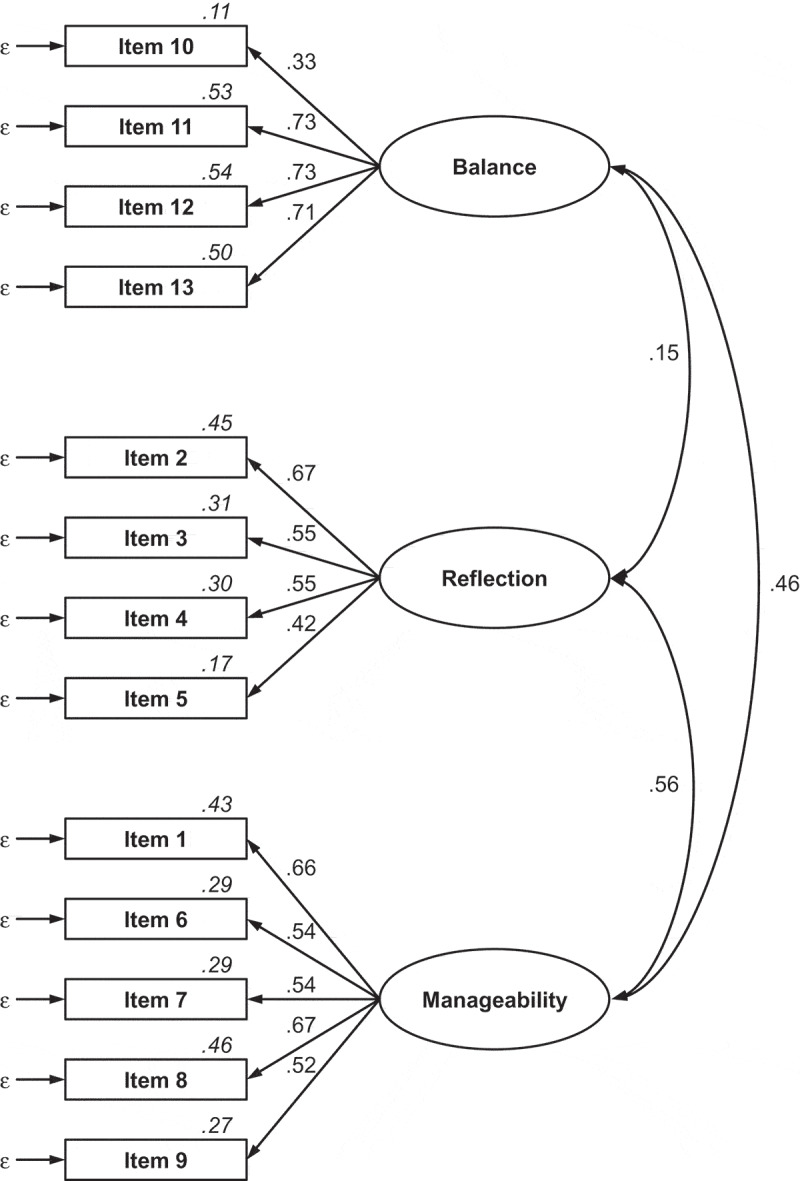
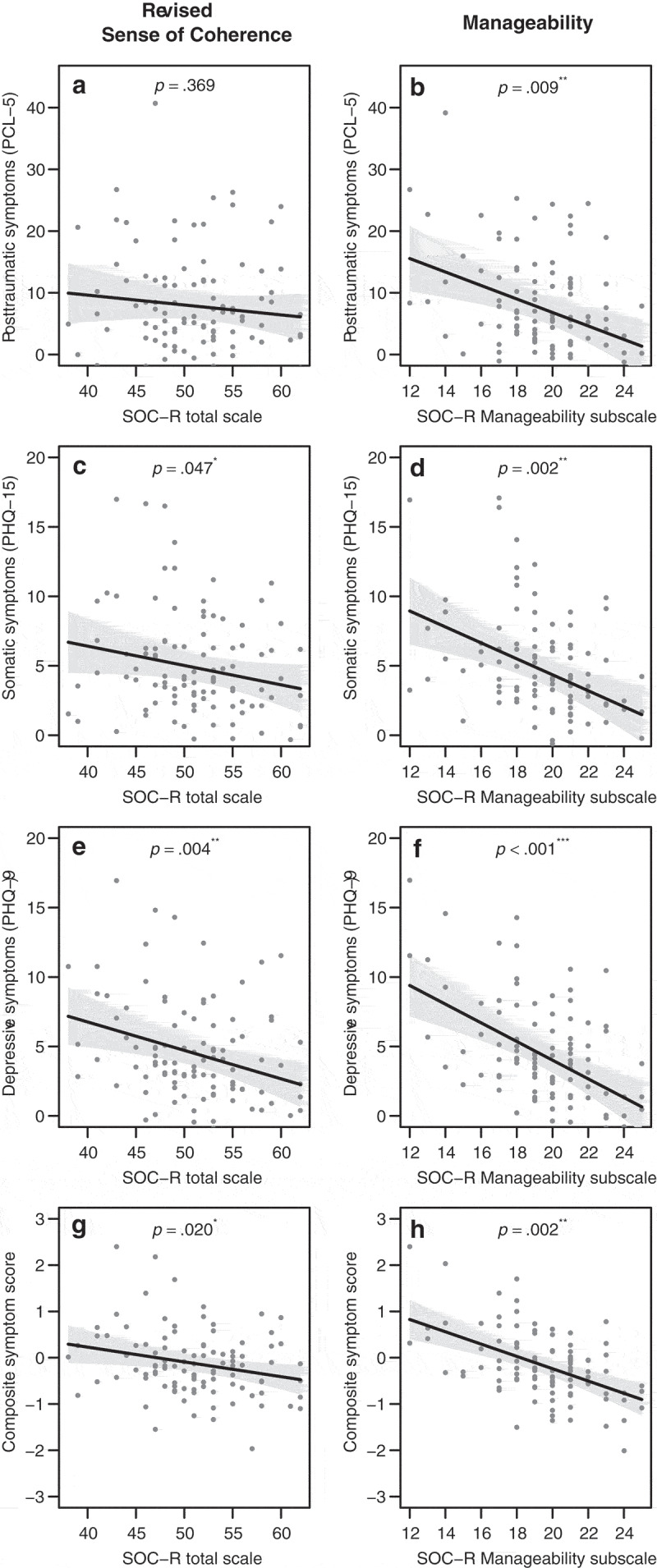
As rescue workers are regularly confronted with potentially traumatising on-duty events, they have an increased risk to develop trauma-related mental and physical health impairments, including post-traumatic, depressive, and somatic symptoms. For this high-risk group, it could be of particular importance to experience their occupational burden as manageable, meaningful, and coherent. This mindset – called sense of coherence – may be a potential resilience factor against the development of mental and physical health problems. In a cross-sectional cohort of 102 rescue workers (Mdn(QD)age = 26.0 (8.5), age range: 18−61), including 36 women, we investigated whether higher values on the Revised Sense of Coherence Scale (SOC-R) predicted lower post-traumatic, depressive, and somatic symptoms. In addition, we evaluated the factor structure of the SOC-R using confirmatory factor analyses. Linear regressions indicated that higher SOC-R, but particularly manageability scores were associated with less post-traumatic (β = −.31, p = .009), depressive (β = −.44, p < .001), and somatic symptoms (β = −.36, p = .002). Furthermore, we found that all symptom scores significantly increased with occupational and private-life trauma exposure. The SOC-R’s factor structure was replicated, comprising the three subscales manageability, reflection, and balance. However, the SOC-R’s convergent factor validity was rather low in the present sample. Taken together, a high sense of coherence, and in particular a high manageability conviction, was observed as resilience factors for high-risk groups that are frequently exposed to potentially traumatic events. Future studies might investigate whether strengthening the sense of coherence could be one building block in an effective prevention program for maintaining long-term health in risk groups.
Overview
The claims and statistics of this paper haven’t been checked yet.
Free: it reads the open-access text and checks the first 5 claims that cite a source we can check. Create a free account to check every claim.
Integrity signals
Registry
Cites
Statistics
Figures
Verification
Claims the paper makes
The claims and statistics of this paper haven’t been checked yet.
Free: it reads the open-access text and checks the first 5 claims that cite a source we can check. Create a free account to check every claim.
Claims other papers make about this one
Each is checked against this paper’s own text: does it say what the citing paper says it does?
The source backs part of the claim, not all of it — or backs it for a different population, condition or comparison.
In the citing paper
“studies have shown that people with a high SOC have a protective factor against PTSD (Pham et al., 2010; Kaźmierczak et al., 2011; Behnke et al., 2019; Streb et al., 2014; Schäfer et al., 2019), but not in the context of natural disasters such as earthquakes.”
From Post-traumatic stress, sense of coherence, and growth after the February earthquake: Evidence from teacher training institute students in Syria (2025) · cites this paper as Behnke et al., 2019
Experimental — accuracy not yet measured
Self-check
Percentages, sums and reported differences re-computed from the paper’s own numbers.
The self-check needs the paper’s full text.
Citations
Cites
R: A Language and Environment for Statistical Computing
R Core Team (2025) · doi:10.32614/r.manuals · Cited by 352,181
Evaluating structural equation models with unobservable variables and measurement error
Fornell, C., & Larcker, D. F. (1981) · Journal of Marketing Research · doi:10.1177/002224378101800104 · Cited by 109,190 · cited 1×
“According to the FornellLarcker criteria (Fornell & Larcker, 1981), satisfying factor convergence is indicated by an average variance extracted (AVE) larger than .50 and a composite reliability (CR) larger than .70.”
MethodHu, L., & Bentler, P. M. (1999) · Structural Equation Modeling A Multidisciplinary Journal · doi:10.1080/10705519909540118 · Cited by 108,788 · cited 1×
“…and the according p-value (p > .05), the relative χ2 statistic (χ2/df < 3), the root mean square error of approximation (RMSEA; ≤ .08), the standardised root mean square residual (SRMR; ≤ .08), and the comparative fit index (CFI; ≥ .95) were used as model fit criteria (Hu & Bentler, 1999).”
Methodlavaan : An R Package for Structural Equation Modeling
Rosseel, Y. (2012) · Journal of Statistical Software · doi:10.18637/jss.v048.i02 · Cited by 27,955
Multivariate Data Analysis, 6th ed
Tatham, R. L., Anderson, R. E., Babin, B. J., Black, W. C., & Hair, J. F. (2006) · Cited by 9,807
EQS : structural equations program manual
Bentler, P. M. (1989) · Medical Entomology and Zoology · Cited by 9,669
Kroenke, K., Spitzer, R. L., Williams, J. B. W., & Löwe, B. (2010) · General Hospital Psychiatry · doi:10.1016/j.genhosppsych.2010.03.006 · Cited by 4,057 · cited 2×
“were assessed with 15 items according to the German version of the Patient Health Questionnaire (PHQ15) (Kroenke et al., 2010; Löwe et al., 2002).”
MethodHealth, stress and coping: (530902004-001)
(1990) · PsycEXTRA Dataset · doi:10.1037/e530902004-001 · Cited by 3,691 · cited 1×
“In addition, Antonovsky proposed a sense of coherence as an important psychological resilience factor (Antonovsky, 1979).”
The structure and properties of the sense of coherence scale
Antonovsky, A. (1993) · Social Science & Medicine · doi:10.1016/0277-9536(93)90033-z · Cited by 3,515 · cited 1×
“Different versions of Antonovsky’s Sense of Coherence Scale (SOC) exist (Antonovsky, 1993).”
BackgroundPerkonigg, A., Kessler, R. C., Storz, S., & Wittchen, H. (2000) · Acta Psychiatrica Scandinavica · doi:10.1034/j.1600-0447.2000.101001046.x · Cited by 970
Research works printed but not linked: 9
- Antonovsky A. (1979). Health, stress, and coping. Jossey-Bass social and behavioral science series. San Francisco, CA: Jossey-Bass Inc.
- Häller P., Michael T., & Balmer Koechlin K. (2009). PTBS und komorbide Beschwerden bei Rettungssanitätern. Verhaltenstherapie and Verhaltensmedizin, 30, 403– 417.
- IBM Corp (2011). IBM SPSS statistics for windows. Armonk, NY: IBM Corp.
- Isele D., Schauer M., Ruf-Leuschner M., & Elbert T (2011). Belastende Kindheitserfahrungen (KERF-20-I) – eine komprimierte Interviewversion In M. Schauer, M.Schauer, F.Neuner, & T. Elbert (Eds (Eds), Narrative exposure therapy (net): a short-term treatment for traumatic stress disorders (2nd ed.). Göttingen/Camebridge: Hogrefe & Huber Publishers.
- LimeSurvey G. (2017). LimeSurvey: An open source survey tool. Hamburg, Germany. Retrieved from http://www.limesurvey.org.
- Löwe B., Spitzer R., Zipfel S., & Herzog W (2002). Gesundheitsfragebogen für Patienten (PHQ-D). Komplettversion und Kurzform. Testmappe mit Manual. Germany, Pfizer: Fragebögen, Schablonen. Karlsruhe.
- Richter S. (2014). Stressbelastung und Stressbewältigung bei haupt- und ehrenamtlichen Einsatzkräften in Rheinland-Pfalz (Doctoral Dissertation). Universität der Bundeswehr, Munich, Germany. Retrieved from https://d-nb.info/1069557307/34.
- Schoch E(2008). Berufliche Belastung und ihre psychischen Folgen bei Einsatzkräften im Rettungsdienst [Occupational stress and its psychological consequences in emergency service employees] (unpublished diploma thesis). Dep. Clinical Psychology, University of Konstanz. Germany: Konstanz.
- Teegen F., & Yasui Y. (2000). Traumaexposition und posttraumatische Belastungsstörungen bei dem Personal von Rettungsdiensten. Verhaltenstherapie and Verhaltensmedizin, 21, 65– 83.
Cited by
Behnke, A., Rojas, R., Karrasch, S., Hitzler, M., & Kolassa, I.-T. (2019) · Frontiers in Psychology · doi:10.3389/fpsyg.2019.02305 · Cited by 40
“Related concepts such as the sense of coherence were found to promote resilience and positive psychological adaptation processes such as post-traumatic growth in EMS personnel after critical experiences (Streb et al., 2014; Behnke et al., 2019; Ragger et al., 2019).”
BackgroundSelf-citationDaneshvar, S., Shafiei, M., & Basharpoor, S. (2022) · Journal of Interpersonal Violence · doi:10.1177/0886260520958660 · Cited by 34
“Thus, SoC can be considered as a possible persistence agent against psychological and physical health issues in trauma-exposed individuals (Behnke et al., 2019).”
BackgroundMarques, A., Ihle, A., Souza, A., Peralta, M., & de Matos, M. G. (2022) · Journal of Affective Disorders · doi:10.1016/j.jad.2022.04.126 · Cited by 43
Sex and gender in psychotrauma research
Langeland, W., & Olff, M. (2024) · European Journal of Psychotraumatology · doi:10.1080/20008066.2024.2358702 · Cited by 33
“Behnke et al. (2019) aimed to examine whether the revised sense of coherence is a potential resilience factor against PTSD, depressive, and somatic symptoms in rescue workers.”
BackgroundZhao, Y., An, Y., Sun, X., & Liu, J. (2019) · Journal of Loss and Trauma · doi:10.1080/15325024.2019.1672935 · Cited by 28
Alghamdi, A. A. (2022) · Frontiers in Psychiatry · doi:10.3389/fpsyt.2022.773100 · Cited by 32
“Behnke et al. (19) found that EMS providers who had a stronger sense of coherence weremore resilient tomental health challenges than those who had a weaker sense of coherence.”
BackgroundShangguan, F., Zhou, C., Qian, W., Zhang, C., Liu, Z., & Zhang, X. (2021) · Frontiers in Psychology · doi:10.3389/fpsyg.2021.633433 · Cited by 24
Rojas, R., Hickmann, M., Wolf, S., Kolassa, I., & Behnke, A. (2022) · Clinical Psychology in Europe · doi:10.32872/cpe.6133 · Cited by 34
Self-citationBerger‐Estilita, J., Abegglen, S., Hornburg, N., Greif, R., & Fuchs, A. (2022) · International Journal of Environmental Research and Public Health · doi:10.3390/ijerph19106053 · Cited by 25
“The manageability component, describing a feeling of having control over the demands of the environment, plays an important role in connection with the appearance of post-traumatic and depressive symptoms [26,27].”
BackgroundObuobi-Donkor, G., Shalaby, R., Eboreime, E., Agyapong, B., Phung, N., Eyben, S., Wells, K., Hilario, C. T., Dias, R. D. L., Jones, C., et al. (2023) · International Journal of Environmental Research and Public Health · doi:10.3390/ijerph20054215 · Cited by 17
“It is unsurprising that most of the literature consistently reports increased stress-related psychopathology among first responders [3,6,7].”
BackgroundRohner, S. L., Bernays, F., Maercker, A., & Thoma, M. V. (2021) · Stress and Health · doi:10.1002/smi.3093 · Cited by 16
“R in a sample of N = 102 rescue workers, a group that frequently encounter acute stress as part of the job (e.g., attacks or injuries to themselves or colleagues, care of severely injured individuals, difficult interactions with relatives of victims; Behnke et al., 2019).”
BackgroundNurses’ sense of coherence and stress management strategies against the types of health status
Betke, K., Basińska, M. A., & Andruszkiewicz, A. (2021) · Nursing Open · doi:10.1002/nop2.886 · Cited by 18
“As a counterpoint to the biomedical model, a salutogenic approach emerged as a basis for identifying determinants of good health and well- being (Behnke et al., 2019; Jażdżewska et al., 2018; Nowicki & Ślusarska, 2011; Wijesinghe & Parshall, 2016).”
MethodRohner, S. L., Bernays, F., Maercker, A., & Thoma, M. V. (2023) · Frontiers in Child and Adolescent Psychiatry · doi:10.3389/frcha.2023.1213142 · Cited by 12
Karrasch, S., Hitzler, M., Behnke, A., Tumani, V., Kolassa, I., & Rojas, R. (2020) · Zeitschrift für Klinische Psychologie und Psychotherapie · doi:10.1026/1616-3443/a000600 · Cited by 8
Self-citationFazelirad, H., Mohammadkhani, S., Mafakheri, A., Arezoumandi, Z., & Griffiths, M. D. (2025) · Psychiatric Quarterly · doi:10.1007/s11126-025-10151-9 · Cited by 5
“Research supports this by associating higher SOC with lower PTSD symptoms [70], improved mental and physical health [6], and a reduced likelihood of engaging in risky behaviors such as alcohol, drug use, and cigarette smoking [33].”
Mikutta, C. A., Sommer, I., & Ehlert, U. (2023) · Air Medical Journal · doi:10.1016/j.amj.2022.12.010 · Cited by 7
Gabay, G. (2024) · Death Studies · doi:10.1080/07481187.2024.2348058 · Cited by 3
“In rescue workers, a stronger SoC maintained mental and physical health during traumatic events (Bachem & Maercker, 2016; Behnke et al., 2019; McGee et al., 2018).”
Hübenthal, S., Muente, C., Pachanov, A., & Pieper, D. (2025) · Notarzt · doi:10.1055/a-2576-6456 · Cited by 2
PERAN KOHERENSI DIRI TERHADAP RESILIENSI KELUARGA PADA ORANG TUA TUNGGAL
Helena, C., & Kinanthi, M. R. (2021) · Journal of Psychological Science and Profession · doi:10.24198/jpsp.v5i3.27018 · Cited by 7
How the Salutogenic Pattern of Health Reflects in Type 2 Diabetes Mellitus: A Narrative Review
Mijač, S., Vitale, K., Lončarek, K., & Slivšek, G. (2025) · Diabetology · doi:10.3390/diabetology6110124 · Cited by 2
Sayahi, H., Vakili, S., & Asaseh, M. (2024) · Educational research in medical sciences · doi:10.5812/ermsj-149418 · Cited by 1
“Therefore, sense of coherence can be viewed as a distinct way of thinking, being, and acting with inner certainty and clarity, enabling individuals to identify, utilize, and draw upon their available resources (28).”
Nohr, L., Nesterko, Y., Specht, F., Stammel, N., Sotelo, I., & Böttche, M. (2025) · Journal of Traumatic Stress · doi:10.1002/jts.23173 · Cited by 3
“It appeared to show a protective influence, which is in line with previous cross-sectional studies in other trauma-affected populations (e.g., Behnke et al., 2019).”
Sarmini, I. M. (2025) · Journal of Indonesian Psychological Science (JIPS) · doi:10.18860/jips.v5i2.36354
“It was standardized on a sample of 360 Palestinian students, with a split-half coefficient of 0.71 and a Cronbach's alpha of 0.82 (Behnke et al., 2019; Ka ź mierczak et al., 2011; Pham et al., 2010; Schäfer, 2019; Streb et al., 2014) (Saydam and Thabet, 2007, p12).”
Influentialفعالیة برنامج تدریبی لتنمیة الإحساس بالتماسک لدى طالبات الدراسات العلیا
منتصر, ش. ع. ا., & إدریس, ص. (2021) · مجلة کلیة التربیة فى العلوم النفسیة · doi:10.21608/jfeps.2021.180061
Vaca, D. J. G., Carpio-Arias, T. V., Betancourt, A. S. R., Ruiz, G. P. I., Veloz, A. F. V., Chiriboga, J., Haro, J. M. P., & Veloz, M. F. V. (2021) · Research Square · doi:10.21203/rs.3.rs-879006/v1 · Cited by 1
Rumich, M. E. L., & Galeano, I. O. (2023) · Revista del Nacional (Itaguá) · doi:10.18004/rdn2023.dic.02.040.050
Shafiq, B., Iqbal, H., & Ali, A. (2024) · Journal of Emergency Management · doi:10.5055/jem.0806 · Cited by 1
Metadata
- Authors
- Behnke, A., Conrad, D., Kolassa, I.-T., & Rojas, R.
- Affiliations
- Universität Ulm (DE)
- University of Konstanz (DE)
- Corresponding author
- Behnke, Alexander
- Venue
- European Journal of Psychotraumatology
- Publisher
- Informa UK Limited
- Published
- 2019-05-20
- Volume
- 10
- Issue
- 1
- Pages
- 1606628-1606628
- ISSN
- 2000-8066 (ISSN-L)
- PMC
- PMC6534248
- OpenAlex
- W2945297114
- Semantic Scholar
- 63b134ebe0414cc97f29fde741c31ac900374a6f
- Cited by
- 26
- References
- 68
- Citations by year
- 2025: 4 · 2024: 4 · 2023: 4 · 2022: 4 · 2021: 6 · 2020: 2 · 2019: 2
- FWCI
- 4.77
- Type
- journal article
- Language
- en
- Open access
- gold
- doi.org
- Licence
- Locations
- European Journal of Psychotraumatology (publishedVersion, cc-by-nc)
- PubMed Central (publishedVersion, cc-by-nc)
- PubMed (publishedVersion)
- DOAJ (DOAJ: Directory of Open Access Journals) (submittedVersion, cc-by-sa)
- KOPS (University of Konstanz) (submittedVersion, cc-by-nc)
- OPen Access Repositorium der Universität Ulm (OPARU) (Ulm University) (submittedVersion, other-oa)
- Universität Ulm, Kommunikations- und Informationszentrum (kiz)
- Funders
- Hector Fellow Academy (Ph.D. scholarship)
- Deutsches Rote Kreuz (Not applicable)
- Studienstiftung des Deutschen Volkes (Ph.D. scholarship)
- Topics
- Health Sciences › Health Professions › General Health Professions › Health, psychology, and well-being
- Social Sciences › Psychology › Clinical Psychology › Resilience and Mental Health
- Social Sciences › Psychology › Social Psychology › Stress and Burnout Research
- Keywords
- sense of coherence, emergency medical services, rescue workers, occupational trauma exposure, post-traumatic symptoms, depressive symptoms, somatic symptoms, resilience, factor structure, convergent validity, occupational health
About these checks
Registry, retraction, Cites and statistics results are computed, not judged, with one exception: a printed reference that no index lists is read once by a model before it counts as a citation error. Claims are extracted by a model and kept only when their quote appears verbatim in the text; each cited source is then checked, with a model’s help, for whether it says what the claim relies on. Those verdicts can be wrong — read the claim’s quote and the cited source before relying on one.
Statistics and arithmetic are recomputed, not judged.
Confidence bands are shown only for fields calibrated on our annotated test set. None is calibrated yet, so no band is shown.
What counts as a claim ›How we measure confidence ›How we check this ›
Are you an author, or do you see a problem with this page? Request a review
Data sources
Bibliographic data: Semantic Scholar, OpenAlex, Crossref.
Contains information from the Semantic Scholar Academic Graph Datasets, made available under the ODC Attribution License (ODC-BY 1.0).
Semantic Scholar’s data is described in: Kinney, R., et al. (2023). The Semantic Scholar Open Data Platform. arXiv:2301.10140.
