

Crossing borders: a systematic review identifying potential mechanisms of intergenerational trauma transmission in asylum-seeking and refugee families
Open accessThe DOI matches its Crossref record; 44 of the 45 references it cites were found in a registry or an index; 5 of the 14 sources its claims cite were checked for support.
Abstract
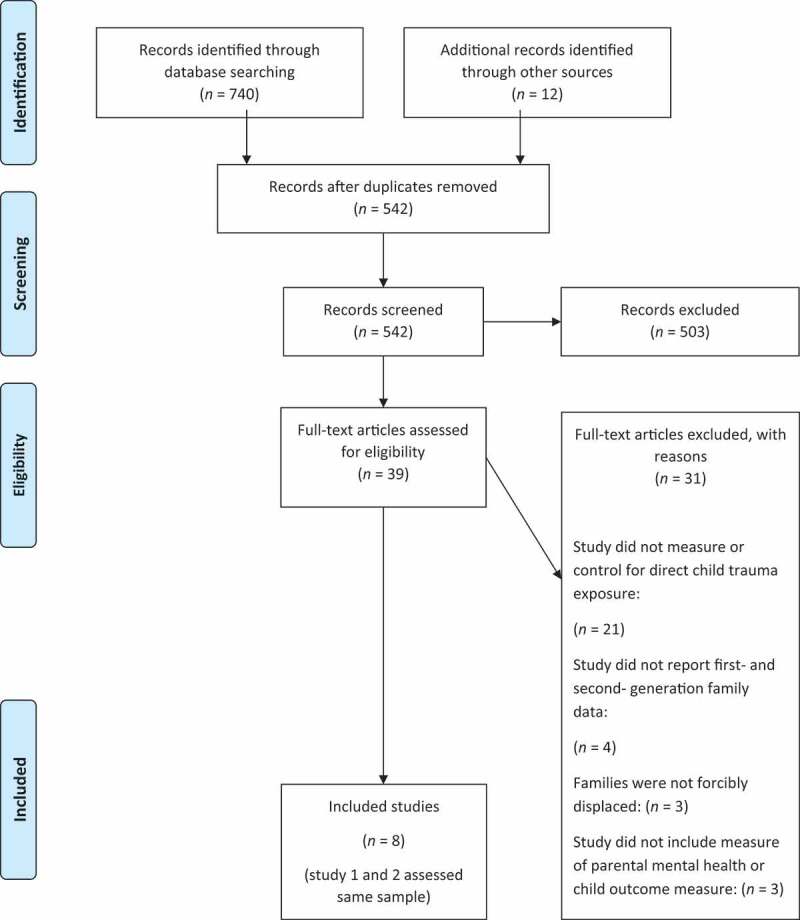
Background: As displacement and forced migration continue to exhibit global growth trends, new and surviving generations of children are being born and spending their formative years in host countries. Refugee children who have not been exposed to traumatic events may still be at risk for adverse developmental and mental health outcomes via intergenerational trauma transmission. Objective: To identify and synthesize potential mechanisms of intergenerational trauma transmission in forcibly displaced families where parents have experienced direct war-related trauma exposure, but children have no history of direct trauma exposure. Methods: PRISMA systematic review guidelines were adhered to. Searches were conducted across seven major databases and included quantitative, qualitative and mixed methods literature from 1945 to 2019. The search resulted in 752 citations and 8 studies (n = 1,684) met review inclusion criteria. Results: Findings suggest that parental trauma exposure and trauma sequelae indirectly affect child well-being via potential mechanisms of insecure attachment; maladaptive parenting styles; diminished parental emotional availability; decreased family functioning; accumulation of family stressors; dysfunctional intra-family communication styles and severity of parental symptomology. Conclusion: Further research is needed to assess independent intergenerational effects and mechanisms of trauma transmission in this population.
Overview
CoChat Summary
## TL;DR
This systematic review identified 8 studies (n = 1,684) on asylum-seeking/refugee families in which children had no direct trauma exposure, and found that parental trauma was linked to poorer child outcomes through parent- and family-level pathways. The paper concludes that more prospective, culturally appropriate research is needed to test independent intergenerational effects and mechanisms.
## Key findings
- Across the 8 included studies, parental trauma exposure and trauma sequelae were associated with higher levels of second-generation mental health or behavioural problems.
- Reported or inferred mechanisms included insecure attachment, maladaptive parenting, diminished parental emotional availability, decreased family functioning, accumulation of family stressors, dysfunctional intra-family communication, and parental symptom severity.
- Family-functioning variables mattered: one study reported that role-reversing parenting and accumulated family stressors explained 22% of the variance in SDQ scores; another found that a large family network in the host country was protective, with lower problem mean scores in children of fathers with large networks.
- One study found indirect effects of maternal torture on child outcomes via maternal withdrawal/detachment and via mothers’ volatility/panic; another reported that parental trauma predicted attachment, which fully mediated the association with adolescents’ sense of coherence.
## Methods
- Systematic review conducted under PRISMA guidelines, searching 7 databases (MEDLINE, ERIC, AMED, CINAHL, PsycINFO, Web of Science, PILOTS) on 11 March 2019 for English-language, peer-reviewed primary studies from January 1945 to March 2019.
- Included families with asylum-seeker or refugee status where parents had direct war-related trauma exposure and children had no history of direct trauma exposure; quantitative, qualitative, and mixed-methods studies were eligible.
- Two authors independently screened, appraised quality with the Mixed Methods Appraisal Tool (MMAT) 2018, and extracted data on study context, sample, trauma exposure, transmission model, outcomes, and mechanisms/covariates.
## Limitations
- The paper states that the evidence base is limited by substantial heterogeneity, a focus on pre-migratory trauma and parental PTSD, lack of culturally validated measures, and a quantitative bias across methodologies.
- It also notes risk of bias and possible reporting bias because only peer-reviewed empirical studies were included, and that 6 of 8 studies were cross-sectional, limiting causal inference.
- Evident from the text: only 8 studies met criteria, and only 8 studies assessed or controlled for direct child trauma exposure, which limits comparability and generalization; additionally, all study countries were Western, high-income profiles, so the review may not reflect current displacement patterns.
Model-written summary. Check it against the paper before relying on it.
Integrity signals
Registry
Cites
Statistics
Figures
Verification
Claims the paper makes
4 Valid · 1 Not valid · 29 Not checked · 36 Own results and interpretations
The cited sources support only part of this claim — read each source’s verdict below.
In the paper
“As reported by Sangalang and Vang (2017) and as echoed in the broader intergenerational trauma field (Dashorst, Mooren, Kleber, de Jong, & Huntjens, 2019), the reviewed studies were consistent in reporting parent- and family-related variables as the most salient mechanisms of transmission.”
§ Crossing borders: a systematic review identifying potential mechanisms of intergenerational trauma transmission in asylum-seeking and refugee families > Discussion
What the sources say
- Partly supportedcites Sangalang and Vang (2017) matched to “Intergenerational Trauma in Refugee Families: A Systematic Review” (2017) sourceExperimental — accuracy not yet measured
The Discussion says the literature was “fairly consistent” in describing parenting and family interactions as playing significant roles in transmission, and the psychosocial-mechanisms section describes studies of those pathways. It does not rank parent- and family-related variables as the most salient mechanisms; that part overstates the review's conclusion. (LLM, conf=0.84)
- Partly supportedcites Dashorst, Mooren, Kleber, de Jong, & Huntjens, 2019 matched to “Intergenerational consequences of the Holocaust on offspring mental health: a systematic review of associated factors and mechanisms” (2019) sourceExperimental — accuracy not yet measured
The Discussion (page unavailable) reports associations involving parental mental health, parenting, attachment, and family conflict, so Dashorst et al. do echo the relevance of parent- and family-related factors. But the Discussion and Conclusion describe transmission as multifactorial, including offspring characteristics and biological factors; they do not say the reviewed studies consistently identified parent- and family-related variables as the most salient mechanisms. (LLM, conf=0.84)
plainstates an association- Asserted: passes — The authors put it forward as true.
- Checkable: passes — It can be checked against evidence.
- Load-bearing: passes — The paper’s conclusions depend on it.
- Based: passes — The paper gives a reason why it holds.
- Partly supported
Every source the paper cites for this claim was checked and supports it.
In the paper
“Consequently, and in contrast to Sangalang and Vang (2017) review, an examination of independent intergenerational effects of trauma transmission was possible.”
§ Crossing borders: a systematic review identifying potential mechanisms of intergenerational trauma transmission in asylum-seeking and refugee families > Discussion
What the sources say
- Supportedcites Sangalang and Vang (2017) matched to “Intergenerational Trauma in Refugee Families: A Systematic Review” (2017) source
The Results describe Sangalang and Vang’s work as a review of studies using varied designs, rather than an independent analysis of intergenerational effects. The Discussion notes that several included studies did not control for potential confounders and calls for more advanced statistical techniques to account for alternative explanations. The cited contrast is supported as a distinction between the review and the citing authors’ own examination. (LLM, conf=0.86)
hedged- Asserted: passes — The authors put it forward as true.
- Checkable: passes — It can be checked against evidence.
- Load-bearing: passes — The paper’s conclusions depend on it.
- Based: passes — The paper gives a reason why it holds.
- Supported
The cited sources support only part of this claim — read each source’s verdict below.
In the paper
“with the present review additionally finding early integration to be protective against second-generation psychological distress (Vaage et al., 2011).”
§ Crossing borders: a systematic review identifying potential mechanisms of intergenerational trauma transmission in asylum-seeking and refugee families > Discussion
What the sources say
- Partly supportedcites Vaage et al., 2011 matched to “Paternal predictors of the mental health of children of Vietnamese refugees” (2011) sourceExperimental — accuracy not yet measured
The Discussion reports that fathers’ early contact with Norwegians positively predicted their children’s mental health 20 years later. But it cautiously describes an apparent advantage of participation in both Vietnamese and Norwegian networks, noting the small sample. Calling early integration broadly ‘protective’ overstates that specific, qualified finding. (LLM, conf=0.84)
plainstates a cause- Asserted: passes — The authors put it forward as true.
- Checkable: passes — It can be checked against evidence.
- Load-bearing: unclear — It is unclear whether the paper’s conclusions depend on it.
- Based: passes — The paper gives a reason why it holds.
- Partly supported
None of the sources cited for this claim have been checked yet.
In the paper
“Study 7 reported paternal PTSD as a significant risk factor for negative second-generation health outcomes over time, and paternal psychological distress was significantly associated with psychological distress in older children.”
§ Crossing borders: a systematic review identifying potential mechanisms of intergenerational trauma transmission in asylum-seeking and refugee families > Results > Transmission: mechanisms and covariates
plainstates an association- Asserted: passes — The authors put it forward as true.
- Checkable: passes — It can be checked against evidence.
- Load-bearing: passes — The paper’s conclusions depend on it.
- Based: passes — The paper gives a reason why it holds.
None of the sources cited for this claim have been checked yet.
In the paper
“Study 4 reported PTSD to be significantly correlated with role-reversing and rejecting parenting, and in turn, rejecting and role-reversing parenting were significantly correlated with child anxiety, and child anxiety and depression, respectively.”
§ Crossing borders: a systematic review identifying potential mechanisms of intergenerational trauma transmission in asylum-seeking and refugee families > Results > Transmission: mechanisms and covariates
plainstates an association- Asserted: passes — The authors put it forward as true.
- Checkable: passes — It can be checked against evidence.
- Load-bearing: passes — The paper’s conclusions depend on it.
- Based: passes — The paper gives a reason why it holds.
37 more claims
Create a free account to see all 70 claims and to verify the 1 reference still open.
- It may state two separate claims as one. 18
- Probably not a substantial claim. 11
- The quote only partly states this claim. 1
Citations
Cites
Preferred reporting items for systematic reviews and meta-analyses: the PRISMA Statement.
(2009) · PubMed Central · Cited by 44,859
Preferred reporting items for systematic reviews and meta-analyses: The PRISMA statement
Moher, D., Liberati, A., Tetzlaff, J., Altman, D. G., & the PRISMA Group* (2009) · Annals of Internal Medicine · doi:10.7326/0003-4819-151-4-200908180-00135 · Cited by 37,554
Fazel, M., Wheeler, J., & Danesh, J. (2005) · The Lancet · doi:10.1016/s0140-6736(05)61027-6 · Cited by 2,292 · cited 1×
“A metaanalysis by Fazel, Wheeler, and Danesh (2005) comprising 20 studies (n = 6,743) reported that adult refugees resettled in high-income countries were ten times more likely to present with posttraumatic stress disorder (PTSD) when compared with the general population.”
BackgroundSteel, Z., Chey, T., Silove, D., Marnane, C., Bryant, R. A., & van Ommeren, M. (2009) · JAMA · doi:10.1001/jama.2009.1132 · Cited by 2,246 · cited 2×
“Unique constellations of events and stressors along migration trajectories place forcibly displaced individuals at an elevated risk for trauma exposure and trauma sequelae (Fazel, Reed, Panter-Brick, & Stein, 2012; Lustig et al., 2004; Miller & Rasco, 2004; Porter & Haslam, 2005; Siriwardhana, Ali, Roberts, & Stewart,…”
BackgroundPorter, M., & Haslam, N. (2005) · JAMA · doi:10.1001/jama.294.5.602 · Cited by 1,793 · cited 2×
“…contextual factors is imperative given that living in uncertainty, punitive asylum protocols, and prolonged wait times for protective status adjudications could compound the effects of trauma exposure and mental health sequelae (Porter & Haslam, 2005) and are likely to affect trauma transmission.”
BackgroundFazel, M., Reed, R. V., Panter-Brick, C., & Stein, A. (2012) · The Lancet · doi:10.1016/s0140-6736(11)60051-2 · Cited by 1,441
International Handbook of Multigenerational Legacies of Trauma
(1998) · doi:10.1007/978-1-4757-5567-1 · Cited by 957
Review of Child and Adolescent Refugee Mental Health
Lustig, S. L., Kia-Keating, M., Knight, W. G., Geltman, P., Ellis, H., Kinzie, J. D., Keane, T., & Saxe, G. N. (2004) · Journal of the American Academy of Child & Adolescent Psychiatry · doi:10.1097/00004583-200401000-00012 · Cited by 788 · cited 2×
“Unique constellations of events and stressors along migration trajectories place forcibly displaced individuals at an elevated risk for trauma exposure and trauma sequelae (Fazel, Reed, Panter-Brick, & Stein, 2012; Lustig et al., 2004; Miller & Rasco, 2004; Porter & Haslam, 2005; Siriwardhana, Ali, Roberts, & Stewart,…”
BackgroundThe 1951 Convention and the 1967 Protocol Relating to the Status of Refugees
(2001) · Refugee Survey Quarterly · doi:10.1093/rsq/20.3.136 · Cited by 646
Psychological distress in refugee children: a systematic review
Bronstein, I., & Montgomery, P. (2011) · Clinical Child and Family Psychology Review · doi:10.1007/s10567-010-0081-0 · Cited by 634 · cited 2×
“…problems (Bean et al., 2007; Nielsen, Nørredam, Christensen, Obel, & Krasnik, 2007; Reijneveld, de Boer, Bean, & Korfker, 2005), with age, gender and country of origin being reported as holding differential predictive validity for trauma-based psychological distress (Bronstein & Montgomery, 2011).”
Background
Research works printed but not linked: 1
- Hong, Q. N., Pluye, P., Fàbregues, S., Bartlett, G., Boardman, F., Cargo, M., … Rousseau, M. C. (2018). Mixed methods appraisal tool (MMAT), version 2018. Montreal, Canada: IC Canadian Intellectual Property Office, Industry Canada.
Cited by
Bunn, M., Zolman, N., Smith, C. P., Khanna, D., Hanneke, R., Betancourt, T. S., & Weine, S. M. (2022) · SSM - Mental Health · doi:10.1016/j.ssmmh.2022.100153 · Cited by 113
“Furthermore, there is a growing body of literature examining the bidirectional in fl uence that trauma can have on the psychosocial health of other family members, as well as intergenerational impacts that can persist long after the events have occurred (Flanagan et al., 2020).”
BackgroundIntergenerational Transmission of Trauma: The Mediating Effects of Family Health
Reese, E. M., Barlow, M. J., Dillon, M., Villalon, S. E., Barnes, M., & Crandall, A. (2022) · International Journal of Environmental Research and Public Health · doi:10.3390/ijerph19105944 · Cited by 76
“Factors that impact ITT include family functioning, parenting ability, parent–child relationship quality, cognitive appraisal of trauma, PTSD, and severity of a parent’s childhood trauma [10–14].”
BackgroundInfluentialChange in child mental health during the Ukraine war: evidence from a large sample of parents
McElroy, E., Hyland, P., Shevlin, M. E., Karatzias, T., Vallières, F., Ben‐Ezra, M., Vang, M. L., Lorberg, B. A., & Martsenkovskyi, D. (2023) · European Child & Adolescent Psychiatry · doi:10.1007/s00787-023-02255-z · Cited by 73
Self-citationPromoting positive development among refugee adolescents
Abdi, S. M., Akinsulure‐Smith, A. M., Sarkadi, A., Fazel, M. S., Ellis, B. H., Gillespie, S., Juang, L. P., & Betancourt, T. S. (2023) · Journal of Research on Adolescence · doi:10.1111/jora.12890 · Cited by 47
“…families have identified a dearth of research on adolescent– caregiver relationships, relative to caregiver relationships with younger children (Flanagan et al., 2020) and several methodological limitations, including a reliance on self-reported, cross-sectional data, and few studies…”
BackgroundCombatting intergenerational effects of psychotrauma with multifamily therapy
Mooren, T., van Ee, E., Hein, I., & Bala, J. (2023) · Frontiers in Psychiatry · doi:10.3389/fpsyt.2022.867305 · Cited by 24
“(13) Refugees Europe, USA 8 2006–2018 1684 Individual offspring Intergenerational consequences of PTSD symptoms, attachment Narrative Disrupted attachment, maladaptive parenting style, diminished emotional availability, disrupted family functioning, accumulaton of family stressors, dysfunctional communication styles,…”
BackgroundAnisman, H., Doubad, D., Asokumar, A., & Matheson, K. (2024) · Neuroscience & Biobehavioral Reviews · doi:10.1016/j.neubiorev.2024.105859 · Cited by 32
Speidel, R., Galarneau, E., Elsayed, D., Mahhouk, S., Filippelli, J., Colasante, T., & Malti, T. (2021) · International Journal of Environmental Research and Public Health · doi:10.3390/ijerph182212180 · Cited by 25
“…are in line with theories of developmental psychopathology, systems, and intergenerational Notably, child pre-migratory adversity was not associated with children’s internalizing or externalizing symptoms. trauma [2,6,7], which emphasize the importance different contexts of the family experience.”
BackgroundInfluentialThe impact of family income and parental factors on children's resilience and mental well‐being
Bruno, W., Dehnel, R., & Al‐Delaimy, W. K. (2023) · Journal of Community Psychology · doi:10.1002/jcop.22995 · Cited by 27
Experiences of nurses caring for involuntary migrant maternal women: a qualitative systematic review
Kassam, S., Butcher, D. L., & Marcellus, L. (2022) · JBI Evidence Synthesis · doi:10.11124/jbies-21-00181 · Cited by 20
The Health and Well-Being of Women and Girls Who Are Refugees: A Case for Action
Chalouhi, J., Currow, D. C., Dumit, N. Y., Sawleshwarkar, S., Glass, N. E., Stanfield, S., DiGiacomo, M. L., & Davidson, P. M. (2025) · International Journal of Environmental Research and Public Health · doi:10.3390/ijerph22020204 · Cited by 27
“Given the increasing evidence of the impact of intergenerational trauma, this is an important focus for future research, as well as non-communicable conditions and health across the life course [89].”
Attachment and family functioning across three generations
Vitulić, H. S., Gosar, D., & Prosen, S. (2022) · Family Process · doi:10.1111/famp.12787 · Cited by 20
Intergenerational Trauma in Phenomenological Research—A Systematic Review
Cacace, A., & Summers, S. J. (2025) · Journal of Loss and Trauma · doi:10.1080/15325024.2025.2490917 · Cited by 22
“…anxiety, poly-substance use, and engagement in high-risk behaviors such as criminal activity in Latinx communities (Cerdeña et al., 2021), Indigenous people of North American countries (Gone et al., 2019), and asylum-seeking and refugee families (Flanagan et al., 2020; Sangalang & Vang, 2017).”
InfluentialScharpf, F., Paulus, M., Christner, N., Beerbaum, L., Kammermeier, M., & Hecker, T. (2023) · Development and Psychopathology · doi:10.1017/s0954579423000846 · Cited by 18
Kelstrup, L., & Carlsson, J. (2022) · Psychiatry Research · doi:10.1016/j.psychres.2022.114604 · Cited by 11
“trauma transmission which is what this review sets out to do (Flanagan et al., 2020).”
BackgroundRecognizing and Breaking the Cycle of Trauma and Violence Among Resettled Refugees
Shi, M., Stey, A. M., & Tatebe, L. C. (2021) · Current Trauma Reports · doi:10.1007/s40719-021-00217-x · Cited by 15
Gitau, L. W., Arop, A., & Lenette, C. (2023) · Social Sciences · doi:10.3390/socsci12080455 · Cited by 17
Father Involvement and Child Development: A Prospective Study of Syrian Refugee Families
Hadfield, K., Al‐Soleiti, M., Dajani, R. B., Mareschal, I., & Panter‐Brick, C. (2024) · Journal of Child and Family Studies · doi:10.1007/s10826-024-02809-y · Cited by 16
“…across the life course directly, as well as indirectly through compromised caregiving (Bryant et al., 2018; Beni Yonis et al., 2021; Eltanamly et al., 2021; Fazel et al., 2011; Flanagan et al., 2020; Frounfelker et al., 2020; MacDermid Wads-worth, 2010; Reed et al., 2011; van Ee et al., 2013).”
Bachem, R., Levin, Y., Yuval, K., Langer, N. K., Solomon, Z., & Bernstein, A. (2024) · European Journal of Psychotraumatology · doi:10.1080/20008066.2023.2300588 · Cited by 16
“Flanagan et al. (2020) reviewed eight studies that focused on interge-nerational trauma transmission in refugee and asy-lum-seeking families with children and adolescents born post-migration.”
BackgroundGillen, M., Goodman, A., Danaher, F. S., Bosson, R. S., Greenwald, M., & Jasrasaria, R. (2024) · Health · doi:10.4236/health.2024.1610063 · Cited by 14
Lowe, M. X., Kettner, H., Jolly, D. R. P., Carhart-Harris, R. L., & Jackson, H. (2024) · Frontiers in Psychiatry · doi:10.3389/fpsyt.2024.1279887 · Cited by 19
Beckmann, J., Wenzel, T., Hautzinger, M., & Kizilhan, J. I. (2022) · Frontiers in Psychiatry · doi:10.3389/fpsyt.2022.947903 · Cited by 10
Trauma as a Public Health Issue: Epidemiology of Trauma and Trauma-Related Disorders
Mew, E. J., Koenen, K. C., & Lowe, S. R. (2022) · Springer eBooks · doi:10.1007/978-3-030-97802-0_2 · Cited by 16
Mew, E. J., Nyhan, K., Bonumwezi, J., Blas, V., Gorman, H., Hennein, R., Quach, K., Shabanova, V., Hawley, N. L., & Lowe, S. R. (2022) · PLoS ONE · doi:10.1371/journal.pone.0276753 · Cited by 11
Family Functioning and the Psychological Wellbeing of Refugee-Background Youth in Australia
Ziaian, T., Miller, E., Puvimanasinghe, T. S., Esterman, A., Dollard, M. F., & de Anstiss, H. (2023) · Journal of Immigrant & Refugee Studies · doi:10.1080/15562948.2023.2238264 · Cited by 8
“However, families from refugee backgrounds may have a risk of intergenerational trauma and negative experiences of older family members can potentially affect the psychological wellbeing of youth (Flanagan et al., 2020).”
Hoffman, S. J., & Fredkove, W. M. (2023) · Advances in Nursing Science · doi:10.1097/ans.0000000000000506 · Cited by 9
Ngameni, É. G., Moro, M. R., Kokou‐Kpolou, C. K., Radjack, R., Dozio, E., & Husseini, M. E. (2022) · Child Care in Practice · doi:10.1080/13575279.2022.2071220 · Cited by 8
“Findings from a study by Flanagan et al. (2020) suggest that parental exposure to trauma and the sequelae of trauma affect the well-being of the child through potential insecure attachment mechanisms, accumulation of family stressors and the severity of parental symptomatology.”
BackgroundAssociations Between Gender, Torture, and Health: A 5-Year Retrospective Cohort Analysis
Hoffman, S. J., Shannon, P. J., Horn, T. L., Letts, J., Kondes, Z., & Mathiason, M. A. (2022) · Journal of Loss and Trauma · doi:10.1080/15325024.2022.2092317 · Cited by 6
“Flanagan et al. (2020) describe a Triple Trauma Paradigm that acknowledges the contributions of pre/intra/post displacement and migration contexts to health and wellbeing (Flanagan et al., 2020).”
BackgroundIntergenerational mental health effects of traumatic victimization in Nepal: A 3-D theory study
Emery, C. R. (2024) · Social Science & Medicine · doi:10.1016/j.socscimed.2024.117020 · Cited by 6
Collective trauma in the forced migration context: A scoping Review
Kirsch, J., & Haran, H. (2025) · Transcultural Psychiatry · doi:10.1177/13634615251341853 · Cited by 10
“In a systematic review of intergenerational trauma among asylum-seeking and refugee families, Flanagan et al. (2020) found that second-generation children, who did not directly experience traumatic events, still exhibited higher levels of mental health issues, re fl ecting the trauma their parents…”
Cultivating Trauma-Informed Educational Practices for Students with Refugee Backgrounds
Bailey, M., Kim, W., Koury, S. P., Green, S. A., & Kim, I. (2023) · Children & Schools · doi:10.1093/cs/cdad017 · Cited by 7
Tesfai, A. H., Captari, L. E., Meyer‐Weitz, A., & Cowden, R. G. (2023) · International Journal of Environmental Research and Public Health · doi:10.3390/ijerph21010050 · Cited by 12
“…are being increasingly elucidated, including “insecure attachment, maladaptive parenting styles, diminished parental emotional availability, decreased family functioning, accumulation of family stressors, dysfunctional intra-family communication styles, and severity of parental symptomology” [53].”
BackgroundStress responses of infants and mothers to a still-face paradigm after traumatic childbirth
Messerli‐Bürgy, N., Sandoz, V., Deforge, C., Lacroix, A., Sekarski, N., & Horsch, A. (2024) · Psychoneuroendocrinology · doi:10.1016/j.psyneuen.2024.107222 · Cited by 6
“Firstly, the impact might happen indirectly through more negative parenting styles, more family conflicts (Flanagan et al., 2020; Van Sieleghem et al., 2022), lower maternal sensitivity (Cook et al., 2018), less adequate interaction distance with the child (Ionio and Di Blasio, 2014), and more…”
Parental post-traumatic stress and psychiatric care utilisation among refugee adolescents
Berg, L., Montgomery, E., Brendler‐Lindquist, M., Mittendorfer‐Rutz, E., & Hjern, A. (2021) · European Child & Adolescent Psychiatry · doi:10.1007/s00787-021-01827-1 · Cited by 10
“The literature suggests different mechanisms in the intergenerational transmission of trauma, mainly focusing on parental trauma-related mental health problems, caregiving behavior, and disrupted attachment [28, 29].”
Background"The Thirst of Tamils is the Homeland of Tamil Eelam": Methodology as a Form of Repatriation
Thambinathan, V. (2022) · International Journal of Qualitative Methods · doi:10.1177/16094069221121238 · Cited by 7
“There is limited knowledge about embodied historical trauma in Canadian refugee families, with gaps in insight particularly about intergenerational trauma (Flanagan et al., 2020; Sangalang and Vang, 2017).”
BackgroundLe GRAND livre des 1000 premiers jours de vie
(2021) · Dunod eBooks · doi:10.3917/dunod.smith.2021.02.0325 · Cited by 2
Dawson, N., & Bain, K. (2022) · Qualitative Research in Psychology · doi:10.1080/14780887.2021.1966559 · Cited by 4
“There is a vast literature documenting the non-conscious transmission of trauma from parent to child (Flanagan et al. 2020).”
BackgroundHong, J., Ruacho, H. C., Zeng, X., & Franklin, C. (2025) · Community Mental Health Journal · doi:10.1007/s10597-025-01463-y · Cited by 7
“…family-based intervention studies targeting intergenerational trauma within refugee and immigrant populations remain scarce, with much of the existing research focused primarily on Holocaust survivors and First Nations communities (Flanagan et al., 2020; Roy et al., 2021; San-galang & Vang, 2017).”
Parental PTSD and Children’s Well-Being During Wartime: The Role of Interpersonal Emotion Regulation
Keleynikov, M., Cohen, N., Polack, R. G., Lassri, D., & Benatov, J. (2025) · International Journal on Child Maltreatment Research Policy and Practice · doi:10.1007/s42448-025-00238-y · Cited by 6
“Nonetheless, research exploring the role of the family environment in high-stress contexts, such as war zones, remains limited (Al-Yagon et al., 2023; Flanagan et al., 2020; Thabet et al., 2009).”
Kassam, S., O’Mahony, J. M., & Clark, N. (2023) · International Health Trends and Perspectives · doi:10.32920/ihtp.v3i1.1727 · Cited by 4
Davoren, N., McEleney, A., Corcoran, S., & Fortune, D. G. (2024) · Psychotherapy Research · doi:10.1080/10503307.2024.2406544 · Cited by 4
“The “Triple Trauma Paradigm” refers to the myriad of traumatic events faced by people who are forcibly displaced; pre-migration, peri-migration, and post-migration (Flanagan et al., 2020).”
Huang, A. Y., Bonumwezi, J., Wang, K., Mew, E. J., Habintwali, D., & Lowe, S. R. (2024) · Journal of Loss and Trauma · doi:10.1080/15325024.2024.2422610 · Cited by 6
A Scoping Review on the Effects of War and Migration on Emotion Regulation In Syrian Children
Ulutaş, D. A., Onur, D., Özkan, M., et al. (2025) · Habitus toplumbilim dergisi · doi:10.62156/habitus.1611710 · Cited by 3
“…this process, a holistic evaluation of factors such as children’s environmental sensitivity, childhood experiences, levels of psychological resilience, and the intergenerational transmission of trauma (Karam et al. 2019; Flanagan et al. 2020; Zerach et al. 2023; Guido et al. 2021) is necessary.”
Ethnic Identity as Social Curse: Intergenerational Transmission of Historical Trauma
Turjanmaa, E., Finell, E., & Tolvanen, A. J. (2025) · Journal of Community & Applied Social Psychology · doi:10.1002/casp.70094 · Cited by 4
Chan, C. D., Rodriguez, C. S., & Jones, C. T. (2025) · Journal of Marital and Family Therapy · doi:10.1111/jmft.70047 · Cited by 2
“According to a systematic review by Flanagan et al. (2020), trauma exposure among refugee and asylum ‐ seeking parents yields mental health issues, disrupted attachment, maladaptive parenting, and diminished family function, which result in unfavorable mental health outcomes among children.”
Expressed emotion and wellbeing in South Asian heritage families living in the UK
Shaikh, M., Fatima, Z., Sharif, H. S., et al. (2023) · Current Psychology · doi:10.1007/s12144-023-04937-y · Cited by 2
“…might be explained by intergenerational trauma which is higher in migrant groups and is often transmitted by diminished parental emotional availability, dysfunctional communication styles and overinvolvement (Flanagan et al., 2020) resulting in lower levels of empathy, criticism and irritability.”
Psycho-social Stressors Experienced by Young war Refugees in Developed Countries: A Scoping Review
Metersky, K., Jordan, A., Al‐Hamad, A., & El‐Masri, M. M. (2024) · Canadian Journal of Nursing Research · doi:10.1177/08445621241263459 · Cited by 2
“Culturally sensitive research is essential to address trauma ’ s intergenerational impact on war refugees in developed countries (Flanagan et al., 2020; Drummond Johansen & Varvin, 2020).”
BackgroundInfluentialLev‐Ari, R. K., Aloni, R., Margalit, D., & Ben-Ari, A. (2024) · Journal of Contextual Behavioral Science · doi:10.1016/j.jcbs.2024.100826 · Cited by 2
Dini, Z., & Solheim, C. A. (2024) · International Journal of Systemic Therapy · doi:10.1080/2692398x.2024.2403851 · Cited by 2
“…studies document the intergenerational effects of trauma-affected 1G refugee parenting behaviors on their children, similar to those that the 2G young adults in our study described (See Flanagan et al. (2020) for a recent systematic review of research on intergenerational transmission of trauma.).”
Falquez, L. D., Silvera, L. P. R., & de Sánchez, A. R. R. (2021) · Psicoperspectivas Individuo y Sociedad · doi:10.5027/psicoperspectivas-vol20-issue1-fulltext-2111 · Cited by 4
From One Generation to the Next: Hmong American Adolescents’ Views of Maternal Racial Socialization
Lamborn, S. D., & Paasch-Anderson, J. (2022) · Journal of Adolescent Research · doi:10.1177/07435584221079725 · Cited by 2
“…and restricted language skills may all conspire to discourage parents from confronting racism, engaging with local authority figures (e.g., police, school officials), or participating in difficult conversations about race and discrimination (Flanagan et al., 2020; Suárez-Orozco et al., 2018).”
BackgroundSeedat, S., & Kastrup, M. C. (2024) · Springer eBooks · doi:10.1007/978-3-030-51366-5_123 · Cited by 2
Gupta, S. L., Sarkadi, A., & Warner, G. (2024) · Journal of Child and Family Studies · doi:10.1007/s10826-024-02947-3 · Cited by 1
“…gap between youth and parents (with youth adapting quicker to the host country compared to may) affect family dynamics (Telzer, 2011) as well as in a trauma context where parental trauma exposure and PTSD affects family patterns and parenting (Flanagan et al., 2020; van Ee et al., 2016).”
Whitaker, D. J., Koreis, J. E., Weeks, E. A., Rao, N., Brown, S., & O’Connor, M. H. (2025) · Child Protection and Practice · doi:10.1016/j.chipro.2025.100099 · Cited by 5
KUŞAKLARARASI AKTARIM: MÜLTECİ AİLELERİN ÇOCUKLARI TRAVMAYI NASIL MİRAS ALIYORLAR?
Sakarya, H. (2025) · Tıbbi Sosyal Hizmet Dergisi · doi:10.46218/tshd.1425259 · Cited by 1
Akintunde, T. Y., Isangha, S. O., & Olurin, T. K. (2025) · Child and Adolescent Social Work Journal · doi:10.1007/s10560-025-01041-x · Cited by 1
“Empirical evidence has shown that ACEs can significantly alter developmental trajectories, impairing emotional regulation, mental health, and interper - sonal functioning (Bravo et al., 2023 ; Flanagan et al., 2020).”
Seedat, S., & Kastrup, M. C. (2023) · Springer eBooks · doi:10.1007/978-3-030-42825-9_123-1 · Cited by 1
Changing Motherhood in the South African Middle-Class Context
Zaidman-Mograbi, R., Bain, K., & Pretorius, E. (2023) · Journal of Family Issues · doi:10.1177/0192513x231211455 · Cited by 1
“While this may have been a result of performance anxiety experienced by all the mothers in the research setting, it may also indicate the subtle intergenerational transmission of relational patterns learned in their own childhoods (Flanagan et al., 2020; Van Ijzendoorn, 2006).”
Tuyishimire, B., Kwaks, J., & Berckmoes, L. H. (2024) · Genealogy · doi:10.3390/genealogy8030119 · Cited by 2
“…where research more often identified parental silence and implicit transmission (Lin et al. 2009; Sangalang and Vang 2017; McCleary et al. 2019; Flanagan et al. 2020), children here were intentionally and explicitly taught anticipatory practices to avert or cope with repetitious, future…”
IMPACT OF TRAUMATIC PARENTAL EXPERIENCES WITH WARS ON OFFSPRING’S MENTAL HEALTH
Kožljan, P., Bagarić, I. R., Ajduković, M., Krasić, J., & Sinčić, N. (2025) · Annual of Social Work · doi:10.3935/ljsr.v31i3.525 · Cited by 1
Thomas, F. C., McGuire, K., Kwong, O. N. H., Parmar, P. K., Goldgruber, B., Doherty, S., Jayawickreme, N., Milligan, K., Dass, G., Sivayokan, S., et al. (2025) · SSM - Mental Health · doi:10.1016/j.ssmmh.2025.100506 · Cited by 2
Intergenerational Transference of Collective Trauma in the Exilic Lives of Sri Lankan Tamil Refugees
Riswana, B., & Gopal, B. (2025) · Journal of International Migration and Integration / Revue de l integration et de la migration internationale · doi:10.1007/s12134-025-01308-3 · Cited by 2
Knettel, B. A., Oliver-Steinberg, A., Lee, M., Rubesin, H., Duke, N. N., Esmaili, E., & Puffer, E. S. (2023) · International Journal of Migration Health and Social Care · doi:10.1108/ijmhsc-11-2021-0110 · Cited by 2
Turjanmaa, E. (2025) · Psykologia · doi:10.62443/psykologia.v57i3.112128 · Cited by 1
Bowe, C., Thomas, C. J., & Mackey, P. (2025) · Child and Adolescent Social Work Journal · doi:10.1007/s10560-025-01027-9 · Cited by 2
“…future generations as Holocaust or war survival (Kellerman, 2001; Miller & Ras-mussen, 2017 ; Solkoff, 1992) with the term “triple trauma paradigm” (Flanagan et al., 2020, p. 2; Miller & Rasco, 2004) encompassing the compounding stressors and adver-sities experienced pre, during, and post…”
Trust perception in Syrian refugee children
Chen, Y. D., Qtaishat, L., Lisi, M., Dajani, R. B., Kharouf, A. E., von Stumm, S., Hadfield, K., Mareschal, I., & Michalek, J. E. (2025) · Development and Psychopathology · doi:10.1017/s0954579425100606
“Parent-child dynamics are likely to play a particularly significant role in refugee populations, for whom the intergenerational transmission of trauma is well-documented (Flanagan et al., 2020).”
Group Prenatal Care for Afghan Refugees: A Pilot Program and Initial Demonstration of Feasibility
Aleinikoff, S., Maratas, A. S., Marcell, L., Mann, E., Dawson-Hahn, E. E., & Yu, K. K.-Y. (2025) · Maternal and Child Health Journal · doi:10.1007/s10995-025-04165-9
“In addition to their experiences preflight, during flight and postflight, newly arrived refugees who are also pregnant have an additional layer of social and medical complexity (Flanagan et al., 2020 ).”
Akdağ, B., Kopuz, H. Y., Günenç, M., & Taşkum, İ. (2025) · Current Psychology · doi:10.1007/s12144-025-08473-9
“Furthermore, exposure to parental trauma can adversely affect children’s well-being through mechanisms such as insecure attachment, suboptimal parenting practices, and reduced emotional availability (Flanagan et al., 2020).”
Tutlam, N. T., Liyew, T., Betancourt, T. S., Powell, B. J., Guo, S., McKay, M. M., & Ssewamala, F. M. (2025) · BMJ Open · doi:10.1136/bmjopen-2025-108824
“40 75 The multiple potential mechanisms of action identified in figure 1 will allow us to target multiple factors that lead to increased risk of mental disorders Open access both among the adolescents and their parents.”
Franke, V. C. (2025) · Journal of Peacebuilding & Development · doi:10.1177/15423166251385306 · Cited by 2
“…or sustained structural violence, prolonged social trauma can have severe short-and long-term consequences, including the transmission of the trauma and related attitudes, values and behavior strategies to future generations (Flanagan et al., 2020; Gorbunova & Klymchuk, 2020; Poletti et al., 2022).”
Leshem, M., & Sher‐Censor, E. (2026) · Journal of Autism and Developmental Disorders · doi:10.1007/s10803-025-07196-x
Bose, C. N., & Diaz, M. (2026) · Frontiers in Psychiatry · doi:10.3389/fpsyt.2025.1715650 · Cited by 1
“A conceptual analysis has discussed potential bene fi ts of such a treatment in the context of intergenerational psychotrauma (49), which may also be a phenomenon refugee and asylum-seeking minors are exposed to (50).”
Hasan, S. R., & Ali, A. A. A. (2026) · Cihan University-Erbil Journal of Humanities and Social Sciences · doi:10.24086/cuejhss.v10n1y2026.pp40-47
Praetorius, R. T., Kirsch, J., & Gallegos, T. (2026) · Migration and Development · doi:10.1177/21632324261419596
Pham, Y., & Daniel, M. (2026) · International Journal of Environmental Research and Public Health · doi:10.3390/ijerph23020266
“Empirical studies on intergenerational trauma among refugee populations suggest that family interaction (i.e., poor parenting) is one of the channels through which trauma is transmitted across generations [4,14].”
Hidden Family History and Sense of Coherence among Second- and Third-Generation Displaced Ingrians
Turjanmaa, E., & Kähäri, O. (2026) · Helsinki University Press eBooks · doi:10.33134/hup-35-8
Intergenerational trauma in forcibly-displaced populations in Latin America: a scoping review
Correa-Salazar, C., Torres-Benítez, D. S., & Agudelo-Avellaneda, E. N. (2026) · BMC Public Health · doi:10.1186/s12889-026-26861-z
“Flanagan et al. (2020) [22]only included in their systematic review Western, high income-profile countries that do not reflect current displacement and migration trends in LAC or with Global South populations.”
Mew, E. J., Poulin, R., Shabanova, V., Gorman, H., Meadows, M.-C., Bonumwezi, J., Chung, V. D., Hennein, R., Huang, A. Y., Quach, K., et al. (2026) · Child Maltreatment · doi:10.1177/10775595261425582 · Cited by 1
Dini, Z., & Solheim, C. A. (2026) · Gezinstherapie Wereldwijd · doi:10.1007/s12440-026-00274-1
Transmission du traumatisme psychique de la mère au bébé chez les femmes migrantes en France
Ngameni, É. G. (2022) · theses.fr (ABES) · doi:10.70675/f8edbb65z6101z4616z859dzc8a56153af57
Gagné, M. H., Edwards, B., Poon, B. T., Janus, M., Guhn, M., Goossen, R., Ortiz, S. S., & Gadermann, A. (2026) · Early Childhood Research Quarterly · doi:10.1016/j.ecresq.2026.04.007
Agborchi, A., Abur, W., Tartakover, S., & Quinton, H. W. (2026) · Springer eBooks · doi:10.1007/978-981-95-6382-1_2
The Impact of Racist Discourse on the Psychosocial Wellbeing of Refugees: A Systematic Review
Naidu, J., Paolucci, E. O., Chowdhury, N. A., Boakye, F., Hiebert, M. S., & Turin, T. C. (2026) · Journal of Immigrant and Minority Health · doi:10.1007/s10903-026-01935-7
Intergenerational Trauma and Posttraumatic Growth among Syrian Families
Tarabishi, L., & Golm, D. (2026) · Lebanese Journal of Mental Health · doi:10.4103/ljmh.ljmh_37_25
Zolman, N., Bunn, M., & Wachter, K. (2026) · Family Process · doi:10.1111/famp.70167 · Cited by 1
Exploring Intergenerational Trauma in Forced Migrant Populations: A Qualitative Meta-Synthesis
Kirsch, J., Rafieifar, M., Haran, H., Xu, L., & Marcial, A. (2026) · Families in Society The Journal of Contemporary Social Services · doi:10.1177/10443894261448360
Diab, J. L. (2026) · American Journal of Community Psychology · doi:10.1002/ajcp.70079
Najdini, M., Frigaux, A., Mathieu, J., Shadili, G., Bazan, A., Melchior, M., Gressier, F., & Essadek, A. (2026) · Addictive Behaviors Reports · doi:10.1016/j.abrep.2026.100721
“A systematic review showed that trauma among refugee parents may be transmitted to their children through mechanisms such as insecure attachment, maladaptive parenting, impaired family functioning, and parental emotional unavailability (Flanagan & Johnsen, 2020).”
Seelische Gesundheit in Kindheit und Jugend Umgang mit Traumata in der Schule
Gibhardt, S., Berger, P., Möller, A. M., Colasante, T., & Malti, T. (2026) · Springer eBooks · doi:10.1007/978-3-662-73219-9_6
Gagné, M. H., Edwards, B., Guhn, M., et al. (2026) · BMJ Paediatrics Open · doi:10.1136/bmjpo-2026-004720
Yasui, M., Jeong, E., & Aronson, S. (2026) · Adversity and Resilience Science · doi:10.1007/s42844-026-00236-0
“Miwa Yasui 1 · Eunseok Jeong 1 · Shira Aronson 1 & Lehrner, 2018 ), as well as through emotional and social processes (Flanagan et al., 2020; Han, 2006 ).”
Pyliou, D. S., Stavropoulou, A., Rovithis, M., GEORGIOS, F., & Μουδάτσου, Μ. (2026) · Healthcare · doi:10.3390/healthcare14152343
“The studies by Cerdeña et al. [3] and Flanagan et al. [51] reached the same conclusion, linking collective intergenerational trauma to difficulties in emotional development, while emotional distancing was also re-ported as a possible consequence [13].”
A Model of Intergenerational Adverse Childhood Experiences in a Sample of Irish Families
Maiorano, N., Vallières, F., & Swords, L. (2026) · Journal of Interpersonal Violence · doi:10.1177/08862605261476097
Self-citationShared presentations in trauma and autism: A systematic review of overlapping clinical features
Visco‐Comandini, F., Marselli, G., Papa, C., Uvelli, A., Cipriani, A., & Pugliese, E. (2026) · European Journal of Trauma & Dissociation · doi:10.1016/j.ejtd.2026.100754
Kim, O., Kim, G. S., Choi, J., Shin, N.-M., Jeon, W. T., & Chu, S. H. (2026) · Acta Psychologica · doi:10.1016/j.actpsy.2026.107903
Metadata
- Authors
- Flanagan, N., Travers, A., Vallières, F., Hansen, M., Halpin, R., Sheaf, G., Rottmann, N., & Johnsen, A. T.
- Affiliations
- University of Southern Denmark (DK)
- ThRIVE, Department of Psychology, University of Southern Denmark, Odense, Denmark
- CONTEXT Research Consortium
- Trinity College Dublin (IE)
- Corresponding author
- Flanagan, Natalie
- Venue
- European Journal of Psychotraumatology
- Publisher
- Informa UK Limited
- Published
- 2020-09-23
- Volume
- 11
- Issue
- 1
- Pages
- 1790283-1790283
- ISSN
- 2000-8066 (ISSN-L)
- PMC
- PMC7534369
- OpenAlex
- W3086901377
- Cited by
- 97
- References
- 45
- Citations by year
- 2026: 24 · 2025: 22 · 2024: 15 · 2023: 15 · 2022: 15 · 2021: 6
- FWCI
- 0.70
- Type
- journal article
- Language
- en
- Open access
- gold
- doi.org
- Licence
- Locations
- European Journal of Psychotraumatology (publishedVersion, cc-by-nc)
- PubMed Central (publishedVersion, cc-by-nc)
- PubMed (publishedVersion)
- DOAJ (DOAJ: Directory of Open Access Journals) (submittedVersion, cc-by-sa)
- University of Southern Denmark Research Portal (University of Southern Denmark) (submittedVersion, cc-by-nc)
- Funders
- European Union’s Horizon
- Topics
- Social Sciences › Psychology › Clinical Psychology › Migration, Health and Trauma
- Social Sciences › Psychology › Clinical Psychology › Child Abuse and Trauma
- Social Sciences › Psychology › Clinical Psychology › Posttraumatic Stress Disorder Research
- Keywords
- intergenerational trauma transmission, refugee children, forced migration, insecure attachment, maladaptive parenting, parental emotional availability, family functioning, family stressors, parental mental health, child mental health
About these checks
Registry, retraction, Cites and statistics results are computed, not judged, with one exception: a printed reference that no index lists is read once by a model before it counts as a citation error. Claims are extracted by a model and kept only when their quote appears verbatim in the text; each cited source is then checked, with a model’s help, for whether it says what the claim relies on. Those verdicts can be wrong — read the claim’s quote and the cited source before relying on one.
The claim verdicts this report counts are experimental: their accuracy is not yet measured.
A language model drew the claims from the paper on 2026-10-09, under version 3 of the claim definition (model deepseek-v4.1-flash, prompt extract-v3).
A second model labelled each claim on 2026-10-09 (model jev-1.13-20260917, definition revision gold-guideline-v0.2).
Cited sources are checked with a language model’s help (gpt-6-sol).
Statistics and arithmetic are recomputed, not judged.
Confidence bands are shown only for fields calibrated on our annotated test set. None is calibrated yet, so no band is shown.
What counts as a claim ›How we measure confidence ›How we check this ›
Are you an author, or do you see a problem with this page? Request a review
Data sources
Bibliographic data: Semantic Scholar, OpenAlex, Crossref.
Contains information from the Semantic Scholar Academic Graph Datasets, made available under the ODC Attribution License (ODC-BY 1.0).
Semantic Scholar’s data is described in: Kinney, R., et al. (2023). The Semantic Scholar Open Data Platform. arXiv:2301.10140.
