

Eye movement desensitization and reprocessing (EMDR) in patients with a personality disorder
Open accessThe DOI matches its Crossref record; 26 of the 26 references it cites were found in a registry or an index.
Abstract
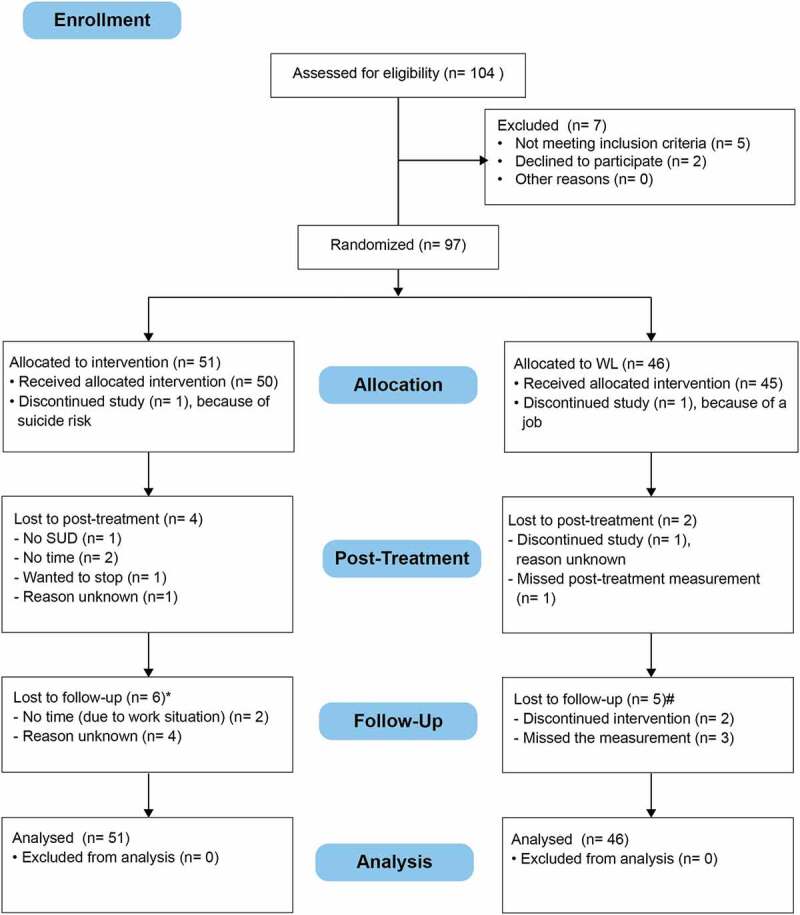
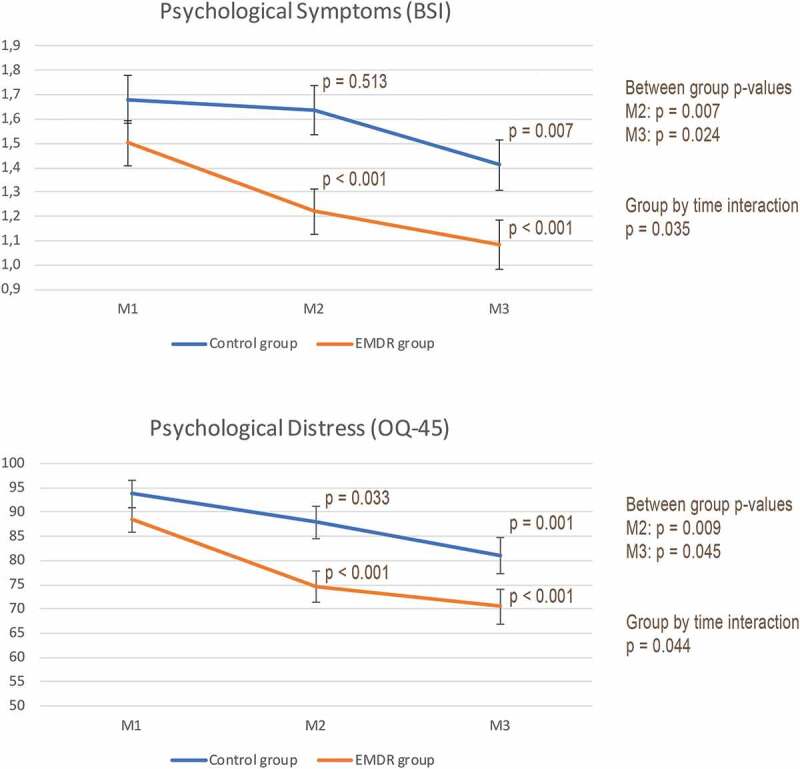
Background: Little is known about the effects of targeting memories of adverse (childhood) events in people with a personality disorder (PD). Objective: Determining the effectiveness of brief EMDR therapy in individuals with PD. Method: In a randomized-controlled trial, 97 outpatients with a PD as main diagnosis were allocated to either five (90 minutes) sessions of EMDR therapy (n = 51) or a waiting list (WL) control condition (n = 46) followed by 3 months of treatment as usual for their PD. Individuals with posttraumatic stress disorder (PTSD) were excluded. Measurements were performed on psychological symptoms, psychological distress, and personality dysfunctioning. Outcomes were compared at baseline, post-treatment, and at 3-month follow up. Data were analysed as intent-to-treat with linear mixed models. Results: EMDR therapy yielded significant improvements with medium to large effect sizes for the primary outcomes after treatment, i.e. psychological symptoms (EMDR: d =.42; control group: d =.07), psychological distress (EMDR: d =.69; control group: d =.29), and personality functioning (EMDR: d =.41; control group: d = −.10) within groups. At 3-month follow-up, after 3 months of TAU, improvements were maintained. Significant differences were found between both groups regarding all outcome measures in favour of the EMDR group at post-treatment (ds between −.62 and −.65), and at follow-up, after 3 months of TAU (ds between −.45 and −.53). Conclusions: The results suggest that EMDR therapy can be beneficial in the treatment of patients with PDs. More rigorous outcome research examining long-term effects and using a longer treatment track is warranted.
Overview
The claims and statistics of this paper haven’t been checked yet.
Free: it reads the open-access text and checks the first 5 claims that cite a source we can check. Create a free account to check every claim.
Integrity signals
Registry
Cites
Statistics
Figures
Verification
Claims the paper makes
The claims and statistics of this paper haven’t been checked yet.
Free: it reads the open-access text and checks the first 5 claims that cite a source we can check. Create a free account to check every claim.
Claims other papers make about this one
Each is checked against this paper’s own text: does it say what the citing paper says it does?
The source backs part of the claim, not all of it — or backs it for a different population, condition or comparison.
In the citing paper
“After 3 months, significant improvements with medium effect sizes were found for psychological symptoms, psychological distress, and personality functioning in the EMDR condition compared to the STAU condition”
From Timing of imagery rescripting during schema therapy for borderline personality disorder: the LUCY trial (2023) · cites this paper as [18]
Experimental — accuracy not yet measuredThe source backs part of the claim, not all of it — or backs it for a different population, condition or comparison.
In the citing paper
“early trauma treatment has a positive effect on the course of PD”
From Timing of imagery rescripting during schema therapy for borderline personality disorder: the LUCY trial (2023) · cites this paper as [18]
Experimental — accuracy not yet measuredThe source backs part of the claim, not all of it — or backs it for a different population, condition or comparison.
In the citing paper
“Trauma processing earlier in therapy might improve the effectiveness of ST, which might lead to shortening the treatment duration and thereby an increase in cost-effectiveness.”
From Timing of imagery rescripting during schema therapy for borderline personality disorder: the LUCY trial (2023) · cites this paper as [18]
Experimental — accuracy not yet measured
Self-check
Percentages, sums and reported differences re-computed from the paper’s own numbers.
The self-check needs the paper’s full text.
Citations
Cites
Sheehan, D., Lecrubier, Y., Harnett Sheehan, K., Janavs, J., Weiller, E., Keskiner, A., Schinka, J., Knapp, E., Sheehan, M., & Dunbar, G. (1997) · European Psychiatry · doi:10.1016/s0924-9338(97)83297-x · Cited by 2,149 · cited 2×
“PTSD was ruled out using the MINI International Neuropsychiatric Interview (Sheehan et al., 1997).”
MethodEye Movement Desensitization and Reprocessing: Basic Principles, Protocols, and Procedures
Shapiro, F. (1995) · Medical Entomology and Zoology · Cited by 1,529
The Use of Psychological Testing for Treatment Planning and Outcomes Assessment
(2004) · doi:10.4324/9781410610614 · Cited by 1,503
Axis I Comorbidity of Borderline Personality Disorder
Zanarini, M. C., Frankenburg, F. R., Dubo, E. D., Sickel, A. E., Trikha, A., Levin, A., & Reynolds, V. (1998) · American Journal of Psychiatry · doi:10.1176/ajp.155.12.1733 · Cited by 977 · cited 1×
“Given the prevalence rate of PTSD in patients diagnosed with PD other than BPD (e.g., 22%; Zanarini et al., 1998) it is likely that a considerable proportion of patients with a PD do not meet diagnostic criteria for PTSD.”
BackgroundBamelis, L. L. M., Evers, S. M. A. A., Spinhoven, P., & Arntz, A. (2014) · American Journal of Psychiatry · doi:10.1176/appi.ajp.2013.12040518 · Cited by 497
Battle, C. L., Shea, M. T., Johnson, D. M., Yen, S., Zlotnick, C., Zanarini, M. C., Sanislow, C. A., Skodol, A. E., Gunderson, J. G., Grilo, C. M., et al. (2004) · Journal of Personality Disorders · doi:10.1521/pedi.18.2.193.32777 · Cited by 465 · cited 1×
“Rates of childhood maltreatment among individuals with PDs are high, with 73% of their sample reporting abuse and 82% reporting neglect (Battle et al., 2004).”
BackgroundChildhood adversity and borderline personality disorder: a meta‐analysis
Porter, C., Palmier‐Claus, J., Branitsky, A., Mansell, W., Warwick, H., & Varese, F. (2020) · Acta Psychiatrica Scandinavica · doi:10.1111/acps.13118 · Cited by 450
The Economic Burden of Personality Disorders in Mental Health Care
Soeteman, D. I., Hakkaart-van Roijen, L., Verheul, R., & Busschbach, J. J. V. (2008) · The Journal of Clinical Psychiatry · doi:10.4088/jcp.v69n0212 · Cited by 417
KAPLAN, S. J., PELCOVITZ, D., & LABRUNA, V. (1999) · Journal of the American Academy of Child & Adolescent Psychiatry · doi:10.1097/00004583-199910000-00009 · Cited by 402
Harned, M. S., Korslund, K. E., & Linehan, M. M. (2014) · Behaviour Research and Therapy · doi:10.1016/j.brat.2014.01.008 · Cited by 388 · cited 2×
“A number of previous studies focused on the treatment of PTSD in patients with a PD as a comorbid disorder (e.g., Bovin et al., 2017; Harned 2013; Harned et al., 2014; Markowitz et al., 2015; Slotema et al., 2019) and found significant effects on symptoms of both PTSD and PD features.”
Research works printed but not linked: 3
- Harned, M. S. (2013). Treatment of posttraumatic stress dis order and comorbid borderline disorder. In Handbook of treating variants and complications in anxiety disorders (pp. 203-221). New York: Springer. doi:10.1007/978-146146458-714 · doi:10.1007/978-146146458-714
- 10.1007/978-14614-6458-714 · doi:10.1007/978-14614-6458-714
- Livesley, W. J. V. (2006). General assessment of personality disorder (GAPD) . BC: Department of Psychiatry, University of British Columbia.
Cited by
Treatment of Posttraumatic Stress Disorder: A State-of-the-art Review
Burback, L., Brémault-Phillips, S., Nijdam, M. J., McFarlane, A., & Vermetten, E. (2024) · Current Neuropharmacology · doi:10.2174/1570159x21666230428091433 · Cited by 208
EMDR as Treatment Option for Conditions Other Than PTSD: A Systematic Review
Scelles, C., & Bulnes, L. C. (2021) · Frontiers in Psychology · doi:10.3389/fpsyg.2021.644369 · Cited by 91
The Adaptive Information Processing Model: The Theoretical Framework for EMDR Therapy
Leeds, A. M. (2023) · Oxford University Press eBooks · doi:10.1093/oxfordhb/9780192898357.013.1 · Cited by 36
Kolthof, K. A., Voorendonk, E. M., van Minnen, A., & de Jongh, A. (2022) · European Journal of Psychotraumatology · doi:10.1080/20008066.2022.2143076 · Cited by 70
“Further, our treat-ment programme was provided on an inpatient basis, so it is not known whether these results can be generalised to outpatient treatment programmes, albeit that outpatient trauma-focussed treatment outcomes suggest similar results (Hafkemeijer et al., 2020).”
ResultTrauma‐focused treatment of a client with Complex PTSD and comorbid pathology using EMDR therapy
de Jongh, A., & Hafkemeijer, L. (2023) · Journal of Clinical Psychology · doi:10.1002/jclp.23521 · Cited by 56
“” This procedure has been found to be effective and yielded no negative consequences for the implementation and effect of EMDR therapy (Hafkemeijer et al., 2020).”
BackgroundMethodSelf-citationHafkemeijer, L., Starrenburg, A., van der Palen, J., Slotema, K., & de Jongh, A. (2021) · Journal of Clinical Medicine · doi:10.3390/jcm10194333 · Cited by 15
“Firstly, because this is a subanalysis of a treatment–outcome study [18], we did not conduct a power analysis.”
BackgroundInfluentialSelf-citationHofman, S., Hafkemeijer, L., de Jongh, A., Starrenburg, A., & Slotema, K. (2022) · Trials · doi:10.1186/s13063-022-06082-6 · Cited by 48
“56), without the occurrence of adverse events [33].”
BackgroundInfluentialSelf-citationAdding EMDR for PTSD at the onset of treatment of borderline personality disorder: A pilot study
Wilhelmus, B., Marissen, M. A. E., van den Berg, D. P. G., Driessen, A., Deen, M. L., & Slotema, K. (2023) · Journal of Behavior Therapy and Experimental Psychiatry · doi:10.1016/j.jbtep.2023.101834 · Cited by 17
de Jongh, A., Hafkemeijer, L., Hofman, S., Slotema, K., & Hornsveld, H. K. (2024) · Frontiers in Psychiatry · doi:10.3389/fpsyt.2024.1331876 · Cited by 49
Self-citationKoppeschaar, A., Bachrach, N., & Arntz, A. (2023) · Frontiers in Psychiatry · doi:10.3389/fpsyt.2023.1204439 · Cited by 9
“We hypothesize, in accordance with recent findings that show positive effects of early trauma treatment on the course of PD, that recovery from BPD (i.e., reduction of BPD severity) benefits from ImRs applied early in therapy (18).”
BackgroundResultInfluentialEMDR treatment in patients with personality disorders. Should we fear symptom exacerbation?
Hafkemeijer, L., de Jongh, A., Starrenburg, A., Hoekstra, T., & Slotema, K. (2024) · European Journal of Psychotraumatology · doi:10.1080/20008066.2024.2407222 · Cited by 13
“…treated with an intensive treatment track consisting of 16 treatment sessions within eight days, during which they received a combination of PE and EMDR therapy, did not find any indication of symptom exacerbation at the end of treatment or thereafter (De Jongh et al., 2020; Kolthof et al., 2022).”
InfluentialSelf-citationDaniëls, M., Meewisse, M., Nugter, A., Rameckers, S. A., Faßbinder, E., & Arntz, A. R. (2025) · European Journal of Psychotraumatology · doi:10.1080/20008066.2025.2454191 · Cited by 8
Hofman, S., Hafkemeijer, L., de Jongh, A., & Slotema, C. W. (2025) · JAMA Network Open · doi:10.1001/jamanetworkopen.2025.33421 · Cited by 7
Self-citationHafkemeijer, L., Slotema, K., de Haard, N., & de Jongh, A. (2023) · Frontiers in Psychiatry · doi:10.3389/fpsyt.2023.1283145 · Cited by 7
“To this end, in particular EMDR therapy has proven to be a useful and effective treatment for patients with PD who do not fulfill the diagnostic criteria for PTSD (21, 22, 26).”
BackgroundMethodResultInfluentialSelf-citationHafkemeijer, L., Hofman, S., de Jongh, A., de Roos, D., van Velzen, M., Starrenburg, A., & Slotema, K. (2025) · Psychotherapy and Psychosomatics · doi:10.1159/000547622 · Cited by 6
“However, a few case studies [16–18] and a randomized controlled trial (RCT) yielded promising results [19].”
Self-citationSeok, J., Kim, K., & Kim, J. U. (2025) · Frontiers in Psychiatry · doi:10.3389/fpsyt.2025.1660046 · Cited by 5
“In particular, EMDR has been shown to be effective not only for PTSD but also for various clinical populations, including major depressive disorder, anxiety disorders, somatic symptom and related disorders, and personality disorders (28 – 31).”
Tian, M., Xing, Q., Wang, X., Yuan, X., Cheng, X., Ming, Y., Yin, K., Li, Z., & Wang, P. (2024) · Psychology Research and Behavior Management · doi:10.2147/prbm.s450083 · Cited by 3
Feasibility of EMDR toward Personality Functioning in Older Adults with PTSD
Gielkens, E. M. J., Sobczak, S., Gerrits, N., Rosowsky, E., Stas, L., Rossi, G. M. P., & van Alphen, S. P. J. (2024) · Clinical Gerontologist · doi:10.1080/07317115.2024.2344793 · Cited by 4
“De Jongh et al. (2020) and Kolthof et al. (2022) reported a decrease in BPD-symptoms after intensive trauma-focused treatment program (including a combination of PE and EMDR) in adults with PTSD and (elevated symptoms of) BPD ( n = 35; M age = 38.9; De Jongh et al., 2020; n = 45; M age = 41.1;…”
InfluentialHofman, S., & Slotema, C. W. (2024) · Journal of Personality Disorders · doi:10.1521/pedi.2024.38.5.477 · Cited by 2
Rothwell-Blake, G. A. A., Stavropoulos, D., & Kotera, Y. (2025) · Discover Psychology · doi:10.1007/s44202-025-00339-2 · Cited by 1
Hummel, L., & Driessen, A. (2021) · Bohn Stafleu van Loghum eBooks · doi:10.1007/978-90-368-2632-7_10
EMDR: An Empirically Supported Therapy
McMullen, S., & Lee, C. W. (2024) · Oxford University Press eBooks · doi:10.1093/oxfordhb/9780192898357.013.47
van Hemert, M. T. C., de Jong, P. M., Brouwer, T. R., Gunst, E., Claes, L., & Morrens, M. (2025) · European Journal of Psychotraumatology · doi:10.1080/20008066.2025.2600873 · Cited by 2
“In EMDR therapy, the ‘blind to therapist’ procedure, where the therapist reassures the client that they do not need to share their trauma story but only focus on it, can help bypass shame (Hafkemeijer et al., 2020).”
A theory-driven rationale for EMDR therapy among patients with a personality disorder
Slotema, C. W., & de Jongh, A. (2026) · Frontiers in Psychology · doi:10.3389/fpsyg.2026.1905539
“The lowest drop-out rates (5% or less) were found in studies with the shortest treat-ment duration, namely 5 weeks or less (Hafkemeijer et al., 2020, 2025; De Jongh et al., 2020; Kolthof et al., 2022).”
Zisquit, ., Shorer, S., Levavi, Y., Shafir, A., Baht, N., Presman, N., & Simons, Y. (2026) · Journal of Traumatic Stress · doi:10.1002/jts.70120
La thérapie comportementale dialectique
Speranza, M., & Perroud, N. (2025) · Carrefour des psychothérapies · doi:10.3917/dbu.chiro.2025.01.0295
Metadata
- Authors
- Hafkemeijer, L., de Jongh, A., van der Palen, J., & Starrenburg, A.
- Affiliations
- GGZ Delfland (NL)
- Academic Centre for Dentistry Amsterdam (ACTA), University of Amsterdam and VU University Amsterdam, Amsterdam, The Netherlands
- Department of Research Methodology, Measurement and Data Analysis, University of Twente, Enschede & Department of Epidemiology, Medisch Spectrum Twente, Enschede, The Netherlands
- Corresponding author
- Hafkemeijer, Laurian
- Venue
- European Journal of Psychotraumatology
- Publisher
- Informa UK Limited
- Published
- 2020-11-19
- Volume
- 11
- Issue
- 1
- Pages
- 1838777-1838777
- ISSN
- 2000-8066 (ISSN-L)
- PMC
- PMC7755323
- OpenAlex
- W3103144719
- Semantic Scholar
- 030c248794526b6dece5abe42016e07553f416b8
- Cited by
- 26
- References
- 26
- Citations by year
- 2026: 2 · 2025: 7 · 2024: 6 · 2023: 6 · 2022: 2 · 2021: 3
- FWCI
- 1.10
- Type
- journal article
- Language
- en
- Open access
- gold
- doi.org
- Licence
- Locations
- European Journal of Psychotraumatology (publishedVersion, cc-by-nc)
- PubMed Central (publishedVersion, cc-by-nc)
- PubMed (publishedVersion)
- VU Research Portal (publishedVersion, other-oa)
- University of Twente Research Information (publishedVersion, cc-by-nc)
- Worcester Research and Publications (University of Worcester) (submittedVersion)
- DOAJ (DOAJ: Directory of Open Access Journals) (submittedVersion, cc-by-sa)
- University of Twente Research Information (submittedVersion, cc-by-nc)
- Data Archiving and Networked Services (DANS) (submittedVersion, other-oa)
- Funders
- Ad de Jongh, Soestdijkseweg Noord (333, 3723 HB)
- Topics
- Social Sciences › Psychology › Clinical Psychology › Personality Disorders and Psychopathology
- Social Sciences › Psychology › Clinical Psychology › Posttraumatic Stress Disorder Research
- Social Sciences › Psychology › Clinical Psychology › Psychotherapy Techniques and Applications
- Keywords
- EMDR, personality disorders, psychological distress, personality functioning, psychological symptoms, brief psychotherapy, usual care, waitlist control
About these checks
Registry, retraction, Cites and statistics results are computed, not judged, with one exception: a printed reference that no index lists is read once by a model before it counts as a citation error. Claims are extracted by a model and kept only when their quote appears verbatim in the text; each cited source is then checked, with a model’s help, for whether it says what the claim relies on. Those verdicts can be wrong — read the claim’s quote and the cited source before relying on one.
Statistics and arithmetic are recomputed, not judged.
Confidence bands are shown only for fields calibrated on our annotated test set. None is calibrated yet, so no band is shown.
What counts as a claim ›How we measure confidence ›How we check this ›
Are you an author, or do you see a problem with this page? Request a review
Data sources
Bibliographic data: Semantic Scholar, OpenAlex, Crossref.
Contains information from the Semantic Scholar Academic Graph Datasets, made available under the ODC Attribution License (ODC-BY 1.0).
Semantic Scholar’s data is described in: Kinney, R., et al. (2023). The Semantic Scholar Open Data Platform. arXiv:2301.10140.
