

Generous hosts: Why the larvae of greater wax moth, Galleria mellonella is a perfect infectious host model?
Open accessThe DOI matches its Crossref record; 31 of the 31 references it cites were found in a registry or an index.
Abstract
The larvae of the greater wax moth, Galleria mellonella (Lepidoptera: Pyralidae) has been used as a host and model system for many fungal and bacterial pathogens due to its reduced innate immune sy...
Overview
The claims and statistics of this paper haven’t been checked yet.
Free: it reads the open-access text and checks the first 5 claims that cite a source we can check. Create a free account to check every claim.
Integrity signals
Registry
Cites
Statistics
Figures
Verification
Claims the paper makes
The claims and statistics of this paper haven’t been checked yet.
Free: it reads the open-access text and checks the first 5 claims that cite a source we can check. Create a free account to check every claim.
Claims other papers make about this one
Each is checked against this paper’s own text: does it say what the citing paper says it does?
The source backs part of the claim, not all of it — or backs it for a different population, condition or comparison.
In the citing paper
“G. mellonella has a single innate immune system that is highly similar to the mammalian innate immune system [40,41]”
From The F 1 F o -ATP synthase α subunit of Candida albicans induces inflammatory responses by controlling amino acid catabolism (2023) · cites this paper as [40]
Experimental — accuracy not yet measuredThe cited source says what the claim attributes to it.
In the citing paper
“G. mellonella is a well-established model to study host immune responses induced by C. albicans [40,41].”
From The F 1 F o -ATP synthase α subunit of Candida albicans induces inflammatory responses by controlling amino acid catabolism (2023) · cites this paper as [40]
Self-check
Percentages, sums and reported differences re-computed from the paper’s own numbers.
The self-check needs the paper’s full text.
Citations
Cites
The Host Defense of Drosophila melanogaster
Lemaitre, B., & Hoffmann, J. (2007) · Annual Review of Immunology · doi:10.1146/annurev.immunol.25.022106.141615 · Cited by 3,324 · cited 1×
“and thus can give more insights about mammalian infection processes [5].”
BackgroundInsect Fat Body: Energy, Metabolism, and Regulation
Arrese, E. L., & Soulages, J. L. (2010) · Annual Review of Entomology · doi:10.1146/annurev-ento-112408-085356 · Cited by 2,514 · cited 1×
“FAs play a variety of roles in insect metabolism, especially in energy storage and demand [21], immunity [22], cell membrane structures [23] and hormone biosynthesis [12].”
BackgroundNew insights on trehalose: a multifunctional molecule
Elbein, A. D. (2003) · Glycobiology · doi:10.1093/glycob/cwg047 · Cited by 1,954 · cited 1×
“cal functions including carbon storage [24], direct utilization for glucose energy metabolism [11], as a cryo-”
BackgroundTsai, C. J.-Y., Loh, J. M. S., & Proft, T. (2016) · Virulence · doi:10.1080/21505594.2015.1135289 · Cited by 778 · cited 5×
“such as Escherichia coli, Pseudomonas aeruginosa, and Klebsiella pneumonia [1].”
BackgroundInfluentialPhloem-sap feeding by animals: problems and solutions
Douglas, A. E. (2006) · Journal of Experimental Botany · doi:10.1093/jxb/erj067 · Cited by 648
The Biochemistry of Insect Hemolymph
Wyatt, G. R. (1961) · Annual Review of Entomology · doi:10.1146/annurev.en.06.010161.000451 · Cited by 552
THE CHEMISTRY OF INSECT HEMOLYMPH
Wyatt, G. R., & Kalf, G. F. (1957) · The Journal of General Physiology · doi:10.1085/jgp.40.6.833 · Cited by 364 · cited 2×
“cal functions including carbon storage [24], direct utilization for glucose energy metabolism [11], as a cryo-”
BackgroundMethods for using Galleria mellonella as a model host to study fungal pathogenesis
Fuchs, B. B., O’Brien, E., El Khoury, J. B., & Mylonakis, E. (2010) · Virulence · doi:10.4161/viru.1.6.12985 · Cited by 308 · cited 1×
“mellonella an excellent infection model [9].”
The Insect Galleria mellonella as a Powerful Infection Model to Investigate Bacterial Pathogenesis
Ramarao, N., Nielsen-Leroux, C., & Lereclus, D. (2012) · Journal of Visualized Experiments · doi:10.3791/4392 · Cited by 277 · cited 1×
“mellonella, pathogens are injected to determine their LD50 and/or to monitor production of antimicrobial peptides (AMPs) such as defensin and lysozyme [2,3].”
BackgroundTHE CHEMISTRY OF INSECT HEMOLYMPH
Wyatt, G. R., Loughheed, T. C., & Wyatt, S. S. (1956) · The Journal of General Physiology · doi:10.1085/jgp.39.6.853 · Cited by 177
Cited by
Galleria mellonella –intracellular bacteria pathogen infection models: the ins and outs
Asai, M., Li, Y., Newton, S. M., Robertson, B. D., & Langford, P. R. (2023) · FEMS Microbiology Reviews · doi:10.1093/femsre/fuad011 · Cited by 84
“…pantothenate availability is sufficient for SAMTB replication and survival in G. mellonella, an insect, i.e. rich in these nutrients (Finke 2015, Killiny 2018), although their abundance may be insufficient to induce wild-type H37Rv level virulence as observed in the most optimal in vitro…”
BackgroundMicrobiology's next top model: Galleria in the molecular age
Dinh, H., Semenec, L., Kumar, S. S., Short, F. L., & Cain, A. K. (2021) · Pathogens and Disease · doi:10.1093/femspd/ftab006 · Cited by 62
Photorhabdus: a tale of contrasting interactions
Clarke, D. J. (2020) · Microbiology · doi:10.1099/mic.0.000907 · Cited by 51
Salamon, H., Nissim-Eliraz, E., Ardronai, O., Nissan, I., & Shpigel, N. Y. (2020) · Veterinary Research · doi:10.1186/s13567-020-00804-x · Cited by 36
Galleria mellonella as an infection model for the virulent Mycobacterium tuberculosis H37Rv
Asai, M., Li, Y., Spiropoulos, J., Cooley, W. A., Everest, D. J., Kendall, S. L., Martín, C., Robertson, B. D., Langford, P. R., & Newton, S. M. (2022) · Virulence · doi:10.1080/21505594.2022.2119657 · Cited by 24
“Previously, we hypothesized that the high abundance of Gm leucine and pantothenate [30,31] allowed SAMTB lux to bypass the double auxotrophy for optimal growth [12].”
Lizana, P., Mutis, A., Quiróz, A., & Venthur, H. (2022) · Frontiers in Physiology · doi:10.3389/fphys.2022.924750 · Cited by 25
“Nevertheless, it can be a model insect due to its ease of rearing and use as hosts for the study of pathogens (Killiny, 2018; Ménard et al., 2021).”
BackgroundSpochacz, M., Chowański, S., Szymczak, M., Marciniak, P., Lelario, F., Salvia, R., Nardiello, M., Scieuzo, C., Scrano, L., Bufo, S. A., et al. (2021) · Toxins · doi:10.3390/toxins13090617 · Cited by 21
Stączek, S., Zdybicka‐Barabas, A., Wojda, I., Wiater, A., Mak, P., Suder, P., Skrzypiec, K., & Cytryńska, M. (2021) · Molecules · doi:10.3390/molecules26165097 · Cited by 22
Hypervirulent Klebsiella pneumoniae detection methods: a minireview
Zhang, Q.-B., Zhu, P., Zhang, S., Rong, Y.-J., Huang, Z., Sun, L.-W., & Cai, T. (2023) · Archives of Microbiology · doi:10.1007/s00203-023-03665-y · Cited by 21
Mathur, C., Rao, U., Kushwah, J., Somvanshi, V. S., & Dutta, T. K. (2019) · Pesticide Biochemistry and Physiology · doi:10.1016/j.pestbp.2019.03.019 · Cited by 18
Evidence of hypervirulence in Listeria monocytogenes clonal complex 14
Cardenas-Alvarez, M. X., Ramsett, M. K. T., Malekmohammadi, S., & Bergholz, T. M. (2019) · Journal of Medical Microbiology · doi:10.1099/jmm.0.001076 · Cited by 15
Asai, M., Li, Y.-W., Spiropoulos, J., Cooley, W. A., Everest, D. J., Robertson, B. D., Langford, P. R., & Newton, S. M. (2020) · Virulence · doi:10.1080/21505594.2020.1781486 · Cited by 14
“91% of the total metabolome detected [22], and common insect feed for rearing G.”
BackgroundMucci, N. C., Jones, K. A., Cao, M., Wyatt, M. R., Foye, S., Kauffman, S., Richards, G. R., Taufer, M., Chikaraishi, Y., Steffan, S. A., et al. (2022) · mSystems · doi:10.1128/msystems.00312-22 · Cited by 15
“mellonella is used for laboratory isolation and propagation of EPNB, is a model host to understand virulence of a variety of microbial pathogens, and has a characterized metabolome (17).”
Background(2022) · International Journal of Veterinary Science · doi:10.47278/journal.ijvs/2022.192 · Cited by 11
Emery, H., Butt, T. M., & Coates, C. J. (2021) · Food and Chemical Toxicology · doi:10.1016/j.fct.2021.112354 · Cited by 10
Nguyen, T. T. H., Chen, P., Wang, P., Wang, W.-H., Lan, C., Backert, S., & Kao, M. (2025) · Virulence · doi:10.1080/21505594.2025.2548620 · Cited by 6
“G . mellonella has been used as an in vivo model over recent years to study the virulence of various Helicobacter species by determining the survival rate of larvae and viable bacteria in the hemolymph of larvae during a time course of infection [23,24].”
Li, Y., Peng, Y., Zhang, N., Liu, H., Mao, J., Yan, Y., Wang, S., Guang, Y., Liu, Y., Li, J., et al. (2022) · Infection and Drug Resistance · doi:10.2147/idr.s377848 · Cited by 4
Li, S., Liu, Y., Weng, L., Zhao, Y., Zhang, Y., Zhang, Z., Yang, Y., Chen, Q., Liu, X., & Zhang, H. (2023) · Virulence · doi:10.1080/21505594.2023.2190645 · Cited by 3
Wang, Y., Wang, K., Zhang, X., Wang, W., Qian, W., & Wang, F. (2024) · PLoS Pathogens · doi:10.1371/journal.ppat.1012533 · Cited by 5
Galleria mellonella (greater wax moth)
Areces-Berazain, F. (2022) · CABI Compendium · doi:10.1079/cabicompendium.24814 · Cited by 3
Effect of biotic and abiotic factors on the abundance of greater wax moth, Galleria mellonella L.
Borah, A., Koundal, S., & Gharde, S. K. (2024) · International Journal of Advanced Biochemistry Research · doi:10.33545/26174693.2024.v8.i7j.1587 · Cited by 2
“Researchers commonly employ them as a model organism due to their ease of handling, short life cycle, and their ability to host various pathogens (Killiny, 2018) [44] .”
Zhang, L.-H., Ren, S.-L., Su, Z.-Q., Xu, P., Ou, D., Wang, L., Sang, W., & Qiu, B. (2021) · Frontiers in Physiology · doi:10.3389/fphys.2021.777908 · Cited by 2
“Further studies indicated that the HLB pathogen may manipulate the synthesis pathway of FAAs in ACP to supplement the intermediate products lacking in the tricarboxylic acid cycle (Killiny, 2018; Killiny et al., 2018).”
BackgroundChemical ecology of an apex predator life cyclePreprint
Mucci, N. C., Jones, K. A., Cao, M., Wyatt, M. R., Foye, S., Kauffman, S., Taufer, M., Chikaraishi, Y., Steffan, S. A., Campagna, S. R., et al. (2021) · bioRxiv (Cold Spring Harbor Laboratory) · doi:10.1101/2021.02.13.430781 · Cited by 2
The transcription factor CgHaa1 plays a role in virulence of the pathogenic yeast Candida glabrata
Salazar, S. B., Pedro, N. A., Silva, S., Mil‐Homens, D., Pimenta, A. I., Włodarczyk, M., Szwed, A., Sasamoto, K., Chibana, H., Michlewska, S., et al. (2025) · FEMS Yeast Research · doi:10.1093/femsyr/foaf054
“The few characterizations made on the metabolites present in the hemolymph of G. mellonella do not report the presence of acetate (Killiny 2018 ) although other carboxylic acids are present (e.g. citric acid, fumaric acid or succinic acid).”
Killiny, N., Nehela, Y., Hijaz, F. M., Rashidi, M., & Jones, S. E. (2025) · Communications Biology · doi:10.1038/s42003-025-08802-5
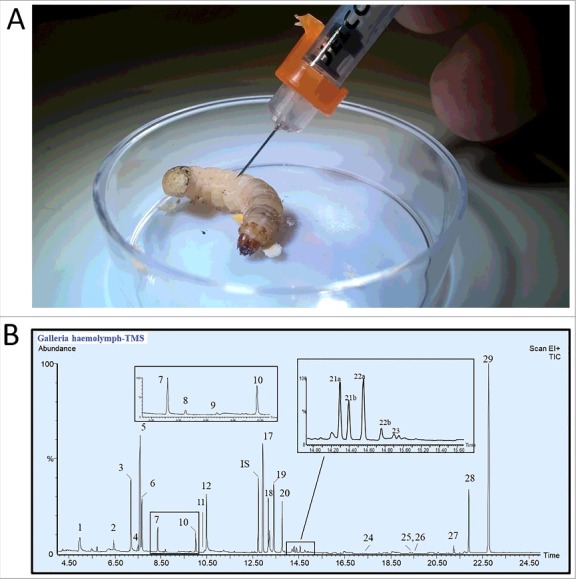
“For non-targeted metabolomics of haemolymph (MSTFA, MCF, and BF 3 ), as well as energy metabolism and nucleotide analysis by HPLC, the experiments were conducted using three independent biological replicates (each replicate contains fi ve larvae), and measured in duplicate (two technical replicates).”
InfluentialSelf-citationSpochacz, M., Chowański, S., Walkowiak‐Nowicka, K., Szymczak, M., & Adamski, Z. (2026) · Toxins · doi:10.3390/toxins18100410
“In G. mellonella , trehalose is a major circulating carbohydrate, while glucose, fructose, amino acids such as proline, and several sugar alcohols can also be detected in the hemolymph [14,19,20].”
Metadata
- Authors
- Killiny, N.
- Affiliations
- University of Florida (US)
- Corresponding author
- Killiny, Nabil
- ORCID
- Killiny, Nabil
- Venue
- Virulence
- Publisher
- Informa UK Limited
- Published
- 2018-05-04
- Volume
- 9
- Issue
- 1
- Pages
- 860-865
- ISSN
- 2150-5594 (ISSN-L)
- 2150-5608
- PMC
- PMC5955462
- OpenAlex
- W2799820434
- Cited by
- 25
- References
- 31
- Citations by year
- 2026: 1 · 2025: 3 · 2024: 2 · 2023: 3 · 2022: 5 · 2021: 6 · 2020: 3 · 2019: 2
- FWCI
- 1.18
- Type
- journal article
- Language
- en
- Open access
- gold
- doi.org
- Locations
- Virulence (publishedVersion, cc-by)
- Europe PMC (PubMed Central) (publishedVersion, cc-by)
- PubMed Central (publishedVersion, cc-by)
- PubMed (publishedVersion)
- DOAJ (DOAJ: Directory of Open Access Journals) (submittedVersion, cc-by-sa)
- Funders
- National Institute of Food and Agriculture (2016-70016-24844)
- Topics
- Life Sciences › Immunology and Microbiology › Immunology › Invertebrate Immune Response Mechanisms
- Life Sciences › Agricultural and Biological Sciences › Insect Science › Entomopathogenic Microorganisms in Pest Control
- Physical Sciences › Environmental Science › Health, Toxicology and Mutagenesis › Insects and Parasite Interactions
- Keywords
- Galleria mellonella, wax moth larvae, fungal pathogens, pathogenic bacteria, innate immunity, host-pathogen interaction, insect immunity
- MeSH terms
- Animals, Bacterial Infections, Disease Models, Animal, Humans, Larva, Moths
About these checks
Registry, retraction, Cites and statistics results are computed, not judged, with one exception: a printed reference that no index lists is read once by a model before it counts as a citation error. Claims are extracted by a model and kept only when their quote appears verbatim in the text; each cited source is then checked, with a model’s help, for whether it says what the claim relies on. Those verdicts can be wrong — read the claim’s quote and the cited source before relying on one.
Statistics and arithmetic are recomputed, not judged.
Confidence bands are shown only for fields calibrated on our annotated test set. None is calibrated yet, so no band is shown.
What counts as a claim ›How we measure confidence ›How we check this ›
Are you an author, or do you see a problem with this page? Request a review
Data sources
Bibliographic data: Semantic Scholar, OpenAlex, Crossref.
Contains information from the Semantic Scholar Academic Graph Datasets, made available under the ODC Attribution License (ODC-BY 1.0).
Semantic Scholar’s data is described in: Kinney, R., et al. (2023). The Semantic Scholar Open Data Platform. arXiv:2301.10140.
