

Economic burden of relapse/recurrence in patients with major depressive disorder
Open accessThe DOI matches its Crossref record; 23 of the 23 references it cites were found in a registry or an index.
Abstract
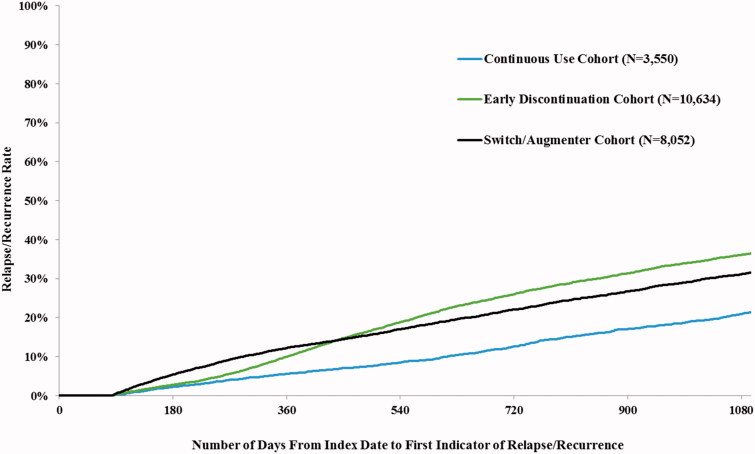
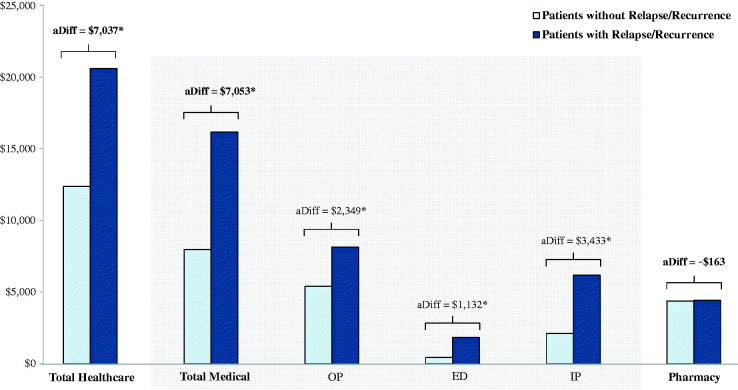
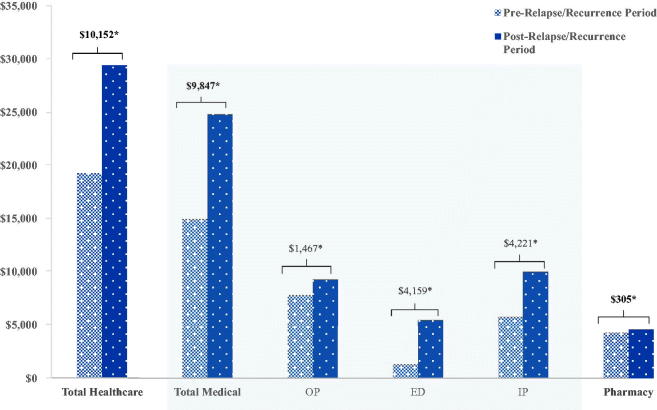
Objective: This study was conducted to determine the incremental healthcare resource utilization (HRU) and costs associated with relapse or recurrence (R/R) in patients with major depressive disorder (MDD) treated with antidepressants (AD) in US clinical practice.Methods: In this retrospective cohort study, adult patients with MDD treated with a branded AD were selected from the Truven Health Analytics MarketScan Databases (January 1, 2004–March 31, 2015). Time to first indicator of R/R was described. Characteristics, HRU, and costs were compared between patients with and without R/R. Among patients with R/R, HRU and costs were also compared between the pre- and post-R/R period.Results: From the 22,236 selected patients, 5,541 had ≥ 1 indicator of R/R and 16,695 did not. The 3-year R/R rate varied between 21.3% and 36.4% based on pattern of AD use (continuous, switch/augmentation, or early discontinuation). Patients with and without R/R presented different characteristics—notably, more intensive prior AD use and a higher comorbidity burden. HRU and costs were high in both patients with and without R/R but substantially higher among those with R/R ($20,590 vs $12,368 per-patient-per-year (PPPY); adjusted difference [aDiff] = $7,037), mainly driven by increased inpatient (IP) services (adjusted incidence rate ratio IP days = 3.95; aDiff IP costs = $3,433 PPPY). Among patients with R/R, emergency department visits, IP days, and IP admissions were over 2-times higher during the post-R/R period and total costs increased by over 50% from $19,267 to $29,419 in the post-R/R period.Conclusions: The economic burden in MDD patients is substantial, but is significantly higher among those who experience R/R.
Overview
The claims and statistics of this paper haven’t been checked yet.
Free: it reads the open-access text and checks the first 5 claims that cite a source we can check. Create a free account to check every claim.
Integrity signals
Registry
Cites
Statistics
Figures
Verification
Claims the paper makes
The claims and statistics of this paper haven’t been checked yet.
Free: it reads the open-access text and checks the first 5 claims that cite a source we can check. Create a free account to check every claim.
Claims other papers make about this one
Each is checked against this paper’s own text: does it say what the citing paper says it does?
The cited source says what the claim attributes to it.
In the citing paper
“Patients with a history of relapse have a more complex MDD profile (2)”
From Administrative criteria in the relapse of depressive disorder: a critical appraisal (2026) · cites this paper as [2]
The cited source says what the claim attributes to it.
In the citing paper
“Regarding the administrative criteria that have been established, the one mentioned in the largest number of articles is hospitalization, being mentioned in 42 of the 51 (82,3%) articles included in the review (1, 2, 4–7, 9–17, 19–21, 23–31, 34, 35, 41–45, 47–52, 54, 55).”
From Administrative criteria in the relapse of depressive disorder: a critical appraisal (2026) · cites this paper as [2]
Self-check
Percentages, sums and reported differences re-computed from the paper’s own numbers.
The self-check needs the paper’s full text.
Citations
Cites
Coding algorithms for defining comorbidities in ICD-9-CM and ICD-10 administrative data
Quan, H., Sundararajan, V., Halfon, P., Fong, A., Burnand, B., Luthi, J.-C., Saunders, L. D., Beck, C. A., Feasby, T. E., & Ghali, W. A. (2005) · Medical Care · doi:10.1097/01.mlr.0000182534.19832.83 · Cited by 10,669
Scoville, W. B. (1949) · Journal of neurosurgery · doi:10.3171/jns.1949.6.1.0065 · Cited by 7,381
Quan, H., Li, B., Couris, C. M., Fushimi, K., Graham, P., Hider, P., Januel, J.-M., & Sundararajan, V. (2011) · American Journal of Epidemiology · doi:10.1093/aje/kwq433 · Cited by 5,843
Ferrari, A. J., Charlson, F. J., Norman, R. E., Patten, S. B., Freedman, G., Murray, C. J. L., Vos, T., & Whiteford, H. A. (2013) · PLoS Medicine · doi:10.1371/journal.pmed.1001547 · Cited by 3,115
The Economic Burden of Adults With Major Depressive Disorder in the United States (2005 and 2010)
Greenberg, P. E., Fournier, A.-A., Sisitsky, T., Pike, C. T., & Kessler, R. C. (2015) · The Journal of Clinical Psychiatry · doi:10.4088/jcp.14m09298 · Cited by 1,779
Risk for recurrence in depression
Burcusa, S. L., & Iacono, W. G. (2007) · Clinical Psychology Review · doi:10.1016/j.cpr.2007.02.005 · Cited by 1,023
Report by the ACNP Task Force on Response and Remission in Major Depressive Disorder
Rush, A. J., Kraemer, H. C., Sackeim, H. A., Fava, M., Trivedi, M. H., Frank, E., Ninan, P. T., Thase, M. E., Gelenberg, A. J., Kupfer, D. J., et al. (2006) · Neuropsychopharmacology · doi:10.1038/sj.npp.1301131 · Cited by 707
A Tipping Point for Measurement-Based Care
Fortney, J. C., Unützer, J., Wrenn, G., Pyne, J. M., Smith, G. R., Schoenbaum, M., & Harbin, H. T. (2017) · Psychiatric Services · doi:10.1176/appi.ps.201500439 · Cited by 558
National Institute of Mental Health (NIMH)
(2008) · Encyclopedia of Global Health · doi:10.4135/9781412963855.n834 · Cited by 348
Cognitive and neurological impairment in mood disorders
Marvel, C. L., & Paradiso, S. (2004) · Psychiatric Clinics of North America · doi:10.1016/s0193-953x(03)00106-0 · Cited by 256 · cited 5×
“For a more comprehensive assessment of HRU and costs associated with R/R, two approaches were used: HRU and costs were compared (1) between patients with and without R/R (inter-patient analysis), and (2) between the periods preceding and following the first indicator of R/R, for patients with R/R (intra-patient analys…”
MethodInfluential
Cited by
Chronic mild stress paradigm as a rat model of depression: facts, artifacts, and future perspectives
Strekalova, T., Liu, Y., Kiselev, D., Khairuddin, S., Chiu, J. L. Y., Lam, J., Chan, Y.-S., Pavlov, D., Proshin, A., Lesch, K.-P., et al. (2022) · Psychopharmacology · doi:10.1007/s00213-021-05982-w · Cited by 141
“experience MDD over the course of a lifetime (Hasin et al. 2018; Gauthier et al. 2019).”
BackgroundForbes, A., Keleher, M. R., Venditto, M., & DiBiasi, F. (2023) · Journal of Medical Internet Research · doi:10.2196/43727 · Cited by 94
“Patients with MDD incur even higher medical costs and health care resource use when they experience relapse or recurrence [14].”
Predicting relapse or recurrence of depression: systematic review of prognostic models
Moriarty, A. S., Meader, N., Snell, K. I. E., Riley, R. D., Paton, L. W., Dawson, S., Hendon, J., Chew-Graham, C. A., Gilbody, S., Churchill, R., et al. (2022) · The British Journal of Psychiatry · doi:10.1192/bjp.2021.218 · Cited by 71
“The economic burden of depression is higher in those who experience relapse or recurrence than in those who do not 46 and, although interventions to prevent relapse or recurrence of depression (including pharmacological and psychological approaches) can be resource-intensive, they are effective 47…”
Ethical Concerns about Psilocybin Intellectual Property
Gerber, K., Flores, I. G., Ruiz, A. C., Ali, I. L., Ginsberg, N. L., & Schenberg, E. E. (2021) · ACS Pharmacology & Translational Science · doi:10.1021/acsptsci.0c00171 · Cited by 68
Predicting relapse or recurrence of depression: A systematic review of prognostic models
Moriarty, A. S., Meader, N., Snell, K. I. E., Riley, R. D., Paton, L. W., Dawson, S., Hendon, J., Chew-Graham, C. A., Gilbody, S. M., Churchill, R. C., et al. (2022) · White Rose Research Online (University of Leeds, The University of Sheffield, University of York) · Cited by 44
Sumiyoshi, T., Watanabe, K., Noto, S., Sakamoto, S., Moriguchi, Y., Hammer-Helmich, L., & Fernandez, J. L. (2021) · Neuropsychiatric Disease and Treatment · doi:10.2147/ndt.s288108 · Cited by 37
“wellbeing but also overall economic burden, which worsens on relapse or recurrence.(29) The strength of the PERFORM studies, including PERFORM-J, relates to the real-world settings and long-”
Strekalova, T. V., Pavlov, D., Трофимов, А. Н., Anthony, D. C., Svistunov, A. A., Proshin, A. T., Umriukhin, A., Lyundup, A. V., Lesch, K., & Cespuglio, R. (2022) · International Journal of Molecular Sciences · doi:10.3390/ijms23042061 · Cited by 32
Effect of mood and anxiety disorders on health care utilization in multiple sclerosis
Marrie, R. A., Walld, R., Bolton, J. M., Sareen, J., Patten, S. B., Singer, A. G., Lix, L. M., Hitchon, C. A., El-Gabalawy, R. M., Katz, A., et al. (2020) · Multiple Sclerosis Journal · doi:10.1177/1352458520963880 · Cited by 25
Touya, M., Lawrence, D. F., Kangethe, A., Chrones, L., Evangelatos, T., & Polson, M. (2022) · BMC Psychiatry · doi:10.1186/s12888-022-03793-7 · Cited by 21
“greater comorbidities (including higher rates of anxiety disorders), and higher rates of inpatient admissions and ED visits at baseline, suggesting that these patients faced a higher risk of relapse and recurrence [13].”
BackgroundResultOetzmann, C., White, K. M., Ivan, A., Julie, J., Leightley, D., Lavelle, G., Lamers, F., Siddi, S., Annas, P., Arranz, S., et al. (2022) · npj Digital Medicine · doi:10.1038/s41746-022-00680-z · Cited by 22
Ju, Y., Wang, M., Liu, J., Liu, B., Yan, D., Lu, X., Sun, J., Dong, Q., Zhang, L., Guo, H., et al. (2022) · Psychological Medicine · doi:10.1017/s0033291722002628 · Cited by 26
“Treatment non-response and recurrence were reportedly the main contributors to the disease burden in patients with MDD (Dennehy et al., 2015; Gauthier, Mucha, Shi, & Guerin, 2019; Touya et al., 2022).”
A Lightweight Machine Learning Approach to Detect Depression from Speech Analysis
Verde, L., Raimo, G., Vitale, F., Carbonaro, B., Cordasco, G., Marrone, S., & Esposito, A. A. (2021) · IEEE International Conference on Tools with Artificial Intelligence (ICTAI) · doi:10.1109/ictai52525.2021.00054 · Cited by 21
White, K. M., Dawe‐Lane, E., Siddi, S., Lamers, F., Simblett, S. K., Alacid, G. R., Ivan, A., Myin‐Germeys, I., Haro, J. M., Oetzmann, C., et al. (2023) · JMIR Human Factors · doi:10.2196/39479 · Cited by 19
“The economic burden of MDD is currently estimated at US $326 billion [3], with high recurrence associated with increased comorbidity burden and health care resource use [4].”
BackgroundTeutenberg, L., Stein, F., Thomas‐Odenthal, F., Usemann, P. L., Brosch, K., Winter, N. R., Goltermann, J., Leenings, R., Konowski, M., Barkhau, C., et al. (2025) · Journal of Affective Disorders · doi:10.1016/j.jad.2025.01.060 · Cited by 17
Hitchon, C. A., Walld, R., PESCHKEN, C. A., Bernstein, C. N., Bolton, J. M., El-Gabalawy, R. M., Fisk, J. D., Katz, A., Lix, L. M., Marriott, J. J., et al. (2020) · Arthritis Care & Research · doi:10.1002/acr.24386 · Cited by 16
“For each year, an individual was considered an annual prevalent psychiatric case (hereinafter referred to as “active”) if there were ≥2 physician claims or 1 hospital claim for the psychiatric disorder in that year; for hospital claims, the disorder had to be the diagnosis most responsible for admission, that is, cons…”
BackgroundMethodResultInfluentialYan, W., Xie, L., Bi, Y., Zeng, T., Zhao, D., Lai, Y., Gao, T., Sun, X., Shi, Y., Dong, Z., et al. (2021) · Clinical and Translational Medicine · doi:10.1002/ctm2.541 · Cited by 10
RetractedTagliaferri, S. D., Han, L. K. M., Khetan, M., Nguyen, J., Markulev, C., Rice, S., Cotton, S., Berk, M., Byrne, E. M., Rickwood, D., et al. (2025) · Journal of the American Academy of Child & Adolescent Psychiatry · doi:10.1016/j.jaac.2025.03.019 · Cited by 15
Hain, D. T., Tredici, A. L. D., Griggs, R. B., Law, R. A., Mabey, B., Johnson, H. L., Taber, K. J., Lynch, K. G., Gutin, A., & Oslin, D. W. (2025) · Frontiers in Pharmacology · doi:10.3389/fphar.2025.1658616 · Cited by 10
“Reduction in relapse and incidence of treatment-resistant depression, driven by faster remission, is also predicted to reduce healthcare costs (Gauthier et al., 2019; Li et al., 2020; Touya et al., 2022).”
White, K. M., Matcham, F., Leightley, D., Carr, E., Conde, P., Dawe‐Lane, E., Ranjan, Y., Simblett, S. K., Henderson, C., & Hotopf, M. H. (2021) · JMIR Research Protocols · doi:10.2196/32653 · Cited by 8
“The economic burden of MDD is currently estimated at US $326 billion [6], with increased risks of comorbidities and health care use associated with high relapse rates [7].”
BackgroundMoriarty, A. S., Paton, L. W., Snell, K. I. E., Archer, L., Riley, R. D., Buckman, J. E. J., Chew-Graham, C. A., Gilbody, S. M., Ali, S., Pilling, S., et al. (2024) · BMJ Mental Health · doi:10.1136/bmjment-2024-301226 · Cited by 4
Teigland, C. L., Mohammadi, I., Agatep, B. C., Boskovic, D. H., & Velligan, D. I. (2024) · Journal of Managed Care & Specialty Pharmacy · doi:10.18553/jmcp.2024.30.9.978 · Cited by 8
Kalaria, S. N., Spence, O., Hong, K., dosReis, S., & Gopalakrishnan, M. (2021) · Clinical Pharmacology & Therapeutics · doi:10.1002/cpt.2249 · Cited by 3
“The inability to control depression can have substantial medical, financial, and social consequences for patients with major depressive disorder, especially for those who experience remission on a particular therapeutic regimen.(14) The poor performance of generic antidepressants could be attributed to the temporal re…”
BackgroundChallenges of Care in Patients with Severe Mental Disorders: An Integrative Review
Saber, S., & Kianian, T. (2023) · Knowledge of Nursing Journal · doi:10.61186/knjournal.1.3.238 · Cited by 1
Stimpson, K. H., Feyder, M. T., Maron‐Katz, A., Kiris, E., Ford, T. J., Carreon, D. M., DeSouza, D. D., Cole, E. J., Meng, N. F., Williams, N., et al. (2025) · Transcranial magnetic stimulation . · doi:10.1016/j.transm.2025.100203 · Cited by 2
Premchand, B., Kothari, N., Tay, I. Q., Shah, K., Mok, Y. M., Kuek, J. H. L., Lim, W. O., & Ang, K. K. (2026) · Applied Sciences · doi:10.3390/app16073582 · Cited by 1
Moriarty, A. S., Robertson, L., Mughal, F., Cook, N., Gilbody, S. M., McMillan, D., Chew-Graham, C. A., Ali, S., Hetrick, S. E., Churchill, R. C., et al. (2021) · Cochrane Database of Systematic Reviews · doi:10.1002/14651858.cd014832 · Cited by 3
“The economic burden of depression is also significantly higher in those who experience a relapse or recurrence compared to those who do not (Gauthier 2019).”
BackgroundWhite, K. M., Dawe‐Lane, E., Siddi, S., Lamers, F., Simblett, S. K., Alacid, G. R., Ivan, A., Myin‐Germeys, I., Haro, J. M., Oetzmann, C., et al. (2022) · Research Square · doi:10.21203/rs.3.rs-1622706/v1 · Cited by 1
Трофимов, А. Н. (2024) · Research Publications (Maastricht University) · doi:10.26481/dis.20240205at · Cited by 1
Administrative criteria in the relapse of depressive disorder: a critical appraisal
Bernal-Cueto, S., Cegla-Schvartzman, F., & Baca-García, E. (2026) · Frontiers in Psychiatry · doi:10.3389/fpsyt.2026.1796386
“Patients with a history of relapse have a more complex MDD pro fi le (2), and it is well studied that patients who experience relapses consume a greater amount of health resources, which translates into a higher annual cost both in total and in relation to MDD (1).”
Asnaani, A. (2023) · Oxford University Press eBooks · doi:10.1093/oso/9780197635971.005.0004
Ahn, J., Noh, S., Yang, X., & Kim, K. (2024) · Health · doi:10.4236/health.2024.1611072
Inconsistency of Antidepressant Prescription for Anxiety and Depression Among U.S. Older AdultsPreprint
Gain, E. P., Yu, X., Kedia, S., Naser, A. M., Ajoku, M. J., & Mou, X. (2025) · SSRN Electronic Journal · doi:10.2139/ssrn.5162665
Müller, S., Keller, A., Wagner, T., & Hoffmann, L. (2021) · Specialty journal of Pharmacognosy Phytochemistry and Biotechnology · doi:10.51847/zgnkximaii
Transformation of the clinic: Data-driven pre-emption of disease and the politics of health
van Dijk, N., & Sideri, K. (2026) · Big Data & Society · doi:10.1177/20539517261455603
“The relapse of patients into episodes of depression presents a signi fi cant economic burden for the hospital budget (Gauthier et al., 2019).”
Xing, J., Jiang, Z., Jing, X., Li, Y., Guo, F., Liu, P., Liu, Z., & Sun, N. (2026) · Annals of General Psychiatry · doi:10.1186/s12991-026-00686-x
“Its clinical features significantly lower patients’ quality of life and place a major socioeconomic burden on families and society [1, 2].”
Multimodal Machine Learning–Based Prediction of Relapse in Major Depressive Disorder
Teutenberg, L., Winter, N. R., Usemann, P. L., Stein, F., Thomas‐Odenthal, F., Flinkenflügel, K., Borgers, T., Meinert, S., Leehr, E. J., Grotegerd, D., et al. (2026) · JAMA Psychiatry · doi:10.1001/jamapsychiatry.2026.3232
Metadata
- Authors
- Gauthier, G., Mucha, L., Shi, S., & Guerin, A.
- Affiliations
- Analysis Group, Inc, Montreal, Canada;
- Takeda (United States) (US)
- ORCID
- Mucha, Lisa
- Venue
- Journal of Drug Assessment
- Publisher
- Informa UK Limited
- Published
- 2019-01-01
- Volume
- 8
- Issue
- 1
- Pages
- 97-103
- ISSN
- 1369-9474 (ISSN-L)
- 2155-6660
- PMC
- PMC6542183
- OpenAlex
- W2942805562
- Cited by
- 36
- References
- 23
- Citations by year
- 2026: 5 · 2025: 5 · 2024: 4 · 2023: 4 · 2022: 8 · 2021: 8 · 2020: 2
- FWCI
- 2.79
- Type
- journal article
- Language
- en
- Open access
- hybrid
- doi.org
- Licence
- Locations
- Journal of Drug Assessment (publishedVersion, cc-by-nc)
- PubMed Central (publishedVersion, cc-by-nc)
- PubMed (publishedVersion)
- Funders
- Takeda Pharmaceutical Center USA
- Topics
- Health Sciences › Medicine › Pharmacology (medical) › Treatment of Major Depression
- Health Sciences › Medicine › Psychiatry and Mental health › Mental Health Treatment and Access
- Social Sciences › Economics, Econometrics and Finance › Economics and Econometrics › Health Systems, Economic Evaluations, Quality of Life
- Keywords
- major depressive disorder, relapse and recurrence, antidepressants, healthcare resource utilization, health care costs, inpatient services, emergency department visits, antidepressant discontinuation, comorbidities, economic burden
About these checks
Registry, retraction, Cites and statistics results are computed, not judged, with one exception: a printed reference that no index lists is read once by a model before it counts as a citation error. Claims are extracted by a model and kept only when their quote appears verbatim in the text; each cited source is then checked, with a model’s help, for whether it says what the claim relies on. Those verdicts can be wrong — read the claim’s quote and the cited source before relying on one.
Statistics and arithmetic are recomputed, not judged.
Confidence bands are shown only for fields calibrated on our annotated test set. None is calibrated yet, so no band is shown.
What counts as a claim ›How we measure confidence ›How we check this ›
Are you an author, or do you see a problem with this page? Request a review
Data sources
Bibliographic data: Semantic Scholar, OpenAlex, Crossref.
Contains information from the Semantic Scholar Academic Graph Datasets, made available under the ODC Attribution License (ODC-BY 1.0).
Semantic Scholar’s data is described in: Kinney, R., et al. (2023). The Semantic Scholar Open Data Platform. arXiv:2301.10140.
