

Helicobacter pylori serology is associated with worse overall survival in patients with melanoma treated with immune checkpoint inhibitors
Open accessThe DOI matches its Crossref record; 41 of the 41 references it cites were found in a registry or an index.
Abstract
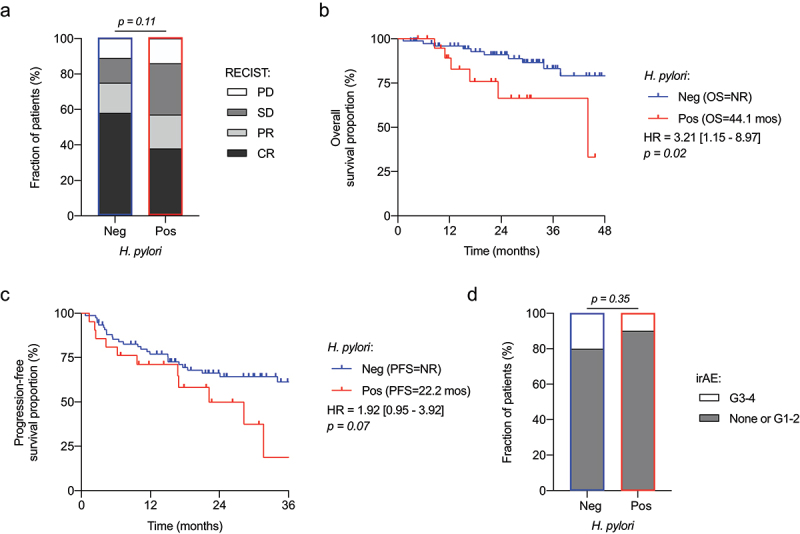
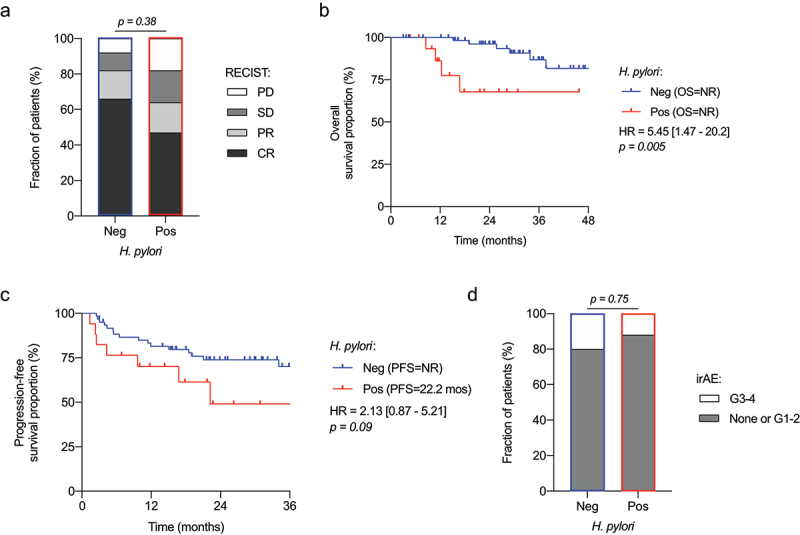
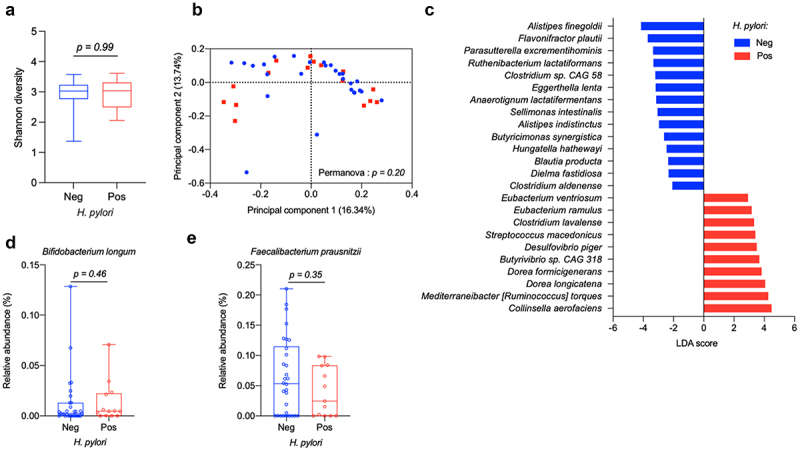
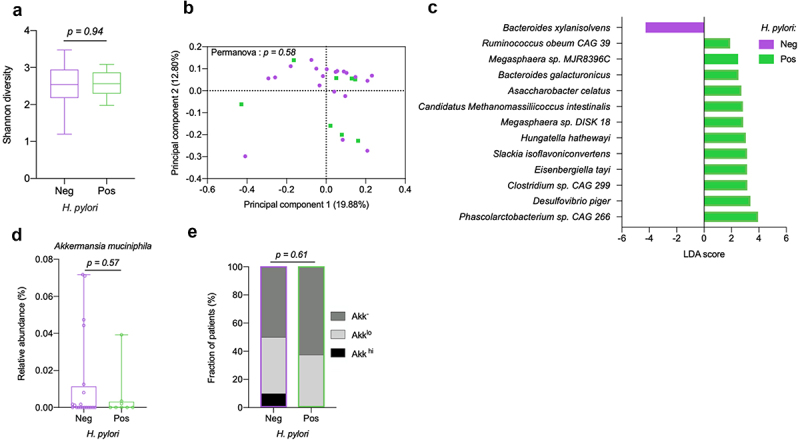
The microbiome is now regarded as one of the hallmarks of cancer and several strategies to modify the gut microbiota to improve immune checkpoint inhibitor (ICI) activity are being evaluated in clinical trials. Preliminary data regarding the upper gastro-intestinal microbiota indicated that Helicobacter pylori seropositivity was associated with a negative prognosis in patients amenable to ICI. In 97 patients with advanced melanoma treated with ICI, we assessed the impact of H. pylori on outcomes and microbiome composition. We performed H. pylori serology and profiled the fecal microbiome with metagenomics sequencing. Among the 97 patients, 22% were H. pylori positive (Pos). H. pylori Pos patients had a significantly shorter overall survival (p = .02) compared to H. pylori negative (Neg) patients. In addition, objective response rate and progression-free survival were decreased in H. pylori Pos patients. Metagenomics sequencing did not reveal any difference in diversity indexes between the H. pylori groups. At the taxa level, Eubacterium ventriosum, Mediterraneibacter (Ruminococcus) torques, and Dorea formicigenerans were increased in the H. pylori Pos group, while Alistipes finegoldii, Hungatella hathewayi and Blautia producta were over-represented in the H. pylori Neg group. In a second independent cohort of patients with NSCLC, diversity indexes were similar in both groups and Bacteroides xylanisolvens was increased in H. pylori Neg patients. Our results demonstrated that the negative impact of H. pylori on outcomes seem to be independent from the fecal microbiome composition. These findings warrant further validation and development of therapeutic strategies to eradicate H. pylori in immuno-oncology arena.
Overview
The claims and statistics of this paper haven’t been checked yet.
Free: it reads the open-access text and checks the first 5 claims that cite a source we can check. Create a free account to check every claim.
Integrity signals
Registry
Cites
Statistics
Figures
Verification
Claims the paper makes
The claims and statistics of this paper haven’t been checked yet.
Free: it reads the open-access text and checks the first 5 claims that cite a source we can check. Create a free account to check every claim.
Claims other papers make about this one
Each is checked against this paper’s own text: does it say what the citing paper says it does?
The source backs part of the claim, not all of it — or backs it for a different population, condition or comparison.
In the citing paper
“In the context of ICIs, three retrospective studies demonstrated that the presence of circulating anti-H. pylori antibodies is associated with resistance to immunotherapy in patients with non-small cell lung cancer (NSCLC), melanoma, and gastric cancer.”
From Melanoma and microbiota: Current understanding and future directions (2024) · cites this paper as [66]
Experimental — accuracy not yet measured
Self-check
Percentages, sums and reported differences re-computed from the paper’s own numbers.
The self-check needs the paper’s full text.
Citations
Cites
Basic local alignment search tool
Altschul, S. F., Gish, W., Miller, W., Myers, E. W., & Lipman, D. J. (1990) · Journal of Molecular Biology · doi:10.1006/jmbi.1990.9999 · Cited by 98,669
Self-citationFast gapped-read alignment with Bowtie 2
Langmead, B., & Salzberg, S. L. (2012) · Nature Methods · doi:10.1038/nmeth.1923 · Cited by 56,400
PD-1 and PD-L1 Immune Checkpoint Blockade to Treat Breast Cancer
Hartkopf, A. D., Taran, F.-A., Wallwiener, M., Walter, C. B., Krämer, B., Grischke, E.-M., & Brucker, S. Y. (2016) · Breast Care · doi:10.1159/000453569 · Cited by 30,845
New response evaluation criteria in solid tumours: revised RECIST guideline (version 1.1)
Eisenhauer, E. A., Therasse, P., Bogaerts, J., Schwartz, L. H., Sargent, D., Ford, R., Dancey, J., Arbuck, S., Gwyther, S., Mooney, M., et al. (2009) · European Journal of Cancer · doi:10.1016/j.ejca.2008.10.026 · Cited by 29,534 · cited 1×
“1.(20) Immune related-adverse events (irAEs) were recorded according to CTCAE v5.”
Methodphyloseq: An R Package for Reproducible Interactive Analysis and Graphics of Microbiome Census Data
McMurdie, P. J., & Holmes, S. (2013) · PLoS ONE · doi:10.1371/journal.pone.0061217 · Cited by 21,322
Hallmarks of Cancer: New Dimensions
Hanahan, D. (2022) · Cancer Discovery · doi:10.1158/2159-8290.cd-21-1059 · Cited by 9,887
Gut microbiome influences efficacy of PD-1-based immunotherapy against epithelial tumors
Routy, B., Le Chatelier, E., Derosa, L., Duong, C. P. M., Alou, M. T., Daillère, R., Fluckiger, A., Messaoudene, M., Rauber, C., Roberti, M. P., et al. (2018) · Science · doi:10.1126/science.aan3706 · Cited by 5,671
Self-citationNivolumab in Previously Untreated Melanoma without BRAF Mutation
Robert, C., Long, G. V., Brady, B., Dutriaux, C., Maio, M., Mortier, L., Hassel, J. C., Rutkowski, P., McNeil, C., Kalinka-Warzocha, E., et al. (2015) · New England Journal of Medicine · doi:10.1056/nejmoa1412082 · Cited by 5,519 · cited 1×
“Despite improved outcomes with these new therapies, there is a need to develop robust biomarkers to adequately predict primary resistance, which occurs in 24–40% of patients.(2,3) Several intrinsic and extrinsic tumor factors such as PD-L1 expression, tumor – infiltrating lymphocytes, and neoantigens have been evaluat…”
BackgroundSelf-citationOverall Survival with Combined Nivolumab and Ipilimumab in Advanced Melanoma
Wolchok, J. D., Chiarion-Sileni, V., Gonzalez, R., Rutkowski, P., Grob, J.-J., Cowey, C. L., Lao, C. D., Wagstaff, J., Schadendorf, D., Ferrucci, P. F., et al. (2017) · New England Journal of Medicine · doi:10.1056/nejmoa1709684 · Cited by 5,357
Five-Year Survival with Combined Nivolumab and Ipilimumab in Advanced Melanoma
Larkin, J., Chiarion-Sileni, V., Gonzalez, R., Grob, J.-J., Rutkowski, P., Lao, C. D., Cowey, C. L., Schadendorf, D., Wagstaff, J., Dummer, R., et al. (2019) · New England Journal of Medicine · doi:10.1056/nejmoa1910836 · Cited by 3,723 · cited 1×
“Despite improved outcomes with these new therapies, there is a need to develop robust biomarkers to adequately predict primary resistance, which occurs in 24–40% of patients.(2,3) Several intrinsic and extrinsic tumor factors such as PD-L1 expression, tumor – infiltrating lymphocytes, and neoantigens have been evaluat…”
BackgroundUNIDENTIFIED CURVED BACILLI ON GASTRIC EPITHELIUM IN ACTIVE CHRONIC GASTRITIS
ROBINWARREN, J. (1983) · The Lancet · doi:10.1016/s0140-6736(83)92719-8 · Cited by 3,597
Fecal microbiota transplant overcomes resistance to anti–PD-1 therapy in melanoma patients
Davar, D., Dzutsev, A. K., McCulloch, J. A., Rodrigues, R. R., Chauvin, J.-M., Morrison, R. M., Deblasio, R. N., Menna, C., Ding, Q., Pagliano, O., et al. (2021) · Science · doi:10.1126/science.abf3363 · Cited by 1,781
Fecal microbiota transplant promotes response in immunotherapy-refractory melanoma patients
Baruch, E. N., Youngster, I., Ben-Betzalel, G., Ortenberg, R., Lahat, A., Katz, L., Adler, K., Dick-Necula, D., Raskin, S., Bloch, N., et al. (2021) · Science · doi:10.1126/science.abb5920 · Cited by 1,757
Hallmarks of response, resistance, and toxicity to immune checkpoint blockade
Morad, G., Helmink, B. A., Sharma, P., & Wargo, J. A. (2021) · Cell · doi:10.1016/j.cell.2021.09.020 · Cited by 1,648 · cited 1×
“Several intrinsic and extrinsic tumor factors such as PD-L1 expression, tumor – infiltrating lymphocytes, and neoantigens have been evaluated as biomarkers of ICI efficacy with moderate performances.(4) The gut microbiome has recently emerged as a biomarker of primary resistance and is now regarded as a hallmark of ca…”
BackgroundSuau, A., Bonnet, R., Sutren, M., Godon, J.-J., Gibson, G. R., Collins, M. D., & Doré, J. (1999) · Applied and Environmental Microbiology · doi:10.1128/aem.65.11.4799-4807.1999 · Cited by 1,490
Hodi, F. S., Chiarion-Sileni, V., Gonzalez, R., Grob, J.-J., Rutkowski, P., Cowey, C. L., Lao, C. D., Schadendorf, D., Wagstaff, J., Dummer, R., et al. (2018) · The Lancet Oncology · doi:10.1016/s1470-2045(18)30700-9 · Cited by 1,399 · cited 1×
“Anti-PD-1 monotherapy or combination therapy with anti-CTLA-4 has led to unparalleled improvements in overall survival (OS) in patients with metastatic melanoma and represents the standard of care.(1) Despite improved outcomes with these new therapies, there is a need to develop robust biomarkers to adequately predict…”
Background10.1016/b978-0-323-67762-2.50051-3
(2000) · CrossRef Listing of Deleted DOIs · doi:10.1016/b978-0-323-67762-2.50051-3 · Cited by 1,156
Dietary fiber and probiotics influence the gut microbiome and melanoma immunotherapy response
Spencer, C. N., McQuade, J. L., Gopalakrishnan, V., McCulloch, J. A., Vetizou, M., Cogdill, A. P., Khan, M. A. W., Zhang, X., White, M. G., Peterson, C. B., et al. (2021) · Science · doi:10.1126/science.aaz7015 · Cited by 966
Self-citationTowards standards for human fecal sample processing in metagenomic studies
Costea, P. I., Zeller, G., Sunagawa, S., Pelletier, E., Alberti, A., Levenez, F., Tramontano, M., Driessen, M., Hercog, R., Jung, F.-E., et al. (2017) · Nature Biotechnology · doi:10.1038/nbt.3960 · Cited by 893
Gene: a gene-centered information resource at NCBI
Brown, G. R., Hem, V., Katz, K. S., Ovetsky, M., Wallin, C., Ermolaeva, O., Tolstoy, I., Tatusova, T., Pruitt, K. D., Maglott, D. R., et al. (2015) · Nucleic Acids Research · doi:10.1093/nar/gku1055 · Cited by 699
Derosa, L., Routy, B., Thomas, A. M., Iebba, V., Zalcman, G., Friard, S., Mazieres, J., Audigier-Valette, C., Moro-Sibilot, D., Goldwasser, F., et al. (2022) · Nature Medicine · doi:10.1038/s41591-021-01655-5 · Cited by 685 · cited 1×
“Nature Medicine 2022.(9) All these analyses were conducted using a Mann–Whitney U test.”
MethodSelf-citationMcCulloch, J. A., Davar, D., Rodrigues, R. R., Badger, J. H., Fang, J. R., Cole, A. M., Balaji, A. K., Vetizou, M., Prescott, S. M., Fernandes, M. R., et al. (2022) · Nature Medicine · doi:10.1038/s41591-022-01698-2 · Cited by 472 · cited 1×
“Bacteroides xylanisolvens has recently been associated with resistance in a large cohort of 94 patients with melanoma.(10) The absence of unique microbiome signature according to H.”
BackgroundLee, K. A., Thomas, A. M., Bolte, L. A., Björk, J. R., de Ruijter, L. K., Armanini, F., Asnicar, F., Blanco-Miguez, A., Board, R., Calbet-Llopart, N., et al. (2022) · Nature Medicine · doi:10.1038/s41591-022-01695-5 · Cited by 464
Gut microbiota signatures are associated with toxicity to combined CTLA-4 and PD-1 blockade
Andrews, M. C., Duong, C. P. M., Gopalakrishnan, V., Iebba, V., Chen, W.-S., Derosa, L., Khan, M. A. W., Cogdill, A. P., White, M. G., Wong, M. C., et al. (2021) · Nature Medicine · doi:10.1038/s41591-021-01406-6 · Cited by 437
Self-citationDerosa, L., Routy, B., Fidelle, M., Iebba, V., Alla, L., Pasolli, E., Segata, N., Desnoyer, A., Pietrantonio, F., Ferrere, G., et al. (2020) · European Urology · doi:10.1016/j.eururo.2020.04.044 · Cited by 398
Self-citationHakozaki, T., Richard, C., Elkrief, A., Hosomi, Y., Benlaïfaoui, M., Mimpen, I., Terrisse, S., Derosa, L., Zitvogel, L., Routy, B., et al. (2020) · Cancer Immunology Research · doi:10.1158/2326-6066.cir-20-0196 · Cited by 316 · cited 1×
“This bacterium is known to be increased post-ATB exposure in NSCLC and RCC and was associated with ICI resistance.(32,33) In the additional metagenomic we performed in the independent NSCLC cohort, we did not observe any evidence of unique bacteria cluster based on H.”
BackgroundSelf-citationMessaoudene, M., Pidgeon, R., Richard, C., Ponce, M., Diop, K., Benlaifaoui, M., Nolin-Lapalme, A., Cauchois, F., Malo, J., Belkaid, W., et al. (2022) · Cancer Discovery · doi:10.1158/2159-8290.cd-21-0808 · Cited by 250
Self-citationCriscuolo, A., & Brisse, S. (2013) · Genomics · doi:10.1016/j.ygeno.2013.07.011 · Cited by 241
The impacts of H. pylori virulence factors on the development of gastroduodenal diseases
Chang, W.-L., Yeh, Y.-C., & Sheu, B.-S. (2018) · Journal of Biomedical Science · doi:10.1186/s12929-018-0466-9 · Cited by 221
Helicobacter pylori infection has a detrimental impact on the efficacy of cancer immunotherapies
Oster, P., Vaillant, L., Riva, E., McMillan, B., Begka, C., Truntzer, C., Richard, C., Leblond, M. M., Messaoudene, M., Machremi, E., et al. (2022) · Gut · doi:10.1136/gutjnl-2020-323392 · Cited by 176 · cited 12×
“pylori Pos patients had decrease ICI efficacy.(18) Oster et al.”
InfluentialSelf-citationMicrobiota-Centered Interventions: The Next Breakthrough in Immuno-Oncology?
Derosa, L., Routy, B., Desilets, A., Daillère, R., Terrisse, S., Kroemer, G., & Zitvogel, L. (2021) · Cancer Discovery · doi:10.1158/2159-8290.cd-21-0236 · Cited by 170
Self-citationHelicobacter pylori: A Review of Current Diagnostic and Management Strategies
Guevara, B., & Cogdill, A. G. (2020) · Digestive Diseases and Sciences · doi:10.1007/s10620-020-06193-7 · Cited by 169
Immune responses to Helicobacter pylori infection
Moyat, M. (2014) · World Journal of Gastroenterology · doi:10.3748/wjg.v20.i19.5583 · Cited by 131
Helicobacter pylori and Chronic ITP
Stasi, R., & Provan, D. (2008) · Hematology · doi:10.1182/asheducation-2008.1.206 · Cited by 93
Derosa, L., Routy, B., Kroemer, G., & Zitvogel, L. (2018) · OncoImmunology · doi:10.1080/2162402x.2018.1434468 · Cited by 74
Self-citationChe, H., Xiong, Q., Ma, J., Chen, S., Wu, H., Xu, H., & Hou, B. (2022) · BMC Cancer · doi:10.1186/s12885-022-10004-9 · Cited by 74
Kim, B. J., Kim, H. S., Jang, H. J., & Kim, J. H. (2018) · Gastroenterology Research and Practice · doi:10.1155/2018/6090878 · Cited by 64
Detecting horizontal gene transfer by mapping sequencing reads across species boundaries
Trappe, K., Marschall, T., & Renard, B. Y. (2016) · Bioinformatics · doi:10.1093/bioinformatics/btw423 · Cited by 44
Kosunen, T. U. (1995) · Annals of Medicine · doi:10.3109/07853899509002477 · Cited by 28
Helicobacter pylori infection has a detrimental impact on the efficacy of cancer immunotherapies
Smith, J., Vaillant, L., Oster, P., Riva, E., McMillan, B., Begka, C., & Truntzer, C. (2022) · Figshare · doi:10.5281/zenodo.7396077 · Cited by 16
Self-citationFormichella, L., Romberg, L., Meyer, H., Bolz, C., Vieth, M. W., Geppert, M., Göttner, G., Nölting, C., Schepp, W., Schneider, A. R. J., et al. (2017) · Journal of Immunology Research · doi:10.1155/2017/8394593 · Cited by 14
Cited by
Intratumoural microbiota: a new frontier in cancer development and therapy
Cao, Y., Xia, H., Tan, X., Shi, C., Ma, Y., Meng, D., Zhou, M., Lv, Z., Wang, S., & Jin, Y. (2024) · Signal Transduction and Targeted Therapy · doi:10.1038/s41392-023-01693-0 · Cited by 253
Melanoma and microbiota: Current understanding and future directions
Routy, B., Jackson, T., Mählmann, L., Baumgartner, C. K., Blaser, M., Byrd, A., Corvaia, N., Couts, K., Davar, D., Derosa, L., et al. (2024) · Cancer Cell · doi:10.1016/j.ccell.2023.12.003 · Cited by 89
Self-citationMagahis, P. T., Maron, S. B., Cowzer, D., King, S., Schattner, M. A., Janjigian, Y. Y., Faleck, D. M., & Laszkowska, M. (2023) · Journal for ImmunoTherapy of Cancer · doi:10.1136/jitc-2023-007699 · Cited by 64
Liu, Z., Zhang, D., & Chen, S. (2024) · Journal of Experimental & Clinical Cancer Research · doi:10.1186/s13046-024-03034-7 · Cited by 63
Guo, J., Meng, F., Hu, R., Chen, L., Jiang, C., Zhao, K., Ren, H., Liu, Z., Hu, P., Wang, G., et al. (2024) · Journal for ImmunoTherapy of Cancer · doi:10.1136/jitc-2024-008831 · Cited by 53
Metadata
- Authors
- Tonneau, M., Nolin-Lapalme, A., Kazandjian, S., Auclin, E., Panasci, J., Benlaifaoui, M., Ponce, M., Al-Saleh, A., Belkaid, W., Naimi, S., Mihalcioiu, C., Watson, I., Bouin, M., Miller, W., Hudson, M., Wong, M. K., Pezo, R. C., Turcotte, S., Bélanger, K., Jamal, R., Oster, P., Velin, D., Richard, C., Messaoudene, M., Elkrief, A., & Routy, B.
- Affiliations
- Université de Lille (FR)
- Centre Hospitalier de l’Université de Montréal (CA)
- McGill University Health Centre (CA)
- Centre de Recherche du Centre Hospitalier de l’Université de Montréal (CRCHUM)
- Institut du cancer Rosalind & Morris Goodman (CA)
- Centre Hospitalier de l’Université de Montréal
- Jewish General Hospital (CA)
- Sunnybrook Health Science Centre (CA)
- Centre Hospitalier Universitaire Vaudois (CH)
- Corresponding author
- Routy, Bertrand
- ORCID
- Venue
- OncoImmunology
- Publisher
- Informa UK Limited
- Published
- 2022-07-07
- Volume
- 11
- Issue
- 1
- Pages
- 2096535-2096535
- ISSN
- 2162-4011 (ISSN-L)
- 2162-402X
- PMC
- PMC9272833
- OpenAlex
- W4284674170
- Cited by
- 34
- References
- 41
- Citations by year
- 2026: 8 · 2025: 8 · 2024: 11 · 2023: 7
- FWCI
- 2.72
- Type
- journal article
- Language
- en
- Open access
- gold
- doi.org
- Licence
- Locations
- OncoImmunology (publishedVersion, cc-by-nc)
- PubMed Central (publishedVersion, cc-by-nc)
- PubMed (publishedVersion)
- SERVAL (Université de Lausanne) (publishedVersion, cc-by-nc)
- IRIS (submittedVersion, cc-by-nc)
- DOAJ (DOAJ: Directory of Open Access Journals) (submittedVersion)
- Funders
- Institut du Cancer de Montréal
- Terry Fox Institute
- Nuovo-Soldati foundation for cancer research
- Fonds de Recherche du Québec FRQS
- Canadian Institutes of Health Research
- Royal College of Surgeons and Physicians of Canada
- Topics
- Health Sciences › Medicine › Oncology › Cancer Immunotherapy and Biomarkers
- Health Sciences › Medicine › Gastroenterology › Helicobacter pylori-related gastroenterology studies
- Life Sciences › Biochemistry, Genetics and Molecular Biology › Molecular Biology › Gut microbiota and health
- Keywords
- Helicobacter pylori, seropositivity, melanoma, immune checkpoint inhibitors, overall survival, fecal microbiota, gut microbiota, non-small cell lung cancer, microbiome diversity, prognostic factors, immunotherapy response, Helicobacter pylori eradication
- MeSH terms
- Immune Checkpoint Inhibitors, Carcinoma, Non-Small-Cell Lung, Humans, Lung Neoplasms, Melanoma, Syndrome, Helicobacter pylori, Helicobacter Infections
About these checks
Registry, retraction, Cites and statistics results are computed, not judged, with one exception: a printed reference that no index lists is read once by a model before it counts as a citation error. Claims are extracted by a model and kept only when their quote appears verbatim in the text; each cited source is then checked, with a model’s help, for whether it says what the claim relies on. Those verdicts can be wrong — read the claim’s quote and the cited source before relying on one.
Statistics and arithmetic are recomputed, not judged.
Confidence bands are shown only for fields calibrated on our annotated test set. None is calibrated yet, so no band is shown.
What counts as a claim ›How we measure confidence ›How we check this ›
Are you an author, or do you see a problem with this page? Request a review
Data sources
Bibliographic data: Semantic Scholar, OpenAlex, Crossref.
Contains information from the Semantic Scholar Academic Graph Datasets, made available under the ODC Attribution License (ODC-BY 1.0).
Semantic Scholar’s data is described in: Kinney, R., et al. (2023). The Semantic Scholar Open Data Platform. arXiv:2301.10140.
