

Fear appeals to promote better health behaviors: an investigation of potential mediators
Open accessThe DOI matches its Crossref record; 78 of the 78 references it cites were found in a registry or an index.
Abstract
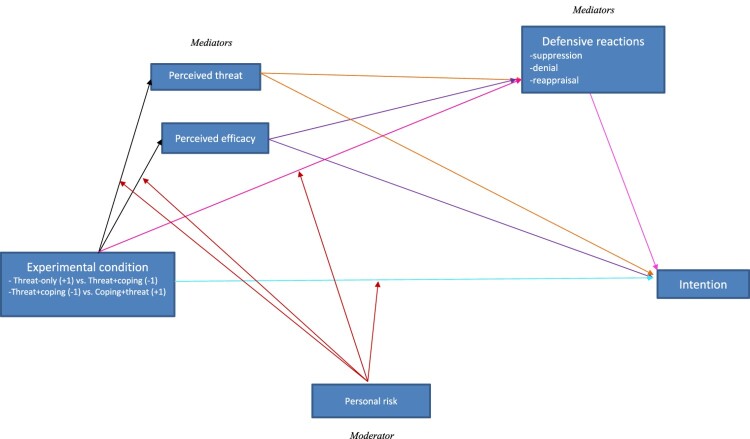
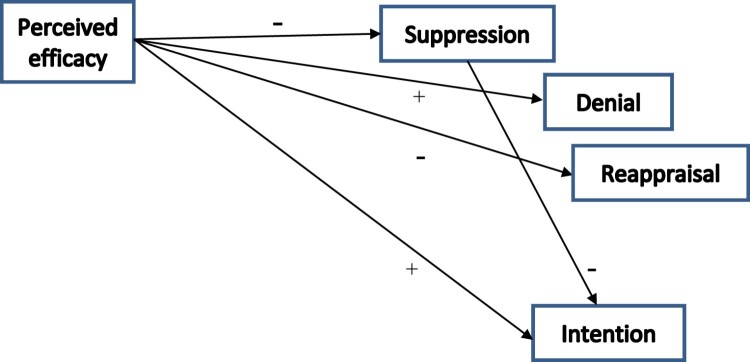
Background: Fear appeals are widely used in health communication, despite conflicting views on their effectiveness. Unresolved issues include possible mediation mechanisms and the effect of defensive reactions aimed at controlling a perceived danger.Methods: The present study compared the impact of three versions of an existing online course on how to prevent noncommunicable diseases. Participants, recruited in South America via a crowdsourcing platform, were divided randomly between three versions of the course – ‘threat only’/‘threat plus coping information’/‘coping information plus threat’ (reverse order). We then asked them to complete a questionnaire measuring perceived efficacy, perceived threat, defensive reactions, and intention to change unhealthy behaviors.Results: Using a serial parallel mediation model to test the course's impact on our dependent variables did not reveal any significant differences between the three versions. Perceived efficacy was positively associated with intention to change behavior, as well as with lower suppression, lower reappraisal, and greater denial. Suppression was the only defensive reaction to be associated with intention to change behavior: greater suppression was linked to less intention to change.Conclusions: Our results open interesting perspectives for research into defensive reactions.
Overview
The claims and statistics of this paper haven’t been checked yet.
Free: it reads the open-access text and checks the first 5 claims that cite a source we can check. Create a free account to check every claim.
Integrity signals
Registry
Cites
Statistics
Figures
Verification
Claims the paper makes
The claims and statistics of this paper haven’t been checked yet.
Free: it reads the open-access text and checks the first 5 claims that cite a source we can check. Create a free account to check every claim.
Claims other papers make about this one
Each is checked against this paper’s own text: does it say what the citing paper says it does?
In the citing paper
“Fear might promote better health behaviours, but on the other hand defensive reactions might also be linked to less intentions to change behaviour [23].”
From Public knowledge about dementia risk reduction in Norway (2022) · cites this paper as [23]
Self-check
Percentages, sums and reported differences re-computed from the paper’s own numbers.
The self-check needs the paper’s full text.
Citations
Cites
(2013) · Cited by 44,563
(1975) · PhilPapers (PhilPapers Foundation) · Cited by 36,737
The weirdest people in the world?
Henrich, J., Heine, S. J., & Norenzayan, A. (2010) · Behavioral and Brain Sciences · doi:10.1017/s0140525x0999152x · Cited by 12,641
Amazon's Mechanical Turk: A New Source of Inexpensive, Yet High-Quality, Data?
Buhrmester, M., Kwang, T., & Gosling, S. D. (2011) · Perspectives on Psychological Science · doi:10.1177/1745691610393980 · Cited by 9,996
‘Small Changes' to Diet and Physical Activity Behaviors for Weight Management
Hills, A. P., Byrne, N. M., Lindstrom, R., & Hill, J. O. (2013) · Obesity Facts · doi:10.1159/000345030 · Cited by 9,493
A Protection Motivation Theory of Fear Appeals and Attitude Change1
Rogers, R. W. (1975) · The Journal of Psychology · doi:10.1080/00223980.1975.9915803 · Cited by 6,805 · cited 3×
“For example, the Extended Parallel Process Model (EPPM, Witte, 1992), which drew on the Drive Reduction Model (Hovland, Janis, & Kelley, 1953), Leventhal’s Danger Control/Fear Control Framework (1970), Protection Motivation Theory (Rogers, 1975), and the Health Belief Model (Rosenstock, 1966), predicts that responses…”
BackgroundLippa, N. C., & Sanderson, S. C. (2013) · Human Heredity · doi:10.1159/000353712 · Cited by 6,078
The World Health Report 2002 - Reducing Risks, Promoting Healthy Life
Not Available, N. A. (2003) · Education for Health: Change in Learning & Practice · doi:10.1080/1357628031000116808 · Cited by 6,046
A review of correlates of physical activity of children and adolescents
SALLIS, J. F., PROCHASKA, J. J., & TAYLOR, W. C. (2000) · Medicine & Science in Sports & Exercise · doi:10.1097/00005768-200005000-00014 · Cited by 4,421
WEIRD languages have misled us, too
Majid, A., & Levinson, S. C. (2010) · Behavioral and Brain Sciences · doi:10.1017/s0140525x1000018x · Cited by 4,076
Research works printed but not linked: 2
- Conner, M., & Norman, P. (2005). Predicting health behaviour. Maidenhead: McGraw-Hill Education.
- Drug Free Action Alliance. (2013). Why scare tactics in drug messaging prevention don’t work. Colombus, OH: Drug Free Action Alliance.
Cited by
Yoon, H., You, M., & Shon, C. (2022) · PLoS ONE · doi:10.1371/journal.pone.0261132 · Cited by 35
“The EPPM, an integrated and comprehensive model of affective and cognitive processes, describes the behavioral change process as the relationship between the fear of a health message or health risk situation, and the individual’s sense of efficacy in coping strategies [14, 15].”
BackgroundPublic knowledge about dementia risk reduction in Norway
Kjelvik, G., Rokstad, A. M. M., Stuebs, J., Thingstad, P., Deckers, K., Köhler, S., & Selbæk, G. (2022) · BMC Public Health · doi:10.1186/s12889-022-14433-w · Cited by 29
“Fear might promote better health behaviours, but on the other hand defensive reactions might also be linked to less intentions to change behaviour [23].”
BackgroundWaring, S., Almond, L., & Halsall, L. (2024) · Transportation Research Part F Traffic Psychology and Behaviour · doi:10.1016/j.trf.2024.07.019 · Cited by 22
Zhu, B., Wu, H., Lv, S., & Xu, Y. (2024) · PLoS ONE · doi:10.1371/journal.pone.0301666 · Cited by 18
“…Primary school or below as reference; (2) Single as reference; (3) � 2000 as reference; (4) Chronic nephritis as reference; (5) 0 as reference; (6) < 1 as reference; (7) 2 as reference. https://doi.org/10.1371/journal.pone.0301666.t002 adopt healthy behaviors and positive treatment approaches [56].”
BackgroundInfluentialApproaches for Imparting Oral Health to Special Groups: A Literature Review
Mishra, P., Devi, K. D., Chaturvedi, A., Priyadarshini, S., & Chandra, S. (2025) · Saudi Journal of Oral and Dental Research · doi:10.36348/sjodr.2025.v10i01.011 · Cited by 11
Awwad, M. S., Awwad, R. M., & Awwad, R. M. (2023) · Journal of Contingencies and Crisis Management · doi:10.1111/1468-5973.12455 · Cited by 8
Muhamad, S., Sowtali, S. N., Arifin, S. R. M., Islah, M. A. R., & Shukri, N. A. M. (2023) · Journal of Human Nutrition and Dietetics · doi:10.1111/jhn.13215 · Cited by 8
Lin, R. S. Y., Bartels, S. L., Baťalík, L., & Su, J. J. (2025) · International Journal of Geriatric Psychiatry · doi:10.1002/gps.70130 · Cited by 7
Liang, J.-C., & Hwang, G. (2025) · Education and Information Technologies · doi:10.1007/s10639-025-13747-7 · Cited by 7
“Both groups developed an addiction treatment plan based on the EPPM, utilizing the fear appeal communication model (Moussaoui et al., 2021) to implement the treatment plan and monitor its effectiveness.”
Dynamic Fear in Fear Appeals: Applying Fear Appeals to Environmental Communication in China
Li, R., Li, W., Gilbert, C., Zheng, X., & Lindenfeld, L. (2024) · Journal of Health Communication · doi:10.1080/10810730.2024.2361356 · Cited by 6
“For example, Moussaoui et al. (2021) found that compared to the “threat only” version, “threat plus coping” or the reversed “coping plus threat” versions of fear appeals did not lead to significantly different persuasive outcomes, although they noted that this null finding might be due to…”
BackgroundResultRoberto, A. J., Mattson, L. D., Feldt, P. A. V., & Xin, Z. (2023) · Social Sciences · doi:10.3390/socsci12110628 · Cited by 4
“Offering opportunities to resolve or reduce some election-based fear (i.e., by voting) could help avoid the risks of ethical concerns (Hastings et al. 2004), defensive reactions (Moussaoui et al. 2021), and emotion-dependent reasoning (Witte 1992) that can be associated with fear appeals.”
BackgroundSenff, J. R., Tack, R. W. P., Tan, B. Y., Prapiadou, S., Kimball, T. N., Ng, S., Duskin, J. A., Shah-Ostrowski, M. J., Nunley, C., Brouwers, H. B., et al. (2025) · Scientific Reports · doi:10.1038/s41598-025-99246-8 · Cited by 3
“Regarding feeling at high risk of developing a stroke, previous literature has shown that fear of disease could either lead to defensive reactions, such as denial or supression of behavior change or proactive change to mitigate the feared risk 44 .”
Norman, M. L. P., Blessing, J. N., & Myrick, J. G. (2025) · Journal of Risk Research · doi:10.1080/13669877.2025.2565583 · Cited by 3
“Given the mixed evidence regarding how information order influences health-related persuasion (Hall, Bishop, and Marteau 2006; Moussaoui, Claxton, and Desrichard 2021; Prentice-Dunn, Floyd, and Flournoy 2001), individual differences likely help explain these inconsistencies.”
Wan, K. S., Choo, B. J.-K., Chan, K.-F., Yeo, J. Y., Tan, C. S.-L., Quek, B., & Gan, S. K. (2021) · Preprints.org · doi:10.20944/preprints202111.0551.v1 · Cited by 3
“Over the years, psychological studies underlying influencing effects have investigated the use of fear [11] in health [12,13], encouraging messages [14]; as well as persuasion through social/peer-pressure [15] among others.”
BackgroundTensions in caring for chronic patients’ medication adherence: A qualitative study in Cyprus
Karashiali, C., Konstantinou, P., Kasinopoulos, O., Michael, C., Papageorgiou, A., Kadianaki, I., Karekla, M., & Kassianos, A. P. (2024) · Journal of Health Psychology · doi:10.1177/13591053241227003 · Cited by 2
“Literature shows that how people react to fear appeals, depends on their coping efficacy level—if efficacy is high, they are more likely to change their behavior in the suggested direction (Kok et al., 2018; Moussaoui et al., 2021).”
BackgroundVlah, A., Wijnia, L., Lutz, C., Burke, M., & Loyens, S. M. M. (2024) · Education Sciences · doi:10.3390/educsci14121284 · Cited by 2
How parents decide whether to have genomic newborn screening: experiences from BabyScreen+
Kanga‐Parabia, A., Tutty, E., Kugenthiran, N., Caruana, J., Downie, L., Gaff, C., Lang, N., Lunke, S., Scarff, K. L., Stark, Z., et al. (2026) · European Journal of Human Genetics · doi:10.1038/s41431-026-02159-x · Cited by 2
Lu, F., & Tu, C. (2024) · Journal of Medical Internet Research · doi:10.2196/57967 · Cited by 3
Ammon, N., Limmer, M., & Kaley, A. (2025) · AIDS Research and Therapy · doi:10.1186/s12981-025-00770-4 · Cited by 2
“…appeals in health communication to stir behaviour change has hitherto provoked controversial debates regarding its ethical appropriateness and usefulness [51], thus, numerous researchers recommended examining fear appeals in relation to their adverse psychological and ethical consequences [52, 53].”
The Effect of Fear of COVID-19 on Health Promotion Behaviors in Adolescents
kaya, D. T., İnci, F. H., & Çelik, F. (2021) · İzmir Katip Çelebi Üniversitesi Sağlık Bilimleri Fakültesi Dergisi · Cited by 2
Public Policy and Lessons from Immunity in a COVID World
Kieber‐Emmons, T. (2024) · Medical Research Archives · doi:10.18103/mra.v12i9.5888 · Cited by 1
Sohail, F., Raza, S. H., Emenyeonu, C. O., Zaman, U., Shah, A. A., Nor, N. H. M., Khan, S., Khan, S. U., & Ayouni, S. (2025) · Humanities and Social Sciences Communications · doi:10.1057/s41599-025-06104-z · Cited by 1
“Moreover, fear can be viewed as a response triggered by perceived risky situations or stimuli in the environment, prompting protective actions (Moussaoui et al., 2021).”
Asfar, T., Brown, E. C., Penedo, F. J., Abrams, I., Jayakumaran, J., Oluwole, O. J., Ferdous, T., Naimi, T. S., Avendano, D., & Maziak, W. (2026) · Cancer · doi:10.1002/cncr.70491 · Cited by 1
“76 Thus it is likely that cancer - specific messages registered better with both moderate and heavy consumers, but the perceived efficacy of behavioral change made moderate consumers more responsive.”
The Use of Fear Appeal to Promote Safe Behaviors Among People in the Event of an Earthquake
Zareipour, M. (2023) · Health in Emergencies & Disasters Quarterly · doi:10.32598/hdq.8.4.544.1 · Cited by 1
Health Anxiety and the Quest for Safety: Interdisciplinary and Critical Perspectives
Csabai, M. (2025) · Routledge eBooks · doi:10.4324/9781003517788 · Cited by 1
Liu, J., Wang, Y., Fabbricatore, J., Norton, E. O., Markey, C. E., McMains, J. T., Worsdale, A., Ye, T., Shi, Z., & Sweet, L. H. (2025) · American Journal of Preventive Medicine · doi:10.1016/j.amepre.2025.108194 · Cited by 1
“67 When emotional appeals are too forceful, they can provoke psychological reactance or dismissal 68 and redirect cognitive resources toward managing discomfort rather than absorbing content.”
Aheto, K. B. (2024) · ScholarWorks (Walden University) · Cited by 1
Kweku Yakubu, K. (2025) · Open University of Cape Town (University of Cape Town) · Cited by 1
Setyawati, E., Dwipayanti, P. I., & Kushayati, N. (2022) · Pengembangan Ilmu dan Praktik Kesehatan · doi:10.56586/pipk.v1i4.239
Empowering Patients: Improve Gender-Sensitive Medical Knowledge Through Interactive Edutainment
Wagnerberger, D., Schott, D., Schwenderling, L., Hansen, C., & Schumacher, D. (2024) · Nordic Conference on Human-Computer Interaction · doi:10.1145/3679318.3685500
Message testing intentions to administer naloxone
Wygonik, Q. R., Glassman, T., Na, L., & Tucker‐Gail, K. (2024) · International Journal of Health Promotion and Education · doi:10.1080/14635240.2024.2438962
“However, such findings should be interpreted in the context of the persisting controversy in the literature regarding the use of fear appeals (Kok et al. 2017; Moussaoui, Claxton, and Desrichard 2021; Riley et al. 2017).”
The Stranger and the K-Quarantine: Foreigners and Pandemic Response in South Korea
Swan, H. (2024) · uO Research (University of Ottawa) · doi:10.20381/ruor-30377
Additional file 3 of Public knowledge about dementia risk reduction in Norway
Kjelvik, G., Rokstad, A. M. M., Stuebs, J., Thingstad, P., Deckers, K., Köhler, S., & Selbæk, G. (2022) · Figshare · doi:10.6084/m9.figshare.21523764
Additional file 2 of Public knowledge about dementia risk reduction in Norway
Kjelvik, G., Rokstad, A. M. M., Stuebs, J., Thingstad, P., Deckers, K., Köhler, S., & Selbæk, G. (2022) · Figshare · doi:10.6084/m9.figshare.21523761
Additional file 1 of Public knowledge about dementia risk reduction in Norway
Kjelvik, G., Rokstad, A. M. M., Stuebs, J., Thingstad, P., Deckers, K., Köhler, S., & Selbæk, G. (2022) · Figshare · doi:10.6084/m9.figshare.21523758
Yu, M., Cao, Y., Zhang, X., & Tan, C.-W. (2025) · Journal of the Association for Information Systems
Mukherjee Nath, S. (2024) · Spectrum Research Repository (Concordia University)
Μήτσιου, Ε. Β., & Μήτσιου, Ε. Β. (2025) · University of Thessaly Institutional Repository (University of Thessaly)
Mudavanhu, A. (2025) · Lirias
Ben-Enukora, C. (2023) · Landmark University Repository (Landmark University)
Zielińska‐Tomczak, Ł., Przymuszała, P., Krasińska, A., Klimek, W., Marciniak, R., & Cerbin‐Koczorowska, M. (2026) · BMC Public Health · doi:10.1186/s12889-026-27697-3
“It is important to note that fear-based motivation does not always lead to behaviour change; in some cases, it may result in information avoidance [45], thus producing effects contrary to the intended ones.”
Reframing our data: promoting positive epidemiology
Yudkin, J. S., & Smith, B. (2026) · Perspectives in Public Health · doi:10.1177/17579139261448475
Ahmed, A., Mojumdar, A., Sharmy, S. T., Mahmud, A., Ahmed, A., & Sadia, H. K. (2026) · Scientific Reports · doi:10.1038/s41598-026-68863-2
Gordon, C. (2026) · Saint Mary's University Institutional Repository (Saint Mary's University)
Kongai, A., Kamdaeng, P., Lorga, T., Apiwongwarn, P., Satjasakulrat, S., Naunboonruang, P., & Anuwatnonthakate, A. (2023) · Journal of Nursing and Therapeutic Care
PADAKI, S.-A., & Kouevi, T. (2023) · International Journal of Accounting, Finance, Auditing, Management and Economics
Visualising Safety Practice: How Organisations Construct Safety Through Visual ArtefactsPreprint
Pomeroy, J., & Pilbeam, C. (2026) · SSRN Electronic Journal · doi:10.2139/ssrn.7607878
Metadata
- Authors
- Moussaoui, L. S., Claxton, N., & Desrichard, O.
- Affiliations
- University of Geneva (CH)
- International Federation of Red Cross and Red Crescent Societies (CH)
- Corresponding author
- Moussaoui, Lisa Selma
- Venue
- Health Psychology and Behavioral Medicine
- Publisher
- Informa UK Limited
- Published
- 2021-01-01
- Volume
- 9
- Issue
- 1
- Pages
- 600-618
- ISSN
- 2164-2850 (ISSN-L)
- PMC
- PMC8266257
- OpenAlex
- W3180356875
- Cited by
- 30
- References
- 77
- Citations by year
- 2026: 5 · 2025: 7 · 2024: 8 · 2023: 4 · 2022: 5 · 2021: 1
- FWCI
- 4.04
- Type
- journal article
- Language
- en
- Open access
- gold
- doi.org
- Licence
- Locations
- Health Psychology and Behavioral Medicine (publishedVersion, cc-by)
- PubMed Central (publishedVersion, cc-by)
- PubMed (publishedVersion)
- Archive ouverte UNIGE (University of Geneva) (publishedVersion, other-oa)
- Archive ouverte UNIGE (University of Geneva) (submittedVersion, cc-by)
- DOAJ (DOAJ: Directory of Open Access Journals) (submittedVersion, cc-by-sa)
- Topics
- Social Sciences › Psychology › Applied Psychology › Behavioral Health and Interventions
- Social Sciences › Communication › Media Influence and Health
- Social Sciences › Sociology and Political Science › Risk Perception and Management
- Keywords
- fear appeals, defensive reactions, threat perception, perceived efficacy, behavioral intention, suppression, cognitive reappraisal, denial, non-communicable disease prevention, health communication, mediation
About these checks
Registry, retraction, Cites and statistics results are computed, not judged, with one exception: a printed reference that no index lists is read once by a model before it counts as a citation error. Claims are extracted by a model and kept only when their quote appears verbatim in the text; each cited source is then checked, with a model’s help, for whether it says what the claim relies on. Those verdicts can be wrong — read the claim’s quote and the cited source before relying on one.
Statistics and arithmetic are recomputed, not judged.
Confidence bands are shown only for fields calibrated on our annotated test set. None is calibrated yet, so no band is shown.
What counts as a claim ›How we measure confidence ›How we check this ›
Are you an author, or do you see a problem with this page? Request a review
Data sources
Bibliographic data: Semantic Scholar, OpenAlex, Crossref.
Contains information from the Semantic Scholar Academic Graph Datasets, made available under the ODC Attribution License (ODC-BY 1.0).
Semantic Scholar’s data is described in: Kinney, R., et al. (2023). The Semantic Scholar Open Data Platform. arXiv:2301.10140.
