

Quality of life of Sudanese patients attending a fertility clinic: a mixed methods study
Open accessThe DOI matches its Crossref record; 59 of the 60 references it cites were found in a registry or an index.
Abstract
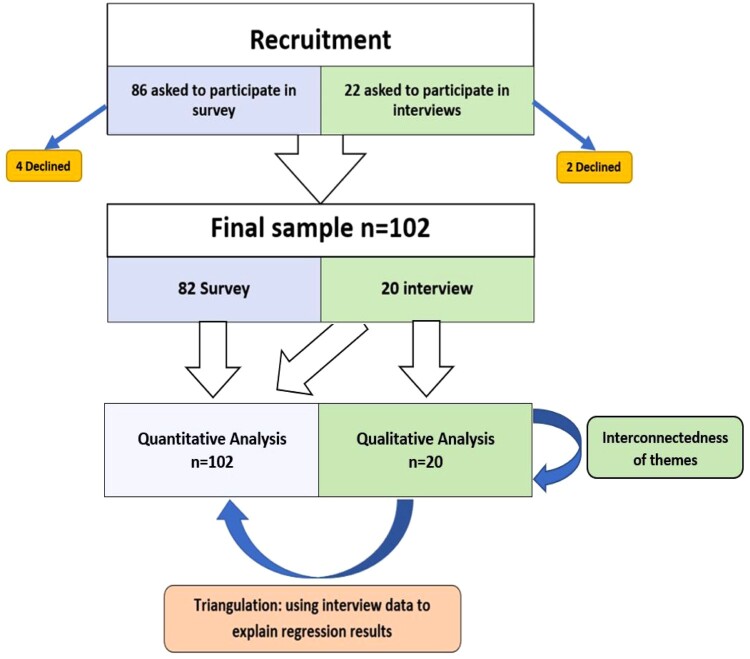
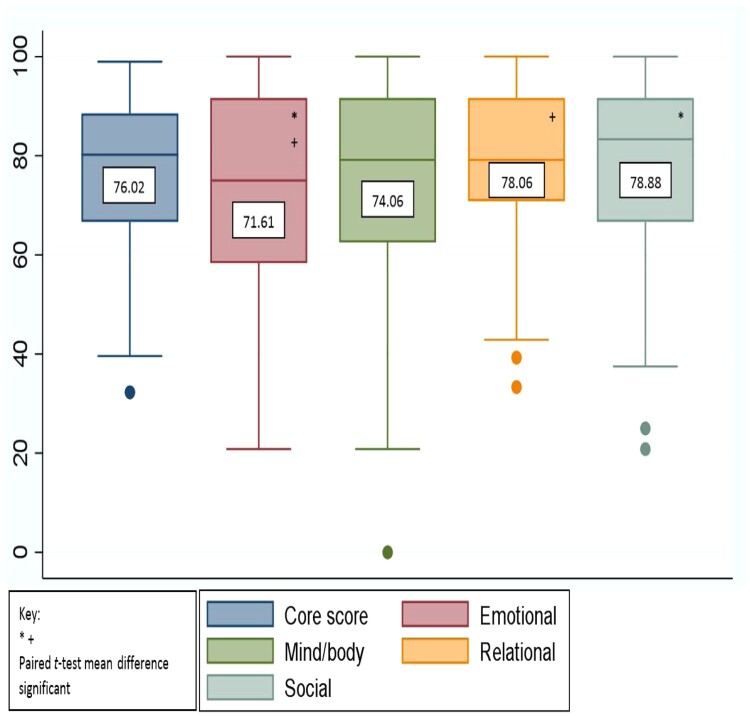
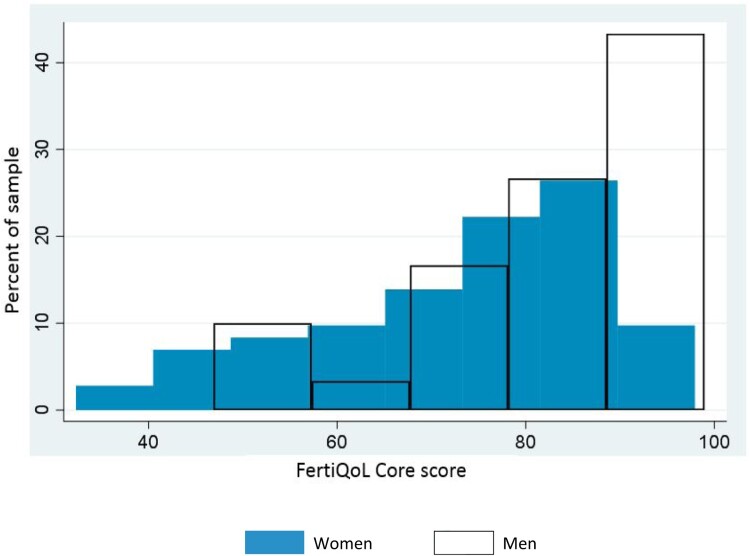
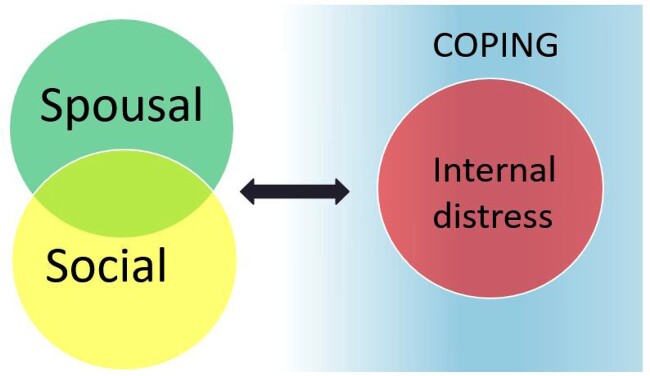
Background Infertility affects over 50 million people globally, the burden is disproportionately borne by women, especially in low and middle-income countries (LMIC). The impact of infertility on quality of life (QoL) has not been well documented or assessed qualitatively in LMIC like Sudan, where infertility is a pervasive problem. Therefore, the purpose of this mixed-methods study was to assess the fertility-related QoL of infertile individuals in Sudan using the fertility quality of life (FertiQoL) tool.Methods We used explanatory sequential design (surveys and interviews) in a fertility clinic in Sudan (January 2017–May 2018). We collected socio-demographic information, medical/reproductive history and used Arabic FertiQoL. We generated descriptive statistics of FertiQoL (core, domain) scores and independent variables; multiple linear regression models to assess the relationship between FertiQoL and dependent variables; and t-tests to compare mean core/domain scores. We conducted thematic analysis on qualitative data about the subjective experience of being infertile.Results The study included 102 participants (72 women), 70 educated beyond secondary school, mean age 33.89 years (SD = 7.82) and mean duration of infertility was 4.03 years (SD 3.29). Mean FertiQoL core score 76.02 (SD = 16.26), domain scores: emotional 71.61 (SD = 22.04), relational 78.06 (SD = 16.62), mind/body 74.06 (SD 22.53) and social 78.88 (SD = 18.24). Men had better fertility-related QoL.Four themes emerged A sense of something missing because of childlessness; social pressure from peoples’ questions; impact on the spousal relationship (which differed amongst participants) and coping (faith-based and non-faith-based) which was necessary when the lived experience led to internal distress.Conclusions Infertility negatively impacted the QoL of participants in this study, and women were worse off. Cognitive appraisal, social support and pressure may be key factors influencing the QoL of infertile individuals, therefore they should be encouraged to seek social and professional support. FertiQoL is a useful tool to assess fertility QoL in LMIC like Sudan.
Overview
The claims and statistics of this paper haven’t been checked yet.
Free: it reads the open-access text and checks the first 5 claims that cite a source we can check. Create a free account to check every claim.
Integrity signals
Registry
Cites
Statistics
Figures
Verification
Claims the paper makes
The claims and statistics of this paper haven’t been checked yet.
Free: it reads the open-access text and checks the first 5 claims that cite a source we can check. Create a free account to check every claim.
Claims other papers make about this one
Each is checked against this paper’s own text: does it say what the citing paper says it does?
The source backs part of the claim, not all of it — or backs it for a different population, condition or comparison.
In the citing paper
“The lack of access indirectly causes significant emotional distress [32,33].”
From Psychosocial interventions for improving marital intimacy, sexual satisfaction, and quality of life of women and couples with infertility problems in low and middle-income countries: Systematic review protocol (2025) · cites this paper as [32]
Experimental — accuracy not yet measuredThe check wasn’t confident either way, so it gives no verdict — never disputed.
In the citing paper
“Qualitative research shows that culturally tailored fertility awareness tools are feasible and acceptable (Bayoumi et al., 2021).”
From Declining global fertility rates and the implications for family planning and family building: an IFFS consensus document based on a narrative review of the literature (2024) · cites this paper as Bayoumi et al., 2021
Experimental — accuracy not yet measured
Self-check
Percentages, sums and reported differences re-computed from the paper’s own numbers.
The self-check needs the paper’s full text.
Citations
Cites
Using thematic analysis in psychology
Braun, V., & Clarke, V. (2006) · Qualitative Research in Psychology · doi:10.1191/1478088706qp063oa · Cited by 194,414
Eysenck, H. J. (1985) · Behaviour Research and Therapy · doi:10.1016/0005-7967(85)90087-7 · Cited by 31,975
(1995) · Social Science & Medicine · doi:10.1016/0277-9536(95)00112-k · Cited by 7,643
Enhancing the quality and credibility of qualitative analysis.
(1999) · PubMed Central · Cited by 4,133
The Use of Triangulation in Qualitative Research
Carter, N., Bryant-Lukosius, D., DiCenso, A., Blythe, J., & Neville, A. J. (2014) · Oncology Nursing Forum · doi:10.1188/14.onf.545-547 · Cited by 3,915 · cited 1×
“%) did.”
Corfman, K. P., & Lynch, J. G. (1983) · University of Groningen research database (University of Groningen / Centre for Information Technology) · Cited by 2,944
Naturalistic inquiry and the saturation concept: a research note
Bowen, G. A. (2008) · Qualitative Research · doi:10.1177/1468794107085301 · Cited by 2,749 · cited 1×
“themes), the point of diminishing returns was reached (Bowen, 2008).”
BackgroundMascarenhas, M. N., Flaxman, S. R., Boerma, T., Vanderpoel, S., & Stevens, G. A. (2012) · PLoS Medicine · doi:10.1371/journal.pmed.1001356 · Cited by 2,312
Gender differences in verbal ability: A meta-analysis.
Hyde, J. S., & Linn, M. C. (1988) · Psychological Bulletin · doi:10.1037/0033-2909.104.1.53 · Cited by 1,405 · cited 1×
“Second, women, in general, are more verbally and emotionally expressive (Hyde & Linn, 1988; Wester, Vogel, Pressly, & Heesacker, 2002).”
The experience of infertility: a review of recent literature
Greil, A. L., Slauson-Blevins, K., & McQuillan, J. (2010) · Sociology of Health & Illness · doi:10.1111/j.1467-9566.2009.01213.x · Cited by 867 · cited 1×
“Moreover, in low and middleincome countries (LMIC) the physical, emotional and financial burden is often borne by women (Greil et al., 2010; Riessman, 2000; Rouchou, 2013).”
BackgroundHealth and quality of life outcomes
Jolly, M., Sequeira, W., & Block, J. A. (2014) · Health and Quality of Life Outcomes · doi:10.1186/s12955-014-0173-5 · Cited by 719
Martin, L. A., Neighbors, H. W., & Griffith, D. M. (2013) · JAMA Psychiatry · doi:10.1001/jamapsychiatry.2013.1985 · Cited by 674 · cited 1×
“Third, it is well documented that men tend to underreport internalizing symptoms like sadness (Call & Shafer, 2018; Smith et al., 2018), consequently, internalizing problems like depression can be underdiagnosed using standard measures (Martin et al., 2013).”
BackgroundThe fertility quality of life (FertiQoL) tool: development and general psychometric properties†
Boivin, J., Takefman, J., & Braverman, A. (2011) · Human Reproduction · doi:10.1093/humrep/der171 · Cited by 478 · cited 4×
“FertiQoL can aid in the identification of individuals requiring psychosocial support and the specific areas of intervention that should be targeted (Boivin et al., 2011).”
BackgroundMethodInfluentialSelf-citationWilliams, J. I., Höher, J., & Lauterbach, K. W. (1998) · Surgical Research · doi:10.1007/978-1-4612-1888-3_57 · Cited by 407
Meyrick, J. (2006) · Journal of Health Psychology · doi:10.1177/1359105306066643 · Cited by 402
Data collection and sampling in qualitative research: does size matter?
Cleary, M., Horsfall, J., & Hayter, M. (2014) · Journal of Advanced Nursing · doi:10.1111/jan.12163 · Cited by 377
STIGMA AND EVERYDAY RESISTANCE PRACTICES: Childless Women in South India
RIESSMAN, C. K. (2000) · Gender & Society · doi:10.1177/089124300014001007 · Cited by 291
Catania, J. A., Binson, D., Canchola, J., Pollack, L. M., & Hauck, W. (1996) · Public Opinion Quarterly · doi:10.1086/297758 · Cited by 286
Primary and secondary infertility in sub-Saharan Africa
Larsen, U. (2000) · International Journal of Epidemiology · doi:10.1093/ije/29.2.285 · Cited by 276
Reviewing the Assumptions About Men’s Mental Health: An Exploration of the Gender Binary
Smith, D. T., Mouzon, D. M., & Elliott, M. (2018) · American Journal of Men's Health · doi:10.1177/1557988316630953 · Cited by 243 · cited 1×
“Third, it is well documented that men tend to underreport internalizing symptoms like sadness (Call & Shafer, 2018; Smith et al., 2018), consequently, internalizing problems like depression can be”
BackgroundFisher, J. R., & Hammarberg, K. (2012) · Asian Journal of Andrology · doi:10.1038/aja.2011.72 · Cited by 242
Aarts, J. W. M., van Empel, I. W. H., Boivin, J., Nelen, W. L., Kremer, J. A. M., & Verhaak, C. M. (2011) · Human Reproduction · doi:10.1093/humrep/der051 · Cited by 207
Self-citationInterviewer Gender and Gender Attitudes
Kane, E. W., & Macaulay, L. J. (1993) · Public Opinion Quarterly · doi:10.1086/269352 · Cited by 201
Hansen, T., Slagsvold, B., & Moum, T. (2009) · Social Indicators Research · doi:10.1007/s11205-008-9426-1 · Cited by 187 · cited 2×
“Reports in the literature suggest that as infertile individuals get older and the likelihood of having biological offspring is reduced, they require more support to cope with the finality of their situation (Gameiro & Finnigan, 2017; Hansen et al., 2009).”
BackgroundDaniluk, J. C. (2001) · Journal of Counseling & Development · doi:10.1002/j.1556-6676.2001.tb01991.x · Cited by 183 · cited 1×
“The sense of lack or incompleteness is not unique to Sudan since parenthood has been identified as a central human life goal (Daniluk, 2001; Gameiro & Finnigan, 2017) and childlessness can be a ‘blocked goal’ that negatively impacts wellbeing, even in western/high income countries (Da Silva, Boivin, & Gameiro, 2016; H…”
BackgroundDyer, S., Lombard, C., & Van der Spuy, Z. (2009) · Human Reproduction · doi:10.1093/humrep/dep278 · Cited by 178
Gendered Manifestations of Depression and Help Seeking Among Men
Call, J. B., & Shafer, K. (2018) · American Journal of Men's Health · doi:10.1177/1557988315623993 · Cited by 174
Consequences of infertility in developing countries
Rouchou, B. (2013) · Perspectives in Public Health · doi:10.1177/1757913912472415 · Cited by 154 · cited 2×
“Given that martial dysfunction, divorce and polygamy have been reported as consequences of infertility (Rouchou, 2013), we anticipated that infertility would impact the spousal relationship negatively.”
BackgroundLi, J., Long, L., Liu, Y., He, W., & Li, M. (2015) · Behaviour Research and Therapy · doi:10.1016/j.brat.2015.12.010 · Cited by 135
Domar, A. D., Gross, J., Rooney, K. L., & Boivin, J. (2015) · Fertility and Sterility · doi:10.1016/j.fertnstert.2015.05.009 · Cited by 134
Self-citationZurlo, M. C., Volta, M. F. C. D., & Vallone, F. (2018) · Quality of Life Research · doi:10.1007/s11136-017-1781-4 · Cited by 129
Programme of Action of the International Conference on Population and Development
Algeria (1994) · Cited by 128
Differences in quality of life and emotional status between infertile women and their partners
Huppelschoten, A. G., van Dongen, A. J. C. M., Verhaak, C. M., Smeenk, J. M. J., Kremer, J. A. M., & Nelen, W. L. D. M. (2013) · Human Reproduction · doi:10.1093/humrep/det239 · Cited by 126 · cited 1×
“Infertility has been reported to impact QoL negatively (Aarts, Huppelschoten et al., 2011, Aarts, Van Empel et al., 2011; Boivin, Takefman, & Braverman, 2011; Domar, Gross, Rooney, & Boivin, 2015; Huppelschoten et al., 2013; Kitchen, Aldhouse, Trigg, Palencia, & Mitchell, 2017), leading to the development of the ferti…”
BackgroundThe Effect of Interviewer Gender on the Survey Response
Huddy, L., Billig, J., Bracciodieta, J., Hoeffler, L., Moynihan, P. J., & Pugliani, P. (1997) · Political Behavior · doi:10.1023/a:1024882714254 · Cited by 125 · cited 2×
“might have been caveats about data collection methods such as impact of a woman interviewer (gender discordant for men participants), which have been shown to impact interviewees in some studies (Catania, Binson, Canchola, Pollack, & Hauck, 1996; Huddy et al., 1997; Kane & Macaulay, 1993).”
BackgroundAarts, J. W. M., Huppelschoten, A. G., van Empel, I. W. H., Boivin, J., Verhaak, C. M., Kremer, J. A. M., & Nelen, W. L. (2012) · Human Reproduction · doi:10.1093/humrep/der386 · Cited by 117
Self-citationValsangkar, S., Bodhare, T., Bele, S., & Sai, S. (2011) · Journal of Human Reproductive Sciences · doi:10.4103/0974-1208.86088 · Cited by 115
Elhussein, O. G., Ahmed, M. A., Suliman, S. O., Yahya, L. I., & Adam, I. (2019) · Fertility Research and Practice · doi:10.1186/s40738-019-0060-1 · Cited by 111
Long-term adjustment to unmet parenthood goals following ART: a systematic review and meta-analysis
Gameiro, S., & Finnigan, A. (2017) · Human Reproduction Update · doi:10.1093/humupd/dmx001 · Cited by 102
Male Gender Role Conflict and Multiculturalism: Implications for Counseling Psychology
Wester, S. R. (2008) · The Counseling Psychologist · doi:10.1177/0011000006286341 · Cited by 70
Järvholm, S., Johannesson, L., Clarke, A. M., & Brännström, M. (2015) · Fertility and Sterility · doi:10.1016/j.fertnstert.2015.06.038 · Cited by 66
Factors associated with poor quality of life among Iranian infertile women undergoing IVF
Maroufizadeh, S., Ghaheri, A., & Omani Samani, R. (2017) · Psychology, Health & Medicine · doi:10.1080/13548506.2016.1153681 · Cited by 64 · cited 1×
“and translations in non-western countries (Asazawa & Mori, 2015; Chi, Park, Sun, Kim, & Lee, 2016; Goker et al., 2018; Li, Long, Liu, He, & Li, 2016; Maroufizadeh et al., 2017; Valsangkar, Bele, Bodhare, & Sai, 2011) and non-English speaking European countries (Cserepes et al.”
Kahyaoglu Sut, H., & Balkanli Kaplan, P. (2015) · Nursing & Health Sciences · doi:10.1111/nhs.12167 · Cited by 63
Effect of infertility on quality of life of women: a validation study of the Turkish FertiQoL
Dural, Ö., Yaşa, C., Keyif, B., Çeliksoy, H. Y., Demiral, İ., Yüksel, B., Uğurlucan, F. G., & Baştu, E. (2016) · Human Fertility · doi:10.1080/14647273.2016.1214754 · Cited by 61 · cited 4×
“The FertiQoL has been used to assess fertility-related QoL globally including the Middle East (Dural et al., 2016; Goker, Yanikkerem, Birge, & Kuscu, 2018; Maroufizadeh, Ghaheri, & Samani, 2017; Sexty et al., 2016; Sut & Kaplan, 2015), but its use in Africa has only been reported once (Patel, van Balen, & Dyer, 2013),…”
MethodInfluentialSexty, R. E., Hamadneh, J., Rösner, S., Strowitzki, T., Ditzen, B., Toth, B., & Wischmann, T. (2016) · Health and Quality of Life Outcomes · doi:10.1186/s12955-016-0429-3 · Cited by 58 · cited 3×
“The FertiQoL has been used to assess fertility-related QoL globally including the Middle East (Dural et al., 2016; Goker, Yanikkerem, Birge, & Kuscu, 2018; Maroufizadeh, Ghaheri, & Samani, 2017; Sexty et al., 2016; Sut & Kaplan, 2015), but its use in Africa has only been reported once (Patel, van Balen, & Dyer, 2013),…”
BackgroundMethodChi, H.-J., Park, I.-H., Sun, H.-G., Kim, J.-W., & Lee, K.-H. (2016) · Daehan saengsik uihak hoeji/Clinical and experimental reproductive medicine · doi:10.5653/cerm.2016.43.3.174 · Cited by 57
Quality of life in Turkish infertile couples and related factors
Göker, A., Yanıkkerem, E., Birge, Ö., & Kuşçu, N. K. (2017) · Human Fertility · doi:10.1080/14647273.2017.1322223 · Cited by 56 · cited 1×
“and translations in non-western countries (Asazawa & Mori, 2015; Chi, Park, Sun, Kim, & Lee, 2016; Goker et al., 2018; Li, Long, Liu, He, & Li, 2016; Maroufizadeh et al., 2017; Valsangkar, Bele, Bodhare, & Sai, 2011) and non-English speaking European countries (Cserepes et al.”
A review of patient-reported outcome measures to assess female infertility-related quality of life
Kitchen, H., Aldhouse, N., Trigg, A., Palencia, R., & Mitchell, S. (2017) · Health and Quality of Life Outcomes · doi:10.1186/s12955-017-0666-0 · Cited by 49
Fertility quality of life tool: update on research and practice considerations
Koert, E., Takefman, J., & Boivin, J. (2021) · Human Fertility · doi:10.1080/14647273.2019.1648887 · Cited by 47 · cited 15×
“These fi ndings may help explain why men scored higher overall and on emotional and relational domains but not why their mind/body and social domain scores were comparable.”
BackgroundMethodResultInfluentialSelf-citationPsychosocial Predictors of Infertility Related Stress: A Review
Gourounti, K., Anagnostopoulos, F., & Βασλαματζής, Γ. (2010) · Current Women s Health Reviews · doi:10.2174/157340410793362159 · Cited by 42 · cited 1×
“social determinants, congruent with previous research (Gourounti et al., 2010).”
Muschalik, C., Elfeddali, I., Candel, M. J. J. M., Crutzen, R., & de Vries, H. (2019) · BMC Psychology · doi:10.1186/s40359-019-0322-z · Cited by 38
da Silva, S. M., Boivin, J., & Gameiro, S. (2016) · PLoS ONE · doi:10.1371/journal.pone.0157649 · Cited by 30
Self-citationCusatis, R. N., Fergestrom, N. M., Cooper, A. L., Schoyer, K. D., Kruper, A., Sandlow, J. I., Strawn, E., & Flynn, K. E. (2019) · BMC Psychology · doi:10.1186/s40359-019-0312-1 · Cited by 28 · cited 2×
“Lower FertiQoL scores were associated with more time spent re fl ecting on infertility treatment (Cusatis et al., 2019), with longer duration of infertility and for people who have psychological vulnerability (Koert et al., 2019).”
BackgroundWhy Me? Male Infertility and Responsibility in the Middle East
Inhorn, M. C. (2012) · Men and Masculinities · doi:10.1177/1097184x12468098 · Cited by 27 · cited 7×
“Those women might have felt their infertility cast doubt about their husbands ’ sexual ability, perpetuated by the myth of fertility being an indicator of the man ’ s sexual virility commonly held in Sudan (Al Sa fi , 2007) and other LMIC (Inhorn, 2012; Widge, 2002).”
BackgroundMethodResultInfluentialCserepes, R. E., Bugán, A., Kórösi, T., Tóth, B., Rösner, S., Strowitzki, T., & Wischmann, T. H. (2014) · Geburtshilfe und Frauenheilkunde · doi:10.1055/s-0034-1383235 · Cited by 24 · cited 2×
“…(Asazawa & Mori, 2015; Chi, Park, Sun, Kim, & Lee, 2016; Goker et al., 2018; Li, Long, Liu, He, & Li, 2016; Marou fi zadeh et al., 2017; Valsangkar, Bele, Bodhare, & Sai, 2011) and non-English speaking European countries (Cserepes et al., 2014; Järvholm, Johannesson, Clarke, & Brännström, 2015).”
Development of a partnership causal model for couples undergoing fertility treatment
Asazawa, K., & Mori, A. (2014) · Japan Journal of Nursing Science · doi:10.1111/jjns.12061 · Cited by 18
Introduction to special section: measuring what matters
Blum, S. I., Ahmed, S., Flood, E. M., Oort, F. J., & Schwartz, C. E. (2017) · Quality of Life Research · doi:10.1007/s11136-017-1743-x · Cited by 16
Management of Infertility within Primary Health Care Program in Sudan
Osman, A. A. (2011) · Asian Journal of Scientific Research · doi:10.3923/ajsr.2011.158.164 · Cited by 15 · cited 1×
“2000) and primary infertility in clinical samples as high as 80%, 69% and 60%, reported respectively (Abdalla, 2011; Elhussein, Ahmed, Suliman, Yahya, & Adam, 2019; Hussein, Gafoor, Gadir, & Hamad, 2019; Osman, 2011).”
Epidemiology of Infertility in Gezira Region, Central of Sudan
Abdalla, N. M. (2011) · Research Journal of Medical Sciences · doi:10.3923/rjmsci.2011.56.60 · Cited by 11 · cited 1×
“2000) and primary infertility in clinical samples as high as 80%, 69% and 60%, reported respectively (Abdalla, 2011; Elhussein, Ahmed, Suliman, Yahya, & Adam, 2019; Hussein, Gafoor, Gadir, & Hamad, 2019; Osman, 2011).”
Prevalence of primary infertility among selected group of Sudanese women with infertility disorders
Hamad, M. N. M., Hussein, M. O. M., & A.Gadir, M. A. G. (2019) · MOJ Women s Health · doi:10.15406/mojwh.2019.08.00221 · Cited by 5
Research works printed but not linked: 9
- Al Safi, A. (2007). Traditional Sudanese medicine: A primer for health care providers, researchers, and students. Khartoum: Azza Printing.
- Center for Disease Control and Prevention, U.S. Department of Health and Human Services. (2014). National public health action plan for the detection, prevention, and management of infertility. Centers for Disiease Control and Prevention, 1– 26.
- Creswell, J. W., & Clark, V. L. P. (2009). Designing and conducting mixed methods research. Organizational research methods. Thousand Oaks, CA: Sage.
- Khalifa, D. S., & Ahmed, M. A. (2012). Reviewing infertility care in Sudan; socio-cultural, policy and ethical barriers. FVV ObGyn, 53– 58.
- Patton, M. Q. (2014). Qualitative research and evaluation methods: Integrating theory and practice. Thousand Oaks: SAGE Publications.
- UNFPA. (2004). Programme of action: Adopted at the international conference on population and development, Cairo, 5–13 September 1994. In: International Conference on Population and Development.
- UNFPA. (2014). Programme of action of the international conference on population development. United Nations Population Fund.
- Wester, S. R., Vogel, D. L., Pressly, P. K., & Heesacker, M. (2002). Sex differences in emotion: A critical review of the literature and implications for counseling psychology. The Counseling Psychologist, 36, 294– 324.
- Widge, A. (2002). Current practices and controversies in assisted reproduction: Sociocultural attitudes towards infertility and assisted reproduction in India. Geneva: World Health Organisation.
Cited by
Fauser, B. C. J. M., Adamson, G. D., Boivin, J., Chambers, G. M., de Geyter, C., Dyer, S., Inhorn, M. C., Schmidt, L., Serour, G. I., Tarlatzis, B., et al. (2024) · Human Reproduction Update · doi:10.1093/humupd/dmad028 · Cited by 224
“Qualitative research shows that culturally tailored fertility awareness tools are feasible and acceptable (Bayoumi et al. , 2021).”
BackgroundSelf-citationGlobal fertility care with assisted reproductive technology
Adamson, G. D., Zegers-Hochschild, F., & Dyer, S. (2023) · Fertility and Sterility · doi:10.1016/j.fertnstert.2023.01.013 · Cited by 101
A scoping review of the psychosocial aspects of infertility in African countries
Roomaney, R., Salie, M., Jenkins, D., Eder, C., Mutumba-Nakalembe, M. J., Volks, C., Holland, N., & Silingile, K. (2024) · Reproductive Health · doi:10.1186/s12978-024-01858-2 · Cited by 45
“…national policies to prioritise infertility as a serious public health issue [126], promote public awareness of infertility to eradicate myths, reduce stigma and boost reproductive healthcare attendance [27, 109, 111, 137, 139, 145, 146], and increase the worth of the girl child in society [96].”
BackgroundInfluentialExperience of Women with Infertility: A Qualitative Study
Kianfar, F., Mohammadi, K., Zahrakar, K., & Gică, N. (2023) · Current Psychology · doi:10.1007/s12144-023-05247-z · Cited by 14
“They show their social isolation by dıstancing from others (Ullah et al., 2021) because, at this time, due to the feeling of losing an opportunity called motherhood and social pressure caused by people prefer to distance themselves from others (Bayoumi et al., 2021).”
Bayoumi, R. R., Koert, E., Boivin, J., McConnell, M. A., Wolde, B., Siddiqui, F., Elmusharaf, K., & Viswanath, K. (2024) · Frontiers in Public Health · doi:10.3389/fpubh.2024.1375643 · Cited by 2
Self-citation
Metadata
- Authors
- Bayoumi, R. R., Koert, E., Boivin, J., Viswanath, K., & McConnell, M.
- Affiliations
- University of Birmingham (GB)
- University of British Columbia (CA)
- Cardiff University (GB)
- Harvard University (US)
- Corresponding author
- Bayoumi, Rasha R.
- Venue
- Health Psychology and Behavioral Medicine
- Publisher
- Informa UK Limited
- Published
- 2021-01-01
- Volume
- 9
- Issue
- 1
- Pages
- 1006-1030
- ISSN
- 2164-2850 (ISSN-L)
- PMC
- PMC8648023
- OpenAlex
- W3216488568
- Cited by
- 12
- References
- 60
- Citations by year
- 2026: 4 · 2025: 2 · 2024: 3 · 2023: 3
- FWCI
- 1.30
- Type
- journal article
- Language
- en
- Open access
- gold
- doi.org
- Licence
- Locations
- Health Psychology and Behavioral Medicine (publishedVersion, cc-by)
- PubMed Central (publishedVersion, cc-by)
- PubMed (publishedVersion)
- ORCA Online Research @Cardiff (Cardiff University) (acceptedVersion)
- DOAJ (DOAJ: Directory of Open Access Journals) (submittedVersion, cc-by-sa)
- University of Birmingham Research Portal (University of Birmingham) (submittedVersion, cc-by)
- Funders
- Economic and Social Research Council
- Global Challenges Research Fund (ES/M500422/1)
- World Health Organization
- Human Reproduction Research Programme
- HRP
- UNDP
- UNFPA
- UNICEF
- World Bank Special Programme of Research, Development and Research Training in Human Reproduction
- University of Khartoum
- Cardiff University
- Takemi Programme
- Harvard T H Chan School of Public Health
- Topics
- Health Sciences › Medicine › Reproductive Medicine › Reproductive Health and Technologies
- Health Sciences › Medicine › Public Health, Environmental and Occupational Health › Reproductive Health and Contraception
- Health Sciences › Medicine › Reproductive Medicine › Reproductive Biology and Fertility
- Keywords
- infertility, fertility-related quality of life, FertiQoL, Sudanese patients, women's health, emotional impact, social pressure, coping, religious coping, social support, gender differences, low- and middle-income countries
About these checks
Registry, retraction, Cites and statistics results are computed, not judged, with one exception: a printed reference that no index lists is read once by a model before it counts as a citation error. Claims are extracted by a model and kept only when their quote appears verbatim in the text; each cited source is then checked, with a model’s help, for whether it says what the claim relies on. Those verdicts can be wrong — read the claim’s quote and the cited source before relying on one.
Statistics and arithmetic are recomputed, not judged.
Confidence bands are shown only for fields calibrated on our annotated test set. None is calibrated yet, so no band is shown.
What counts as a claim ›How we measure confidence ›How we check this ›
Are you an author, or do you see a problem with this page? Request a review
Data sources
Bibliographic data: Semantic Scholar, OpenAlex, Crossref.
Contains information from the Semantic Scholar Academic Graph Datasets, made available under the ODC Attribution License (ODC-BY 1.0).
Semantic Scholar’s data is described in: Kinney, R., et al. (2023). The Semantic Scholar Open Data Platform. arXiv:2301.10140.
