

The DOI matches its Crossref record; 131 of the 132 references it cites were found in a registry or an index.
HPV vaccination in a context of public mistrust and uncertainty: a systematic literature review of determinants of HPV vaccine hesitancy in Europe
Open accessAbstract
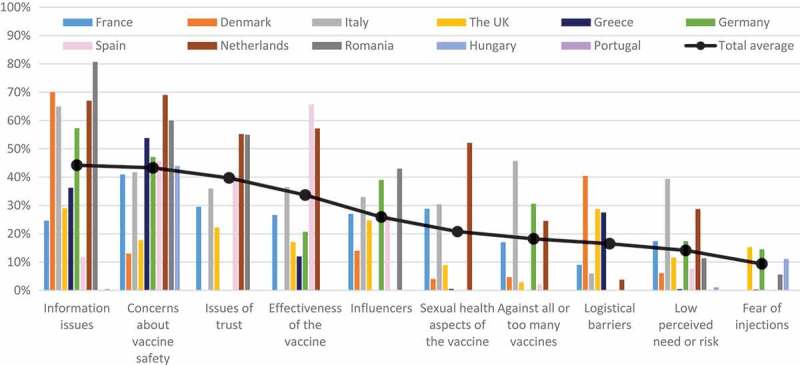
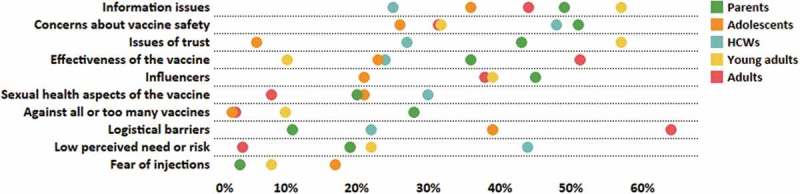
Europe is increasingly described as the region in the world with the least confidence in vaccination, and particularly in the safety of vaccines. The aim of this systematic literature review was to gather and summarise all peer-reviewed and grey literature published about determinants of Human Papillomavirus (HPV) vaccine hesitancy in Europe. Ten thematic categories were identified across the 103 articles which were included in the review. Participants from European studies most commonly reported issues with the quantity and quality of information available about HPV vaccination; followed by concerns about potential side effects of the vaccine; and mistrust of health authorities, healthcare workers, and new vaccines. Comparative analyses indicated that confidence determinants differed by country and population groups. This evidence supports the need to develop context-specific interventions to improve confidence in HPV vaccination and design community engagement strategies aiming to build public trust.
Overview
The claims and statistics of this paper haven’t been checked yet.
Run the check — free, no account needed. It reads the open-access text and checks the sources it cites.
Integrity signals
Registry
Cites
Statistics
Figures
Verification
Claims the paper makes
The claims and statistics of this paper haven’t been checked yet.
Run the check — free, no account needed. It reads the open-access text and checks the sources it cites.
Claims other papers make about this one
Each is checked against this paper’s own text: does it say what the citing paper says it does?
In the citing paper
“Low rates of vaccine compliance, particularly with the HPV vaccine,48 provide additional cautionary notes and highlight the challenges to be faced in overcoming potential vaccine hesitancy regarding SARS-CoV-2 vaccines in children.”
From SARS-CoV-2 vaccine testing and trials in the pediatric population: biologic, ethical, research, and implementation challenges (2021) · cites this paper as [48]
Self-check
Percentages, sums and reported differences re-computed from the paper’s own numbers.
The self-check needs the paper’s full text.
Citations
Cites
Dermyshi, E., Wang, Y., Yan, C., Hong, W., Qiu, G., Gong, X., & Zhang, T. (2017) · Neonatology · doi:10.1159/000454668 · Cited by 24,586
Meta-analysis of Observational Studies in Epidemiology<SUBTITLE>A Proposal for Reporting</SUBTITLE>
Stroup, D. F. (2000) · JAMA · doi:10.1001/jama.283.15.2008 · Cited by 20,623
Critical appraisal skills programme
Singh, J. (2013) · Journal of Pharmacology and Pharmacotherapeutics · doi:10.4103/0976-500x.107697 · Cited by 2,601
Methods for the synthesis of qualitative research: a critical review
Barnett-Page, E., & Thomas, J. (2009) · BMC Medical Research Methodology · doi:10.1186/1471-2288-9-59 · Cited by 2,386
Larson, H. J., Jarrett, C., Eckersberger, E., Smith, D. M. D., & Paterson, P. (2014) · Vaccine · doi:10.1016/j.vaccine.2014.01.081 · Cited by 2,254
Self-citationDubé, È., Laberge, C., Guay, M., Bramadat, P. A., Roy, R., & Bettinger, J. A. (2013) · Human Vaccines & Immunotherapeutics · doi:10.4161/hv.24657 · Cited by 2,178 · cited 1×
“A number of studies have shown that uncertainty can influence as much as empirical evidence in vaccination decision-making.(122,123) Uncertainty is still often framed as something that can be overcome by filling information gaps with more facts; however, mistrust of health authorities and some doctors was commonly rep…”
BackgroundRAMESES publication standards: realist syntheses
Wong, G., Greenhalgh, T., Westhorp, G., Buckingham, J., & Pawson, R. (2013) · BMC Medicine · doi:10.1186/1741-7015-11-21 · Cited by 1,374
The State of Vaccine Confidence 2016: Global Insights Through a 67-Country Survey
Larson, H. J., de Figueiredo, A., Xiahong, Z., Schulz, W. S., Verger, P., Johnston, I. G., Cook, A. R., & Jones, N. S. (2016) · EBioMedicine · doi:10.1016/j.ebiom.2016.08.042 · Cited by 1,264
Self-citationMeta‐synthesis method for qualitative research: a literature review
Walsh, D., & Downe, S. (2005) · Journal of Advanced Nursing · doi:10.1111/j.1365-2648.2005.03380.x · Cited by 1,246
Strategies for addressing vaccine hesitancy–A systematic review
Jarrett, C., Wilson, R., O’Leary, M., Eckersberger, E., & Larson, H. J. (2015) · Vaccine · doi:10.1016/j.vaccine.2015.04.040 · Cited by 1,066
Self-citation
Research works printed but not linked: 5
- European Centre for Disease Prevention and Control. Rapid literature review on motivating hesitant population groups in Europe to vaccinate. Stockholm, Sweden: ECDC; 2015.
- Pope C, Mays N, Jennie P. Synthesising qualitative and quantitative health evidence: a guide to methods. Maidenhead, England: Open University Press; 2007.
- The Joanna Briggs Institute. The Joanna Briggs institute reviewers’ manual - methodology for JBI mixed methods systematic reviews. Adelaide, Australia: The University of Adelaide; 2014.
- Camano-Puig R, Sanchis-Martinez MM. Human papilloma virus vaccination in teenage girls: a focus group evaluation. Revista de Salud Publica. 2014;16:646–57.
- Abram Z, Tar G. Health education of mothers about their girls’ vaccination. 4th world conference on educational sciences. Procedia Soc Behav Sci. 2012;462012:5330–34.
Cited by
Sorted by citations
Vaccine hesitancy in the era of COVID-19
Troiano, G., & Nardi, A. (2021) · Public Health · doi:10.1016/j.puhe.2021.02.025 · Cited by 1,342
Freeman, D. H., Loe, B. S., Chadwick, A., Vaccari, C., Waite, F., Rosebrock, L. E., Jenner, L., Petit, A., Lewandowsky, S., Vanderslott, S., et al. (2020) · Psychological Medicine · doi:10.1017/s0033291720005188 · Cited by 802
Larson, H. J., Gakidou, E. E., & Murray, C. J. L. (2022) · New England Journal of Medicine · doi:10.1056/nejmra2106441 · Cited by 516
Self-citationChew, N., Cheong, C., Kong, G., Phua, K., Ngiam, J. N., Tan, B. Y., Wang, B., Hao, F., Tan, W., Han, X., et al. (2021) · International Journal of Infectious Diseases · doi:10.1016/j.ijid.2021.03.069 · Cited by 177
Overcoming COVID-19 vaccine hesitancy among ethnic minorities: A systematic review of UK studies
Hussain, B., Latif, A., Timmons, S., Nkhoma, K. B., & Nellums, L. B. (2022) · Vaccine · doi:10.1016/j.vaccine.2022.04.030 · Cited by 135
“Misconceptions about the immunisation process [45], lack of trust in government or healthcare [46], newness of a vaccine [47], perceived incompatibility of vaccines with religious and cultural beliefs [25] and conspiracy theories [48] were highlighted as factors known to aggravate lack of confidence in vaccines.”
Metadata
- Authors
- Karafillakis, E., Simas, C., Jarrett, C., Verger, P., Peretti-Watel, P., Dib, F., De Angelis, S., Takacs, J., Ali, K. A., Pastore Celentano, L., & Larson, H.
- Affiliations
- London School of Hygiene & Tropical Medicine (GB)
- Swiss Tropical and Public Health Institute (CH)
- Inserm (FR)
- Aix Marseille Univ, IRD, AP-HM, SSA, VITROME, IHU-Méditerranée Infection, Marseille, France
- Vaccine Preventable Disease Programme, European Centre for Disease Prevention and Control, Stockholm, Sweden
- Centre for Social Sciences, Hungarian Academy of Sciences, Budapest, Hungary
- European Centre for Disease Prevention and Control (SE)
- University of Washington (US)
- Corresponding author
- Karafillakis, Emilie
- Venue
- Human Vaccines & Immunotherapeutics
- Publisher
- Informa UK Limited
- Published
- 2019-02-20
- Volume
- 15
- Issue
- 7-8
- Pages
- 1615-1627
- ISSN
- 2164-5515 (ISSN-L)
- 2164-554X
- PMC
- PMC6783136
- OpenAlex
- W2910348912
- Cited by
- 328
- References
- 132
- Citations by year
- 2026: 43 · 2025: 53 · 2024: 49 · 2023: 48 · 2022: 63 · 2021: 36 · 2020: 25 · 2019: 11
- FWCI
- 7.18
- Type
- journal article
- Language
- en
- Open access
- hybrid
- doi.org
- Licence
- Locations
- Human Vaccines & Immunotherapeutics (publishedVersion, cc-by-nc-nd)
- PubMed Central (publishedVersion, cc-by-nc-nd)
- PubMed (publishedVersion)
- edoc (University of Basel) (acceptedVersion)
- Repository of the Academy's Library (Library of the Hungarian Academy of Sciences) (acceptedVersion)
- DOAJ (DOAJ: Directory of Open Access Journals) (acceptedVersion)
- LSHTM Research Online (London School of Hygiene and Tropical Medicine) (acceptedVersion)
- HAL AMU (submittedVersion, cc-by-nc-nd)
- Funders
- European Centre for Disease Prevention and Control (OCS-2016-0UT-2050-MCTeFo)
- Topics
- Social Sciences › Health › Vaccine Coverage and Hesitancy
- Health Sciences › Medicine › Epidemiology › Cervical Cancer and HPV Research
- Health Sciences › Medicine › Public Health, Environmental and Occupational Health › Women's cancer prevention and management
- Keywords
- HPV vaccination, vaccine hesitancy, vaccine confidence, vaccine safety concerns, vaccine side effects, determinants of vaccine hesitancy, community participation, Europe
- MeSH terms
- Vaccination Refusal, Uterine Cervical Neoplasms, Europe, Female, Humans, Health Knowledge, Attitudes, Practice, Patient Acceptance of Health Care, Vaccination, Papillomavirus Infections, Uncertainty, Trust, Papillomavirus Vaccines
About these checks
Registry, retraction, Cites and statistics results are computed, not judged, with one exception: a printed reference that no index lists is read once by a model before it counts as a citation error. Claims are extracted by a model and kept only when their quote appears verbatim in the text; each cited source is then checked, with a model’s help, for whether it says what the claim relies on. Those verdicts can be wrong — read the claim’s quote and the cited source before relying on one.
Statistics and arithmetic are recomputed, not judged.
Confidence bands are shown only for fields calibrated on our annotated test set. None is calibrated yet, so no band is shown.
What counts as a claim ›How we measure confidence ›How we check this ›
Are you an author, or do you see a problem with this page? Request a review
