

A unified model for the molecular basis of Xeroderma pigmentosum-Cockayne Syndrome
Open accessThe DOI matches its Crossref record; 32 of the 33 references it cites were found in a registry or an index.
Abstract
Nucleotide Excision Repair (NER) is a pathway that removes lesions distorting the DNA helix. The molecular basis of the rare diseases Xeroderma pigmentosum (XP) and Cockayne Syndrome (CS) are explained based on the defects happening in 2 NER branches: Global-Genome Repair and Transcription-Coupled Repair, respectively. Nevertheless, both afflictions sporadically occur together, giving rise to XP/CS; however, the molecular basis of XP/CS is not understood very well. Many efforts have been made to clarify why mutations in only 4 NER genes, namely XPB, XPD, XPF and XPG, are the basis of this disease. Effort has also been made to unravel why mutations within these genes lead to XP, XP/CS, or other pathologies. We have recently contributed to the disclosure of this puzzle by characterizing Rad3/XPD mutations in Saccharomyces cerevisiae and human cells. Based on our, and others', observations, we propose a model compatible with all XP/CS cases and the current bibliography.
Overview
The claims and statistics of this paper haven’t been checked yet.
Free: it reads the open-access text and checks the first 5 claims that cite a source we can check. Create a free account to check every claim.
Integrity signals
Registry
Cites
Statistics
Figures
Verification
Claims the paper makes
The claims and statistics of this paper haven’t been checked yet.
Free: it reads the open-access text and checks the first 5 claims that cite a source we can check. Create a free account to check every claim.
Claims other papers make about this one
Each is checked against this paper’s own text: does it say what the citing paper says it does?
The cited source says what the claim attributes to it.
In the citing paper
“Nevertheless, defects in both XP and CS can occur together in the same patient, which gives rise to a XP/CS phenotype [233].”
From Sunlight damage to cellular DNA: focus on oxidatively generated lesions (2017) · cites this paper as [233]
Self-check
Percentages, sums and reported differences re-computed from the paper’s own numbers.
The self-check needs the paper’s full text.
Citations
Cites
Nucleotide excision repair and human syndromes
de Boer, J., & Hoeijmakers, J. H. J. (2000) · Carcinogenesis · doi:10.1093/carcin/21.3.453 · Cited by 674
Venema, J., Mullenders, L. H., Natarajan, A. T., van Zeeland, A. A., & Mayne, L. V. (1990) · Proceedings of the National Academy of Sciences · doi:10.1073/pnas.87.12.4707 · Cited by 551 · cited 1×
“The XP molecular basis is explained by defects in GlobalGenome Repair (GGR), in which lesions are recognized all over the genome, whereas the molecular basis of CS has been classically explained by defects in Transcription-Coupled Repair (TCR), a NER subpathway in which the lesions are encountered and signaled by the…”
BackgroundBradford, P. T., Goldstein, A. M., Tamura, D., Khan, S. G., Ueda, T., Boyle, J., Oh, K.-S., Imoto, K., Inui, H., Moriwaki, S.-I., et al. (2011) · Journal of Medical Genetics · doi:10.1136/jmg.2010.083022 · Cited by 480
Disorders of nucleotide excision repair: the genetic and molecular basis of heterogeneity
Cleaver, J. E., Lam, E. T., & Revet, I. (2009) · Nature Reviews Genetics · doi:10.1038/nrg2663 · Cited by 428
Fan, L., Fuss, J. O., Cheng, Q. J., Arvai, A. S., Hammel, M., Roberts, V. A., Cooper, P. K., & Tainer, J. A. (2008) · Cell · doi:10.1016/j.cell.2008.04.030 · Cited by 369
Secrets of a double agent: CDK7 in cell-cycle control and transcription
Fisher, R. P. (2005) · Journal of Cell Science · doi:10.1242/jcs.02718 · Cited by 363 · cited 2×
“The CAK subcomplex is released from the core TFIIH during NER, which is known to stimulate incision and repair of damaged DNA, while its re-association does not occur until resumption of transcription.18 A relevant consequence of having an excess of free CAK is an alteration in cell cycle progression, since many key p…”
BackgroundReconstitution of the Transcription Factor TFIIH
Tirode, F., Busso, D., Coin, F., & Egly, J.-M. (1999) · Molecular Cell · doi:10.1016/s1097-2765(00)80177-x · Cited by 301 · cited 2×
“However, TFIIH also has a fundamental role in the initiation of transcription, since it allows promoter opening via another helicase, Rad25/ XPB, and promotes RNA polymerase escape to start elongation.(6) The latter function is achieved by the kinase activity of the CDK Activating Kinase (CAK), a subcomplex of TFIIH.”
BackgroundCoordination of dual incision and repair synthesis in human nucleotide excision repair
Staresincic, L., Fagbemi, A. F., Enzlin, J. H., Gourdin, A. M., Wijgers, N., Dunand‐Sauthier, I., Giglia‐Mari, G., Clarkson, S. G., Vermeulen, W., & Schärer, O. D. (2009) · The EMBO Journal · doi:10.1038/emboj.2009.49 · Cited by 287
Kashiyama, K., Nakazawa, Y., Pilz, D. T., Guo, C., Shimada, M., Sasaki, K., Fawcett, H., Wing, J. F., Lewin, S. O., Carr, L., et al. (2013) · The American Journal of Human Genetics · doi:10.1016/j.ajhg.2013.04.007 · Cited by 212
Ito, S., Kuraoka, I., Chymkowitch, P., Compe, E., Takedachi, A., Ishigami, C., Coin, F., Egly, J.-M., & Tanaka, K. (2007) · Molecular Cell · doi:10.1016/j.molcel.2007.03.013 · Cited by 197 · cited 2×
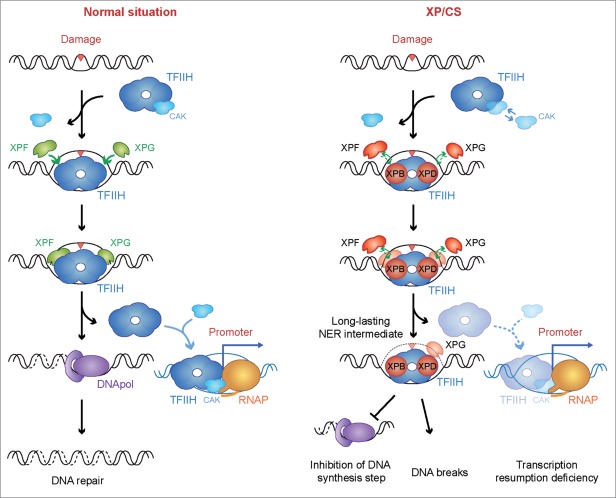
“TFIIH association with the lesion may therefore occur, but the inability to recruit XPG halts incision by both XPF-ERCC1 and XPG at the 50 side or at the 30 side of the lesion, respectively,(22,30) and may even cause late XPD and CAK dissociation, leaving an aberrant repair bubble without further processing.(24) There…”
BackgroundKeriel, A., Stary, A., Sarasin, A., Rochette-Egly, C., & Egly, J.-M. (2002) · Cell · doi:10.1016/s0092-8674(02)00692-x · Cited by 192 · cited 1×
“First, an XP-B/CS-causing mutation (XPCS1BA patient) was not seen to induce a relevant increase in free CAK(24) and, second, mutations in the C-terminus of XPD (XPD-R683W) weakening the association of the CAK to TFIIH were at the base of an XP, but not of an XP/CS, condition.(26) One simple way of resolving these inco…”
BackgroundFan, L., Arvai, A. S., Cooper, P. K., Iwai, S., Hanaoka, F., & Tainer, J. A. (2006) · Molecular Cell · doi:10.1016/j.molcel.2006.02.017 · Cited by 178 · cited 3×
“XPB-associated ATPase activity needs to be exerted for NER.(27) In analogy with XPD, any loss of ATPase activity in context of a functional TFIIH may cause a gain of affinity for DNA.”
BackgroundNucleotide Excision Repair Driven by the Dissociation of CAK from TFIIH
Coin, F., Oksenych, V., Mocquet, V., Groh, S., Blattner, C., & Egly, J. M. (2008) · Molecular Cell · doi:10.1016/j.molcel.2008.04.024 · Cited by 178 · cited 1×
“The CAK subcomplex is released from the core TFIIH during NER, which is known to stimulate incision and repair of damaged DNA, while its re-association does not occur until resumption of transcription.(18) A relevant consequence of having an excess of free CAK is an alteration in cell cycle progression, since many key…”
BackgroundMocquet, V., Lainé, J. P., Riedl, T., Yajin, Z., Lee, M. Y., & Egly, J. M. (2008) · The EMBO Journal · doi:10.1038/sj.emboj.7601948 · Cited by 164 · cited 2×
“Second, XPG mutations leading to XP/CS are as well able to promote TFIIH assembly and bubble establishment, but recruitment of DNA synthesis factors is prevented.(11) Altogether, we propose the long-lasting NER intermediate as the general molecular defect underlying all XP/CS deficiencies, irrespective of whether it i…”
BackgroundXpd/Ercc2 regulates CAK activity and mitotic progression
Chen, J., Larochelle, S., Li, X., & Suter, B. (2003) · Nature · doi:10.1038/nature01746 · Cited by 127 · cited 1×
“Thus, in Drosophila embryos, excess of XPD titrates CAK activity resulting in defects at mitosis, while down regulation of XPD leads to an excess of free CAK and a burst in proliferation.(20) In agreement, the yeast mutants rad3–102 (Rad3-H661Y) and rad3–2 show faster entry into the Sphase.”
BackgroundMMXD, a TFIIH-Independent XPD-MMS19 Protein Complex Involved in Chromosome Segregation
Ito, S., Tan, L. J., Andoh, D., Narita, T., Seki, M., Hirano, Y., Narita, K., Kuraoka, I., Hiraoka, Y., & Tanaka, K. (2010) · Molecular Cell · doi:10.1016/j.molcel.2010.07.029 · Cited by 121 · cited 1×
“The proposals were raised because an excess of free CAK had been reported in different XP/CS cells, as is the case of XP-G/CS cells,(24) and in XP-D/CS cells, which furthermore show aberrant chromosome segregation due to premature commitment to mitosis.(25)”
ResultGiannattasio, M., Follonier, C., Tourrière, H., Puddu, F., Lazzaro, F., Pasero, P., Lopes, M., Plevani, P., & Muzi-Falconi, M. (2010) · Molecular Cell · doi:10.1016/j.molcel.2010.09.004 · Cited by 121 · cited 1×
“In non-cycling cells this may lead to extensive resection of the processed DNA strand, subsequent accumulation of ssDNA and therefore genetic instability.(12) In dividing cells, the ssDNA gap would be converted into a double strand break (DSB) when an incoming replication fork hits the unfinished NER intermediate.”
BackgroundIn TFIIH, XPD Helicase Is Exclusively Devoted to DNA Repair
Kuper, J., Braun, C., Elias, A., Michels, G., Sauer, F., Schmitt, D. R., Poterszman, A., Egly, J., & Kisker, C. (2014) · PLoS Biology · doi:10.1371/journal.pbio.1001954 · Cited by 112 · cited 1×
“In transcription, the Rad3/XPD role is strictly structural, serving to bridge the CAK with the rest of the complex.(6,7) Fundamentally, rad3 mutants can be ascribed either to those being highly UV-sensitive, because of a NER defect, and those bearing transcription initiation problems, due to a defect in the TFIIH asse…”
BackgroundPhotobleaching approaches to investigate diffusional mobility and trafficking of Ras in living cells
Goodwin, J. S., & Kenworthy, A. K. (2005) · Methods · doi:10.1016/j.ymeth.2005.05.013 · Cited by 99 · cited 1×
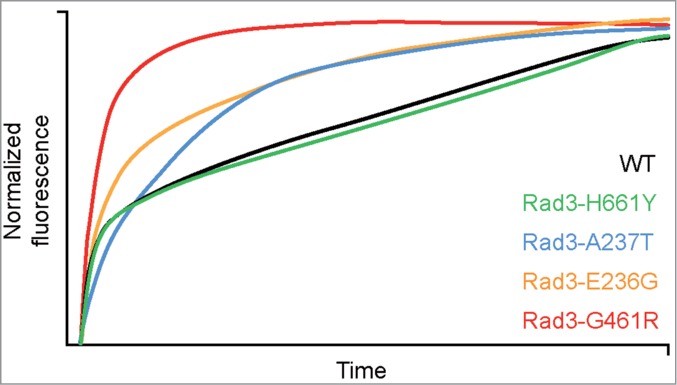
“The time in which the given recovery is achieved is proportional to the molecular weight of the complex being analyzed.(16) When the latter quantification was done (by plotting the data relative to a normalized maximum value), we perceived differences in the slopes among the various strains, indicative of faster TFIIH…”
BackgroundNaumovski, L., Chu, G., Berg, P. R., & Friedberg, E. C. (1985) · Molecular and Cellular Biology · doi:10.1128/mcb.5.1.17 · Cited by 94
Dynamic Interaction of TTDA with TFIIH Is Stabilized by Nucleotide Excision Repair in Living Cells
Giglia-Mari, G., Miquel, C., Theil, A. F., Mari, P.-O., Hoogstraten, D., Ng, J. M. Y., Dinant, C., Hoeijmakers, J. H. J., & Vermeulen, W. (2006) · PLoS Biology · doi:10.1371/journal.pbio.0040156 · Cited by 89 · cited 1×
“The TFIIH mobility curve, expressed as the mean of the different states of association of a protein with its different partners, had indeed been characterized for a given TFIIH protein.(17) In these assays, the steepest slope would mean a higher fraction of assembled TFIIH complexes with lower molecular weight (rad3–2…”
BackgroundMontelone, B. A., Hoekstra, M. F., & Malone, R. E. (1988) · Genetics · doi:10.1093/genetics/119.2.289 · Cited by 76
Phosphorylation of XPB helicase regulates TFIIH nucleotide excision repair activity
Coin, F., Auriol, J., Tapias, A., Clivio, P., Vermeulen, W., & Egly, J. (2004) · The EMBO Journal · doi:10.1038/sj.emboj.7600480 · Cited by 75
Moriel‐Carretero, M., & Aguilera, A. (2010) · Molecular Cell · doi:10.1016/j.molcel.2010.02.008 · Cited by 71 · cited 6×
“The genetic defect in Cockayne syndrome is associated with a defect in repair of UVinduced DNA damage in transcriptionally active DNA.”
BackgroundSelf-citationThe molecular basis for different disease states caused by mutations in TFIIH and XPG
Schärer, O. D. (2008) · DNA repair · doi:10.1016/j.dnarep.2007.10.007 · Cited by 55
Vélez-Cruz, R., Zadorin, A. S., Coin, F., & Egly, J. (2012) · Proceedings of the National Academy of Sciences · doi:10.1073/pnas.1213076110 · Cited by 36 · cited 1×
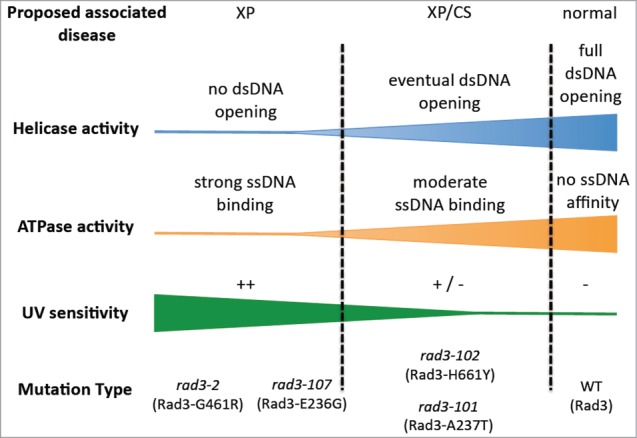
“Moreover, this correlates with heterochromatinization of the same promoters, tentatively because the retour of the complex is delayed.(15) A gradient of phenotypes is expected considering that different mutations in the ATPbinding groove of Rad3/XPD will confer different degrees of helicase inactivation and different…”
BackgroundOh, K., Imoto, K., Boyle, J., Khan, S. G., & Kraemer, K. H. (2007) · DNA repair · doi:10.1016/j.dnarep.2007.03.025 · Cited by 34
Arab, H. H., Wani, G., Ray, A., Shah, Z. I., Zhu, Q., & Wani, A. A. (2010) · PLoS ONE · doi:10.1371/journal.pone.0011007 · Cited by 33 · cited 1×
“Indeed, the idea of an excess of free CAK has already been proposed as a molecular hallmark of all XP/CS pathologies.(22,23) The proposals were raised because an excess of free CAK had been reported in different XP/CS cells, as is the case of XP-G/CS cells,(24) and in XP-D/CS cells, which furthermore show aberrant chr…”
ResultWinkler, G. S., Sugasawa, K., Eker, A. P. M., de Laat, W. L., & Hoeijmakers, J. H. J. (2001) · Biochemistry · doi:10.1021/bi002021b · Cited by 28 · cited 4×
“Our model thus provides a uniform explanation compatible with the role during NER not only of XPD (see above), but also of XPB, XPF and XPG. www.tandfonline.com e1079362-3Rare Diseases XPB-associated ATPase activity needs to be exerted for NER.27 In analogy with XPD, any loss of ATPase activity in context of a functio…”
BackgroundInfluentialGeneration of DNA single‐strand displacement by compromised nucleotide excision repair
Godon, C., Mourgues, S., Nonnekens, J., Mourcet, A., Coin, F., Vermeulen, W., Mari, P., & Giglia‐Mari, G. (2012) · The EMBO Journal · doi:10.1038/emboj.2012.193 · Cited by 26
Replication fork breakage and re-start: New insights into Rad3/XPD-associated deficiencies
Moriel‐Carretero, M., & Aguilera, A. (2010) · Cell Cycle · doi:10.4161/cc.9.15.12408 · Cited by 15
Self-citationHerrera‐Moyano, E., Moriel‐Carretero, M., Montelone, B. A., & Aguilera, A. (2014) · PLoS Genetics · doi:10.1371/journal.pgen.1004859 · Cited by 8 · cited 4×
“Moreover, not only the spontaneous damage that is a substrate of NER would generate DSBs in an XP/CS-like context, but also their production could be exacerbated if cells are directly challenged with UV light-mimetic drugs.(9) Thus, if the local delivery of such drugs in combination with HR inhibitors is feasible, thi…”
BackgroundSelf-citation
Cited by
NAD + metabolism: Bioenergetics, signaling and manipulation for therapy
Yang, Y., & Sauve, A. A. (2016) · Biochimica et Biophysica Acta (BBA) - Proteins and Proteomics · doi:10.1016/j.bbapap.2016.06.014 · Cited by 497
“DNA Repair Syndromes Cockayne’s Syndrome is an accelerated aging disease involving mutations in either Cockayne syndrome group A (CSA) or CSB proteins, involved in DNA repair, leading to progressive neurodegeneration [132, 133].”
BackgroundSunlight damage to cellular DNA: focus on oxidatively generated lesions
Schuch, A. P., Moreno, N. C., Schuch, N. J., Menck, C. F. M., & Garcia, C. C. M. (2017) · Free Radical Biology and Medicine · doi:10.1016/j.freeradbiomed.2017.01.029 · Cited by 436
The essential and multifunctional TFIIH complex
Rimel, J. K., & Taatjes, D. J. (2018) · Protein Science · doi:10.1002/pro.3424 · Cited by 136
The complete structure of the human TFIIH core complex
Greber, B. J., Toso, D. B., Fang, J., & Nogales, E. (2019) · eLife · doi:10.7554/elife.44771 · Cited by 138
Xeroderma pigmentosum-Cockayne syndrome complex
Natale, V., & Raquer, H. (2017) · Orphanet Journal of Rare Diseases · doi:10.1186/s13023-017-0616-2 · Cited by 85
“A recent report proposed that XP-CS may result from the retention of the NER intermediate TFIIH during cellular attempts at repairing UV and other bulky lesions [59].”
Background
Metadata
- Authors
- Moriel-Carretero, M., Herrera-Moyano, E., & Aguilera, A.
- Affiliations
- Centro Andaluz de Biología Molecular y Medicina Regenerativa CABIMER; Universidad de Sevilla; Seville, Spain
- Centro Andaluz de Biología Molecular y Medicina Regenerativa (ES)
- Corresponding author
- Aguilera, Andrés
- ORCID
- Aguilera, Andrés
- Venue
- Rare Diseases
- Publisher
- Informa UK Limited
- Published
- 2015-01
- Volume
- 3
- Issue
- 1
- Pages
- e1079362
- ISSN
- 2167-549X (ISSN-L)
- 2167-5511
- PMC
- PMC4588225
- OpenAlex
- W1608710719
- Cited by
- 16
- References
- 33
- Citations by year
- 2024: 2 · 2022: 1 · 2021: 1 · 2020: 2 · 2019: 3 · 2018: 3 · 2017: 3 · 2016: 1
- FWCI
- 1.01
- Type
- journal article
- Language
- en
- Open access
- hybrid
- doi.org
- Licence
- cc-by-nc
- Locations
- Rare Diseases (publishedVersion, cc-by-nc)
- PubMed Central (publishedVersion, cc-by-nc)
- PubMed (publishedVersion)
- LA Referencia (Red Federada de Repositorios Institucionales de Publicaciones Científicas) (publishedVersion, cc-by-nc-nd)
- DIGITAL.CSIC (Spanish National Research Council (CSIC)) (submittedVersion, cc-by-nc)
- idUS (Universidad de Sevilla) (submittedVersion, cc-by-nc-nd)
- Funders
- European Commission
- Ministerio de Economía y Competitividad
- Topics
- Life Sciences › Biochemistry, Genetics and Molecular Biology › Molecular Biology › DNA Repair Mechanisms
- Life Sciences › Biochemistry, Genetics and Molecular Biology › Genetics › Genomics and Rare Diseases
- Life Sciences › Biochemistry, Genetics and Molecular Biology › Molecular Biology › Nuclear Structure and Function
- Keywords
- xeroderma pigmentosum, Cockayne syndrome, nucleotide excision repair, global genome repair, transcription-coupled repair, XPG, XPD, XPC, Saccharomyces cerevisiae, DNA repair genes, DNA damage
About these checks
Registry, retraction, Cites and statistics results are computed, not judged, with one exception: a printed reference that no index lists is read once by a model before it counts as a citation error. Claims are extracted by a model and kept only when their quote appears verbatim in the text; each cited source is then checked, with a model’s help, for whether it says what the claim relies on. Those verdicts can be wrong — read the claim’s quote and the cited source before relying on one.
Statistics and arithmetic are recomputed, not judged.
Confidence bands are shown only for fields calibrated on our annotated test set. None is calibrated yet, so no band is shown.
What counts as a claim ›How we measure confidence ›How we check this ›
Are you an author, or do you see a problem with this page? Request a review
Data sources
Bibliographic data: Semantic Scholar, OpenAlex, Crossref.
Contains information from the Semantic Scholar Academic Graph Datasets, made available under the ODC Attribution License (ODC-BY 1.0).
Semantic Scholar’s data is described in: Kinney, R., et al. (2023). The Semantic Scholar Open Data Platform. arXiv:2301.10140.
