

Public debt and inflation nexus in Nigeria: An ARDL bounds test approach
Open accessThe DOI matches its Crossref record; 63 of the 65 references it cites were found in a registry or an index, and 1 are not checked yet; 1 of the 11 sources its claims cite were checked for support.
Abstract
Inflationary tendencies of public debt have been the cause of an unsettling debate among policymakers in Nigeria. Using the autoregressive distributed lag (ARDL) framework, this study attempts to investigate the impact of total public debt on inflation in Nigeria for the period 1983-2018. The cointegrating regression results reveal evidence of a stable long-run relationship among inflation, total public debt, money supply, interest rate, economic growth, trade openness, and private investment in the presence of structural breaks. Empirical results show that the impact of public debt on inflation is statistically insignificant, irrespective of whether the regression was in the short or the long run.
Verified 2026-11-22 · 1 reference not checked yet
Overview
CoChat Summary
## TL;DR
This study uses annual Nigerian time-series data from 1983–2018 and an ARDL bounds-testing approach to examine whether public debt affects inflation. It finds a stable long-run relationship among the variables, but total public debt has no statistically significant impact on inflation in either the short run or the long run.
## Key findings
- The ARDL bounds test gives an F-statistic of 6.38*, leading the authors to reject no cointegration and conclude that the variables are cointegrated.
- In the long-run and short-run estimates, the coefficient on public debt is statistically insignificant; the paper interprets this as a neutral impact of public debt on inflation in Nigeria.
- The lagged error-correction term is negative and significant at the 1% level, and the paper states that 61.3% of any previous-year disequilibrium is corrected in the current year.
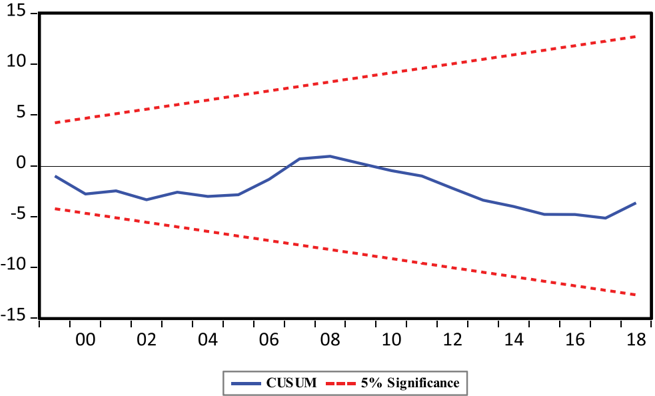
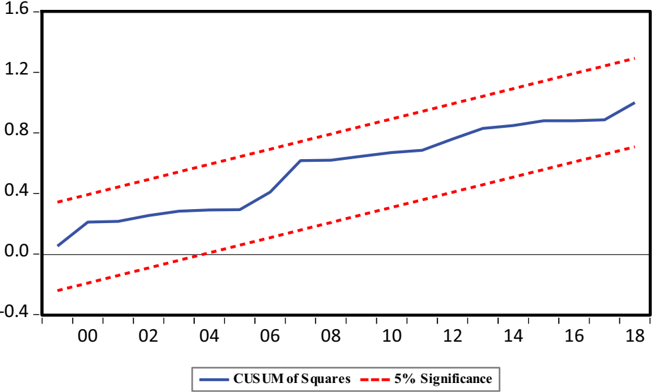
- The model’s adjusted R-squared is 65.28%, and the reported diagnostic tests indicate no serial correlation, no heteroscedasticity, normal residuals, and stable CUSUM/CUSUMSQ plots.
## Methods
- The paper studies Nigeria using annual time-series data from 1983–2018.
- It models inflation as a function of public debt, money supply, interest rate, economic growth, trade openness, and private investment, and includes a dummy for a structural break in 1998.
- Main analysis uses the ARDL bounds test approach, preceded by PP, DF-GLS, and Zivot-Andrews unit root tests, with an error-correction model for short-run dynamics and long-run estimation.
## Limitations
- The authors state that the study is limited by the use of aggregated public debt data rather than disaggregated data, so they cannot distinguish the effects of external and domestic public debt.
- The paper itself also notes that further work should use longer and disaggregated time-series data; this is a limitation stated by the authors.
- Evident from the text: the study is single-country and based on annual data only, which limits generalization and the ability to capture higher-frequency dynamics.
Model-written summary. Check it against the paper before relying on it.
Integrity signals
Registry
Cites
Statistics
Figures























Verification
Claims the paper makes
1 Valid · 1 Not valid · 5 Not checked · 34 Own results and interpretations
The cited sources support only part of this claim — read each source’s verdict below.
In the paper
“Evidence on the impact of public debt on inflation from literature reviewed in this study tilts towards a positive relationship.”
What the sources say
- Not checked — no full text of the sourcecites Bleaney (1996) matched to “INFLATION AND PUBLIC DEBT*” (1996) source
- Partly supportedcites Bilan and Roman (2014) matched to “Interconnections between Public Indebtedness and Inflation in Contemporary Economies” (2014) sourceExperimental — accuracy not yet measured
The literature this paper reviews does lean that way: Section 1 states that 'the negative impact of loans contracting for budget deficit financing on price levels is widely accounted for in the literature, mainly for developing countries' (citing Patience & Augustine, Catao & Terrones, Avgeris & Katrakilidis and others), and the Section 3 discussion invokes the 'specialized literature which shows that debt financing of the budget deficit in less developed countries is, to a greater extent, inflationary'. But the source bounds and hedges that tilt in ways the citing sentence drops: the same section adds that the link is 'usually quite weak', stronger only in particular countries and periods, that Table 2 shows opposite evolutions in Argentina (2005-2012), Bulgaria (2003-2011) and Moldova (2008-2012), that a reverse conditionality exists, and the Abstract and Conclusions conclude the correlation is 'quite difficult to identify in the practice, especially for currently developed economies' and that 'we were not able to certainly establish the existence of a direct conditionality'. So the general 'positive relationship' reading, unqualified as to country group and strength, overstates what the source supports. (LLM, conf=0.72)
- Not matchedcites Nguyen (2015)
An author–year citation the paper’s reference list doesn’t settle. We don’t search these by name.
hedgedstates an association- Asserted: passes — The authors put it forward as true.
- Checkable: passes — It can be checked against evidence.
- Load-bearing: unclear — It is unclear whether the paper’s conclusions depend on it.
- Based: passes — The paper gives a reason why it holds.
A result the paper reports from its own data — it cites no other source for it, so there is none to check. The quote shows it is in the paper.
In the paper
“Empirical results show that the impact of public debt on inflation is statistically insignificant, irrespective of whether the regression was in the short or the long run.”
- Also stated in: § PUBLIC INTEREST STATEMENT · boosted
“The findings of this study confirm that total public debt has a neutral impact on inflation, irrespective of whether the analysis is conducted in the short - or the long run.”
boosted- Asserted: passes — The authors put it forward as true.
- Checkable: passes — It can be checked against evidence.
- Load-bearing: passes — The paper’s conclusions depend on it.
- Based: passes — The paper gives a reason why it holds.
- Also stated in: § PUBLIC INTEREST STATEMENT · boosted
A result the paper reports from its own data — it cites no other source for it, so there is none to check. The quote shows it is in the paper.
In the paper
“The results displayed in Table 3 show that none of the variables is integrated of order two (i.e. I (2)), or higher for PP and DF-GLS unit root test.”
- Also stated in: § 4.2.1. Unit root test · plain
“Table 4 also shows that the results reported for ZA test confirmed that none of the variables is I (2).”
- Also stated in: § 4.2.1. Unit root test · plain
“The results reported in Tables 3 and 4 show that none of the variables used in this study is I(2).”
plain- Asserted: passes — The authors put it forward as true.
- Checkable: passes — It can be checked against evidence.
- Load-bearing: passes — The paper’s conclusions depend on it.
- Based: passes — The paper gives a reason why it holds.
- Also stated in: § 4.2.1. Unit root test · plain
A result the paper reports from its own data — it cites no other source for it, so there is none to check. The quote shows it is in the paper.
In the paper
“The structural change in inflation took place in 1998.”
- Also stated in: § 4.2.1. Unit root test · plain
“Table 4 shows that structural change in inflation (INF) took place in 1998 during the indirect approach to monetary management.”
plain- Asserted: passes — The authors put it forward as true.
- Checkable: passes — It can be checked against evidence.
- Load-bearing: unclear — It is unclear whether the paper’s conclusions depend on it.
- Based: passes — The paper gives a reason why it holds.
- Also stated in: § 4.2.1. Unit root test · plain
A result the paper reports from its own data — it cites no other source for it, so there is none to check. The quote shows it is in the paper.
In the paper
“The cointegrating regression results reveal evidence of a stable long-run relationship among inflation, total public debt, money supply, interest rate, economic growth, trade openness, and private investment in the presence of structural breaks.”
plainstates an association- Asserted: passes — The authors put it forward as true.
- Checkable: passes — It can be checked against evidence.
- Load-bearing: passes — The paper’s conclusions depend on it.
- Based: passes — The paper gives a reason why it holds.
17 more claims
Create a free account to see all 41 claims and every source verdict.
- The quote only partly states this claim. 3
- It may state two separate claims as one. 10
- Probably not a substantial claim. 9
Citations
Cites
null (2016) · Philosophy Study · doi:10.17265/2159-5313/2016.09.003 · Cited by 28,317
Bounds testing approaches to the analysis of level relationships
Pesaran, M. H., Shin, Y., & Smith, R. J. (2001) · Journal of Applied Econometrics · doi:10.1002/jae.616 · Cited by 20,385 · cited 2×
“To investigate and provide estimates of the short-run dynamics and long-run relationships of Equation 1, this study adopted the ARDL model approach, and the ensuing model specification following Pesaran et al. (2001) is expressed as: Table 1.”
MethodAre Government Bonds Net Wealth?
Barro, R. J. (1974) · Journal of Political Economy · doi:10.1086/260266 · Cited by 5,994 · cited 2×
“According to Barro (1974, 1989), the theorem is based on the monetarist view on inflation, namely that public debt does not have a significant impact in determining the price level, meaning that public debt does not create any wealth effects.”
BackgroundMethodTechniques for Testing the Constancy of Regression Relationships Over Time
Brown, R. L., Durbin, J., & Evans, J. M. (1975) · Journal of the Royal Statistical Society Series B: Statistical Methodology · doi:10.1111/j.2517-6161.1975.tb01532.x · Cited by 5,128 · cited 5×
“For instance, Budina and Wijnbergen (2000) argue that since 1989, persistent fiscal deficit problems have been the key factors behind inflation volatility for Eastern European countries. Islam and Wetzel (1991) also argue that, for less-developed countries, fiscal deficit has been blamed for much of the debt crisis, h…”
BackgroundMethodInfluentialInternational Journal of Humanities and Social Science
(2018) · International Journal of Humanities and Social Science · doi:10.30845/ijhss · Cited by 2,794
Equilibria under ‘active’ and ‘passive’ monetary and fiscal policies
Leeper, E. M. (1991) · Journal of Monetary Economics · doi:10.1016/0304-3932(91)90007-b · Cited by 2,058 · cited 3×
“Fiscal policy affects monetary authority’s ability to control inflation, especially under a fiscal dominant regime where the central bank may not be able to control inflationary pressures effectively (Leeper, 1991).”
BackgroundSome Unpleasant Monetarist Arithmetic
Sargent, T. J. (1981) · Quarterly Review · doi:10.21034/qr.531 · Cited by 1,511
Working with Microfit 4.0 : interactive econometric analysis
Pesaran, M. H., & Pesaran, B. (1997) · Oxford University Press eBooks · Cited by 1,364
The Ricardian Approach to Budget Deficits
Barro, R. J. (1989) · Journal of Economic Perspectives · doi:10.1257/jep.3.2.37 · Cited by 970
NBER macroeconomics annual 1987
(1989) · Journal of Macroeconomics · doi:10.1016/0164-0704(89)90056-6 · Cited by 917
Research works printed but not linked: 12
- Attiya Y. J., 2008, The Pakistan Development Review, 47, 763
- Bawa S., 2016, CBN Journal of Applied Statistics, 7, 255
- Bildirici, M., & Ersin, O. (2007). Domestic Debt, Inflation and Economic Crises: A Panel Co-integration Application to Emerging and Developed Economies. Applied Econometrics and International Development , 7 (1), 31-47.
- Cardoso, E., & Fishlow, A. (1990). External Debt, Budget Deficits, and Inflation. Developing Country Debt and Economic Performance. In J. D. Sachs (Ed.), NBER Macroeconomics Annual (Vol. 2, pp. 318-334). University of Chicago Press.
- Central Bank of Nigeria. (2001). Annual Statistical Bulletin 2000: Financial Statistics, Public Finance Statistics, External Sector Statistics and Domestic Production, Consumption and Prices , Volume 12, December 2001.
- Dada, E. A. (2016). Inflation Targeting Monetary Policy and Output in Nigeria. Journal of Monetary and Economic Integration , 11 (1), 35-57.
- Davig, T., & Leeper, E. M. (2007). Fluctuating Macro Policies and the Fiscal Theory. In D. Acemoglu, K. Rogoff, & M. Woodford (Eds.), NBER Macroeconomics Annual (Vol. 21, pp. 247-316). The MIT Press.
- Essien S. N., 2016, CBN Journal of Applied Statistics, 7, 125
- Karakaplan, M. U. (2009). The Conditional Effects of External Debt on Inflation. Journal of Social and Economic Research , 9 (17), 203-217.
- Ngerebo, T. A. (2014). Domestic Debt Burden, Debt Overhang and Inflationary Pressure in Nigeria. Journal of Empirical Economics , 3 (3), 172-183.
- Romero, J. P. B., & Marin, K. L. (2017). Inflation and Public Debt. Monetaria , V (1), 39-94.
- Titus, G. S. (2013). Public Debt and Economic Growth: Evidence from Nigeria's Data. West African Financial and Economic Review , 10 (1), 55-92.
Cited by
Sumba, J. O., Ochenge, R. O., Mugambi, P. J., & Musafiri, C. M. (2024) · Cogent Economics & Finance · doi:10.1080/23322039.2024.2326451 · Cited by 22
“For example Aimola and Odhiambo (2021a) study on the public debt and inflation nexus in Nigeria using Autoregressive distributed lag bounds model found that public debt does not cause inflation either in long or short run.”
InfluentialIs the effect of public debt on inflation symmetric or asymmetric? Evidence from the Gambia
Aimola, A. U., & Odhiambo, N. M. (2022) · Croatian Review of Economic Business and Social Statistics · doi:10.2478/crebss-2022-0004 · Cited by 17
“A stable and reduced inflation rate will help to increase real return on investment enabling economic actors to respond to various investment opportunities and opening up opportunities for new and existing investors in the promotion of economic development (Aimola, Odhiambo, 2021a).”
BackgroundResultSelf-citationSharaf, M. F., Shahen, A. M., & Binzaid, B. A. (2024) · Economies · doi:10.3390/economies12010018 · Cited by 12
“…the linear ARDL model imply an absence of a statistically significant long-term impact of foreign debt on inflation, aligning with studies such as Aimola and Odhiambo (2021b) and Essien et al. (2016) on Nigeria and Janssen et al. (2002) on U.K., whose findings also suggest no significant…”
BackgroundResultInfluentialEffect of renewable energy consumption and public debt on human capital in Nigeria
Osei-Gyebi, S., & Ajayi, P. I. (2025) · SN Business & Economics · doi:10.1007/s43546-025-00785-z · Cited by 4
“Other studies such as Ajayi and Edewusi (2020) and Aimola and Odhiambo (2021) reported the negative effect of public debt on economic variables like inflation in Nigeria.”
Influential
Metadata
- Authors
- Aimola, A. U., & Odhiambo, N. M.
- Affiliations
- University of South Africa (ZA)
- Corresponding author
- Aimola, Akingbade U.
- Venue
- Cogent Economics & Finance
- Publisher
- Informa UK Limited
- Published
- 2021-01-01
- Volume
- 9
- Issue
- 1
- ISSN
- 2332-2039 (ISSN-L)
- OpenAlex
- W3181990397
- Cited by
- 15
- References
- 52
- Citations by year
- 2026: 1 · 2025: 2 · 2024: 4 · 2023: 4 · 2022: 3 · 2021: 1
- FWCI
- 4.54
- Type
- journal article
- Language
- en
- Open access
- gold
- doi.org
- Licence
- Locations
- Cogent Economics & Finance (publishedVersion, cc-by)
- RePEc: Research Papers in Economics (submittedVersion)
- DOAJ (DOAJ: Directory of Open Access Journals) (submittedVersion, cc-by-sa)
- Econstor (Econstor) (submittedVersion, cc-by)
- Unisa Institutional Repository (University of South Africa) (submittedVersion)
- Funders
- research
- Topics
- Social Sciences › Economics, Econometrics and Finance › General Economics, Econometrics and Finance › Monetary Policy and Economic Impact
- Social Sciences › Economics, Econometrics and Finance › Economics and Econometrics › Fiscal Policies and Political Economy
- Social Sciences › Economics, Econometrics and Finance › Economics and Econometrics › Fiscal Policy and Economic Growth
- Keywords
- public debt, inflation, Nigeria, money supply, interest rates, economic growth, trade openness, private investment, structural breaks, long-run relationship
About these checks
Registry, retraction, Cites and statistics results are computed, not judged, with one exception: a printed reference that no index lists is read once by a model before it counts as a citation error. Claims are extracted by a model and kept only when their quote appears verbatim in the text; each cited source is then checked, with a model’s help, for whether it says what the claim relies on. Those verdicts can be wrong — read the claim’s quote and the cited source before relying on one.
The claim verdicts this report counts are experimental: their accuracy is not yet measured.
A language model drew the claims from the paper on 2026-10-10, under version 3 of the claim definition (model deepseek-v4.1-flash, prompt extract-v3).
A second model labelled each claim on 2026-10-10 (model jev-1.13-20260917, definition revision gold-guideline-v0.2).
Cited sources are checked with a language model’s help (qwen3.8-omni-flash).
Statistics and arithmetic are recomputed, not judged.
Confidence bands are shown only for fields calibrated on our annotated test set. None is calibrated yet, so no band is shown.
What counts as a claim ›How we measure confidence ›How we check this ›
Are you an author, or do you see a problem with this page? Request a review
Data sources
Bibliographic data: Semantic Scholar, OpenAlex, Crossref.
Contains information from the Semantic Scholar Academic Graph Datasets, made available under the ODC Attribution License (ODC-BY 1.0).
Semantic Scholar’s data is described in: Kinney, R., et al. (2023). The Semantic Scholar Open Data Platform. arXiv:2301.10140.
