

Subacute pain trajectories following major musculoskeletal surgery in adolescents: A pilot study
Open accessThe DOI matches its Crossref record; 38 of the 39 references it cites were found in a registry or an index.
Abstract
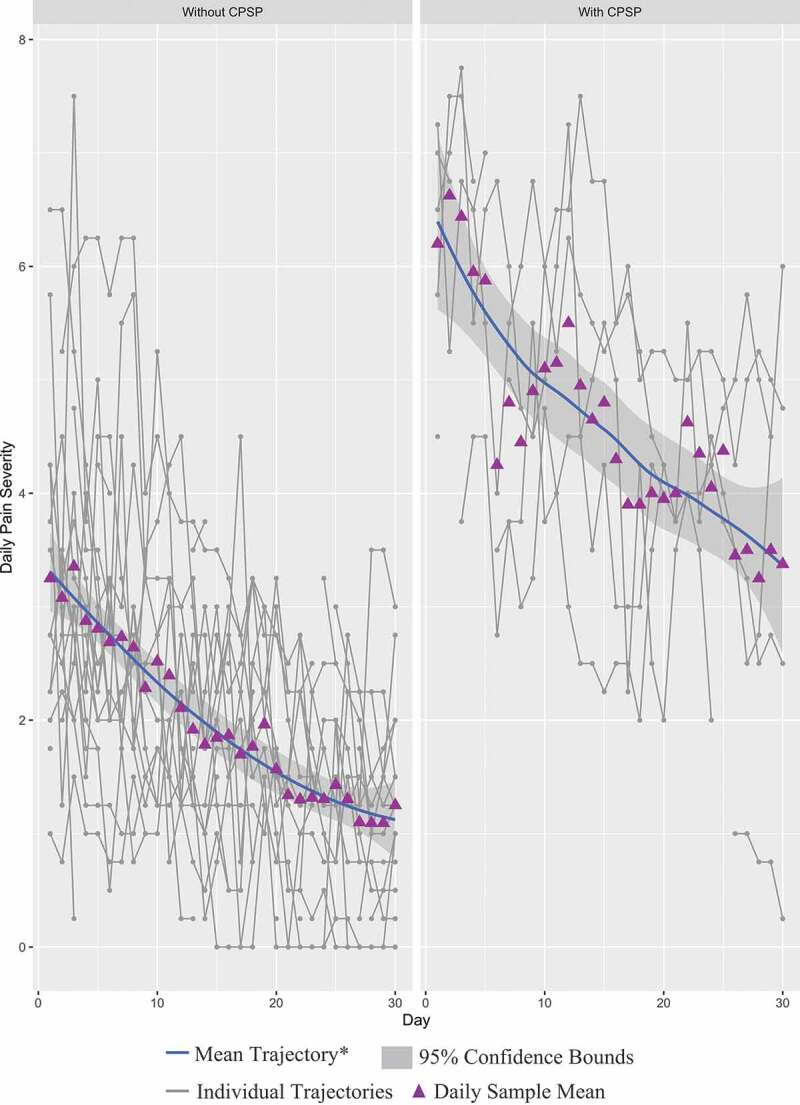
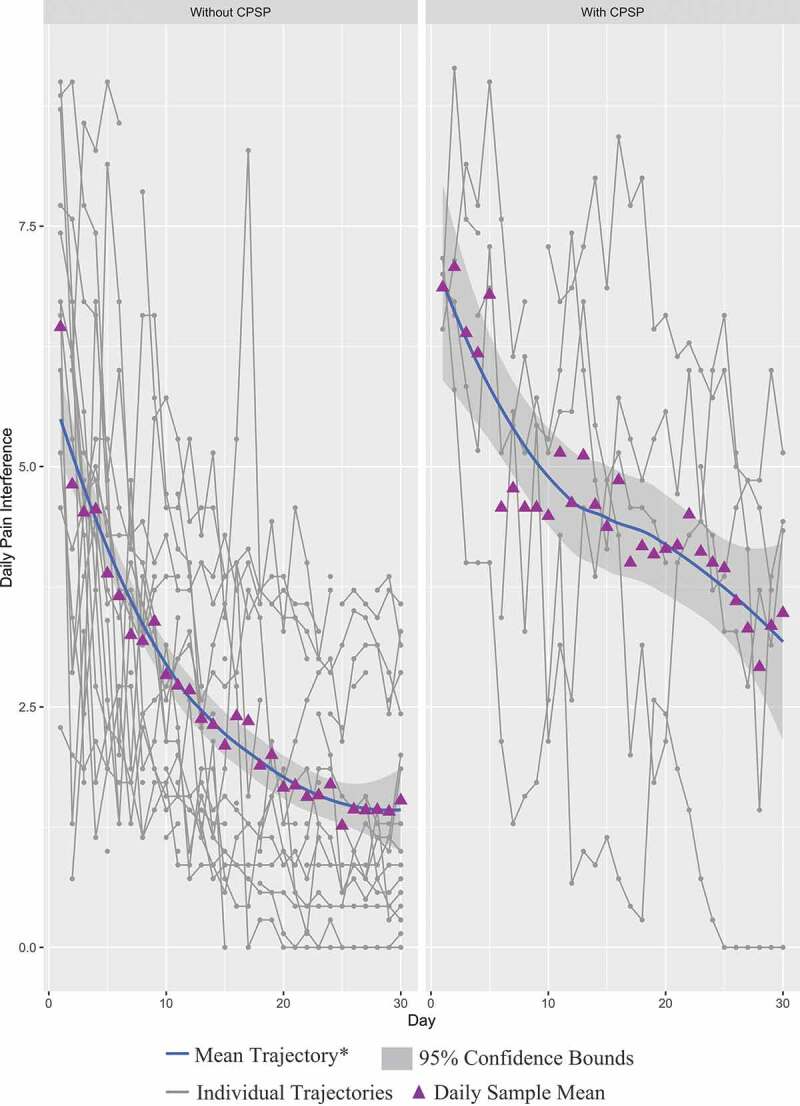
BACKGROUND: Adolescents who undergo major surgery experience high rates of disabling acute and chronic postsurgical pain (CPSP). However, little is known about the subacute period when acute to chronic pain transition occurs. AIMS: Examine feasibility of electronic daily monitoring of pain and opioid use in adolescents during the first 30-days at home following major surgery, and identify target features of subacute pain curves associated with CPSP at 4 months. METHODS: 25 youth (10-18 years) undergoing major musculoskeletal surgery reported daily pain severity, interference, and opioid use on the Brief Pain Inventory, each evening for 30 days after hospital discharge, to form short time series trajectories. At 4 months, youth reported on pain intensity and health-related quality of life. Characteristics of subacute pain severity and interference curves were compared by 4-month CPSP status. RESULTS: At 4 months, 20.8% of youth met criteria for CPSP. During the 30-day monitoring period, youth who went on to develop CPSP reported high pain severity on 45.9% of days as compared to 2.9% of days in youth who recovered (P=0.005), and high pain interference on 49.4% of days vs. 9.7% in youth who recovered (P=0.01). Pain variability and rate of change were not significantly associated with CPSP in our pilot sample. CONCLUSIONS: We found it feasible to collect daily pain data in youth recovering at home after major surgery. Pilot findings suggest that daily electronic monitoring may identify early recovery problems at home after surgery. Larger studies are needed to validate subacute pain trajectory features to identify risk for CPSP.
Overview
The claims and statistics of this paper haven’t been checked yet.
Free: it reads the open-access text and checks the first 5 claims that cite a source we can check. Create a free account to check every claim.
Integrity signals
Registry
Cites
Statistics
Figures
Verification
Claims the paper makes
The claims and statistics of this paper haven’t been checked yet.
Free: it reads the open-access text and checks the first 5 claims that cite a source we can check. Create a free account to check every claim.
Claims other papers make about this one
Each is checked against this paper’s own text: does it say what the citing paper says it does?
The source backs part of the claim, not all of it — or backs it for a different population, condition or comparison.
In the citing paper
“and higher acute postsurgical pain intensity scores are a reliable risk factor for developing CPSP. 25,26”
From Virtual psychoeducation for improvement of pain catastrophizing in pediatric presurgical patients and caregivers: a proof-of-concept study (2023) · cites this paper as [25]
Experimental — accuracy not yet measured
Self-check
Percentages, sums and reported differences re-computed from the paper’s own numbers.
The self-check needs the paper’s full text.
Citations
Cites
Controlling the False Discovery Rate: A Practical and Powerful Approach to Multiple Testing
Benjamini, Y., & Hochberg, Y. (1995) · Journal of the Royal Statistical Society Series B: Statistical Methodology · doi:10.1111/j.2517-6161.1995.tb02031.x · Cited by 109,482
Harris, P. A., Taylor, R., Thielke, R., Payne, J., Gonzalez, N., & Conde, J. G. (2009) · Journal of Biomedical Informatics · doi:10.1016/j.jbi.2008.08.010 · Cited by 51,384
The control of the false discovery rate in multiple testing under dependency
Benjamini, Y., & Yekutieli, D. (2001) · The Annals of Statistics · doi:10.1214/aos/1013699998 · Cited by 10,490
Varni, J. W., Seid, M., & Kurtin, P. S. (2001) · Medical Care · doi:10.1097/00005650-200108000-00006 · Cited by 5,131
Validation of the Brief Pain Inventory for chronic nonmalignant pain
Tan, G., Jensen, M. P., Thornby, J. I., & Shanti, B. F. (2004) · The Journal of Pain · doi:10.1016/j.jpain.2003.12.005 · Cited by 1,416
Keller, S., Bann, C. M., Dodd, S. L., Schein, J., Mendoza, T. R., & Cleeland, C. S. (2004) · The Clinical Journal of Pain · doi:10.1097/00002508-200409000-00005 · Cited by 1,233
Prescription Opioids in Adolescence and Future Opioid Misuse
Miech, R., Johnston, L., O’Malley, P. M., Keyes, K. M., & Heard, K. (2015) · Pediatrics · doi:10.1542/peds.2015-1364 · Cited by 466
Persistent Opioid Use Among Pediatric Patients After Surgery
Harbaugh, C. M., Lee, J. S., Hu, H. M., McCabe, S. E., Voepel-Lewis, T., Englesbe, M. J., Brummett, C. M., & Waljee, J. F. (2018) · Pediatrics · doi:10.1542/peds.2017-2439 · Cited by 449
I. Defining persistent post-surgical pain: is an update required?
Werner, M. U., & Kongsgaard, U. E. (2014) · British Journal of Anaesthesia · doi:10.1093/bja/aeu012 · Cited by 363
Rabbitts, J. A., Fisher, E., Rosenbloom, B. N., & Palermo, T. M. (2017) · The Journal of Pain · doi:10.1016/j.jpain.2017.03.007 · Cited by 317
Self-citation
Cited by
Rabbitts, J. A., Palermo, T. M., & Lang, E. A. (2020) · Journal of Pain Research · doi:10.2147/jpr.s239320 · Cited by 70
Self-citationAAAPT: Assessment of the Acute Pain Trajectory
Bayman, E. O., Oleson, J., & Rabbitts, J. A. (2021) · Pain Medicine · doi:10.1093/pm/pnaa440 · Cited by 28
Self-citationNarayanasamy, S., Yang, F., Ding, L., Geisler, K. J., Glynn, S. M., Ganesh, A., Sathyamoorthy, M., García, V., Sturm, P., & Chidambaran, V. (2021) · Journal of Pain · doi:10.1016/j.jpain.2021.06.014 · Cited by 27
Ellyson, A. M., Gordon, G., Zhou, C., & Rabbitts, J. A. (2021) · Journal of Pain · doi:10.1016/j.jpain.2021.12.009 · Cited by 26
Self-citationRabbitts, J. A., Zhou, C., de la Vega, R., Aalfs, H., Murray, C. B., & Palermo, T. M. (2021) · Trials · doi:10.1186/s13063-021-05421-3 · Cited by 25
Self-citationChronic Postsurgical Pain in Children and Adolescents: A Call for Action
Einhorn, L. M., Krishnan, P., Poirier, C., & Ingelmo, P. M. (2024) · Journal of Pain Research · doi:10.2147/jpr.s464009 · Cited by 25
Rosenbloom, B. N., Frederiksen, S. D., Wang, V., Park, C., Gordon, G., Brar, G., Rasic, N. F., Stinson, J., Birnie, K. A., & Rabbitts, J. A. (2025) · Regional Anesthesia & Pain Medicine · doi:10.1136/rapm-2024-105696 · Cited by 19
Self-citationLi, R., Rogers, A. H., Sujan, A. C., Zhou, C., Thiagarajan, P., Palermo, T. M., Kain, Z. N., & Rabbitts, J. A. (2025) · Pain · doi:10.1097/j.pain.0000000000003631 · Cited by 10
Self-citationPavlova, M., Lund, T., Sun, J., Katz, J. D., Brindle, M. E., & Noel, M. E. (2022) · Canadian Journal of Pain · doi:10.1080/24740527.2022.2058919 · Cited by 8
Daily Pain Experiences in Chronic Pancreatitis: Identifying Pain Phenotypes
Han, S. S., Li, R., & Palermo, T. M. (2023) · Pancreas · doi:10.1097/mpa.0000000000002271 · Cited by 6
Current Trends and New Strategies in Acute Postoperative Pain Management in Children
Pérez, E. V., Lizama, G., & Cárdenas, V. H. G. (2021) · Medical Research Archives · doi:10.18103/mra.v9i9.2539 · Cited by 6
Drake‐Brockman, T. F. E., Smallbone, H., Sommerfield, D. L., & von Ungern-Sternberg, B. S. (2022) · Pediatric Anesthesia · doi:10.1111/pan.14481 · Cited by 5
Zachariades, F., Maras, D., Mervitz, D., Martelli, B., Prayal-Brown, A., Hayawi, L., Barrowman, N., & Lamontagne, C. (2023) · Canadian Journal of Anesthesia/Journal canadien d anesthésie · doi:10.1007/s12630-023-02583-3 · Cited by 4
Rabbitts, J. A., Zhou, C., de la Vega, R., Aalfs, H., Murray, C. B., & Palermo, T. M. (2021) · Trials · doi:10.1186/s13063-021-05596-9 · Cited by 1
Self-citationPowelson, E. B., Chandra, N. A., Jessen-Fiddick, T., Zhou, C., & Rabbitts, J. A. (2022) · Pain Medicine · doi:10.1093/pm/pnac033 · Cited by 1
Self-citationSujan, A. C., Groenewald, C. B., Li, R., Schreiber, K. L., Palermo, T. M., Kain, Z. N., & Rabbitts, J. A. (2026) · Journal of Pain · doi:10.1016/j.jpain.2026.106327 · Cited by 1
Self-citationChronic Postsurgical Pain in Children
Raghavan, K. C., Anghelescu, D. L., & Frett, M. J. (2025) · Springer eBooks · doi:10.1007/978-3-031-76882-8_44 · Cited by 1
Chronic Postsurgical Pain in Children
Raghavan, K. C., Anghelescu, D. L., & Frett, M. J. (2023) · Springer eBooks · doi:10.1007/978-3-030-71113-9_44-1
Sex differences in adolescent chronic pain outcomes after spinal fusion: role of coping strategies
Li, R., Ceniza-Bordallo, G., Pester, B., Lulla, A., Palermo, T. M., Kain, Z. N., & Rabbitts, J. A. (2026) · Pain · doi:10.1097/j.pain.0000000000004007
Self-citationPain, function, and acute neuropathic pain up to one month after surgery: a registry-based analysis
Garduño-López, A. L., Baumbach, P., Acosta-Nava, V. M., Verdugo-Velázquez, F. F., Vidaña-Martínez, G. J., Molina-Niño, E., Cuéllar-Guzmán, L. F., García-Herrera, B. A., Rascón-Martínez, D. M., Islas-Lagunas, G., et al. (2026) · PAIN Reports · doi:10.1097/pr9.0000000000001456
Cummings, C., Ewing, S. W. F., Tran, D. D., Stoyles, S. A., Dieckmann, N. F., Holley, A. L., & Wilson, A. C. (2022) · Journal of Behavioral Medicine · doi:10.1007/s10865-022-00297-3
Metadata
- Authors
- Rabbitts, J. A., Groenewald, C. B., & Zhou, C.
- Affiliations
- Seattle Children's Hospital (US)
- Corresponding author
- Rabbitts, Jennifer A.
- Venue
- Canadian Journal of Pain
- Publisher
- Informa UK Limited
- Published
- 2020-12-21
- Volume
- 4
- Issue
- 4
- Pages
- 3-12
- ISSN
- 2474-0527 (ISSN-L)
- PMC
- PMC7787390
- OpenAlex
- W3025181790
- Cited by
- 20
- References
- 39
- Citations by year
- 2026: 3 · 2025: 3 · 2024: 1 · 2023: 3 · 2022: 4 · 2021: 4 · 2020: 2
- FWCI
- 2.97
- Type
- journal article
- Language
- en
- Open access
- gold
- doi.org
- Locations
- Canadian Journal of Pain (publishedVersion, cc-by)
- PubMed Central (publishedVersion, cc-by)
- PubMed (publishedVersion)
- DOAJ (DOAJ: Directory of Open Access Journals) (submittedVersion, cc-by-sa)
- Funders
- National Institutes of Health (R01AR073780)
- National Institute of Arthritis, Musculoskeletal National Heart, Lung, and Blood Institute (K23HL138155)
- Topics
- Health Sciences › Medicine › Anesthesiology and Pain Medicine › Anesthesia and Pain Management
- Health Sciences › Medicine › Pediatrics, Perinatology and Child Health › Pediatric Pain Management Techniques
- Health Sciences › Medicine › Anesthesiology and Pain Medicine › Pain Management and Treatment
- Keywords
- chronic postoperative pain, musculoskeletal surgery, adolescents, postoperative pain, pain interference, opioid use, pain variability
About these checks
Registry, retraction, Cites and statistics results are computed, not judged, with one exception: a printed reference that no index lists is read once by a model before it counts as a citation error. Claims are extracted by a model and kept only when their quote appears verbatim in the text; each cited source is then checked, with a model’s help, for whether it says what the claim relies on. Those verdicts can be wrong — read the claim’s quote and the cited source before relying on one.
Statistics and arithmetic are recomputed, not judged.
Confidence bands are shown only for fields calibrated on our annotated test set. None is calibrated yet, so no band is shown.
What counts as a claim ›How we measure confidence ›How we check this ›
Are you an author, or do you see a problem with this page? Request a review
Data sources
Bibliographic data: Semantic Scholar, OpenAlex, Crossref.
Contains information from the Semantic Scholar Academic Graph Datasets, made available under the ODC Attribution License (ODC-BY 1.0).
Semantic Scholar’s data is described in: Kinney, R., et al. (2023). The Semantic Scholar Open Data Platform. arXiv:2301.10140.
