

A Conceptual Model of Biopsychosocial Mechanisms of Transition from Acute to Chronic Postsurgical Pain in Children and Adolescents
Open accessThe DOI matches its Crossref record; 79 of the 80 references it cites were found in a registry or an index.
Abstract
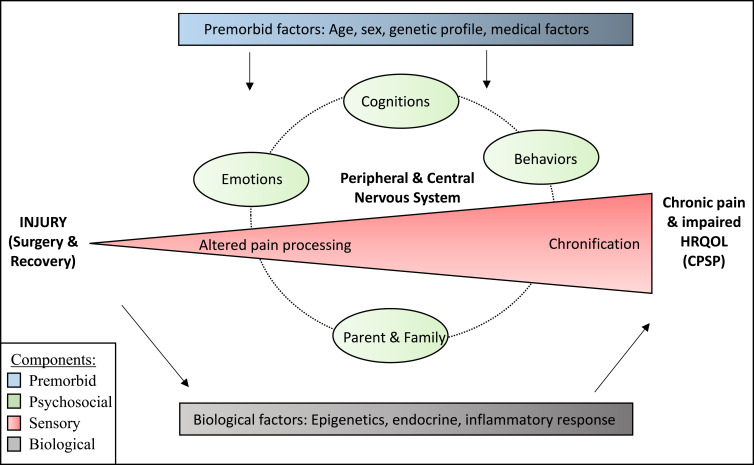
Acute and chronic pain are highly prevalent and impactful consequences of surgery across the lifespan, yet a comprehensive conceptual model encompassing biopsychosocial factors underlying acute to chronic pain transition is lacking, particularly in youth. Building on prior chronic postsurgical pain models, we propose a new conceptual model of biopsychosocial mechanisms of transition from acute to chronic postsurgical pain. This review aims to summarize existing research examining key factors underlying acute to chronic postsurgical pain transition in order to guide prevention and intervention efforts aimed at addressing this health issue in children. As pain transitions from acute nociceptive pain to chronic pain, changes in the peripheral and central nervous system contribute to the chronification of pain after surgery. These changes include alterations in sensory pain processing and psychosocial processes (psychological, behavioral, and social components), which promote the development of chronic pain. Patient-related premorbid factors (eg, demographic factors, genetic profile, and medical factors such as premorbid pain) may further modulate these changes. Factors related to acute injury and recovery (eg, surgical and treatment factors), as well as biological response to surgery (eg, epigenetic, inflammatory, and endocrine factors), may also influence this process. Overall, longitudinal studies examining temporal pathways of biopsychosocial processes including both risk and resiliency factors will be essential to identify the mechanisms involved in the transition from acute to chronic pain. Research is also needed to unravel connections between the acute pain experience, opioid exposure, and sensory pain processing during acute to chronic pain transition. Furthermore, future studies should include larger and more diverse samples to more fully explore risk factors in a broader range of pediatric surgeries. The use of conceptual models to guide intervention approaches targeting mechanisms of transition from acute to chronic pain will significantly advance this field and improve outcomes for children and adolescents undergoing surgery.
Overview
The claims and statistics of this paper haven’t been checked yet.
Free: it reads the open-access text and checks the first 5 claims that cite a source we can check. Create a free account to check every claim.
Integrity signals
Registry
Cites
Statistics
Figures
Verification
Claims the paper makes
The claims and statistics of this paper haven’t been checked yet.
Free: it reads the open-access text and checks the first 5 claims that cite a source we can check. Create a free account to check every claim.
Claims other papers make about this one
Each is checked against this paper’s own text: does it say what the citing paper says it does?
The source backs part of the claim, not all of it — or backs it for a different population, condition or comparison.
In the citing paper
“Research shows that presurgical psychosocial distress (e.g., child anxiety, child depression, child pain coping efficacy, and child and parental pain catastrophizing) increases the likelihood of CPSP. 13,14,17,18”
From Virtual psychoeducation for improvement of pain catastrophizing in pediatric presurgical patients and caregivers: a proof-of-concept study (2023) · cites this paper as [13]
Experimental — accuracy not yet measured
Self-check
Percentages, sums and reported differences re-computed from the paper’s own numbers.
The self-check needs the paper’s full text.
Citations
Cites
Persistent postsurgical pain: risk factors and prevention
Kehlet, H., Jensen, T. S., & Woolf, C. J. (2006) · The Lancet · doi:10.1016/s0140-6736(06)68700-x · Cited by 4,086
Diatchenko, L., Slade, G. D., Nackley, A. G., Bhalang, K., Sigurdsson, A., Belfer, I., Goldman, D., Xu, K., Shabalina, S. A., Shagin, D., et al. (2005) · Human Molecular Genetics · doi:10.1093/hmg/ddi013 · Cited by 1,280
COMT val 158 met Genotype Affects µ-Opioid Neurotransmitter Responses to a Pain Stressor
Zubieta, J.-K., Heitzeg, M. M., Smith, Y. R., Bueller, J. A., Xu, K., Xu, Y., Koeppe, R. A., Stohler, C. S., & Goldman, D. (2003) · Science · doi:10.1126/science.1078546 · Cited by 1,125
The role of psychosocial processes in the development and maintenance of chronic pain
Edwards, R. R., Dworkin, R. H., Sullivan, M. D., Turk, D. C., & Wasan, A. D. (2016) · The Journal of Pain · doi:10.1016/j.jpain.2016.01.001 · Cited by 954
McGrath, P. J., Walco, G. A., Turk, D. C., Dworkin, R. H., Brown, M. T., Davidson, K., Eccleston, C., Finley, G. A., Goldschneider, K., Haverkos, L., et al. (2008) · The Journal of Pain · doi:10.1016/j.jpain.2008.04.007 · Cited by 851
Self-citationTransition from acute to chronic postsurgical pain: risk factors and protective factors
Katz, J., & Seltzer, Z. (2009) · Expert Review of Neurotherapeutics · doi:10.1586/ern.09.20 · Cited by 782
Prediction of chronic post-operative pain: Pre-operative DNIC testing identifies patients at risk
Yarnitsky, D., Crispel, Y., Eisenberg, E., Granovsky, Y., Ben-Nun, A., Sprecher, E., Best, L.-A., & Granot, M. (2008) · Pain · doi:10.1016/j.pain.2007.10.033 · Cited by 750
Spinal cord mechanisms of pain
D’Mello, R., & Dickenson, A. H. (2008) · British Journal of Anaesthesia · doi:10.1093/bja/aen088 · Cited by 640
Getting the pain you expect: mechanisms of placebo, nocebo and reappraisal effects in humans
Tracey, I. (2010) · Nature Medicine · doi:10.1038/nm.2229 · Cited by 553
When does acute pain become chronic?
Voscopoulos, C., & Lema, M. (2010) · British Journal of Anaesthesia · doi:10.1093/bja/aeq323 · Cited by 473
Cited by
Li, Z., & Weng, X. (2022) · Journal of Orthopaedic Surgery and Research · doi:10.1186/s13018-022-03293-0 · Cited by 65
Alqudimat, M. R., Mesaroli, G., Lalloo, C., Stinson, J., & Matava, C. T. (2021) · Current anesthesiology reports · doi:10.1007/s40140-021-00472-3 · Cited by 42
Li, Z., Zeng, L., Cheng, K.-Y., & Weng, X. (2021) · The Journal of Arthroplasty · doi:10.1016/j.arth.2021.03.056 · Cited by 31
Epigenetics and Pain: New Insights to an Old Problem
Nirvanie-Persaud, L., & Millis, R. M. (2022) · Cureus · doi:10.7759/cureus.29353 · Cited by 30
Ellyson, A. M., Gordon, G., Zhou, C., & Rabbitts, J. A. (2021) · Journal of Pain · doi:10.1016/j.jpain.2021.12.009 · Cited by 26
Self-citation
Metadata
- Authors
- Rabbitts, J. A., Palermo, T. M., & Lang, E. A.
- Affiliations
- Seattle Children's Hospital (US)
- Weill Cornell Medicine (US)
- Corresponding author
- Rabbitts, Jennifer A
- Venue
- Journal of Pain Research
- Publisher
- Informa UK Limited
- Published
- 2020-11
- Volume
- Volume 13
- Pages
- 3071-3080
- ISSN
- 1178-7090 (ISSN-L)
- PMC
- PMC7699440
- OpenAlex
- W3106829174
- Cited by
- 70
- References
- 80
- Citations by year
- 2026: 13 · 2025: 18 · 2024: 9 · 2023: 7 · 2022: 12 · 2021: 11
- FWCI
- 1.65
- Type
- journal article
- Language
- en
- Open access
- gold
- doi.org
- Licence
- Locations
- Journal of Pain Research (publishedVersion, cc-by-nc)
- PubMed Central (publishedVersion, cc-by-nc)
- PubMed (publishedVersion)
- Dove Medical Press (Taylor and Francis Group) (submittedVersion, cc-by-nc)
- Funders
- National Institute of Arthritis and Musculoskeletal and Skin Diseases (R01AR073780)
- Topics
- Health Sciences › Medicine › Pediatrics, Perinatology and Child Health › Pediatric Pain Management Techniques
- Health Sciences › Medicine › Anesthesiology and Pain Medicine › Anesthesia and Pain Management
- Health Sciences › Medicine › Anesthesiology and Pain Medicine › Pain Management and Treatment
- Keywords
- postoperative pain, chronic postoperative pain, acute to chronic pain transition, biopsychosocial model, pediatric surgery, children and adolescents, pain chronification, psychosocial factors, epigenetics, inflammation, hormonal factors, opioid exposure
About these checks
Registry, retraction, Cites and statistics results are computed, not judged, with one exception: a printed reference that no index lists is read once by a model before it counts as a citation error. Claims are extracted by a model and kept only when their quote appears verbatim in the text; each cited source is then checked, with a model’s help, for whether it says what the claim relies on. Those verdicts can be wrong — read the claim’s quote and the cited source before relying on one.
Statistics and arithmetic are recomputed, not judged.
Confidence bands are shown only for fields calibrated on our annotated test set. None is calibrated yet, so no band is shown.
What counts as a claim ›How we measure confidence ›How we check this ›
Are you an author, or do you see a problem with this page? Request a review
How to cite
Cite CoChat for the checks on this page, and the paper for its own findings.
- This page
- CoChat. (2026). Citation check: A Conceptual Model of Biopsychosocial Mechanisms of Transition from Acute to Chronic Postsurgical Pain in Children and Adolescents. https://app.cochat.ai/papers/10.2147/jpr.s239320
- The paper
- Rabbitts, J. A., Palermo, T. M., & Lang, E. A. (2020). A Conceptual Model of Biopsychosocial Mechanisms of Transition from Acute to Chronic Postsurgical Pain in Children and Adolescents. Journal of Pain Research. https://doi.org/10.2147/jpr.s239320
Data sources
Bibliographic data: Semantic Scholar, OpenAlex, Crossref.
Contains information from the Semantic Scholar Academic Graph Datasets, made available under the ODC Attribution License (ODC-BY 1.0).
Semantic Scholar’s data is described in: Kinney, R., et al. (2023). The Semantic Scholar Open Data Platform. arXiv:2301.10140.
