

Mapping the current state of pediatric surgical pain care across Canada and assessing readiness for change
Open accessThe DOI matches its Crossref record; 57 of the 58 references it cites were found in a registry or an index.
Abstract
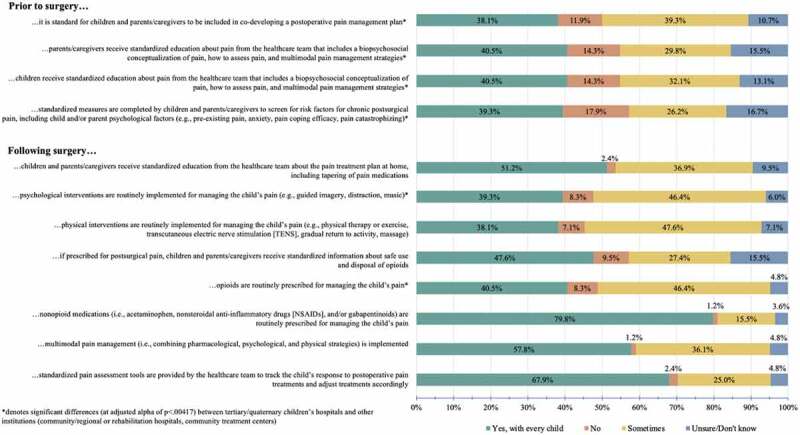
Background: Preventing pediatric chronic postsurgical pain is a patient, parent/caregiver, health care professional, and policymaker priority. Poorly managed presurgical and acute postsurgical pain are established risk factors for pediatric chronic postsurgical pain. Effective perioperative pain management is essential to prevent the transition from acute to chronic pain after surgery. Aims: The aim of this study was to identify current pediatric surgical pain management practices and assess health system readiness for change at health care institutions conducting pediatric surgery in Canada. Methods: An online survey was completed by 85 multidisciplinary health care professionals (nurses, surgeons, anesthesiologists, allied health) from 20 health institutions in Canada regarding institutional pre- and postsurgical pediatric pain care, specialty pain services, and Organizational Readiness for Implementing Change (ORIC). Results: Of all specialty pain services, acute and chronic/complex pain services were most common, primarily with physician and nursing involvement. Alignment to recommended practices for pediatric pre- and postsurgical pain care varied (38.1%-79.8% reported "yes, for every child"), with tertiary/quaternary children's hospitals reporting less alignment than other institutions (community/regional or rehabilitation hospitals, community treatment centers). No significant differences were reported between health care institutions serving pediatric populations only versus those also serving adults. Health care professional experience/practice was the most reported strength in pediatric surgical pain care, with inconsistent standard of care the most common gap. Participants "somewhat agreed" that their institutions were committed and capable of change in pediatric surgical pain care. Conclusions: There is a continued need to improve pediatric pain care during the perioperative period at Canadian health care institutions to effectively prevent the development of pediatric postsurgical pain.
Overview
The claims and statistics of this paper haven’t been checked yet.
Free: it reads the open-access text and checks the first 5 claims that cite a source we can check. Create a free account to check every claim.
Integrity signals
Registry
Cites
Statistics
Figures
Verification
Claims the paper makes
The claims and statistics of this paper haven’t been checked yet.
Free: it reads the open-access text and checks the first 5 claims that cite a source we can check. Create a free account to check every claim.
Claims other papers make about this one
Each is checked against this paper’s own text: does it say what the citing paper says it does?
The cited source says what the claim attributes to it.
In the citing paper
“Addressing these psychological risk factors during the presurgical period has been identified as a gap in pain care in Canada. 12”
From Virtual psychoeducation for improvement of pain catastrophizing in pediatric presurgical patients and caregivers: a proof-of-concept study (2023) · cites this paper as [12]
Self-check
Percentages, sums and reported differences re-computed from the paper’s own numbers.
The self-check needs the paper’s full text.
Citations
Cites
Damschroder, L. J., Aron, D. C., Keith, R. E., Kirsh, S. R., Alexander, J. A., & Lowery, J. C. (2009) · Implementation Science · doi:10.1186/1748-5908-4-50 · Cited by 14,496
What's in a name? Qualitative description revisited
Sandelowski, M. (2010) · Research in Nursing & Health · doi:10.1002/nur.20362 · Cited by 4,975 · cited 1×
“Open-ended questions were coded using simple content analysis.(41,42) All responses were read by two coders (lead author K.”
MethodCanadian Institute for Health Information.
Lalonde, A. (1994) · PubMed · Cited by 4,739
Chou, R., Gordon, D. B., de Leon-Casasola, O. A., Rosenberg, J. M., Bickler, S., Brennan, T., Carter, T., Cassidy, C. L., Chittenden, E. H., Degenhardt, E., et al. (2016) · The Journal of Pain · doi:10.1016/j.jpain.2015.12.008 · Cited by 3,171 · cited 3×
“Despite the preliminary application of a measure to identify children at risk for chronic postsurgical pain(24) and the availability of treatment guidelines,(20) there is no established model of care targeting the prevention of pediatric chronic postsurgical pain.(20,25) This is critical to address because under treat…”
BackgroundOrganizational readiness for implementing change: a psychometric assessment of a new measure
Shea, C. M., Jacobs, S. R., Esserman, D. A., Bruce, K., & Weiner, B. J. (2014) · Implementation Science · doi:10.1186/1748-5908-9-7 · Cited by 856
Disruptive Innovation In Health Care Delivery: A Framework For Business-Model Innovation
Hwang, J., & Christensen, C. M. (2008) · Health Affairs · doi:10.1377/hlthaff.27.5.1329 · Cited by 495
Prescription Opioids in Adolescence and Future Opioid Misuse
Miech, R., Johnston, L., O’Malley, P. M., Keyes, K. M., & Heard, K. (2015) · Pediatrics · doi:10.1542/peds.2015-1364 · Cited by 466
Persistent Opioid Use Among Pediatric Patients After Surgery
Harbaugh, C. M., Lee, J. S., Hu, H. M., McCabe, S. E., Voepel-Lewis, T., Englesbe, M. J., Brummett, C. M., & Waljee, J. F. (2018) · Pediatrics · doi:10.1542/peds.2017-2439 · Cited by 449
Harte, R., Glynn, L., Rodríguez-Molinero, A., Baker, P. M., Scharf, T., Quinlan, L. R., & ÓLaighin, G. (2017) · JMIR Human Factors · doi:10.2196/humanfactors.5443 · Cited by 399
Delivering transformative action in paediatric pain: a Lancet Child & Adolescent Health Commission
Eccleston, C., Fisher, E., Howard, R. F., Slater, R., Forgeron, P., Palermo, T. M., Birnie, K. A., Anderson, B. J., Chambers, C. T., Crombez, G., et al. (2021) · The Lancet Child & Adolescent Health · doi:10.1016/s2352-4642(20)30277-7 · Cited by 328
Self-citation
Research works printed but not linked: 3
- Canadian Pain Task Force. An action plan for pain in Canada. Ontario (Canada): Health Canada; 2021.
- REDCap. Nashville (TN): Vanderbuilt University; 2018.
- Schechter N, Finley GA, Bright NS, Laycock M, Forgeron P. ChildKind: a global initiative to reduce pain in children. Pediatr Pain Lett. 2010; 12: 6.
Cited by
Organizational readiness for change: A systematic review of the healthcare literature
Caci, L., Nyantakyi, E., Blum, K., Sonpar, A., Schultes, M.-T., Albers, B., & Clack, L. (2025) · Implementation Research and Practice · doi:10.1177/26334895251334536 · Cited by 95
Kaseweter, K., Nazemi, M., Gregoire, N., Louw, W. F., Walsh, Z., & Holtzman, S. (2023) · BMC Health Services Research · doi:10.1186/s12913-023-10157-8 · Cited by 28
Rosenbloom, B. N., Frederiksen, S. D., Wang, V., Park, C., Gordon, G., Brar, G., Rasic, N. F., Stinson, J., Birnie, K. A., & Rabbitts, J. A. (2025) · Regional Anesthesia & Pain Medicine · doi:10.1136/rapm-2024-105696 · Cited by 19
Self-citationDevelopment and expansion of a pediatric transitional pain service to prevent complex chronic pain
Isaac, L., Rosenbloom, B. N., Tyrrell, J., Ruskin, D. A., & Birnie, K. A. (2023) · Frontiers in Pain Research · doi:10.3389/fpain.2023.1173675 · Cited by 16
Self-citationChildren’s Experiences With Pain and Pain-Relieving Strategies After Surgery: A Qualitative Study
Næss, T., Sørensen, K. E., & Smeland, A. H. (2025) · Pain Management Nursing · doi:10.1016/j.pmn.2025.07.005 · Cited by 8
Metadata
- Authors
- Birnie, K. A., Stinson, J., Isaac, L., Tyrrell, J., Campbell, F., Jordan, I. P., Marianayagam, J., Richards, D., Rosenbloom, B. N., Clement, F., & Hubley, P.
- Affiliations
- University of Calgary (CA)
- University of Toronto (CA)
- Parent Partner, Partnering For Pain Research Program, University of Calgary
- NOSM University (CA)
- Five02Labs, Inc, Toronto, Ontario, Canada
- Hospital for Sick Children (CA)
- Corresponding author
- Birnie, Kathryn A.
- ORCID
- Venue
- Canadian Journal of Pain
- Publisher
- Informa UK Limited
- Published
- 2022-06-06
- Volume
- 6
- Issue
- 2
- Pages
- 108-120
- ISSN
- 2474-0527 (ISSN-L)
- PMC
- PMC9176261
- OpenAlex
- W4212799766
- Cited by
- 13
- References
- 58
- Citations by year
- 2026: 1 · 2025: 5 · 2024: 3 · 2023: 3 · 2022: 1
- FWCI
- 3.29
- Type
- journal article
- Language
- en
- Open access
- gold
- doi.org
- Locations
- Canadian Journal of Pain (publishedVersion, cc-by)
- PubMed Central (publishedVersion, cc-by)
- PubMed (publishedVersion)
- DOAJ (DOAJ: Directory of Open Access Journals) (submittedVersion, cc-by-sa)
- Funders
- Canadian Pain Society
- Topics
- Health Sciences › Medicine › Pediatrics, Perinatology and Child Health › Pediatric Pain Management Techniques
- Health Sciences › Medicine › Anesthesiology and Pain Medicine › Anesthesia and Pain Management
- Health Sciences › Medicine › Anesthesiology and Pain Medicine › Pain Management and Opioid Use
- Keywords
- chronic postoperative pain, perioperative pain management, organizational preparedness, health system preparedness, children's hospitals
About these checks
Registry, retraction, Cites and statistics results are computed, not judged, with one exception: a printed reference that no index lists is read once by a model before it counts as a citation error. Claims are extracted by a model and kept only when their quote appears verbatim in the text; each cited source is then checked, with a model’s help, for whether it says what the claim relies on. Those verdicts can be wrong — read the claim’s quote and the cited source before relying on one.
Statistics and arithmetic are recomputed, not judged.
Confidence bands are shown only for fields calibrated on our annotated test set. None is calibrated yet, so no band is shown.
What counts as a claim ›How we measure confidence ›How we check this ›
Are you an author, or do you see a problem with this page? Request a review
How to cite
Cite CoChat for the checks on this page, and the paper for its own findings.
- This page
- CoChat. (2026). Citation check: Mapping the current state of pediatric surgical pain care across Canada and assessing readiness for change. https://app.cochat.ai/papers/10.1080/24740527.2022.2038031
- The paper
- Birnie, K. A., Stinson, J., Isaac, L., Tyrrell, J., Campbell, F., Jordan, I. P., Marianayagam, J., Richards, D., Rosenbloom, B. N., Clement, F., & Hubley, P. (2022). Mapping the current state of pediatric surgical pain care across Canada and assessing readiness for change. Canadian Journal of Pain. https://doi.org/10.1080/24740527.2022.2038031
Data sources
Bibliographic data: Semantic Scholar, OpenAlex, Crossref.
Contains information from the Semantic Scholar Academic Graph Datasets, made available under the ODC Attribution License (ODC-BY 1.0).
Semantic Scholar’s data is described in: Kinney, R., et al. (2023). The Semantic Scholar Open Data Platform. arXiv:2301.10140.
