

Facilitators and barriers of maternal and infant healthcare access for undocumented migrants in the first 1000 days of life: a systematic review of the literature
Open accessThe DOI matches its Crossref record; 71 of the 71 references it cites were found in a registry or an index.
Abstract
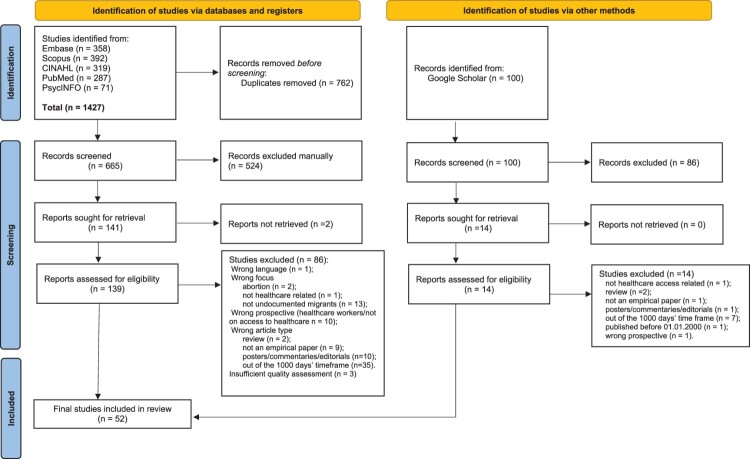
Adequate access to maternal and infant healthcare in the first 1000 days of life is concurrent with lifelong well-being and should be guaranteed regardless of nationality, legal status, and social conditions. By exploring how migration status affects the social determinants of health, this review provides a nuanced understanding of the barriers and facilitators encountered accessing healthcare by undocumented women and their infants in the first 1000 days of life. Following the PRISMA guidelines and the registered protocol (CRD42022328220), a literature search was conducted in PubMed, Embase, CINAHL, PsycInfo and Scopus. The search focused on manuscripts including undocumented migrants as study participants and reported direct or indirect data on the utilisation or outcomes of maternal and infant healthcare within the defined first 1000 days of life. Fifty-two studies met the inclusion criteria. A narrative synthesis was performed to summarise the information obtained from the data extraction process. Identified barriers include legal barriers (e.g criminalisation of migrants or complexity of administrative procedures, and socio-cultural barriers, (e.g. inadequate health literacy and financial challenges). Facilitators encompassed legal facilitators, like dedicated healthcare clinics, and socio-cultural facilitators, such as language support and healthier lifestyle habits. Ethical issues in connection to healthcare access of undocumented migrants in the first 1000 days were also mapped from the included papers. Considering the health consequences on future generations, the economic implications, and the vulnerability of migrant women, the findings offer positive examples that could be put into place to move towards universal health coverage through a holistic approach that shifts from exclusion and criminalisation to support and compassion.
Overview
The claims and statistics of this paper haven’t been checked yet.
Free: it reads the open-access text and checks the first 5 claims that cite a source we can check. Create a free account to check every claim.
Integrity signals
Registry
Cites
Statistics
Figures
Verification
Claims the paper makes
The claims and statistics of this paper haven’t been checked yet.
Free: it reads the open-access text and checks the first 5 claims that cite a source we can check. Create a free account to check every claim.
Self-check
Percentages, sums and reported differences re-computed from the paper’s own numbers.
The self-check needs the paper’s full text.
Citations
Cites
The PRISMA 2020 statement: An updated guideline for reporting systematic reviews
Page, M. J., McKenzie, J. E., Bossuyt, P. M., Boutron, I., Hoffmann, T. C., Mulrow, C. D., Shamseer, L., Tetzlaff, J. M., Akl, E. A., Brennan, S. E., et al. (2021) · BMJ · doi:10.1136/bmj.n71 · Cited by 108,283
Preferred Reporting Items for Systematic Reviews and Meta-Analyses: The PRISMA Statement
Moher, D., Liberati, A., Tetzlaff, J., & Altman, D. G. (2009) · Journal of Clinical Epidemiology · doi:10.1016/j.jclinepi.2009.06.005 · Cited by 19,575 · cited 1×
“43,44 The protocol of this systematic review has been registered in PROSPERO and can be accessed through its registration number CRD42022328220.”
Maternal and child undernutrition and overweight in low-income and middle-income countries
Black, R. E., Victora, C. G., Walker, S. P., Bhutta, Z. A., Christian, P., de Onis, M., Ezzati, M., Grantham-McGregor, S., Katz, J., Martorell, R., et al. (2013) · The Lancet · doi:10.1016/s0140-6736(13)60937-x · Cited by 8,475
Maternal and child undernutrition: consequences for adult health and human capital
Victora, C. G., Adair, L., Fall, C., Hallal, P. C., Martorell, R., Richter, L., & Sachdev, H. S. (2008) · The Lancet · doi:10.1016/s0140-6736(07)61692-4 · Cited by 3,952
What works? Interventions for maternal and child undernutrition and survival
Bhutta, Z. A., Ahmed, T., Black, R. E., Cousens, S., Dewey, K., Giugliani, E., Haider, B. A., Kirkwood, B., Morris, S. S., Sachdev, H., et al. (2008) · The Lancet · doi:10.1016/s0140-6736(07)61693-6 · Cited by 2,258
Equity of access to health care: outlining the foundations for action
Oliver, A., & Mossialos, E. (2004) · Journal of Epidemiology and Community Health · doi:10.1136/jech.2003.017731 · Cited by 506 · cited 1×
“32 Conversely, literature on the “healthy migrant effect”, meaning when the migrant population has “a better health status compared with others in the home country, but also in comparison with the population in the host country”, 33 challenges what was thought to be a solid connection between poor…”
Maternal and child undernutrition: effective action at national level
Bryce, J., Coitinho, D., Darnton-Hill, I., Pelletier, D., & Pinstrup-Andersen, P. (2008) · The Lancet · doi:10.1016/s0140-6736(07)61694-8 · Cited by 474 · cited 1×
“4 8 In fact, maternal and neonatal adverse health-related events, like preterm birth, have proved to influence the child’s short-and long-term developments.”
How Immigrants Contribute to Developing Countries' Economies
OECD, & International Labour Organization (2018) · International Labour Office eBooks · doi:10.1787/9789264288737-en · Cited by 213
Illegality as risk factor: A survey of unauthorized migrant patients in a Berlin clinic
Castañeda, H. (2009) · Social Science & Medicine · doi:10.1016/j.socscimed.2009.01.024 · Cited by 175 · cited 1×
“…and individuals 14,59 ; (c) the implicit bias and discrimination that prevent equitable access to care and feelings of undeservingness or distrust 50,70 ; and (d) the vulnerability of pregnant migrant women as subjects of unjust policies that promote sterilisation among vulnerable populations as…”
Beyond survival: the lasting effects of premature birth
Morniroli, D., Tiraferri, V., Maiocco, G., Rose, D. U. D., Cresi, F., Coscia, A., Mosca, F., & Giannì, M. L. (2023) · Frontiers in Pediatrics · doi:10.3389/fped.2023.1213243 · Cited by 167 · cited 1×
“9 Studying this window of opportunity not only safeguards the health and development of the child but also yields long-term societal benefits by reducing health disparities, improving educational outcomes, and lowering the burden of disease across the lifespan.”
Undocumented migrants lack access to pregnancy care and prevention
Wolff, H., Epiney, M., Lourenco, A. P., Costanza, M. C., Delieutraz-Marchand, J., Andreoli, N., Dubuisson, J.-B., Gaspoz, J.-M., & Irion, O. (2008) · BMC Public Health · doi:10.1186/1471-2458-8-93 · Cited by 166 · cited 4×
“34,35 In the field of maternal and infant health, this phenomenon is known as the “Latina paradox”, 36 after its first analysis among Latin American undo-cumented migrants accessing healthcare in the state of New York, 37 where maternal and infant health outcomes of undocumented populations often…”
InfluentialIllegal Migration and Gender in a Global and Historical Perspective
Schrover, M., van der Leun, J., Lucassen, L., & Quispel, G. C. (2008) · Amsterdam University Press eBooks · doi:10.5117/9789089640475 · Cited by 149
Healthy migrant effect in the Swedish context: a register-based, longitudinal cohort study.
Helgesson, M., Johansson, B., Nordquist, T., Vingård, E., & Svartengren, M. (2019) · BMJ Open · doi:10.1136/bmjopen-2018-026972 · Cited by 148 · cited 2×
“…on the “healthy migrant effect”, meaning when the migrant population has “a better health status compared with others in the home country, but also in comparison with the population in the host country”, 33 challenges what was thought to be a solid connection between poor access and poor outcomes.”
Maternal and child undernutrition: an urgent opportunity
Horton, R. C. (2008) · The Lancet · doi:10.1016/s0140-6736(07)61869-8 · Cited by 147
Restrictive Immigration Law and Birth Outcomes of Immigrant Women
Torche, F., & Sirois, C. (2019) · American Journal of Epidemiology · doi:10.1093/aje/kwy218 · Cited by 140 · cited 1×
“54,55 Similarly, complex administrative procedures to obtain affordable care prevent access to health-care and are reported together with delayed and irregular antenatal care, 41,56 higher risk of severe maternal morbidity 57 and a higher proportion of hypothyroidism.”
Korinek, K., & Smith, K. R. (2011) · Social Science & Medicine · doi:10.1016/j.socscimed.2011.02.046 · Cited by 124 · cited 4×
“Against the many barriers, several facilitators have been identified that offer Network extent and length of stay (28,30, 31,51) The longer history in the U.S. immigration of Mexicans is mentioned as potential facilitators at a national level (Held 2018).”
InfluentialFlores, M. E. S., Simonsen, S. E., Manuck, T. A., Dyer, J. M., & Turok, D. K. (2012) · Women s Health Issues · doi:10.1016/j.whi.2012.07.005 · Cited by 121 · cited 1×
“34,35 In the field of maternal and infant health, this phenomenon is known as the “Latina paradox”, 36 after its first analysis among Latin American undo-cumented migrants accessing healthcare in the state of New York, 37 where maternal and infant health outcomes of undocumented populations often…”
Fear of Discovery Among Latino Immigrants Presenting to the Emergency Department
Maldonado, C. Z., Rodriguez, R. M., Torres, J. R., Flores, Y. S., & Lovato, L. M. (2013) · Academic Emergency Medicine · doi:10.1111/acem.12079 · Cited by 119 · cited 2×
“20,21 On the same note, research suggests that only for immediate urgent matters do undocumented migrants seek healthcare.”
Dang, B. N., Giordano, T. P., & Kim, J. H. (2011) · Journal of Immigrant and Minority Health · doi:10.1007/s10903-011-9542-x · Cited by 119 · cited 1×
“24 According to the recent literature, undocumented migration has in fact been associated with increased occurrence of adverse pregnancy outcomes including maternal depressive symptoms as well as gestational diabetes and pre-eclampsia.”
A World of Babies: Imagined Childcare Guides for Eight Societies
Gottlieb, A., & DeLoache, J. S. (2016) · Cambridge University Press eBooks · doi:10.1017/cbo9781316480625 · Cited by 118
Expanding Prenatal Care to Unauthorized Immigrant Women and the Effects on Infant Health
Swartz, J. J., Hainmueller, J., Lawrence, D., & Rodriguez, M. I. (2017) · Obstetrics and Gynecology · doi:10.1097/aog.0000000000002275 · Cited by 105 · cited 5×
“While maternal and fetal as well as neonatal and early infancy health are closely related, only three studies 49–51 have extended their focus beyond the pregnancy period and the moment of childbirth, also addressing healthcare access after the birth of the child.”
InfluentialBirth outcomes in Colorado's undocumented immigrant population
Reed, M. M., Westfall, J. M., Bublitz, C., Battaglia, C., & Fickenscher, A. (2005) · BMC Public Health · doi:10.1186/1471-2458-5-100 · Cited by 101 · cited 2×
“49 In five included articles, no barriers are discussed.”
Liu, C., Ahlberg, M., Hjern, A., & Stephansson, O. (2019) · European Journal of Public Health · doi:10.1093/eurpub/ckz120 · Cited by 95 · cited 2×
“52 In fact, when criminalisation of undocumented migrants is cited as a barrier by a given study, authors state that access to all forms of primary healthcare like family planning services is restricted, which often results in ante-partum hospitalisation, miscarriages, and induced abortion 53 as…”
Nellums, L. B., Powis, J., Jones, L., Miller, A., Rustage, K., Russell, N., Friedland, J. S., & Hargreaves, S. (2020) · Social Science & Medicine · doi:10.1016/j.socscimed.2020.113610 · Cited by 86 · cited 6×
“…a given study, authors state that access to all forms of primary healthcare like family planning services is restricted, which often results in ante-partum hospitalisation, miscarriages, and induced abortion 53 as well as delays in accessing antenatal care 27 and, as mentioned, teenage pregnancies.”
InfluentialHealth care and illegality: a survey of undocumented pregnant immigrants in Geneva
Wolff, H., Stalder, H., Epiney, M., Walder, A., Irion, O., & Morabia, A. (2005) · Social Science & Medicine · doi:10.1016/j.socscimed.2004.12.007 · Cited by 80 · cited 2×
“73 Similarly, as shown in a north American study, having a prior cultural understanding of the health interventions during the first 1000 days of life and healthcare systems of the host country allows undocumented migrants to easily adapt to and have no measurable differences in low birth weight…”
Lu, M., Lin, Y. G., Prietto, N. M., & Garite, T. J. (2000) · American Journal of Obstetrics and Gynecology · doi:10.1016/s0002-9378(00)70518-7 · Cited by 76 · cited 1×
“14 Preterm birth, 35,58,64,65 low birth weight, 56,58,64,65 worse fetal outcomes and perinatal mortality 65 are also outcomes cited together with this legal barrier.”
Castañeda, H. (2008) · Medical Anthropology Quarterly · doi:10.1111/j.1548-1387.2008.00039.x · Cited by 70
Differences in low-birthweight among documented and undocumented foreign-born and US-born Latinas
Kelaher, M., & Jessop, D. J. (2002) · Social Science & Medicine · doi:10.1016/s0277-9536(01)00360-4 · Cited by 67 · cited 1×
“29,30,51,66,67 Ethical considerations in the first 1000 days of life In Table 4, we present the ethical considerations related to maternal and infant healthcare access for undocumented migrants in the first 1000 days of life.”
Binder, P., Johnsdotter, S., & Essén, B. (2012) · Social Science & Medicine · doi:10.1016/j.socscimed.2012.08.010 · Cited by 61
Chetail, V. (2016) · European Journal of International Law · doi:10.1093/ejil/chw059 · Cited by 59
Sami, J., Lötscher, K. Q., Éperon, I., Gonik, L., de Tejada, B. M., Epiney, M., & Schmidt, N. C. (2019) · Reproductive Health · doi:10.1186/s12978-019-0771-0 · Cited by 58 · cited 4×
“Against the many barriers, several facilitators have been identified that offer Network extent and length of stay (28,30, 31,51) The longer history in the U.S. immigration of Mexicans is mentioned as potential facilitators at a national level (Held 2018).”
InfluentialRuiz‐Casares, M., Rousseau, C., Laurin‐Lamothe, A., Rummens, J. A., Zelkowitz, P., Crépeau, F., & Steinmetz, N. (2012) · Maternal and Child Health Journal · doi:10.1007/s10995-012-0973-3 · Cited by 55 · cited 1×
“82,83 Based on these experiences, new policies should be implemented, aimed at improving the general socioeconomic, cultural and environmental conditions to respect and ensure health rights.”
Maternal Mental Health and Reproductive Outcomes: A Scoping Review of the Current Literature
Montagnoli, C., Zanconato, G., Cinelli, G., Tozzi, A. E., Bovo, C., Bortolus, R., & Ruggeri, S. (2020) · Archives of Gynecology and Obstetrics · doi:10.1007/s00404-020-05685-1 · Cited by 47 · cited 1×
“86,87 Fourth, the societal, legal, and community integration efforts are reflected at the “individual level” where, depending on the enabling or disabling context the undocumented person finds themself in, lifestyle habits are seen as barriers or facilitators.”
Self-citationUse of Prenatal Care by Hispanic Women After Welfare Reform
Fuentes‐Afflick, E., Hessol, N. A., Bauer, T. A., O’Sullivan, M. J., Gomez‐Lobo, V., Holman, S., Wilson, T. E., & MINKOFF, H. L. (2006) · Obstetrics and Gynecology · doi:10.1097/01.aog.0000191299.24469.1b · Cited by 47
Association between Migrant Women’s Legal Status and Prenatal Care Utilization in the PreCARE Cohort
Eslier, M., Deneux‐Tharaux, C., Sauvegrain, P., Schmitz, T., Luton, D., Mandelbrot, L., Estellat, C., & Azria, É. (2020) · International Journal of Environmental Research and Public Health · doi:10.3390/ijerph17197174 · Cited by 43 · cited 2×
“31 59–63 The consequences of inadequate antenatal care are also often connected with complications during pregnancy 27 and lower prenatal care screening for sexually transmitted infections (STIs).”
Oregon’s Expansion of Prenatal Care Improved Utilization Among Immigrant Women
Swartz, J. J., Hainmueller, J., Lawrence, D., & Rodriguez, M. I. (2018) · Maternal and Child Health Journal · doi:10.1007/s10995-018-2611-1 · Cited by 42 · cited 1×
“71 With improved legal conditions, a lower frequency of adverse maternal conditions such as diabetes, gestational diabetes, higher BMI, 72 is observed, as are increased rates of screenings and vaccines.”
NHS charging for maternity care in England: Its impact on migrant women
Feldman, R. A. (2020) · Critical Social Policy · doi:10.1177/0261018320950168 · Cited by 41 · cited 2×
“Against the many barriers, several facilitators have been identified that offer Network extent and length of stay (28,30, 31,51) The longer history in the U.S. immigration of Mexicans is mentioned as potential facilitators at a national level (Held 2018).”
Limited midwifery care for undocumented women in the Netherlands
de Jonge, A., Rijnders, M. E. B., Agyemang, C. O., van der Stouwe, R. A., den Otter, J., van den Muijsenbergh, M. E. T. C., & Buitendijk, S. E. (2011) · Journal of Psychosomatic Obstetrics & Gynecology · doi:10.3109/0167482x.2011.589016 · Cited by 40 · cited 1×
“79,80 Poor healthcare access for mothers and their infants can be prevented by putting in place policies enforcing and protecting health rights of the migrant population.”
Lee, S., Adam, E., Kanyike, A. M., Wani, S., Kasibante, S., Mukunya, D., & Nantale, R. (2024) · PLoS ONE · doi:10.1371/journal.pone.0314769 · Cited by 40
Immigration Enforcement and Infant Health
Amuedo‐Dorantes, C., Churchill, B. F., & Song, Y. (2021) · American Journal of Health Economics · doi:10.1086/718510 · Cited by 37 · cited 2×
“27,54,63,74,75”
Fedeli, U., Alba, N., Lisiero, M., Zambon, F., Avossa, F., & Spolaore, P. (2010) · Acta Obstetricia et Gynecologica Scandinavica · doi:10.3109/00016349.2010.512065 · Cited by 37 · cited 1×
“…a given study, authors state that access to all forms of primary healthcare like family planning services is restricted, which often results in ante-partum hospitalisation, miscarriages, and induced abortion 53 as well as delays in accessing antenatal care 27 and, as mentioned, teenage pregnancies.”
Immigrant apprehensions and birth outcomes: Evidence from California birth records 2008–2015
Ro, A. E., Bruckner, T. A., & Duquette-Rury, L. (2020) · Social Science & Medicine · doi:10.1016/j.socscimed.2020.112849 · Cited by 34 · cited 1×
“48 The interest in this population appears to have evolved over time.”
Tasa, J., Holmberg, V., Sainio, S., Kankkunen, P., & Vehviläinen-Julkunen, K. M. (2021) · BMC Pregnancy and Childbirth · doi:10.1186/s12884-021-03642-7 · Cited by 33 · cited 1×
“61 As opposed to social interventions put in place to improve the experience and indirectly the health outcomes of undocumented migrants, personal characteristics also seem to play an important role in accessing healthcare in the first 1000 days.”
Cleaveland, C. L., & Ihara, E. S. (2012) · Journal of Human Behavior in the Social Environment · doi:10.1080/10911359.2012.704781 · Cited by 33 · cited 1×
“79,80 Poor healthcare access for mothers and their infants can be prevented by putting in place policies enforcing and protecting health rights of the migrant population.”
Maternal periconceptional nutrition matters. A scoping review of the current literature
Montagnoli, C., Santoro, C. B., Buzzi, T., & Bortolus, R. (2021) · The Journal of Maternal-Fetal & Neonatal Medicine · doi:10.1080/14767058.2021.1962843 · Cited by 31 · cited 1×
“37,42,88 Additionally, it extends to other cultural and educational components related to reproductive health.”
Self-citationUndocumented migrants have diverse health problems.
Ehmsen, B. K., Biswas, D., Jensen, N. K., Krasnik, A., & Nørredam, M. L. (2014) · PubMed · Cited by 30
Wendland, A., Ehmsen, B. K., Lenskjold, V., Astrup, B. S., Mohr, M., Williams, C. J., & Cowan, S. A. (2016) · BMC Public Health · doi:10.1186/s12889-016-3096-8 · Cited by 28 · cited 2×
“…even before their birth 69 ; (b) the economic and long-term consequences of barriers to healthcare access on both societies and individuals 14,59 ; (c) the implicit bias and discrimination that prevent equitable access to care and feelings of undeservingness or distrust 50,70 ; and (d)…”
Eick, F., Vallersnes, O. M., Fjeld, H., Sørbye, I. K., Storkås, G., Ekrem, M., Børmer, M., Løberg, S. A., Ebbing, C., Voldner, N., et al. (2022) · BMC Pregnancy and Childbirth · doi:10.1186/s12884-022-05112-0 · Cited by 26 · cited 2×
“71 With improved legal conditions, a lower frequency of adverse maternal conditions such as diabetes, gestational diabetes, higher BMI, 72 is observed, as are increased rates of screenings and vaccines.”
Spesny, S. L. (2015) · Anthropology and Medicine · doi:10.1080/13648470.2015.1004503 · Cited by 26 · cited 1×
“27,54,63,74,75”
Clifford, N., Blanco, N. S., Bang, S. H., Heitkemper, E., & García, A. A. (2023) · Journal of Advanced Nursing · doi:10.1111/jan.15845 · Cited by 25 · cited 1×
“76 When then focusing specifically on women, we have found an interesting example from Sweden, conceptualising how adverse obstetric outcomes among immigrant women in high-income settings are directly impacted by three layers of delay in healthcare access.”
Severe maternal morbidity among undocumented migrant women in the PreCARE prospective cohort study
Eslier, M., Deneux‐Tharaux, C., Sauvegrain, P., Schmitz, T., Luton, D., Mandelbrot, L., Estellat, C., & Azria, É. (2022) · BJOG An International Journal of Obstetrics & Gynaecology · doi:10.1111/1471-0528.17124 · Cited by 25 · cited 1×
“54,55 Similarly, complex administrative procedures to obtain affordable care prevent access to health-care and are reported together with delayed and irregular antenatal care, 41,56 higher risk of severe maternal morbidity 57 and a higher proportion of hypothyroidism.”
Goldade, K. (2011) · Medical Anthropology · doi:10.1080/01459740.2011.577043 · Cited by 23 · cited 1×
“26,27 These disparities encompass multiple dimensions, ranging from reduced utilisation of contraceptive methods, leading to higher rates of unintended pregnancies, delays in seeking peri-natal care, and a heightened prevalence of pregnancy and delivery-related complications.”
Spetz, J., Baker, L. C., Phibbs, C. S., Pedersen, R., & Tafoya, S. M. (2000) · Journal of Immigrant Health · doi:10.1023/a:1009540313141 · Cited by 23 · cited 2×
“27,54,63,74,75”
Neeser, N. B., Martani, A., Clercq, E. D., Geyter, C. D., Vulliémoz, N. R., Elger, B. S., & Wangmo, T. (2023) · Human Reproduction Open · doi:10.1093/hropen/hoad042 · Cited by 20 · cited 1×
“58,90 To sum up, efforts primarily ensuring the inclusion of migrant populations in new public health policies at government level should be paired with local ones, mainly connected with tack-ling the cultural and rooted stigma surrounding undocumented migration.”
Self-citationFakhoury, J., Burton‐Jeangros, C., Guessous, I., Consoli, L., Duvoisin, A., & Jackson, Y. (2021) · BMC Public Health · doi:10.1186/s12889-021-11239-0 · Cited by 20 · cited 2×
“86 What is more, the extent of one’s networks brings, beside working opportunities, social support to navigate the hosting society in all its cultural do’s and don’ts and improves mental health.”
Vignier, N., Fontaines, V. H. D., Villemeur, A. B. D., Roblot, F., Hoen, B., Chauvin, F., Lepelletier, D., Chidiac, C., & Billaud, É. (2022) · Infectious Diseases Now · doi:10.1016/j.idnow.2022.04.006 · Cited by 18 · cited 1×
“38 Legal definitions of who constitutes an undocumented migrant differ from one receiving country to another.”
Atkins, D. N., Held, M. L., & Lindley, L. C. (2018) · Public Health Nursing · doi:10.1111/phn.12524 · Cited by 17 · cited 2×
“These include adequate prenatal care and more prenatal care visits, 42,51,69 higher fetal weight gain, 42 reduced inadequate care and increased diagnosis of gestational diabetes and pre-existing diabetes mellitus.”
Sahraoui, N. (2021) · Social Policy and Society · doi:10.1017/s1474746421000038 · Cited by 17 · cited 1×
“…individuals 14,59 ; (c) the implicit bias and discrimination that prevent equitable access to care and feelings of undeservingness or distrust 50,70 ; and (d) the vulnerability of pregnant migrant women as subjects of unjust policies that promote sterilisation among vulnerable populations as a…”
Undocumented Motherhood: Gender, Maternal Identity, and the Politics of Health Care
Farfán‐Santos, E. (2019) · Medical Anthropology · doi:10.1080/01459740.2019.1587421 · Cited by 16 · cited 3×
“The sample sizes across these studies exhibit a wide range, from a single participant in qualitative ethnographic research 41 to over 3.9 million participants in quantitative research.”
InfluentialSchoenborn, C., Spiegelaere, M. D., & Racapé, J. (2021) · BMC Pregnancy and Childbirth · doi:10.1186/s12884-021-04183-9 · Cited by 15
Winter, A., Due, C., & Ziersch, A. M. (2023) · Journal of Immigrant and Minority Health · doi:10.1007/s10903-023-01510-4 · Cited by 14
Urgent Medical Aid and Associated Obstetric Mortality in Belgium
Vanneste, C., Barlow, P., & Rozenberg, S. (2019) · Journal of Immigrant and Minority Health · doi:10.1007/s10903-019-00897-3 · Cited by 14 · cited 4×
“58 As per the socio-cultural barriers ( N = 9), we have found three major categories of obstacles to access healthcare in the first 1000 days of life.”
InfluentialReproductive health issues of undocumented migrant women living in Istanbul
Mamuk, R., & Şahin, N. H. (2020) · The European Journal of Contraception & Reproductive Health Care · doi:10.1080/13625187.2020.1843618 · Cited by 12 · cited 2×
“29,30,51,66,67 Ethical considerations in the first 1000 days of life In Table 4, we present the ethical considerations related to maternal and infant healthcare access for undocumented migrants in the first 1000 days of life.”
Funge, J. K., Boye, M. C., Parellada, C. B., & Nørredam, M. L. (2021) · Scandinavian Journal of Public Health · doi:10.1177/14034948211011400 · Cited by 12 · cited 1×
“27,54,63,74,75”
Maternal Health of Undocumented Women With and Without Medicaid Access in Nebraska, 2007-2011
Atkins, D. N., Barroso, C. S., Anderson, A. J., Meadows, J. T., & Lindley, L. C. (2016) · Hispanic Health Care International · doi:10.1177/1540415316682722 · Cited by 12 · cited 3×
“37,42,88 Additionally, it extends to other cultural and educational components related to reproductive health.”
Barsanti, S. (2018) · The International Journal of Health Planning and Management · doi:10.1002/hpm.2516 · Cited by 11 · cited 1×
“85 Third, regular employment and dignified housing influence the “social and community net-works” level that is documented to be well developed in migrant populations, specifically for its scope and survival.”
Held, M. L., & Lindley, L. C. (2018) · Family & Community Health · doi:10.1097/fch.0000000000000199 · Cited by 10
Schönborn, C., Castetbon, K., & Spiegelaere, M. D. (2022) · PLoS ONE · doi:10.1371/journal.pone.0267098 · Cited by 10
Gutiérrez, M. M. V., Fernández-Niño, J. A., & Rojas-Botero, M. L. (2020) · Revista de Salud Pública · doi:10.15446/rsap.v22n4.87572 · Cited by 6 · cited 3×
“58 Infants of mothers whose access is prevented via complex administrative procedures report higher rates of low birth weight 56,58 and preterm birth.”
Montagnoli, C., & Wanner, P. (2023) · BMC Pregnancy and Childbirth · doi:10.1186/s12884-023-05870-5 · Cited by 5 · cited 1×
“34,35 In the field of maternal and infant health, this phenomenon is known as the “Latina paradox”, 36 after its first analysis among Latin American undo-cumented migrants accessing healthcare in the state of New York, 37 where maternal and infant health outcomes of undocumented populations often…”
Self-citationHealth Care Access and Utilization for Latino Youth in the United States
Alberto, C. K., Pintor, J. K., Martínez-Donate, A. P., Chen, J., & Ortega, A. N. (2020) · Medical Care · doi:10.1097/mlr.0000000000001306 · Cited by 4
Research works printed but not linked: 6
- World Health Organization. WHO recommendations on antenatal care for a positive pregnancy experience. Geneva: World Health Organization; 2016. 28079998
- World Health Organization. WHO recommendations on maternal and newborn care for a positive postnatal experience: executive summary; 2022. 35467813
- Castañeda H. Illegal migration, gender and health care: perspectives from Germany and the United States. In: Schrover M, van der Leun J, Lucassen L, Quispel C, editors. Illegal migration and gender in a global and historical perspective. Amsterdam: Amsterdam University Press; 2008. p. 171– 188.
- Galvez A. Patient citizens, immigrant mothers: Mexican women, public prenatal care, and the birth weight paradox. New Brunswick, NJ: Rutgers University Press; 2011.
- Covidence – Better systematic review management. Covidence; n.d. [accessed 2023 August 25]. https://www.covidence.org/.
- Beauchamp TL, Childress JF. Principles of biomedical ethics. Oxford: Oxford University Press; 1979.
Cited by
Cohort Profile: the SMRU Refugee and Migrant Pregnancy Study in Western Thailand and Eastern Myanmar
McGready, R., J White, N., Nosten, F. H., & Collaborators, S. R. A. M. P. S. (2026) · Wellcome Open Research · doi:10.12688/wellcomeopenres.25582.2 · Cited by 2
Kashyap, K. (2026) · IGI Global eBooks · doi:10.4018/979-8-3373-6162-8.ch007
Anand, A., Lindong, I., & Barrett, S. E. (2026) · International Journal of Environmental Research and Public Health · doi:10.3390/ijerph23060745
“In addition, these women face considerable barriers when trying to access perinatal services [2,14,37].”
Montagnoli, C., Elger, B. S., Jackson, Y., & Wangmo, T. (2026) · BMJ Public Health · doi:10.1136/bmjph-2025-002791
Self-citation
Metadata
- Authors
- Montagnoli, C., Neeser, N. B., Elger, B. S., & Wangmo, T.
- Affiliations
- HES-SO University of Applied Sciences and Arts Western Switzerland (CH)
- University of Basel (CH)
- University of Geneva (CH)
- Corresponding author
- Montagnoli, Caterina
- Venue
- Sexual and Reproductive Health Matters
- Publisher
- Informa UK Limited
- Published
- 2025-10-20
- Volume
- 33
- Issue
- 1
- Pages
- 2560189-2560189
- ISSN
- 2641-0397 (ISSN-L)
- PMC
- PMC12538716
- OpenAlex
- W4414289723
- Cited by
- 4
- References
- 70
- Citations by year
- 2026: 4
- FWCI
- 0.88
- Type
- journal article
- Language
- en
- Open access
- gold
- doi.org
- Licence
- Locations
- Sexual and Reproductive Health Matters (publishedVersion, cc-by)
- Europe PMC (PubMed Central) (publishedVersion, cc-by)
- PubMed (publishedVersion)
- IRIS (submittedVersion, cc-by)
- DOAJ (DOAJ: Directory of Open Access Journals) (submittedVersion, cc-by-sa)
- ArODES (HES-SO (https://www.hes-so.ch/)) (submittedVersion)
- Funders
- University of Basel
- University of Applied Sciences and Arts of Western Switzerland
- Topics
- Social Sciences › Psychology › Clinical Psychology › Migration, Health and Trauma
- Social Sciences › Law › Migration, Racism, and Human Rights
- Social Sciences › Sociology and Political Science › Migration, Identity, and Health
- Keywords
- undocumented immigrants, access to maternal health services, first 1000 days, barriers to care, legal status of migrants, health literacy, language barriers, migrant women's health, social determinants of health, universal health coverage
- MeSH terms
- Undocumented Immigrants, Child, Preschool, Female, Health Services Accessibility, Humans, Infant, Infant, Newborn, Maternal Health Services, Transients and Migrants
About these checks
Registry, retraction, Cites and statistics results are computed, not judged, with one exception: a printed reference that no index lists is read once by a model before it counts as a citation error. Claims are extracted by a model and kept only when their quote appears verbatim in the text; each cited source is then checked, with a model’s help, for whether it says what the claim relies on. Those verdicts can be wrong — read the claim’s quote and the cited source before relying on one.
Statistics and arithmetic are recomputed, not judged.
Confidence bands are shown only for fields calibrated on our annotated test set. None is calibrated yet, so no band is shown.
What counts as a claim ›How we measure confidence ›How we check this ›
Are you an author, or do you see a problem with this page? Request a review
Data sources
Bibliographic data: Semantic Scholar, OpenAlex, Crossref.
Contains information from the Semantic Scholar Academic Graph Datasets, made available under the ODC Attribution License (ODC-BY 1.0).
Semantic Scholar’s data is described in: Kinney, R., et al. (2023). The Semantic Scholar Open Data Platform. arXiv:2301.10140.
