

The DOI matches its Crossref record; 31 of the 31 references it cites were found in a registry or an index.
Helicobacter pylori CagA protein targets the c-Met receptor and enhances the motogenic response
Open accessAbstract
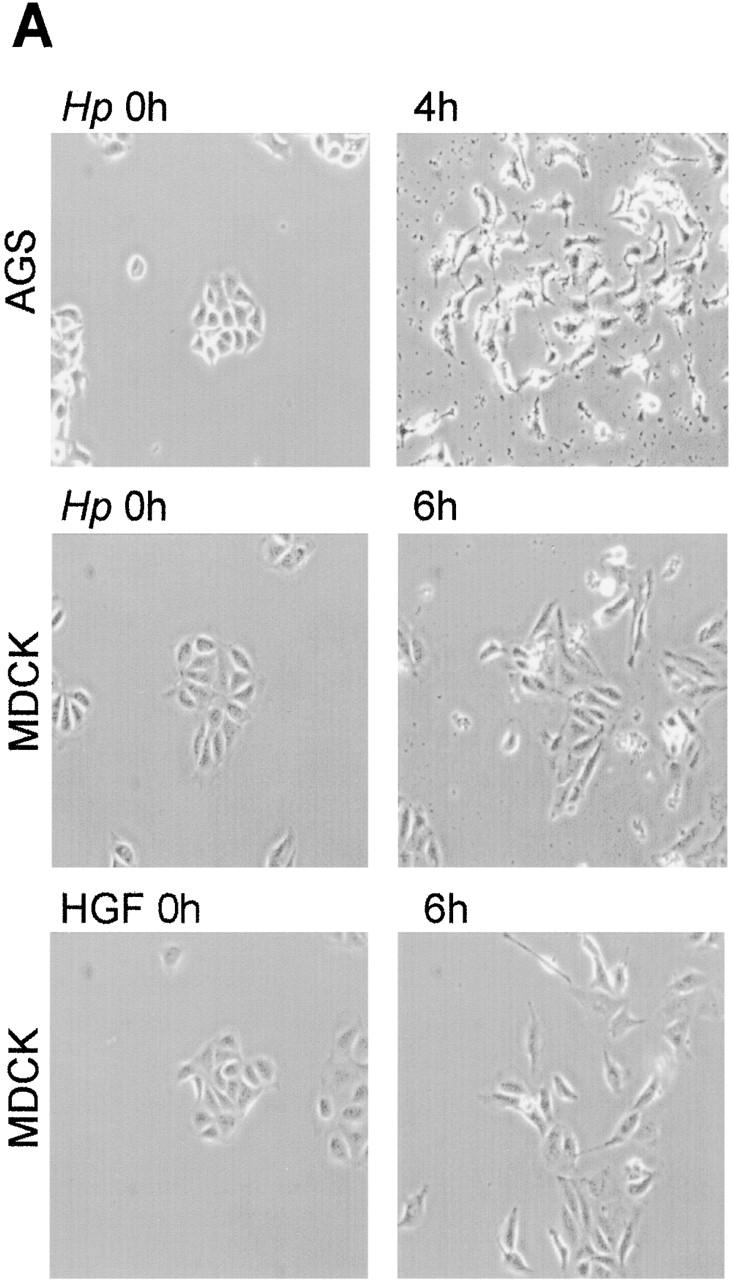
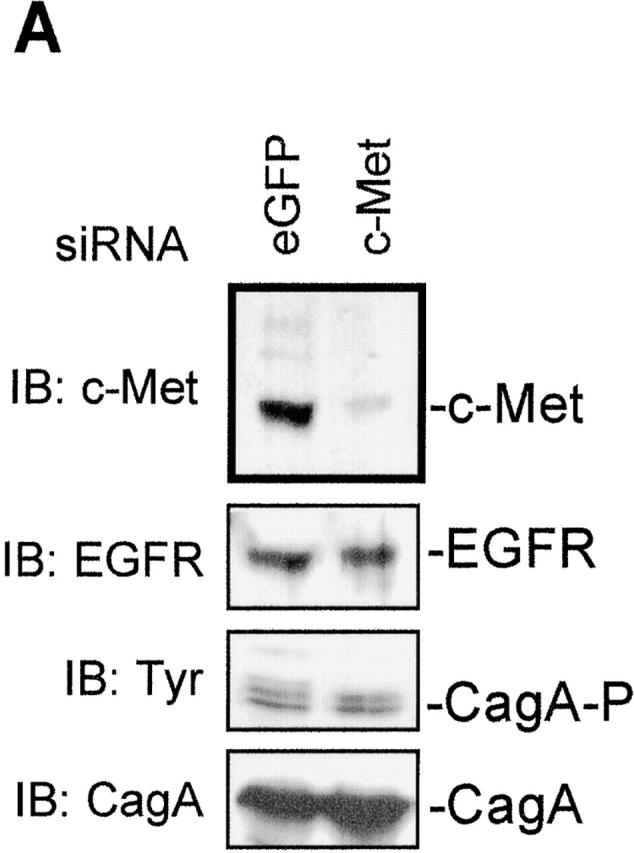
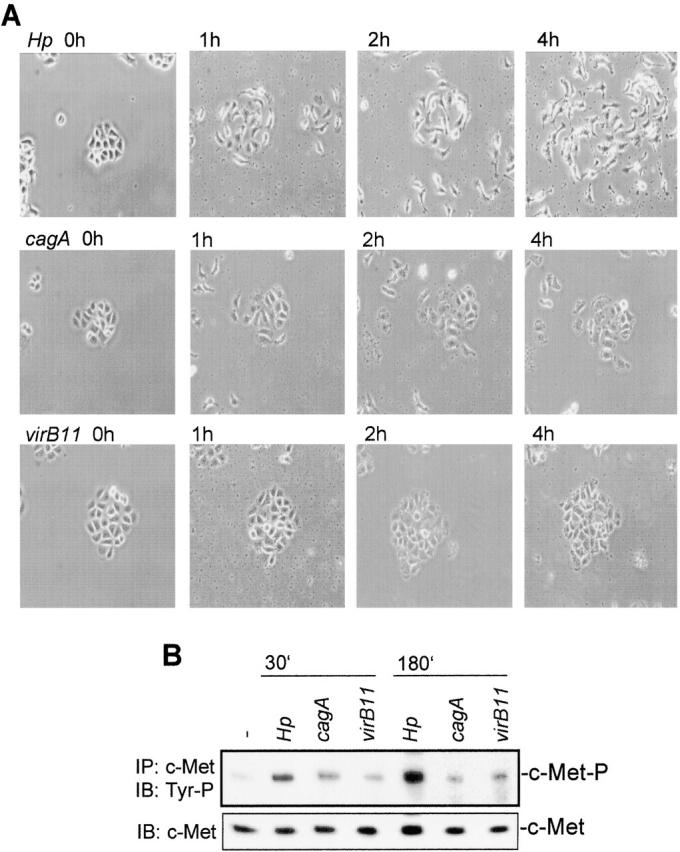
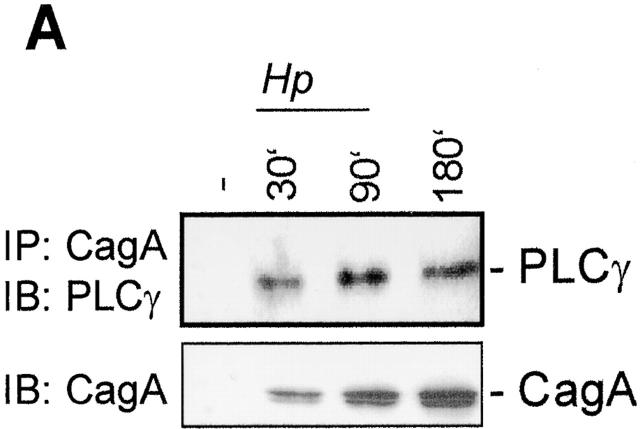
Infection with the human microbial pathogen Helicobacter pylori is assumed to lead to invasive gastric cancer. We find that H. pylori activates the hepatocyte growth factor/scatter factor receptor c-Met, which is involved in invasive growth of tumor cells. The H. pylori effector protein CagA intracellularly targets the c-Met receptor and promotes cellular processes leading to a forceful motogenic response. CagA could represent a bacterial adaptor protein that associates with phospholipase Cγ but not Grb2-associated binder 1 or growth factor receptor–bound protein 2. The H. pylori–induced motogenic response is suppressed and blocked by the inhibition of PLCγ and of MAPK, respectively. Thus, upon translocation, CagA modulates cellular functions by deregulating c-Met receptor signaling. The activation of the motogenic response in H. pylori–infected epithelial cells suggests that CagA could be involved in tumor progression.
Overview
The claims and statistics of this paper haven’t been checked yet.
Run the check — free, no account needed. It reads the open-access text and checks the sources it cites.
Integrity signals
Registry
Cites
Statistics
Figures
Verification
Claims the paper makes
The claims and statistics of this paper haven’t been checked yet.
Run the check — free, no account needed. It reads the open-access text and checks the sources it cites.
Claims other papers make about this one
Each is checked against this paper’s own text: does it say what the citing paper says it does?
The source backs part of the claim, not all of it — or backs it for a different population, condition or comparison.
In the citing paper
“CagA binds to and activates c-Met, stimulating epithelial cell motility and invasiveness, processes that are precursors to carcinogenesis [32].”
From Candida albicans stimulates formation of a multi-receptor complex that mediates epithelial cell invasion during oropharyngeal infection (2023) · cites this paper as [32]
Experimental — accuracy not yet measuredThe source backs part of the claim, not all of it — or backs it for a different population, condition or comparison.
In the citing paper
“Helicobacter pylori activates c-Met by injecting cytotoxin-associated gene A (CagA) into gastric epithelial cells via the type IV secretion system.”
From Candida albicans stimulates formation of a multi-receptor complex that mediates epithelial cell invasion during oropharyngeal infection (2023) · cites this paper as [32]
Experimental — accuracy not yet measured
Self-check
Percentages, sums and reported differences re-computed from the paper’s own numbers.
The self-check needs the paper’s full text.
Citations
Cites
Duplexes of 21-nucleotide RNAs mediate RNA interference in cultured mammalian cells
Elbashir, S. M., Harborth, J., Lendeckel, W., Yalcin, A., Weber, K., & Tuschl, T. (2001) · Nature · doi:10.1038/35078107 · Cited by 9,456
Epithelial–mesenchymal transitions in tumour progression
Thiery, J. P. (2002) · Nature reviews. Cancer · doi:10.1038/nrc822 · Cited by 6,767
Helicobacter pylori and gastrointestinal tract adenocarcinomas
Peek, R. M., & Blaser, M. J. (2002) · Nature reviews. Cancer · doi:10.1038/nrc703 · Cited by 1,807
Rho GTPases Control Polarity, Protrusion, and Adhesion during Cell Movement
Nobes, C. D., & Hall, A. K. (1999) · The Journal of Cell Biology · doi:10.1083/jcb.144.6.1235 · Cited by 1,450
Translocation of Helicobacter pylori CagA into Gastric Epithelial Cells by Type IV Secretion
Odenbreit, S., Püls, J., Sedlmaier, B., Gerland, E., Fischer, W. H., & Haas, R. (2000) · Science · doi:10.1126/science.287.5457.1497 · Cited by 1,286
Regulation of Cell Motility by Mitogen-activated Protein Kinase
Klemke, R. L., Cai, S., Giannini, A. L. M., Gallagher, P. J., de Lanerolle, P., & Cheresh, D. A. (1997) · The Journal of Cell Biology · doi:10.1083/jcb.137.2.481 · Cited by 1,239
Helicobacter pylori Virulence and Genetic Geography
Covacci, A., Telford, J. L., Giudice, G. D., Parsonnet, J., & Rappuoli, R. (1999) · Science · doi:10.1126/science.284.5418.1328 · Cited by 1,047
SHP-2 Tyrosine Phosphatase as an Intracellular Target of Helicobacter pylori CagA Protein
Higashi, H., Tsutsumi, R., Muto, S., Sugiyama, T., Azuma, T., Asaka, M., & Hatakeyama, M. (2002) · Science · doi:10.1126/science.1067147 · Cited by 1,028
Ponzetto, C., Bardelli, A., Zhen, Z., Maina, F., Zonca, P. D., Giordano, S., Graziani, A., Panayotou, G., & Comoglio, P. M. (1994) · Cell · doi:10.1016/0092-8674(94)90318-2 · Cited by 994
Segal, E. D., Cha, J., Lo, J., Falkow, S., & Tompkins, L. S. (1999) · Proceedings of the National Academy of Sciences · doi:10.1073/pnas.96.25.14559 · Cited by 769
PKB/Akt: connecting phosphoinositide 3-kinase to cell survival and beyond
Marte, B. M. (1997) · Trends in Biochemical Sciences · doi:10.1016/s0968-0004(97)01097-9 · Cited by 692
Stein, M., Rappuoli, R., & Covacci, A. (2000) · Proceedings of the National Academy of Sciences · doi:10.1073/pnas.97.3.1263 · Cited by 578
Weidner, K. M., Cesare, S. D., Sachs, M., Brinkmann, V., Behrens, J., & Birchmeier, W. (1996) · Nature · doi:10.1038/384173a0 · Cited by 575
Self-citationHigashi, H., Tsutsumi, R., Fujita, A., Yamazaki, S., Asaka, M., Azuma, T., & Hatakeyama, M. (2002) · Proceedings of the National Academy of Sciences · doi:10.1073/pnas.222375399 · Cited by 573
Helicobacter pylori Caga Protein Can Be Tyrosine Phosphorylated in Gastric Epithelial Cells
Asahi, M., Azuma, T., Ito, S., Ito, Y., Suto, H., Nagai, Y., Tsubokawa, M., Tohyama, Y., Maeda, S., Omata, M., et al. (2000) · The Journal of Experimental Medicine · doi:10.1084/jem.191.4.593 · Cited by 474
Met receptor tyrosine kinase: enhanced signaling through adapter proteins
Furge, K. A., Zhang, Y.-W., & Woude, G. F. V. (2000) · Oncogene · doi:10.1038/sj.onc.1203859 · Cited by 412
Backert, S., Ziska, E., Brinkmann, V., Zimny‐Arndt, U., Fauconnier, A., Jungblut, P. R., Naumann, M., & Meyer, T. F. (2000) · Cellular Microbiology · doi:10.1046/j.1462-5822.2000.00043.x · Cited by 403
Self-citationKeates, S. E., Keates, A. C., Warny, M., Peek, R. M., Murray, P. G., & Kelly, C. P. (1999) · The Journal of Immunology · doi:10.4049/jimmunol.163.10.5552 · Cited by 274
Phospholipase C-γ as a Signal-Transducing Element
Carpenter, G. F., & Ji, Q. (1999) · Experimental Cell Research · doi:10.1006/excr.1999.4671 · Cited by 252
Xie, H., Pallero, M. A., Gupta, K. B., Chang, P., Ware, M. F., Witke, W., Kwiatkowski, D. J., Lauffenburger, D. A., Murphy-Ullrich, J. E., & Wells, A. H. (1998) · Journal of Cell Science · doi:10.1242/jcs.111.5.615 · Cited by 230
Keates, S. E., Sougioultzis, S., Keates, A. C., Zhao, D., Peek, R. M., Shaw, L. M., & Kelly, C. P. (2001) · Journal of Biological Chemistry · doi:10.1074/jbc.m107630200 · Cited by 194
The tyrosine kinase encoded by the MET proto-oncogene is activated by autophosphorylation.
Naldini, L., Vigna, E., Ferracini, R., Longati, P., Gandino, L., Prat, M., & Comoglio, P. M. (1991) · Molecular and Cellular Biology · doi:10.1128/mcb.11.4.1793 · Cited by 185
Tumor invasion as dysregulated cell motility
Kassis, J. N., Lauffenburger, D. A., Turner, T., & Wells, A. H. (2001) · Seminars in Cancer Biology · doi:10.1006/scbi.2000.0362 · Cited by 165
A role for gelsolin in actuating epidermal growth factor receptor-mediated cell motility.
Chen, P., Murphy-Ullrich, J. E., & Wells, A. H. (1996) · The Journal of Cell Biology · doi:10.1083/jcb.134.3.689 · Cited by 155
Scatter factors and invasive growth
Comoglio, P. M., & Boccaccio, C. (2001) · Seminars in Cancer Biology · doi:10.1006/scbi.2000.0366 · Cited by 119
Wallasch, C., Crabtree, J. E., Bevec, D., Robinson, P. A., Wagner, H., & Ullrich, A. (2002) · Biochemical and Biophysical Research Communications · doi:10.1016/s0006-291x(02)00740-4 · Cited by 115
Bardelli, A., Longati, P., Gramaglia, D., Basilico, C., Tamagnone, L., Giordano, S., Ballinari, D., Michieli, P., & Comoglio, P. M. (1998) · Proceedings of the National Academy of Sciences · doi:10.1073/pnas.95.24.14379 · Cited by 106
Churin, Y., Kardalinou, E., Meyer, T. F., & Naumann, M. (2001) · Molecular Microbiology · doi:10.1046/j.1365-2958.2001.02443.x · Cited by 94
Self-citationWells, A. H., Ware, M. F., Allen, F. D., & Lauffenburger, D. A. (1999) · Cell Motility and the Cytoskeleton · doi:10.1002/(sici)1097-0169(199912)44:4 · Cited by 79
Weßler, S., Höcker, M. R., Fischer, W. H., Wang, T. C., Rosewicz, S., Haas, R., Wiedenmann, B. J., Meyer, T. F., & Naumann, M. (2000) · Journal of Biological Chemistry · doi:10.1074/jbc.275.5.3629 · Cited by 69
Self-citationThe Tyrosine Kinase Encoded by the MET Proto-Oncogene Is Activated by Autophosphorylation
Naldini, L., Vigna, E., Ferracini, R., Longati, P., Gandino, L., Prat, M., & Comoglio, P. M. (1991) · Molecular and Cellular Biology · doi:10.1128/mcb.11.4.1793-1803.1991 · Cited by 46
Research works printed but not linked: 1
- 1991, Mol. Cell. Biol., 11, 1793
Cited by
Sorted by citations
Helicobacter pylori and Gastric Cancer: Factors That Modulate Disease Risk
Wroblewski, L. E., Peek, R. M., & Wilson, K. T. (2010) · Clinical Microbiology Reviews · doi:10.1128/cmr.00011-10 · Cited by 1,503
Helicobacter pylori: gastric cancer and beyond
Polk, D. B., & Peek, R. M. (2010) · Nature Reviews Cancer · doi:10.1038/nrc2857 · Cited by 1,158
Modelling human development and disease in pluripotent stem-cell-derived gastric organoids
McCracken, K. W., Catá, E. M., Crawford, C. M., Sinagoga, K. L., Schumacher, M., Rockich, B. E., Tsai, Y.-H., Mayhew, C. N., Spence, J. R., Zavros, Y., et al. (2014) · Nature · doi:10.1038/nature13863 · Cited by 980
Oncogenic mechanisms of the Helicobacter pylori CagA protein
Hatakeyama, M. (2004) · Nature reviews. Cancer · doi:10.1038/nrc1433 · Cited by 756
The versatile bacterial type IV secretion systems
Cascalès, E., & Christie, P. J. (2003) · Nature Reviews Microbiology · doi:10.1038/nrmicro753 · Cited by 695
Metadata
- Authors
- Churin, Y., Al-Ghoul, L., Kepp, O., Meyer, T. F., Birchmeier, W., & Naumann, M.
- Affiliations
- Max Planck Institute for Infection Biology (DE)
- Otto-von-Guericke-Universität Magdeburg (DE)
- Max Delbrück Center (DE)
- Max Planck Society (DE)
- Corresponding author
- Naumann, Michael
- Venue
- The Journal of Cell Biology
- Publisher
- Rockefeller University Press
- Published
- 2003-04-28
- Volume
- 161
- Issue
- 2
- Pages
- 249-255
- ISSN
- 0021-9525 (ISSN-L)
- 1540-8140
- PMC
- PMC2172921
- OpenAlex
- W1991444764
- Cited by
- 354
- References
- 31
- Citations by year
- 2026: 2 · 2025: 3 · 2024: 6 · 2023: 9 · 2022: 9 · 2021: 6 · 2020: 11 · 2019: 15 · 2018: 8 · 2017: 25 · 2016: 16 · 2015: 10 · 2014: 17 · 2013: 14 · 2012: 14
- FWCI
- 26.28
- Type
- journal article
- Language
- en
- Open access
- green
- www.ncbi.nlm.nih.gov
- Licence
- cc-by-nc-sa
- Locations
- The Journal of Cell Biology (publishedVersion)
- Europe PMC (PubMed Central) (publishedVersion, cc-by-nc-sa)
- PubMed Central (publishedVersion, cc-by-nc-sa)
- PubMed (publishedVersion)
- MDC Repository (Max-Delbrueck-Center for Molecular Medicine) (acceptedVersion)
- MPG.PuRe (Max Planck Society) (submittedVersion, other-oa)
- Max Planck Institute for Plasma Physics (submittedVersion)
- Funders
- Deutsche Forschungsgemeinschaft
- Topics
- Health Sciences › Medicine › Gastroenterology › Helicobacter pylori-related gastroenterology studies
- Health Sciences › Medicine › Oncology › Gastric Cancer Management and Outcomes
- Health Sciences › Medicine › Gastroenterology › Gastrointestinal motility and disorders
- Keywords
- Helicobacter pylori, CagA, c-Met, hepatocyte growth factor, bacterial effector proteins, cell motility, phospholipase C-gamma, MAPK signaling, gastric cancer, tumor progression, epithelial cells, receptor translocation
- MeSH terms
- Antigens, Bacterial, Bacterial Proteins, Carcinoma, Cell Division, Cell Transformation, Neoplastic, Enzyme Inhibitors, Humans, Type C Phospholipases, Phosphoproteins, Proteins, Stomach Neoplasms, Tumor Cells, Cultured, Signal Transduction, Helicobacter pylori, Helicobacter Infections, Hepatocyte Growth Factor, Proto-Oncogene Proteins c-met, Mitogen-Activated Protein Kinase 1, Protein Transport, Adaptor Proteins, Signal Transducing, GRB2 Adaptor Protein, Phospholipase C gamma
About these checks
Registry, retraction, Cites and statistics results are computed, not judged, with one exception: a printed reference that no index lists is read once by a model before it counts as a citation error. Claims are extracted by a model and kept only when their quote appears verbatim in the text; each cited source is then checked, with a model’s help, for whether it says what the claim relies on. Those verdicts can be wrong — read the claim’s quote and the cited source before relying on one.
Statistics and arithmetic are recomputed, not judged.
Confidence bands are shown only for fields calibrated on our annotated test set. None is calibrated yet, so no band is shown.
What counts as a claim ›How we measure confidence ›How we check this ›
Are you an author, or do you see a problem with this page? Request a review
