

The DOI matches its Crossref record; 20 of the 20 references it cites were found in a registry or an index.
Telomere Length, Telomerase Activity, and Replicative Potential in HIV Infection: Analysis of CD4+ and CD8+T Cells from HIV-discordant Monozygotic Twins
Open accessAbstract
To address the possible role of replicative senescence in human immunodeficiency virus (HIV) infection, telomere length, telomerase activity, and in vitro replicative capacity were assessed in peripheral blood T cells from HIV+ and HIV− donors. Genetic and age-specific effects on these parameters were controlled by studying HIV-discordant pairs of monozygotic twins. Telomere terminal restriction fragment (TRF) lengths from CD4+ T cells of HIV+ donors were significantly greater than those from HIV− twins. In contrast, telomere lengths in CD8+ T cells from HIV+ donors were shorter than in HIV− donors. The in vitro replicative capacity of CD4+ cells from HIV+ donors was equivalent to that of HIV− donors in response to stimulation through T cell receptor CD3 and CD28. Little or no telomerase activity was detected in freshly isolated CD4+ or CD8+ lymphocytes from HIV+ or HIV− donors, but was induced by in vitro stimulation of both HIV+ and HIV− donor cells. These results suggest that HIV infection is associated with alterations in the population dynamics of both CD4+ and CD8+ T cells, but fail to provide evidence for clonal exhaustion or replicative senescence as a mechanism underlying the decline in CD4+ T cells of HIV-infected donors.
Overview
The claims and statistics of this paper haven’t been checked yet.
Run the check — free, no account needed. It reads the open-access text and checks the sources it cites.
Integrity signals
Registry
Cites
Statistics
Figures
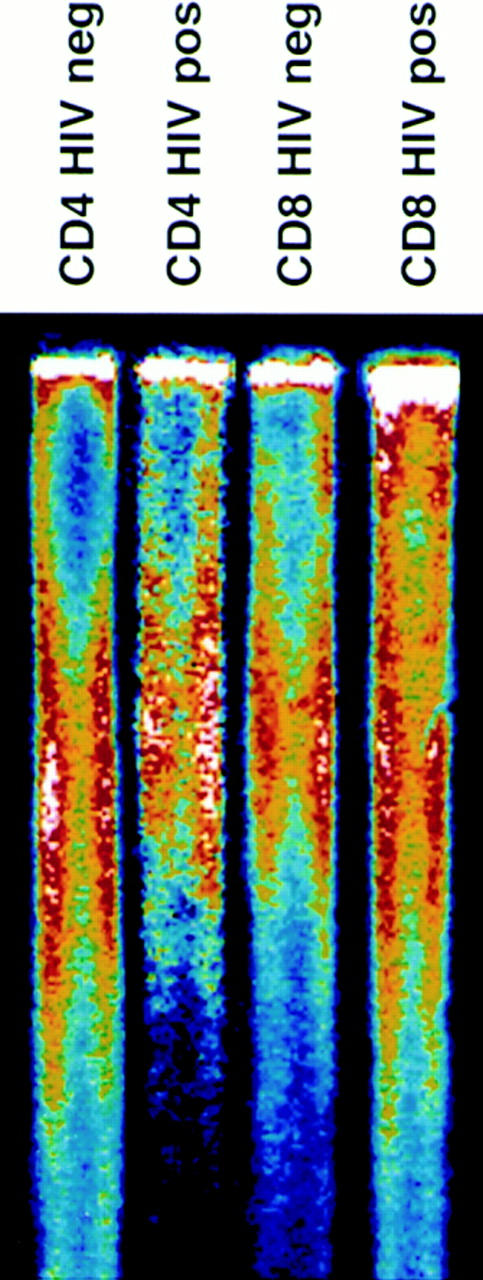
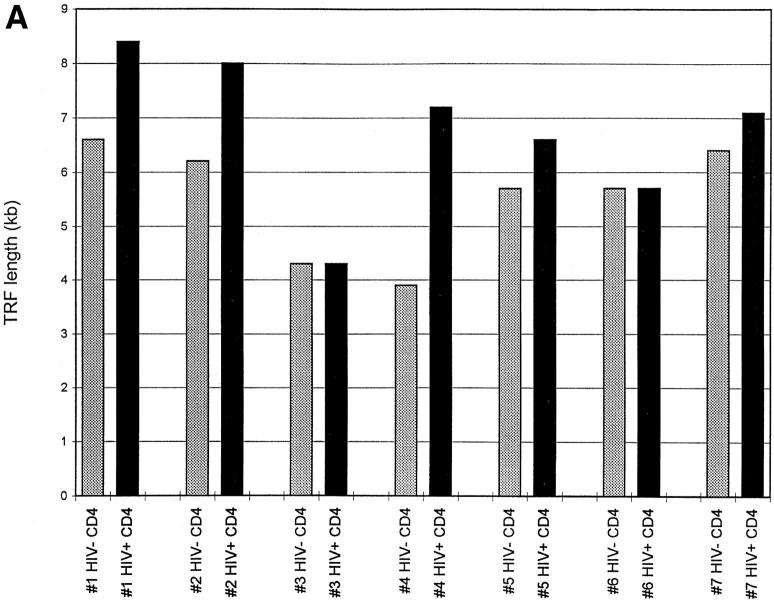
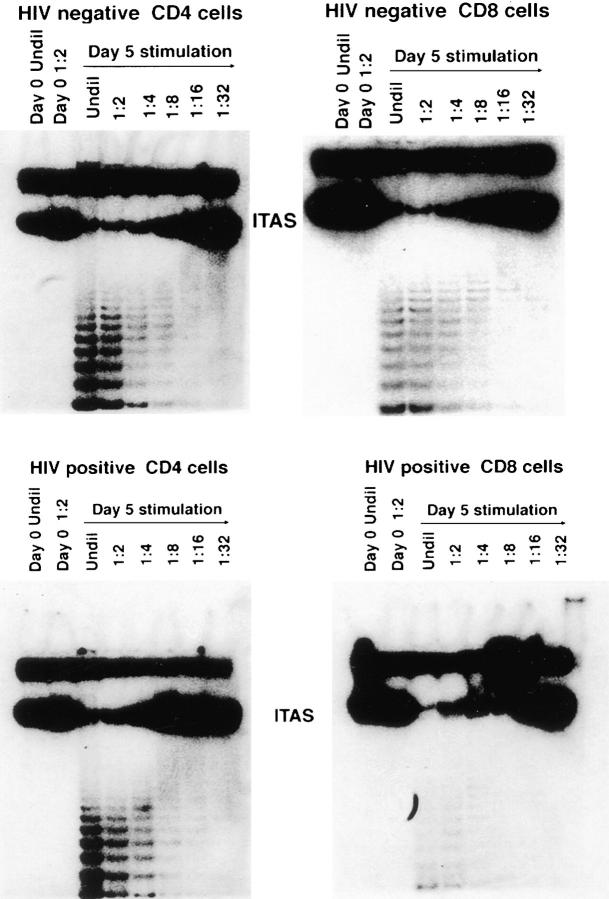
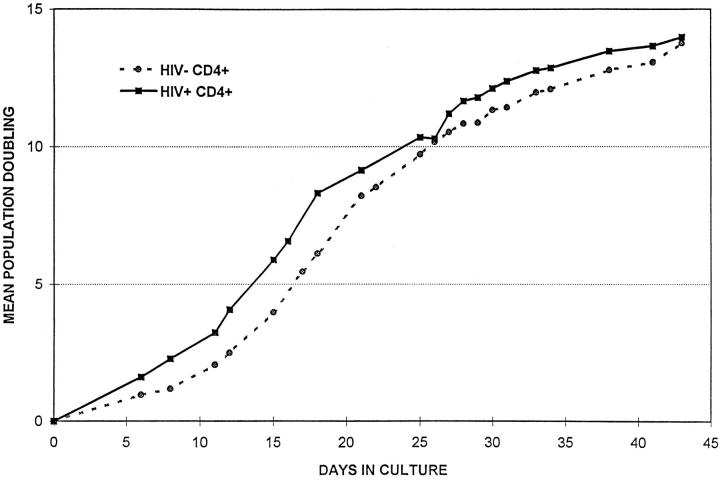
Verification
Claims the paper makes
The claims and statistics of this paper haven’t been checked yet.
Run the check — free, no account needed. It reads the open-access text and checks the sources it cites.
Claims other papers make about this one
Each is checked against this paper’s own text: does it say what the citing paper says it does?
In the citing paper
“Telomere lengths of CD8+ T cells are shorter in HIV patients compared to healthy individuals, but this observation was not found in CD4+ T cells.”
From The struggle of a good friend getting old: cellular senescence in viral responses and therapy (2021) · cites this paper as Palmer et al, 1997
In the citing paper
“Interestingly, certain hallmarks of cellular senescence are also found in T cells from patients with HIV (Effros et al, 1996; Wolthers et al, 1996; Palmer et al, 1997; Nelson et al, 2012; Pereira Ribeiro et al, 2016).”
From The struggle of a good friend getting old: cellular senescence in viral responses and therapy (2021) · cites this paper as Palmer et al, 1997
In the citing paper
“These finds were also independent on whether HIV patients were on antiretroviral therapy (Effros et al, 1996; Wolthers et al, 1996; Palmer et al, 1997).”
From The struggle of a good friend getting old: cellular senescence in viral responses and therapy (2021) · cites this paper as Palmer et al, 1997
In the citing paper
“Telomere lengths of CD8+ T cells are shorter in HIV patients compared to healthy individuals, but this observation was not found in CD4+ T cells.”
From The struggle of a good friend getting old: cellular senescence in viral responses and therapy (2021) · cites this paper as Palmer et al, 1997
Self-check
Percentages, sums and reported differences re-computed from the paper’s own numbers.
The self-check needs the paper’s full text.
Citations
Cites
The serial cultivation of human diploid cell strains
Hayflick, L., & Moorhead, P. S. (1961) · Experimental Cell Research · doi:10.1016/0014-4827(61)90192-6 · Cited by 8,508
Telomeres shorten during ageing of human fibroblasts
Harley, C. B., Futcher, A. B., & Greider, C. W. (1990) · Nature · doi:10.1038/345458a0 · Cited by 5,750
Rapid turnover of plasma virions and CD4 lymphocytes in HIV-1 infection
Ho, D. D., Neumann, A. U., Perelson, A. S., Chen, W., Leonard, J. M., & Markowitz, M. H. (1995) · Nature · doi:10.1038/373123a0 · Cited by 4,261
Identification of a specific telomere terminal transferase activity in tetrahymena extracts
Greider, C. W., & Blackburn, E. H. (1985) · Cell · doi:10.1016/0092-8674(85)90170-9 · Cited by 3,400
The RNA Component of Human Telomerase
Feng, J., Funk, W. D., Wang, S.-S., Weinrich, S. L., Avilion, A. A., Chiu, C.-P., Adams, R. R., Chang, E., Allsopp, R. C., Yu, J., et al. (1995) · Science · doi:10.1126/science.7544491 · Cited by 2,227
Telomere length predicts replicative capacity of human fibroblasts.
Allsopp, R. C., Vaziri, H., Patterson, C., Goldstein, S., Younglai, E. V., Futcher, A. B., Greider, C. W., & Harley, C. B. (1992) · Proceedings of the National Academy of Sciences · doi:10.1073/pnas.89.21.10114 · Cited by 2,200
Moskophidis, D., Lechner, F., Pircher, H., & Zinkernagel, R. M. (1993) · Nature · doi:10.1038/362758a0 · Cited by 1,240
Evidence for a mitotic clock in human hematopoietic stem cells: loss of telomeric DNA with age.
Vaziri, H., Dragowska, W., Allsopp, R. C., Thomas, T. E., Harley, C. B., & Lansdorp, P. M. (1994) · Proceedings of the National Academy of Sciences · doi:10.1073/pnas.91.21.9857 · Cited by 1,132
Telomerase activity in normal and malignant hematopoietic cells.
Broccoli, D., Young, J. W., & de Lange, T. (1995) · Proceedings of the National Academy of Sciences · doi:10.1073/pnas.92.20.9082 · Cited by 754
Genetic determination of telomere size in humans: a twin study of three age groups.
Slagboom, P. E., Droog, S., & Boomsma, D. I. (1994) · PubMed Central · Cited by 734
Cited by
Sorted by citations
Brenchley, J. M., Karandikar, N. J., Betts, M. R., Ambrozak, D. R., Hill, B. J., Crotty, L. E., Casazza, J. P., Kuruppu, J., Migueles, S. A., Connors, M., et al. (2003) · Blood · doi:10.1182/blood-2002-07-2103 · Cited by 1,073
Pakker, N. G., Notermans, D. W., de Boer, R. J., Roos, M. T. L., de Wolf, F., Hill, A., Leonard, J. M., Danner, S. A., Miedema, F. F., & Schellekens, P. T. A. (1998) · Nature Medicine · doi:10.1038/nm0298-208 · Cited by 701
Directly measured kinetics of circulating T lymphocytes in normal and HIV-1-infected humans
Hellerstein, M. K., Hanley, M. B., Cesar, D., Siler, S., Papageorgopoulos, C., Wieder, E., Schmidt, D. J., Hoh, R., Neese, R. A., Macallan, D. C., et al. (1999) · Nature Medicine · doi:10.1038/4772 · Cited by 592
CD 4 + T‐cell depletion in HIV infection: mechanisms of immunological failure
Okoye, A. A., & Picker, L. J. (2013) · Immunological Reviews · doi:10.1111/imr.12066 · Cited by 571
Telomere length dynamics in human lymphocyte subpopulations measured by flow cytometry
Rufer, N., Dragowska, W. H., Thornbury, G., Roosnek, E. E., & Lansdorp, P. M. (1998) · Nature Biotechnology · doi:10.1038/nbt0898-743 · Cited by 551
Metadata
- Authors
- Palmer, L. D., Weng, N.-P., Levine, B. L., June, C. H., Lane, H. C., & Hodes, R. J.
- Affiliations
- National Institutes of Health (US)
- Venue
- The Journal of Experimental Medicine
- Publisher
- Rockefeller University Press
- Published
- 1997-04-07
- Volume
- 185
- Issue
- 7
- Pages
- 1381-1386
- ISSN
- 0022-1007 (ISSN-L)
- 1540-9538
- PMC
- PMC2196247
- OpenAlex
- W2114119969
- Cited by
- 129
- References
- 20
- Citations by year
- 2026: 1 · 2024: 2 · 2022: 1 · 2021: 3 · 2019: 1 · 2018: 4 · 2017: 3 · 2016: 2 · 2015: 1 · 2014: 3 · 2013: 5 · 2012: 2
- FWCI
- 5.96
- Type
- journal article
- Language
- en
- Open access
- bronze
- doi.org
- Locations
- The Journal of Experimental Medicine (publishedVersion)
- PubMed Central (publishedVersion, cc-by-nc-sa)
- PubMed (publishedVersion)
- Topics
- Life Sciences › Immunology and Microbiology › Virology › HIV Research and Treatment
- Life Sciences › Biochemistry, Genetics and Molecular Biology › Cell Biology › Telomeres, Telomerase, and Senescence
- Health Sciences › Medicine › Infectious Diseases › HIV-related health complications and treatments
- Keywords
- HIV infection, telomere length, telomerase activity, replicative senescence, CD4+ T cells, CD8+ T cells, terminal restriction fragments, CD4+ T cell decline
- MeSH terms
- Adult, Cells, Cultured, Humans, Lymphocyte Activation, Middle Aged, Twins, Monozygotic, CD4-Positive T-Lymphocytes, HIV Infections, T-Lymphocyte Subsets, Telomere, Cellular Senescence, CD8-Positive T-Lymphocytes, Telomerase
About these checks
Registry, retraction, Cites and statistics results are computed, not judged, with one exception: a printed reference that no index lists is read once by a model before it counts as a citation error. Claims are extracted by a model and kept only when their quote appears verbatim in the text; each cited source is then checked, with a model’s help, for whether it says what the claim relies on. Those verdicts can be wrong — read the claim’s quote and the cited source before relying on one.
Statistics and arithmetic are recomputed, not judged.
Confidence bands are shown only for fields calibrated on our annotated test set. None is calibrated yet, so no band is shown.
What counts as a claim ›How we measure confidence ›How we check this ›
Are you an author, or do you see a problem with this page? Request a review
