

The DOI matches its Crossref record; 57 of the 58 references it cites were found in a registry or an index.
Influence of Polymorphism in the Genes for the Interleukin (IL)-1 Receptor Antagonist and IL-1β on Tuberculosis
Open accessAbstract
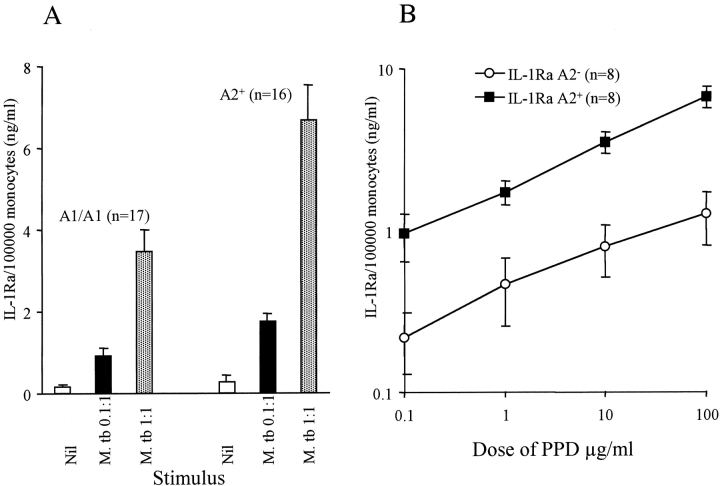
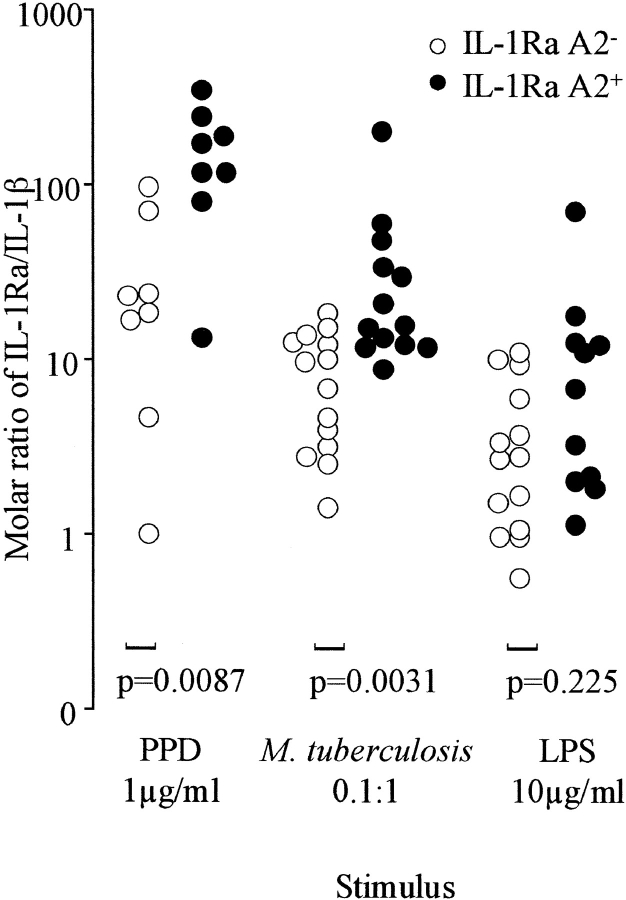
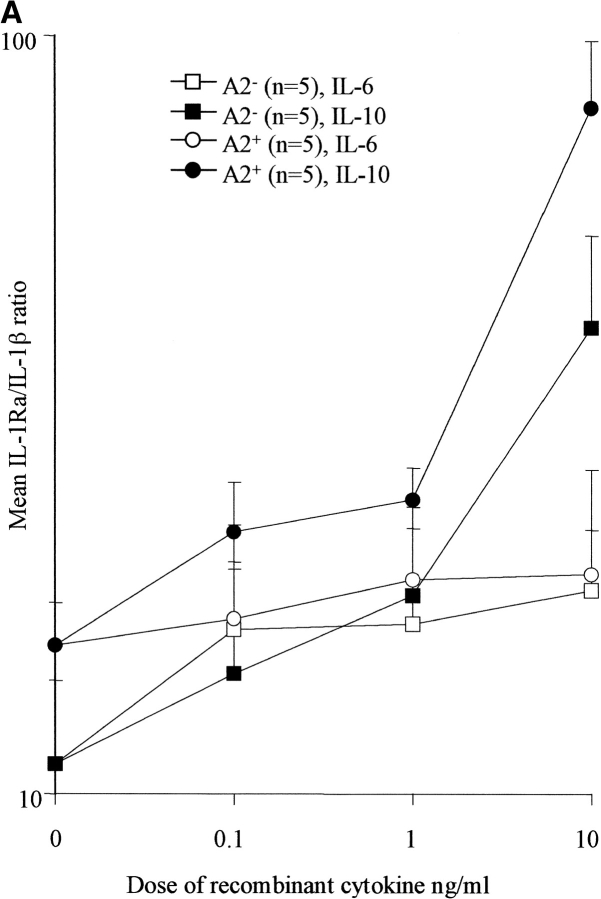
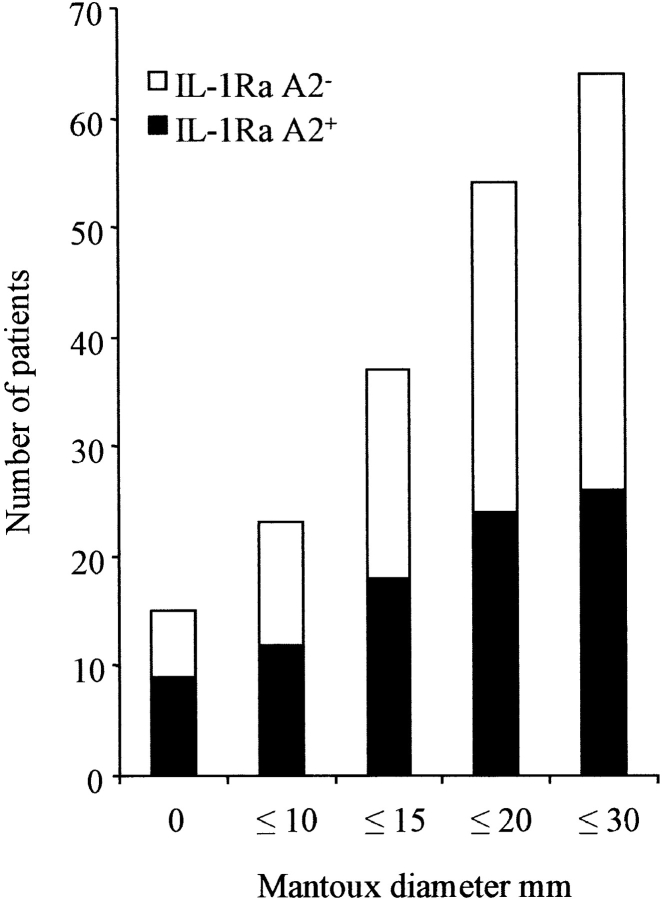
Several lines of evidence suggest that host genetic factors controlling the immune response influence infection by Mycobacterium tuberculosis. The proinflammatory cytokine interleukin (IL)-1β and its antagonist, IL-1Ra (IL-1 receptor agonist), are strongly induced by M. tuberculosis and are encoded by polymorphic genes. The induction of both IL-1Ra mRNA and secreted protein by M. tuberculosis in IL-1Ra allele A2–positive (IL-1Ra A2+) healthy subjects was 1.9-fold higher than in IL-1Ra A2− subjects. The M. tuberculosis–induced expression of mRNA for IL-1β was higher in subjects of the IL-1β (+3953) A1+ haplotype (P = 0.04). The molar ratio of IL-1Ra/IL-1β induced by M. tuberculosis was markedly higher in IL-1Ra A2+ individuals (P < 0.05), with minor overlap between the groups, reflecting linkage between the IL-1Ra A2 and IL-1β (+3953) A2 alleles. In M. tuberculosis–stimulated peripheral blood mononuclear cells, the addition of IL-4 increased IL-1Ra secretion, whereas interferon γ increased and IL-10 decreased IL-1β production, indicative of a differential influence on the IL-1Ra/IL-1β ratio by cytokines. In a study of 114 healthy purified protein derivative–reactive subjects and 89 patients with tuberculosis, the frequency of allelic variants at two positions (−511 and +3953) in the IL-1β and IL-1Ra genes did not differ between the groups. However, the proinflammatory IL-1Ra A2−/IL-1β (+3953) A1+ haplotype was unevenly distributed, being more common in patients with tuberculous pleurisy (92%) in comparison with healthy M. tuberculosis–sensitized control subjects or patients with other disease forms (57%, P = 0.028 and 56%, P = 0.024, respectively). Furthermore, the IL-1Ra A2+ haplotype was associated with a reduced Mantoux response to purified protein derivative of M. tuberculosis: 60% of tuberculin-nonreactive patients were of this type. Thus, the polymorphism at the IL-1 locus influences the cytokine response and may be a determinant of delayed-type hypersensitivity and disease expression in human tuberculosis.
Overview
The claims and statistics of this paper haven’t been checked yet.
Run the check — free, no account needed. It reads the open-access text and checks the sources it cites.
Integrity signals
Registry
Cites
Statistics
Figures
Verification
Claims the paper makes
The claims and statistics of this paper haven’t been checked yet.
Run the check — free, no account needed. It reads the open-access text and checks the sources it cites.
Claims other papers make about this one
Each is checked against this paper’s own text: does it say what the citing paper says it does?
In the citing paper
“and human polymorphisms of IL-1 genes were associated with susceptibility to tuberculosis (99).”
From Macrophage defense mechanisms against intracellular bacteria (2015) · cites this paper as [99]
Self-check
Percentages, sums and reported differences re-computed from the paper’s own numbers.
The self-check needs the paper’s full text.
Citations
Cites
Kindler, V., Sappino, A., Grau, G. E., Piguet, P., & VASSALLI, P. (1989) · Cell · doi:10.1016/0092-8674(89)90676-4 · Cited by 1,239
A Mutation in the Interferon-γ –Receptor Gene and Susceptibility to Mycobacterial Infection
Newport, M. J., Huxley, C. M., Huston, S., Hawrylowicz, C. M., Oostra, B. A., Williamson, R., & Levin, M. (1996) · New England Journal of Medicine · doi:10.1056/nejm199612263352602 · Cited by 1,198
INTERLEUKIN-1 RECEPTOR ANTAGONIST: Role in Biology
Arend, W. P., Malyak, M., Guthridge, C. J., & Gabay, C. (1998) · Annual Review of Immunology · doi:10.1146/annurev.immunol.16.1.27 · Cited by 1,071
Sreevatsan, S., Pan, X., Stockbauer, K. E., Connell, N. D., Kreiswirth, B. N., Whittam, T. S., & Musser, J. M. (1997) · Proceedings of the National Academy of Sciences · doi:10.1073/pnas.94.18.9869 · Cited by 1,035
Tuberculosis: Pathogenesis, Protection and Control
(1996) · Nature Medicine · doi:10.1038/nm0296-244b · Cited by 977
Pociot, F., Mølvig, J., Wogensen, L., Worsaae, H., & Nerup, J. (1992) · European Journal of Clinical Investigation · doi:10.1111/j.1365-2362.1992.tb01480.x · Cited by 921
Interferon-γ –Receptor Deficiency in an Infant with Fatal Bacille Calmette–Guérin Infection
Jouanguy, E., Altare, F., Lamhamedi‐Cherradi, S., Revy, P., Emile, J., Newport, M. J., Levin, M., Blanche, S., Seboun, E., Fischer, A., et al. (1996) · New England Journal of Medicine · doi:10.1056/nejm199612263352604 · Cited by 892
Impairment of Mycobacterial Immunity in Human Interleukin-12 Receptor Deficiency
Altare, F., Durandy, A., Lammas, D. A., Emile, J., Lamhamedi‐Cherradi, S., Deist, F. L., Drysdale, P., Jouanguy, E., Döffinger, R., Bernaudin, F., et al. (1998) · Science · doi:10.1126/science.280.5368.1432 · Cited by 843
Severe Mycobacterial and Salmonella Infections in Interleukin-12 Receptor-Deficient Patients
de Jong, R., Altare, F., Haagen, I.-A., Elferink, D. G., de Boer, T., Vriesman, P. J. C. V. B., Kabel, P. J., Draaisma, J. M. T., van Dissel, J. T., Kroon, F. P., et al. (1998) · Science · doi:10.1126/science.280.5368.1435 · Cited by 819
Variations in the NRAMP1 Gene and Susceptibility to Tuberculosis in West Africans
Bellamy, R., Ruwende, C., Corrah, T., McAdam, K. P. W. J., Whittle, H. C., & Hill, A. V. S. (1998) · New England Journal of Medicine · doi:10.1056/nejm199803053381002 · Cited by 738
Cited by
Sorted by citations
Opal, S. M., & DePalo, V. A. (2000) · Chest · doi:10.1378/chest.117.4.1162 · Cited by 1,752
Macrophage defense mechanisms against intracellular bacteria
Weiss, G., & Schaible, U. E. (2015) · Immunological Reviews · doi:10.1111/imr.12266 · Cited by 989
Genetic Dissection of Immunity to Mycobacteria: The Human Model
Casanova, J., & Abel, L. (2002) · Annual Review of Immunology · doi:10.1146/annurev.immunol.20.081501.125851 · Cited by 1,006
Wilkinson, R. J., Llewelyn, M., Toossi, Z., Patel, P., Pasvol, G., Lalvani, A., Wright, D. J., Latif, M., & Davidson, R. N. (2000) · The Lancet · doi:10.1016/s0140-6736(99)02301-6 · Cited by 768
Self-citationFrieden, T. R., Sterling, T. R., Munsiff, S. S., Watt, C. J., & Dye, C. (2003) · The Lancet · doi:10.1016/s0140-6736(03)14333-4 · Cited by 689
Metadata
- Authors
- Wilkinson, R. J., Patel, P., Llewelyn, M., Hirsch, C. S., Pasvol, G., Snounou, G., Davidson, R. N., & Toossi, Z.
- Affiliations
- Northwick Park Hospital (GB)
- Corresponding author
- Toossi, Zahra
- Venue
- The Journal of Experimental Medicine
- Publisher
- Rockefeller University Press
- Published
- 1999-06-21
- Volume
- 189
- Issue
- 12
- Pages
- 1863-1874
- ISSN
- 0022-1007 (ISSN-L)
- 1540-9538
- PMC
- PMC2192963
- OpenAlex
- W2156995597
- Cited by
- 295
- References
- 58
- Citations by year
- 2026: 1 · 2025: 1 · 2024: 7 · 2023: 3 · 2022: 3 · 2021: 3 · 2020: 8 · 2019: 4 · 2018: 9 · 2017: 7 · 2016: 6 · 2015: 11 · 2014: 9 · 2013: 10 · 2012: 9
- FWCI
- 14.57
- Type
- journal article
- Language
- en
- Open access
- bronze
- doi.org
- Locations
- The Journal of Experimental Medicine (publishedVersion)
- PubMed Central (publishedVersion, cc-by-nc-sa)
- PubMed (publishedVersion)
- Spiral (Imperial College London) (submittedVersion)
- Sussex Research Online (University of Sussex) (submittedVersion)
- Funders
- Wellcome Trust
- Imperial College London
- National Institutes of Health
- Medical Research Council
- National Institute of Allergy and Infectious Diseases (AI-18471)
- Topics
- Health Sciences › Medicine › Infectious Diseases › Tuberculosis Research and Epidemiology
- Life Sciences › Biochemistry, Genetics and Molecular Biology › Genetics › Genetic Associations and Epidemiology
- Life Sciences › Immunology and Microbiology › Immunology › Immune Response and Inflammation
- Keywords
- interleukin-1 receptor antagonist, IL-1β, genetic polymorphism, host genetic susceptibility, Mycobacterium tuberculosis, pleural tuberculosis, tuberculin skin test
- MeSH terms
- Cell Division, Genotype, Haplotypes, Humans, Hypersensitivity, Delayed, Interleukin-1, Leukocytes, Mycobacterium tuberculosis, Polymorphism, Genetic, RNA, Messenger, Sialoglycoproteins, Tuberculin, Tuberculosis, Interleukin-4, Interleukin-6, Interleukin-10, Receptors, Interleukin-1, Interleukin 1 Receptor Antagonist Protein
About these checks
Registry, retraction, Cites and statistics results are computed, not judged, with one exception: a printed reference that no index lists is read once by a model before it counts as a citation error. Claims are extracted by a model and kept only when their quote appears verbatim in the text; each cited source is then checked, with a model’s help, for whether it says what the claim relies on. Those verdicts can be wrong — read the claim’s quote and the cited source before relying on one.
Statistics and arithmetic are recomputed, not judged.
Confidence bands are shown only for fields calibrated on our annotated test set. None is calibrated yet, so no band is shown.
What counts as a claim ›How we measure confidence ›How we check this ›
Are you an author, or do you see a problem with this page? Request a review
