

The DOI matches its Crossref record; 43 of the 45 references it cites were found in a registry or an index.
Subsets of Human Dendritic Cell Precursors Express Different Toll-like Receptors and Respond to Different Microbial Antigens
Open accessAbstract
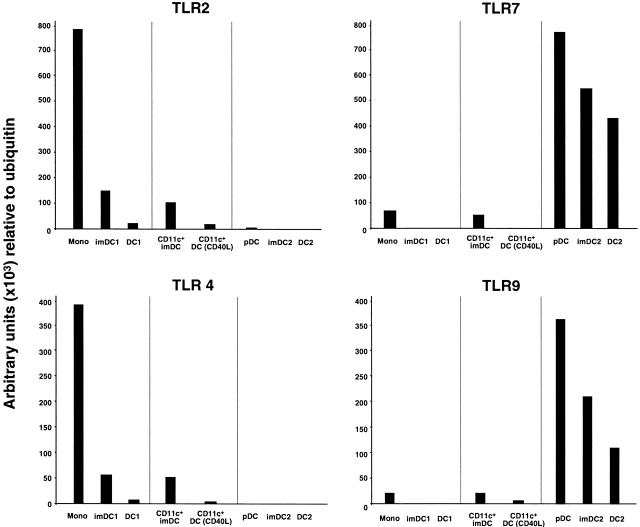
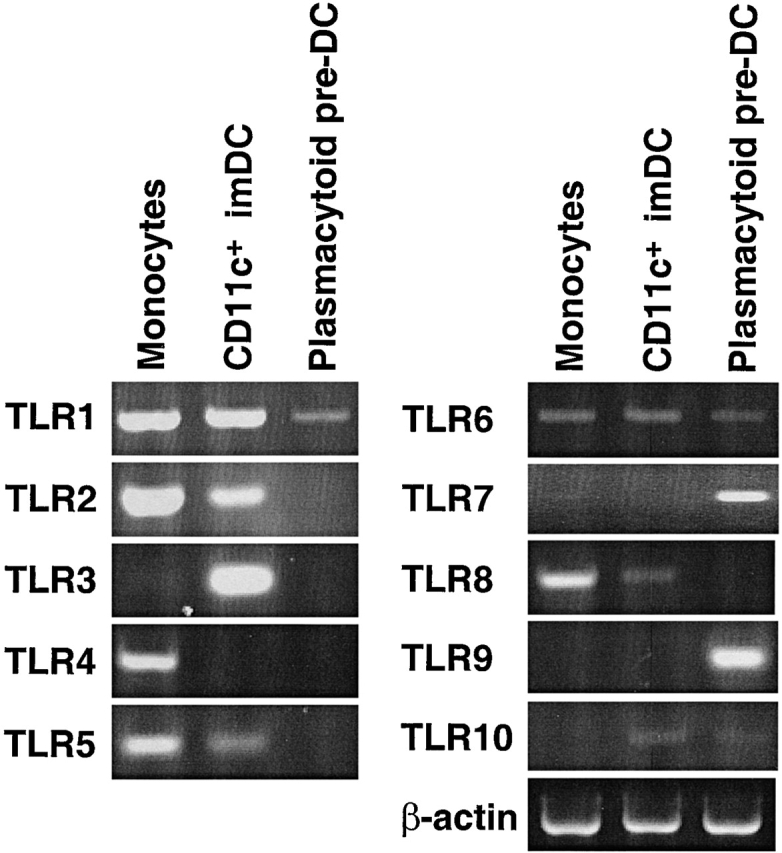
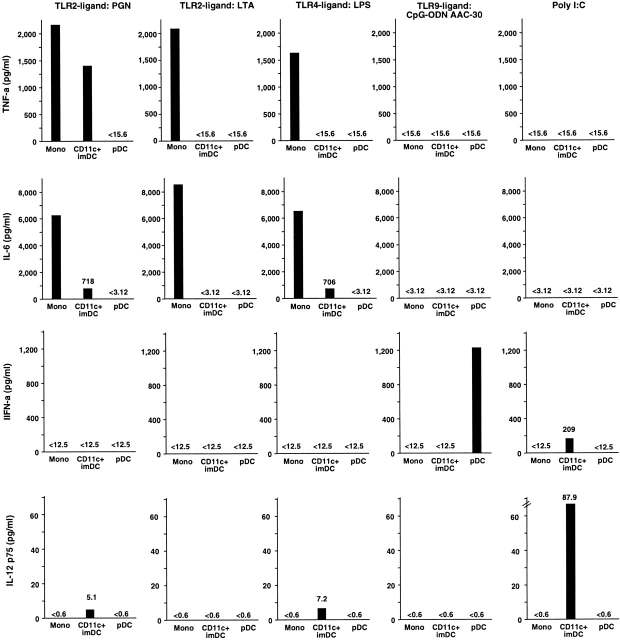
Toll-like receptors (TLRs) are ancient microbial pattern recognition receptors highly conserved from Drosophila to humans. To investigate if subsets of human dendritic cell precursors (pre-DC), including monocytes (pre-DC1), plasmacytoid DC precursors (pre-DC2), and CD11c+ immature DCs (imDCs) are developed to recognize different microbes or microbial antigens, we studied their TLR expression and responses to microbial antigens. We demonstrate that whereas monocytes preferentially express TLR 1, 2, 4, 5, and 8, plasmacytoid pre-DC strongly express TLR 7 and 9. In accordance with these TLR expression profiles, monocytes respond to the known microbial ligands for TLR2 (peptidoglycan [PGN], lipoteichoic acid) and TLR4 (lipopolysaccharide), by producing tumor necrosis factor (TNF)-α and interleukin (IL)-6. In contrast, plasmacytoid pre-DCs only respond to the microbial TLR9-ligand, CpG-ODNs (oligodeoxynucleotides [ODNs] containing unmethylated CpG motifs), by producing IFN-α. CD11c+ imDCs preferentially express TLR 1, 2, and 3 and respond to TLR 2-ligand PGN by producing large amounts of TNF-α, and to viral double-stranded RNA-like molecule poly I:C, by producing IFN-α and IL-12. The expression of distinct sets of TLRs and the corresponding difference in reactivity to microbial molecules among subsets of pre-DCs and imDCs support the concept that they have developed through distinct evolutionary pathways to recognize different microbial antigens.
Overview
The claims and statistics of this paper haven’t been checked yet.
Run the check — free, no account needed. It reads the open-access text and checks the sources it cites.
Integrity signals
Registry
Cites
Statistics
Figures
Verification
Claims the paper makes
The claims and statistics of this paper haven’t been checked yet.
Run the check — free, no account needed. It reads the open-access text and checks the sources it cites.
Claims other papers make about this one
Each is checked against this paper’s own text: does it say what the citing paper says it does?
In the citing paper
“In addition, cytokines produced by the epithelium or by migrating inflammatory cells upon viral infection may affect cell-to-cell contact through interaction with TJs and desmosomes and thus disrupt the continuity of the epithelial barrier (135).”
From The airway epithelium: soldier in the fight against respiratory viruses (2011) · cites this paper as [135]
Self-check
Percentages, sums and reported differences re-computed from the paper’s own numbers.
The self-check needs the paper’s full text.
Citations
Cites
Single-Step Method of RNA Isolation by Acid Guanidinium Thiocyanate–Phenol–Chloroform Extraction
Chomczynski, P., & Sacchi, N. (1987) · Analytical Biochemistry · doi:10.1006/abio.1987.9999 · Cited by 65,515
Dendritic cells and the control of immunity
Banchereau, J., & Steinman, R. M. (1998) · Nature · doi:10.1038/32588 · Cited by 14,486
A Toll-like receptor recognizes bacterial DNA
Hemmi, H., Takeuchi, O., Kawai, T., Kaisho, T., Sato, S., Sanjo, H., Matsumoto, M., Hoshino, K., Wagner, H., Takeda, K., et al. (2000) · Nature · doi:10.1038/35047123 · Cited by 6,491
Takeuchi, O., Hoshino, K., Kawai, T., Sanjo, H., Takada, H., Ogawa, T., Takeda, K., & Akira, S. (1999) · Immunity · doi:10.1016/s1074-7613(00)80119-3 · Cited by 3,680
Toll-like receptors in the induction of the innate immune response
Aderem, A. A., & Ulevitch, R. J. (2000) · Nature · doi:10.1038/35021228 · Cited by 3,082
The Nature of the Principal Type 1 Interferon-Producing Cells in Human Blood
Siegal, F. P., Kadowaki, N., Shodell, M., Fitzgerald-Bocarsly, P. A., Shah, K., Ho, S., Antonenko, S., & Liu, Y.-J. (1999) · Science · doi:10.1126/science.284.5421.1835 · Cited by 2,293
Self-citationOzinsky, A., Underhill, D. M., Fontenot, J. D., Hajjar, A. M., Smith, K. D., Wilson, C. B., Schroeder, L. A., & Aderem, A. A. (2000) · Proceedings of the National Academy of Sciences · doi:10.1073/pnas.250476497 · Cited by 2,086
Reciprocal Control of T Helper Cell and Dendritic Cell Differentiation
Rissoan, M., Soumelis, V., Kadowaki, N., Grouard, G., Brière, F., Malefyt, R. D. W., & Liu, Y.-J. (1999) · Science · doi:10.1126/science.283.5405.1183 · Cited by 1,835
Self-citationCella, M., Jarrossay, D., Facchetti, F., Alebardi, O., Nakajima, H., Lanzavecchia, A., & Colonna, M. (1999) · Nature Medicine · doi:10.1038/11360 · Cited by 1,734
Peptidoglycan- and Lipoteichoic Acid-induced Cell Activation Is Mediated by Toll-like Receptor 2
Schwandner, R., Dziarski, R., Wesche, H., Rothe, M., & Kirschning, C. J. (1999) · Journal of Biological Chemistry · doi:10.1074/jbc.274.25.17406 · Cited by 1,704
Cited by
Sorted by citations
Takeda, K., Kaisho, T., & Akira, S. (2003) · Annual Review of Immunology · doi:10.1146/annurev.immunol.21.120601.141126 · Cited by 6,143
Toll-like receptor control of the adaptive immune responses
Iwasaki, A., & Medzhitov, R. M. (2004) · Nature Immunology · doi:10.1038/ni1112 · Cited by 4,166
Interleukin-12 and the regulation of innate resistance and adaptive immunity
Trinchieri, G. (2003) · Nature reviews. Immunology · doi:10.1038/nri1001 · Cited by 4,007
Photodynamic therapy and anti-tumour immunity
Castaño, A. P., Mróz, P., & Hamblin, M. R. (2006) · Nature reviews. Cancer · doi:10.1038/nrc1894 · Cited by 2,685
CpG Motifs in Bacterial DNA and Their Immune Effects
Krieg, A. Μ. (2002) · Annual Review of Immunology · doi:10.1146/annurev.immunol.20.100301.064842 · Cited by 2,598
Metadata
- Authors
- Kadowaki, N., Ho, S., Antonenko, S., de Waal Malefyt, R., Kastelein, R. A., Bazan, F., & Liu, Y.-J.
- Affiliations
- aDNAX Research Institute of Molecular and Cellular Biology, Palo Alto, CA 94304
- Venue
- The Journal of Experimental Medicine
- Publisher
- Rockefeller University Press
- Published
- 2001-09-17
- Volume
- 194
- Issue
- 6
- Pages
- 863-870
- ISSN
- 0022-1007 (ISSN-L)
- 1540-9538
- PMC
- PMC2195968
- OpenAlex
- W2104904748
- Cited by
- 1,964
- References
- 45
- Citations by year
- 2026: 10 · 2025: 12 · 2024: 16 · 2023: 16 · 2022: 27 · 2021: 37 · 2020: 39 · 2019: 38 · 2018: 28 · 2017: 62 · 2016: 52 · 2015: 56 · 2014: 86 · 2013: 90 · 2012: 95
- FWCI
- 40.14
- Type
- journal article
- Language
- en
- Open access
- bronze
- doi.org
- Locations
- The Journal of Experimental Medicine (publishedVersion)
- PubMed Central (publishedVersion, cc-by-nc-sa)
- PubMed (publishedVersion)
- Topics
- Life Sciences › Immunology and Microbiology › Immunology › Immune Response and Inflammation
- Life Sciences › Immunology and Microbiology › Immunology › Immunotherapy and Immune Responses
- Life Sciences › Immunology and Microbiology › Immunology › Immune responses and vaccinations
- Keywords
- Toll-like receptors, dendritic cell precursors, plasmacytoid dendritic cells, monocytes, TLR2, TLR4, TLR7, TLR9, peptidoglycan, lipoteichoic acid, lipopolysaccharide, CpG oligodeoxynucleotides, poly(I:C), TNF-α, interleukin-6, interferon-alpha, IL-12, dendritic cell development
- MeSH terms
- Dendritic Cells, Hematopoietic Stem Cells, Humans, Lipopolysaccharides, Membrane Glycoproteins, Monocytes, Oligodeoxyribonucleotides, Receptors, Cell Surface, Staphylococcus aureus, Biomarkers, Gene Expression, Cytokines, Drosophila Proteins, Toll-Like Receptors, Toll-Like Receptor 1, Toll-Like Receptor 2, Toll-Like Receptor 4, Toll-Like Receptor 7, Toll-Like Receptor 9
About these checks
Registry, retraction, Cites and statistics results are computed, not judged, with one exception: a printed reference that no index lists is read once by a model before it counts as a citation error. Claims are extracted by a model and kept only when their quote appears verbatim in the text; each cited source is then checked, with a model’s help, for whether it says what the claim relies on. Those verdicts can be wrong — read the claim’s quote and the cited source before relying on one.
Statistics and arithmetic are recomputed, not judged.
Confidence bands are shown only for fields calibrated on our annotated test set. None is calibrated yet, so no band is shown.
What counts as a claim ›How we measure confidence ›How we check this ›
Are you an author, or do you see a problem with this page? Request a review
