

RING EDGE WAVES AND THE MASSES OF NEARBY SATELLITES
Open accessThe DOI matches its Crossref record; 28 of the 28 references it cites were found in a registry or an index.
Abstract
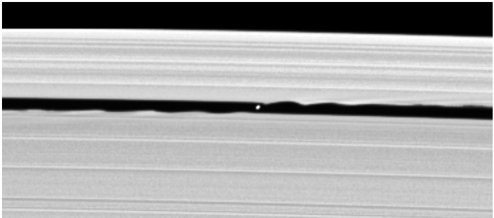
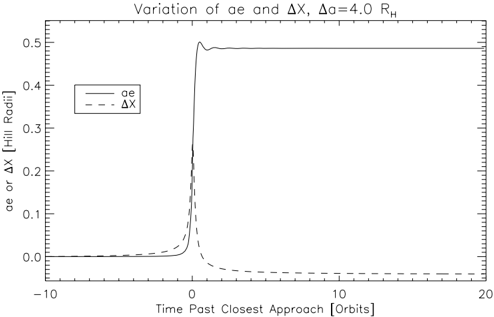
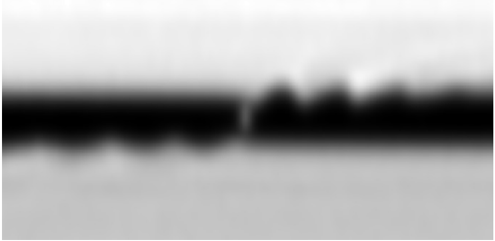
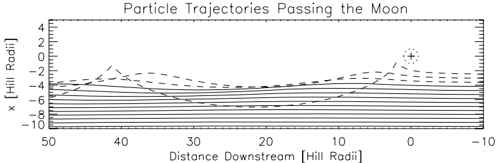
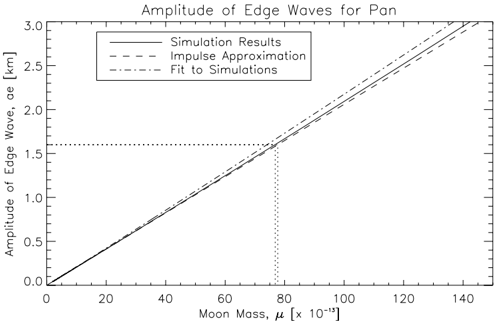
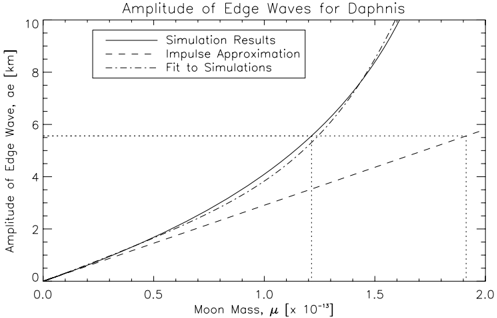
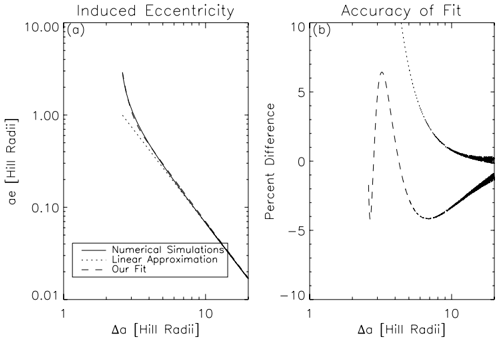
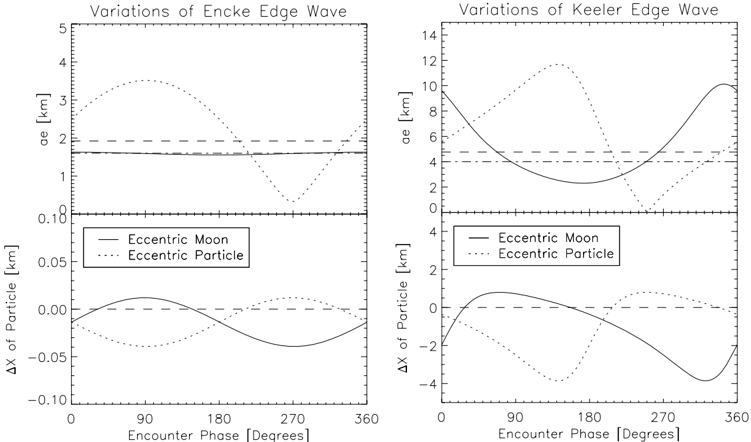
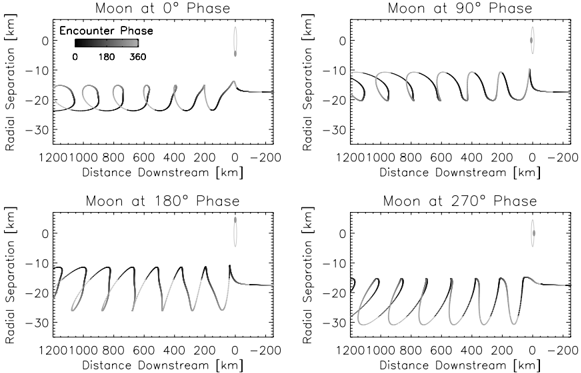
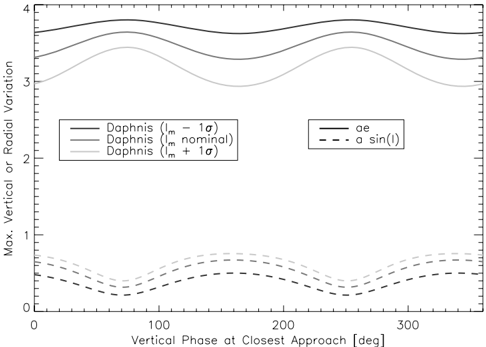
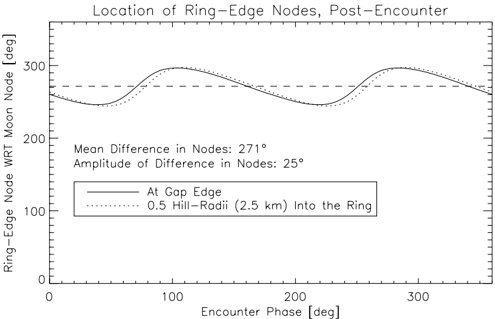
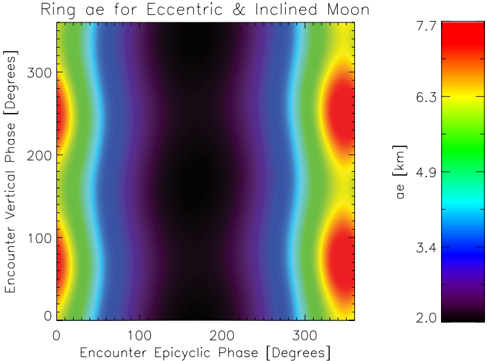
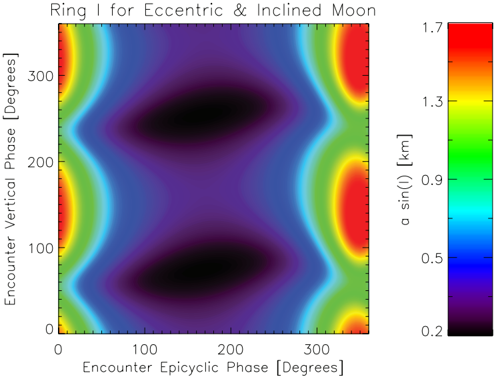
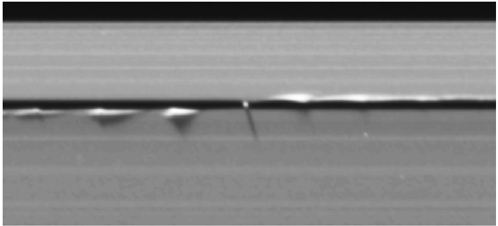
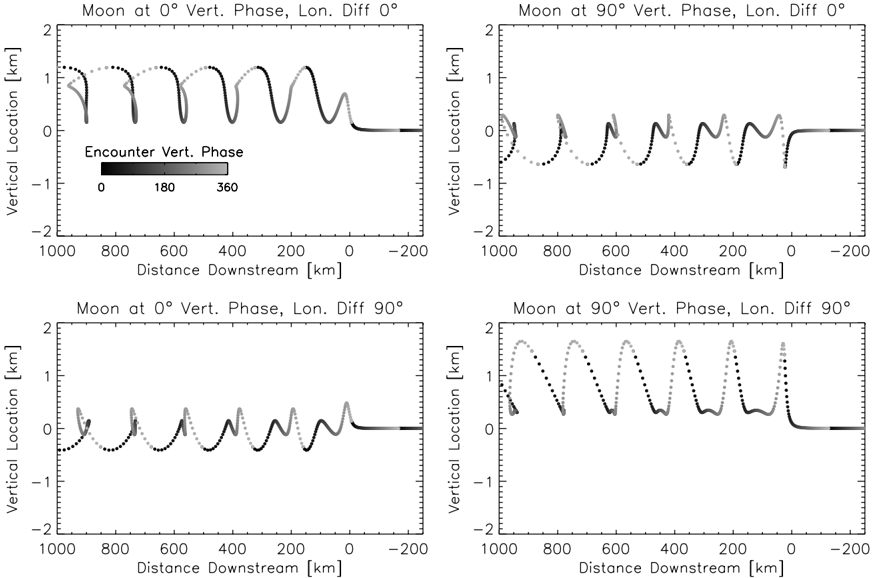
Moons embedded in gaps within Saturn's main rings generate waves on the gap edges due to their gravitational disturbances. These edge waves can serve as diagnostics for the masses and, in some cases, orbital characteristics of the embedded moons. Although N -body simulations of the edges are far better in inferring masses from edge morphology, the long run-times of this technique often make it impractical. In this paper, we describe a faster approach to narrow the range of masses to explore with N -body simulations, to explore the multidimensional parameter space of edge/moon interactions, and to guide the planning of spacecraft observations. Using numerical, test-particle models and neglecting particle–particle interactions, we demonstrate that the simple analytic theory of the edge waves applies well to Pan in the Encke Gap but breaks down for smaller moons/gaps like Daphnis in the Keeler Gap. Fitting an analytic model to our simulation results allows us to suggest an improved relationship between moon-mass and edge wave amplitude. Numerical methods also grant freedom to explore a wider range of moon and ring orbits than the circular, coplanar case considered by analytic theory. We examine how pre-encounter inclinations and eccentricities affect the properties of the edge waves. In the case where the moon or ring-edge particle orbits initially have eccentric radial variations that are large compared to the gap width, there is considerable variation in edge wave amplitude depending on the orbital phase of the encounter. Inclined moons also affect the edge wave amplitude, potentially significantly, as well as generate vertical waves on the gap-edges. Recent Cassini images acquired as Saturn approaches equinox and the Sun's elevation on the ringplane is extremely low have revealed long shadows associated with the Keeler gap edge waves created by the embedded moon Daphnis. We interpret these as being cast by ∼1 km high vertical structure in the waves created by Daphnis' out-of-plane perturbations on the ring particles.
Overview
The claims and statistics of this paper haven’t been checked yet.
Free: it reads the open-access text and checks the first 5 claims that cite a source we can check. Create a free account to check every claim.
Integrity signals
Registry
Cites
Statistics
Figures
Verification
Claims the paper makes
The claims and statistics of this paper haven’t been checked yet.
Free: it reads the open-access text and checks the first 5 claims that cite a source we can check. Create a free account to check every claim.
Claims other papers make about this one
Each is checked against this paper’s own text: does it say what the citing paper says it does?
The cited source doesn’t support the claim as written.
In the citing paper
“The embedded moons in Saturn's rings, Pan and Daphnis, were shown to create gaps with half widths of ∆𝑎 ≈ 3.8𝑅𝐻𝑖𝑙𝑙 (Weiss et al 2009), but only where ∆𝑎 was small compared to 𝑎 and where ring particles encounter the moon on circular orbits.”
From Mean motion resonances with nearby moons: an unlikely origin for the gaps observed in the ring around the exoplanet J1407b (2019) · cites this paper as Weiss et al 2009
Checked by a reasoning model — may be wrong.
Experimental — accuracy not yet measuredThe cited source doesn’t support the claim as written.
In the citing paper
“Analytically it has been shown Pan and Daphnis create gaps with half widths of ∆𝑎 ≈ 3.8𝑅ℎ𝑖𝑙𝑙 (Weiss et al 2009).”
From Mean motion resonances with nearby moons: an unlikely origin for the gaps observed in the ring around the exoplanet J1407b (2019) · cites this paper as Weiss et al 2009
Checked by a reasoning model — may be wrong.
Experimental — accuracy not yet measuredThe cited source doesn’t support the claim as written.
In the citing paper
“For the case of Pan and Daphnis, the gap half-width was found to be Δa ≈ 3.8R hill (Weiss et al., 2009), where Δa is small in respect to the semimajor axis a for the moon.”
From A Self-Gravitating Exoring Around J1407b and Implications for In-Situ Exomoon Formation (2022) · cites this paper as Weiss et al., 2009
Checked by a reasoning model — may be wrong.
Experimental — accuracy not yet measuredThe source backs part of the claim, not all of it — or backs it for a different population, condition or comparison.
In the citing paper
“Assuming a moon mass on the order 𝑀⊕ then the ring edge at 0.6𝐴𝑈 is likely to show significant distortion for the 2:1 MMR, which lies at 0.63𝐴𝑈 , as it is within 3.8𝑅 ℎ𝑖𝑙𝑙 (Weiss et al 2009).”
From Mean motion resonances with nearby moons: an unlikely origin for the gaps observed in the ring around the exoplanet J1407b (2019) · cites this paper as Weiss et al 2009
Experimental — accuracy not yet measuredThe source backs part of the claim, not all of it — or backs it for a different population, condition or comparison.
In the citing paper
“Secondly, moons embedded within the ring can carve out a gap proportional to their Hill radius.”
From A Self-Gravitating Exoring Around J1407b and Implications for In-Situ Exomoon Formation (2022) · cites this paper as Weiss et al., 2009
Experimental — accuracy not yet measured
2 more claims about this paper
Create a free account to see every claim other papers make about this one.
Self-check
Percentages, sums and reported differences re-computed from the paper’s own numbers.
The self-check needs the paper’s full text.
Citations
Cites
Numerical recipes in C: the art of scientific computing
(1993) · Choice Reviews Online · doi:10.5860/choice.30-5638 · Cited by 17,933
Buckingham, R. A. (1966) · Cited by 2,899
Crimins, F. (2003) · Applied Biochemistry and Biotechnology · doi:10.1007/s12010-003-0001-6 · Cited by 2,000
Researches in the Lunar Theory
Hill, G. W. (1878) · American Journal of Mathematics · doi:10.2307/2369430 · Cited by 822
Non-Axisymmetric Responses of Differentially Rotating Disks of Stars
Julian, W. H., & Toomre, A. (1966) · The Astrophysical Journal · doi:10.1086/148957 · Cited by 488
The Dynamics of Planetary Rings
Goldreich, P., & Tremaine, S. (1982) · Annual Review of Astronomy and Astrophysics · doi:10.1146/annurev.aa.20.090182.001341 · Cited by 392
Porco, C. C., West, R. A., Squyres, S., Mcewen, A., Thomas, P., Murray, C. D., Delgenio, A., Ingersoll, A. P., Johnson, T. V., Neukum, G., et al. (2004) · Space Science Reviews · doi:10.1007/s11214-004-1456-7 · Cited by 365
Self-citationCassini Imaging Science: Initial Results on Saturn's Rings and Small Satellites
Porco, C. C., Baker, E., Barbara, J., Beurle, K., Brahic, A., Burns, J. A., Charnoz, S., Cooper, N., Dawson, D. D., Del Genio, A. D., et al. (2005) · Science · doi:10.1126/science.1108056 · Cited by 204
Self-citationThe dynamics of tadpole and horseshoe orbits
Dermott, S. F., & Murray, C. D. (1981) · Icarus · doi:10.1016/0019-1035(81)90147-0 · Cited by 183
Saturn's Small Inner Satellites: Clues to Their Origins
Porco, C. C., Thomas, P. C., Weiss, J. W., & Richardson, D. C. (2007) · Science · doi:10.1126/science.1143977 · Cited by 150
Self-citationCassini imaging of Saturn's rings
Tiscareno, M. S., Burns, J. A., Nicholson, P. D., Hedman, M. M., & Porco, C. C. (2007) · Icarus · doi:10.1016/j.icarus.2006.12.025 · Cited by 118
Self-citationVisual detection of 1981S13, Saturn's eighteenth satellite, and its role in the Encke gap
Showalter, M. R. (1991) · Nature · doi:10.1038/351709a0 · Cited by 116
Self‐gravity wakes in Saturn's A ring measured by stellar occultations from Cassini
Colwell, J. E., Esposito, L. W., & Sremčević, M. (2006) · Geophysical Research Letters · doi:10.1029/2005gl025163 · Cited by 106
Satellite “wakes” and the orbit of the Encke Gap moonlet
Showalter, M. R., Cuzzi, J. N., Marouf, E. A., & Esposito, L. W. (1986) · Icarus · doi:10.1016/0019-1035(86)90160-0 · Cited by 102
Spitale, J. N., Jacobson, R. A., Porco, C. C., & Owen, Jr. (2006) · The Astronomical Journal · doi:10.1086/505206 · Cited by 87
Self-citationA numerical study of Saturn's F-ring
Showalter, M. R., & Burns, J. A. (1982) · Icarus · doi:10.1016/0019-1035(82)90013-6 · Cited by 84
REVISED ORBITS OF SATURN'S SMALL INNER SATELLITES
Jacobson, R. A., Spitale, J., Porco, C. C., Beurle, K., Cooper, N. J., Evans, M. W., & Murray, C. D. (2008) · The Astronomical Journal · doi:10.1088/0004-6256/135/1/261 · Cited by 79 · cited 8×
“Because of Saturn’s oblateness, these two phases do not have constant separations in time but rather, due to regression of the node and precession of the periapse, shift relative to each other by 6◦ day−1 (Jacobson et al. 2008).”
BackgroundMethodSelf-citationWavy edges suggest moonlet in Encke's gap
Cuzzi, J. N., & Scargle, J. D. (1985) · The Astrophysical Journal · doi:10.1086/163158 · Cited by 78
Resonance structures in Saturn's rings probed by radio occultation: II. Results and interpretation
Rosen, P., Tyler, G., Marouf, E., & Lissauer, J. (1991) · Icarus · doi:10.1016/0019-1035(91)90161-l · Cited by 71
Porco, C. C., Weiss, J. W., Richardson, D. C., Dones, L., Quinn, T., & Throop, H. (2008) · The Astronomical Journal · doi:10.1088/0004-6256/136/5/2172 · Cited by 71 · cited 4×
“064 Hill radii) and our models of edge wave behavior using this inclination for Pan are indistinguishable from the uninclined case. We will therefore not treat the Pan–Encke case any further in this section. Daphnis’ inclination is substantially larger, 0. ◦0036±0. ◦0013, corresponding to 8.6 km (1.7 Hill radii) verti…”
BackgroundResultSelf-citationBorderies, N., Goldreich, P., & Tremaine, S. (1983) · Icarus · doi:10.1016/0019-1035(83)90055-6 · Cited by 44
Collisional Dynamics of Perturbed Planetary Rings. I.
Lewis, M. C., & Stewart, G. R. (2000) · The Astronomical Journal · doi:10.1086/316853 · Cited by 41
Excitation of inclinations in ring-satellite systems
Borderies, N., Goldreich, P., & Tremaine, S. (1984) · The Astrophysical Journal · doi:10.1086/162423 · Cited by 37
Orbits and masses of Saturn's coorbital and F-ring shepherding satellites
Jacobson, R. A., & French, R. G. (2004) · Icarus · doi:10.1016/j.icarus.2004.08.018 · Cited by 23
Nonlinear satellite wakes in planetary rings
Stewart, G. R. (1991) · Icarus · doi:10.1016/0019-1035(91)90240-t · Cited by 17
Three-dimensional perturbations of particles in a narrow planetary ring
Kolvoord, R. A., & Burns, J. A. (1992) · Icarus · doi:10.1016/0019-1035(92)90042-6 · Cited by 16
Spiral Bending Waves Launched at a Vertical Secular Resonance
Ward, W. R., & Hahn, J. M. (2003) · The Astronomical Journal · doi:10.1086/374941 · Cited by 15
Hahn, J. M. (2007) · The Astrophysical Journal · doi:10.1086/519275 · Cited by 14
Research works printed but not linked: 6
- Dermott, S. F. 1984, in Planetary Rings, Dynamics of Narrow Rings (Tucson, AZ: Univ. Arizona Press), 589
- Lewis, M. C., & Stewart, G. R. 2006, BAAS, 38, 560
- Perrine, R. P., & Richardson, D. C. 2006, BAAS, 38, 560
- Porco, C. C. The Cassini Imaging Team 2005, IAU Circ., 8524, 1
- Tiscareno, M. S., Burns, J. A., Hedman, M. M., Spitale, J. N., Porco, C. C., & Murray, C. D. Cassini Imaging Team 2005, BAAS, 37, 767
- Torrey, P. A., Tiscareno, M. S., Burns, J. A., & Porco, C. C. 2008, in AAS / Division of Dynamical Astronomy Meeting, Vol. 39, 15.19
Cited by
Circumstellar debris and pollution at white dwarf stars
Farihi, J. (2016) · New Astronomy Reviews · doi:10.1016/j.newar.2016.03.001 · Cited by 255
“As an example, Daphnis has a diameter of 8 km and causes 1 km vertical disturbances in the A ring of Saturn; this is 100 times larger than the height of the unperturbed rings (Weiss et al., 2009).”
BackgroundFarihi, J., Jura, M., Lee, J.-E., & Zuckerman, B. (2010) · The Astrophysical Journal · doi:10.1088/0004-637x/714/2/1386 · Cited by 157
“Saturn’s ring-moon Daphnis – 8 km in diameter and comparable to a small asteroid – causes 1 km vertical disturbances in the A ring; 100 times larger than the height of the unperturbed rings (Weiss et al. 2009).”
BackgroundAn Evolving View of Saturn’s Dynamic Rings
Cuzzi, J. N., Burns, J. A., Charnoz, S., Clark, R. N., Colwell, J. E., Dones, L., Esposito, L. W., Filacchione, G., French, R. G., Hedman, M. M., et al. (2010) · Science · doi:10.1126/science.1179118 · Cited by 138
Self-citationFast-moving features in the debris disk around AU Microscopii
Boccaletti, A., Thalmann, C., Lagrange, A. ‐., Janson, M., Augereau, J. ‐., Schneider, G., Milli, J., Grady, C. A., Debes, J. H., Langlois, M., et al. (2015) · Nature · doi:10.1038/nature15705 · Cited by 142
Relentless and complex transits from a planetesimal debris disc
Farihi, J., Hermes, J. J., Marsh, T. R., Mustill, A. J., Wyatt, M. C., Guidry, J. A., Wilson, T. G., Redfield, S., Izquierdo, P., Toloza, O., et al. (2021) · Monthly Notices of the Royal Astronomical Society · doi:10.1093/mnras/stab3475 · Cited by 48
Metadata
- Authors
- Weiss, J. W., Porco, C. C., & Tiscareno, M. S.
- Affiliations
- Space Science Institute (US)
- Cornell University (US)
- Venue
- The Astronomical Journal
- Publisher
- American Astronomical Society
- Published
- 2009-06-11
- Volume
- 138
- Issue
- 1
- Pages
- 272-286
- ISSN
- 0004-6256 (ISSN-L)
- 1538-3881
- OpenAlex
- W2134623651
- Semantic Scholar
- 20d8b993eae8363d30c162424ac7ca1eaa71615e
- Cited by
- 41
- References
- 28
- Citations by year
- 2026: 1 · 2025: 3 · 2024: 2 · 2023: 1 · 2022: 1 · 2021: 1 · 2020: 1 · 2019: 5 · 2018: 7 · 2017: 3 · 2016: 1 · 2015: 2 · 2013: 3 · 2012: 3
- FWCI
- 1.68
- Type
- journal article
- Language
- en
- Open access
- bronze
- doi.org
- Locations
- The Astronomical Journal (publishedVersion)
- Funders
- Japan Science Society
- Topics
- Physical Sciences › Earth and Planetary Sciences › Space and Planetary Science › Astro and Planetary Science
- Physical Sciences › Engineering › Aerospace Engineering › Space Satellite Systems and Control
- Physical Sciences › Physics and Astronomy › Astronomy and Astrophysics › Stellar, planetary, and galactic studies
- Keywords
- Saturn rings, Pan, Daphnis, test particle simulation, orbital eccentricity, orbital inclination, Cassini observations, ring-moon interactions
About these checks
Registry, retraction, Cites and statistics results are computed, not judged, with one exception: a printed reference that no index lists is read once by a model before it counts as a citation error. Claims are extracted by a model and kept only when their quote appears verbatim in the text; each cited source is then checked, with a model’s help, for whether it says what the claim relies on. Those verdicts can be wrong — read the claim’s quote and the cited source before relying on one.
Statistics and arithmetic are recomputed, not judged.
Confidence bands are shown only for fields calibrated on our annotated test set. None is calibrated yet, so no band is shown.
What counts as a claim ›How we measure confidence ›How we check this ›
Are you an author, or do you see a problem with this page? Request a review
Data sources
Bibliographic data: Semantic Scholar, OpenAlex, Crossref.
Contains information from the Semantic Scholar Academic Graph Datasets, made available under the ODC Attribution License (ODC-BY 1.0).
Semantic Scholar’s data is described in: Kinney, R., et al. (2023). The Semantic Scholar Open Data Platform. arXiv:2301.10140.
