

RING EDGE WAVES AND THE MASSES OF NEARBY SATELLITES
Open accessThe DOI matches its Crossref record; 28 of the 28 references it cites were found in a registry or an index.
Abstract
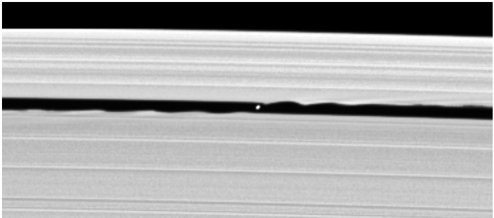
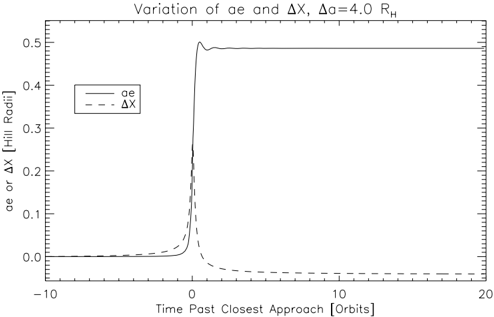
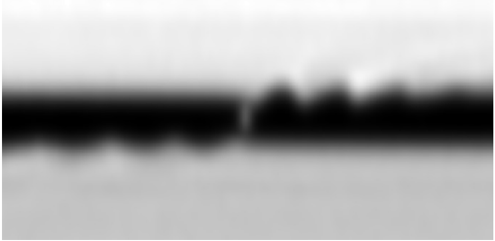
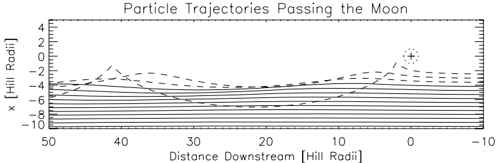
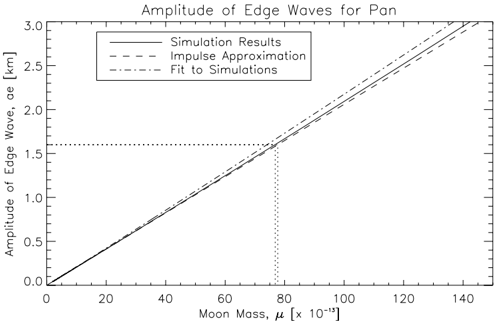
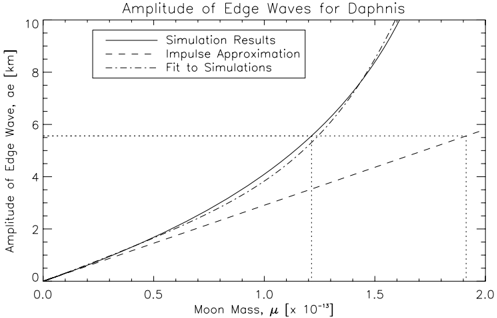
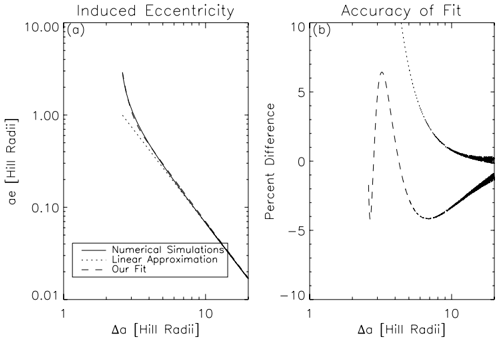
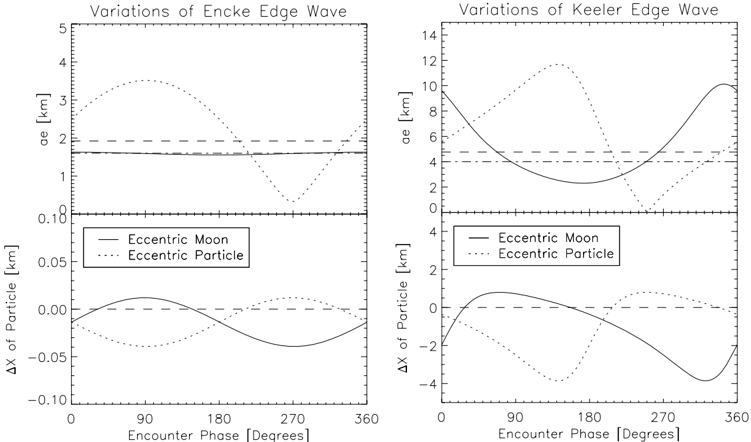
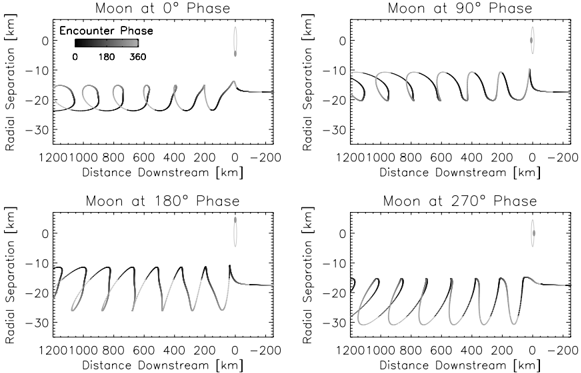
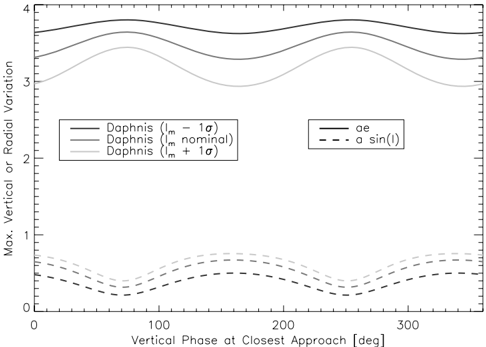
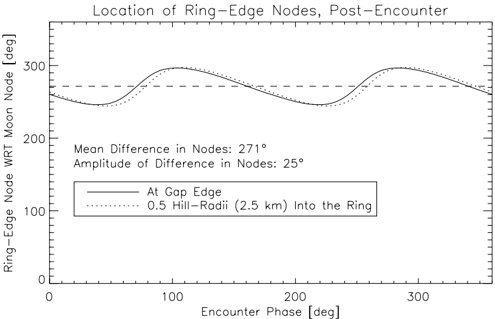
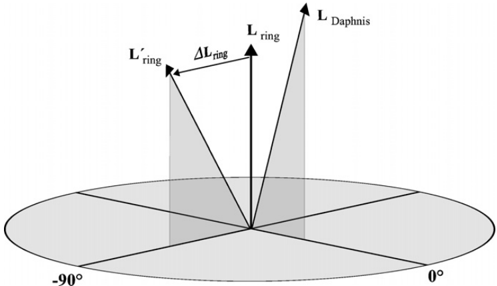
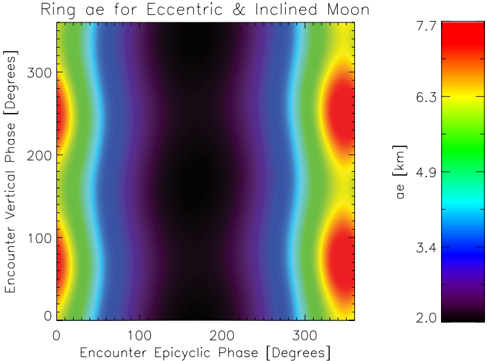
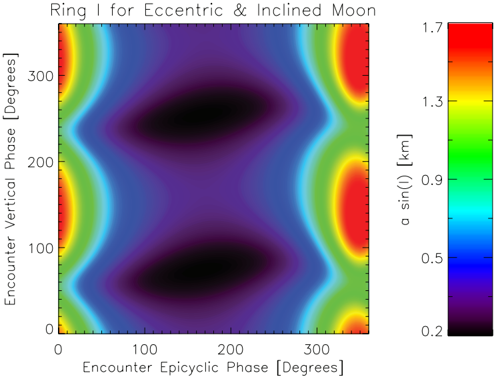
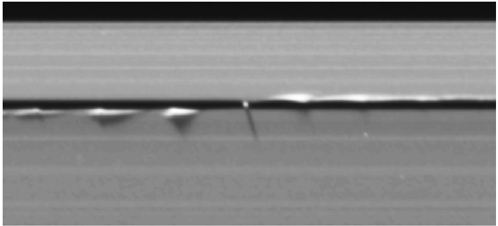
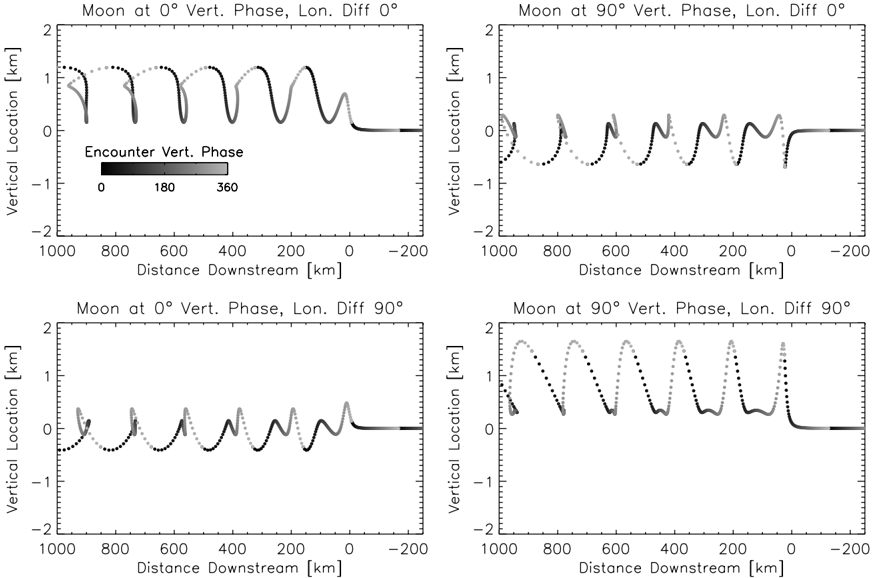
Moons embedded in gaps within Saturn's main rings generate waves on the gap edges due to their gravitational disturbances. These edge waves can serve as diagnostics for the masses and, in some cases, orbital characteristics of the embedded moons. Although N -body simulations of the edges are far better in inferring masses from edge morphology, the long run-times of this technique often make it impractical. In this paper, we describe a faster approach to narrow the range of masses to explore with N -body simulations, to explore the multidimensional parameter space of edge/moon interactions, and to guide the planning of spacecraft observations. Using numerical, test-particle models and neglecting particle–particle interactions, we demonstrate that the simple analytic theory of the edge waves applies well to Pan in the Encke Gap but breaks down for smaller moons/gaps like Daphnis in the Keeler Gap. Fitting an analytic model to our simulation results allows us to suggest an improved relationship between moon-mass and edge wave amplitude. Numerical methods also grant freedom to explore a wider range of moon and ring orbits than the circular, coplanar case considered by analytic theory. We examine how pre-encounter inclinations and eccentricities affect the properties of the edge waves. In the case where the moon or ring-edge particle orbits initially have eccentric radial variations that are large compared to the gap width, there is considerable variation in edge wave amplitude depending on the orbital phase of the encounter. Inclined moons also affect the edge wave amplitude, potentially significantly, as well as generate vertical waves on the gap-edges. Recent Cassini images acquired as Saturn approaches equinox and the Sun's elevation on the ringplane is extremely low have revealed long shadows associated with the Keeler gap edge waves created by the embedded moon Daphnis. We interpret these as being cast by ∼1 km high vertical structure in the waves created by Daphnis' out-of-plane perturbations on the ring particles.
Overview
The claims and statistics of this paper haven’t been checked yet.
Free: it reads the open-access text and checks the first 5 claims that cite a source we can check. Create a free account to check every claim.
Integrity signals
Registry
Cites
Statistics
Figures
Verification
Claims the paper makes
The claims and statistics of this paper haven’t been checked yet.
Free: it reads the open-access text and checks the first 5 claims that cite a source we can check. Create a free account to check every claim.
Claims other papers make about this one
Each is checked against this paper’s own text: does it say what the citing paper says it does?
The cited source doesn’t support the claim as written.
In the citing paper
“The embedded moons in Saturn's rings, Pan and Daphnis, were shown to create gaps with half widths of ∆𝑎 ≈ 3.8𝑅𝐻𝑖𝑙𝑙 (Weiss et al 2009), but only where ∆𝑎 was small compared to 𝑎 and where ring particles encounter the moon on circular orbits.”
From Mean motion resonances with nearby moons: an unlikely origin for the gaps observed in the ring around the exoplanet J1407b (2019) · cites this paper as Weiss et al 2009
Checked by a reasoning model — may be wrong.
Experimental — accuracy not yet measuredThe cited source doesn’t support the claim as written.
In the citing paper
“Analytically it has been shown Pan and Daphnis create gaps with half widths of ∆𝑎 ≈ 3.8𝑅ℎ𝑖𝑙𝑙 (Weiss et al 2009).”
From Mean motion resonances with nearby moons: an unlikely origin for the gaps observed in the ring around the exoplanet J1407b (2019) · cites this paper as Weiss et al 2009
Checked by a reasoning model — may be wrong.
Experimental — accuracy not yet measuredThe cited source doesn’t support the claim as written.
In the citing paper
“For the case of Pan and Daphnis, the gap half-width was found to be Δa ≈ 3.8R hill (Weiss et al., 2009), where Δa is small in respect to the semimajor axis a for the moon.”
From A Self-Gravitating Exoring Around J1407b and Implications for In-Situ Exomoon Formation (2022) · cites this paper as Weiss et al., 2009
Checked by a reasoning model — may be wrong.
Experimental — accuracy not yet measuredThe source backs part of the claim, not all of it — or backs it for a different population, condition or comparison.
In the citing paper
“Assuming a moon mass on the order 𝑀⊕ then the ring edge at 0.6𝐴𝑈 is likely to show significant distortion for the 2:1 MMR, which lies at 0.63𝐴𝑈 , as it is within 3.8𝑅 ℎ𝑖𝑙𝑙 (Weiss et al 2009).”
From Mean motion resonances with nearby moons: an unlikely origin for the gaps observed in the ring around the exoplanet J1407b (2019) · cites this paper as Weiss et al 2009
Experimental — accuracy not yet measuredThe source backs part of the claim, not all of it — or backs it for a different population, condition or comparison.
In the citing paper
“Secondly, moons embedded within the ring can carve out a gap proportional to their Hill radius.”
From A Self-Gravitating Exoring Around J1407b and Implications for In-Situ Exomoon Formation (2022) · cites this paper as Weiss et al., 2009
Experimental — accuracy not yet measured
2 more claims about this paper
Create a free account to see every claim other papers make about this one.
Self-check
Percentages, sums and reported differences re-computed from the paper’s own numbers.
The self-check needs the paper’s full text.
Citations
Cites
Numerical recipes in C: the art of scientific computing
(1993) · Choice Reviews Online · doi:10.5860/choice.30-5638 · Cited by 17,933
Buckingham, R. A. (1966) · Cited by 2,899
Crimins, F. (2003) · Applied Biochemistry and Biotechnology · doi:10.1007/s12010-003-0001-6 · Cited by 2,000
Researches in the Lunar Theory
Hill, G. W. (1878) · American Journal of Mathematics · doi:10.2307/2369430 · Cited by 822
Non-Axisymmetric Responses of Differentially Rotating Disks of Stars
Julian, W. H., & Toomre, A. (1966) · The Astrophysical Journal · doi:10.1086/148957 · Cited by 488
The Dynamics of Planetary Rings
Goldreich, P., & Tremaine, S. (1982) · Annual Review of Astronomy and Astrophysics · doi:10.1146/annurev.aa.20.090182.001341 · Cited by 392
Porco, C. C., West, R. A., Squyres, S., Mcewen, A., Thomas, P., Murray, C. D., Delgenio, A., Ingersoll, A. P., Johnson, T. V., Neukum, G., et al. (2004) · Space Science Reviews · doi:10.1007/s11214-004-1456-7 · Cited by 365
Self-citationCassini Imaging Science: Initial Results on Saturn's Rings and Small Satellites
Porco, C. C., Baker, E., Barbara, J., Beurle, K., Brahic, A., Burns, J. A., Charnoz, S., Cooper, N., Dawson, D. D., Del Genio, A. D., et al. (2005) · Science · doi:10.1126/science.1108056 · Cited by 204
Self-citationThe dynamics of tadpole and horseshoe orbits
Dermott, S. F., & Murray, C. D. (1981) · Icarus · doi:10.1016/0019-1035(81)90147-0 · Cited by 183
Saturn's Small Inner Satellites: Clues to Their Origins
Porco, C. C., Thomas, P. C., Weiss, J. W., & Richardson, D. C. (2007) · Science · doi:10.1126/science.1143977 · Cited by 150
Self-citation
Research works printed but not linked: 6
- Dermott, S. F. 1984, in Planetary Rings, Dynamics of Narrow Rings (Tucson, AZ: Univ. Arizona Press), 589
- Lewis, M. C., & Stewart, G. R. 2006, BAAS, 38, 560
- Perrine, R. P., & Richardson, D. C. 2006, BAAS, 38, 560
- Porco, C. C. The Cassini Imaging Team 2005, IAU Circ., 8524, 1
- Tiscareno, M. S., Burns, J. A., Hedman, M. M., Spitale, J. N., Porco, C. C., & Murray, C. D. Cassini Imaging Team 2005, BAAS, 37, 767
- Torrey, P. A., Tiscareno, M. S., Burns, J. A., & Porco, C. C. 2008, in AAS / Division of Dynamical Astronomy Meeting, Vol. 39, 15.19
Cited by
Circumstellar debris and pollution at white dwarf stars
Farihi, J. (2016) · New Astronomy Reviews · doi:10.1016/j.newar.2016.03.001 · Cited by 255
“As an example, Daphnis has a diameter of 8 km and causes 1 km vertical disturbances in the A ring of Saturn; this is 100 times larger than the height of the unperturbed rings (Weiss et al., 2009).”
BackgroundFarihi, J., Jura, M., Lee, J.-E., & Zuckerman, B. (2010) · The Astrophysical Journal · doi:10.1088/0004-637x/714/2/1386 · Cited by 157
“Saturn’s ring-moon Daphnis – 8 km in diameter and comparable to a small asteroid – causes 1 km vertical disturbances in the A ring; 100 times larger than the height of the unperturbed rings (Weiss et al. 2009).”
BackgroundAn Evolving View of Saturn’s Dynamic Rings
Cuzzi, J. N., Burns, J. A., Charnoz, S., Clark, R. N., Colwell, J. E., Dones, L., Esposito, L. W., Filacchione, G., French, R. G., Hedman, M. M., et al. (2010) · Science · doi:10.1126/science.1179118 · Cited by 138
Self-citationFast-moving features in the debris disk around AU Microscopii
Boccaletti, A., Thalmann, C., Lagrange, A. ‐., Janson, M., Augereau, J. ‐., Schneider, G., Milli, J., Grady, C. A., Debes, J. H., Langlois, M., et al. (2015) · Nature · doi:10.1038/nature15705 · Cited by 142
Relentless and complex transits from a planetesimal debris disc
Farihi, J., Hermes, J. J., Marsh, T. R., Mustill, A. J., Wyatt, M. C., Guidry, J. A., Wilson, T. G., Redfield, S., Izquierdo, P., Toloza, O., et al. (2021) · Monthly Notices of the Royal Astronomical Society · doi:10.1093/mnras/stab3475 · Cited by 48
FREE UNSTABLE MODES AND MASSIVE BODIES IN SATURN'S OUTER B RING
Spitale, J., & Porco, C. (2009) · The Astronomical Journal · doi:10.1088/0004-6256/140/6/1747 · Cited by 41
“…in region A are on inclined orbits and are driving vertical motions the way that Daphnis drives vertical motions in the edge of the Keeler gap (Weiss et al. 2009), is not likely since sustained vertical motions, even for a 1-km moonlet, would almost certainly damp due to the collisions with…”
BackgroundSelf-citationTiscareno, M. S. (2013) · Planets, Stars and Stellar Systems · doi:10.1007/978-94-007-5606-9_7 · Cited by 37
“The resulting vertical corrugation of nearby portions of the gap edge were predicted and then seen by their shadows cast during the 2009 equinox (Weiss et al. 2009).”
Self-citationExpelled grains from an unseen parent body around AU Microscopii
Sezestre, É., Augereau, J. ‐., Boccaletti, A., & Thébault, P. (2017) · Astronomy and Astrophysics · doi:10.1051/0004-6361/201731061 · Cited by 38
“Vertical resonances with a planetary companion can form arch-like structures, but they stay on a Keplerian orbit (analogous to the case of Saturn’s moons; see, e.g., Weiss et al. 2009).”
BackgroundClose Cassini flybys of Saturn’s ring moons Pan, Daphnis, Atlas, Pandora, and Epimetheus
Buratti, B. J., Thomas, P. C., Roussos, E., Howett, C. J. A., Seiß, M., Hendrix, A., Helfenstein, P., Brown, R. H., Clark, R. N., Denk, T., et al. (2019) · Science · doi:10.1126/science.aat2349 · Cited by 34
Self-citationThe small inner satellites of Saturn: Shapes, structures and some implications
Thomas, P. C., & Helfenstein, P. (2019) · Icarus · doi:10.1016/j.icarus.2019.06.016 · Cited by 32
MIGRATION OF SMALL MOONS IN SATURN's RINGS
Bromley, B. C., & Kenyon, S. J. (2013) · The Astrophysical Journal · doi:10.1088/0004-637x/764/2/192 · Cited by 29
“Several of these resonances lie close to but are not obviously coincident with the orbit of Daphnis within the Keeler gap.”
BackgroundInfluentialWhat Confines the Rings of Saturn?
Tajeddine, R., Nicholson, P. D., Longaretti, P., Moutamid, M. E., & Burns, J. A. (2017) · The Astrophysical Journal Supplement Series · doi:10.3847/1538-4365/aa8c09 · Cited by 28
“Encke gap (radius ~133,854 km), the overlapping resonance model is more appropriate than the discrete resonance one. Applying Eqs. (6) and (7) to these features, and using the estimates of mass from Weiss et al. (2009), we obtain an effective ring viscosity of ~14 cm2 s-1 and ~64 cm2 s-1, respectively. Note the decrea…”
InfluentialClose-range remote sensing of Saturn’s rings during Cassini’s ring-grazing orbits and Grand Finale
Tiscareno, M. S., Nicholson, P. D., Cuzzi, J. N., Spilker, L. J., Murray, C. D., Hedman, M. M., Colwell, J. E., Burns, J. A., Brooks, S. M., Clark, R. N., et al. (2019) · Science · doi:10.1126/science.aau1017 · Cited by 26
Self-citationTIME VARIABILITY IN THE OUTER EDGE OF SATURN'S A-RING REVEALED BY CASSINI IMAGING
Spitale, J. N., & Porco, C. C. (2009) · The Astronomical Journal · doi:10.1088/0004-6256/138/5/1520 · Cited by 22
“Pan and Daphnis both have such an effect on the edges of their respective gaps, Encke and Keeler, though in practice those patterns are quite complex (Weiss et al. 2009).”
BackgroundSelf-citationOf Horseshoes and Heliotropes: Dynamics of Dust in the Encke Gap
Hedman, M. M., Burns, J. A., Hamilton, D. P., & Showalter, M. R. (2013) · Icarus · doi:10.1016/j.icarus.2012.11.036 · Cited by 20
“8 # 10"11 (Porco et al., 1561 2007; Weiss et al., 2009) yields vaP ! "2 # 10"5 m/s, which is 1562 remarkably close to the above value for vaD.”
BackgroundInfluentialMorphology and variability of the Titan ringlet and Huygens ringlet edges
Jerousek, R. G., Colwell, J. E., & Esposito, L. W. (2011) · Icarus · doi:10.1016/j.icarus.2011.09.001 · Cited by 18
“These edges are known to be strongly perturbed by Mimas, Pan, and Daphnis, respectively and to exhibit large ring thicknesses at some satellite-relative longitudes (Weiss et al., 2009).”
BackgroundCuzzi, J. N., Filacchione, G., & Marouf, E. A. (2018) · Cambridge University Press eBooks · doi:10.1017/9781316286791.003 · Cited by 26
The stability around Chariklo and the confinement of its rings
Winter, S. M. G., Madeira, G., Ribeiro, T. F. S., Winter, O. C., Barbosa, G., & Borderes-Motta, G. (2023) · Astronomy and Astrophysics · doi:10.1051/0004-6361/202345864 · Cited by 25
TRACKING THE GEYSERS OF ENCELADUS INTO SATURN’S E RING
Mitchell, C. J., Porco, C. C., & Weiss, J. W. (2015) · The Astronomical Journal · doi:10.1088/0004-6256/149/5/156 · Cited by 20
“This code is both well-tested and robust enough to handle the equations of motion and charging, and has been used previously for calculating the trajectories of uncharged particles in the edge waves produced by Pan and Daphnis (Weiss et al. 2009).”
MethodSelf-citationProbing the inner boundaries of Saturn’s A ring with the Iapetus −1:0 nodal bending wave
Tiscareno, M., Hedman, M., Burns, J., Weiss, J. W., & Porco, C. (2013) · Icarus · doi:10.1016/j.icarus.2013.02.026 · Cited by 15
“to the rings (Fig. 1) highlighted vertical structure of many kinds, including radial corrugations (Hedman et al., 2011), impact ejecta clouds (Tiscareno et al., 2013), vertically scalloped gap edges (Weiss et al., 2009; Spitale and Porco, 2010), shadows cast by \propellers" and other compact embedded structures (…”
BackgroundSelf-citationDynamical phenomena at the inner edge of the Keeler gap
Tajeddine, R., Nicholson, P. D., Tiscareno, M. S., Hedman, M. M., Burns, J. A., & Moutamid, M. E. (2017) · Icarus · doi:10.1016/j.icarus.2017.02.002 · Cited by 15
“Using a mass of Daphnis of 6.8 × 10¹³ kg (Weiss et al., 2009, measured from the amplitude of the waves produced by Daphnis on the gap edges), and a surface density of 15 g/cm2 (Tiscareno & Harris 2015, 2017), we estimate the sizes of these torques to be Tv = 6.5 × 10¹³ Nm (if we use a ring…”
BackgroundMethodInfluentialSelf-citationNegative diffusion in planetary rings with a nearby moon
Lewis, M. C., Stewart, G., Leezer, J., & West, A. (2011) · Icarus · doi:10.1016/j.icarus.2010.11.022 · Cited by 15
Review of Saturn’s icy moons following the Cassini mission
Dougherty, M. K., & Spilker, L. J. (2018) · Reports on Progress in Physics · doi:10.1088/1361-6633/aabdfb · Cited by 16
Narrow Rings, Gaps, and Sharp Edges
Nicholson, P. D., French, R. G., & Spitale, J. N. (2018) · Cambridge University Press eBooks · doi:10.1017/9781316286791.011 · Cited by 11
The Age and Origin of Saturn’s Rings
Crida, A., Estrada, P. R., Nicholson, P. D., & Murray, C. D. (2025) · Space Science Reviews · doi:10.1007/s11214-025-01189-z · Cited by 10
“…A and B rings are clearly controlled by the Janus 7:6 and Mimas 2:1 resonances (Porco et al. 1984; Nicholson et al. 2014a; French et al. 2023), while the Encke and Keeler gaps are maintained against viscous closing by the shepherding torques exerted by their embedded satellites (Weiss et al. 2009).”
Seiß, M., Spahn, F., & Schmidt, J. (2010) · Icarus · doi:10.1016/j.icarus.2010.06.013 · Cited by 6
“Resonant perturbations of the edges by moons outside the ring system, as well as an eccentric orbit of the embedded moon, may partly explain this behavior (Porco et al. (2005); Tiscareno et al. (2005); Weiss et al. (2005, 2009)).”
BackgroundMethodInfluentialTorii, N., Ida, S., Kokubo, E., & Michikoshi, S. (2024) · Icarus · doi:10.1016/j.icarus.2024.116029 · Cited by 6
“The mean physical radius of Pan is 14.2 ± 1.3 km and it opens the Encke gap with 161 km half-width (Porco et al., 2007; Weiss et al., 2009).”
BackgroundResultInfluentialThe Origin and Composition of Saturn’s Ring Moons
Ciarniello, M., Filacchione, G., Nicholson, P. D., Hedman, M. M., Charnoz, S., Cuzzi, J. N., Moutamid, M. E., Hendrix, A. R., Rambaux, N., Miller, K. E., et al. (2024) · Space Science Reviews · doi:10.1007/s11214-024-01103-z · Cited by 8
“…and maintaining the 322 km-wide Encke gap in the outer A ring, at whose edges and in the adjoining ring material it drives a complex pattern of km-scale oscillations collectively referred to as ‘satellite wakes’ (Showalter et al. 1986; Weiss et al. 2009), from which its mass has been estimated.”
BackgroundAn Introduction to Planetary Ring Dynamics
Hedman, M. M. (2018) · Cambridge University Press eBooks · doi:10.1017/9781316286791.002 · Cited by 7
Sutton, P. J. (2019) · Monthly Notices of the Royal Astronomical Society · doi:10.1093/mnras/stz563 · Cited by 5
“The width of the gap formed for large moons scales with mass such that 𝐷𝑔𝑎𝑝 ∝ 𝑀𝑚𝑜𝑜𝑛 2 3⁄ (Petit & Hénon 1988; Horn et al 1996; Torrey et al 2008; Weiss et al 2009).”
InfluentialAccretion of ornamental equatorial ridges on Pan, Atlas and Daphnis
Quillen, A. C., Zaidouni, F., Nakajima, M., & Wright, E. (2020) · Icarus · doi:10.1016/j.icarus.2020.114260 · Cited by 5
A Self-Gravitating Exoring Around J1407b and Implications for In-Situ Exomoon Formation
Sutton, P. J., Albery, B., & Muff, J. (2022) · Frontiers in Astronomy and Space Sciences · doi:10.3389/fspas.2022.819933 · Cited by 2
On the Tidal Environment of an Outwardly Migrating F Ring
Sutton, P. J. (2018) · Monthly Notices of the Royal Astronomical Society · doi:10.1093/mnras/sty995 · Cited by 2
“…Attree et al 2014; Rein & Latter 2013; Hedman et al 2013; Attree et al 2012; Hedman et al 2011; Beurle et al 2010; Rein & Papaloizou 2010; Tiscareno et al 2010; Lewis & Stewart 2009; Weiss et al 2009; Murray et al 2008; Thomson et al 2007; Hedman et al 2007; Murray et al 2005; Salo et al 2001).”
BackgroundTorii, N., Ida, S., Kokubo, E., & Michikoshi, S. (2025) · Icarus · doi:10.1016/j.icarus.2025.116608 · Cited by 3
Hydrodynamic Simulations of Moonlet-induced Propellers in Saturn’s Rings: Application to Blériot
Seiß, M., Albers, N., Sremčević, M., Schmidt, J., Salo, H., Seiler, M., Hoffmann, H., & Spahn, F. (2018) · The Astronomical Journal · doi:10.3847/1538-3881/aaed44 · Cited by 6
“Pan as well as wavy gap edges and the corresponding wakes (Cuzzi and Scargle, 1985; Showalter et al., 1986; Borderies et al., 1989; Spahn et al., 1994; Hertzsch et al., 1997; Lewis and Stewart, 2000; Weiss et al., 2009; Seiˇ et al., 2010). Smaller moons (moonlets) with radii between 50 m and 500 m cannot be observed d…”
BackgroundVertical structures induced by embedded moonlets in Saturn's rings: the gap regionPreprint
Hoffmann, H., Spahn, F., & Seiß, M. (2012) · arXiv (Cornell University) · doi:10.48550/arxiv.1208.4775
Unusual one-armed density waves in the Cassini Division of Saturn's rings
French, R., McGhee-French, C., Nicholson, P., Hedman, M., Rappaport, N., Marouf, E., Longaretti, P., & Hahn, J. (2020) · Icarus (New York, N.Y. 1962) · doi:10.1016/j.icarus.2019.113600 · Cited by 1
“, 2016), as well as the perturbed edges of the Encke and Keeler gaps in the outer A ring (Tajeddine et al., 2017; Tiscareno et al., 2005; Weiss et al., 2009) and a large number of satellite-driven density and bending waves, chiefly in the A ring (Tiscareno and Harris, 2018).”
BackgroundHahn, J. M., Hamilton, D. P., Rimlinger, T., & Lu, Y. (2025) · The Astrophysical Journal · doi:10.3847/1538-4357/add3f5
“However, the local gravitational perturbations exerted by the shepherds on the nearby ring material also excite prominent kinks ( C. D. Murray et al. 2005 ) and scalloping ( J. W. Weiss et al. 2009 ) of the ring edges, which should invite detection of the hypothetical satellites.”
The Encke and Keeler Gaps as Chirikov–Wisdom Effects
Шевченко, И. И., & Drobchik, S. A. (2026) · Journal of Experimental and Theoretical Physics Letters · doi:10.1134/s0021364026607633
Metadata
- Authors
- Weiss, J. W., Porco, C. C., & Tiscareno, M. S.
- Affiliations
- Space Science Institute (US)
- Cornell University (US)
- Venue
- The Astronomical Journal
- Publisher
- American Astronomical Society
- Published
- 2009-06-11
- Volume
- 138
- Issue
- 1
- Pages
- 272-286
- ISSN
- 0004-6256 (ISSN-L)
- 1538-3881
- OpenAlex
- W2134623651
- Semantic Scholar
- 20d8b993eae8363d30c162424ac7ca1eaa71615e
- Cited by
- 41
- References
- 28
- Citations by year
- 2026: 1 · 2025: 3 · 2024: 2 · 2023: 1 · 2022: 1 · 2021: 1 · 2020: 1 · 2019: 5 · 2018: 7 · 2017: 3 · 2016: 1 · 2015: 2 · 2013: 3 · 2012: 3
- FWCI
- 1.68
- Type
- journal article
- Language
- en
- Open access
- bronze
- doi.org
- Locations
- The Astronomical Journal (publishedVersion)
- Funders
- Japan Science Society
- Topics
- Physical Sciences › Earth and Planetary Sciences › Space and Planetary Science › Astro and Planetary Science
- Physical Sciences › Engineering › Aerospace Engineering › Space Satellite Systems and Control
- Physical Sciences › Physics and Astronomy › Astronomy and Astrophysics › Stellar, planetary, and galactic studies
- Keywords
- Saturn rings, Pan, Daphnis, test particle simulation, orbital eccentricity, orbital inclination, Cassini observations, ring-moon interactions
About these checks
Registry, retraction, Cites and statistics results are computed, not judged, with one exception: a printed reference that no index lists is read once by a model before it counts as a citation error. Claims are extracted by a model and kept only when their quote appears verbatim in the text; each cited source is then checked, with a model’s help, for whether it says what the claim relies on. Those verdicts can be wrong — read the claim’s quote and the cited source before relying on one.
Statistics and arithmetic are recomputed, not judged.
Confidence bands are shown only for fields calibrated on our annotated test set. None is calibrated yet, so no band is shown.
What counts as a claim ›How we measure confidence ›How we check this ›
Are you an author, or do you see a problem with this page? Request a review
Data sources
Bibliographic data: Semantic Scholar, OpenAlex, Crossref.
Contains information from the Semantic Scholar Academic Graph Datasets, made available under the ODC Attribution License (ODC-BY 1.0).
Semantic Scholar’s data is described in: Kinney, R., et al. (2023). The Semantic Scholar Open Data Platform. arXiv:2301.10140.
