

Relativistic corrections for time and frequency transfer in optical fibres
Open accessThe DOI matches its Crossref record; 19 of the 21 references it cites were found in a registry or an index; 5 of the 11 sources its claims cite were checked for support.
Abstract
We derive relativistic corrections for one-way and two-way time and frequency transfer over optical fibres neglecting no terms that exceed 1 ps in time and 10 −18 in fractional frequency, and estimate their magnitude in typical fibre links. We also provide estimates of the uncertainties in the evaluation of the relativistic corrections due to imperfect knowledge of parameters like the coordinates of the fibre and stations, Earth rotation, or thermal effects of the fibre index and length. The links between Teddington(UK) and Paris(F) as well as Braunschweig(D) and Paris(F), that are currently under construction, are studied as specific examples.
Overview
CoChat Summary
TL;DR
The paper derives relativistic corrections for one-way and two-way time and frequency transfer in optical fibres, keeping all terms larger than 1 ps in time and 10^-18 in fractional frequency. It then estimates the size and uncertainty of these corrections for typical links and applies the formulas to the NPL–SYRTE and PTB–SYRTE fibre links.
Key findings
- For a 1000 km fibre with refractive index 1.5, the main one-way time-transfer terms are estimated as 5 ms (Newtonian, c^-1), ±5 ns (Sagnac, c^-2), and 3 ps (c^-3 Shapiro-related term); higher-order terms are said to be negligible for 1 ps accuracy.
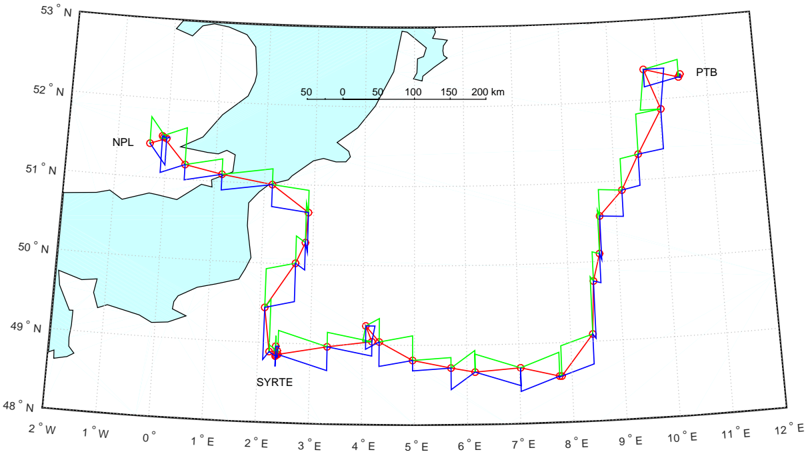
- For two-way time transfer on real links, the computed Sagnac corrections are 3976 ± 27 ps for PTB–SYRTE (1401 km) and 1214 ± 6 ps for NPL–SYRTE (813 km); the uncertainty from poorly known fibre path is estimated from a 53 ps spread for PTB–SYRTE paths and 12 ps for NPL–SYRTE paths.
- For one-way frequency transfer, the paper estimates a c^-1 term of about 2 × 10^-13 for a 1000 km fibre with n = 1.5 when temperature-driven refractive-index change is used as the example.
- For two-way frequency transfer, the paper reports that the largest fibre-process contributions are below 10^-18, with example magnitudes of 8 × 10^-20 (Coriolis from Earth tides), 4 × 10^-20 (Euler term), and 3 × 10^-20 (Earth-tide acceleration) per 1000 km.
Methods
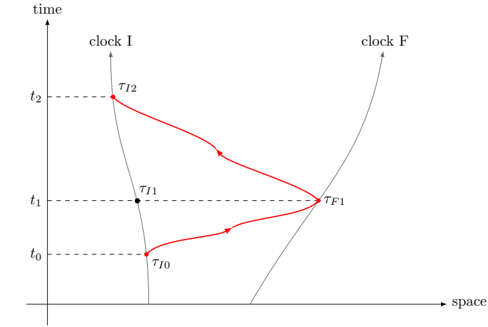
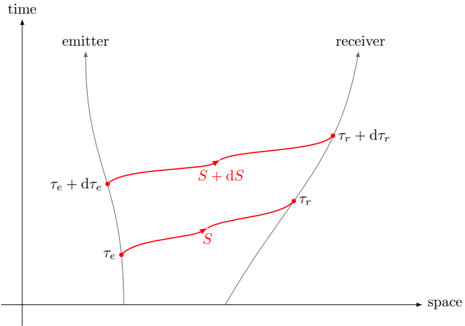
- The paper develops a relativistic model of signal propagation in a moving optical fibre using the Geocentric Celestial Reference System (GCRS), deriving propagation equations and expanding them up to order c^-3 for time transfer and c^-2 for frequency transfer.
- It evaluates required input-parameter uncertainties for 1 ps time-transfer accuracy and 10^-18 frequency-transfer accuracy, including fibre length, refractive index, fibre position, fibre velocity/acceleration, Earth rotation, and thermal effects.
- It computes numerical corrections for two European fibre links (NPL–SYRTE and PTB–SYRTE) using discretized fibre routes built from measured shelter positions and fibre lengths, with direct, maximum, and minimum path scenarios.
Limitations
- The paper states that the fibre path between PTB–SYRTE and NPL–SYRTE is “poorly known,” so the uncertainty of the computed Sagnac correction is limited by incomplete route knowledge.
- The authors state that the gravitational-plus-centrifugal endpoint terms in frequency transfer are not treated in detail here and are “a subject of a separate research.”
- Evident from the text: several derivations rely on approximations and neglected higher-order terms; the paper explicitly says formulas are kept only to the level needed for 1 ps or 10^-18 accuracy, so effects below those thresholds are not modeled in detail.
Model-written summary. Check it against the paper before relying on it.
Integrity signals
Registry
Cites
Statistics
Figures
Verification
Claims the paper makes
5 Valid · 8 Not valid · 8 Not checked · 96 Own results and interpretations
A result the paper reports from its own data — it cites no other source for it, so there is none to check. The quote shows it is in the paper.
In the paper
“If we consider a 1000 km long fibre with n = 1 . 5 we obtain a value of 2 × 10 -13 for the c -1 term of (16).”
- Also stated in: § 4. Frequency transfer · hedged
“| Variations in length and refractive index due to temperature changes (1-way only) | ∼ 10 - 13 |”
plainSingle case- Asserted: passes — The authors put it forward as true.
- Checkable: passes — It can be checked against evidence.
- Load-bearing: passes — The paper’s conclusions depend on it.
- Based: passes — The paper gives a reason why it holds.
- Also stated in: § 4. Frequency transfer · hedged
The paper states this without a source or data behind it here, so there is nothing to check it against. The quote shows it is in the paper.
In the paper
“The required uncertainty of the length of the fibre in case of one-way time transfer would be 0.2 mm to achieve 1 ps uncertainty of the propagation time.”
hedgedstates a cause- Asserted: passes — The authors put it forward as true.
- Checkable: passes — It can be checked against evidence.
- Load-bearing: passes — The paper’s conclusions depend on it.
- Based: unclear — It is unclear why the paper says it holds.
A result the paper states — it cites no source for it, so there is none to check. The quote shows it is in the paper.
In the paper
“We can see that the terms depending on velocity of the end-points cancel.”
plain- Asserted: passes — The authors put it forward as true.
- Checkable: passes — It can be checked against evidence.
- Load-bearing: passes — The paper’s conclusions depend on it.
- Based: passes — The paper gives a reason why it holds.
A result the paper states — it cites no source for it, so there is none to check. The quote shows it is in the paper.
In the paper
“For 1000 km long fibre the required uncertainty of the effective refractive index would be 3 × 10 -10 .”
hedgedstates a cause- Asserted: passes — The authors put it forward as true.
- Checkable: passes — It can be checked against evidence.
- Load-bearing: passes — The paper’s conclusions depend on it.
- Based: passes — The paper gives a reason why it holds.
A result the paper states — it cites no source for it, so there is none to check. The quote shows it is in the paper.
In the paper
“| Euler acceleration of the fibre due to angular acceleration of the Earth rotation | 4 × 10 - 20 |”
- Also stated in: § 4. Frequency transfer · plain
“In this maximizing example we obtain the contribution of 4 × 10 -20 per 1000 km of the fibre.”
plainstates a cause- Asserted: passes — The authors put it forward as true.
- Checkable: passes — It can be checked against evidence.
- Load-bearing: unclear — It is unclear whether the paper’s conclusions depend on it.
- Based: passes — The paper gives a reason why it holds.
- Rests on an assumption not shown here.
- Also stated in: § 4. Frequency transfer · plain
61 more claims
Create a free account to see all 117 claims and every source verdict.
- Probably not a substantial claim. 25
- It may state two separate claims as one. 29
- The quote only partly states this claim. 7
Claims other papers make about this one
Each is checked against this paper’s own text: does it say what the citing paper says it does?
The source backs part of the claim, not all of it — or backs it for a different population, condition or comparison.
In the citing paper
“If the signal propagates in an optical fibre, the term (d t B / d t A ) has been calculated up to order c -3 in [122] for one-way and two-way time and frequency transfers.”
From Chronometric Geodesy: Methods and Applications (2019) · cites this paper as [122]
Experimental — accuracy not yet measuredThe cited source says what the claim attributes to it.
In the citing paper
“In this context, geodynamic effects also lead to additional velocity contributions, and the effect of these on time and frequency comparisons has to be considered (see Gersl et al. 2015).”
From Geodetic methods to determine the relativistic redshift at the level of 10 $$^{-18}$$ - 18 in the context of international timescales: a review and practical results (2018) · cites this paper as Gersl et al. 2015
Citations
Cites
An optical lattice clock with accuracy and stability at the 10−18 level
Bloom, B. J., Nicholson, T. L., Williams, J. R., Campbell, S. L., Bishof, M., Zhang, X., Zhang, W., Bromley, S. L., & Ye, J. (2014) · Nature · doi:10.1038/nature12941 · Cited by 1,073 · cited 2×
“Atomic clocks have been improving rapidly over the past years and are now reaching stabilities and accuracies of a few parts in 10(18) in fractional frequency [1, 2].”
BackgroundAn Atomic Clock with 10 –18 Instability
Hinkley, N., Sherman, J. A., Phillips, N. B., Schioppo, M., Lemke, N. D., Beloy, K., Pizzocaro, M., Oates, C. W., & Ludlow, A. D. (2013) · Science · doi:10.1126/science.1240420 · Cited by 817 · cited 1×
“Atomic clocks have been improving rapidly over the past years and are now reaching stabilities and accuracies of a few parts in 10(18) in fractional frequency [1, 2].”
BackgroundA 920-Kilometer Optical Fiber Link for Frequency Metrology at the 19th Decimal Place
Predehl, K., Grosche, G., Raupach, S. M. F., Droste, S., Terra, O., Alnis, J., Legero, T., Hänsch, T. W., Udem, T., Holzwarth, R., et al. (2012) · Science · doi:10.1126/science.1218442 · Cited by 543
Soffel, M., Klioner, S. A., Petit, G., Wolf, P., Kopeikin, S. M., Bretagnon, P., Brumberg, V. A., Capitaine, N., Damour, T., Fukushima, T., et al. (2003) · The Astronomical Journal · doi:10.1086/378162 · Cited by 392
Self-citationOptical-Frequency Transfer over a Single-Span 1840 km Fiber Link
Droste, S., Ozimek, F., Udem, T., Predehl, K., Hänsch, T. W., Schnatz, H., Grosche, G., & Holzwarth, R. (2013) · Physical Review Letters · doi:10.1103/physrevlett.111.110801 · Cited by 315
Zur Lichtfortpflanzung nach der Relativitätstheorie
Gordon, W. (1923) · Annalen der Physik · doi:10.1002/andp.19233772202 · Cited by 294 · cited 2×
“This condition is equivalent to the one found by Gordon [5].”
ResultUltra-stable long distance optical frequency distribution using the Internet fiber network
Lopez, O., Haboucha, A., Chanteau, B., Chardonnet, C., Amy-Klein, A., & Santarelli, G. (2012) · Optics Express · doi:10.1364/oe.20.023518 · Cited by 175
Relativistic theory for time and frequency transfer to order $\vec {c}^{-3}$
Blanchet, L., Salomon, C., Teyssandier, P., & Wolf, P. (2001) · Astronomy & Astrophysics · doi:10.1051/0004-6361:20010233 · Cited by 132
Self-citationGeneral post-Minkowskian expansion of time transfer functions
Teyssandier, P., & Le Poncin-Lafitte, C. (2008) · Classical and Quantum Gravity · doi:10.1088/0264-9381/25/14/145020 · Cited by 101 · cited 1×
“for the case of satellite transfer so far [6, 7, 8, 9].”
BackgroundSciences of Geodesy - I: Advances and Future Directions
Xu, G. (2010) · Springer eBooks · doi:10.1007/978-3-642-11741-1 · Cited by 99
Cited by
Test of Special Relativity Using a Fiber Network of Optical Clocks
Delva, P., Lodewyck, J., Bilicki, S., Bookjans, E., Vallet, G., Le Targat, R., Pottie, P.-E., Guerlin, C., Meynadier, F., Le Poncin-Lafitte, C., et al. (2017) · Physical Review Letters · doi:10.1103/physrevlett.118.221102 · Cited by 227
Self-citationDenker, H., Timmen, L., Voigt, C., Weyers, S., Peik, E., Margolis, H. S., Delva, P., Wolf, P., & Petit, G. (2018) · Journal of Geodesy · doi:10.1007/s00190-017-1075-1 · Cited by 91
Self-citationHigh Performance Clocks and Gravity Field Determination
Müller, J., Dirkx, D., Kopeikin, S. M., Lion, G., Panet, I., Petit, G., & Visser, P. N. A. M. (2018) · Space Science Reviews · doi:10.1007/s11214-017-0431-z · Cited by 81
“Two clocks in remote locations can be compared by different methods, in practice all relying on the transmission of electromagnetic signals between the two clocks (see e.g. Petit et al. 2014 and Gersl et al. 2015).”
MethodKodet, J., Pánek, P., & Procházka, I. (2015) · Metrologia · doi:10.1088/0026-1394/53/1/18 · Cited by 62
Voigt, C., Denker, H., & Timmen, L. (2016) · Metrologia · doi:10.1088/0026-1394/53/6/1365 · Cited by 50
“In this context, systematic relativistic treatments of time and frequency transfer in the vicinity of the Earth (including satellites) can be found in [18–22], while the situation for optical fibres is discussed in detail in [23].”
BackgroundThe unit of time: Present and future directions
Bize, S. (2019) · Comptes Rendus. Physique · doi:10.1016/j.crhy.2019.02.002 · Cited by 47
“Relativistic effects in optical fiber links are studied from a theoretical standpoint in [149].”
BackgroundHigh-Precision Time Transfer Over 2000-km Fiber Link
Zhang, H., Wu, G., Hu, L., Li, X., & Chen, J. (2015) · IEEE photonics journal · doi:10.1109/jphot.2015.2499541 · Cited by 45
“The uncertainty from the correction of Sagnac effect (term 5) is calculated by 4 AE!=c(2) [14], where ! and c are the rotation speed of the Earth and the speed of light respectively, AE is the uncertainty in determining the equatorial projection area of the surface swept by the vector from the center of the Earth and…”
BackgroundVojtěch, J., Šlapák, M., Škoda, P., Radil, J., Havliš, O., Altmann, M., Münster, P., Velc, R., Kundrát, J., Altmannová, L., et al. (2017) · Optical Engineering · doi:10.1117/1.oe.56.2.027101 · Cited by 33
Wang, D., Jiang, T., Liu, C., Zhou, S., & Yu, S. (2018) · Optics Express · doi:10.1364/oe.26.024479 · Cited by 30
Chronometric Geodesy: Methods and Applications
Delva, P., Denker, H., & Lion, G. (2019) · Fundamental Theories of Physics · doi:10.1007/978-3-030-11500-5_2 · Cited by 28
“A physical model has been formulated to describe the relativistic effects relevant to time and frequency transfer over optical fibre links, and has been used to evaluate the relativistic corrections for the fibre links now in place between NPL, LNE-SYRTE and PTB, as well as to provide guidelines on the importance of e…”
MethodSelf-citationA Sub-ps Stability Time Transfer Method Based on Optical Modems
Frank, F., Stefani, F., Tuckey, P. A., & Pottie, P.-É. (2018) · IEEE Transactions on Ultrasonics Ferroelectrics and Frequency Control · doi:10.1109/tuffc.2018.2833389 · Cited by 21
Uncertainty analysis of BTDM-SFSW based fiber-optic time transfer
Zhang, H., Wu, G., Li, X., & Chen, J. (2017) · Metrologia · doi:10.1088/1681-7575/aa52ee · Cited by 21
“The τ ∆ Sagnac, induced by the Sagnac effect for the relative motion between the Earth and the transmitted lights, can be corrected by (6) [19, 20],”
BackgroundMethodResultPicoseconds-Accurate Fiber-Optic Time Transfer With Relative Stabilization of Lasers Wavelengths
Śliwczyński, Ł., Krehlik, P., Buczek, Ł., & Schnatz, H. (2020) · Journal of Lightwave Technology · doi:10.1109/jlt.2020.2999158 · Cited by 20
“about the fiber’s path and can be accounted for using appropriate models [6].”
BackgroundTANAKA, H. K. M. (2022) · Scientific Reports · doi:10.1038/s41598-022-11104-z · Cited by 19
Relativistic tidal effects on clock-comparison experiments
Qin, C.-G., Tan, Y.-J., & Shao, C.-G. (2019) · Classical and Quantum Gravity · doi:10.1088/1361-6382/ab01ae · Cited by 16
Reciprocity of propagation in optical fiber links demonstrated to 10−21
Xu, D., Delva, P., Lopez, O., Amy-Klein, A., & Pottie, P.-E. (2019) · Optics Express · doi:10.1364/oe.27.036965 · Cited by 15
Self-citationPrecise time transfer on the IPE - VUGKT line - a detailed analysis
Vojtěch, J., Šlapák, M., Škoda, P., et al. (2016) · International Conference on Telecommunications and Signal Processing (TSP) · doi:10.1109/tsp.2016.7760986 · Cited by 9
“The higher terms can be easily omitted for ps precision [6], for example the contribution of c-4 term will be of order 10-17 for above mentioned line.”
BackgroundInfluentialThe Tidal Clock Effects of the Lunisolar Gravitational Field and the Earth’s Tidal Deformation
Qin, C.-G., Tan, Y.-J., & Shao, C.-G. (2020) · The Astronomical Journal · doi:10.3847/1538-3881/abc06f · Cited by 11
General expansion of time transfer functions in optical spacetime
Bourgoin, A. (2020) · Physical review. D/Physical review. D. · doi:10.1103/physrevd.101.064035 · Cited by 11
DWDM stabilized optics for white rabbit
Boven, P. (2018) · European Frequency and Time Forum · doi:10.1109/eftf.2018.8409035 · Cited by 9
Delva, P., & Geršl, J. (2017) · Universe · doi:10.3390/universe3010024 · Cited by 10
“If the signal propagates in an optical fiber, the term (24) has been calculated up to order c−3 in [52].”
BackgroundSelf-citationAutomated numerical calculation of Sagnac correction for photonic paths
Šlapák, M., Vojtěch, J., & Velc, R. (2016) · Optics Communications · doi:10.1016/j.optcom.2016.12.029 · Cited by 8
Some approximated methods of calculation Sagnac correction for optical fiber time transfer
Czubla, A., Krehlik, P., Śliwczyński, Ł., Kołodziej, J., Binczewski, A., Turza, K., Bogacki, W., & Rydlichowski, P. (2017) · Joint Conference of the European Frequency and Time Forum and IEEE International Frequency Control Symposium (EFTF/IFCS) · doi:10.1109/fcs.2017.8088903 · Cited by 8
“This effect, called Sagnac effect, is very well known in TWSTFT and optical fiber time transfer [1-4], however the calculation of the value of Sagnac correction for optical fiber link can be difficult in practice.”
BackgroundMethodŚliwczyński, Ł., Krehlik, P., Buczek, Ł., & Schnatz, H. (2022) · Journal of Lightwave Technology · doi:10.1109/jlt.2022.3147591 · Cited by 6
Joint stable optical frequency and precise time transfer over 406 km of shared fiber lines — Study
Vojtěch, J., Havliš, O., Šlapák, M., Škoda, P., Smotlacha, V., Velc, R., Münster, P., Kundrát, J., Altmann, M., Radil, J., et al. (2017) · International Conference on Telecommunications and Signal Processing (TSP) · doi:10.1109/tsp.2017.8076076 · Cited by 6
Optical two-way timing system for space geodesy applications
Kodet, J., Schreiber, U. K., Pánek, P., Procházka, I., Männel, B., & Schüler, T. (2016) · European Frequency and Time Forum · doi:10.1109/eftf.2016.7477788 · Cited by 5
Hoang, A. T., Shen, Z., Shen, W., Cai, C., Xu, W. S., Ning, A., & Wu, Y. (2021) · Geodesy and Geodynamics · doi:10.1016/j.geog.2021.08.003 · Cited by 8
English, E., Ashkhasi, A., & Whibberley, P. B. (2021) · Contemporary Physics · doi:10.1080/00107514.2021.1963543 · Cited by 4
“Relativistic effects caused by the Earth’s rotation and gravitational potential on the signal propagation delay have been analysed [9].”
BackgroundReal like transmission lines for sagnac correction study
Šlapák, M., & Vojtěch, J. (2018) · European Frequency and Time Forum · doi:10.1109/eftf.2018.8409054 · Cited by 4
“The values of Sagnac correction presented in [3] are computed for the two-way transfer, therefore we derived the half value for the one-way transfer.”
BackgroundMethodResultInfluentialThe Sagnac effect in optic fiber link synchronization of high-precision frequency standards
Михайловна, М. Е., & Petrov, A. N. (2023) · Geodesy and Cartography · doi:10.22389/0016-7126-2022-990-12-12-21 · Cited by 3
Analysis of Sagnac Correction for Time Transfer in Optical Fibers
Wang, B., & Chen, J. (2019) · Lecture notes in electrical engineering · doi:10.1007/978-981-13-7751-8_55 · Cited by 3
Systematic Frequency Error in Laser Synchronization Circuits for Fiber-Optic Time-Transfer Systems
Śliwczyński, Ł., Krehlik, P., Buczek, Ł., & Schnatz, H. (2023) · IEEE Transactions on Ultrasonics Ferroelectrics and Frequency Control · doi:10.1109/tuffc.2023.3245289 · Cited by 2
“where the first term is related to the chromatic dispersion of the fiber (1λA↔B is the wavelength difference of the local and remote lasers and DT is the chromatic dispersion accumulated along the fiber), τSagnac is the Sagnac correction [18], τpol is related to the polarization dispersion, and τC is the correction re…”
BackgroundVojtěch, J., Šlapák, M., Škoda, P., Radil, J., Havliš, O., Altmann, M., Münster, P., Smotlacha, V., Kundrát, J., Velc, R., et al. (2016) · Proceedings of SPIE, the International Society for Optical Engineering/Proceedings of SPIE · doi:10.1117/12.2237205 · Cited by 2
“It changes in time with Earth’s tides but as stated in [12] the contribution to Sagnac term in (1) is only 0.”
BackgroundInfluentialEstimation of positioning sparsity for Sagnac correction in fiber-optic time transfer
Yu, L., Shi, L., Li, C., Li, X., Wei, J., Zhu, Z., Zhou, Y., & Meng, Q. (2022) · Applied Optics · doi:10.1364/ao.467987 · Cited by 1
Test of special relativity using comparisons of clock frequencies
Lu, X.-Y., Wang, Y., Tan, Y.-J., & Shao, C.-G. (2018) · Physical review. D/Physical review. D. · doi:10.1103/physrevd.98.096022 · Cited by 1
Use of Geodesy and Geophysics Measurements to Probe the Gravitational Interaction
Hees, A., Bourgoin, A., Delva, P., Poncin-Lafitte, C. L., & Wolf, P. (2019) · Fundamental theories of physics · doi:10.1007/978-3-030-11500-5_9 · Cited by 2
Self-citationHigh Performance Clocks and Gravity Field Determination
Müller, J., Dirkx, D., Kopeikin, S. M., Lion, G., Panet, I., Petit, G., & Visser, P. N. A. M. (2017) · Space sciences series of ISSI · doi:10.1007/978-94-024-1566-7_4 · Cited by 1
Theoretical substantiations of the Sagnac effect
Михайловна, М. Е., & Petrov, A. N. (2022) · Geodesy and Cartography · doi:10.22389/0016-7126-2022-988-10-2-8 · Cited by 1
McCarthy, D. D., & Seidelmann, P. K. (2018) · Cambridge University Press eBooks · doi:10.1017/9781108178365.018
Chatzinikos, M., & Delva, P. (2026) · International Association of Geodesy symposia · doi:10.1007/1345_2026_308
Self-citation
Metadata
- Authors
- Geršl, J., Delva, P., & Wolf, P.
- Affiliations
- Český metrologický institut (CZ)
- Systèmes de Référence Temps-Espace (FR)
- Corresponding author
- Geršl, J
- Venue
- Metrologia
- Publisher
- IOP Publishing
- Published
- 2015-07-16
- Volume
- 52
- Issue
- 4
- Pages
- 552-564
- ISSN
- 0026-1394 (ISSN-L)
- 1681-7575
- OpenAlex
- W2762679738
- Semantic Scholar
- 62ccf5378049e50f5af59f28b0518d8d65596c5f
- Cited by
- 40
- References
- 21
- Citations by year
- 2026: 1 · 2023: 2 · 2022: 4 · 2021: 2 · 2020: 3 · 2019: 6 · 2018: 6 · 2017: 9 · 2016: 5 · 2015: 2
- FWCI
- 3.54
- Type
- journal article
- Language
- en
- Open access
- bronze
- doi.org
- Licence
- publishingsupport.iopscience.iop.org/iop-standard/v1 (vor)
- iopscience.iop.org/info/page/text-and-data-mining (tdm)
- Locations
- Metrologia (publishedVersion)
- arXiv (Cornell University) (submittedVersion)
- HAL (submittedVersion, other-oa)
- arXiv (Cornell University)
- Funders
- EURAMET (SIB55 ITOC)
- Topics
- Physical Sciences › Physics and Astronomy › Atomic and Molecular Physics, and Optics › Advanced Frequency and Time Standards
- Physical Sciences › Computer Science › Computer Networks and Communications › Network Time Synchronization Technologies
- Physical Sciences › Physics and Astronomy › Astronomy and Astrophysics › Relativity and Gravitational Theory
- Keywords
- relativistic corrections, time transfer, frequency transfer, optical fibers, Earth rotation, uncertainty estimation
About these checks
Registry, retraction, Cites and statistics results are computed, not judged, with one exception: a printed reference that no index lists is read once by a model before it counts as a citation error. Claims are extracted by a model and kept only when their quote appears verbatim in the text; each cited source is then checked, with a model’s help, for whether it says what the claim relies on. Those verdicts can be wrong — read the claim’s quote and the cited source before relying on one.
The claim verdicts this report counts are experimental: their accuracy is not yet measured.
A language model drew the claims from the paper on 2026-10-10, under version 3 of the claim definition (model deepseek-v4.1-flash, prompt extract-v3).
A second model labelled each claim on 2026-10-10 (model jev-1.13-20260917, definition revision gold-guideline-v0.2).
Statistics and arithmetic are recomputed, not judged.
Confidence bands are shown only for fields calibrated on our annotated test set. None is calibrated yet, so no band is shown.
What counts as a claim ›How we measure confidence ›How we check this ›
Are you an author, or do you see a problem with this page? Request a review
Data sources
Bibliographic data: Semantic Scholar, OpenAlex, Crossref.
Contains information from the Semantic Scholar Academic Graph Datasets, made available under the ODC Attribution License (ODC-BY 1.0).
Semantic Scholar’s data is described in: Kinney, R., et al. (2023). The Semantic Scholar Open Data Platform. arXiv:2301.10140.
