

Integrated photonic quantum walks
Open accessThe DOI matches its Crossref record; 166 of the 174 references it cites were found in a registry or an index; 24 of the 44 sources its claims cite were checked for support.
Abstract
Quantum walks (QWs) are one of the fundamental concepts in quantum information science, being an essential component for various new applications. Implementing QWs using integrated photonic waveguide lattices allows for realizing long evolution times, for exploring novel lattice geometries, and even for controllable coupling to the environment. This tutorial gives an introduction to the field of on-chip QWs of single photons and photon pairs featuring non-classical two-photon correlations.
Overview
CoChat Summary
TL;DR
This tutorial reviews integrated photonic quantum walks implemented in waveguide lattices, covering discrete- and continuous-time dynamics of single photons and photon pairs. It explains fabrication, photon-pair generation/detection, and nonclassical correlation phenomena including W-states, perfect state transfer, Anderson localization, Bloch oscillations, and non-Hermitian QWs.
Key findings
- Integrated photonic lattices allow long evolution times, 3D geometries, and controllable coupling; direct laser-written waveguides have refractive-index increase ~10^-3, straight-section losses 0.3–0.9 dB cm^-1, and cm-scale bending radii, while silica-on-silicon offers 0.1 dB cm^-1 but only 2D structures.
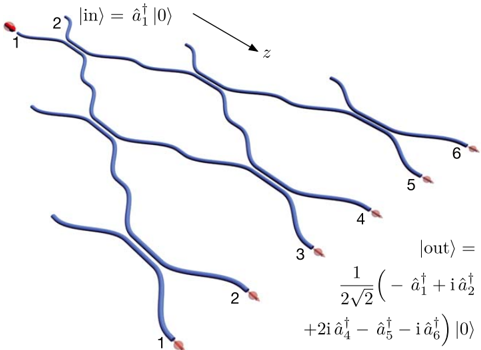
- In discrete-time single-photon QWs, a 31-step DC mesh shows quantum interference: after three steps the photon has vanishing probability in channel 3, and unlike the binomial Galton-board output, the walker most likely emerges opposite the input; adding random phases after each DC (uniform [0,π], averaged over 20,000 realizations) washes out ballistic lobes into a diffusive/binomial/Gaussian distribution.
- Two-photon QWs exhibit nonclassical correlations: a 50:50 DC produces HOM interference with measured visibility approximately 96.4%; separable indistinguishable photons show bunching, path-entangled input shows anti-bunching, and distinguishable photons show four characteristic correlation peaks.
- The tutorial reports on-chip W-state generation up to N=16, perfect state transfer in a 19-waveguide J_x lattice (input guide 1↔19, 2↔18), Anderson colocalization in 101-site disordered arrays with N=20 input, Bloch oscillations with revival success probability >92% in a 16-waveguide lattice, and non-Hermitian quasi-PT-symmetric lattices where transport becomes diffusive and row sums of the correlation function no longer equal average particle number.
Methods
- Design: tutorial/review with theoretical derivations and discussion of experiments; introduces discrete-time QWs via directional couplers and continuous-time QWs via evanescently coupled waveguide arrays; uses Heisenberg and quantum Langevin equations, unitary evolution operator, and correlation functions.
- Data/sample: no new primary dataset; draws on cited integrated-photonic experiments, including an AlGaAs 100-waveguide array, a 31-step DC mesh, a 5-waveguide W-state array, a 19-waveguide J_x lattice, 101-site disordered arrays, a 16-waveguide BO lattice, and non-Hermitian arrays. Photon pairs are generated by SPDC and detected by APDs, SNSPDs, or TESs.
- Main analysis: analytical/numerical modeling of photon number and two-photon correlation functions, compared with experimental coincidence/correlation maps; nonclassicality is assessed via Bell-like inequalities and a visibility threshold (above 50% ensures nonclassical quantum interference).
Limitations
- Stated in the paper: full on-chip integration of source, waveguide chip, and detection has not been realized; losses between source, chip, and detectors due to mode-size mismatch can be minimized with thermally enhanced core fibers and adiabatic inscription. Direct laser-written waveguides have moderate index increase (~10^-3), cm-scale bending radii, and 0.3–0.9 dB cm^-1 losses; silica-on-silicon is limited to 2D. Detection limitations include APDs cannot resolve multiple simultaneous photons and InGaAs telecom versions have enhanced noise/low efficiency; SNSPDs require <4 K; TESs require ~100 mK, have lower count rates, and photon-number discrimination degrades for higher N. The tutorial also states its generation/detection overview is brief and not essential to the principles.
- Evident from the text: the manuscript is a tutorial/review rather than a primary research report, so its quantitative “findings” are syntheses of cited experiments rather than a single new experimental dataset.
Model-written summary. Check it against the paper before relying on it.
Integrity signals
Registry
Cites
Statistics
Figures




Verification
Claims the paper makes
13 Valid · 4 Not valid · 15 Not checked · 44 Own results and interpretations
Some cited sources support this claim and some don’t — read each source’s verdict below.
In the paper
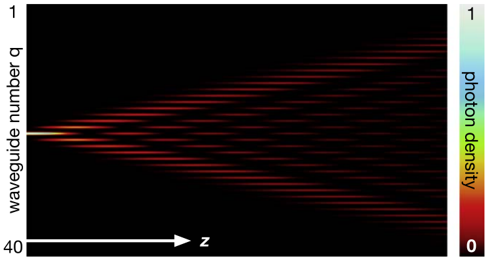
“An interesting fact is that such lattices do not feature ballistic evolution of the average photon number, but rather diffusion [24,76].”
§ Integrated photonic quantum walks > = å
What the sources say
- Partly supportedcites [24] Gräfe M, Heilmann R, Keil R, Eichelkraut T, Heinrich M, Nolte S and Szameit A 2013 Correlations of indistinguishable particles in non-Hermitian lattices New J. Phys. 15 033008 sourceExperimental — accuracy not yet measured
In §3, Numerical investigations (page not available), the paper reports diffusive wave evolution in quasi-PT-symmetric lattices: the wave-packet variance grows linearly with propagation. It does not establish that the average photon number itself evolves diffusively rather than ballistically; that is a different quantity. (LLM, conf=0.84)
- Disputedcites [76] Eichelkraut T, Heilmann R, Weimann S, Stützer S, Dreisow F, Christodoulides D N, Nolte S and Szameit A 2013 Mobility transition from ballistic to diffusive transport in non-Hermitian lattices Nat. Commun. 4 2533 sourceExperimental — accuracy not yet measured
The Figure 2 caption (Waveguide fabrication; page not provided) says the quasi-PT-symmetric system initially shows ballistic spreading and becomes diffusive only at larger propagation distances. The Theory section likewise describes a transition from initially ballistic to diffusive transport, rather than an absence of ballistic evolution. These passages concern wave-packet spreading, not average photon number. (LLM, conf=0.88)
Checked by a reasoning model — may be wrong.
plainstates a cause- Asserted: passes — The authors put it forward as true.
- Checkable: passes — It can be checked against evidence.
- Load-bearing: unclear — It is unclear whether the paper’s conclusions depend on it.
- Based: passes — The paper gives a reason why it holds.
- Partly supported
At least one cited source doesn’t support this claim or points to a different paper, and none confirmed it — see the verdicts below.
In the paper
“In contrast, this does not hold for the two-photon correlation functions.”
§ Integrated photonic quantum walks > 6.1. Disordered lattices and Anderson localization
What the sources say
- Disputedcites [116] Lahini Y, Bromberg Y, Christodoulides D N and Silberberg Y 2010 Quantum correlations in two-particle Anderson localization Phys. Rev. Lett. 105 163905 sourceExperimental — accuracy not yet measured
The paper says the two-particle correlation function has a localized component (Fig. 2, p. 2), and that at longer times localized particles exhibit correlations within the localization length (p. 1). It distinguishes the correlations’ spatial structure from the localized particle density; it does not say the correlations fail to localize. (LLM, conf=0.83)
Checked by a reasoning model — may be wrong.
plain- Asserted: passes — The authors put it forward as true.
- Checkable: passes — It can be checked against evidence.
- Load-bearing: passes — The paper’s conclusions depend on it.
- Based: passes — The paper gives a reason why it holds.
- Disputed
The cited sources support only part of this claim — read each source’s verdict below.
In the paper
“Inspired by spin chains [100-102] (see figure 12(a)), by tailoring the hopping rates between the waveguides of an array to match the matrix elements of the J x angular momentum operator, such a task becomes possible.”
§ Integrated photonic quantum walks > 5.3. Perfect state transfer in a J x lattice
What the sources say
- Partly supportedcites [100] Bose S 2003 Quantum communication through an unmodulated spin chain Phys. Rev. Lett. 91 207901 sourceExperimental — accuracy not yet measured
The paper reports perfect state transfer for certain short spin chains (p. 3), so it supports that limited outcome. But its open-chain model uses equal-strength nearest-neighbor interactions (p. 2); it does not describe waveguide hopping rates tailored to Jₓ matrix elements as the means of achieving transfer. (LLM, conf=0.83)
- Could not verifycites [101] Pazy E, Biolatti E, Calarco T, D'Amico I, Zanardi P, Rossi F and Zoller P 2003 Spin-based optical quantum computation via Pauli blocking in semiconductor quantum dots Europhys. Lett. 62 175 sourceExperimental — accuracy not yet measured
The indexed passages (labeled Abstract; page unavailable) describe laser-controlled gates in semiconductor quantum dots, not hopping between waveguides. Searches for J_x, waveguide hopping rates, and spin-chain state transfer found no passage addressing the claimed method of perfect state transfer. (LLM, conf=0.76)
- Partly supportedcites [102] Christandl M, Datta N, Ekert A and Landahl A J 2004 Perfect state transfer in quantum spin networks Phys. Rev. Lett. 92 187902 sourceExperimental — accuracy not yet measured
The paper shows that engineering inter-qubit couplings in a linear spin chain to match an angular-momentum operator yields perfect state transfer (p. 3). It does not study hopping rates between waveguides, so the waveguide-array application is not established by this source. (LLM, conf=0.86)
hedgedstates a cause- Asserted: passes — The authors put it forward as true.
- Checkable: passes — It can be checked against evidence.
- Load-bearing: passes — The paper’s conclusions depend on it.
- Based: passes — The paper gives a reason why it holds.
- Partly supported
The cited sources support only part of this claim — read each source’s verdict below.
In the paper
“In the case of a separable input state both photons tend to occupy the same channel localized around the excitation sites.”
§ Integrated photonic quantum walks > 6.1. Disordered lattices and Anderson localization
What the sources say
- Partly supportedcites [116] Lahini Y, Bromberg Y, Christodoulides D N and Silberberg Y 2010 Quantum correlations in two-particle Anderson localization Phys. Rev. Lett. 105 163905 sourceExperimental — accuracy not yet measured
The paper identifies its two-adjacent-site input as a separable state (p. 2), and Fig. 2 reports that bosons tend to appear at the same site. But the discussion of Fig. 2 (p. 2) attributes spatial bunching to the ballistic component and describes the localized component as having no spatial correlations. It therefore does not establish that the photons tend to share a channel specifically when localized around the excitation sites. (LLM, conf=0.85)
plainstates an association- Asserted: passes — The authors put it forward as true.
- Checkable: passes — It can be checked against evidence.
- Load-bearing: passes — The paper’s conclusions depend on it.
- Based: passes — The paper gives a reason why it holds.
- Partly supported
The cited sources support only part of this claim — read each source’s verdict below.
In the paper
“In their experimental study, Lebugle and co-workers achieved a revival with success probability greater than 92% depending on the specific input state [121].”
§ Integrated photonic quantum walks > 6.2. Quantum BOs
What the sources say
- Partly supportedcites [121] Lebugle M, Gräfe M, Heilmann R, Perez-Leija A, Nolte S and Szameit A 2015 Experimental observation of N00N state Bloch oscillations Nat. Commun. 6 8273 sourceExperimental — accuracy not yet measured
The Discussion reports a first-revival probability of 0.92±0.02 for symmetric input and 0.94±0.01 for antisymmetric input. Thus the measured probability exceeds 92% for the antisymmetric input, but the symmetric-input estimate is 92%, not greater than 92%. (LLM, conf=0.86)
plainstates an association- Asserted: passes — The authors put it forward as true.
- Checkable: passes — It can be checked against evidence.
- Load-bearing: unclear — It is unclear whether the paper’s conclusions depend on it.
- Based: passes — The paper gives a reason why it holds.
- Partly supported
33 more claims · 1 with their cited sources checked
Create a free account to see all 76 claims and every source verdict.
- Probably not a substantial claim. 19
- It may state two separate claims as one. 25
- The quote only partly states this claim. 2
Self-check
Percentages, sums and reported differences re-computed from the paper’s own numbers.
Each contradiction between two passages listed here was confirmed by an independent check.
Rated minor: it would not touch a result — a value no result rests on, a p-value that stays on the same side of the significance level, or a conflict that is clerical, resolved elsewhere in the paper, or outside its own findings.
In the paper
§ Integrated photonic quantum walks > 3. Direct laser-written waveguides
“The very first QW experiment was carried out in a silica-on-silicon waveguide array (see 5.1).”
§ Integrated photonic quantum walks > 5.1. Single photons in waveguide arrays
“Perets and co-workers were able to investigate single-photon QWs in a homogeneous array of 100 waveguides etched onto an AlGaAs substrate [69]”
Rated minor: it would not touch a result — a value no result rests on, a p-value that stays on the same side of the significance level, or a conflict that is clerical, resolved elsewhere in the paper, or outside its own findings.
In the paper
§ Integrated photonic quantum walks > 1. Introduction
“in the very same year, Einstein and Smoluchowski presented their seminal works on Brownian motion, which where modeled as random walks [2,3].”
§ Integrated photonic quantum walks > References
“3. von Smoluchowski M 1906 Zur kinetischen Theorie der Brownschen Molekularbewegung und der Suspensionen”
Rated minor: it would not touch a result — a value no result rests on, a p-value that stays on the same side of the significance level, or a conflict that is clerical, resolved elsewhere in the paper, or outside its own findings.
In the paper
§ Integrated photonic quantum walks > 2.3. QWs of two photons
“two indistinguishable photons, one launched into each input channel of a DC.”
§ Integrated photonic quantum walks > 2.3. QWs of two photons
“(two photons in each input port) yields G = G = 0 1,2 2,1”
Citations
Cites
Absence of Diffusion in Certain Random Lattices
Anderson, P. W. (1958) · Physical Review · doi:10.1103/physrev.109.1492 · Cited by 12,468 · cited 2×
“In contrast, the wave packet remains localized around the initial excitation site (Anderson localization) for discorded lattices [71].”
BackgroundQuantum Mechanics and Path Integrals
(1966) · Students Quarterly Journal · doi:10.1049/sqj.1966.0063 · Cited by 9,537
A fast quantum mechanical algorithm for database search
Grover, L. K. (1996) · Proceedings of the twenty-eighth annual ACM symposium on Theory of computing - STOC '96 · doi:10.1145/237814.237866 · Cited by 8,830 · cited 1×
“Since then, QWs have found applications as the fundamental concept behind Groverʼs search algorithm [9] or universal quantum computing [10, 11].”
BackgroundOptical Coherence and Quantum Optics
Mandel, L., & Wolf, E. (1995) · doi:10.1017/cbo9781139644105 · Cited by 8,356
Einstein, A. (1905) · Annalen der Physik · doi:10.1002/andp.19053220806 · Cited by 8,265
(1998) · doi:10.1103/physrevlett.80.5243 · Cited by 6,280 · cited 1×
“The peculiarity is that despite these systems generally not being Hermitian they can feature a completely real eigenvalue spectrum [124].”
BackgroundMeasurement of subpicosecond time intervals between two photons by interference
Hong, C. K., Ou, Z. Y., & Mandel, L. (1987) · Physical Review Letters · doi:10.1103/physrevlett.59.2044 · Cited by 4,369 · cited 1×
“The HOM effect was first observed in 1987 at a bulk beam splitter and was carried over to the integrated optical domain more than 20 years later [30, 31].”
Background�ber die Quantenmechanik der Elektronen in Kristallgittern
Bloch, F. (1929) · Zeitschrift f�r Physik · doi:10.1007/bf01339455 · Cited by 3,436
Three qubits can be entangled in two inequivalent ways
Dür, W., Vidal, G., & Cirac, J. I. (2000) · Physical Review A · doi:10.1103/physreva.62.062314 · Cited by 3,384 · cited 1×
“First introduced as coherent and balanced superposition of three qubit states [81] they can be readily generalized to N qubits.”
BackgroundSuperlattice and negative differential conductivity in semiconductors
Esaki, L., & Tsu, R. (1970) · IBM Journal of Research and Development · doi:10.1147/rd.141.0061 · Cited by 3,341 · cited 2×
“In addition, applyinga linear potential to an ordered latticethe wave packet will periodically spread andre-localize, which is denoted as Bloch oscillations [110, 111].”
Background
Research works printed but not linked: 1
- Yariv A 1989 Quantum Electronics (New York: Wiley)
Cited by
Tan, D., Wang, Z., Xu, B., & Qiu, J. (2021) · Advanced Photonics · doi:10.1117/1.ap.3.2.024002 · Cited by 185
Quantum state processing through controllable synthetic temporal photonic lattices
Monika, M., Nosrati, F., George, A., Sciara, S., Fazili, R., Muniz, A. L. M., Bisianov, A., Franco, R. L., Munro, W. J., Chemnitz, M., et al. (2024) · Nature Photonics · doi:10.1038/s41566-024-01546-4 · Cited by 47
Comparison of quantum-walk implementations on noisy intermediate-scale quantum computers
Γεωργόπουλος, Κ., Emary, C., & Zuliani, P. (2021) · Physical Review A · doi:10.1103/physreva.103.022408 · Cited by 28
Higher-order topological biphoton corner states in two-dimensional photonic lattices
Li, C., Li, M., Yan, L., Ye, S., Hu, X., Gong, Q., & Li, Y. (2022) · Physical Review Research · doi:10.1103/physrevresearch.4.023049 · Cited by 20
Quantum simulations with multiphoton Fock states
Sturges, T. J., McDermott, T. C., Buraczewski, A., Clements, W. R., Renema, J. J., Nam, S. W., Gerrits, T., Lita, A., Kolthammer, W. S., Eckstein, A., et al. (2021) · npj Quantum Information · doi:10.1038/s41534-021-00427-w · Cited by 34
Metadata
- Authors
- Gräfe, M., & Szameit, A.
- Affiliations
- Fraunhofer Institute for Applied Optics and Precision Engineering (DE)
- University of Rostock (DE)
- Corresponding author
- Gräfe, Markus
- Venue
- Journal of Physics B: Atomic, Molecular and Optical Physics
- Publisher
- IOP Publishing
- Published
- 2020-03-10
- Volume
- 53
- Issue
- 7
- Pages
- 073001
- ISSN
- 0953-4075 (ISSN-L)
- 1361-6455
- OpenAlex
- W2999198815
- Semantic Scholar
- 91be1f1c160bb3a3e2a9efacd7d82e23b333e579
- Cited by
- 28
- References
- 174
- Citations by year
- 2025: 5 · 2024: 5 · 2023: 5 · 2022: 4 · 2021: 9
- FWCI
- 1.74
- Type
- journal article
- Language
- en
- Open access
- hybrid
- doi.org
- Licence
- cc-by
- publishingsupport.iopscience.iop.org/iop-standard/v1 (vor)
- iopscience.iop.org/info/page/text-and-data-mining (tdm)
- Locations
- Journal of Physics B Atomic Molecular and Optical Physics (publishedVersion, cc-by)
- Publikationsdatenbank der Fraunhofer-Gesellschaft (Fraunhofer-Gesellschaft) (submittedVersion)
- Fraunhofer-Publica (Fraunhofer-Gesellschaft) (submittedVersion)
- Funders
- Deutsche Forschungsgemeinschaft (SZ 276/12-11)
- Fraunhofer-Gesellschaft (QUILT)
- Topics
- Physical Sciences › Computer Science › Artificial Intelligence › Quantum Computing Algorithms and Architecture
- Physical Sciences › Physics and Astronomy › Atomic and Molecular Physics, and Optics › Quantum Information and Cryptography
- Physical Sciences › Physics and Astronomy › Atomic and Molecular Physics, and Optics › Quantum optics and atomic interactions
- Keywords
- quantum walks, integrated photonics, single photons, photon pairs, two-photon correlations, nonclassical correlations
About these checks
Registry, retraction, Cites and statistics results are computed, not judged, with one exception: a printed reference that no index lists is read once by a model before it counts as a citation error. Claims are extracted by a model and kept only when their quote appears verbatim in the text; each cited source is then checked, with a model’s help, for whether it says what the claim relies on. Those verdicts can be wrong — read the claim’s quote and the cited source before relying on one.
The claim verdicts this report counts are experimental: their accuracy is not yet measured.
A language model drew the claims from the paper on 2026-10-07, under version 3 of the claim definition (model deepseek-v4.1-flash, prompt extract-v3).
A second model labelled each claim on 2026-10-07 (model jev-1.13-20260917, definition revision gold-guideline-v0.2).
Cited sources are checked with a language model’s help (gpt-6-sol).
Statistics and arithmetic are recomputed, not judged.
Confidence bands are shown only for fields calibrated on our annotated test set. None is calibrated yet, so no band is shown.
What counts as a claim ›How we measure confidence ›How we check this ›
Are you an author, or do you see a problem with this page? Request a review
How to cite
Cite CoChat for the checks on this page, and the paper for its own findings.
- This page
- CoChat. (2026). Citation check: Integrated photonic quantum walks. https://app.cochat.ai/papers/10.1088/1361-6455/ab6cfc
- The paper
- Gräfe, M., & Szameit, A. (2020). Integrated photonic quantum walks. Journal of Physics B: Atomic, Molecular and Optical Physics. https://doi.org/10.1088/1361-6455/ab6cfc
Data sources
Bibliographic data: Semantic Scholar, OpenAlex, Crossref.
Contains information from the Semantic Scholar Academic Graph Datasets, made available under the ODC Attribution License (ODC-BY 1.0).
Semantic Scholar’s data is described in: Kinney, R., et al. (2023). The Semantic Scholar Open Data Platform. arXiv:2301.10140.
