

Percolation of localized attack on complex networks
Open accessThe DOI matches its Crossref record; 36 of the 36 references it cites were found in a registry or an index.
Abstract
The robustness of complex networks against node failure and malicious attack has been of interest for decades, while most of the research has focused on random attack or hub-targeted attack. In many real-world scenarios, however, attacks are neither random nor hub-targeted, but localized, where a group of neighboring nodes in a network are attacked and fail. In this paper we develop a percolation framework to analytically and numerically study the robustness of complex networks against such localized attack. In particular, we investigate this robustness in Erdős–Rényi networks, random-regular networks, and scale-free networks. Our results provide insight into how to better protect networks, enhance cybersecurity, and facilitate the design of more robust infrastructures.
Overview
The claims and statistics of this paper haven’t been checked yet.
Free: it reads the open-access text and checks the first 5 claims that cite a source we can check. Create a free account to check every claim.
Integrity signals
Registry
Cites
Statistics
Figures
Verification
Claims the paper makes
The claims and statistics of this paper haven’t been checked yet.
Free: it reads the open-access text and checks the first 5 claims that cite a source we can check. Create a free account to check every claim.
Claims other papers make about this one
Each is checked against this paper’s own text: does it say what the citing paper says it does?
The check wasn’t confident either way, so it gives no verdict — never disputed.
In the citing paper
“under the fractional threshold failure mechanism scale-free networks are more vulnerable compared to their ER counterparts with the same average degree39.”
From Mitigation of cascading failures in complex networks (2020) · cites this paper as [39]
Experimental — accuracy not yet measured
Self-check
Percentages, sums and reported differences re-computed from the paper’s own numbers.
The self-check needs the paper’s full text.
Citations
Cites
Statistical mechanics of complex networks
Albert, R., & Barabási, A.-L. (2002) · Reviews of Modern Physics · doi:10.1103/revmodphys.74.47 · Cited by 20,471
Error and attack tolerance of complex networks
Albert, R., Jeong, H., & Barabási, A.-L. (2000) · Nature · doi:10.1038/35019019 · Cited by 7,534
Introduction to Percolation Theory
Stauffer, D., Aharony, A., & Redner, S. (1993) · Physics Today · doi:10.1063/1.2808877 · Cited by 6,666
Newman, M. (2010) · doi:10.1093/acprof:oso/9780199206650.001.0001 · Cited by 6,595
Error and attack tolerance of complex networks
Albert, R., Jeong, H., & Barabási, A.-Ĺ. (2000) · RePEc: Research Papers in Economics · Cited by 6,460
Bollobás, B. (1985) · Cited by 6,196
Catastrophic cascade of failures in interdependent networks
Buldyrev, S. V., Parshani, R., Paul, G., Stanley, H. E., & Havlin, S. (2010) · Nature · doi:10.1038/nature08932 · Cited by 4,513
Self-citationRandom graphs with arbitrary degree distributions and their applications
Newman, M. E. J., Strogatz, S. H., & Watts, D. J. (2001) · Physical Review E · doi:10.1103/physreve.64.026118 · Cited by 3,648
Spread of epidemic disease on networks
Newman, M. E. J. (2002) · Physical Review E · doi:10.1103/physreve.66.016128 · Cited by 3,218
(2011) · Choice Reviews Online · doi:10.5860/choice.48-3328 · Cited by 2,736
Research works printed but not linked: 2
- 2. Albert R, Jeong H and Barabási A L 2000 Nature 406 378 · DOI · Paper page
- 26. Neumayer S, Zussman G, Cohen R and Modiano E 2009 INFOCOM IEEE 1566-74 · doi:10.1109/infocom.2009.5062074
Cited by
Items 101–186 of 186
Liang, Y., Qi, M., Chen, P., & Duan, X. (2025) · Chaos An Interdisciplinary Journal of Nonlinear Science · doi:10.1063/5.0280808 · Cited by 5
Predictive Model Resilience in Edge Computing
Wang, Q., Mateo, J., Anagnostopoulos, C. B., & Kolomvatsos, K. (2022) · IEEE World Forum on Internet of Things (WF-IoT) · doi:10.1109/wf-iot54382.2022.10152282 · Cited by 5
“Similarly, such failures could be caused by internal factors like hardware malfunction, energy depletion, link failure and system crash or external adverse environment [6], [7] or even external malicious attacks [8].”
BackgroundKusunoki, R., & Hayashi, Y. (2024) · PLoS ONE · doi:10.1371/journal.pone.0297094 · Cited by 5
Guo, S. J., Lyu, J., Zhu, X., & Fan, H. (2024) · Chaos Solitons & Fractals · doi:10.1016/j.chaos.2024.115902 · Cited by 5
On the Complexity of Color-Avoiding Site and Bond Percolation
Molontay, R., & Varga, K. (2019) · Lecture notes in computer science · doi:10.1007/978-3-030-10801-4_28 · Cited by 5
Node differentiation protection concerning model of localized attack on real networks
Fu, T., Sun, R., Li, C., & Wu, L. J. (2019) · Physica A Statistical Mechanics and its Applications · doi:10.1016/j.physa.2019.04.183 · Cited by 5
Shiroky, A., & Kalashnikov, A. (2021) · Mathematics · doi:10.3390/math9192468 · Cited by 5
“Network structure changes Unintentional or no changes at all (1) Random attack percolation models [13,14] Error tolerance model [7] “Forest fire” (FF) [8] based models: FF with immune trees [9], Demon model [10], Cellular automata-based model [11,12] (2) Attacker–Defender, Defender–Attacker, Defender–Attacker–Defender…”
BackgroundRealtime Robustification of Interdependent Networks under Cascading Attacks
Chen, Z., Tong, H., & Ying, L. (2018) · IEEE International Conference on Big Data (BigData) · doi:10.1109/bigdata.2018.8622022 · Cited by 5
“In this paper, we consider the problem of robustifying an interdependent network in realtime under a localized attack [14], where attacked nodes attack their neighbors so the attack spreads in the network hop-by-hop starting from the source.”
BackgroundIdentification of Critical Nodes and Edges in a Network Based on Clustering
Gaur, V., Yadav, O. P., Soni, G., & Rathore, A. P. S. (2020) · Procedia Manufacturing · doi:10.1016/j.promfg.2020.10.181 · Cited by 5
Methodology to quantify robustness in networks: case study—Higher Education System in Mexico
Montes-Orozco, E., Mora-Gutiérrez, R. A., Obregón-Quintana, B., de-los-Cobos-Silva, S. G., Rincón-García, E. A., Lara-Velázquez, P., & Andrade, M. Á. G. (2021) · Computing · doi:10.1007/s00607-021-00909-x · Cited by 5
The Effect of Time-Varying Value on Infrastructure Resilience Assessments
Poulin, C., & Kane, M. B. (2021) · IEEE Access · doi:10.1109/access.2021.3112944 · Cited by 5
“Others incorporate an additional category for spatial considerations [105]–[107].”
BackgroundColor-avoiding percolation and branching processes
Fekete, P. T., Molontay, R., Ráth, B., & Varga, K. (2024) · Journal of Applied Probability · doi:10.1017/jpr.2023.115 · Cited by 5
“The mathematical analysis of the robustness of random graphs and networks has been the focus of research interest in the last two decades [1, 5, 18, 28].”
Guo, F., Chen, C., Zeng, L., Pu, T., Qing, F., & Fan, C. (2025) · Expert Systems with Applications · doi:10.1016/j.eswa.2025.128121 · Cited by 4
Coping with abnormal organizational behaviors in complex project based on network attack theory
Yang, L., Lv, X., & Zhao, X. (2023) · Engineering Construction & Architectural Management · doi:10.1108/ecam-10-2022-0959 · Cited by 4
Yang, B., Zuo, Y., Xiaoming Hu, A., Cheng, W., Li, N., & Liu, Q. (2024) · Chaos Solitons & Fractals · doi:10.1016/j.chaos.2024.114932 · Cited by 4
Phase transition in evolving networks that combine preferential attachment and random node deletion
Budnick, B., Biham, O., & Katzav, E. (2025) · Journal of Statistical Mechanics Theory and Experiment · doi:10.1088/1742-5468/ad99c7 · Cited by 5
Anti-modularization for both high robustness and efficiency including the optimal case
Kim, J., & Hayashi, Y. (2024) · PLoS ONE · doi:10.1371/journal.pone.0301269 · Cited by 4
Spreading of Failures in Interdependent Networks
Shekhtman, L., Danziger, M. M., & Havlin, S. (2017) · Springer eBooks · doi:10.1007/978-3-319-67798-9_20 · Cited by 6
Self-citationCharacterizing spatial point processes by percolation transitions
Villegas, P., Gili, T., Gabrielli, A., & Caldarelli, G. (2022) · Journal of Statistical Mechanics Theory and Experiment · doi:10.1088/1742-5468/ac7a2c · Cited by 4
Percolation on random networks with proliferation
Shang, Y. (2018) · International Journal of Modern Physics B · doi:10.1142/s0217979218503599 · Cited by 4
The Recoverability of Network Controllability
Chen, A., Sun, P., & Kooi, R. E. (2021) · International Conference on System Reliability and Safety (ICSRS) · doi:10.1109/icsrs53853.2021.9660667 · Cited by 3
Acquaintance immunization with limited knowledge of network structure
Liu, Y., Huang, Q., Dong, G., Yao, M., Shekhtman, L., & Stanley, E. (2023) · New Journal of Physics · doi:10.1088/1367-2630/acf067 · Cited by 3
“In contrast, in many cases the interconnected nodes are of interest [25, 41, 42] and how our model could incorporate potential limited knowledge of a node’s interconnections would be an interesting extension.”
BackgroundIdentification of Vulnerabilities in Networked Systems
Faramondi, L., & Setola, R. (2019) · Advanced sciences and technologies for security applications · doi:10.1007/978-3-030-00024-0_5 · Cited by 3
Networks with degree–degree correlations are special cases of the edge-coloured random graph
Balogh, S. G., Palla, G., & Kryven, I. (2020) · Journal of Complex Networks · doi:10.1093/comnet/cnaa045 · Cited by 3
Targeted Avoidance in Complex Networks
Zhang, A., Yeung, C. H., Zhao, C., Fan, Y., & Zeng, A. (2025) · Physical Review Letters · doi:10.1103/physrevlett.134.047401 · Cited by 3
Network Defensive Strategy Definition Based on Node Criticality
Faramondi, L., Oliva, G., & Setola, R. (2019) · Conference proceedings/Conference proceedings - IEEE International Conference on Systems, Man, and Cybernetics · doi:10.1109/smc.2019.8914665 · Cited by 3
“A typical approach in the literature to spot such vulnerabilities is to assume that the network is under attack and to identify the nodes that are particularly worth being attacked, in order to raise their protection [1], [2], [3], [4], [5], [6], [7], [8].”
BackgroundCharacterizing the robustness of power-law networks that experience spatially-correlated failures
Johnson, C. A., Reilly, A., Flage, R., & Guikema, S. D. (2020) · Proceedings of the Institution of Mechanical Engineers Part O Journal of Risk and Reliability · doi:10.1177/1748006x20974476 · Cited by 3
Dynamic Voltage Support Capability Assessment of Distributed Generators in Microgrid
Cao, S., Huang, W. M., Zhu, L., Li, J., Shen, Y., Zhang, W., & Shuai, Z. (2023) · IEEE/IAS Industrial and Commercial Power System Asia (I&CPS Asia) · doi:10.1109/icpsasia58343.2023.10294528 · Cited by 3
“( ) i v However, a node may hold a central position in degree centrality or other centrality metrics, but "contagion" spreads over the links of a complex network and changes the "state" of the nodes as it spreads, either recoverable or irrecoverable [13-15].”
BackgroundA Framework for Analyzing Vulnerability of Critical Infrastructures Under Localized Attacks
Yan, K., Rong, L., Lu, T., & Ni, Z.-J. (2016) · Communications in computer and information science · doi:10.1007/978-981-10-2857-1_8 · Cited by 2
Tegnitsap, J. V. N., Manjunatha, K. K. H., Manjunatha, K. K. H., Zhao, M., D’Agata, F., Njitacke, Z. T., Fang, F., Valdes-Sosa, P. A., Ito, H., Boccaletti, S., et al. (2026) · Physical Review Research · doi:10.1103/16f3-t125 · Cited by 4
Epidemic spreading driven by local and nonlocal random walks on complex networks
Xiong, X., Zhu, F., & Li, M. (2026) · International Journal of Modern Physics C · doi:10.1142/s0129183127500793 · Cited by 2
Vulnerability of Complex Networks under Neighbor Nodes Attack Strategies
Yaohui, H., Cheng, Q., Han, B., & Yang, W. (2018) · IEEE International Conference on Computer and Communications (ICCC) · doi:10.1109/compcomm.2018.8780655 · Cited by 2
Multiscale Empirical Analysis of Software Network Evolution
Gou, X., Fan, L., Li, Z., Shao, Q., Bian, C., & Yang, S. (2021) · IEEE International Conference on Software Quality, Reliability and Security Companion (QRS-C) · doi:10.1109/qrs-c55045.2021.00165 · Cited by 2
A machine-learning procedure to detect network attacks
Coppes, D., & Cermelli, P. (2023) · Journal of Complex Networks · doi:10.1093/comnet/cnad017 · Cited by 2
“Random failures are generally understood to consist in random deletion of nodes [1, 4, 5, 6, 7], while targeted attacks are usually performed by removing nodes according to some centrality measure, such as degree centrality [1, 3, 4, 5, 6, 7, 8, 9], or betweenness centrality [3, 5, 6, 7, 8, 9], even though other types…”
BackgroundMethodInfluentialAn innovative defense strategy against targeted spreading in complex networks
Yin, H., Cui, X., & Zeng, A. (2024) · Physica A Statistical Mechanics and its Applications · doi:10.1016/j.physa.2024.130120 · Cited by 2
A GRAPH CONVOLUTIONAL NETWORK APPROACH FOR PREDICTING NETWORK ROBUSTNESS
Lu, X., Liu, Z., XING, H., XIE, X., & YE, C. (2024) · Advances in Complex Systems · doi:10.1142/s021952592550002x · Cited by 2
Neighbor-induced damage percolation
Cirigliano, L., & Castellano, C. (2025) · Physical review. E · doi:10.1103/physreve.111.054312 · Cited by 2
Robustness of multiple interdependent networks under shell attack
Wang, F., Dong, G., Du, R., & Li-xin, T. (2017) · Chinese Control Conference (CCC) · doi:10.23919/chicc.2017.8027554 · Cited by 3
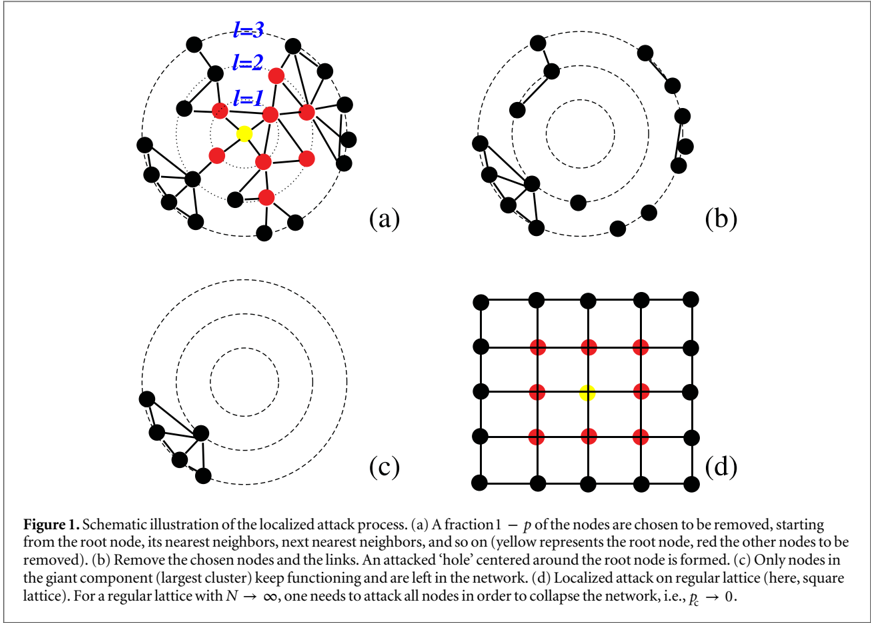
“The process of a localized attack [13] into two stages: (i) at the first stage, we remove all the nodes belonging to the attacked area but keep the links connecting the removed nodes to the remaining nodes; (ii) at the second stage, we remove those links.”
BackgroundInfluentialAbnormal dynamics of cascading edge failures with congestion effect
Wang, J., He, J., Chen, W., & Xu, B. (2018) · International Journal of Modern Physics C · doi:10.1142/s012918311850095x · Cited by 2
Resilience of Urban Infrastructure in Latin American Cities
Alatrista-Salas, H., López, M. G. R., & Núñez-del-Prado, M. (2019) · Advances in logistics, operations, and management science book series · doi:10.4018/978-1-5225-8160-4.ch019 · Cited by 2
Phase Transitions in Collective Damage of Civil Structures under Natural HazardsPreprint
Oh, S., Zhao, J., Rincón, R., Padgett, J. E., & Wang, Z. (2026) · arXiv (Cornell University) · doi:10.48550/arxiv.2602.16195 · Cited by 2
Practical counting of substitutive paths on a planar infrastructure network
Hayashi, Y., & Tanaka, A. (2022) · Scientific Reports · doi:10.1038/s41598-022-18927-w · Cited by 1
Improving network robustness against localized attacks by link modification
Chujyo, M., Liu, S., & Toriumi, F. (2025) · Nonlinear Theory and Its Applications IEICE · doi:10.1587/nolta.16.561 · Cited by 1
Исследование каскадных отказов в системах сетей на основе модели «Дом качества»
ГВОЗДЕВ, В. Е., Bezhaeva, O., Ракипова, А. С., Ракипов, Р. Р., ПРИХОДЬКО, В. Е., & Тепляшин, П. Н. (2025) · Информационные и математические технологии в науке и управлении · doi:10.25729/esi.2025.40.4.001 · Cited by 1
Impact of seed node position on network robustness under localized attacks
Chujyo, M., Liu, S., & Toriumi, F. (2026) · PLoS ONE · doi:10.1371/journal.pone.0358769 · Cited by 1
“To model these dynamics, researchers have investigated localized attacks (LAs) on complex networks, where nodes are sequentially removed based on their topological or spatial proximity to a designated seed node [7, 8, 9, 10].”
InfluentialSystem-Level Assessment of Road Network Vulnerability: A Multi-Disruption Approach with Applications
Mylonas, C., Mitsakis, E., & Kepaptsoglou, K. L. (2026) · Networks and Spatial Economics · doi:10.1007/s11067-025-09720-z · Cited by 1
Attacking Mode Based on Shell Structure of Complex Networks
Dong, G., Hao, H., Du, R., & Tian, L. (2015) · Cited by 1
Universal resilience patterns in cascading load model: More capacity is not always better
Wang, J., Wang, X., Cai, L., Ni, C., Xie, W., & Xu, B. (2017) · International Journal of Modern Physics C · doi:10.1142/s0129183117500413 · Cited by 1
Robustness of the complex networks by statistical physics method
Lin, H. T., Wang, J., Li, X., Wang, H., & Ma, B. (2017) · Chinese Control Conference (CCC) · doi:10.23919/chicc.2017.8028663 · Cited by 1
“In complex networks reaserch field, the study of the percolation has been popular in the last decades [8-12].”
BackgroundImpact of local coupling on the vulnerability of 2D spatially embedded interdependent networks
Dong, Z., Tian, M., & Fang, Y. (2018) · Physics Letters A · doi:10.1016/j.physleta.2018.07.003 · Cited by 1
Optimal resource allocation for network functionality
Patron, A., & Reuven Cohen, C. (2020) · New Journal of Physics · doi:10.1088/1367-2630/ab8e15 · Cited by 1
Bachmann, I., & Bustos-Jiménez, J. (2022) · Lecture notes in computer science · doi:10.1007/978-3-030-97240-0_1 · Cited by 1
Dynamics of node cascading model with source-sink edges
Li, W., Wang, D., Liu, X., Gao, Q., & Wang, J. (2022) · International Journal of Modern Physics C · doi:10.1142/s0129183122501558 · Cited by 1
Dong, G., Sun, Z., Sun, N., & Wang, F. (2022) · Europhysics Letters (EPL) · doi:10.1209/0295-5075/ac8ba1 · Cited by 2
Transport collapse in dynamically evolving networks
Berthelot, G., Tupikina, L., Kang, M., Dedecker, J., & Grebenkov, D. S. (2023) · Journal of The Royal Society Interface · doi:10.1098/rsif.2022.0906 · Cited by 1
“Other examples include the lung airway tree [10], braided streams [11, 12], social networks [13] and transportation networks for passengers [14, 15, 16, 17].”
BackgroundSpreading of Failures in Interdependent Networks
Shekhtman, L., Danziger, M. M., & Havlin, S. (2023) · Springer eBooks · doi:10.1007/978-3-031-05946-9_20 · Cited by 2
Self-citationAvalanche-size distribution of Cayley tree
Patron, A. (2023) · Scientific Reports · doi:10.1038/s41598-023-38332-1 · Cited by 1
Resilient edge predictive analytics by enhancing local models
Wang, Q., ALFahad, S., Mateo, J., Anagnostopoulos, C. B., & Kolomvatsos, K. (2024) · Open Computer Science · doi:10.1515/comp-2023-0116 · Cited by 1
The recovery strategy of interdependent networks under targeted attacks
Li, L. (2024) · Heliyon · doi:10.1016/j.heliyon.2024.e37774 · Cited by 2
A percolation-based recovery mechanism for bot infected P2P cloud
De, S., Barik, M. S., & Banerjee, I. (2019) · International Conference on Distributed Computing and Networking (ICDCN) · doi:10.1145/3288599.3295597 · Cited by 1
“As infection can spread from a single node of a network and move on to other nodes through connecting edges or links [21], likewise, a recovery procedure can move through the network from one node to another only through the edges or links which connect the nodes.”
BackgroundGeographical interdependent robustness measures in transportation networks
Rueda, D. F., & Fernando, D. (2018) · LA Referencia (Red Federada de Repositorios Institucionales de Publicaciones Científicas) · Cited by 1
A Vulnerability Study on Academic Collaboration Networks Based on Network DynamicsPreprint
Gutiérrez-Fandiño, A., Armengol-Estapé, J., & Villegas, M. (2020) · arXiv (Cornell University) · doi:10.48550/arxiv.2012.11699 · Cited by 1
“[5] analyze how a network evolves in terms of percolation in the context of an attack.”
BackgroundInformation and Self-Organization in Complex Networks
Culbreth, G. T. (2021) · University of North Texas Digital Library (University of North Texas) · doi:10.12794/metadc1873551 · Cited by 1
Shell attack on interdependent networks
Dong, G., Du, R., Hao, H., & Li-xin, T. (2016) · Chinese Control Conference (CCC) · doi:10.1109/chicc.2016.7553249
Percolation and reinforcement on complex networks
Xin, Y. L. (2017) · OpenBU (Boston University)
Research on Cascading Failures in Complex Network
Nan, Y., Hao, Y., Zhang, F., & Zhou, G. Y. (2018) · Lecture notes in computer science · doi:10.1007/978-3-030-00021-9_57
Gong, K., Wu, J.-J., Li, Q., & Zhu, Y. (2018) · arXiv (Cornell University) · doi:10.48550/arxiv.1810.09441
“According to Ref.[14], the interdependent spatially embedded networks have two distinct features: (a) each node in network is only connected to the nodes in their spatial vicinity; (b) the dependence links between the networks are not random but have a certain dependency length r.”
BackgroundMethodInfluentialMeasuring the Resilience of the Transport Infrastructure in Big Cities
Alatrista-Salas, H., Núñez-del-Prado, M., & López, M. G. R. (2018) · IEEE Latin American Conference on Computational Intelligence (LA-CCI) · doi:10.1109/la-cci.2018.8625202
“To study the vulnerability, the network was analyzed after applying the interruption attacks described in [17], [18], [19].”
MethodRobustez de las redes urbanas densamente pobladas en relación con la propagación del tráfico
Alatrista-Salas, H., Núñez-del-Prado, M., & López, M. G. R. (2019) · TECHNO REVIEW International Technology Science and Society Review /Revista Internacional de Tecnología Ciencia y Sociedad · doi:10.37467/gka-revtechno.v8.2042
Assessing Node Criticality in Dynamical Distributed Systems
Faramondi, L., Panzieri, S., Setola, R., & Oliva, G. (2019) · European Control Conference (ECC) · doi:10.23919/ecc.2019.8795856 · Cited by 1
Network Strengthening Against Malicious Attacks
Rong, Q., Zhang, J., Sun, X., & Wandelt, S. (2019) · Studies in computational intelligence · doi:10.1007/978-3-030-36687-2_63
Isolated Zones and Granulation of Complex Network Systems
Polishchuk, O. (2021) · IEEE International Conference on Electronics and Information Technologies (ELIT) · doi:10.1109/elit53502.2021.9501141
“To prevent the spread of such phenomena by the system, the theory of complex networks usually uses methods of percolation theory [6], which consist in sequential removal of a certain part of network nodes and connections until the percolation cluster breaks up into unconnected components, one of which contains a threa…”
Network Robustness Based on Inverse Percolation
Sajadi, F. A. (2021) · Iranian Journal of Science and Technology Transactions A Science · doi:10.1007/s40995-021-01104-5
CloudWall: A Cloud-enabled Resiliency Framework for HealthCare IT Infrastructures
Marsá-Maestre, I., Giménez-Guzmán, J. M., Cruz-Piris, L., Fernández, S., Martínez-Herráiz, J.-J., Alarcos, B., & Blanco-Chacón, I. (2021) · Colección Jornadas y congresos · doi:10.18239/jornadas_2021.34.32
Li, C., Yang, Z., & Liu, Z. (2021) · Lecture notes in electrical engineering · doi:10.1007/978-981-16-5429-9_13
A bottom-up simulation on competition of online interpersonal communication platforms
Fu, T., & Zou, L. (2022) · Journal of Economic Interaction and Coordination · doi:10.1007/s11403-022-00351-y
“In this regard, at time step Ti , Platform 2’s initial adopter selection strategy was switched fromrandomselectiontoselectingnodeswiththehighestdegreesorlocalizeddiffusion (Shaoetal.2015).”
BackgroundAnálisis de influencia y robustez en redes sociales multiplex
Montes-Orozco, E. (2022) · doi:10.24275/uami.df65v804p
Scenario-based infrastructure resilience analyses: challenges and opportunities
Poulin, C. (2021) · Digital Repository Service (Northeastern University) · doi:10.17760/d20416788 · Cited by 2
Resilience of finite clusters of carbon flux network under localized attack
Qing, T., Wang, F., Du, R., Dong, G., & Tian, L. (2024) · Chaos An Interdisciplinary Journal of Nonlinear Science · doi:10.1063/5.0206900
Hybrid spatial network disintegration strategy considering geographic and topological information
Ran, L., Wu, G., & Luo, Q. (2024) · Journal of Complex Networks · doi:10.1093/comnet/cnae025
Comparing the effectiveness of ring and block-vaccination strategies on networks
Scianna, M., Gallotti, R., Tizzoni, M., Artime, O., & Alvarez-Zuzek, L. G. (2025) · PLoS Computational Biology · doi:10.1371/journal.pcbi.1013274 · Cited by 1
“For the block vaccination case, we generalize the work of Shai and coauthors [41], where it is introduced a localized percolation strategy that removes (in our case, vaccinates) concentric neighborhoods of increasing distance around a root node.”
InfluentialA network modeling and analysis approach for post-disaster hospital systems: a case study of Beijing
Zhao, Y. (2025) · Network Modeling Analysis in Health Informatics and Bioinformatics · doi:10.1007/s13721-025-00634-x
“Therefore, the size of the largest component is an important indicator to represent system navigability in facing failures (Gao et al. 2016; Shao et al. 2015).”
Defending core-periphery structure in networks against multiple localized attacks
Yang, B., Zuo, Y., Lyu, H., Pei, Z., Lin, W., & Jiang, L. (2026) · International Journal of Modern Physics C · doi:10.1142/s0129183127500677
On the robustness of self-healing multipartite networks
Yang, B., Guo, C., Xiaoming Hu, A., Pei, Z., Hong, S., & Lyu, H. (2026) · International Journal of Modern Physics C · doi:10.1142/s0129183127500987
Epidemic spreading on multilayer networks with asymmetric layer-preferential coupling
Xiong, X., Zhu, F., Mingyu, L., & Yin, X. (2026) · Physica A Statistical Mechanics and its Applications · doi:10.1016/j.physa.2026.131952
Shibah, S. R. M. (2026) · SSRN Electronic Journal · doi:10.2139/ssrn.7382958
Metadata
- Authors
- Shao, S., Huang, X., Stanley, H. E., & Havlin, S.
- Affiliations
- Boston University (US)
- Corresponding author
- Shao, Shuai
- Venue
- New Journal of Physics
- Publisher
- IOP Publishing
- Published
- 2015-02-18
- Volume
- 17
- Issue
- 2
- Pages
- 023049
- ISSN
- 1367-2630 (ISSN-L)
- OpenAlex
- W1979169856
- Semantic Scholar
- 8da1b8bb89b94c6b2705067f967adc3aef894ab3
- Cited by
- 182
- References
- 36
- Citations by year
- 2026: 5 · 2025: 12 · 2024: 13 · 2023: 13 · 2022: 15 · 2021: 22 · 2020: 15 · 2019: 27 · 2018: 22 · 2017: 18 · 2016: 14 · 2015: 6
- FWCI
- 12.61
- Type
- journal article
- Language
- en
- Open access
- gold
- doi.org
- Licence
- cc-by
- iopscience.iop.org/info/page/text-and-data-mining (tdm)
- creativecommons.org/licenses/by/3.0/ (vor)
- Locations
- New Journal of Physics (publishedVersion, cc-by)
- arXiv (Cornell University) (submittedVersion)
- DOAJ (DOAJ: Directory of Open Access Journals) (submittedVersion)
- arXiv (Cornell University)
- Funders
- Defense Threat Reduction Agency: (HDTRA-1-09-1-0035, HDTRA-1-10-1-0014)
- Israel Science Foundation
- EUROPEAN MULTIPLEX, CONGAS and LINC projects, DFG, the Next Generation Infrastructure (Bsik)
- European Union: (FOC program)
- Directorate for Biological Sciences: (CMM1 1125290)
- Office of Naval Research: (N00014-09-1-0380, N00014-12-1-0548, N62909-14-1-N019)
- Topics
- Physical Sciences › Physics and Astronomy › Statistical and Nonlinear Physics › Complex Network Analysis Techniques
- Physical Sciences › Engineering › Civil and Structural Engineering › Infrastructure Resilience and Vulnerability Analysis
- Social Sciences › Economics, Econometrics and Finance › Economics and Econometrics › Complex Systems and Time Series Analysis
- Keywords
- localized attacks, complex networks, network robustness, percolation, node failure, Erdős-Rényi random graphs, random regular networks, scale-free networks, network protection, cybersecurity
About these checks
Registry, retraction, Cites and statistics results are computed, not judged, with one exception: a printed reference that no index lists is read once by a model before it counts as a citation error. Claims are extracted by a model and kept only when their quote appears verbatim in the text; each cited source is then checked, with a model’s help, for whether it says what the claim relies on. Those verdicts can be wrong — read the claim’s quote and the cited source before relying on one.
Statistics and arithmetic are recomputed, not judged.
Confidence bands are shown only for fields calibrated on our annotated test set. None is calibrated yet, so no band is shown.
What counts as a claim ›How we measure confidence ›How we check this ›
Are you an author, or do you see a problem with this page? Request a review
Data sources
Bibliographic data: Semantic Scholar, OpenAlex, Crossref.
Contains information from the Semantic Scholar Academic Graph Datasets, made available under the ODC Attribution License (ODC-BY 1.0).
Semantic Scholar’s data is described in: Kinney, R., et al. (2023). The Semantic Scholar Open Data Platform. arXiv:2301.10140.
