

Percolation of localized attack on complex networks
Open accessThe DOI matches its Crossref record; 36 of the 36 references it cites were found in a registry or an index.
Abstract
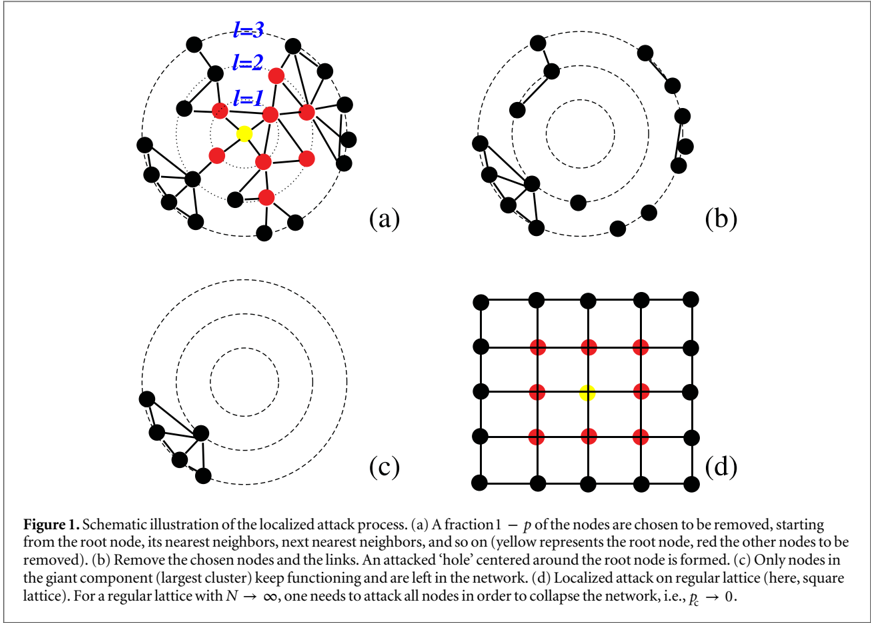
The robustness of complex networks against node failure and malicious attack has been of interest for decades, while most of the research has focused on random attack or hub-targeted attack. In many real-world scenarios, however, attacks are neither random nor hub-targeted, but localized, where a group of neighboring nodes in a network are attacked and fail. In this paper we develop a percolation framework to analytically and numerically study the robustness of complex networks against such localized attack. In particular, we investigate this robustness in Erdős–Rényi networks, random-regular networks, and scale-free networks. Our results provide insight into how to better protect networks, enhance cybersecurity, and facilitate the design of more robust infrastructures.
Overview
The claims and statistics of this paper haven’t been checked yet.
Free: it reads the open-access text and checks the first 5 claims that cite a source we can check. Create a free account to check every claim.
Integrity signals
Registry
Cites
Statistics
Figures
Verification
Claims the paper makes
The claims and statistics of this paper haven’t been checked yet.
Free: it reads the open-access text and checks the first 5 claims that cite a source we can check. Create a free account to check every claim.
Claims other papers make about this one
Each is checked against this paper’s own text: does it say what the citing paper says it does?
The check wasn’t confident either way, so it gives no verdict — never disputed.
In the citing paper
“under the fractional threshold failure mechanism scale-free networks are more vulnerable compared to their ER counterparts with the same average degree39.”
From Mitigation of cascading failures in complex networks (2020) · cites this paper as [39]
Experimental — accuracy not yet measured
Self-check
Percentages, sums and reported differences re-computed from the paper’s own numbers.
The self-check needs the paper’s full text.
Citations
Cites
Statistical mechanics of complex networks
Albert, R., & Barabási, A.-L. (2002) · Reviews of Modern Physics · doi:10.1103/revmodphys.74.47 · Cited by 20,471
Error and attack tolerance of complex networks
Albert, R., Jeong, H., & Barabási, A.-L. (2000) · Nature · doi:10.1038/35019019 · Cited by 7,534
Introduction to Percolation Theory
Stauffer, D., Aharony, A., & Redner, S. (1993) · Physics Today · doi:10.1063/1.2808877 · Cited by 6,666
Newman, M. (2010) · doi:10.1093/acprof:oso/9780199206650.001.0001 · Cited by 6,595
Error and attack tolerance of complex networks
Albert, R., Jeong, H., & Barabási, A.-Ĺ. (2000) · RePEc: Research Papers in Economics · Cited by 6,460
Bollobás, B. (1985) · Cited by 6,196
Catastrophic cascade of failures in interdependent networks
Buldyrev, S. V., Parshani, R., Paul, G., Stanley, H. E., & Havlin, S. (2010) · Nature · doi:10.1038/nature08932 · Cited by 4,513
Self-citationRandom graphs with arbitrary degree distributions and their applications
Newman, M. E. J., Strogatz, S. H., & Watts, D. J. (2001) · Physical Review E · doi:10.1103/physreve.64.026118 · Cited by 3,648
Spread of epidemic disease on networks
Newman, M. E. J. (2002) · Physical Review E · doi:10.1103/physreve.66.016128 · Cited by 3,218
(2011) · Choice Reviews Online · doi:10.5860/choice.48-3328 · Cited by 2,736
Research works printed but not linked: 2
- 2. Albert R, Jeong H and Barabási A L 2000 Nature 406 378 · DOI · Paper page
- 26. Neumayer S, Zussman G, Cohen R and Modiano E 2009 INFOCOM IEEE 1566-74 · doi:10.1109/infocom.2009.5062074
Cited by
Challenges in the vulnerability and risk analysis of critical infrastructures
Zio, E. (2016) · Reliability Engineering & System Safety · doi:10.1016/j.ress.2016.02.009 · Cited by 429
Percolation on complex networks: Theory and application
Li, M., Liu, R.-R., Lü, L., Hu, M.-B., Xu, S., & Zhang, Y.-C. (2021) · Physics Reports · doi:10.1016/j.physrep.2020.12.003 · Cited by 365
Local floods induce large-scale abrupt failures of road networks
Wang, W., Yang, S., Stanley, H. E., & Gao, J. (2019) · Nature Communications · doi:10.1038/s41467-019-10063-w · Cited by 199
Localized attacks on spatially embedded networks with dependencies
Berezin, Y., Bashan, A., Danziger, M. M., Li, D., & Havlin, S. (2015) · Scientific Reports · doi:10.1038/srep08934 · Cited by 189
Self-citationDong, S., Esmalian, A., Farahmand, H., & Mostafavi, A. (2020) · Computers, Environment and Urban Systems · doi:10.1016/j.compenvurbsys.2019.101443 · Cited by 198
Yin, K., Wu, J., Wang, W., Lee, D., & Wei, Y. (2023) · Transportation Research Part A Policy and Practice · doi:10.1016/j.tra.2023.103687 · Cited by 155
Subgraph Robustness of Complex Networks Under Attacks
Shang, Y. (2017) · IEEE Transactions on Systems Man and Cybernetics Systems · doi:10.1109/tsmc.2017.2733545 · Cited by 133
“The generating function of the degree distribution of the remaining nodes in US can be derived as [40] ˜ G 0 , p where 1 ) .”
BackgroundInfluentialRecent Progress on the Resilience of Complex Networks
Gao, J., Liu, X., Li, D., & Havlin, S. (2015) · Energies · doi:10.3390/en81012187 · Cited by 130
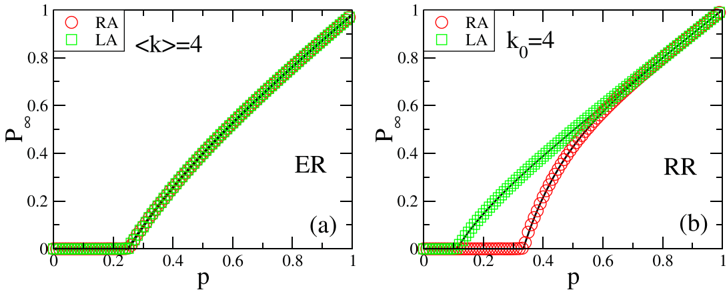
“Note that for non-embedded networks, the effect of local failures on different networks is different when compared to random failures [102]: the effects of local failures and random failures on an ER network are identical; an RR network is more robust under local failures compared to random…”
BackgroundSelf-citationRecent advances on failure and recovery in networks of networks
Shekhtman, L., Danziger, M. M., & Havlin, S. (2016) · Chaos Solitons & Fractals · doi:10.1016/j.chaos.2016.02.002 · Cited by 112
Self-citationRecovery of infrastructure networks after localised attacks
Hu, F., Yeung, C. H., Yang, S., Wang, W., & Zeng, A. (2016) · Scientific Reports · doi:10.1038/srep24522 · Cited by 118
Modest flooding can trigger catastrophic road network collapse due to compound failure
Dong, S., Gao, X., Mostafavi, A., & Gao, J. (2022) · Communications Earth & Environment · doi:10.1038/s43247-022-00366-0 · Cited by 102
Dong, S., Wang, H., Mostafavi, A., & Gao, J. (2019) · Journal of The Royal Society Interface · doi:10.1098/rsif.2019.0149 · Cited by 84
Yuan, X., Shao, S., Stanley, E., & Havlin, S. (2015) · Physical Review E · doi:10.1103/physreve.92.032122 · Cited by 83
Self-citationOn connectivity of post-earthquake road networks
Zhou, Y., Wang, J., & Sheu, J. (2019) · Transportation Research Part E Logistics and Transportation Review · doi:10.1016/j.tre.2019.01.009 · Cited by 78
Liu, R.-R., Eisenberg, D. A., Seager, T. P., & Lai, Y. (2018) · Scientific Reports · doi:10.1038/s41598-018-20019-7 · Cited by 75
Ouyang, M., Tian, H., Wang, Z., Liu, H., & Mao, Z. (2017) · Risk Analysis · doi:10.1111/risa.12708 · Cited by 72
“,(35) the system is less vulnerable to TLFs than RFs, but the system is more vulnerable to TLFs than SLFs.”
BackgroundInfluentialk -core percolation on complex networks: Comparing random, localized, and targeted attacks
Yuan, X., Dai, Y., Stanley, E., & Havlin, S. (2016) · Physical review. E · doi:10.1103/physreve.93.062302 · Cited by 73
Self-citationMitigation of cascading failures in complex networks
Smolyak, A., Levy, O., Vodenska, I., Buldyrev, S., & Havlin, S. (2020) · Scientific Reports · doi:10.1038/s41598-020-72771-4 · Cited by 67
Self-citationThe interdependent network of gene regulation and metabolism is robust where it needs to be
Klosik, D. F., Grimbs, A., Bornholdt, S., & Hütt, M. ‐. (2017) · Nature Communications · doi:10.1038/s41467-017-00587-4 · Cited by 69
An approach for cascading effects within critical infrastructure systems
Wang, W., Yang, S., Hu, F., Stanley, E., He, S., & Shi, M. (2018) · Physica A Statistical Mechanics and its Applications · doi:10.1016/j.physa.2018.06.129 · Cited by 72
“Although numerous models for studying the robustness and vulnerability of CI networks have been proposed [15,20,40, 41], we still have no integrated approach that considers multiple factors including types of attack, network dependencies, and types of cascading effects.”
BackgroundMethodInfluentialLocalized recovery of complex networks against failure
Shang, Y. (2016) · Scientific Reports · doi:10.1038/srep30521 · Cited by 66
“It is worth mentioning that a balance phenomenon for ER networks under random and localized attacks has been observed recently by Shao et al. 26 .”
BackgroundMethodResilience of networks formed of interdependent modular networks
Shekhtman, L., Shai, S., & Havlin, S. (2015) · New Journal of Physics · doi:10.1088/1367-2630/17/12/123007 · Cited by 65
“Further studies have also exploredmore realistic structures such as spatially embedded networks [35–40], and different types of realistic failures such as response under degree-based attacks [41, 42] and localized attacks [26, 39].”
BackgroundSelf-citationSpreading of localized attacks in spatial multiplex networks
Vaknin, D., Danziger, M. M., & Havlin, S. (2017) · New Journal of Physics · doi:10.1088/1367-2630/aa7b09 · Cited by 62
“It has also been shown that localized attacks (formed by shells surrounding a root node) in Erdős–Rényi multiplex networks have the same percolation threshold as random attacks [40, 41].”
BackgroundSelf-citationA literature review on network reliability analysis and its engineering applications
Gaur, V., Yadav, O. P., Soni, G., & Rathore, A. P. S. (2020) · Proceedings of the Institution of Mechanical Engineers Part O Journal of Risk and Reliability · doi:10.1177/1748006x20962258 · Cited by 59
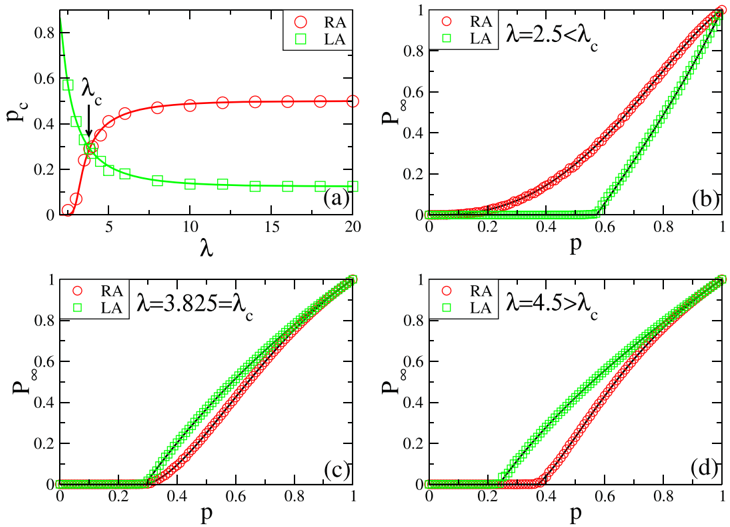
“Shao et al.(64) applied percolation to study the effects of localized attacks on the networks with a varying degree distribution.”
BackgroundDong, S., Malecha, M. L., Farahmand, H., Mostafavi, A., Berke, P. R., & Woodruff, S. (2021) · Cities · doi:10.1016/j.cities.2021.103318 · Cited by 60
Finding critical nodes in infrastructure networks
Faramondi, L., Setola, R., Panzieri, S., Pascucci, F., & Oliva, G. (2017) · International Journal of Critical Infrastructure Protection · doi:10.1016/j.ijcip.2017.11.004 · Cited by 47
A method of network robustness under strategic goals for project portfolio selection
Bai, L., Han, X., Wang, H., Zhang, K., & Sun, Y. (2021) · Computers & Industrial Engineering · doi:10.1016/j.cie.2021.107658 · Cited by 50
Robustness analysis of interdependent networks under multiple-attacking strategies
Gao, Y., Chen, S., Nie, S., Ma, F., & Guan, J. (2017) · Physica A Statistical Mechanics and its Applications · doi:10.1016/j.physa.2017.12.085 · Cited by 45
Robustness Evaluation of Multipartite Complex Networks Based on Percolation Theory
Cai, Q., Alam, S., Pratama, M., & Liu, J. (2020) · IEEE Transactions on Systems Man and Cybernetics Systems · doi:10.1109/tsmc.2019.2960156 · Cited by 43
“Existing studies on network robustness can be roughly cat-egorised into two branches, i.e., empirical studies [11]–[13] and theoretical studies [14]–[17].”
BackgroundVulnerability of Interdependent Networks and Networks of Networks
Danziger, M. M., Shekhtman, L., Bashan, A., Berezin, Y., & Havlin, S. (2016) · Understanding complex systems · doi:10.1007/978-3-319-23947-7_5 · Cited by 44
“[86].”
Self-citationNetwork Structural Vulnerability: A Multiobjective Attacker Perspective
Faramondi, L., Oliva, G., Panzieri, S., Pascucci, F., Schlueter, M., Munetomo, M., & Setola, R. (2018) · IEEE Transactions on Systems Man and Cybernetics Systems · doi:10.1109/tsmc.2018.2790438 · Cited by 41
Effective Quarantine and Recovery Scheme Against Advanced Persistent Threat
Yang, L., Li, P., Yang, X., Xiang, Y., Jiang, F., & Zhou, W. (2019) · IEEE Transactions on Systems Man and Cybernetics Systems · doi:10.1109/tsmc.2019.2956860 · Cited by 34
“Last, since percolation theory can be used to assess the robustness and resilience of networks [53]–[55], it may be feasible to build an integrated APT defense system by combining percolation theory with optimal control theory.”
MethodEfficiency of complex networks under failures and attacks: A percolation approach
Zhou, Y., & Wang, J. (2018) · Physica A Statistical Mechanics and its Applications · doi:10.1016/j.physa.2018.08.093 · Cited by 33
Cascading failures in coupled networks with both inner-dependency and inter-dependency links
Liu, R.-R., Li, M., Jia, C.-X., & Wang, B.-H. (2016) · Scientific Reports · doi:10.1038/srep25294 · Cited by 34
Distance distribution in configuration-model networks
Nitzan, M., Katzav, E., Kühn, R., & Biham, O. (2016) · Physical review. E · doi:10.1103/physreve.93.062309 · Cited by 34
Abnormal cascading failure spreading on complex networks
Wang, J., Sun, E., Xu, B., Li, P., & Ni, C. (2016) · Chaos Solitons & Fractals · doi:10.1016/j.chaos.2016.08.007 · Cited by 31
GraphChallenge.org: Raising the Bar on Graph Analytic Performance
Samsi, S., Gadepally, V. N., Hurley, M. B., Jones, M. P., Kao, E. K., Mohindra, S., Monticciolo, P., Reuther, A., Smith, S. T., Song, W., et al. (2018) · IEEE High Performance Extreme Computing Conference · doi:10.1109/hpec.2018.8547527 · Cited by 29
“networks [8]–[11], social media [12], [13], cybersecurity [14], [15], and sparse machine learning [16]–[20].”
BackgroundFalse Positive and False Negative Effects on Network Attacks
Shang, Y. (2017) · Journal of Statistical Physics · doi:10.1007/s10955-017-1923-7 · Cited by 30
“6 The similar phenomenon in the special case of q = 1 and α = 0 was observed in [18].”
BackgroundInfluentialOptimization of the post-crisis recovery plans in scale-free networks
Bahrami, M., Chinichian, N., Hosseiny, A., Jafari, G., & Ausloos, M. (2019) · Physica A Statistical Mechanics and its Applications · doi:10.1016/j.physa.2019.123203 · Cited by 27
“There are several known ways to produce scale-free networks [21, 25, 26, 27, 28].”
BackgroundAttack robustness and stability of generalized k-cores
Shang, Y. (2019) · New Journal of Physics · doi:10.1088/1367-2630/ab3d7c · Cited by 29
Assessing the vulnerability of infrastructure networks based on distribution measures
Galvan, G., & Agarwal, J. (2019) · Reliability Engineering & System Safety · doi:10.1016/j.ress.2019.106743 · Cited by 28
“More recently, the percolation of coupled networks has been studied (19), in order to understand the behaviour of interdependent networks, as well as the percolation of spatial networks (20), which model more closely real world infrastructure networks.”
BackgroundDistribution of shortest path lengths in subcritical Erdős-Rényi networks
Katzav, E., Biham, O., & Hartmann, A. K. (2018) · Physical review. E · doi:10.1103/physreve.98.012301 · Cited by 31
“In the context of network attacks, the DSPL describes a generic class of violent local attacks, which spreads throughout the network [30].”
BackgroundMoore, T. J., & Cho, J.-H. (2018) · Springer eBooks · doi:10.1007/978-3-319-77492-3_6 · Cited by 26
Role of topology in complex functional networks of beta cells
Cherubini, C., Filippi, S., Gizzi, A., & Loppini, A. (2015) · Physical Review E · doi:10.1103/physreve.92.042702 · Cited by 28
Robustness of partially interdependent networks under combined attack
Liu, Y., Zhao, C., Yi, D., & Stanley, E. (2019) · Chaos An Interdisciplinary Journal of Nonlinear Science · doi:10.1063/1.5085850 · Cited by 25
Remote control of cascading dynamics on complex multilayer networks
Liu, R.-R., Jia, C.-X., & Lai, Y.-C. (2019) · New Journal of Physics · doi:10.1088/1367-2630/ab0e1a · Cited by 24
Overview of precaution and recovery strategies for cascading failures in multilayer networks
Jiang, W., Liu, R.-R., Fan, T.-L., Liu, S., & Lü, L. (2020) · Acta Physica Sinica · doi:10.7498/aps.69.20192000 · Cited by 24
Modeling of risk cascading propagation in project portfolio network
Zhang, K., Bai, L., Xie, X., & Wang, C. (2023) · Physica A Statistical Mechanics and its Applications · doi:10.1016/j.physa.2023.128450 · Cited by 25
The distribution of path lengths of self avoiding walks on Erdős–Rényi networks
Tishby, I., Biham, O., & Katzav, E. (2016) · Journal of Physics A Mathematical and Theoretical · doi:10.1088/1751-8113/49/28/285002 · Cited by 31
Abrupt transition due to non-local cascade propagation in multiplex systems
Artime, O., & Domenico, M. D. (2020) · New Journal of Physics · doi:10.1088/1367-2630/abaf6b · Cited by 22
Nucleation phenomena and extreme vulnerability of spatial k-core systems
Xue, L., Gao, S., Gallos, L. K., Levy, O., Gross, B., Di, Z., & Havlin, S. (2024) · Nature Communications · doi:10.1038/s41467-024-50273-5 · Cited by 26
“The system in this phase behaves in marked contrast to regular percolation, where the network in the regime above p c always remains connected and cannot collapse by any localized attacks 36 .”
Self-citationPercolation of hierarchical networks and networks of networks
Shekhtman, L., & Havlin, S. (2018) · Physical review. E · doi:10.1103/physreve.98.052305 · Cited by 21
Self-citationInterdependency and Vulnerability of Multipartite Networks under Target Node Attacks
Cai, Q., Pratama, M., & Alam, S. (2019) · Complexity · doi:10.1155/2019/2680972 · Cited by 21
Resilience patterns of urban road networks under the worst‐case localized disruptions
Du, C., Ouyang, M., Zhang, H., Wang, B., & Wang, N. (2023) · Risk Analysis · doi:10.1111/risa.14236 · Cited by 18
“Moreover, the resilience of URNs is shaped by their structural characteristics (Shao et al., 2015).”
Localized attack on networks with clustering
Dong, G., Xiao, H., Wang, F., Du, R., Shao, S., Tian, L., Stanley, E., & Havlin, S. (2019) · New Journal of Physics · doi:10.1088/1367-2630/aaf773 · Cited by 18
“The distribution of nodes with s single links and t triangles in the remaining network is [35, 38]”
BackgroundInfluentialSelf-citationUncertainty in vulnerability of networks under attack
Ermagun, A., Tajik, N., & Mahmassani, H. S. (2023) · Scientific Reports · doi:10.1038/s41598-023-29899-w · Cited by 17
Effects of mobility restrictions during COVID19 in Italy
Smolyak, A., Bonaccorsi, G., Flori, A., Pammolli, F., & Havlin, S. (2021) · Scientific Reports · doi:10.1038/s41598-021-01076-x · Cited by 21
Self-citationDesign, Generation, and Validation of Extreme Scale Power-Law Graphs
Kepner, J., Samsi, S., Arcand, W., Bestor, D., Bergeron, B., Davis, T., Gadepally, V. N., Houle, M., Hubbell, M., Jananthan, H., et al. (2018) · IEEE International Symposium on Parallel & Distributed Processing, Workshops and Phd Forum · doi:10.1109/ipdpsw.2018.00055 · Cited by 16
“Specific domains where such graphs are important include genomics [5]–[10], brain mapping [11], computer networks [12]–[15], social media [16], [17], cybersecurity [18], [19], and sparse machine learning [20]–[24].”
BackgroundDong, Z., Tian, M., Liang, J., Fang, Y., & Lu, Y. (2018) · Physica A Statistical Mechanics and its Applications · doi:10.1016/j.physa.2018.09.007 · Cited by 17
Feasibility study of PRA for critical infrastructure risk analysis
Johnson, C. A., Flage, R., & Guikema, S. D. (2021) · Reliability Engineering & System Safety · doi:10.1016/j.ress.2021.107643 · Cited by 16
Searching High-value Edges Attack sequence through deep Reinforcement learning
Chen, L., Wang, L., Zeng, C., Liu, H., & Chen, J. (2023) · Knowledge-Based Systems · doi:10.1016/j.knosys.2023.110562 · Cited by 17
Percolation thresholds for robust network connectivity
Mohseni-Kabir, A., Pant, M., Towsley, D., Guha, S., & Swami, A. (2021) · Journal of Statistical Mechanics Theory and Experiment · doi:10.1088/1742-5468/abd312 · Cited by 18
“…looking at the size of the largest connected component (LCC), i.e., the largest set of nodes of which each pair is connected by at least one path, as a function of a probability or a rate parameter that controls either random [11], localized [39, 6], or targeted [13, 22] node and/or edge removals.”
Geng, H., Cao, M., Guo, C., Peng, C., Du, S., & Yuan, J. (2021) · Physical review. E · doi:10.1103/physreve.103.022313 · Cited by 16
Modified localized attack on complex network
Dong, G., Du, R., Hao, H., & Tian, L. (2016) · Europhysics Letters (EPL) · doi:10.1209/0295-5075/113/28002 · Cited by 15
Spreading of localized attacks on spatial multiplex networks with a community structure
Vaknin, D., Gross, B., Buldyrev, S. V., & Havlin, S. (2020) · Physical Review Research · doi:10.1103/physrevresearch.2.043005 · Cited by 15
“Recent studies show that in different cases of spatial interdependent networks, localized attacks are significantly more damaging than random attacks [8–11].”
BackgroundSelf-citationRobustness of spatial networks and networks of networks
Shekhtman, L., Danziger, M. M., Porath, D. B., & Havlin, S. (2018) · Comptes Rendus Physique · doi:10.1016/j.crhy.2018.09.005 · Cited by 18
Self-citationImproving the robustness of scale-free networks by maintaining community structure
Mozafari, M., & Khansari, M. (2019) · Journal of Complex Networks · doi:10.1093/comnet/cnz009 · Cited by 14
Bachmann, I., Valdés, V., Bustos-Jiménez, J., & Bustos, B. (2021) · International Journal of Critical Infrastructure Protection · doi:10.1016/j.ijcip.2021.100483 · Cited by 14
Resilience assessment of urban bus-metro system to floods under future climate change
Guo, C., Tang, J., Hong, J., Lu, Q., Wu, H., & Wei, R. (2025) · Transportation Research Part D Transport and Environment · doi:10.1016/j.trd.2025.104925 · Cited by 14
Faramondi, L., Oliva, G., Setola, R., Pascucci, F., Amideo, A. E., & Scaparra, M. P. (2017) · Springer proceedings in mathematics & statistics · doi:10.1007/978-3-319-67308-0_32 · Cited by 13
GraphChallenge.org Triangle Counting Performance
Samsi, S., Kepner, J., Gadepally, V. N., Hurley, M. B., Jones, M. P., Kao, E. K., Mohindra, S., Reuther, A., Smith, S. T., Song, W., et al. (2020) · IEEE High Performance Extreme Computing Conference · doi:10.1109/hpec43674.2020.9286166 · Cited by 13
“The importance of graph analysis has dramatically increased and is critical to a wide variety of domains that include the analysis of genomics [1]–[6], brain mapping [7], computer networks [8]–[13], social media [14], [15], cybersecurity [16], [17], and sparse machine learning [18]–[24].”
BackgroundYan, K., Rong, L., & Li, Q. (2017) · Modern Physics Letters B · doi:10.1142/s0217984917500890 · Cited by 13
The epidemiology of lateral movement: exposures and countermeasures with network contagion models
Powell, B. A. (2019) · Journal of Cyber Security Technology · doi:10.1080/23742917.2019.1627702 · Cited by 13
“Contagion models have also been used to study network resiliency [12,13], where an attack causing system failure cascades through the network spreading indiscriminately from infected to susceptible systems.”
Network Adaptations Under Cascading Failures for Mission-Oriented Networks
Moore, T. J., Cho, J.-H., & Chen, I.-R. (2019) · IEEE Transactions on Network and Service Management · doi:10.1109/tnsm.2019.2917934 · Cited by 12
“, an epidemic process that compromises nodes initially in a localized region of the network) in order to obtain a critical percolation threshold [44].”
BackgroundPercolation of attack with tunable limited knowledge
Shang, Y. (2021) · Physical review. E · doi:10.1103/physreve.103.042316 · Cited by 12
Cascading failures in anisotropic interdependent networks of spatial modular structures
Porath, D. B., Bashan, A., Braunstein, L. A., Buldyrev, S. V., & Havlin, S. (2021) · New Journal of Physics · doi:10.1088/1367-2630/ac2e3c · Cited by 13
Self-citationMulti-Universality and Localized Attacks in Spatially Embedded Networks
Gross, B., Porath, D. B., Danziger, M. M., & Havlin, S. (2017) · doi:10.7566/jpscp.16.011002 · Cited by 11
Self-citationStructure of networks that evolve under a combination of growth and contraction
Budnick, B., Biham, O., & Katzav, E. (2022) · Physical review. E · doi:10.1103/physreve.106.044305 · Cited by 14
Cascading failures in interdependent directed networks under localized attacks
Lv, M., Pan, L., & Liu, X. (2023) · Physica A Statistical Mechanics and its Applications · doi:10.1016/j.physa.2023.128761 · Cited by 11
Optimal cost for strengthening or destroying a given network
Patron, A., Reuven Cohen, C., Li, D., & Havlin, S. (2017) · Physical review. E · doi:10.1103/physreve.95.052305 · Cited by 11
Self-citationResearch on the Robustness of Interdependent Networks under Localized Attack
Wang, J., Lao, S., Ruan, Y., Bai, L., & Hou, L. (2017) · Applied Sciences · doi:10.3390/app7060597 · Cited by 13
“This is consistent with the conclusion of [21] that “there is a higher probability that higher degree nodes will be within the attacked hole, which accelerates the fragmentation of the BA network”.”
ResultEfficient Network Dismantling via Node Explosive Percolation*
Qin, S.-M., Ren, X.-L., & Lü, L. (2019) · Communications in Theoretical Physics · doi:10.1088/0253-6102/71/6/764 · Cited by 11
REACT: reactive resilience for critical infrastructures using graph-coloring techniques
Marsá-Maestre, I., Giménez-Guzmán, J. M., Orden, D., de la Hoz, E., & Klein, M. (2019) · Journal of Network and Computer Applications · doi:10.1016/j.jnca.2019.07.003 · Cited by 14
Percolation of interdependent networks with limited knowledge
Shang, Y. (2022) · Physical review. E · doi:10.1103/physreve.105.044305 · Cited by 11
Robustness of non-interdependent and interdependent networks against dependent and adaptive attacks
Tyra, A., Li, J., Shang, Y., Jiang, S., Zhao, Y., & Xu, S. (2017) · Physica A Statistical Mechanics and its Applications · doi:10.1016/j.physa.2017.04.078 · Cited by 10
“Finally, it should be noted that a related attack strategy has been analytically addressed in [8], where the attacker attempts to destroy the neighborhood of a node.”
BackgroundGong, K., Wu, J.-J., Liu, Y., Li, Q., Liu, R.-R., & Tang, M. (2019) · Complexity · doi:10.1155/2019/7912857 · Cited by 9
“Such localized attacks on some networks are significantly more destructive than random failures [22–25], since the failures of several nodes can trigger an avalanche.”
BackgroundHypergraph-based modeling of cascading failures with probabilistic node-to-group interactions
Liu, R.-R., Chu, C., Meng, F., & Jia, C.-X. (2025) · Chaos Solitons & Fractals · doi:10.1016/j.chaos.2025.116050 · Cited by 8
A Distributed, Multi-Agent Approach to Reactive Network Resilience
de la Hoz, E., Giménez-Guzmán, J. M., Marsá-Maestre, I., Cruz-Piris, L., & Orden, D. (2017) · Adaptive Agents and Multi-Agents Systems · doi:10.5555/3091125.3091273 · Cited by 11
Robustness of spontaneous cascading dynamics driven by reachable area
Wang, J., Wang, S., & Wang, Z. (2021) · Physica A Statistical Mechanics and its Applications · doi:10.1016/j.physa.2021.126399 · Cited by 8
Joint Cyber Risk Assessment of Network Systems with Heterogeneous ComponentsPreprint
Da, G., Xu, M., Zhang, J., & Zhao, P. (2020) · arXiv (Cornell University) · doi:10.48550/arxiv.2006.16092 · Cited by 9
“It is interesting to see that the L-hop model can be connected to the L-hop percolation model in the literature of cyber security [18], [19].”
Resilience Assessment of Repair Strategies Against Localized Attacks for Infrastructure Protection
Afrin, T., & Yodo, N. (2019) · Annual Reliability and Maintainability Symposium (RAMS) · doi:10.1109/rams.2019.8769282 · Cited by 7
“described the percolation of localized attack on complex networks [4].”
BackgroundIdentification of Influential Nodes in Industrial Networks Based on Structure Analysis
Wang, T., Zeng, P., Zhao, J., Liu, X., & Zhang, B. (2022) · Symmetry · doi:10.3390/sym14020211 · Cited by 8
Percolation in Spatial Networks: Spatial Network Models Beyond Nearest Neighbours Structures
Gross, B., & Havlin, S. (2022) · Cambridge University Press eBooks · doi:10.1017/9781009168076 · Cited by 11
Self-citationPercolation behaviors of finite components on complex networks
Wang, F., Dong, G., Tian, L., & Stanley, E. (2022) · New Journal of Physics · doi:10.1088/1367-2630/ac5f86 · Cited by 7
“The π 1 is Derivative of π 1 is As d π 1 d p = 0, one can obtain k P ( k ) k ( k − 1) f k − 2 = G 0 ( f ), which is same with the critical point determined by GC [21], as shown in figure 5(d).”
BackgroundMethodInfluentialPipeline network robustness analysis with complex network theory
Feng, D., Zhang, H., Zhang, W., Xie, H., Zhang, Y., & Song, X. (2025) · Journal of Pipeline Science and Engineering · doi:10.1016/j.jpse.2025.100420 · Cited by 6
Phase transition behavior of finite clusters under localized attack
Qing, T., Dong, G., Wang, F., Du, R., & Tian, L. (2022) · Chaos An Interdisciplinary Journal of Nonlinear Science · doi:10.1063/5.0079489 · Cited by 6
Node and edge centrality based failures in multi-layer complex networks
Das, D., Bapat, J. L., & Das, D. (2024) · Journal of Computational Science · doi:10.1016/j.jocs.2024.102396 · Cited by 6
Identifying localized influential spreaders of information spreading
Liu, X., Zhu, X., Tian, H., Zhang, Z., & Wang, W. (2018) · Physica A Statistical Mechanics and its Applications · doi:10.1016/j.physa.2018.11.045 · Cited by 6
Dynamical Recovery of Complex Networks under a Localised Attack
Wang, F., Dong, G., & Tian, L. (2021) · Algorithms · doi:10.3390/a14090274 · Cited by 6
“This phenomena can also be found in a single static ER network [22].”
BackgroundResultInfluentialMULTI-HOP GENERALIZED CORE PERCOLATION ON COMPLEX NETWORKS
Shang, Y. (2020) · Advances in Complex Systems · doi:10.1142/s0219525920500010 · Cited by 6
“Moreover, a proximity-based percolation strategy on single networks, referred to as localized attack, characterizes how a network dismantles starting from a seed node, its nearest neighbors, and next nearest neighbors, and so on [15–17].”
Metadata
- Authors
- Shao, S., Huang, X., Stanley, H. E., & Havlin, S.
- Affiliations
- Boston University (US)
- Corresponding author
- Shao, Shuai
- Venue
- New Journal of Physics
- Publisher
- IOP Publishing
- Published
- 2015-02-18
- Volume
- 17
- Issue
- 2
- Pages
- 023049
- ISSN
- 1367-2630 (ISSN-L)
- OpenAlex
- W1979169856
- Semantic Scholar
- 8da1b8bb89b94c6b2705067f967adc3aef894ab3
- Cited by
- 182
- References
- 36
- Citations by year
- 2026: 5 · 2025: 12 · 2024: 13 · 2023: 13 · 2022: 15 · 2021: 22 · 2020: 15 · 2019: 27 · 2018: 22 · 2017: 18 · 2016: 14 · 2015: 6
- FWCI
- 12.61
- Type
- journal article
- Language
- en
- Open access
- gold
- doi.org
- Licence
- cc-by
- iopscience.iop.org/info/page/text-and-data-mining (tdm)
- creativecommons.org/licenses/by/3.0/ (vor)
- Locations
- New Journal of Physics (publishedVersion, cc-by)
- arXiv (Cornell University) (submittedVersion)
- DOAJ (DOAJ: Directory of Open Access Journals) (submittedVersion)
- arXiv (Cornell University)
- Funders
- Defense Threat Reduction Agency: (HDTRA-1-09-1-0035, HDTRA-1-10-1-0014)
- Israel Science Foundation
- EUROPEAN MULTIPLEX, CONGAS and LINC projects, DFG, the Next Generation Infrastructure (Bsik)
- European Union: (FOC program)
- Directorate for Biological Sciences: (CMM1 1125290)
- Office of Naval Research: (N00014-09-1-0380, N00014-12-1-0548, N62909-14-1-N019)
- Topics
- Physical Sciences › Physics and Astronomy › Statistical and Nonlinear Physics › Complex Network Analysis Techniques
- Physical Sciences › Engineering › Civil and Structural Engineering › Infrastructure Resilience and Vulnerability Analysis
- Social Sciences › Economics, Econometrics and Finance › Economics and Econometrics › Complex Systems and Time Series Analysis
- Keywords
- localized attacks, complex networks, network robustness, percolation, node failure, Erdős-Rényi random graphs, random regular networks, scale-free networks, network protection, cybersecurity
About these checks
Registry, retraction, Cites and statistics results are computed, not judged, with one exception: a printed reference that no index lists is read once by a model before it counts as a citation error. Claims are extracted by a model and kept only when their quote appears verbatim in the text; each cited source is then checked, with a model’s help, for whether it says what the claim relies on. Those verdicts can be wrong — read the claim’s quote and the cited source before relying on one.
Statistics and arithmetic are recomputed, not judged.
Confidence bands are shown only for fields calibrated on our annotated test set. None is calibrated yet, so no band is shown.
What counts as a claim ›How we measure confidence ›How we check this ›
Are you an author, or do you see a problem with this page? Request a review
Data sources
Bibliographic data: Semantic Scholar, OpenAlex, Crossref.
Contains information from the Semantic Scholar Academic Graph Datasets, made available under the ODC Attribution License (ODC-BY 1.0).
Semantic Scholar’s data is described in: Kinney, R., et al. (2023). The Semantic Scholar Open Data Platform. arXiv:2301.10140.
