

Exponentially more precise quantum simulation of fermions in second quantization
Open accessThe DOI matches its Crossref record; 47 of the 49 references it cites were found in a registry or an index.
Abstract
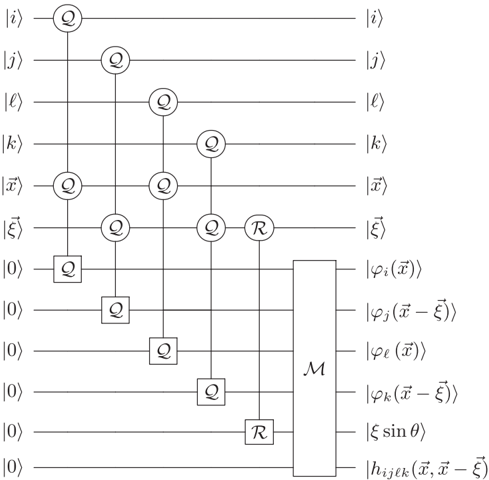
We introduce novel algorithms for the quantum simulation of fermionic systems which are dramatically more efficient than those based on the Lie–Trotter–Suzuki decomposition. We present the first application of a general technique for simulating Hamiltonian evolution using a truncated Taylor series to obtain logarithmic scaling with the inverse of the desired precision. The key difficulty in applying algorithms for general sparse Hamiltonian simulation to fermionic simulation is that a query, corresponding to computation of an entry of the Hamiltonian, is costly to compute. This means that the gate complexity would be much higher than quantified by the query complexity. We solve this problem with a novel quantum algorithm for on-the-fly computation of integrals that is exponentially faster than classical sampling. While the approaches presented here are readily applicable to a wide class of fermionic models, we focus on quantum chemistry simulation in second quantization, perhaps the most studied application of Hamiltonian simulation. Our central result is an algorithm for simulating an N spin–orbital system that requires O ~ ( N 5 t ) gates. This approach is exponentially faster in the inverse precision and at least cubically faster in N than all previous approaches to chemistry simulation in the literature.
Overview
The claims and statistics of this paper haven’t been checked yet.
Free: it reads the open-access text and checks the first 5 claims that cite a source we can check. Create a free account to check every claim.
Integrity signals
Registry
Cites
Statistics
Figures
Verification
Claims the paper makes
The claims and statistics of this paper haven’t been checked yet.
Free: it reads the open-access text and checks the first 5 claims that cite a source we can check. Create a free account to check every claim.
Claims other papers make about this one
Each is checked against this paper’s own text: does it say what the citing paper says it does?
In the citing paper
“Most notably, it has been shown that finding the ground state energy of many simple locally interacting systems is QMA -complete 207,208 .”
From Quantum Chemistry in the Age of Quantum Computing (2019) · cites this paper as [207]
Self-check
Percentages, sums and reported differences re-computed from the paper’s own numbers.
The self-check needs the paper’s full text.
Citations
Cites
A fast quantum mechanical algorithm for database search
Grover, L. K. (1996) · Proceedings of the twenty-eighth annual ACM symposium on Theory of computing - STOC '96 · doi:10.1145/237814.237866 · Cited by 8,830
A variational eigenvalue solver on a photonic quantum processor
Peruzzo, A., McClean, J., Shadbolt, P., Yung, M.-H., Zhou, X.-Q., Love, P. J., Aspuru-Guzik, A., & O’Brien, J. L. (2014) · Nature Communications · doi:10.1038/ncomms5213 · Cited by 4,552
Self-citationLloyd, S. (1996) · Science · doi:10.1126/science.273.5278.1073 · Cited by 3,088
�ber das Paulische �quivalenzverbot
Jordan, P., & Wigner, E. (1928) · Zeitschrift f�r Physik · doi:10.1007/bf01331938 · Cited by 2,597
Molecular Electronic‐Structure Theory
Helgaker, T., Jørgensen, P., & Olsen, J. (2000) · doi:10.1002/9781119019572 · Cited by 2,594
The theory of variational hybrid quantum-classical algorithms
McClean, J. R., Romero, J., Babbush, R., & Aspuru-Guzik, A. (2016) · New Journal of Physics · doi:10.1088/1367-2630/18/2/023023 · Cited by 2,227
Self-citationSuperconducting quantum circuits at the surface code threshold for fault tolerance
Barends, R., Kelly, J., Megrant, A., Veitia, A., Sank, D., Jeffrey, E., White, T. C., Mutus, J., Fowler, A. G., Campbell, B., et al. (2014) · Nature · doi:10.1038/nature13171 · Cited by 1,733
Molecular electronic-structure theory
Ratner, M. A. (2000) · Cited by 1,565
Simulated Quantum Computation of Molecular Energies
Aspuru-Guzik, A., Dutoi, A. D., Love, P. J., & Head-Gordon, M. (2005) · Science · doi:10.1126/science.1113479 · Cited by 1,418
Self-citationBravyi, S. B., & Kitaev, A. Y. (2002) · Annals of Physics · doi:10.1006/aphy.2002.6254 · Cited by 1,033
Research works printed but not linked: 3
- Berry D W, Ahokas G, Cleve R and Sanders B C 2007 Commun. Math. Phys. 270 359 · DOI · Paper page
- Abrams D S and Williams C P 1999 arXiv:quant-ph/9908083 · arXiv
- Grover L K 1996 Proc. 28th Annual ACM Symp. on Theory of Computing (STOC '96 ACM) (New York, NY, USA) pp 212-9
Cited by
The theory of variational hybrid quantum-classical algorithms
McClean, J. R., Romero, J., Babbush, R., & Aspuru-Guzik, A. (2016) · New Journal of Physics · doi:10.1088/1367-2630/18/2/023023 · Cited by 2,227
Self-citationQuantum computational chemistry
McArdle, S., Endo, S., Aspuru-Guzik, A., Benjamin, S. C., & Yuan, X. (2020) · Reviews of Modern Physics · doi:10.1103/revmodphys.92.015003 · Cited by 1,621
Self-citationQuantum Chemistry in the Age of Quantum Computing
Cao, Y., Romero, J., Olson, J. P., Degroote, M., Johnson, P. D., Kieferová, M., Kivlichan, I. D., Menke, T., Peropadre, B., Sawaya, N. P. D., et al. (2019) · Chemical Reviews · doi:10.1021/acs.chemrev.8b00803 · Cited by 1,560
Self-citationScalable Quantum Simulation of Molecular Energies
O’Malley, P. J. J., Babbush, R., Kivlichan, I. D., Romero, J., McClean, J. R., Barends, R., Kelly, J., Roushan, P., Tranter, A., Ding, N., et al. (2016) · Physical Review X · doi:10.1103/physrevx.6.031007 · Cited by 1,059
Self-citationHamiltonian Simulation by Qubitization
Low, G. H., & Chuang, I. L. (2019) · Quantum · doi:10.22331/q-2019-07-12-163 · Cited by 854
Metadata
- Authors
- Babbush, R., Berry, D. W., Kivlichan, I. D., Wei, A. Y., Love, P. J., & Aspuru-Guzik, A.
- Affiliations
- Google (United States) (US)
- Macquarie University (AU)
- Harvard University (US)
- Tufts University (US)
- Venue
- New Journal of Physics
- Publisher
- IOP Publishing
- Published
- 2016-03-24
- Volume
- 18
- Issue
- 3
- Pages
- 033032
- ISSN
- 1367-2630 (ISSN-L)
- OpenAlex
- W3101201397
- Cited by
- 135
- References
- 49
- Citations by year
- 2026: 4 · 2025: 8 · 2024: 12 · 2023: 14 · 2022: 9 · 2021: 18 · 2020: 13 · 2019: 14 · 2018: 23 · 2017: 9 · 2016: 10
- FWCI
- 15.34
- Type
- journal article
- Language
- en
- Open access
- gold
- doi.org
- Licence
- cc-by
- iopscience.iop.org/info/page/text-and-data-mining (tdm)
- creativecommons.org/licenses/by/3.0/ (vor)
- creativecommons.org/licenses/by/3.0 (am)
- Locations
- New Journal of Physics (publishedVersion, cc-by)
- arXiv (Cornell University) (submittedVersion)
- Digital Access to Scholarship at Harvard (DASH) (Harvard University) (submittedVersion, cc-by)
- DOAJ (DOAJ: Directory of Open Access Journals) (submittedVersion)
- arXiv (Cornell University)
- Funders
- National Science Foundation (PHY-0955518)
- Air Force Office of Scientific Research (FA9550-12-1-0046)
- Australian Research Council (FT100100761)
- Discovery Project (DP160102426)
- Office of Naval Research (N00014-16-1-2008)
- Topics
- Physical Sciences › Computer Science › Artificial Intelligence › Quantum Computing Algorithms and Architecture
- Physical Sciences › Physics and Astronomy › Atomic and Molecular Physics, and Optics › Quantum many-body systems
- Physical Sciences › Physics and Astronomy › Atomic and Molecular Physics, and Optics › Quantum Mechanics and Applications
- Keywords
- Hamiltonian simulation, second quantization, truncated Taylor series, quantum chemistry simulation, gate complexity, query complexity
About these checks
Registry, retraction, Cites and statistics results are computed, not judged, with one exception: a printed reference that no index lists is read once by a model before it counts as a citation error. Claims are extracted by a model and kept only when their quote appears verbatim in the text; each cited source is then checked, with a model’s help, for whether it says what the claim relies on. Those verdicts can be wrong — read the claim’s quote and the cited source before relying on one.
Statistics and arithmetic are recomputed, not judged.
Confidence bands are shown only for fields calibrated on our annotated test set. None is calibrated yet, so no band is shown.
What counts as a claim ›How we measure confidence ›How we check this ›
Are you an author, or do you see a problem with this page? Request a review
How to cite
Cite CoChat for the checks on this page, and the paper for its own findings.
- This page
- CoChat. (2026). Citation check: Exponentially more precise quantum simulation of fermions in second quantization. https://app.cochat.ai/papers/10.1088/1367-2630/18/3/033032
- The paper
- Babbush, R., Berry, D. W., Kivlichan, I. D., Wei, A. Y., Love, P. J., & Aspuru-Guzik, A. (2016). Exponentially more precise quantum simulation of fermions in second quantization. New Journal of Physics. https://doi.org/10.1088/1367-2630/18/3/033032
Data sources
Bibliographic data: Semantic Scholar, OpenAlex, Crossref.
Contains information from the Semantic Scholar Academic Graph Datasets, made available under the ODC Attribution License (ODC-BY 1.0).
Semantic Scholar’s data is described in: Kinney, R., et al. (2023). The Semantic Scholar Open Data Platform. arXiv:2301.10140.
