

The DOI matches its Crossref record; 61 of the 62 references it cites were found in a registry or an index; none of the 25 sources its claims cite is checked for support yet.
Markovian master equations for quantum thermal machines: local versus global approach
Open accessAbstract
The study of quantum thermal machines, and more generally of open quantum systems, often relies on master equations. Two approaches are mainly followed. On the one hand, there is the widely used, but often criticized, local approach, where machine sub-systems locally couple to thermal baths. On the other hand, in the more established global approach, thermal baths couple to global degrees of freedom of the machine. There has been debate as to which of these two conceptually different approaches should be used in situations out of thermal equilibrium. Here we compare the local and global approaches against an exact solution for a particular class of thermal machines. We consider thermodynamically relevant observables, such as heat currents, as well as the quantum state of the machine. Our results show that the use of a local master equation is generally well justified. In particular, for weak inter-system coupling, the local approach agrees with the exact solution, whereas the global approach fails for non-equilibrium situations. For intermediate coupling, the local and the global approach both agree with the exact solution and for strong coupling, the global approach is preferable. These results are backed by detailed derivations of the regimes of validity for the respective approaches.
Overview
AI snapshot
Written from the paper’s full text.
TL;DR
The paper benchmarks local versus global Markovian master equations for quantum thermal machines against exact numerics for a quadratic heat engine. It finds the local approach is generally well justified for weakly interacting subsystems, while the global approach is preferable for strong inter-system coupling and in equilibrium.
Key findings
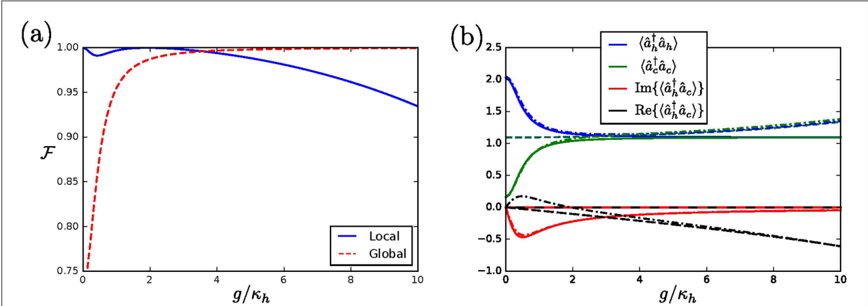
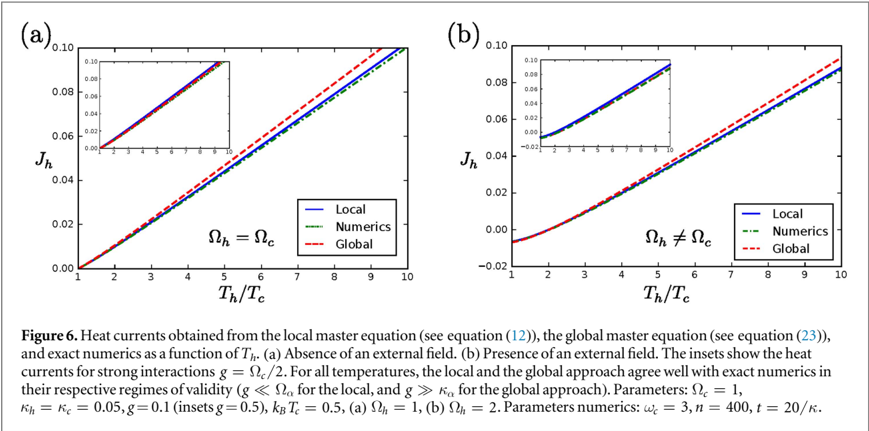
- For the harmonic-oscillator heat engine, the local master equation agrees well with exact numerics when the inter-system coupling satisfies \(g \lesssim \Omega_a\), whereas the global approach fails out of equilibrium when \(g \lesssim \kappa_a\), even predicting a finite heat current as \(g \to 0\).
- At intermediate coupling both approaches agree with exact numerics; at strong coupling the global approach becomes preferable. In equilibrium, the global approach outperforms the local approach except in the limit \(g \to 0\).
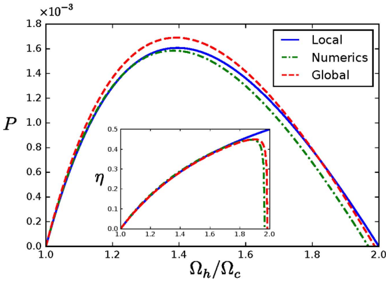
- The local approach gives the heat-engine efficiency \(\eta = 1 - \Omega_c/\Omega_h\) and, with an external drive, does not violate thermodynamic laws. The global approach requires dressed-state definitions of heat currents; using local-like definitions instead gives \(P=0\) and \(J_h=-J_c\).
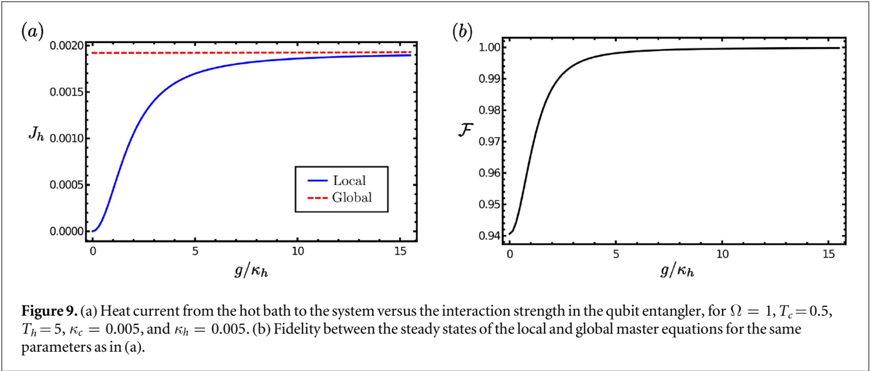
- For the two-qubit entangler, the global approach again predicts a constant heat current as \(g \to 0\), while the local model predicts vanishing current; the two models agree well for intermediate coupling. No exact benchmark is available for this case.
Methods
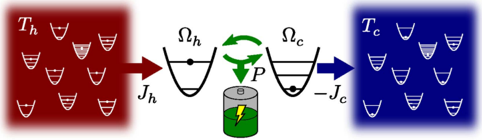
- The main model is a heat engine of two harmonic oscillators with frequencies \(\Omega_c\) and \(\Omega_h\), each coupled to a thermal bath and coupled to each other via an external drive. The full Hamiltonian is quadratic, so exact unitary dynamics of system plus finite baths is simulated at the level of covariance matrices.
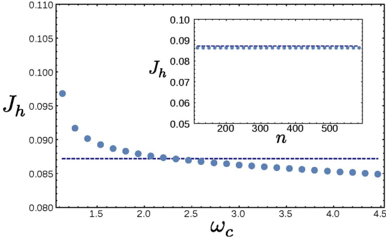
- Exact numerics use baths of about 400 oscillators, cutoff \(\omega_c=3\), and evolution time \(t \approx 20\,\tau_{\rm eq}\). These are compared with local and global Markovian master equations for steady-state heat currents, power, efficiency, and fidelity of reduced Gaussian states.
- A finite-dimensional two-qubit entangler is also analyzed by comparing local and global GKSL master equations, without an exact benchmark.
Limitations
- Stated: the exact benchmark is available only for the harmonic-oscillator heat engine; for the qubit entangler, conclusions are conjectural because no exact solution is provided.
- Stated: the Hamiltonian renormalization is neglected, which causes a dip in local-approach fidelity near \(g \approx |\Sigma_h|\) and a small dependence on the bath cutoff in the appendix.
- Stated/evident: the validity regimes are asymptotic and model-specific, derived for bosonic Ohmic baths; the local approach fails at strong coupling, the global approach fails at weak coupling and out of equilibrium, and analogous fermionic-bath conditions are noted as usually not fulfilled at low temperatures.
Model-written summary. Check it against the paper before relying on it.
Integrity signals
Registry
Cites
Statistics
Figures
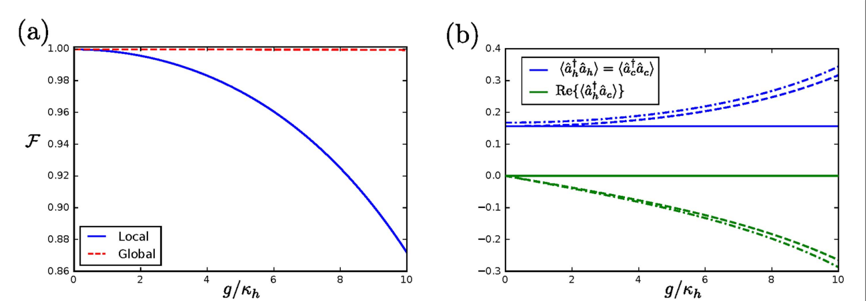
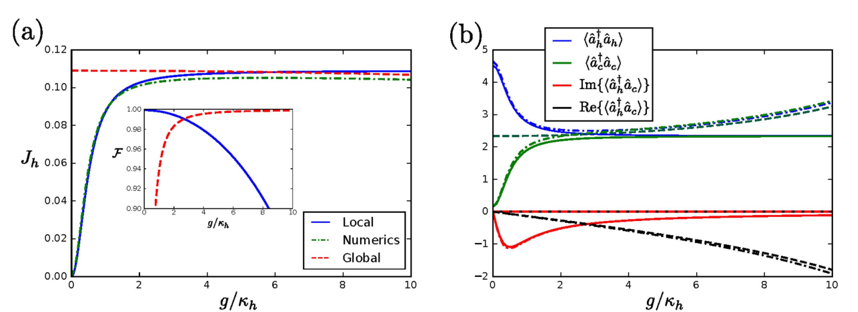
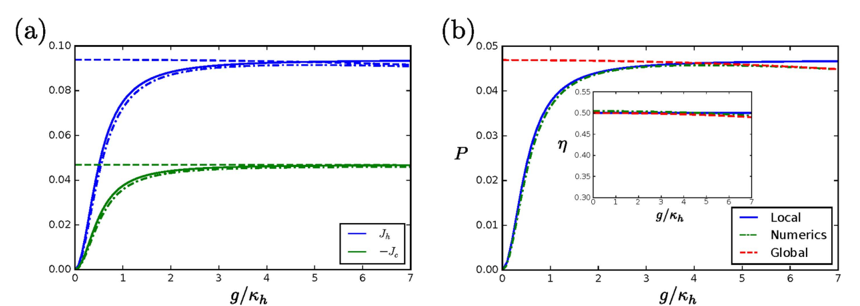

Verification
Claims the paper makes
24 Own interpretation · 23 Own result · 12 Not checked yet · 12 No basis given · 4 Own method
The paper states this without a source or data behind it here, so there is nothing to check it against. The quote shows it is in the paper.
In the paper
“From equations (18), we can infer that the second term in the heat current decays exponentially in time.”
§ Markovian master equations for quantum thermal machines: local versus global approach > B h c c h
plaindirect- Asserted: passes — The authors put it forward as true.
- Checkable: passes — It can be checked against evidence.
- Load-bearing: unclear — It is unclear whether the paper’s conclusions depend on it.
- Based: passes — The paper gives a reason why it holds.
The paper states this without a source or data behind it here, so there is nothing to check it against. The quote shows it is in the paper.
In the paper
“We note that this efficiency fulfills equation (45).”
§ Markovian master equations for quantum thermal machines: local versus global approach > B h c c h
plain- Asserted: passes — The authors put it forward as true.
- Checkable: passes — It can be checked against evidence.
- Load-bearing: passes — The paper’s conclusions depend on it.
- Based: passes — The paper gives a reason why it holds.
None of the sources cited for this claim have been checked yet.
In the paper
“In contrast to [58,59,63], which lack an external field, we find that the presence of such a field ensures that the local master equation does not result in any violations of the laws of thermodynamics.”
§ Markovian master equations for quantum thermal machines: local versus global approach > 3. Heat engine
What the sources say
plaindirect- Asserted: passes — The authors put it forward as true.
- Checkable: passes — It can be checked against evidence.
- Load-bearing: passes — The paper’s conclusions depend on it.
- Based: passes — The paper gives a reason why it holds.
A result the paper reports from its own data — it cites no other source for it, so there is none to check. The quote shows it is in the paper.
In the paper
“For intermediate coupling, the local and the global approach both agree with the exact solution”
- Also stated in: § 1. Introduction · plain
“Moving to the regime of intermediate coupling, we find that both approaches provide good descriptions of the system.”
§ Markovian master equations for quantum thermal machines: local versus global approach > Abstract
plaincorrelational- Asserted: passes — The authors put it forward as true.
- Checkable: passes — It can be checked against evidence.
- Load-bearing: passes — The paper’s conclusions depend on it.
- Based: passes — The paper gives a reason why it holds.
- Also stated in: § 1. Introduction · plain
The paper states this without a source or data behind it here, so there is nothing to check it against. The quote shows it is in the paper.
In the paper
“resulting in the efficiency h = - W W ( ) 1 . 49 c h”
§ Markovian master equations for quantum thermal machines: local versus global approach > B h c c h
plaindirect- Asserted: passes — The authors put it forward as true.
- Checkable: passes — It can be checked against evidence.
- Load-bearing: passes — The paper’s conclusions depend on it.
- Based: passes — The paper gives a reason why it holds.
A result the paper reports from its own data — it cites no other source for it, so there is none to check. The quote shows it is in the paper.
In the paper
“As we show in section 7, the local approach gives reliable predictions even for interactions that are several times the broadening.”
§ Markovian master equations for quantum thermal machines: local versus global approach > B
plain- Asserted: passes — The authors put it forward as true.
- Checkable: passes — It can be checked against evidence.
- Load-bearing: passes — The paper’s conclusions depend on it.
- Based: passes — The paper gives a reason why it holds.
A result the paper reports from its own data — it cites no other source for it, so there is none to check. The quote shows it is in the paper.
In the paper
“In the steady state, we find that the state is a product of thermal states with occupation numbers á ñ = s ˆ † a a n as expected.”
§ Markovian master equations for quantum thermal machines: local versus global approach > 4.2. Global master equation
plaincorrelational- Asserted: passes — The authors put it forward as true.
- Checkable: passes — It can be checked against evidence.
- Load-bearing: unclear — It is unclear whether the paper’s conclusions depend on it.
- Based: passes — The paper gives a reason why it holds.
- The authors state this as an assumption: The baths are in thermal states.
- The authors state this as an assumption: The renormalization of the Hamiltonian is neglected.
A result the paper reports from its own data — it cites no other source for it, so there is none to check. The quote shows it is in the paper.
In the paper
“for strong coupling, the global approach is preferable.”
- Also stated in: § 1. Introduction · plain
“For very strong inter-system coupling strengths, the local approach starts to fail while the global approach still yields a faithful description of the system.”
§ Markovian master equations for quantum thermal machines: local versus global approach > Abstract
plaindirect- Asserted: passes — The authors put it forward as true.
- Checkable: passes — It can be checked against evidence.
- Load-bearing: passes — The paper’s conclusions depend on it.
- Based: passes — The paper gives a reason why it holds.
- Also stated in: § 1. Introduction · plain
A result the paper reports from its own data — it cites no other source for it, so there is none to check. The quote shows it is in the paper.
In the paper
“In particular, the numerical value for the efficiency is very close to the universal value h = -W W 1 c h obtained from the local master equation.”
§ Markovian master equations for quantum thermal machines: local versus global approach > 7. Results
plaincorrelational- Asserted: passes — The authors put it forward as true.
- Checkable: passes — It can be checked against evidence.
- Load-bearing: passes — The paper’s conclusions depend on it.
- Based: passes — The paper gives a reason why it holds.
The paper states this without a source or data behind it here, so there is nothing to check it against. The quote shows it is in the paper.
In the paper
“Finally, we focus on the heat engine regime which requires both a thermal bias as well as an external field.Again, the global approach breaks down for small values of g as expected.”
§ Markovian master equations for quantum thermal machines: local versus global approach > 7. Results
plaindirect- Asserted: passes — The authors put it forward as true.
- Checkable: passes — It can be checked against evidence.
- Load-bearing: passes — The paper’s conclusions depend on it.
- Based: passes — The paper gives a reason why it holds.
- It may state two separate claims as one. 21
- The quote only partly states this claim. 2
- Probably not a substantial claim. 4
A result the paper reports from its own data — it cites no other source for it, so there is none to check. The quote shows it is in the paper.
In the paper
“In particular, for weak inter-system coupling, the local approach agrees with the exact solution, whereas the global approach fails for non-equilibrium situations.”
- Also stated in: § 1. Introduction · boosted
“In the weak inter-system coupling regime, we see that the local approach provides an accurate description of the system, capturing both the thermodynamical observables and the quantum state.”
§ Markovian master equations for quantum thermal machines: local versus global approach > Abstract
boostedcorrelational- Asserted: passes — The authors put it forward as true.
- Checkable: passes — It can be checked against evidence.
- Load-bearing: passes — The paper’s conclusions depend on it.
- Based: passes — The paper gives a reason why it holds.
It may state two separate claims as one.
- Also stated in: § 1. Introduction · boosted
A result the paper reports from its own data — it cites no other source for it, so there is none to check. The quote shows it is in the paper.
In the paper
“whereas the global approach fails for non-equilibrium situations.”
- Also stated in: § 1. Introduction · plain
“On the contrary, the global approach fails in this regime.”
§ Markovian master equations for quantum thermal machines: local versus global approach > Abstract
plaindirect- Asserted: passes — The authors put it forward as true.
- Checkable: passes — It can be checked against evidence.
- Load-bearing: passes — The paper’s conclusions depend on it.
- Based: passes — The paper gives a reason why it holds.
The quote only partly states this claim.
- Also stated in: § 1. Introduction · plain
A result the paper reports from its own data — it cites no other source for it, so there is none to check. The quote shows it is in the paper.
In the paper
“In particular, the global approach still fails in the weak coupling regime, while for intermediate coupling, the two approaches agree well.”
§ Markovian master equations for quantum thermal machines: local versus global approach > 1. Introduction
plaindirectSingle case- Asserted: passes — The authors put it forward as true.
- Checkable: passes — It can be checked against evidence.
- Load-bearing: passes — The paper’s conclusions depend on it.
- Based: passes — The paper gives a reason why it holds.
It may state two separate claims as one.
The paper states this without a source or data behind it here, so there is nothing to check it against. The quote shows it is in the paper.
In the paper
“Note that all models fulfill + = J J P c h (first law), and h h < C (second law).”
§ Markovian master equations for quantum thermal machines: local versus global approach > 7.3. Thermal bias and external field
plain- Asserted: passes — The authors put it forward as true.
- Checkable: passes — It can be checked against evidence.
- Load-bearing: unclear — It is unclear whether the paper’s conclusions depend on it.
- Based: passes — The paper gives a reason why it holds.
It may state two separate claims as one.
A result the paper reports from its own data — it cites no other source for it, so there is none to check. The quote shows it is in the paper.
In the paper
“As expected, the local approach reliably reproduces the steady state for small values of g while the global approach works well for large values of g.”
§ Markovian master equations for quantum thermal machines: local versus global approach > 7.2. Thermal bias
plaincorrelational- Asserted: passes — The authors put it forward as true.
- Checkable: passes — It can be checked against evidence.
- Load-bearing: passes — The paper’s conclusions depend on it.
- Based: passes — The paper gives a reason why it holds.
It may state two separate claims as one.
A result the paper reports from its own data — it cites no other source for it, so there is none to check. The quote shows it is in the paper.
In the paper
“Note that the occupation numbers obtained from the local approach differ quite a bit from the ones obtained from exact numerics for large interactions.Nevertheless, the heat current is still captured very well by the local approach.”
§ Markovian master equations for quantum thermal machines: local versus global approach > 7.2. Thermal bias
plaincorrelational- Asserted: passes — The authors put it forward as true.
- Checkable: passes — It can be checked against evidence.
- Load-bearing: passes — The paper’s conclusions depend on it.
- Based: passes — The paper gives a reason why it holds.
It may state two separate claims as one.
A result the paper reports from its own data — it cites no other source for it, so there is none to check. The quote shows it is in the paper.
In the paper
“We find good agreement in the power as well as the efficiency between the local approach, the global approach, and the exact numerics.Only when the machine is operated close to the Carnot point (W = W T T h h c c ) do the efficiencies deviate considerably.”
§ Markovian master equations for quantum thermal machines: local versus global approach > 7.3. Thermal bias and external field
plaincorrelational- Asserted: passes — The authors put it forward as true.
- Checkable: passes — It can be checked against evidence.
- Load-bearing: passes — The paper’s conclusions depend on it.
- Based: passes — The paper gives a reason why it holds.
It may state two separate claims as one.
The paper states this without a source or data behind it here, so there is nothing to check it against. The quote shows it is in the paper.
In the paper
“For w » W a c , the results do not closely match the analytics, which is expected because energetically possible transitions are not captured by the bath.”
§ Markovian master equations for quantum thermal machines: local versus global approach > Appendix. Details on the simulation
plaindirect- Asserted: fails — The authors may not put it forward as true.
- Checkable: passes — It can be checked against evidence.
- Load-bearing: fails — The paper’s conclusions may not depend on it.
- Based: passes — The paper gives a reason why it holds.
Probably not a substantial claim. The authors may not put it forward as true. The paper’s conclusions may not depend on it. It may state two separate claims as one.
A result the paper reports from its own data — it cites no other source for it, so there is none to check. The quote shows it is in the paper.
In the paper
“As expected, the global approach yields an accurate description of the steady state while the local approach gets progressively worse as the inter-system interaction g increases.”
§ Markovian master equations for quantum thermal machines: local versus global approach > 7.1. Equilibrium
plaindirect- Asserted: passes — The authors put it forward as true.
- Checkable: passes — It can be checked against evidence.
- Load-bearing: passes — The paper’s conclusions depend on it.
- Based: passes — The paper gives a reason why it holds.
It may state two separate claims as one.
A result the paper reports from its own data — it cites no other source for it, so there is none to check. The quote shows it is in the paper.
In the paper
“Note that when g becomes comparable to W c , the local approach starts to deviate from the exact numerics and the global approach becomes preferable.”
§ Markovian master equations for quantum thermal machines: local versus global approach > 7. Results
plaindirect- Asserted: passes — The authors put it forward as true.
- Checkable: passes — It can be checked against evidence.
- Load-bearing: passes — The paper’s conclusions depend on it.
- Based: passes — The paper gives a reason why it holds.
It may state two separate claims as one.
A result the paper reports from its own data — it cites no other source for it, so there is none to check. The quote shows it is in the paper.
In the paper
“While the local approach agrees extremely well with exact numerics, the global approach fails for small g.”
§ Markovian master equations for quantum thermal machines: local versus global approach > 7.3. Thermal bias and external field
plaindirect- Asserted: passes — The authors put it forward as true.
- Checkable: passes — It can be checked against evidence.
- Load-bearing: passes — The paper’s conclusions depend on it.
- Based: passes — The paper gives a reason why it holds.
It may state two separate claims as one. The quote only partly states this claim.
None of the sources cited for this claim have been checked yet.
In the paper
“Since it does not guarantee positive evolution [1], further approximations are usually made to obtain a master equation in Gorini-Kossakowski-Sudarshan-Lindblad (GKSL) form [3,4] ensuring completely positive dynamics.”
§ Markovian master equations for quantum thermal machines: local versus global approach > S H t i S
What the sources say
plaindirect- Asserted: passes — The authors put it forward as true.
- Checkable: passes — It can be checked against evidence.
- Load-bearing: passes — The paper’s conclusions depend on it.
- Based: passes — The paper gives a reason why it holds.
It may state two separate claims as one.
- The authors state this as an assumption: The baths are in thermal states.
What the paper did — it cites no source for this, so there is none to check. The quote shows it is in the paper.
In the paper
“This exact numerical solution serves as a benchmark for evaluating the performance of both the local and global master equations.”
- Also stated in: § 5. Exact numerics · plain
“In this section we briefly describe how we obtain exact numerics which are used as a benchmark when comparing the different master equations.”
§ Markovian master equations for quantum thermal machines: local versus global approach > 1. Introduction
plain- Asserted: passes — The authors put it forward as true.
- Checkable: passes — It can be checked against evidence.
- Load-bearing: passes — The paper’s conclusions depend on it.
- Based: passes — The paper gives a reason why it holds.
Probably not a substantial claim.
- Also stated in: § 5. Exact numerics · plain
A conclusion the paper draws from its own results — it cites no other source for it, so there is none to check. The quote shows it is in the paper.
In the paper
“While the local master equation yields correct results in this case, the global approach fails, resulting in a finite energy current through the system even in the absence of an interaction.”
§ Markovian master equations for quantum thermal machines: local versus global approach > 2. Local versus global
plaindirect- Asserted: passes — The authors put it forward as true.
- Checkable: passes — It can be checked against evidence.
- Load-bearing: passes — The paper’s conclusions depend on it.
- Based: passes — The paper gives a reason why it holds.
It may state two separate claims as one.
- Rests on an assumption: If the sub-systems do not interact, each sub-system thermalizes to its respective bath.
A conclusion the paper draws from its own results — it cites no other source for it, so there is none to check. The quote shows it is in the paper.
In the paper
“We note that in the limit g 0, the local master equation is no longer recovered.Because the secular approximation is no longer justified in this limit, we expect the global master equation to break down.”
§ Markovian master equations for quantum thermal machines: local versus global approach > 4.2. Global master equation
hedgeddirect- Asserted: passes — The authors put it forward as true.
- Checkable: passes — It can be checked against evidence.
- Load-bearing: passes — The paper’s conclusions depend on it.
- Based: passes — The paper gives a reason why it holds.
It may state two separate claims as one.
- The authors state this as an assumption: The baths are in thermal states.
- The authors state this as an assumption: The renormalization of the Hamiltonian is neglected.
The paper states this without a source or data behind it here, so there is nothing to check it against. The quote shows it is in the paper.
In the paper
“In the global master equation, the bath couples to global states which are dressed by the external field.Therefore, the dissipative terms include the external field and the definitions introduced in the last subsection are no longer valid.”
§ Markovian master equations for quantum thermal machines: local versus global approach > 6.1.2. Global master equation
plaindirect- Asserted: passes — The authors put it forward as true.
- Checkable: passes — It can be checked against evidence.
- Load-bearing: passes — The paper’s conclusions depend on it.
- Based: passes — The paper gives a reason why it holds.
It may state two separate claims as one.
The paper states this without a source or data behind it here, so there is nothing to check it against. The quote shows it is in the paper.
In the paper
“We note that for the global approach, we enforce the first law while in the local approach, it follows from the expressions for heat currents and power.”
§ Markovian master equations for quantum thermal machines: local versus global approach > 6.1.2. Global master equation
plaindirect- Asserted: passes — The authors put it forward as true.
- Checkable: passes — It can be checked against evidence.
- Load-bearing: unclear — It is unclear whether the paper’s conclusions depend on it.
- Based: passes — The paper gives a reason why it holds.
It may state two separate claims as one.
- The authors state this as an assumption: The first law of thermodynamics is enforced in the global approach.
A conclusion the paper draws from its own results — it cites no other source for it, so there is none to check. The quote shows it is in the paper.
In the paper
“Finally, we note that for W = W h c , where there is no external power, heat always flows from the hot bath to the cold bath as dictated by the second law of thermodynamics.”
§ Markovian master equations for quantum thermal machines: local versus global approach > B h c c h
plaindirect- Asserted: passes — The authors put it forward as true.
- Checkable: passes — It can be checked against evidence.
- Load-bearing: passes — The paper’s conclusions depend on it.
- Based: passes — The paper gives a reason why it holds.
It may state two separate claims as one.
In the paper
“As long as h h < C , our machine is thus a heat engine, h h = C denotes the point of reversibility, where all the energy currents vanish, and for h h > C , the machine acts as a refrigerator, using power to induce a heat current from the cold bath to the hot bath [44].”
§ Markovian master equations for quantum thermal machines: local versus global approach > B h c c h
What the sources say
- Not checked yetcites [44] source
plaindirect- Asserted: passes — The authors put it forward as true.
- Checkable: passes — It can be checked against evidence.
- Load-bearing: passes — The paper’s conclusions depend on it.
- Based: passes — The paper gives a reason why it holds.
It may state two separate claims as one.
A conclusion the paper draws from its own results — it cites no other source for it, so there is none to check. The quote shows it is in the paper.
In the paper
“The choice w = 3 c is hence large enough to capture the different energy transitions, and at the same time not too large so that the effect of the renormalization can be neglected.”
§ Markovian master equations for quantum thermal machines: local versus global approach > Appendix. Details on the simulation
plaindirect- Asserted: passes — The authors put it forward as true.
- Checkable: passes — It can be checked against evidence.
- Load-bearing: passes — The paper’s conclusions depend on it.
- Based: passes — The paper gives a reason why it holds.
It may state two separate claims as one.
In the paper
“This machine can generate entanglement between the two qubits in the steady state, as shown in [51].”
§ Markovian master equations for quantum thermal machines: local versus global approach > 8. Qubit entangler
What the sources say
- Not checked yetcites [51] Brask J B, 2015, New J. Phys.
plaindirect- Asserted: passes — The authors put it forward as true.
- Checkable: passes — It can be checked against evidence.
- Load-bearing: fails — The paper’s conclusions may not depend on it.
- Based: passes — The paper gives a reason why it holds.
Probably not a substantial claim. The paper’s conclusions may not depend on it.
A conclusion the paper draws from its own results — it cites no other source for it, so there is none to check. The quote shows it is in the paper.
In the paper
“The efficiency can only reach the Carnot value if one of the channels carries no energy (i.e.c = 1 or c = 0) or if both channels can simultaneously reach the Carnot point (which is the case if equations (17) hold).”
§ Markovian master equations for quantum thermal machines: local versus global approach > 6.1.2. Global master equation
plainconditional- Asserted: passes — The authors put it forward as true.
- Checkable: passes — It can be checked against evidence.
- Load-bearing: passes — The paper’s conclusions depend on it.
- Based: passes — The paper gives a reason why it holds.
It may state two separate claims as one.
A conclusion the paper draws from its own results — it cites no other source for it, so there is none to check. The quote shows it is in the paper.
In the paper
“We note that the local approach is by no means more phenomenological than the global approach.Indeed, the approximation leading to the local master equation is completely analogous to the Markov approximation and has a well defined regime of validity.”
§ Markovian master equations for quantum thermal machines: local versus global approach > 9. Conclusions
boosted- Asserted: passes — The authors put it forward as true.
- Checkable: passes — It can be checked against evidence.
- Load-bearing: passes — The paper’s conclusions depend on it.
- Based: passes — The paper gives a reason why it holds.
It may state two separate claims as one.
In the paper
“This is consistent with the results of [15], which discusses the absence of any currents as expressed through system observables in the global approach.”
§ Markovian master equations for quantum thermal machines: local versus global approach > 7.3. Thermal bias and external field
What the sources say
- Not checked yetcites [15] source
plain- Asserted: passes — The authors put it forward as true.
- Checkable: passes — It can be checked against evidence.
- Load-bearing: fails — The paper’s conclusions may not depend on it.
- Based: passes — The paper gives a reason why it holds.
Probably not a substantial claim. The paper’s conclusions may not depend on it.
None of the sources cited for this claim have been checked yet.
In the paper
“Both the local and global master equations can be written in GKSL form with constant rates [3,4], and so lead to Markovian (specifically semigroup) evolution”
§ Markovian master equations for quantum thermal machines: local versus global approach > 8. Qubit entangler
plaindirect- Asserted: passes — The authors put it forward as true.
- Checkable: passes — It can be checked against evidence.
- Load-bearing: unclear — It is unclear whether the paper’s conclusions depend on it.
- Based: passes — The paper gives a reason why it holds.
It may state two separate claims as one.
The authors state this as an assumption.
The baths are in thermal states.
“where we assumed the baths to be in thermal states.”
The authors state this as an assumption.
The renormalization of the Hamiltonian is neglected.
“In the following, we will thus neglect this renormalization.”
“As for the local approach, we will neglect the renormalization of the Hamiltonian in the following.”
The paper relies on this without support.
If the sub-systems do not interact, each sub-system thermalizes to its respective bath.
“Clearly, if the sub-systems do not interact, each sub-system should thermalize to its respective bath.”
The authors state this as an assumption.
The dip in fidelity for the local approach arises from neglecting the renormalization of the Hamiltonian.
“The dip in the fidelity for the local approach occurs at » S | | g h and is therefore assumed to arise from neglecting the renormalization of the Hamiltonian; see equation (16).”
The authors state this as an assumption.
The first law of thermodynamics is enforced in the global approach.
“We note that for the global approach, we enforce the first law while in the local approach, it follows from the expressions for heat currents and power.”
Claims other papers make about this one
Each is checked against this paper’s own text: does it say what the citing paper says it does?
In the citing paper
“In the dressed picture, the separate baths acting locally on each buffer spins become global baths [102,103] acting collectively on the dressed buffer spins.”
From Quantum Models of Consciousness from a Quantum Information Science Perspective (2025) · cites this paper as [103]
Citations
Cites
On the generators of quantum dynamical semigroups
Lindblad, G. (1976) · Communications in Mathematical Physics · doi:10.1007/bf01608499 · Cited by 7,548 · cited 2×
“Since it does not guarantee positive evolution [1], further approximations are usually made to obtain a master equation in Gorini-Kossakowski-Sudarshan-Lindblad (GKSL) form [3,4] ensuring completely positive dynamics.”
BackgroundCompletely positive dynamical semigroups of N -level systems
Gorini, V., Kossakowski, A., & Sudarshan, E. C. G. (1976) · Journal of Mathematical Physics · doi:10.1063/1.522979 · Cited by 3,998 · cited 2×
“Since it does not guarantee positive evolution [1], further approximations are usually made to obtain a master equation in Gorini-Kossakowski-Sudarshan-Lindblad (GKSL) form [3,4] ensuring completely positive dynamics.”
BackgroundKinetic equations from Hamiltonian dynamics: Markovian limits
Spohn, H. (1980) · Reviews of Modern Physics · doi:10.1103/revmodphys.52.569 · Cited by 1,013
The role of quantum information in thermodynamics—a topical review
Goold, J., Huber, M., Riera, A., del Rio, L., & Skrzypczyk, P. (2016) · Journal of Physics A Mathematical and Theoretical · doi:10.1088/1751-8113/49/14/143001 · Cited by 973
Vinjanampathy, S., & Anders, J. (2016) · Contemporary Physics · doi:10.1080/00107514.2016.1201896 · Cited by 940
Davies, E. B. (1974) · Communications in Mathematical Physics · doi:10.1007/bf01608389 · Cited by 934
Rivas, ́., & Huelga, S. F. (2011) · SpringerBriefs in physics · doi:10.1007/978-3-642-23354-8 · Cited by 876
Quantum Thermodynamics: A Dynamical Viewpoint
Kosloff, R. (2013) · Entropy · doi:10.3390/e15062100 · Cited by 857
Weiß, U. (1993) · Series in modern condensed matter physics · doi:10.1142/1476 · Cited by 799
Quantum thermodynamic cycles and quantum heat engines
Quan, H. T., Liu, Y.-X., Sun, C. P., & Nori, F. (2007) · Physical Review E · doi:10.1103/physreve.76.031105 · Cited by 789
Cited by
Sorted by citations
Items 101–200 of 271
Wigner entropy production and heat transport in linear quantum lattices
Malouf, W. T. B., Santos, J. P., Correa, L. A., Paternostro, M., & Landi, G. T. (2019) · Physical Review A · doi:10.1103/physreva.99.052104 · Cited by 21
Strong system-bath coupling effects in quantum absorption refrigerators
Ivander, F., Anto-Sztrikacs, N., & Segal, D. (2022) · Physical review. E · doi:10.1103/physreve.105.034112 · Cited by 21
Trushechkin, A. S. (2019) · Lobachevskii Journal of Mathematics · doi:10.1134/s1995080219100275 · Cited by 20
Gerry, M., & Segal, D. (2023) · Physical review. E · doi:10.1103/physreve.107.054115 · Cited by 20
Classical emulation of quantum-coherent thermal machines
González, J. O., Palao, J. P., Alonso, D., & Correa, L. A. (2019) · Physical review. E · doi:10.1103/physreve.99.062102 · Cited by 20
Bhandari, B., Fazio, R., Taddei, F., & Arrachea, L. (2021) · Physical review. B./Physical review. B · doi:10.1103/physrevb.104.035425 · Cited by 22
Sakamoto, S., & Tanimura, Y. (2020) · The Journal of Chemical Physics · doi:10.1063/5.0033664 · Cited by 19
Photonic Chiral State Transfer near the Liouvillian Exceptional Point
Gao, H., Sun, K., Qu, D., Wang, K., Xiao, L., Yi, W., & Xue, P. (2025) · Physical Review Letters · doi:10.1103/physrevlett.134.146602 · Cited by 22
Current rectification in a double quantum dot through fermionic reservoir engineering
Malz, D., & Nunnenkamp, A. (2018) · Physical review. B./Physical review. B · doi:10.1103/physrevb.97.165308 · Cited by 18
Subdiffusive Phases in Open Clean Long-Range Systems
Purkayastha, A., Saha, M., & Agarwalla, B. K. (2021) · Physical Review Letters · doi:10.1103/physrevlett.127.240601 · Cited by 18
Operational nonclassicality in minimal autonomous thermal machines
Brask, J. B., Clivaz, F., Haack, G., & Tavakoli, A. (2022) · Quantum · doi:10.22331/q-2022-03-22-672 · Cited by 18
Self-citationVaaranta, A., Cattaneo, M., & Lake, R. E. (2022) · Physical Review A · doi:10.1103/physreva.106.042605 · Cited by 19
Characterizing the performance of heat rectifiers
Khandelwal, S., Perarnau-Llobet, M., Seah, S., Brunner, N., & Haack, G. (2023) · Physical Review Research · doi:10.1103/physrevresearch.5.013129 · Cited by 18
Self-citationBath-assisted transport in a three-site spin chain: Global versus local approach
Benatti, F., Roberto Floreanini, B., & Memarzadeh, L. (2020) · Physical Review A · doi:10.1103/physreva.102.042219 · Cited by 18
Perturbation theory for Lindblad superoperators for interacting open quantum systems
Shishkov, V. Y., Andrianov, E. S., Пухов, А. А., Vinogradov, A. P., & Lisyansky, A. A. (2020) · Physical Review A · doi:10.1103/physreva.102.032207 · Cited by 18
Local master equations may fail to describe dissipative critical behavior
Konopik, M., & Lutz, E. (2022) · Physical Review Research · doi:10.1103/physrevresearch.4.013171 · Cited by 18
Reservoir-assisted quantum battery charging at finite temperatures
Yao, Y., & Shao, X. Q. (2025) · Physical Review A · doi:10.1103/vqnk-kzqg · Cited by 17
Precision is not limited by the second law of thermodynamics
Meier, F., Minoguchi, Y., Sundelin, S., Apollaro, T. J. G., Erker, P., Gasparinetti, S., & Huber, M. (2025) · Nature Physics · doi:10.1038/s41567-025-02929-2 · Cited by 24
Harnessing coherence generation for precision single- and two-qubit quantum thermometry
Aiache, Y., Allati, A. E., & Anouz, K. E. (2024) · Physical Review A · doi:10.1103/physreva.110.032605 · Cited by 17
Validity of Born-Markov master equations for single- and two-qubit systems
Vadimov, V., Tuorila, J., Orell, T., Stockburger, J. T., Ala-Nissilä, T., Ankerhold, J., & Möttönen, M. (2021) · Physical review. B./Physical review. B · doi:10.1103/physrevb.103.214308 · Cited by 17
Nonreciprocal quantum transport at junctions of structured leads
Mascarenhas, E., Damanet, F., Flannigan, S., Tagliacozzo, L., Daley, A. J., Goold, J., & de Vega, I. (2019) · Physical review. B./Physical review. B · doi:10.1103/physrevb.99.245134 · Cited by 16
Non-Markovian effects on the performance of a quantum Otto refrigerator
Allati, A. E., Anouz, K. E., Chakour, M. H. B. A., & Al-Kuwari, S. M. (2024) · Physics Letters A · doi:10.1016/j.physleta.2024.129316 · Cited by 16
Non-Markovian dynamics under time-translation symmetry
Dann, R., Megier, N., & Kosloff, R. (2022) · Physical Review Research · doi:10.1103/physrevresearch.4.043075 · Cited by 18
Active energy transport and the role of symmetry breaking in microscopic power grids
Huber, J., & Rabl, P. (2019) · Physical Review A · doi:10.1103/physreva.100.012129 · Cited by 15
Bettmann, L. P., Kewming, M. J., & Goold, J. (2023) · Physical review. E · doi:10.1103/physreve.107.044102 · Cited by 19
Efficient quantum algorithm to simulate open systems through a single environmental qubit
Bartolomeo, G. D., Vischi, M., Feri, T., Bassi, A., & Donadi, S. (2024) · Physical Review Research · doi:10.1103/physrevresearch.6.043321 · Cited by 17
Quantum Features and Signatures of Quantum Thermal Machines
Levy, A., & Gelbwaser-Klimovsky, D. (2018) · Fundamental theories of physics · doi:10.1007/978-3-319-99046-0_4 · Cited by 17
Revealing the strokes of autonomous quantum heat engines with work and heat fluctuations
Verteletsky, K., & Mølmer, K. (2020) · Physical Review A · doi:10.1103/physreva.101.010101 · Cited by 15
Sudden death of entanglement induced by a minimal thermal environment
Deçordi, G. L., & Vidiella-Barranco, A. (2020) · Optics Communications · doi:10.1016/j.optcom.2020.126233 · Cited by 15
Quantum collisional thermostats
Tabanera-Bravo, J., Luque, I., Jacob, S. L., Esposito, M., Barra, F., & Parrondo, J. M. R. (2022) · New Journal of Physics · doi:10.1088/1367-2630/ac4923 · Cited by 15
Quantum Models of Consciousness from a Quantum Information Science Perspective
Gassab, L., Pusuluk, O., Cattaneo, M., & Müstecaplıoğlu, Ö. E. (2025) · Entropy · doi:10.3390/e27030243 · Cited by 14
Quantum-enhanced performance in superconducting Andreev reflection engines
Manzano, G., & López, R. (2023) · Physical Review Research · doi:10.1103/physrevresearch.5.043041 · Cited by 14
Blasi, G., Khandelwal, S., & Haack, G. (2024) · Physical Review Research · doi:10.1103/physrevresearch.6.043091 · Cited by 14
Self-citationThermalization in the quantum Ising model—approximations, limits, and beyond
Jaschke, D., Carr, L. D., & de Vega, I. (2019) · Quantum Science and Technology · doi:10.1088/2058-9565/ab1a71 · Cited by 15
Ultrasensitive Calorimetric Detection of Single Photons from Qubit Decay
Pekola, J. P., & Karimi, B. (2022) · Physical Review X · doi:10.1103/physrevx.12.011026 · Cited by 13
Yu, C., Guo, B.-Q., & Liu, T. (2019) · Optics Express · doi:10.1364/oe.27.006863 · Cited by 13
Thermalization and Dephasing in Collisional Reservoirs
Tabanera-Bravo, J., Parrondo, J. M. R., Esposito, M., & Barra, F. (2023) · Physical Review Letters · doi:10.1103/physrevlett.130.200402 · Cited by 12
McConnell, P., Houhou, O., Brunelli, M., & Ferraro, A. (2024) · Physical Review A · doi:10.1103/physreva.109.033508 · Cited by 12
Learning the best nanoscale heat engines through evolving network topology
Ashida, Y., & Sagawa, T. (2021) · Communications Physics · doi:10.1038/s42005-021-00553-z · Cited by 12
Noninteracting many-particle quantum transport between finite reservoirs
Amato, G., Breuer, H., Wimberger, S., Rodríguez, A., & Buchleitner, A. (2020) · Physical Review A · doi:10.1103/physreva.102.022207 · Cited by 12
Winczewski, M., Mandarino, A., Suárez, G., Alicki, R., & Horodecki, M. (2024) · Physical review. E · doi:10.1103/physreve.110.024110 · Cited by 22
Machine Learning Applied to Quantum Synchronization‐Assisted Probing
Estarellas, G. G., Giorgi, G. L., Soriano, M. C., & Zambrini, R. (2019) · Advanced Quantum Technologies · doi:10.1002/qute.201800085 · Cited by 12
Heat current control in trapped Bose–Einstein Condensates
Charalambous, C., García-March, M. Á., Mehboudi, M., & Lewenstein, M. (2019) · New Journal of Physics · doi:10.1088/1367-2630/ab3832 · Cited by 12
Exact Steady State of the Open X X -Spin Chain: Entanglement and Transport Properties
Benatti, F., Roberto Floreanini, B., & Memarzadeh, L. (2021) · PRX Quantum · doi:10.1103/prxquantum.2.030344 · Cited by 14
Towards quantum thermal multi-transistor systems: Energy divider formalism
Wijesekara, R. T., Gunapala, S. D., & Premaratne, M. (2022) · Physical review. B./Physical review. B · doi:10.1103/physrevb.105.235412 · Cited by 12
Catalytic Advantage in Otto-like Two-Stroke Quantum Engines
Łobejko, M., Biswas, T., Mazurek, P., & Horodecki, M. (2024) · Physical Review Letters · doi:10.1103/physrevlett.132.260403 · Cited by 11
Dicke superradiant heat current enhancement in circuit quantum electrodynamics
Andolina, G. M., Erdman, P. A., Noé, F., Pekola, J. P., & Schirò, M. (2024) · Physical Review Research · doi:10.1103/physrevresearch.6.043128 · Cited by 11
Quantum master equation for many-body systems based on the Lieb-Robinson bound
Shiraishi, K., Nakagawa, M., Mori, T., & Ueda, M. (2025) · Physical review. B./Physical review. B · doi:10.1103/physrevb.111.184311 · Cited by 12
Enhancing energy transfer in quantum systems via periodic driving: Floquet master equations
Qaleh, Z. N., & Rezakhani, A. T. (2022) · Physical Review A · doi:10.1103/physreva.105.012208 · Cited by 14
Designing refrigerators in higher dimensions using quantum spin models
Konar, T. K., Ghosh, S., Pal, A. K., & Sen, A. (2023) · Physical Review A · doi:10.1103/physreva.107.032602 · Cited by 10
Physical Implementations of Quantum Absorption Refrigerators
Mitchison, M. T., & Potts, P. P. (2018) · Fundamental theories of physics · doi:10.1007/978-3-319-99046-0_6 · Cited by 11
Clausius inequality versus quantum coherence
Soltanmanesh, A., & Shafiee, A. (2019) · The European Physical Journal Plus · doi:10.1140/epjp/i2019-12687-9 · Cited by 11
Locally purified density operators for noisy quantum circuits
Guo, Y., & Yang, S. (2024) · Chinese Physics Letters · doi:10.1088/0256-307x/41/12/120302 · Cited by 10
Tarif, H., Slaoui, A., & Laamara, R. A. (2025) · Physica A Statistical Mechanics and its Applications · doi:10.1016/j.physa.2025.130469 · Cited by 10
Entropy production in the mesoscopic-leads formulation of quantum thermodynamics
Lacerda, A. M., Kewming, M. J., Brenes, M., Jackson, C., Clark, S. R. L., Mitchison, M. T., & Goold, J. (2024) · Physical review. E · doi:10.1103/physreve.110.014125 · Cited by 10
Topological signatures in a weakly dissipative Kitaev chain of finite length
D’Abbruzzo, A., & Rossini, D. (2021) · Physical review. B./Physical review. B · doi:10.1103/physrevb.104.115139 · Cited by 10
Simulating quantum transport via collisional models on a digital quantum computer
Erbanni, R., Xu, X., Demarie, T. F., & Poletti, D. (2023) · Physical Review A · doi:10.1103/physreva.108.032619 · Cited by 11
Certifying steady-state properties of open quantum systems
Mortimer, L., Farina, D., Bello, G. D., Jansen, D., Leitherer, A., Mujal, P., & Acín, A. (2025) · Physical Review Research · doi:10.1103/hbrt-cn8q · Cited by 11
Thermodynamic precision in the nonequilibrium exchange scenario
Farina, D., Benazout, B., Centrone, F., & Acín, A. (2024) · Physical review. E · doi:10.1103/physreve.109.034112 · Cited by 9
Time dependent Markovian master equation beyond the adiabatic limit
Meglio, G. D., Plenio, M. B., & Huelga, S. F. (2024) · Quantum · doi:10.22331/q-2024-11-21-1534 · Cited by 10
Coupling of two autonomous quantum refrigerators: Collective and relative performances
Chakour, M. H. B. A., Allati, A. E., & Hassouni, Y. (2022) · Physics Letters A · doi:10.1016/j.physleta.2022.128410 · Cited by 9
The Josephson junction as a quantum engine
Alicki, R., Horodecki, M., Jenkins, A., Łobejko, M., & Suárez, G. (2023) · New Journal of Physics · doi:10.1088/1367-2630/ad06d8 · Cited by 9
Nonequilibrium boundary-driven quantum systems: Models, methods, and properties
Landi, G. T., Poletti, D., & Schaller, G. (2022) · Reviews of Modern Physics · doi:10.1103/revmodphys.94.045006 · Cited by 256
Atomic switch for control of heat transfer in coupled cavities
Meher, N., & Sivakumar, S. (2019) · Journal of the Optical Society of America B · doi:10.1364/josab.37.000138 · Cited by 8
One-Dimensional Atomic Superfluids as a Model System for Quantum Thermodynamics
Schmiedmayer, J. (2018) · Fundamental theories of physics · doi:10.1007/978-3-319-99046-0_34 · Cited by 7
Thermodynamics of the Coarse-Graining Master Equation
Schaller, G., & Ablaßmayer, J. (2020) · Entropy · doi:10.3390/e22050525 · Cited by 8
A multifunctional quantum thermal device: With and without inner coupling
Huangfu, Y., Qi, S.-F., & Jing, J. (2021) · Physics Letters A · doi:10.1016/j.physleta.2021.127172 · Cited by 8
Exploring quantum synchronization with a composite two-qubit oscillator
Vaidya, G. M., Mamgain, A., Hawaldar, S., Hahn, W., Kaubruegger, R., Suri, B., & Shankar, A. (2024) · Physical Review A · doi:10.1103/physreva.109.033718 · Cited by 8
Feasible platform to study negative temperatures
de Assis, R. J., Villas-Bôas, C. J., & de Almeida, N. G. (2019) · Journal of Physics B Atomic Molecular and Optical Physics · doi:10.1088/1361-6455/ab0117 · Cited by 8
Floquet analysis of a superradiant many-qutrit refrigerator
Kolisnyk, D., Queißer, F., Schaller, G., & Schützhold, R. (2024) · Physical Review Applied · doi:10.1103/physrevapplied.21.044050 · Cited by 7
Catalytic enhancement in the performance of the microscopic two-stroke heat engine
Biswas, T., Łobejko, M., Mazurek, P., & Horodecki, M. (2024) · Physical review. E · doi:10.1103/physreve.110.044120 · Cited by 7
Zahia, A. A. (2025) · Physica Scripta · doi:10.1088/1402-4896/adee67 · Cited by 7
Certifying quantum enhancements in thermal machines beyond the Thermodynamic Uncertainty Relation
Almanza-Marrero, J. A., & Manzano, G. (2025) · Quantum · doi:10.22331/q-2025-10-07-1878 · Cited by 7
Maximal steady-state entanglement in autonomous quantum thermal machines
Khandelwal, S., Annby-Andersson, B., Diotallevi, G. F., Wacker, A., & Tavakoli, A. (2025) · npj Quantum Information · doi:10.1038/s41534-025-00981-7 · Cited by 7
Driving-assisted open quantum transport in qubit networks
Dwiputra, D., Kosasih, J. S., Sulaiman, A., & Zen, F. P. (2020) · Physical Review A · doi:10.1103/physreva.101.012113 · Cited by 7
Quantum versus classical transport of energy in coupled two-level systems
Medina, I., Moreira, S. V., & Semião, F. L. (2021) · Physical Review A · doi:10.1103/physreva.103.052216 · Cited by 7
Xing, B., Xu, X., Balachandran, V., & Poletti, D. (2020) · Physical review. B./Physical review. B · doi:10.1103/physrevb.102.245433 · Cited by 7
Nonresonant two-level transitions: Insights from quantum thermodynamics
Wacker, A. (2022) · Physical Review A · doi:10.1103/physreva.105.012214 · Cited by 7
Environment-induced decay dynamics of antiferromagnetic order in Mott-Hubbard systems
Schaller, G., Queißer, F., Szpak, N., König, J., & Schützhold, R. (2022) · Physical review. B./Physical review. B · doi:10.1103/physrevb.105.115139 · Cited by 8
Leveraging Collective Effects for Thermometry in Waveguide Quantum Electrodynamics
Sharafiev, A., Juan, M. L., Cattaneo, M., & Kirchmair, G. (2025) · Physical Review Letters · doi:10.1103/physrevlett.134.213602 · Cited by 6
Maximum power of coupled-qubit Otto engines
Gao, J., & Hatano, N. (2024) · Physical Review Research · doi:10.1103/physrevresearch.6.023172 · Cited by 6
Angeletti, J., Zippilli, S., & Vitali, D. (2023) · Quantum Science and Technology · doi:10.1088/2058-9565/acd4e3 · Cited by 6
Control of a qubit under Markovian and non-Markovian noise
Delben, G. J., Beims, M. W., & da Luz, M. G. E. (2023) · Physical Review A · doi:10.1103/physreva.108.012620 · Cited by 6
Quantum thermal transistor: a unified method from weak to strong internal coupling
Yang, H., & Tan, Y.-G. (2020) · Journal of Physics B Atomic Molecular and Optical Physics · doi:10.1088/1361-6455/abade1 · Cited by 6
Effect of Inter-System Coupling on Heat Transport in a Microscopic Collision Model
Tian, F., Zou, J., Li, L., Li, H., & Shao, B. (2021) · Entropy · doi:10.3390/e23040471 · Cited by 6
Features of quantum thermodynamics induced by common environments based on collision model
Huang, R., Man, Z., Zhang, Y., & Xia, Y. (2022) · EPJ Quantum Technology · doi:10.1140/epjqt/s40507-022-00148-9 · Cited by 6
Kraus Operators for a Pair of Interacting Qubits: a Case Study
Arsenijević, M., Jeknić-Dugić, J., & Dugić, M. (2018) · Brazilian Journal of Physics · doi:10.1007/s13538-018-0570-z · Cited by 6
Thermodynamic precision in nonequilibrium critical quantum systems
Zhang, X., Liu, Y., Cao, X., & He, D. (2025) · Physical review. B./Physical review. B · doi:10.1103/physrevb.111.235401 · Cited by 5
Thermalization in Open Many-Body Systems and KMS Detailed Balance
Scandi, M., & Alhambra, A. M. (2025) · Physical Review X · doi:10.1103/sfp3-3sqf · Cited by 8
Thermodynamics of coupled time crystals with an application to energy storage
Paulino, P. J., Cabot, A., Chiara, G. D., Antezza, M., Lesanovsky, I., & Carollo, F. (2025) · Quantum Science and Technology · doi:10.1088/2058-9565/ae186c · Cited by 5
Wang, Y., Man, Z., Zhang, Y.-J., & Xia, Y. (2022) · New Journal of Physics · doi:10.1088/1367-2630/ac6a01 · Cited by 5
Quantum thermal machine as a rectifier
Santiago-García, M., Pusuluk, O., Müstecaplıoğlu, Ö. E., Çakmak, B., & Román-Ancheyta, R. (2025) · Quantum Science and Technology · doi:10.1088/2058-9565/adaee0 · Cited by 5
Probing the dynamics of an open quantum system via a single qubit
Vázquez, P. C. L., & Gorin, T. (2020) · Journal of Physics A Mathematical and Theoretical · doi:10.1088/1751-8121/ab9edc · Cited by 5
Thermodynamically consistent master equation based on subsystem eigenstates
Wang, S., Yang, Q., & Zhang, F. (2023) · Physical review. E · doi:10.1103/physreve.107.014108 · Cited by 5
Quantum Kinetic Rates within the Nonequilibrium Steady State
Joubert-Doriol, L., Jung, K. A., Izmaylov, A. F., & Brumer, P. W. (2023) · Journal of Chemical Theory and Computation · doi:10.1021/acs.jctc.2c00987 · Cited by 5
Signature of topology via heat transfer analysis in the Su–Schrieffer–Heeger (SSH) model
Upadhyay, V., Naseem, M. T., Müstecaplıoğlu, Ö. E., & Marathe, R. (2023) · New Journal of Physics · doi:10.1088/1367-2630/ad19aa · Cited by 5
All-thermal reversal of heat currents using qutrits
Picatoste, I. A., & Sánchez, R. (2024) · Physical Review A · doi:10.1103/physreva.110.022210 · Cited by 5
Bourgeois, J., Blasi, G., Khandelwal, S., & Haack, G. (2024) · Entropy · doi:10.3390/e26060497 · Cited by 5
Self-citationBounds on skewness and kurtosis of steady-state currents
Ptaszyński, K. (2022) · Physical review. E · doi:10.1103/physreve.106.024119 · Cited by 5
Quantum stochastic thermodynamics in the mesoscopic-leads formulation
Bettmann, L. P., Kewming, M. J., Landi, G. T., Goold, J., & Mitchison, M. T. (2025) · Physical review. E · doi:10.1103/3msj-9qgb · Cited by 4
Metadata
- Authors
- Hofer, P. P., Perarnau-Llobet, M., Miranda, L. D. M., Haack, G., Silva, R., Brask, J. B., & Brunner, N.
- Affiliations
- Max Planck Institute of Quantum Optics (DE)
- University of Geneva (CH)
- Venue
- New Journal of Physics
- Publisher
- IOP Publishing
- Published
- 2017-12-20
- Volume
- 19
- Issue
- 12
- Pages
- 123037
- ISSN
- 1367-2630 (ISSN-L)
- OpenAlex
- W2740733769
- Semantic Scholar
- 0ed3d4abdd81b77e7873e95081dde2094a2201d1
- Cited by
- 272
- References
- 61
- Citations by year
- 2026: 19 · 2025: 34 · 2024: 36 · 2023: 22 · 2022: 28 · 2021: 43 · 2020: 25 · 2019: 37 · 2018: 25 · 2017: 3
- FWCI
- 12.75
- Type
- journal article
- Language
- en
- Open access
- gold
- doi.org
- Licence
- Locations
- New Journal of Physics (publishedVersion, cc-by)
- arXiv (Cornell University) (publishedVersion)
- edoc (University of Basel) (acceptedVersion)
- DOAJ (DOAJ: Directory of Open Access Journals) (submittedVersion)
- Lund University Publications (Lund University) (submittedVersion)
- arXiv (Cornell University)
- Funders
- Alexander von Humboldt-Stiftung
- European Cooperation in Science and Technology (Thermodynamics in the quantum regim)
- Schweizerischer Nationalfonds zur Förderung der Wissenschaftlichen Forschung (200021_169002, Marie-Heim Vögtlin, 164466, QSIT, Starting Grant DIAQ)
- Topics
- Physical Sciences › Physics and Astronomy › Statistical and Nonlinear Physics › Advanced Thermodynamics and Statistical Mechanics
- Physical Sciences › Engineering › Mechanical Engineering › Advanced Thermodynamic Systems and Engines
- Physical Sciences › Physics and Astronomy › Atomic and Molecular Physics, and Optics › Quantum Mechanics and Applications
- Keywords
- quantum thermal machines, Markovian master equation, open quantum systems, heat current, non-equilibrium thermodynamics, weak and strong coupling, exact solution comparison
About these checks
Registry, retraction, Cites and statistics results are computed, not judged, with one exception: a printed reference that no index lists is read once by a model before it counts as a citation error. Claims are extracted by a model and kept only when their quote appears verbatim in the text; each cited source is then checked, with a model’s help, for whether it says what the claim relies on. Those verdicts can be wrong — read the claim’s quote and the cited source before relying on one.
A language model drew the claims from the paper on 2026-10-10, under version 3 of the claim definition (model deepseek-v4.1-flash, prompt extract-v3).
A second model labelled each claim on 2026-10-10 (model jev-1.13-20260917, definition revision gold-guideline-v0.2).
Statistics and arithmetic are recomputed, not judged.
Confidence bands are shown only for fields calibrated on our annotated test set. None is calibrated yet, so no band is shown.
What counts as a claim ›How we measure confidence ›How we check this ›
Are you an author, or do you see a problem with this page? Request a review
