

Triangular color codes on trivalent graphs with flag qubits
Open accessThe DOI matches its Crossref record; 54 of the 56 references it cites were found in a registry or an index.
Abstract
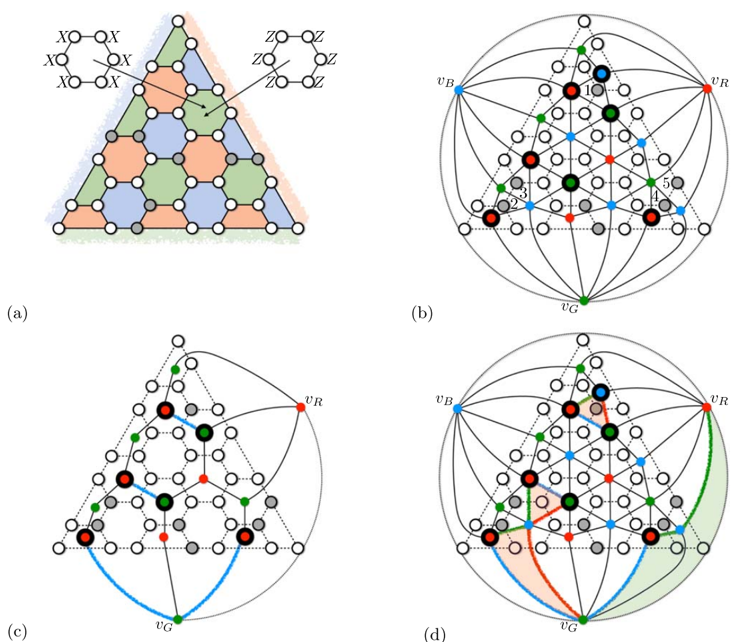
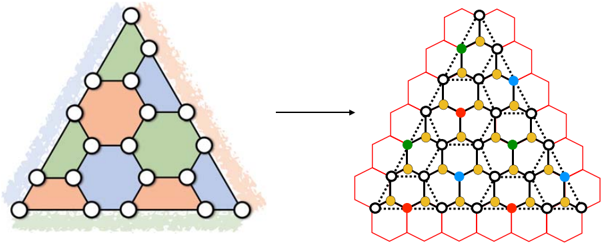
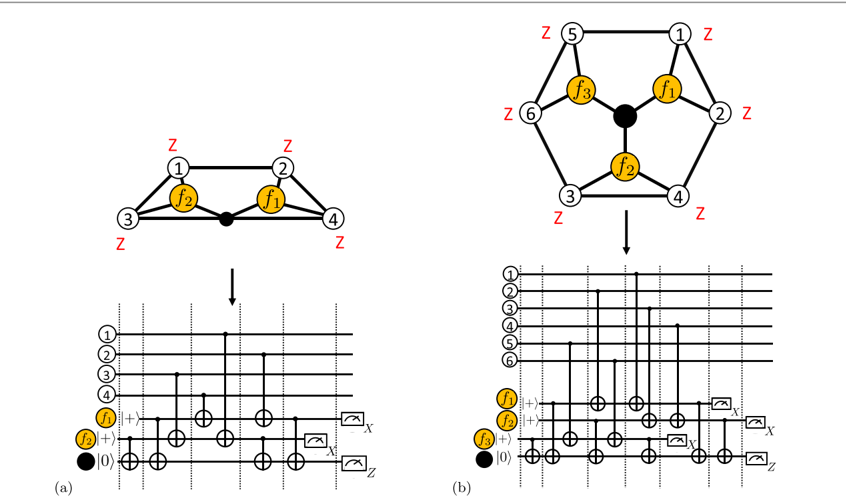
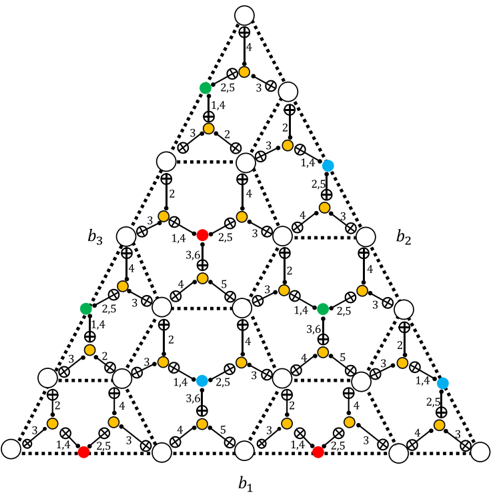
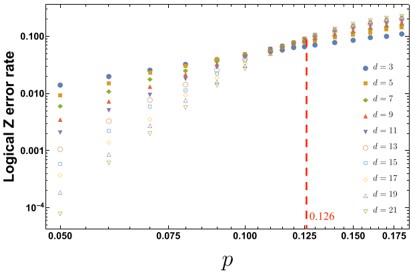
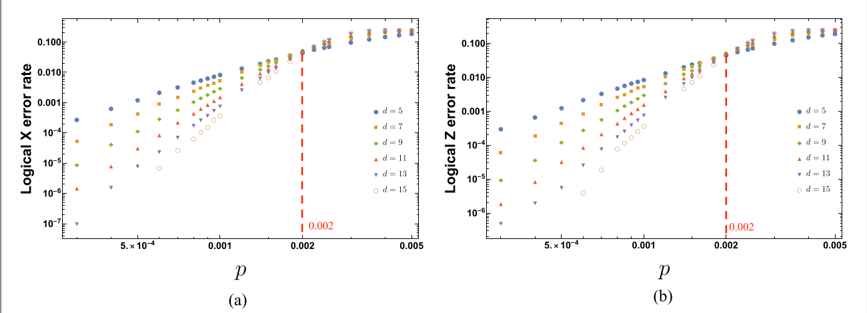
The color code is a topological quantum error-correcting code supporting a variety of valuable fault-tolerant logical gates. Its two-dimensional version, the triangular color code, may soon be realized with currently available superconducting hardware despite constrained qubit connectivity. To guide this experimental effort, we study the storage threshold of the triangular color code against circuit-level depolarizing noise. First, we adapt the Restriction Decoder to the setting of the triangular color code and to phenomenological noise. Then, we propose a fault-tolerant implementation of the stabilizer measurement circuits, which incorporates flag qubits. We show how information from flag qubits can be used in an efficient and scalable way with the Restriction Decoder to maintain the effective distance of the code. We numerically estimate the threshold of the triangular color code to be 0.2%, which is competitive with the thresholds of other topological quantum codes. We also prove that 1-flag stabilizer measurement circuits are sufficient to preserve the full code distance, which may be used to find simpler syndrome extraction circuits of the color code.
Overview
The claims and statistics of this paper haven’t been checked yet.
Free: it reads the open-access text and checks the first 5 claims that cite a source we can check. Create a free account to check every claim.
Integrity signals
Registry
Cites
Statistics
Figures
Verification
Claims the paper makes
The claims and statistics of this paper haven’t been checked yet.
Free: it reads the open-access text and checks the first 5 claims that cite a source we can check. Create a free account to check every claim.
Claims other papers make about this one
Each is checked against this paper’s own text: does it say what the citing paper says it does?
The cited source says what the claim attributes to it.
In the citing paper
“However, we emphasize that the techniques used here directly apply to larger-distance colour codes92.”
From Logical quantum processor based on reconfigurable atom arrays (2024) · cites this paper as [92]
Self-check
Percentages, sums and reported differences re-computed from the paper’s own numbers.
The self-check needs the paper’s full text.
Citations
Cites
Algorithms for quantum computation: discrete logarithms and factoring
Shor, P. W. (2002) · Proceedings 35th Annual Symposium on Foundations of Computer Science · doi:10.1109/sfcs.1994.365700 · Cited by 8,713
Fault-tolerant quantum computation by anyons
Kitaev, A. Y. (2003) · Annals of Physics · doi:10.1016/s0003-4916(02)00018-0 · Cited by 7,238
Surface codes: Towards practical large-scale quantum computation
Fowler, A. G., Mariantoni, M., Martinis, J. M., & Cleland, A. N. (2012) · Physical Review A · doi:10.1103/physreva.86.032324 · Cited by 3,059 · cited 2×
“Measurement errors result in 3D vertical edges connecting the same vertex in two different syndrome measurement rounds (see for instance [60]).”
BackgroundEdmonds, J. (1965) · Canadian Journal of Mathematics · doi:10.4153/cjm-1965-045-4 · Cited by 2,428 · cited 2×
“[50] Jack Edmonds.”
MethodDennis, E., Kitaev, A., Landahl, A., & Preskill, J. (2002) · Journal of Mathematical Physics · doi:10.1063/1.1499754 · Cited by 1,768
Quantum error correction for quantum memories
Terhal, B. M. (2015) · Reviews of Modern Physics · doi:10.1103/revmodphys.87.307 · Cited by 1,354
Quantum computing with realistically noisy devices
Knill, E. (2005) · Nature · doi:10.1038/nature03350 · Cited by 1,184
Stabilizer Codes and Quantum Error Correction
Gottesman, D. (1997) · arXiv · doi:10.48550/arxiv.quant-ph/9705052 · Cited by 753
Topological Quantum Distillation
Bombin, H., & Martin-Delgado, M. A. (2006) · Physical Review Letters · doi:10.1103/physrevlett.97.180501 · Cited by 700 · cited 2×
“The color code is distinguished in this latter sense since, unlike for the toric code, all logical Clifford gates can be implemented transversally [14–17].”
Simple All-Microwave Entangling Gate for Fixed-Frequency Superconducting Qubits
Chow, J. M., Córcoles, A. D., Gambetta, J. M., Rigetti, C., Johnson, B. R., Smolin, J. A., Rozen, J. R., Keefe, G. A., Rothwell, M. B., Ketchen, M. B., et al. (2011) · Physical Review Letters · doi:10.1103/physrevlett.107.080502 · Cited by 464
Restrictions on Transversal Encoded Quantum Gate Sets
Eastin, B., & Knill, E. (2009) · Physical Review Letters · doi:10.1103/physrevlett.102.110502 · Cited by 457 · cited 2×
“[9] Bryan Eastin and Emanuel Knill.”
BackgroundQuantum codes on a lattice with boundary
Bravyi, S. B., & Kitaev, A. Y. (1998) · arXiv · doi:10.48550/arxiv.quant-ph/9811052 · Cited by 394
Rigetti, C., & Devoret, M. (2010) · Physical Review B · doi:10.1103/physrevb.81.134507 · Cited by 356
Surface code quantum computing with error rates over 1%
Wang, D. S., Fowler, A. G., & Hollenberg, L. C. L. (2011) · Physical Review A · doi:10.1103/physreva.83.020302 · Cited by 343
Low-distance surface codes under realistic quantum noise
Tomita, Y., & Svore, K. M. (2014) · Physical Review A · doi:10.1103/physreva.90.062320 · Cited by 281
Topological and Subsystem Codes on Low-Degree Graphs with Flag Qubits
Chamberland, C., Zhu, G., Yoder, T. J., Hertzberg, J. B., & Cross, A. W. (2020) · Physical Review X · doi:10.1103/physrevx.10.011022 · Cited by 223 · cited 6×
“[34], for superconducting qubit architectures with fixed frequency qubits, frequency collisions and cross-talk errors can be reduced by using codes where the degree of the connectivity between qubits is small.”
BackgroundInfluentialSelf-citationQuantum Error Correction with Only Two Extra Qubits
Chao, R., & Reichardt, B. W. (2018) · Physical Review Letters · doi:10.1103/physrevlett.121.050502 · Cited by 221
Gauge color codes: optimal transversal gates and gauge fixing in topological stabilizer codes
Bombín, H. (2015) · New Journal of Physics · doi:10.1088/1367-2630/17/8/083002 · Cited by 217
Subsystem Fault Tolerance with the Bacon-Shor Code
Aliferis, P., & Cross, A. W. (2007) · Physical Review Letters · doi:10.1103/physrevlett.98.220502 · Cited by 203
Flag fault-tolerant error correction with arbitrary distance codes
Chamberland, C., & Beverland, M. E. (2018) · Quantum · doi:10.22331/q-2018-02-08-53 · Cited by 159
Self-citationClassification of Topologically Protected Gates for Local Stabilizer Codes
Bravyi, S., & König, R. (2013) · Physical Review Letters · doi:10.1103/physrevlett.110.170503 · Cited by 151
Strong Resilience of Topological Codes to Depolarization
Bombin, H., Andrist, R. S., Ohzeki, M., Katzgraber, H. G., & Martin-Delgado, M. A. (2012) · Physical Review X · doi:10.1103/physrevx.2.021004 · Cited by 149
Kubica, A., Yoshida, B., & Pastawski, F. (2015) · New Journal of Physics · doi:10.1088/1367-2630/17/8/083026 · Cited by 148
Self-citationTransversality Versus Universality for Additive Quantum Codes
Zeng, B., Cross, A., & Chuang, I. L. (2011) · IEEE Transactions on Information Theory · doi:10.1109/tit.2011.2161917 · Cited by 138
Fault-tolerant quantum computation with few qubits
Chao, R., & Reichardt, B. W. (2018) · npj Quantum Information · doi:10.1038/s41534-018-0085-z · Cited by 137
Effective Fault-Tolerant Quantum Computation with Slow Measurements
DiVincenzo, D. P., & Aliferis, P. (2007) · Physical Review Letters · doi:10.1103/physrevlett.98.020501 · Cited by 135
Universal transversal gates with color codes: A simplified approach
Kubica, A., & Beverland, M. E. (2015) · Physical Review A · doi:10.1103/physreva.91.032330 · Cited by 128
Self-citationError Threshold for Color Codes and Random Three-Body Ising Models
Katzgraber, H. G., Bombin, H., & Martin-Delgado, M. A. (2009) · Physical Review Letters · doi:10.1103/physrevlett.103.090501 · Cited by 125
Tailoring Surface Codes for Highly Biased Noise
Tuckett, D. K., Darmawan, A. S., Chubb, C. T., Bravyi, S., Bartlett, S. D., & Flammia, S. T. (2019) · Physical Review X · doi:10.1103/physrevx.9.041031 · Cited by 124
Fault-tolerant error correction with the gauge color code
Brown, B. J., Nickerson, N. H., & Browne, D. E. (2016) · Nature Communications · doi:10.1038/ncomms12302 · Cited by 104
Fault-tolerant logical gates in quantum error-correcting codes
Pastawski, F., & Yoshida, B. (2015) · Physical Review A · doi:10.1103/physreva.91.012305 · Cited by 102
Universal topological phase of two-dimensional stabilizer codes
Bombin, H., Duclos-Cianci, G., & Poulin, D. (2012) · New Journal of Physics · doi:10.1088/1367-2630/14/7/073048 · Cited by 94
Decoding color codes by projection onto surface codes
Delfosse, N. (2014) · Physical Review A · doi:10.1103/physreva.89.012317 · Cited by 90
Deep neural decoders for near term fault-tolerant experiments
Chamberland, C., & Ronagh, P. (2018) · Quantum Science and Technology · doi:10.1088/2058-9565/aad1f7 · Cited by 86
Self-citationHardness of Decoding Quantum Stabilizer Codes
Iyer, P., & Poulin, D. (2015) · IEEE Transactions on Information Theory · doi:10.1109/tit.2015.2422294 · Cited by 83
Fault-tolerant magic state preparation with flag qubits
Chamberland, C., & Cross, A. W. (2019) · Quantum · doi:10.22331/q-2019-05-20-143 · Cited by 83
Self-citationThree-Dimensional Color Code Thresholds via Statistical-Mechanical Mapping
Kubica, A., Beverland, M. E., Brandão, F. G. S. L., Preskill, J. P., & Svore, K. M. (2018) · Physical Review Letters · doi:10.1103/physrevlett.120.180501 · Cited by 82
Self-citationFault-tolerant quantum computing with color codes
Landahl, A. J., Anderson, J. T., & Rice, P. R. (2011) · arXiv · doi:10.48550/arxiv.1108.5738 · Cited by 79
Advantages of versatile neural-network decoding for topological codes
Maskara, N., Kubica, A., & Jochym-O'Connor, T. (2019) · Physical Review A · doi:10.1103/physreva.99.052351 · Cited by 77
Self-citationNP-hardness of decoding quantum error-correction codes
Hsieh, M.-H., & Le Gall, F. (2011) · Physical Review A · doi:10.1103/physreva.83.052331 · Cited by 71
Neural network decoder for topological color codes with circuit level noise
Baireuther, P., Caio, M. D., Criger, B., Beenakker, C. W. J., & O’Brien, T. E. (2019) · New Journal of Physics · doi:10.1088/1367-2630/aaf29e · Cited by 65
Fault-tolerant preparation of approximate GKP states
Shi, Y., Chamberland, C., & Cross, A. (2019) · New Journal of Physics · doi:10.1088/1367-2630/ab3a62 · Cited by 63
Self-citationKesselring, M. S., Pastawski, F., Eisert, J., & Brown, B. J. (2018) · Quantum · doi:10.22331/q-2018-10-19-101 · Cited by 58
Reichardt, B. W. (2021) · Quantum Science and Technology · doi:10.1088/2058-9565/abc6f4 · Cited by 56
Fault-tolerant quantum computing in the Pauli or Clifford frame with slow error diagnostics
Chamberland, C., Iyer, P., & Poulin, D. (2018) · Quantum · doi:10.22331/q-2018-01-04-43 · Cited by 53
Self-citationEfficient decoding of topological color codes
Sarvepalli, P., & Raussendorf, R. (2012) · Physical Review A · doi:10.1103/physreva.85.022317 · Cited by 51
Disjointness of Stabilizer Codes and Limitations on Fault-Tolerant Logical Gates
Jochym-O’Connor, T., Kubica, A., & Yoder, T. J. (2018) · Physical Review X · doi:10.1103/physrevx.8.021047 · Cited by 48
Self-citationLi, M., Miller, D., Newman, M., Wu, Y., & Brown, K. R. (2019) · Physical Review X · doi:10.1103/physrevx.9.021041 · Cited by 48
Tansuwannont, T., Chamberland, C., & Leung, D. (2020) · Physical Review A · doi:10.1103/physreva.101.012342 · Cited by 41
Self-citationKubica, A. (2018) · CaltechTHESIS (California Institute of Technology) · doi:10.7907/059v-mg69 · Cited by 27
Self-citationAn Introduction to Topological Quantum Codes
Bombin, H. (2013) · arXiv · doi:10.48550/arxiv.1311.0277 · Cited by 25
Projecting three-dimensional color codes onto three-dimensional toric codes
Aloshious, A. B., & Sarvepalli, P. K. (2018) · Physical Review A · doi:10.1103/physreva.98.012302 · Cited by 14
Efficient color code decoders in $d\geq 2$ dimensions from toric code decodersPreprint
Kubica, A., & Delfosse, N. (2019) · arXiv (Cornell University) · doi:10.48550/arxiv.1905.07393 · Cited by 6
Self-citationToward Realizable Quantum Computers
Beverland, M. E. (2016) · CaltechTHESIS (California Institute of Technology) · doi:10.7907/z96m34sc · Cited by 6
Research works printed but not linked: 1
- Wang, 2010, Graphical algorithms and threshold error rates for the 2d colour code, Quantum Inf. Comput., 10, 780
Cited by
Logical quantum processor based on reconfigurable atom arrays
Bluvstein, D., Evered, S. J., Geim, A. A., Li, S. H., Zhou, H., Manovitz, T., Ebadi, S., Cain, M., Kalinowski, M., Hangleiter, D., et al. (2024) · Nature · doi:10.1038/s41586-023-06927-3 · Cited by 1,119
“This d = 3 colour code is identical to the seven-qubit Steane code. we emphasize that the techniques used here directly apply to larger-distance colour codes 92 .”
MethodBuilding a Fault-Tolerant Quantum Computer Using Concatenated Cat Codes
Chamberland, C., Noh, K., Arrangoiz-Arriola, P., Campbell, E. T., Hann, C. T., Iverson, J., Putterman, H., Bohdanowicz, T. C., Flammia, S. T., Keller, A., et al. (2022) · PRX Quantum · doi:10.1103/prxquantum.3.010329 · Cited by 281
Self-citationEncoding a magic state with beyond break-even fidelity
Gupta, R. S., Sundaresan, N., Alexander, T., Wood, C. J., Merkel, S. T., Healy, M. B., Hillenbrand, M., Jochym-O’Connor, T., Wootton, J. R., Yoder, T. J., et al. (2024) · Nature · doi:10.1038/s41586-023-06846-3 · Cited by 115
Self-citationEfficient classical simulation of noisy random quantum circuits in one dimension
Noh, K., Jiang, L., & Fefferman, B. (2020) · Quantum · doi:10.22331/q-2020-09-11-318 · Cited by 172
“, to perform a detailed circuit-level noise analysis) [8, 9, 16, 19–24].”
MethodFault-Tolerant Continuous-Variable Measurement-based Quantum Computation Architecture
Larsen, M. V., Chamberland, C., Noh, K., Neergaard-Nielsen, J. S., & Andersen, U. L. (2021) · PRX Quantum · doi:10.1103/prxquantum.2.030325 · Cited by 99
Self-citation
Metadata
- Authors
- Chamberland, C., Kubica, A., Yoder, T. J., & Zhu, G.
- Affiliations
- IBM Research - Thomas J. Watson Research Center (US)
- University of Waterloo (CA)
- Corresponding author
- Chamberland, Christopher
- Venue
- New Journal of Physics
- Publisher
- IOP Publishing
- Published
- 2020-02-01
- Volume
- 22
- Issue
- 2
- Pages
- 023019
- ISSN
- 1367-2630 (ISSN-L)
- OpenAlex
- W2984245858
- Cited by
- 105
- References
- 56
- Citations by year
- 2026: 4 · 2025: 14 · 2024: 22 · 2023: 17 · 2022: 17 · 2021: 19 · 2020: 12
- FWCI
- 6.38
- Type
- journal article
- Language
- en
- Open access
- gold
- doi.org
- Licence
- cc-by
- creativecommons.org/licenses/by/4.0/ (vor, 6 d)
- iopscience.iop.org/info/page/text-and-data-mining (tdm, 6 d)
- Locations
- New Journal of Physics (publishedVersion, cc-by)
- arXiv (Cornell University) (submittedVersion)
- DOAJ (DOAJ: Directory of Open Access Journals) (submittedVersion)
- Funders
- Intelligence Advanced Research Projects Activity (W911NF-16-0114)
- Topics
- Physical Sciences › Computer Science › Artificial Intelligence › Quantum Computing Algorithms and Architecture
- Physical Sciences › Physics and Astronomy › Atomic and Molecular Physics, and Optics › Quantum Information and Cryptography
- Physical Sciences › Physics and Astronomy › Atomic and Molecular Physics, and Optics › Quantum many-body systems
- Keywords
- topological quantum error correction, depolarizing noise, syndrome extraction, code distance, cubic graphs, superconducting qubits, fault-tolerant quantum computing
About these checks
Registry, retraction, Cites and statistics results are computed, not judged, with one exception: a printed reference that no index lists is read once by a model before it counts as a citation error. Claims are extracted by a model and kept only when their quote appears verbatim in the text; each cited source is then checked, with a model’s help, for whether it says what the claim relies on. Those verdicts can be wrong — read the claim’s quote and the cited source before relying on one.
Statistics and arithmetic are recomputed, not judged.
Confidence bands are shown only for fields calibrated on our annotated test set. None is calibrated yet, so no band is shown.
What counts as a claim ›How we measure confidence ›How we check this ›
Are you an author, or do you see a problem with this page? Request a review
Data sources
Bibliographic data: Semantic Scholar, OpenAlex, Crossref.
Contains information from the Semantic Scholar Academic Graph Datasets, made available under the ODC Attribution License (ODC-BY 1.0).
Semantic Scholar’s data is described in: Kinney, R., et al. (2023). The Semantic Scholar Open Data Platform. arXiv:2301.10140.
