

Triangular color codes on trivalent graphs with flag qubits
Open accessThe DOI matches its Crossref record; 55 of the 56 references it cites were found in a registry or an index.
Abstract
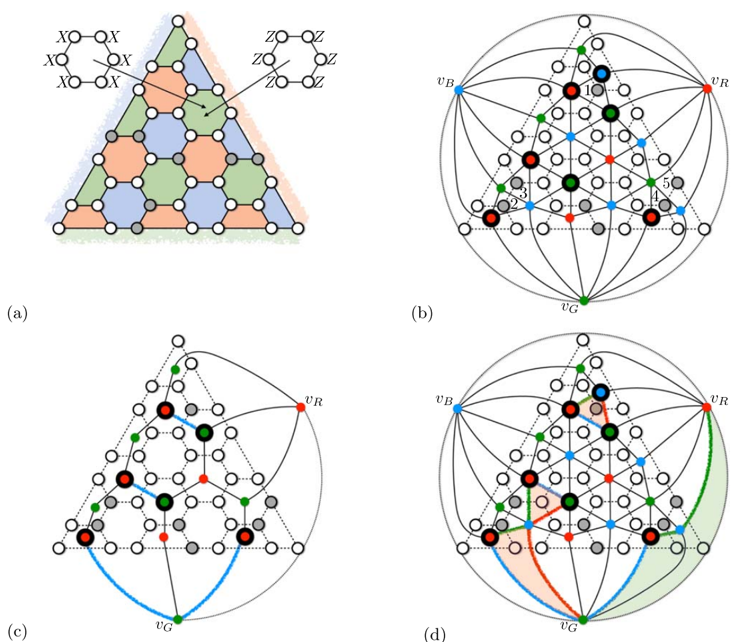
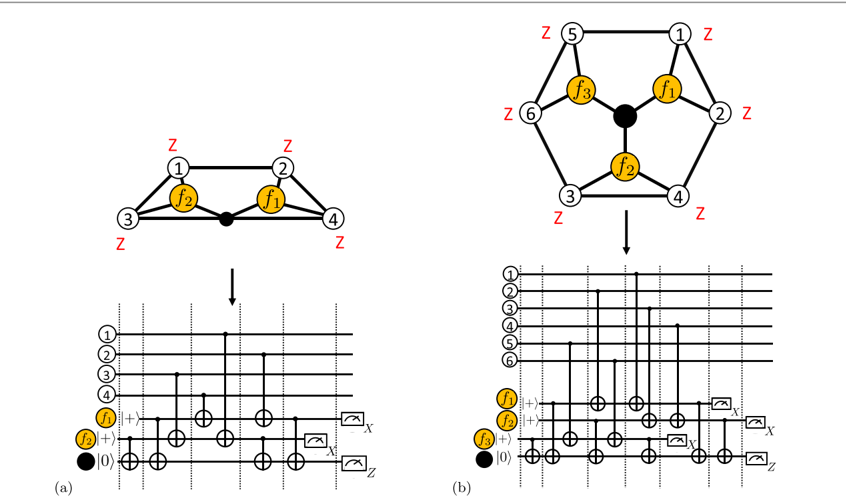
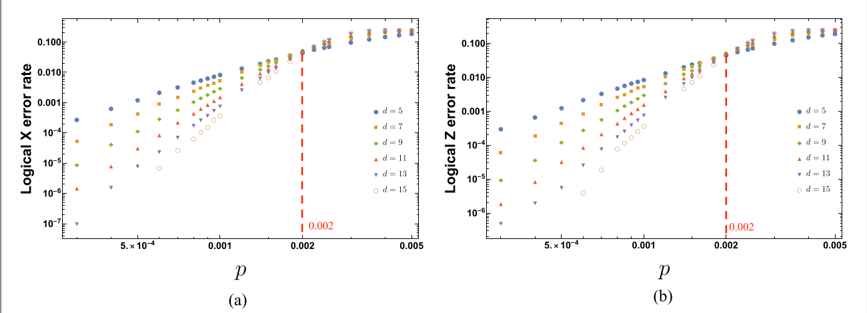
The color code is a topological quantum error-correcting code supporting a variety of valuable fault-tolerant logical gates. Its two-dimensional version, the triangular color code, may soon be realized with currently available superconducting hardware despite constrained qubit connectivity. To guide this experimental effort, we study the storage threshold of the triangular color code against circuit-level depolarizing noise. First, we adapt the Restriction Decoder to the setting of the triangular color code and to phenomenological noise. Then, we propose a fault-tolerant implementation of the stabilizer measurement circuits, which incorporates flag qubits. We show how information from flag qubits can be used in an efficient and scalable way with the Restriction Decoder to maintain the effective distance of the code. We numerically estimate the threshold of the triangular color code to be 0.2%, which is competitive with the thresholds of other topological quantum codes. We also prove that 1-flag stabilizer measurement circuits are sufficient to preserve the full code distance, which may be used to find simpler syndrome extraction circuits of the color code.
Overview
The claims and statistics of this paper haven’t been checked yet.
Free: it reads the open-access text and checks the first 5 claims that cite a source we can check. Create a free account to check every claim.
Integrity signals
Registry
Cites
Statistics
Figures
Verification
Claims the paper makes
The claims and statistics of this paper haven’t been checked yet.
Free: it reads the open-access text and checks the first 5 claims that cite a source we can check. Create a free account to check every claim.
Claims other papers make about this one
Each is checked against this paper’s own text: does it say what the citing paper says it does?
The cited source says what the claim attributes to it.
In the citing paper
“However, we emphasize that the techniques used here directly apply to larger-distance colour codes92.”
From Logical quantum processor based on reconfigurable atom arrays (2024) · cites this paper as [92]
Self-check
Percentages, sums and reported differences re-computed from the paper’s own numbers.
The self-check needs the paper’s full text.
Citations
Cites
Algorithms for quantum computation: discrete logarithms and factoring
Shor, P. W. (2002) · Proceedings 35th Annual Symposium on Foundations of Computer Science · doi:10.1109/sfcs.1994.365700 · Cited by 8,713 · cited 2×
“[1] P.”
BackgroundFault-tolerant quantum computation by anyons
Kitaev, A. Y. (2003) · Annals of Physics · doi:10.1016/s0003-4916(02)00018-0 · Cited by 7,238
Surface codes: Towards practical large-scale quantum computation
Fowler, A. G., Mariantoni, M., Martinis, J. M., & Cleland, A. N. (2012) · Physical Review A · doi:10.1103/physreva.86.032324 · Cited by 3,059 · cited 2×
“Measurement errors result in 3D vertical edges connecting the same vertex in two different syndrome measurement rounds (see for instance [60]).”
BackgroundEdmonds, J. (1965) · Canadian Journal of Mathematics · doi:10.4153/cjm-1965-045-4 · Cited by 2,428 · cited 2×
“[50] Jack Edmonds.”
MethodDennis, E., Kitaev, A., Landahl, A., & Preskill, J. (2002) · Journal of Mathematical Physics · doi:10.1063/1.1499754 · Cited by 1,768
Quantum error correction for quantum memories
Terhal, B. M. (2015) · Reviews of Modern Physics · doi:10.1103/revmodphys.87.307 · Cited by 1,354
Quantum computing with realistically noisy devices
Knill, E. (2005) · Nature · doi:10.1038/nature03350 · Cited by 1,184
Stabilizer Codes and Quantum Error Correction
Gottesman, D. (1997) · arXiv · doi:10.48550/arxiv.quant-ph/9705052 · Cited by 753
Topological Quantum Distillation
Bombin, H., & Martin-Delgado, M. A. (2006) · Physical Review Letters · doi:10.1103/physrevlett.97.180501 · Cited by 700 · cited 2×
“The color code is distinguished in this latter sense since, unlike for the toric code, all logical Clifford gates can be implemented transversally [14–17].”
Simple All-Microwave Entangling Gate for Fixed-Frequency Superconducting Qubits
Chow, J. M., Córcoles, A. D., Gambetta, J. M., Rigetti, C., Johnson, B. R., Smolin, J. A., Rozen, J. R., Keefe, G. A., Rothwell, M. B., Ketchen, M. B., et al. (2011) · Physical Review Letters · doi:10.1103/physrevlett.107.080502 · Cited by 464
Research works printed but not linked: 3
- Calderbank A R, Rains E M, Shor P W and Sloane N J A 1996 Quantum Error Correction via Codes over GF(4) arXiv:quant-ph/ 9608006
- Wang D S, Fowler A G, Hill C D and Hollenberg L C L 2010 Graphical algorithms and threshold error rates for the 2d colour code Quantum Inf. Comput. 10 780
- Debroy D M, Li M, Huang S and Brown K R 2019 Logical performance of 9 qubit compass codes in ion traps with crosstalk errors arXiv:1910.08495 · arXiv
Cited by
Logical quantum processor based on reconfigurable atom arrays
Bluvstein, D., Evered, S. J., Geim, A. A., Li, S. H., Zhou, H., Manovitz, T., Ebadi, S., Cain, M., Kalinowski, M., Hangleiter, D., et al. (2024) · Nature · doi:10.1038/s41586-023-06927-3 · Cited by 1,119
“This d = 3 colour code is identical to the seven-qubit Steane code. we emphasize that the techniques used here directly apply to larger-distance colour codes 92 .”
MethodBuilding a Fault-Tolerant Quantum Computer Using Concatenated Cat Codes
Chamberland, C., Noh, K., Arrangoiz-Arriola, P., Campbell, E. T., Hann, C. T., Iverson, J., Putterman, H., Bohdanowicz, T. C., Flammia, S. T., Keller, A., et al. (2022) · PRX Quantum · doi:10.1103/prxquantum.3.010329 · Cited by 281
Self-citationEncoding a magic state with beyond break-even fidelity
Gupta, R. S., Sundaresan, N., Alexander, T., Wood, C. J., Merkel, S. T., Healy, M. B., Hillenbrand, M., Jochym-O’Connor, T., Wootton, J. R., Yoder, T. J., et al. (2024) · Nature · doi:10.1038/s41586-023-06846-3 · Cited by 115
Self-citationEfficient classical simulation of noisy random quantum circuits in one dimension
Noh, K., Jiang, L., & Fefferman, B. (2020) · Quantum · doi:10.22331/q-2020-09-11-318 · Cited by 174
“, to perform a detailed circuit-level noise analysis) [8, 9, 16, 19–24].”
MethodFault-Tolerant Continuous-Variable Measurement-based Quantum Computation Architecture
Larsen, M. V., Chamberland, C., Noh, K., Neergaard-Nielsen, J. S., & Andersen, U. L. (2021) · PRX Quantum · doi:10.1103/prxquantum.2.030325 · Cited by 99
Self-citationFlag Fault-Tolerant Error Correction for any Stabilizer Code
Chao, R., & Reichardt, B. W. (2020) · PRX Quantum · doi:10.1103/prxquantum.1.010302 · Cited by 95
A Fault-Tolerant Honeycomb Memory
Gidney, C., Newman, M., Fowler, A., & Broughton, M. (2021) · Quantum · doi:10.22331/q-2021-12-20-605 · Cited by 83
Beverland, M. E., Kubica, A., & Svore, K. M. (2021) · PRX Quantum · doi:10.1103/prxquantum.2.020341 · Cited by 82
Self-citationUniversal Quantum Computing with Twist-Free and Temporally Encoded Lattice Surgery
Chamberland, C., & Campbell, E. T. (2022) · PRX Quantum · doi:10.1103/prxquantum.3.010331 · Cited by 80
“[45, 46] with the exception that two idle locations were included during measurement and re-initialization of the ancillas.”
BackgroundSelf-citationLow-Overhead Fault-Tolerant Quantum Error Correction with the Surface-GKP Code
Noh, K., Chamberland, C., & Brandão, F. G. S. L. (2022) · PRX Quantum · doi:10.1103/prxquantum.3.010315 · Cited by 75
Self-citationChamberland, C., & Noh, K. (2020) · npj Quantum Information · doi:10.1038/s41534-020-00319-5 · Cited by 71
Self-citationFault-Tolerant Parity Readout on a Shuttling-Based Trapped-Ion Quantum Computer
Hilder, J., Pijn, D., Onishchenko, O., Stahl, A., Orth, M., Lekitsch, B., Rodriguez-Blanco, A., Müller, M., Schmidt-Kaler, F., & Poschinger, U. G. (2022) · Physical Review X · doi:10.1103/physrevx.12.011032 · Cited by 66
Real-time decoding for fault-tolerant quantum computing: progress, challenges and outlook
Battistel, F., Chamberland, C., Johar, K., Overwater, R. W. J., Sebastiano, F., Skorić, L., Ueno, Y., & Usman, M. (2023) · Nano Futures · doi:10.1088/2399-1984/aceba6 · Cited by 168
“While polynomially-efficient decoders for color codes have been proposed [48, 49], further work is required in order to improve performance in realistic conditions in the presence of circuit-level noise [50].”
BackgroundSelf-citationCrosstalk Suppression for Fault-tolerant Quantum Error Correction with Trapped Ions
Parrado-Rodríguez, P., Ryan-Anderson, C., Bermudez, A., & Müller, M. (2021) · Quantum · doi:10.22331/q-2021-06-29-487 · Cited by 60
Fault-tolerant weighted union-find decoding on the toric code
Huang, S., Newman, M., & Brown, K. R. (2020) · Physical Review A · doi:10.1103/physreva.102.012419 · Cited by 58
Crosstalk Suppression for Fault-tolerant Quantum Error Correction with Trapped IonsPreprint
Parrado-Rodríguez, P., Ryan-Anderson, C., Bermúdez, A., & Müller, M. (2020) · RWTH Publications (RWTH Aachen) · Cited by 52
Path-Independent Quantum Gates with Noisy Ancilla
Ma, W.-L., Zhang, M., Wong, Y., Noh, K., Rosenblum, S., Reinhold, P., Schoelkopf, R. J., & Jiang, L. (2020) · Physical Review Letters · doi:10.1103/physrevlett.125.110503 · Cited by 45
Vasmer, M., & Kubica, A. (2022) · PRX Quantum · doi:10.1103/prxquantum.3.030319 · Cited by 39
“For our decoder to be directly applicable to this situation, we would need to modify our algorithm to work for codes with boundaries, but we expect that this modification would proceed in a similar way to the restriction decoder [60].”
MethodSelf-citationDecoder for the Triangular Color Code by Matching on a Möbius Strip
Sahay, K., & Brown, B. J. (2022) · PRX Quantum · doi:10.1103/prxquantum.3.010310 · Cited by 38
“This strategy is commonly adopted elsewhere in the literature, see for instance [24, 25, 52, 76].”
MethodInfluentialHigh-fidelity light-shift gate for clock-state qubits
Baldwin, C. H., Bjork, B., Foss‐Feig, M., Gaebler, J., Hayes, D., Kokish, M., Langer, C., Sedlacek, J. A., Stack, D. T., & Vittorini, G. (2021) · Physical Review A · doi:10.1103/physreva.103.012603 · Cited by 46
Local Predecoder to Reduce the Bandwidth and Latency of Quantum Error Correction
Smith, S. C., Brown, B. J., & Bartlett, S. D. (2023) · Physical Review Applied · doi:10.1103/physrevapplied.19.034050 · Cited by 52
Techniques for combining fast local decoders with global decoders under circuit-level noise
Chamberland, C., Goncalves, L., Sivarajah, P., Peterson, E., & Grimberg, S. (2023) · Quantum Science and Technology · doi:10.1088/2058-9565/ace64d · Cited by 75
“This noise model is similar to the one used in [56, 57].”
Self-citationEfficient color code decoders in d≥2 dimensions from toric code decoders
Kubica, A., & Delfosse, N. (2023) · Quantum · doi:10.22331/q-2023-02-21-929 · Cited by 29
“We do not perceive any fundamental difficulties with incorporating a possibility of measurement errors into the Restriction Decoder, as well as incorporating the boundaries; see, for instance, the follow-up work [63].”
BackgroundSelf-citationFault-Tolerant Code-Switching Protocols for Near-Term Quantum Processors
Butt, F., Heußen, S., Rispler, M., & Müller, M. (2024) · PRX Quantum · doi:10.1103/prxquantum.5.020345 · Cited by 41
“The concept of flag qubits was introduced in [52] and has, for example, been used for FT error correction in color codes in two and three dimensions [48, 53, 54] and the initialization of logical qubits [40–42].”
MethodTownsend-Teague, A., de la Fuente, J. C. M., & Kesselring, M. S. (2023) · Electronic Proceedings in Theoretical Computer Science · doi:10.4204/eptcs.384.14 · Cited by 61
Quantum computation from dynamic automorphism codes
Davydova, M. D., Tantivasadakarn, N., Balasubramanian, S., & Aasen, D. (2024) · Quantum · doi:10.22331/q-2024-08-27-1448 · Cited by 73
Circuit-level protocol and analysis for twist-based lattice surgery
Chamberland, C., & Campbell, E. T. (2022) · Physical Review Research · doi:10.1103/physrevresearch.4.023090 · Cited by 43
Self-citationLooped Pipelines Enabling Effective 3D Qubit Lattices in a Strictly 2D Device
Cai, Z., Siegel, A. C., & Benjamin, S. C. (2023) · PRX Quantum · doi:10.1103/prxquantum.4.020345 · Cited by 41
Generating Fault-Tolerant Cluster States from Crystal Structures
Newman, M., de Castro, L. A., & Brown, K. R. (2020) · Quantum · doi:10.22331/q-2020-07-13-295 · Cited by 40
“However, the sacrifice is often worth the cost, as locality is more valuable than it might appear at the level of gate errors [80, 81, 106].”
BackgroundFour-dimensional toric code with non-Clifford transversal gates
Jochym-O’Connor, T., & Yoder, T. J. (2021) · Physical Review Research · doi:10.1103/physrevresearch.3.013118 · Cited by 29
“Such codes provide numerous computing advantages including a pathway for experimental qubit layout [2–6], efficient decoding algorithms [7–12], and provable target threshold error rates for numerous local noise models [2, 13, 14].”
BackgroundSelf-citationExtended flag gadgets for low-overhead circuit verification
Debroy, D. M., & Brown, K. R. (2020) · Physical Review A · doi:10.1103/physreva.102.052409 · Cited by 36
Adaptive syndrome measurements for Shor-style error correction
Tansuwannont, T., Pató, B., & Brown, K. R. (2023) · Quantum · doi:10.22331/q-2023-08-08-1075 · Cited by 45
“the schemes for certain families of codes may require fewer [23, 25, 26, 27, 28, 29, 19].”
BackgroundQuFI: a Quantum Fault Injector to Measure the Reliability of Qubits and Quantum Circuits
Oliveira, D. V., Giusto, E., Dri, E., Casciola, N., Baheri, B., Guan, Q., Montrucchio, B., & Rech, P. (2022) · International Conference on Dependable Systems & Networks/Proceedings · doi:10.1109/dsn53405.2022.00025 · Cited by 24
Color code decoder with improved scaling for correcting circuit-level noise
Lee, S.-H., Li, A., & Bartlett, S. D. (2025) · Quantum · doi:10.22331/q-2025-01-27-1609 · Cited by 16
“11(a), we schematize an error with weight O ( d/ 3) that is uncorrectable via the projection decoder [19, 20, 23].”
Low-overhead quantum computing with the color code
Thomsen, F., Kesselring, M. S., Bartlett, S. D., & Brown, B. J. (2024) · Physical Review Research · doi:10.1103/physrevresearch.6.043125 · Cited by 15
Achieving Fault Tolerance on Capped Color Codes with Few Ancillas
Tansuwannont, T., & Leung, D. (2022) · PRX Quantum · doi:10.1103/prxquantum.3.030322 · Cited by 22
Quantum error correction with the color-Gottesman-Kitaev-Preskill code
Zhang, J., Zhao, J., Wu, Y.-C., & Guo, G. (2021) · Physical Review A · doi:10.1103/physreva.104.062434 · Cited by 20
“[55] Christopher Chamberland, Aleksander Kubica, Theodore J Yoder, and Guanyu Zhu.”
BackgroundMethodInfluentialFault-Tolerant Continuous-Variable Measurement-based Quantum Computation Architecture
Larsen, M. V., Chamberland, C., Noh, K., Neergaard-Nielsen, J. S., & Andersen, U. L. (2021) · Technical University of Denmark, DTU Orbit (Technical University of Denmark, DTU) · Cited by 13
Self-citationA Systematic Methodology to Compute the Quantum Vulnerability Factors for Quantum Circuits
Oliveira, D., Giusto, E., Baheri, B., Guan, Q., Montrucchio, B., & Rech, P. (2023) · IEEE Transactions on Dependable and Secure Computing · doi:10.1109/tdsc.2023.3313934 · Cited by 24
“The turning point that made the intriguing theory of quantum computing a promising computing paradigm was the achievement of sufficiently fault tolerant qubits to allow the computation of small, yet crucial, circuits [5], [6].”
BackgroundFundamental thresholds of realistic quantum error correction circuits from classical spin models
Vodola, D., Rispler, M., Kim, S., & Müller, M. (2022) · Quantum · doi:10.22331/q-2022-01-05-618 · Cited by 25
Zhu, G., Sikander, S., Portnoy, E., Cross, A. W., & Brown, B. J. (2025) · PRX Quantum · doi:10.1103/wcxs-w69t · Cited by 82
“…on the construction of LDPC color codes supported on 3-manifolds which have transversal T and S gates as the logical gates, one might worry that the color code stabilizers have relatively large weight and the decoding for 3D color code also may be more sophisticated than the 3D toric codes [78].”
Self-citationFacilitating practical fault-tolerant quantum computing based on color codes
Zhang, J., Wu, Y.-C., & Guo, G.-P. (2024) · Physical Review Research · doi:10.1103/physrevresearch.6.033086 · Cited by 12
“[14] Christopher Chamberland, Aleksander Kubica, Theodore J Yoder, and Guanyu Zhu.”
BackgroundFault-tolerant quantum error correction using error weight parities
Tansuwannont, T., & Leung, D. (2021) · Physical Review A · doi:10.1103/physreva.104.042410 · Cited by 13
Trellis Decoding for Qudit Stabilizer Codes and Its Application to Qubit Topological Codes
Sabo, E., Aloshious, A. B., & Brown, K. R. (2024) · IEEE Transactions on Quantum Engineering · doi:10.1109/tqe.2024.3401857 · Cited by 21
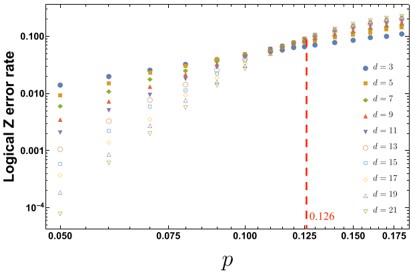
“This was modified to include boundaries in [75], which reports a full depolarizing noise threshold of 12.6% for the 6.6.6 lattice, which results in a Z threshold of roughly 8.4%.”
BackgroundInfluentialEfficient fault-tolerant code switching via one-way transversal CNOT gates
Heußen, S., & Hilder, J. (2025) · Quantum · doi:10.22331/q-2025-09-03-1846 · Cited by 12
Shutty, N., & Chamberland, C. (2022) · Physical Review Applied · doi:10.1103/physrevapplied.18.014072 · Cited by 23
“) The implementation of the Lift subroutine is easily and efficiently implemented using bruteforce search or linear algebra techniques, as described in [3].”
BackgroundMethodInfluentialSelf-citationImproving Threshold for Fault-Tolerant Color-Code Quantum Computing by Flagged Weight Optimization
Takada, Y., & Fujii, K. (2024) · PRX Quantum · doi:10.1103/prxquantum.5.030352 · Cited by 10
“[10], a method is proposed to account for the impact of correlated errors in color codes by adding additional edges in the decoding graph.”
BackgroundMethodInfluentialRecurrent neural network decoding of rotated surface codes based on distributed strategy
李, F. 帆. L., Li, A.-Q., Qi-Di, G. A. N., & 马, H.-Y. 鸿. M. (2024) · Chinese Physics B · doi:10.1088/1674-1056/ad2bef · Cited by 10
Low-Overhead Magic State Distillation with Color Codes
Lee, S.-H., Thomsen, F., Fazio, N., Brown, B. J., & Bartlett, S. D. (2025) · PRX Quantum · doi:10.1103/ch5r-cnfq · Cited by 49
On maximum-likelihood decoding with circuit-level errors
Pryadko, L. P. (2020) · Quantum · doi:10.22331/q-2020-08-06-304 · Cited by 20
“[11] Christopher Chamberland, Aleksander Kubica, Theodore J Yoder, and Guanyu Zhu, “Triangular color codes on trivalent graphs with flag qubits,” New”
BackgroundBomantara, R. W., & Gong, J. (2020) · Journal of Physics Condensed Matter · doi:10.1088/1361-648x/aba291 · Cited by 16
Alibaba Cloud Quantum Development Platform: Surface Code Simulations with CrosstalkPreprint
Huang, C., Ni, X., Zhang, F., Newman, M., Ding, D., Gao, X., Wang, T., Zhao, H., Wu, F., Zhang, G., et al. (2020) · arXiv (Cornell University) · doi:10.48550/arxiv.2002.08918 · Cited by 27
“mains a significant experimental error, with physical solutions like tunable couplers [4] or sparse lattice geometries [11, 38, 10] being proposed to combat it.”
BackgroundMagic state distillation and cost analysis in fault-tolerant universal quantum computation
Liu, Y., Ma, Z., Luo, L., Du, C., Fei, Y., Wang, H., Duan, Q., & Yang, J. (2023) · Quantum Science and Technology · doi:10.1088/2058-9565/ace6ca · Cited by 11
“However, the weight-4 stabilizers are identical to those in [124].”
de la Fuente, J. C. M., Old, J., Townsend-Teague, A., Rispler, M., Eisert, J., & Müller, M. (2025) · PRX Quantum · doi:10.1103/prxquantum.6.010360 · Cited by 32
Lee, S.-H., & Jeong, H. (2022) · Physical Review Research · doi:10.1103/physrevresearch.4.013010 · Cited by 12
Very low overhead fault-tolerant quantum error correction with the surface-GKP codePreprint
Noh, K., Chamberland, C., & Brandão, F. G. S. L. (2021) · arXiv (Cornell University) · Cited by 9
Self-citationRobust sparse IQP sampling in constant depth
Paletta, L., Leverrier, A., Sarlette, A., Mirrahimi, M., & Vuillot, C. (2024) · Quantum · doi:10.22331/q-2024-05-06-1337 · Cited by 8
“Here we have only used 2D and 3D color codes decoders and therefore the existence of efficient 2D and 3D color code decoders [35, 38, 36, 37] implies the existence of an efficient decoder for the tetrahelix code.”
BackgroundMethodQuantum Circuit Discovery for Fault-Tolerant Logical State Preparation with Reinforcement Learning
Zen, R. A. M., Ollé, J., Colmenárez, L., Puviani, M. B., Müller, M., & Marquardt, F. (2025) · Physical Review X · doi:10.1103/gqpr-dgz7 · Cited by 58
“The most common representation is to directly observe the quantum circuit [90, 91] or to observe the state vector of the state that the circuit represents [52, 54, 55, 92].”
BackgroundLow-loss belief propagation decoder with Tanner graph in quantum error-correction codes
Yan, D., Fan, X., Chen, Z.-Y., & Ma, H. (2021) · Chinese Physics B · doi:10.1088/1674-1056/ac11cf · Cited by 8
Das, P., Locharla, A., & Jones, C. (2021) · arXiv (Cornell University) · doi:10.48550/arxiv.2108.06569 · Cited by 8
“In general, there is no widely accepted standard decoding algorithm for color codes similar to MWPM for surface codes [12, 35].”
MethodFault-tolerant syndrome extraction and cat state preparation with fewer qubits
Prabhu, P., & Reichardt, B. W. (2023) · Quantum · doi:10.22331/q-2023-10-24-1154 · Cited by 30
“In topological codes where stabilizers are localized in space and are of low weight, only a few flag qubits close to each stabilizer suffice to impart fault tolerance [7, 8, 9].”
BackgroundLattice Hamiltonians and stray interactions within quantum processors
Xu, X., Manabputra, Vignes, C., Ansari, M. H., & Martinis, J. M. (2024) · Physical Review Applied · doi:10.1103/physrevapplied.22.064030 · Cited by 16
“Such configurations are instrumental in developing quantum error-correcting codes, like the triangular color code [28].”
BackgroundFault-tolerant preparation of quantum polar codes encoding one logical qubit
Goswami, A., Mhalla, M., & Savin, V. (2023) · Physical Review A · doi:10.1103/physreva.108.042605 · Cited by 10
Low-Depth Flag-Style Syndrome Extraction for Small Quantum Error-Correction Codes
Bhatnagar, D., Steinberg, M., Elkouss, D., Almudéver, C. G., & Feld, S. (2023) · IEEE International Conference on Quantum Computing and Engineering (QCE) · doi:10.1109/qce57702.2023.00016 · Cited by 17
Vittal, S., Javadi-Abhari, A., Cross, A. W., Bishop, L. S., & Qureshi, M. K. (2024) · IEEE/ACM International Symposium on Microarchitecture (MICRO) · doi:10.1109/micro61859.2024.00059 · Cited by 18
“Similarly, the [[216 , 40 , 8 , 8] qubits to encode 40 logical qubits while having comparable error rates to the d = 7 planar color code, which would require from 2200 to 4000 physical qubits, depending on implementation [11, 32].”
InfluentialOptimization Tools for Distance-Preserving Flag Fault-Tolerant Error Correction
Pató, B., Tansuwannont, T., Huang, S., & Brown, K. R. (2024) · PRX Quantum · doi:10.1103/prxquantum.5.020336 · Cited by 9
Tiurev, K., Pesah, A. C., Derks, P.-J. H. S., Roffe, J., Eisert, J., Kesselring, M. S., & Reiner, J.-M. (2024) · Physical Review Letters · doi:10.1103/physrevlett.133.110601 · Cited by 19
Reducing Quantum Error Correction Overhead With Versatile Flag-Sharing Syndrome Extraction Circuits
Liou, P.-H., & Lai, C. (2025) · IEEE Transactions on Quantum Engineering · doi:10.1109/tqe.2025.3572764 · Cited by 9
Pinpointing the System Reliability Degradation in NISQ Machines
Baheri, B., Xu, Z., Chaudhary, V., Mao, Y., Fang, B., Xu, S., & Guan, Q. (2022) · IEEE International Conference on Quantum Computing and Engineering (QCE) · doi:10.1109/qce53715.2022.00087 · Cited by 14
“Rather than understanding the characteristics of quantum noise and the immediate influence on quantum applications, existing work mainly focuses on mitigating the noise [4], [7], [27], [29] and re-adjusting the results based on the outcome distribution of the quantum algorithms, and quantum noise data [19], [20].”
BackgroundQuantum Error Detection in Qubit-Resonator Star Architecture
Vigneau, F., Majumder, S., Rath, A., Parrado-Rodríguez, P., Pereira, F. R. F., Ku, H.-S., Šimkovic, F., Pogorzalek, S., Jones, T., Wurz, N., et al. (2025) · PRX Quantum · doi:10.1103/8m33-wn4g · Cited by 13
“…qubits, individual stabilizers of color code have been demonstrated on a five qubit device [19– 21] and a mapping of color code has been proposed for the heavy-hex architecture [22] where extra two-qubit gates and qubits were employed for routing and measuring syndrome-circuit error flags.”
Neural Decoders for Universal Quantum Algorithms
Ataides, J. P. B., Gu, A., Yelin, S. F., & Lukin, M. D. (2026) · PRX Intelligence · doi:10.1103/vjn1-mbxl · Cited by 28
“[72].”
Improved performance of the Bacon-Shor code with Steane's syndrome extraction method
Escobar-Arrieta, G., & Gutiérrez, M. (2025) · Physical Review A · doi:10.1103/physreva.111.032427 · Cited by 7
“One of the rules of thumb in the construction of fault-tolerant circuits for QEC is that the code distance needs to be maintained.”
Concatenated Steane code with single-flag syndrome checks
Pató, B., Tansuwannont, T., & Brown, K. R. (2024) · Physical Review A · doi:10.1103/physreva.110.032411 · Cited by 6
“In recent years, great progress has been made in creating lightweight ancillary structures using flag qubits to measure error syndromes and assist decoding [7–9 In this work, we explore the performance of the [[49 , 1 , 9]] concatenated Steane code.”
BackgroundResultInfluentialGeodesic algorithm for unitary gate design with time-independent Hamiltonians
Lewis, D., Wiersema, R., Carrasquilla, J., & Bose, S. (2025) · Physical Review A · doi:10.1103/physreva.111.052618 · Cited by 15
“Finally, there are more complex codes that require higher-weight parity checks, e.g. color codes [28] and weight six parity checks [29] in the honeycomb XYZ 2 code.”
Flag Gadgets Based on Classical Codes
Anker, B., & Marvian, M. (2024) · PRX Quantum · doi:10.1103/prxquantum.5.040340 · Cited by 12
Parallel Flagged Fault‐tolerant Error Correction for Stabilizer Codes of Distance 5
Du, C., Ma, Z., Liu, Y., Duan, Q., & Fei, Y. (2024) · Advanced Quantum Technologies · doi:10.1002/qute.202300291 · Cited by 4
Distance-four quantum codes with combined postselection and error correction
Prabhu, P., & Reichardt, B. W. (2024) · Physical Review A · doi:10.1103/physreva.110.012419 · Cited by 17
Magic Mirror on the Wall, How to Benchmark Quantum Error Correction Codes, Overall?
Chatterjee, A., & Ghosh, S. (2024) · IEEE International Conference on Quantum Computing and Engineering (QCE) · doi:10.1109/qce60285.2024.00050 · Cited by 8
“0 × 10 [14, 21] and 4 .”
Low-overhead fault-tolerant error correction scheme based on quantum stabilizer codes
Chen, X., Zhao, L.-Y., Xu, G., Pan, X.-B., Chen, S., Cheng, Z., & Yang, Y. (2021) · Chinese Physics B · doi:10.1088/1674-1056/ac3817 · Cited by 4
Understanding the Impact of Cutting in Quantum Circuits Reliability to Transient Faults
Casciola, N., Giusto, E., Dri, E., Oliveira, D., Rech, P., & Montrucchio, B. (2022) · IEEE International On-Line Testing Symposium (IOLTS) · doi:10.1109/iolts56730.2022.9897308 · Cited by 5
“Extremely costly fault-tolerant solutions (that include intrinsic replication and isolation from the external environment) guarantee sufficiently stable qubits for the computation of small, yet crucial, circuits [7], [8].”
BackgroundNew circuits and an open source decoder for the color code
Gidney, C., & Jones, C. (2023) · arXiv · doi:10.48550/arxiv.2312.08813 · Cited by 3
Practical Quantum Error Correction with the XZZX Code and Kerr-Cat Qubits
Darmawan, A. S., Brown, B. J., Grimsmo, A. L., Tuckett, D. K., & Puri, S. (2021) · PRX Quantum · doi:10.1103/prxquantum.2.030345 · Cited by 2
“The amount of phase flips, ∝ ε/κ2α(3), increases with ε [84].”
BackgroundA memristive neural decoder for cryogenic fault-tolerant quantum error correction
Yon, V., Marcotte, F., Mouny, P.-A., Dagnew, G. A., Kulchytskyy, B., Rochette, S., Beilliard, Y., Drouin, D., & Ronagh, P. (2025) · Quantum Science and Technology · doi:10.1088/2058-9565/adc3ba · Cited by 11
Low-Depth Flagged Syndrome Extraction for Calderbank-Shor-Steane Codes of Distance 3
Du, C., Ma, Z., Liu, Y., Wang, H., & Duan, Q. (2024) · IEEE Transactions on Information Theory · doi:10.1109/tit.2024.3425853 · Cited by 4
“Furthermore, the flag-FTEC protocol holds promising applications for Calderbank-Shor-Steane (CSS) codes and topological codes [15], [16], [17], [18].”
BackgroundMethodInfluentialFault-tolerant double-circular connectivity pattern for quantum stabilizer codes
Du, C., Ma, Z., Liu, Y., Wang, H., & Fei, Y. (2024) · EPJ Quantum Technology · doi:10.1140/epjqt/s40507-024-00278-2 · Cited by 2
Magic state injection on IBM quantum processors above the distillation threshold
Kim, Y., Sevior, M. E., & Usman, M. (2026) · Scientific Reports · doi:10.1038/s41598-026-40381-1 · Cited by 21
“In summary, our protocols pave the way for promising near-term advancements in quantum error codes for quantum hardware with connectivity constraints such as the heavy-hexagon structure employed by the IBM quantum processors.”
Minimising surface-code failures using a color-code decoder
Benhemou, A., Sahay, K., Lao, L., & Brown, B. J. (2025) · Quantum · doi:10.22331/q-2025-02-17-1632 · Cited by 10
Quantum Computation and Communication in Bosonic SystemsPreprint
Noh, K. (2021) · arXiv (Cornell University) · doi:10.48550/arxiv.2103.09445 · Cited by 8
Fundamental thresholds of realistic quantum error correction circuits from classical spin modelsPreprint
Vodola, D., Rispler, M., Kim, S., & Müller, M. (2021) · arXiv (Cornell University) · doi:10.18154/rwth-2021-06920 · Cited by 2
Lattice Surgery Compilation Beyond the Surface Code
Herzog, L. S., Berent, L., Kubica, A., & Wille, R. (2025) · IEEE International Conference on Quantum Computing and Engineering (QCE) · doi:10.1109/qce65121.2025.00061 · Cited by 13
Self-citationThe application of weight parity error correction in quantum codes
Du, C., Liu, Y., & Ma, Z. (2023) · Quantum Information Processing · doi:10.1007/s11128-022-03790-5 · Cited by 1
“Many excellent innovations based on flag qubits have been presented in [6, 8, 10, 11, 19, 30].”
BackgroundUnderstanding the Effect of Transpilation in the Reliability of Quantum Circuits
Dilillo, N., Giusto, E., Dri, E., Baheri, B., Guan, Q., Montrucchio, B., & Rech, P. (2023) · IEEE International Conference on Quantum Computing and Engineering (QCE) · doi:10.1109/qce57702.2023.10220 · Cited by 2
“Quantum computing became a viable computing paradigm when fault-tolerant qubits were successfully developed [1], [2], enabling the computation of small but fundamental circuits.”
BackgroundWitnessing entanglement in trapped-ion quantum error correction under realistic noise
Blanco, A., Shähandeh, F., & Bermúdez, A. (2024) · Physical Review A · doi:10.1103/physreva.109.052417 · Cited by 5
Characterization and implementation of robust quantum information processing
Fernandez, D. (2020) · Cronfa (Swansea University) · doi:10.23889/suthesis.56913 · Cited by 1
A decoder for the 3d color code with boundariesPreprint
Turner, S. (2021) · arXiv (Cornell University)
Tansuwannont, T. (2021) · UWSpace (University of Waterloo)
Mapping Surface Code to Superconducting Quantum ProcessorsPreprint
Wu, A., Li, G., Zhang, H., Guerreschi, G. G., Ding, Y., & Xie, Y. (2021) · arXiv (Cornell University) · doi:10.48550/arxiv.2111.13729 · Cited by 6
“[31] proposes a trivalent architecture where it is straightforward to allocate data qubits of triangular color codes.”
BackgroundHarnessing Bayesian Optimisation for Quantum Information Processing
Martínez-García, F. (2022) · Cronfa (Swansea University) · doi:10.23889/suthesis.60301
Modern Approaches to Topological Quantum Error Correction
Parrado-Rodríguez, P. (2022) · Cronfa (Swansea University) · doi:10.23889/suthesis.60302
New Quantum Color Codes Based on Hyperbolic Geometry
Naghipour, A., & Nguyen, D. M. (2022) · Journal of quantum computing · doi:10.32604/jqc.2022.033712
Metadata
- Authors
- Chamberland, C., Kubica, A., Yoder, T. J., & Zhu, G.
- Affiliations
- IBM Research - Thomas J. Watson Research Center (US)
- University of Waterloo (CA)
- Corresponding author
- Chamberland, Christopher
- Venue
- New Journal of Physics
- Publisher
- IOP Publishing
- Published
- 2020-02-01
- Volume
- 22
- Issue
- 2
- Pages
- 023019
- ISSN
- 1367-2630 (ISSN-L)
- OpenAlex
- W2984245858
- Cited by
- 105
- References
- 56
- Citations by year
- 2026: 4 · 2025: 14 · 2024: 22 · 2023: 17 · 2022: 17 · 2021: 19 · 2020: 12
- FWCI
- 6.38
- Type
- journal article
- Language
- en
- Open access
- gold
- doi.org
- Licence
- cc-by
- creativecommons.org/licenses/by/4.0/ (vor, 6 d)
- iopscience.iop.org/info/page/text-and-data-mining (tdm, 6 d)
- Locations
- New Journal of Physics (publishedVersion, cc-by)
- arXiv (Cornell University) (submittedVersion)
- DOAJ (DOAJ: Directory of Open Access Journals) (submittedVersion)
- Funders
- Intelligence Advanced Research Projects Activity (W911NF-16-0114)
- Topics
- Physical Sciences › Computer Science › Artificial Intelligence › Quantum Computing Algorithms and Architecture
- Physical Sciences › Physics and Astronomy › Atomic and Molecular Physics, and Optics › Quantum Information and Cryptography
- Physical Sciences › Physics and Astronomy › Atomic and Molecular Physics, and Optics › Quantum many-body systems
- Keywords
- topological quantum error correction, depolarizing noise, syndrome extraction, code distance, cubic graphs, superconducting qubits, fault-tolerant quantum computing
About these checks
Registry, retraction, Cites and statistics results are computed, not judged, with one exception: a printed reference that no index lists is read once by a model before it counts as a citation error. Claims are extracted by a model and kept only when their quote appears verbatim in the text; each cited source is then checked, with a model’s help, for whether it says what the claim relies on. Those verdicts can be wrong — read the claim’s quote and the cited source before relying on one.
Statistics and arithmetic are recomputed, not judged.
Confidence bands are shown only for fields calibrated on our annotated test set. None is calibrated yet, so no band is shown.
What counts as a claim ›How we measure confidence ›How we check this ›
Are you an author, or do you see a problem with this page? Request a review
Data sources
Bibliographic data: Semantic Scholar, OpenAlex, Crossref.
Contains information from the Semantic Scholar Academic Graph Datasets, made available under the ODC Attribution License (ODC-BY 1.0).
Semantic Scholar’s data is described in: Kinney, R., et al. (2023). The Semantic Scholar Open Data Platform. arXiv:2301.10140.
