

The DOI matches its Crossref record; 46 of the 46 references it cites were found in a registry or an index; none of the 28 sources its claims cite is checked for support yet.
Bubbles of nothing and supersymmetric compactifications
Open accessAbstract
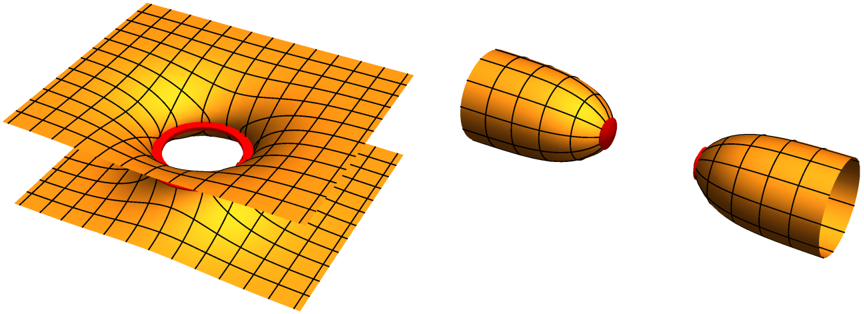
We investigate the non-perturbative stability of supersymmetric compactifications with respect to decay via a bubble of nothing. We show examples where this kind of instability is not prohibited by the spin structure, i.e., periodicity of fermions about the extra dimension. However, such ``topologically unobstructed'' cases do exhibit an extra-dimensional analog of the well-known Coleman-De Luccia suppression mechanism, which prohibits the decay of supersymmetric vacua. We demonstrate this explicitly in a four dimensional Abelian-Higgs toy model coupled to supergravity. The compactification of this model to M 3 × S 1 presents the possibility of vacua with different windings for the scalar field. Away from the supersymmetric limit, these states decay by the formation of a bubble of nothing, dressed with an Abelian-Higgs vortex. We show how, as one approaches the supersymmetric limit, the circumference of the topologically unobstructed bubble becomes infinite, thereby preventing the realization of this decay. This demonstrates the dynamical origin of the decay suppression, as opposed to the more familiar argument based on the spin structure. We conjecture that this is a generic mechanism that enforces stability of any topologically unobstructed supersymmetric compactification.
Overview
CoChat Summary
TL;DR
The paper studies whether supersymmetric compactifications can decay via bubbles of nothing when the usual spin-structure obstruction is absent. It finds that topologically unobstructed cases are still stabilized dynamically: as the supersymmetric limit is approached, the bubble becomes infinitely large and flat, suppressing the decay by a Coleman-De Luccia-type mechanism.
Key findings
- The authors construct a supersymmetric Kaluza-Klein compactification on \(S^1\) with anti-periodic fermions, using a winding scalar and a Wilson line, so Witten’s spin-structure argument does not forbid a bubble-of-nothing decay. This requires \(\gamma \equiv \kappa^2\eta^2 = 1\).
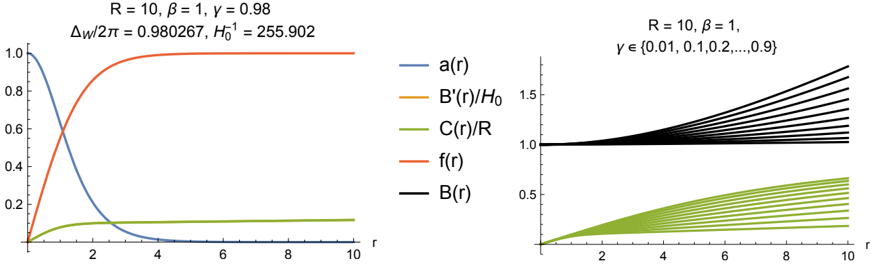
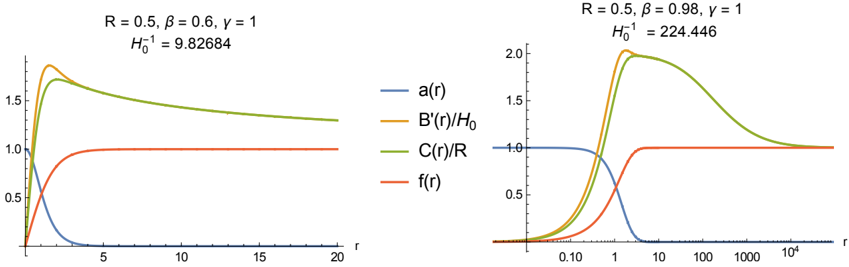
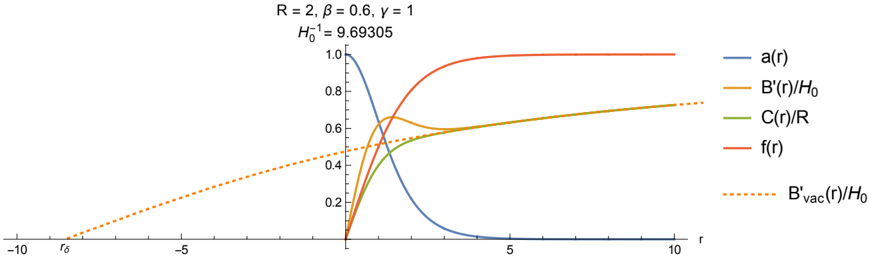
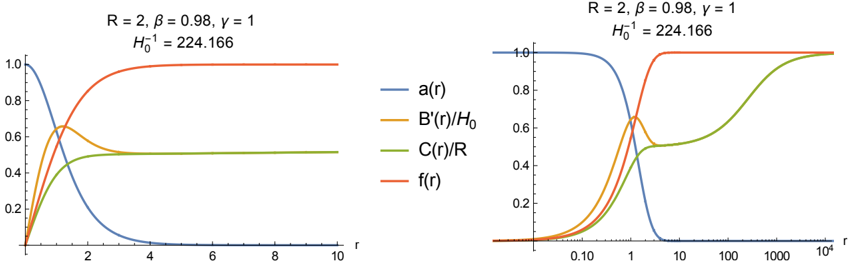
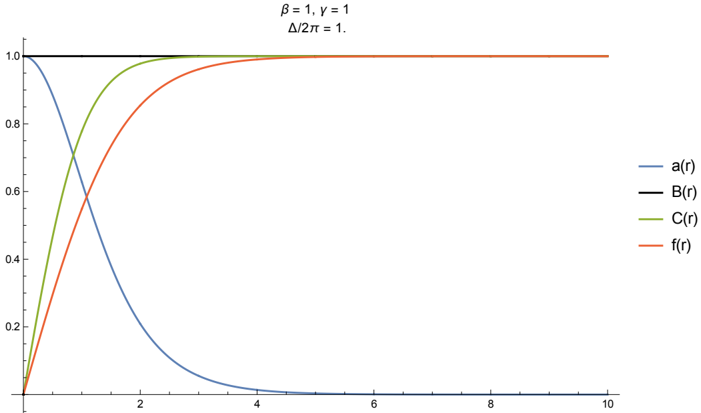
- In the supersymmetric limit \((\beta=1,\gamma=1)\), the bubble of nothing becomes infinitely large: \(H_0 \to 0\), so the bubble circumference \(2\pi H_0^{-1}\) diverges and the Euclidean action diverges, suppressing the decay. A numerical example near the limit \((\gamma=0.98)\) gives \(H_0^{-1}\approx 256\), compared with the thin-wall prediction \(H_0^{-1}\approx 250\).
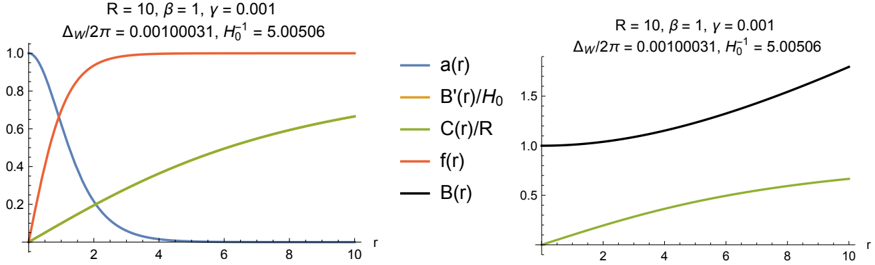
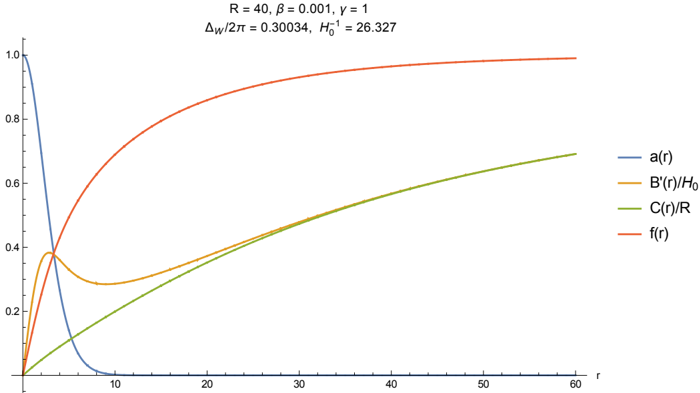
- Away from supersymmetry, bubble-of-nothing solutions exist and are dressed by an Abelian-Higgs vortex. For \(\beta=1,\gamma=10^{-3},R=10\), the numerical deficit angle is \(\Delta_W\approx 2\pi\,10^{-3}\), matching the analytic result \(2\pi\gamma=2\pi\,10^{-3}\). For \(\beta=0.001,\gamma=1,R=40\), the solution gives \(H_0^{-1}\approx 26 > R/2=20\).
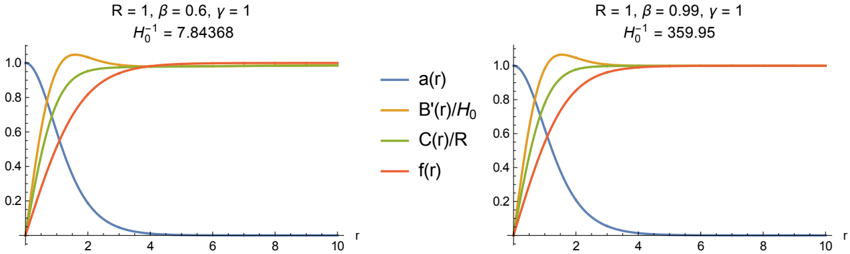
- For the special case \(R=1\) in the supersymmetric limit, the configuration becomes a half-BPS vortex solution interpolating between \(M_3\times S^1\) and a pure magnetic spherical compactification \(M_2\times S^2\), preventing the decay.
Methods
- The paper uses a four-dimensional \(N=1\) supergravity Abelian-Higgs toy model compactified on a circle, \(M_4 \to M_3\times S^1\), with a complex scalar, \(U(1)\) gauge field, and parameters \(\beta\) and \(\gamma=\kappa^2\eta^2\).
- It studies bubble-of-nothing instanton geometries, first in a thin-wall/Nambu-Goto approximation with a vortex/string at the bubble tip, then numerically solves the coupled matter and Einstein equations using a multiple-shooting method from the bubble core to asymptotic boundary conditions.
- Numerical profile functions are compared with analytic thin-wall predictions for the deficit angle and the bubble size \(H_0^{-1}\), including cases with \(R\gg1\), \(R<1\), \(R\sim O(1)\), and \(R=1\).
Limitations
- The paper states that the thin-wall approximation may not be valid in all regimes and explicitly tests the results numerically outside that approximation.
- The authors present the stabilization mechanism as a conjecture for generic supersymmetric compactifications, not a general proof; the explicit analysis is in a four-dimensional Abelian-Higgs toy model.
- The main text treats the Fayet-Iliopoulos term as a continuous parameter, though the appendix argues that its quantization does not affect the conclusions. Evident from the text: the numerical study covers selected parameter choices rather than a complete parameter-space scan.
Model-written summary. Check it against the paper before relying on it.
Integrity signals
Registry
Cites
Statistics
Figures
Verification
Claims the paper makes
69 Own result · 58 Own interpretation · 10 Check pending · 6 No full text of the sources · 4 Own method · 3 Not checked yet · 2 No basis given
A result the paper states — it cites no source for it, so there is none to check. The quote shows it is in the paper.
In the paper
“the background (3.6) can only be supersymmetric when the boundary conditions for the fermions in the Kaluza-Klein reduction are chosen to be periodic.”
§ Bubbles of nothing and supersymmetric compactifications > 3.2 Pure vacuum solutions and periodic fermions
plainstates a cause- Asserted: passes — The authors put it forward as true.
- Checkable: passes — It can be checked against evidence.
- Load-bearing: passes — The paper’s conclusions depend on it.
- Based: passes — The paper gives a reason why it holds.
A result the paper reports from its own data — it cites no other source for it, so there is none to check. The quote shows it is in the paper.
In the paper
“We show examples where this kind of instability is not prohibited by the spin structure, i.e., periodicity of fermions about the extra dimension.”
- Also stated in: § JCAP10(2016)002 · plain
“In the following, we will show that there are indeed some supersymmetric compactifications that allow for the same spin structure as the bubble of nothing geometry, therefore circumventing Witten's argument on stability.”
§ Bubbles of nothing and supersymmetric compactifications > Abstract
plain- Asserted: passes — The authors put it forward as true.
- Checkable: passes — It can be checked against evidence.
- Load-bearing: passes — The paper’s conclusions depend on it.
- Based: passes — The paper gives a reason why it holds.
- Also stated in: § JCAP10(2016)002 · plain
A result the paper states — it cites no source for it, so there is none to check. The quote shows it is in the paper.
In the paper
“The model described by the action (2.1) admits a Kaluza-Klein type of vacuum, where one of the spatial dimensions is compactified on a circle, M 4 → M 3 × S 1 , and the matter fields are in their vacuum”
§ Bubbles of nothing and supersymmetric compactifications > 3.1 Generalized Kaluza-Klein compactification
plainstates an association- Asserted: passes — The authors put it forward as true.
- Checkable: passes — It can be checked against evidence.
- Load-bearing: passes — The paper’s conclusions depend on it.
- Based: passes — The paper gives a reason why it holds.
A result the paper states — it cites no source for it, so there is none to check. The quote shows it is in the paper.
In the paper
“The compactification of this model to M 3 ×S 1 presents the possibility of vacua with different windings for the scalar field.”
§ Bubbles of nothing and supersymmetric compactifications > Abstract
hedgedstates an association- Asserted: passes — The authors put it forward as true.
- Checkable: passes — It can be checked against evidence.
- Load-bearing: passes — The paper’s conclusions depend on it.
- Based: passes — The paper gives a reason why it holds.
A result the paper states — it cites no source for it, so there is none to check. The quote shows it is in the paper.
In the paper
“We will show in this paper that we can find a compactification with these characteristics within the Abelian-Higgs model coupled to N = 1 supergravity in 3 + 1 dimensions.”
§ Bubbles of nothing and supersymmetric compactifications > 2 The model
plainstates a causeSingle case- Asserted: passes — The authors put it forward as true.
- Checkable: passes — It can be checked against evidence.
- Load-bearing: passes — The paper’s conclusions depend on it.
- Based: passes — The paper gives a reason why it holds.
89 more claims
Create a free account to see all 152 claims and to verify the 20 references still open.
- It may state two separate claims as one. 45
- The quote only partly states this claim. 4
- Probably not a substantial claim. 11
Claims other papers make about this one
Each is checked against this paper’s own text: does it say what the citing paper says it does?
In the citing paper
“This phenomenon was first described in [10], in the context of 4D supergravity on R 3 × S 1 .”
From Neutralizing topological obstructions to bubbles of nothing (2023) · cites this paper as [10]
In the citing paper
“There are various issues with R-symmetry in 4D supergravity [20][21][22][23], and in the model of [10] the gauged U(1) R is Higgsed at the Planck scale.”
From Neutralizing topological obstructions to bubbles of nothing (2023) · cites this paper as [10]
In the citing paper
“In absence of e.g.extra U(1)'s which might provide Wilson lines along the circle (see [6]), the spin structure cannot be deformed continuously, so it provides a topological obstruction to the existence of the bubble.”
From Nothing is certain in string compactifications (2020) · cites this paper as [6]
In the citing paper
“Similarly, in the case of the Kaluza-Klein compactification of [6], where no topological protection is present, the Coleman-DeLuccia mechanism was also shown to prevent the decay to nothing in the absence of supersymmetry breaking.”
From Nothing is certain in string compactifications (2020) · cites this paper as [6]
In the citing paper
“In that setting the coupling between the Wilson line and the fermions renders the decay topologically unobstructed, and the stability of supersymmetric compactifications is instead dynamically enforced.”
From Nothing is certain in string compactifications (2020) · cites this paper as [6]
7 more claims about this paper
Create a free account to see every claim other papers make about this one.
Citations
Cites
Cosmic Strings and Other Topological Defects
Vilenkin, A., & Shellard, E. P. S. (1985) · CERN Document Server (European Organization for Nuclear Research) · Cited by 2,816
Fate of the false vacuum: Semiclassical theory
Coleman, S. (1977) · Physical Review D · doi:10.1103/physrevd.15.2929 · Cited by 2,552
Fate of the false vacuum. II. First quantum corrections
Callan, C. G., & Coleman, S. (1977) · Physical Review D · doi:10.1103/physrevd.16.1762 · Cited by 1,789
Geometry, Topology and Physics
Nakahara, M. (2018) · CRC Press eBooks · doi:10.1201/9781315275826 · Cited by 1,647
Geometry, Topology and Physics
Nakahara, M. (1990) · doi:10.1887/0750306068 · Cited by 1,620
Gravitational effects on and of vacuum decay
Coleman, S., & De Luccia, F. (1980) · Physical Review D · doi:10.1103/physrevd.21.3305 · Cited by 1,537 · cited 8×
“However, we will show that in these cases, the stability of the compactification is preserved by the Coleman-De Luccia suppression mechanism, where the nucleated bubble would need to be infinitely large and the decay would therefore be completely suppressed.”
BackgroundMethodInfluentialHow to get masses from extra dimensions
Scherk, J., & Schwarz, J. H. (1979) · Nuclear Physics B · doi:10.1016/0550-3213(79)90592-3 · Cited by 958
Freedman, D. Z., & Proeyen, A. V. (2012) · Cambridge University Press eBooks · doi:10.1017/cbo9781139026833 · Cited by 780
Dynamical mass generation by compact extra dimensions
Hosotani, Y. (1983) · Physics Letters B · doi:10.1016/0370-2693(83)90170-3 · Cited by 715
Tomás Ortín, C. (2004) · Cambridge University Press eBooks · doi:10.1017/cbo9780511616563 · Cited by 663
Research works printed but not linked: 1
- 10.1017/cbo9781139019750 · DOI
Cited by
Nothing is certain in string compactifications
Etxebarria, I. G., Montero, M., Sousa, K., & Valenzuela, I. (2020) · Journal of High Energy Physics · doi:10.1007/jhep12(2020)032 · Cited by 87
Self-citationWeak gravity conjecture, multiple point principle and the standard model landscape
Hamada, Y., & Shiu, G. (2017) · Journal of High Energy Physics · doi:10.1007/jhep11(2017)043 · Cited by 63
Hiding the extra dimensions: A review on scale separation in string theory
Coudarchet, T. (2024) · Physics Reports · doi:10.1016/j.physrep.2024.02.003 · Cited by 50
Looking for structure in the cobordism conjecture
Andriot, D., Carqueville, N., & Cribiori, N. (2022) · SciPost Physics · doi:10.21468/scipostphys.13.3.071 · Cited by 31
Cobordism and bubbles of anything in the string landscape
Friedrich, B., Hebecker, A., & Walcher, J. (2024) · Journal of High Energy Physics · doi:10.1007/jhep02(2024)127 · Cited by 26
Metadata
- Authors
- Blanco-Pillado, J. J., Shlaer, B., Sousa, K., & Urrestilla, J.
- Affiliations
- Ikerbasque (ES)
- Tufts University (US)
- Consejo Superior de Investigaciones Científicas (ES)
- University of the Basque Country (ES)
- Venue
- Journal of Cosmology and Astroparticle Physics
- Publisher
- IOP Publishing
- Published
- 2016-10-03
- Volume
- 2016
- Issue
- 10
- Pages
- 002-002
- ISSN
- 1475-7516 (ISSN-L)
- OpenAlex
- W2415402231
- Cited by
- 27
- References
- 46
- Citations by year
- 2026: 6 · 2025: 5 · 2024: 6 · 2023: 3 · 2022: 3 · 2021: 1 · 2020: 1 · 2017: 1 · 2016: 1
- FWCI
- 0.25
- Type
- journal article
- Language
- en
- Open access
- hybrid
- doi.org
- Licence
- Locations
- Journal of Cosmology and Astroparticle Physics (publishedVersion, cc-by)
- arXiv (Cornell University) (submittedVersion)
- ResearchSpace (University of Auckland) (submittedVersion, cc-by)
- arXiv (Cornell University)
- Funders
- Eusko Jaurlaritza (IT-559-10)
- Topics
- Physical Sciences › Physics and Astronomy › Nuclear and High Energy Physics › Black Holes and Theoretical Physics
- Physical Sciences › Physics and Astronomy › Nuclear and High Energy Physics › Particle physics theoretical and experimental studies
- Physical Sciences › Physics and Astronomy › Astronomy and Astrophysics › Cosmology and Gravitation Theories
- Keywords
- bubble of nothing, supersymmetric compactification, extra dimensions, spin structure, Abelian Higgs model, supergravity, vortex decay, vacuum decay
About these checks
Registry, retraction, Cites and statistics results are computed, not judged, with one exception: a printed reference that no index lists is read once by a model before it counts as a citation error. Claims are extracted by a model and kept only when their quote appears verbatim in the text; each cited source is then checked, with a model’s help, for whether it says what the claim relies on. Those verdicts can be wrong — read the claim’s quote and the cited source before relying on one.
A language model drew the claims from the paper on 2026-11-13, under version 3 of the claim definition (model deepseek-v4.1-flash, prompt extract-v3).
A second model labelled each claim on 2026-11-13 (model jev-1.13-20260917, definition revision gold-guideline-v0.2).
Statistics and arithmetic are recomputed, not judged.
Confidence bands are shown only for fields calibrated on our annotated test set. None is calibrated yet, so no band is shown.
What counts as a claim ›How we measure confidence ›How we check this ›
Are you an author, or do you see a problem with this page? Request a review
How to cite
Cite CoChat for the checks on this page, and the paper for its own findings.
- This page
- CoChat. (2026). Citation check: Bubbles of nothing and supersymmetric compactifications. https://app.cochat.ai/papers/10.1088/1475-7516/2016/10/002
- The paper
- Blanco-Pillado, J. J., Shlaer, B., Sousa, K., & Urrestilla, J. (2016). Bubbles of nothing and supersymmetric compactifications. Journal of Cosmology and Astroparticle Physics. https://doi.org/10.1088/1475-7516/2016/10/002
Data sources
Bibliographic data: Semantic Scholar, OpenAlex, Crossref.
Contains information from the Semantic Scholar Academic Graph Datasets, made available under the ODC Attribution License (ODC-BY 1.0).
Semantic Scholar’s data is described in: Kinney, R., et al. (2023). The Semantic Scholar Open Data Platform. arXiv:2301.10140.
