

Evaluation of the accuracy of winnowing, rabin karp and knuth morris pratt algorithms in plagiarism detection applications
Open accessThe DOI matches its Crossref record; 23 of the 37 references it cites were found in a registry or an index; none of the 2 sources its claims cite is checked for support yet.
Abstract
The unethical behaviour of acts of plagiarism has been a disgrace in the educational realm. Using the internet, people can easily find articles or documents that are relevant to their current work, and simply duplicate the sentences or paragraphs without paraphrasing or giving correct citations. Such action falls into the area of plagiarism. In order to minimize the problem, especially in the educational field, it is necessary to develop plagiarism detection applications. The algorithm employed in the application plays an important role in obtaining accurate plagiarism detection results. To the best of our knowledge, three algorithms are commonly used in plagiarism detection applications, namely Winnowing, Rabin Karp and Knuth Morris Pratt, which are all employed in our application. To specify the accuracy of each algorithm, the percentages of the plagiarism detection results are compared to the results from examination by a human expert. From our results, we found that the order of the accuracy from highest to lowest corresponded to the Winnowing algorithm, Rabin Karp algorithm and Knuth Morris Pratt algorithm, with value differences of 1.19%, 53.91% and 83.91% respectively.
Overview
CoChat Summary
TL;DR
This paper compares Winnowing, Rabin Karp, and Knuth Morris Pratt (KMP) algorithms for plagiarism detection in Indonesian and English texts. It concludes that Winnowing is the most accurate, with 94.30% similarity and only a 1.19% difference from human expert examination.
Key findings
- In the final accuracy test, Winnowing produced 94.30% similarity against a manual/reference value of 93.11%, a difference of 1.19%.
- Rabin Karp produced 39.20% similarity, a difference of 53.91% from the reference.
- KMP produced 9.20% similarity, a difference of 83.91% from the reference.
- The paper concludes the accuracy order from highest to lowest is Winnowing, Rabin Karp, then KMP.
Methods
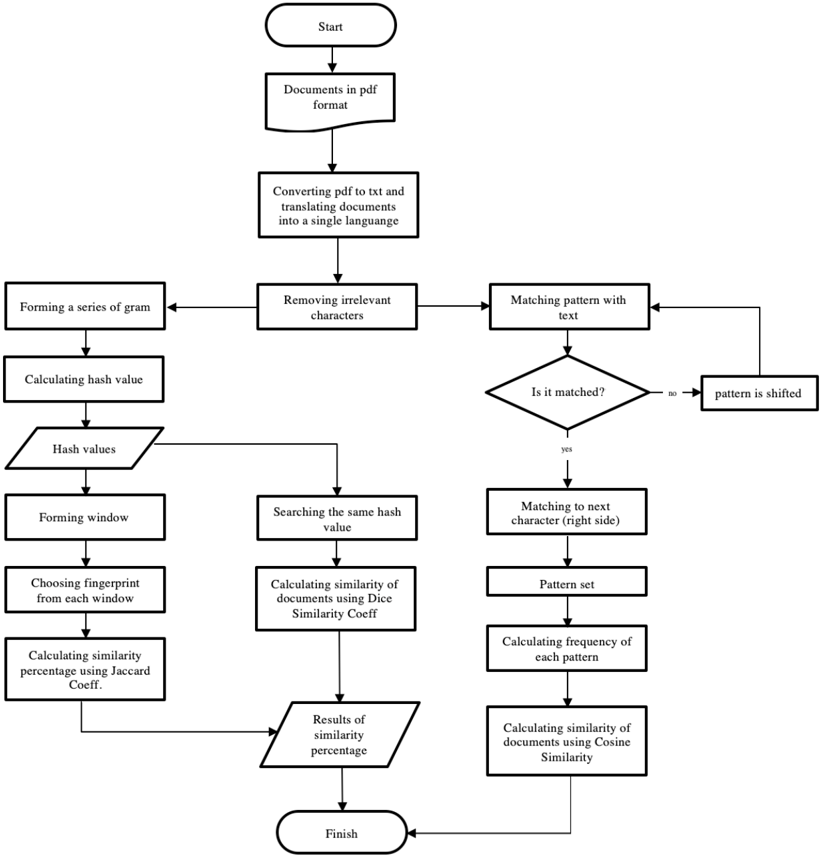
- The study compared Winnowing, Rabin Karp, and KMP for plagiarism detection using documents written in Bahasa and English on grouping; it used 10 test documents and 20 comparison documents in .pdf format.
- Algorithm settings: Winnowing used gram = 5, window = 7, base = 3, and Jaccard similarity; Rabin Karp used gram = 7, base = 3, and Dice similarity; KMP used cosine similarity.
- Accuracy was assessed by comparing algorithm similarity percentages to manual/human expert examination; for this test, document 1 had 17,605 characters and document 2 had 16,393 characters after removing several sentences from document 1, giving a manual similarity of 93.11%.
Limitations
- The paper does not state a limitations section.
- Evident from the text: the accuracy test used a small set of documents, and document 2 was derived from document 1 by removing sentences, which may limit generalizability.
- Evident from the text: the three algorithms use different similarity measures (Jaccard, Dice, cosine), which may affect direct comparability of their reported percentages.
Model-written summary. Check it against the paper before relying on it.
Integrity signals
Registry
Cites
Statistics
Figures


Verification
Claims the paper makes
0 Valid · 0 Not valid · 2 Not checked · 17 Own results and interpretations
A result the paper reports from its own data — it cites no other source for it, so there is none to check. The quote shows it is in the paper.
In the paper
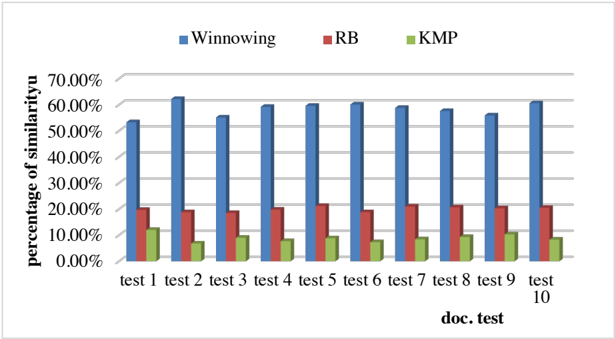
“the use of the Winnowing algorithm produced is approximately 40% to 75%.”
plainSingle case- Asserted: passes — The authors put it forward as true.
- Checkable: passes — It can be checked against evidence.
- Load-bearing: unclear — It is unclear whether the paper’s conclusions depend on it.
- Based: passes — The paper gives a reason why it holds.
A result the paper reports from its own data — it cites no other source for it, so there is none to check. The quote shows it is in the paper.
In the paper
“percentage of similarity between the documents was produced, on average between 15% and 25%.”
plainSingle case- Asserted: passes — The authors put it forward as true.
- Checkable: passes — It can be checked against evidence.
- Load-bearing: unclear — It is unclear whether the paper’s conclusions depend on it.
- Based: passes — The paper gives a reason why it holds.
A result the paper reports from its own data — it cites no other source for it, so there is none to check. The quote shows it is in the paper.
In the paper
“| Winnowing | 94.30 | | 1.19 |”
- Also stated in: § I Widaningrum 1* , D Mustikasari 1 , R Arifin 2 , And H A Pratiwi 1 · plain
“with value differences of 1.19%, 53.91% and 83.91% respectively.”
- Also stated in: § 4. Conclusion · plain
“with only a 1.19% difference from the examination by the human expert, at 93.11%.”
plainSingle case- Asserted: passes — The authors put it forward as true.
- Checkable: passes — It can be checked against evidence.
- Load-bearing: passes — The paper’s conclusions depend on it.
- Based: passes — The paper gives a reason why it holds.
- Rests on 2 assumptions not shown here.
- Also stated in: § I Widaningrum 1* , D Mustikasari 1 , R Arifin 2 , And H A Pratiwi 1 · plain
A result the paper reports from its own data — it cites no other source for it, so there is none to check. The quote shows it is in the paper.
In the paper
“there was a low percentage of similarity between the documents, or only a small degree of similarity between the documents, because the percentage produced was less than 15%.”
plainSingle case- Asserted: passes — The authors put it forward as true.
- Checkable: passes — It can be checked against evidence.
- Load-bearing: passes — The paper’s conclusions depend on it.
- Based: passes — The paper gives a reason why it holds.
A result the paper reports from its own data — it cites no other source for it, so there is none to check. The quote shows it is in the paper.
In the paper
“| Knuth Morris Pratt | 9.20 | | 83.91 |”
- Also stated in: § I Widaningrum 1* , D Mustikasari 1 , R Arifin 2 , And H A Pratiwi 1 · plain
“with value differences of 1.19%, 53.91% and 83.91% respectively.”
plainSingle case- Asserted: passes — The authors put it forward as true.
- Checkable: passes — It can be checked against evidence.
- Load-bearing: passes — The paper’s conclusions depend on it.
- Based: passes — The paper gives a reason why it holds.
- Rests on 2 assumptions not shown here.
- Also stated in: § I Widaningrum 1* , D Mustikasari 1 , R Arifin 2 , And H A Pratiwi 1 · plain
12 more claims
Create a free account to see all 19 claims and every source verdict.
- Probably not a substantial claim. 1
- It may state two separate claims as one. 1
Self-check
Percentages, sums and reported differences re-computed from the paper’s own numbers.
Each contradiction between two passages listed here was confirmed by an independent check.
Rated minor: it would not touch a result — a value no result rests on, a p-value that stays on the same side of the significance level, or a conflict that is clerical, resolved elsewhere in the paper, or outside its own findings.
In the paper
§ 2. Method
“| di | 1 | 0 |”
§ 2. Method
“Sentence 2: 'Jurusan Teknik Informatika adalah salah satu jurusan terfavorit di FT Unmuh Ponorogo'”
Citations
Cites
Rayward-Smith, V. J. (1991) · Journal of the Operational Research Society · doi:10.1057/jors.1991.155 · Cited by 16,821
Fast Pattern Matching in Strings
Knuth, D. E., Morris, Jr., & Pratt, V. R. (1977) · SIAM Journal on Computing · doi:10.1137/0206024 · Cited by 2,936
Efficient randomized pattern-matching algorithms
Karp, R. M., & Rabin, M. O. (1987) · IBM Journal of Research and Development · doi:10.1147/rd.312.0249 · Cited by 1,269
Schleimer, S., S, W. D., & Aiken, A. (2003) · Proceedings of the 2003 ACM SIGMOD International Conference on Management of Data · doi:10.1145/872757.872770 · Cited by 1,099
An analysis of the Karp-Rabin string matching algorithm
Gonnet, G. H., & Baeza-Yates, R. A. (1990) · Information Processing Letters · doi:10.1016/0020-0190(90)90135-k · Cited by 45
ALAMSYAH, N. (2017) · Technologia: Jurnal Ilmiah · doi:10.31602/tji.v8i3.1116 · Cited by 20
Salmuasih, S., & Sunyoto, A. (2013) · Seminar Nasional Aplikasi Teknologi Informasi (SNATI) · Cited by 19
Analisis Perbandingan Algoritma Rabin-Karp dan Levenshtein Distance dalam Menghitung Kemiripan Teks
Purba, A. H., & Situmorang, Z. (2017) · doi:10.17605/jti.v2i2.187 · Cited by 15
Examination of Document Similarity Using Rabin-Karp Algorithm
Siahaan, A. P. U. (2017) · International Journal of Recent Trends in Engineering and Research · doi:10.23883/ijrter.2017.3404.4sndk · Cited by 14
Research works printed but not linked: 3
- [1] D. Steveson, H. Agung, dan F. Mulia, 'Rabin Karp Plagiarisme Detection Applications For Tasks and Problems in School Using Rabin Karp Algorithm,' no. 1, hal. 12-17, 2018. -
- [2] M. Syarif, 'Implementasi Algoritma String Matching Dalam Pencarian Surat Dan Ayat Dalam Al-Quran Berbasis Web,' iIndonesian J. Netw. Secur. , vol. 6, no. 2, hal. 70-76, 2017. -
- [27] E. Nugroho, 'Perancangan Sistem Deteksi Plagiarisme Dokumen Teks Dengan Menggunakan Algoritma Rabin-Karp,' J. Strateg. Stud. , vol. 34, no. 2, hal. 281-293, 2011. -
Cited by
Astica, Y., Utami, E., & Hartanto, A. D. (2023) · International Journal of Artificial Intelligence Research · doi:10.29099/ijair.v7i1.902 · Cited by 3
Similarity Identification Based on Word Trigrams Using Exact String Matching Algorithms
Fadlil, A., Sunardi, S., & Ramdhani, R. (2022) · INTENSIF Jurnal Ilmiah Penelitian dan Penerapan Teknologi Sistem Informasi · doi:10.29407/intensif.v6i2.18141 · Cited by 2
Automatic essay assessment in e-learning using winnowing algorithm
Amalia, E. L., Lestari, V. A., Wijayaningrum, V. N., et al. (2022) · Indonesian Journal of Electrical Engineering and Computer Science · doi:10.11591/ijeecs.v29.i1.pp572-582 · Cited by 1
Penerapan Algoritma Winnowing dan Word-Level Trigrams Untuk Mengidentifikasi Kesamaan Kata
Ramdhani, R., Fadlil, A., & Sunardi, S. (2022) · JURIKOM (Jurnal Riset Komputer) · doi:10.30865/jurikom.v9i2.4060 · Cited by 2
Metadata
- Authors
- Widaningrum, I., Mustikasari, D., Arifin, R., & Pratiwi, H. A.
- Affiliations
- Muhammadiyah University of Ponorogo (ID)
- Corresponding author
- Widaningrum, I
- Venue
- Journal of Physics: Conference Series
- Publisher
- IOP Publishing
- Published
- 2020-04-01
- Volume
- 1517
- Issue
- 1
- Pages
- 012093
- ISSN
- 1742-6588 (ISSN-L)
- 1742-6596
- OpenAlex
- W3031967427
- Cited by
- 6
- References
- 37
- Citations by year
- 2024: 1 · 2023: 1 · 2022: 3 · 2021: 1
- FWCI
- 1.30
- Type
- conference paper
- Language
- en
- Open access
- diamond
- doi.org
- Licence
- cc-by
- creativecommons.org/licenses/by/3.0/ (vor)
- iopscience.iop.org/info/page/text-and-data-mining (tdm)
- Locations
- Journal of Physics Conference Series (publishedVersion, cc-by)
- Topics
- Social Sciences › Education › Academic integrity and plagiarism
- Physical Sciences › Mathematics › Theoretical Computer Science › Algorithms and Data Compression
- Physical Sciences › Computer Science › Information Systems › Software Engineering Research
- Keywords
- plagiarism detection, winnowing algorithm, Rabin-Karp algorithm, Knuth-Morris-Pratt algorithm, string matching, algorithm accuracy comparison, text similarity, academic integrity
About these checks
Registry, retraction, Cites and statistics results are computed, not judged, with one exception: a printed reference that no index lists is read once by a model before it counts as a citation error. Claims are extracted by a model and kept only when their quote appears verbatim in the text; each cited source is then checked, with a model’s help, for whether it says what the claim relies on. Those verdicts can be wrong — read the claim’s quote and the cited source before relying on one.
A language model drew the claims from the paper on 2026-10-10, under version 3 of the claim definition (model deepseek-v4.1-flash, prompt extract-v3).
A second model labelled each claim on 2026-10-10 (model jev-1.13-20260917, definition revision gold-guideline-v0.2).
Statistics and arithmetic are recomputed, not judged.
Confidence bands are shown only for fields calibrated on our annotated test set. None is calibrated yet, so no band is shown.
What counts as a claim ›How we measure confidence ›How we check this ›
Are you an author, or do you see a problem with this page? Request a review
How to cite
Cite CoChat for the checks on this page, and the paper for its own findings.
- This page
- CoChat. (2026). Citation check: Evaluation of the accuracy of winnowing, rabin karp and knuth morris pratt algorithms in plagiarism detection applications. https://app.cochat.ai/papers/10.1088/1742-6596/1517/1/012093
- The paper
- Widaningrum, I., Mustikasari, D., Arifin, R., & Pratiwi, H. A. (2020). Evaluation of the accuracy of winnowing, rabin karp and knuth morris pratt algorithms in plagiarism detection applications. Journal of Physics: Conference Series. https://doi.org/10.1088/1742-6596/1517/1/012093
Data sources
Bibliographic data: Semantic Scholar, OpenAlex, Crossref.
Contains information from the Semantic Scholar Academic Graph Datasets, made available under the ODC Attribution License (ODC-BY 1.0).
Semantic Scholar’s data is described in: Kinney, R., et al. (2023). The Semantic Scholar Open Data Platform. arXiv:2301.10140.
