

Multiobjective optimization of synechocytis culture in flat-plate photobioreactor toward optimal growth and exergy
Open accessThe DOI matches its Crossref record; 22 of the 22 references it cites were found in a registry or an index.
Abstract
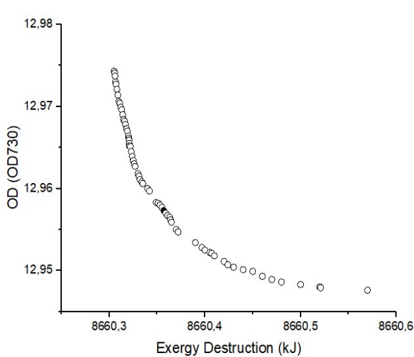
Many researchers are analyzing microalgae as a fuel source due to their high potential. Since microalgae are grown on a narrow area of land and less water, microalgae can contain high lipids. Carbon dioxide, water, inorganic salts, temperature and degree of acidity (pH), and light intensity in photobioreactors affect microalgae growth. Microalgae Synechocystis cultivated in BG-11 medium on closed PBRs with an addition of 10 mM NaHCO 3. Culture medium illuminated at one side with Orange-red LED (636 nm) at light intensities of 50, 200, 300, 500, 800, 950, and 1,460 µ mol photon/m 2.s with light intensity adjustment every 24 hours. Optical density and exergy destruction also optimize for artificial neural network training and Multiobjective Genetic Algorithms. The optimum value from the TOPSIS approach is the OD 12.957 OD730 and 8660.35 kJ exergy destruction. The optimum condition is derived from the optimum value. The light intensity of 71 µ mol photon/m 2 s and the dry cell weight of 0.119 g/OD730L are ideal conditions for optimal microalgae development.
Overview
The claims and statistics of this paper haven’t been checked yet.
Free: it reads the open-access text and checks the first 5 claims that cite a source we can check. Create a free account to check every claim.
Integrity signals
Registry
Cites
Statistics
Figures
Verification
Claims the paper makes
The claims and statistics of this paper haven’t been checked yet.
Free: it reads the open-access text and checks the first 5 claims that cite a source we can check. Create a free account to check every claim.
Self-check
Percentages, sums and reported differences re-computed from the paper’s own numbers.
The self-check needs the paper’s full text.
Citations
Cites
Multiple Attribute Decision Making: Methods and Applications
Tzeng, G., & Huang, J. (2011) · Cited by 2,233
Constraining the Dark Energy Equation of State using Alternative High-z Cosmic Tracers
Plionis, M., Terlevich, R. J., Basilakos, S., Bresolin, F., Terlevich, E., Melnick, J., Chavez, R., Alimi, J., & Fuözfa, A. (2010) · AIP conference proceedings · doi:10.1063/1.3462645 · Cited by 1,244
A review on feedstocks, production processes, and yield for different generations of biodiesel
Singh, D., Sharma, D., Soni, S. L., Sharma, S., Kumar Sharma, P., & Jhalani, A. (2020) · Fuel · doi:10.1016/j.fuel.2019.116553 · Cited by 998 · cited 1×
“Introduction Microalgae need relatively limited land for growth as biomass sources, less freshwater, not affecting food supply, high growth rates, and more elevated lipids [1, 3].”
BackgroundEffects of light intensity on growth and lipid production in microalgae grown in wastewater
Nzayisenga, J. C., Farge, X., Groll, S. L., & Sellstedt, A. (2020) · Biotechnology for Biofuels · doi:10.1186/s13068-019-1646-x · Cited by 347
Advances in the Production of High-Value Products by Microalgae
Leu, S., & Boussiba, S. (2014) · Industrial Biotechnology · doi:10.1089/ind.2013.0039 · Cited by 253 · cited 1×
“Optimal growth conditions, the amount of lipid content, the capacity for wide-scale production, and the importance of algae by-products must be considered in the species selection process [5].”
BackgroundEffect of Light Intensity and Quality on Growth Rate and Composition of Chlorella vulgaris
Metsoviti, M. N., Papapolymerou, G., Karapanagiotidis, I. T., & Katsoulas, N. (2019) · Plants · doi:10.3390/plants9010031 · Cited by 252
A review of biodiesel production from microalgae
Dickinson, S., Mientus, M., Frey, D., Amini-Hajibashi, A., Ozturk, S., Shaikh, F., Sengupta, D., & El-Halwagi, M. M. (2017) · Clean Technologies and Environmental Policy · doi:10.1007/s10098-016-1309-6 · Cited by 190
Quantifying COVID-19 Content in the Online Health Opinion War Using Machine Learning
Sear, R. F., Velasquez, N., Leahy, R., Restrepo, N. J., Oud, S. E., Gabriel, N., Lupu, Y., & Johnson, N. F. (2020) · IEEE Access · doi:10.1109/access.2020.2993967 · Cited by 132 · cited 1×
“Meanwhile, some of the following researchers [2, 9, 24] have recently succeeded in using dimension reduction for large amounts of small-scale data through the use of machine learning methods.”
Backgrounddel Rio‐Chanona, E. A., Wagner, J. L., Ali, H., Fiorelli, F., Zhang, D., & Hellgardt, K. (2019) · AIChE Journal · doi:10.1002/aic.16473 · Cited by 123
Esteves, A. F., Soares, O. S. G. P., Vilar, V. J. P., Pires, J. C. M., & Gonçalves, A. L. (2020) · Energies · doi:10.3390/en13020333 · Cited by 86
A Two-Dimensional Sparse Matrix Profile DenseNet for COVID-19 Diagnosis Using Chest CT Images
Liu, Q., Leung, C. K.-S., & Hu, P. (2020) · IEEE Access · doi:10.1109/access.2020.3040245 · Cited by 86 · cited 1×
“Meanwhile, some of the following researchers [2, 9, 24] have recently succeeded in using dimension reduction for large amounts of small-scale data through the use of machine learning methods.”
BackgroundLi, Y., Wei, D., Chen, J., Cao, S., Zhou, H.-Y., Zhu, Y., Wu, J., Lan, L., Sun, W., Qian, T., et al. (2020) · IEEE Journal of Biomedical and Health Informatics · doi:10.1109/jbhi.2020.3018181 · Cited by 70 · cited 1×
“Meanwhile, some of the following researchers [2, 9, 24] have recently succeeded in using dimension reduction for large amounts of small-scale data through the use of machine learning methods.”
BackgroundCordara, A., Re, A., Pagliano, C., Van Alphen, P., Pirone, R., Saracco, G., Branco dos Santos, F., Hellingwerf, K., & Vasile, N. (2018) · PeerJ · doi:10.7717/peerj.5256 · Cited by 41 · cited 4×
“The light intensity in this optimization is varied at 50, 200, 300, 500, 800, 950, and 1,460 μmol photon/m2s [1, 11].”
BackgroundMethodInfluentialAghbashlo, M., Hosseinpour, S., Tabatabaei, M., Dadak, A., Younesi, H., & Najafpour, G. D. (2016) · International Journal of Hydrogen Energy · doi:10.1016/j.ijhydene.2016.08.123 · Cited by 39
Aghbashlo, M., Tabatabaei, M., Hosseini, S. S., Younesi, H., & Najafpour, G. D. (2016) · International Journal of Hydrogen Energy · doi:10.1016/j.ijhydene.2015.12.070 · Cited by 37 · cited 1×
“Table 1 lists the equations for calculating exergy, and table 2 contains the exergy standard of each chemical in the culture media [20].”
BackgroundHossain, S. M. Z., Alnoaimi, A., Razzak, S. A., Ezuber, H., Al‐Bastaki, N., Safdar, M., Alkaabi, S., & Hossain, M. M. (2018) · The Canadian Journal of Chemical Engineering · doi:10.1002/cjce.23168 · Cited by 32 · cited 1×
“For instance, Hossain S Z, Alnoaimi A [13] optimized CO2 capture rate, biomass productivity, and specific growth rate of Chlorella vulgaris.”
BackgroundKazeem, M. A., Hossain, S. M. Z., Hossain, M. M., & Razzak, S. A. (2018) · Chemical Product and Process Modeling · doi:10.1515/cppm-2017-0082 · Cited by 26
Complex mathematical analysis of photobioreactor system
Scheufele, F. B., Hinterholz, C. L., Zaharieva, M. M., Najdenski, H. M., Módenes, A. N., Trigueros, D. E. G., Borba, C. E., Espinoza‐Quiñones, F. R., & Kroumov, A. D. (2018) · Engineering in Life Sciences · doi:10.1002/elsc.201800044 · Cited by 25
Duarte, J. H., de Souza, C. O., Druzian, J. I., & Costa, J. A. V. (2019) · Bioresource Technology · doi:10.1016/j.biortech.2019.02.009 · Cited by 21
Combination a Skeleton Filter and Reduction Dimension of Kernel PCA Based on Palmprint Recognition
Kusban, M., Susanto, A., & Wahyunggoro, O. (2016) · International Journal of Electrical and Computer Engineering (IJECE) · doi:10.11591/ijece.v6i6.pp3255-3261 · Cited by 15
Combination a Skeleton Filter and Reduction Dimension of Kernel PCA Based on Palmprint Recognition
Kusban, M., Susanto, A., & Wahyunggoro, O. (2016) · International Journal of Electrical and Computer Engineering (IJECE) · doi:10.11591/ijece.v6i6.11677 · Cited by 11 · cited 1×
“Researchers [14] use KPCA to reduce the features of complex data dimensions.”
MethodMulti objective optimization of microalgae flat plate photobioreactor design
Rahman, A., Nasution, S. B. S., Siregar, S. R. H., & Nasruddin, N. (2018) · E3S Web of Conferences · doi:10.1051/e3sconf/20186702053 · Cited by 1
Self-citation
Research works printed but not linked: 4
- Rahman A, Prihantini N B, Nasruddin, editors. Fatty acid of microalgae as a potential feedstock for biodiesel production in Indonesia. AIP Conference Proceedings; 2019: AIP Publishing LLC.
- ICETIA 2020 Journal of Physics: Conference Series 1858 (2021) 012038 IOP Publishing doi:10.1088/1742-6596/1858/1/012038 7 · doi:10.1088/1742-6596/1858/1/0120387
- Krogh A. 2008. What are artificial neural networks? Nature biotechnology. 26(2):195-7.
- Zabed H M, Qi X, Yun J, Zhang H. Anaerobic Digestion of Microalgae Biomass for Methane Production. Microalgae Biotechnology for Development of Biofuel and Wastewater Treatment: Springer; 2019. p. 397-421.
Cited by
Lab-scale photobioreactor systems: principles, applications, and scalability
Benner, P., Meier, L., Pfeffer, A., Krüger, K., Oropeza Vargas, J. E., & Weuster-Botz, D. (2022) · Bioprocess and Biosystems Engineering · doi:10.1007/s00449-022-02711-1 · Cited by 215
“In some flat plate photobioreactors, the measurement of the optical density is applied during the process [82, 128].”
BackgroundMethodOptimization of Cdx Transcription Factors Characteristics
Javanbakht, T. (2023) · Journal of Engineering Sciences · doi:10.21272/jes.2023.10(2).e1 · Cited by 1
“Recently, this technique has been used to predict the properties of some biomolecules [52–54].”
Method
Metadata
- Authors
- Nastiti, K. D., Rahman, A., & Nasruddin
- Affiliations
- University of Indonesia (ID)
- Venue
- Journal of Physics: Conference Series
- Publisher
- IOP Publishing
- Published
- 2021-04-01
- Volume
- 1858
- Issue
- 1
- Pages
- 012038
- ISSN
- 1742-6588 (ISSN-L)
- 1742-6596
- OpenAlex
- W3159372264
- Semantic Scholar
- e9ecd068f7814d10106cc8e9bfb5f65a31662dbb
- Cited by
- 2
- References
- 21
- Citations by year
- 2023: 1 · 2022: 1
- FWCI
- 1.04
- Type
- conference paper
- Language
- en
- Open access
- diamond
- doi.org
- Licence
- cc-by
- creativecommons.org/licenses/by/3.0/ (vor)
- iopscience.iop.org/info/page/text-and-data-mining (tdm)
- Locations
- Journal of Physics Conference Series (publishedVersion, cc-by)
- Funders
- Universitas Indonesia (RST/HKP.05.00/2020, 00/2020)
- Topics
- Physical Sciences › Energy › Renewable Energy, Sustainability and the Environment › Algal biology and biofuel production
- Physical Sciences › Environmental Science › Environmental Chemistry › Aquatic Ecosystems and Phytoplankton Dynamics
- Life Sciences › Biochemistry, Genetics and Molecular Biology › Molecular Biology › Microbial Metabolic Engineering and Bioproduction
- Keywords
- Synechocystis, microalgae cultivation, flat panel photobioreactor, multi-objective optimization, exergy destruction, light intensity, BG-11 medium, dry cell weight, optical density, TOPSIS, artificial neural networks, multi-objective genetic algorithm, microalgal biofuels
About these checks
Registry, retraction, Cites and statistics results are computed, not judged, with one exception: a printed reference that no index lists is read once by a model before it counts as a citation error. Claims are extracted by a model and kept only when their quote appears verbatim in the text; each cited source is then checked, with a model’s help, for whether it says what the claim relies on. Those verdicts can be wrong — read the claim’s quote and the cited source before relying on one.
Statistics and arithmetic are recomputed, not judged.
Confidence bands are shown only for fields calibrated on our annotated test set. None is calibrated yet, so no band is shown.
What counts as a claim ›How we measure confidence ›How we check this ›
Are you an author, or do you see a problem with this page? Request a review
Data sources
Bibliographic data: Semantic Scholar, OpenAlex, Crossref.
Contains information from the Semantic Scholar Academic Graph Datasets, made available under the ODC Attribution License (ODC-BY 1.0).
Semantic Scholar’s data is described in: Kinney, R., et al. (2023). The Semantic Scholar Open Data Platform. arXiv:2301.10140.
