

Very high energy calibration of silicon Timepix detectors
Open accessThe DOI matches its Crossref record; 21 of the 21 references it cites were found in a registry or an index.
Abstract
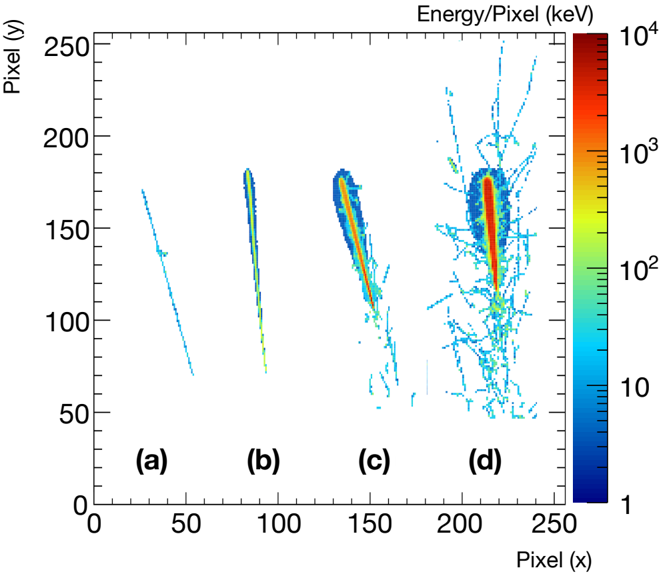
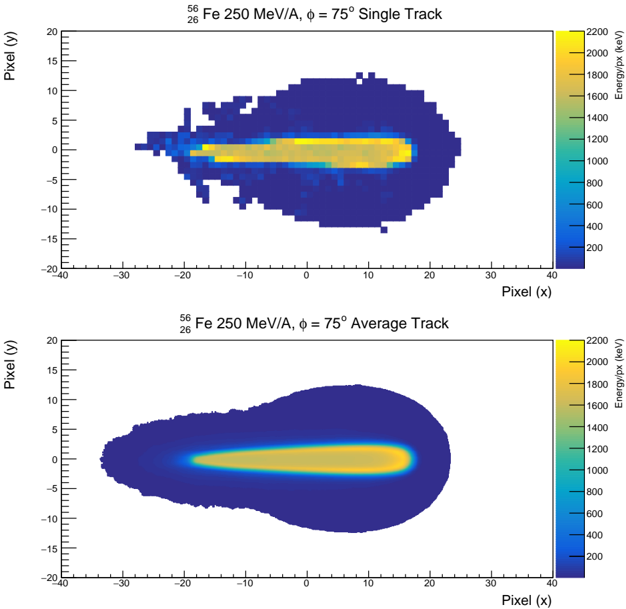
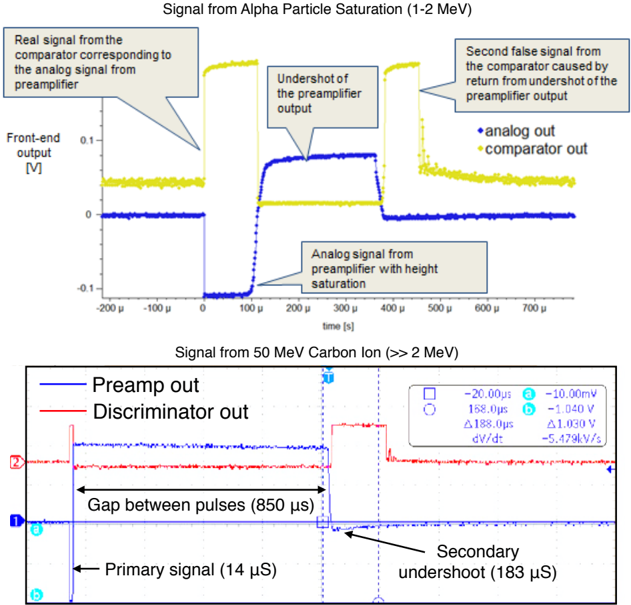
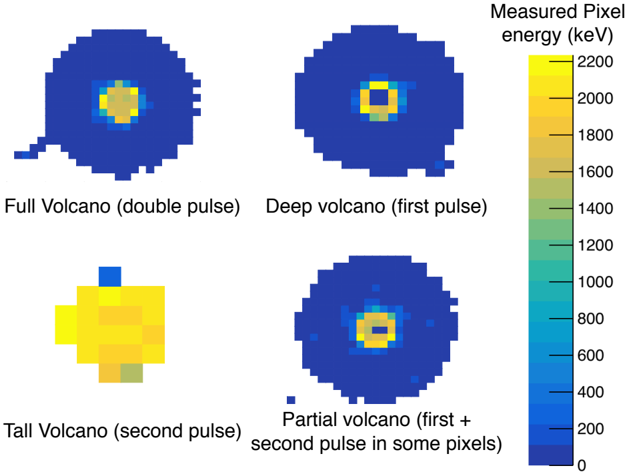
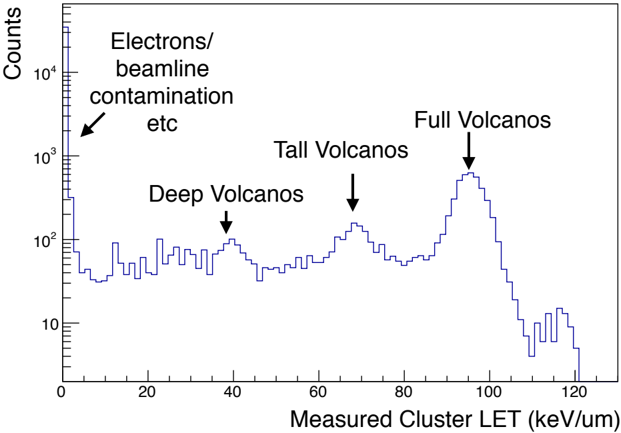
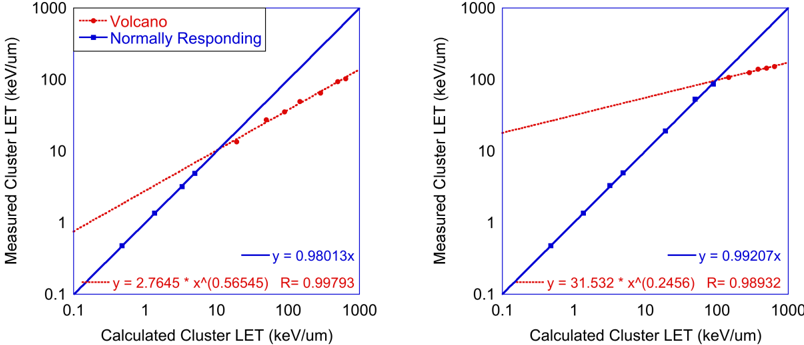
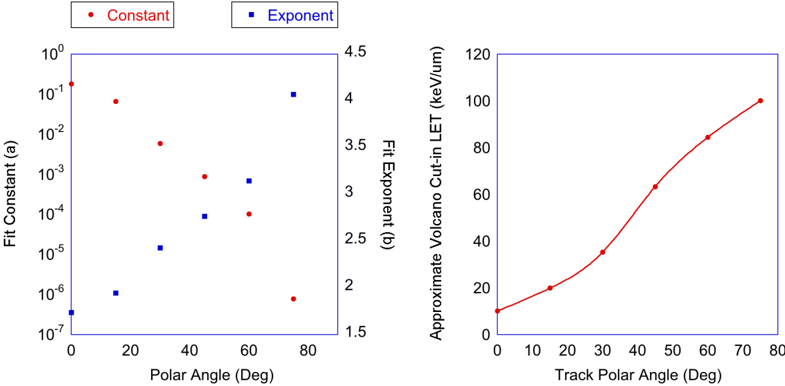
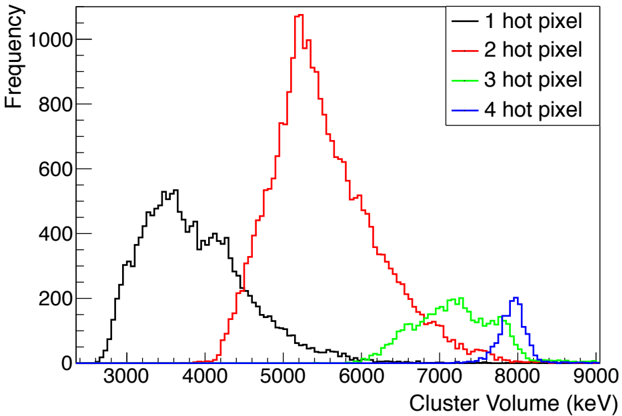
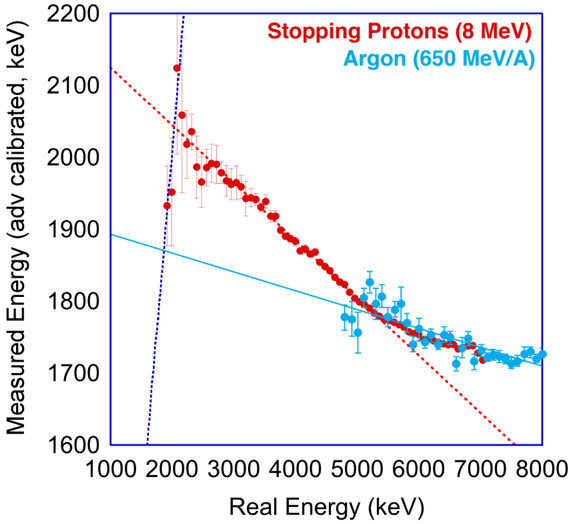
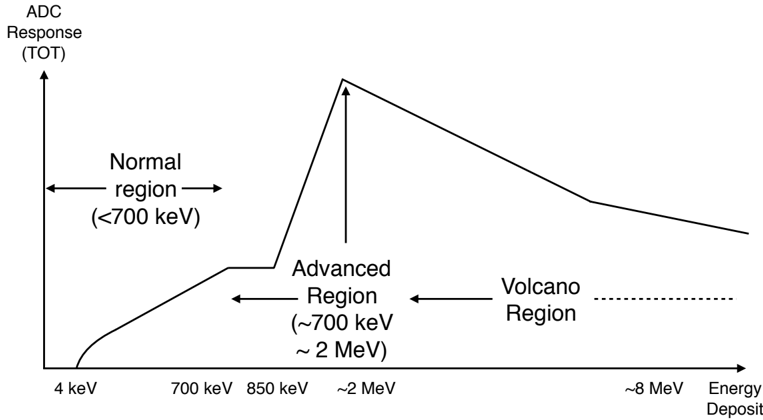
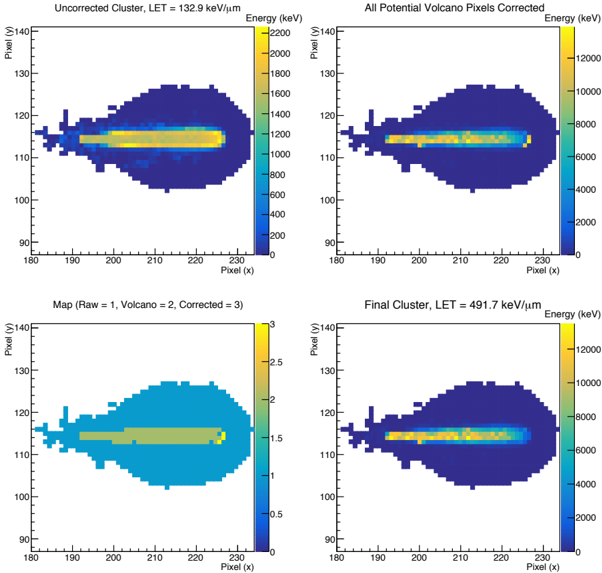
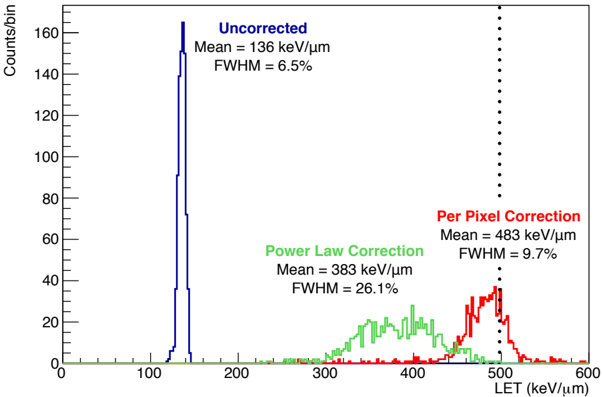
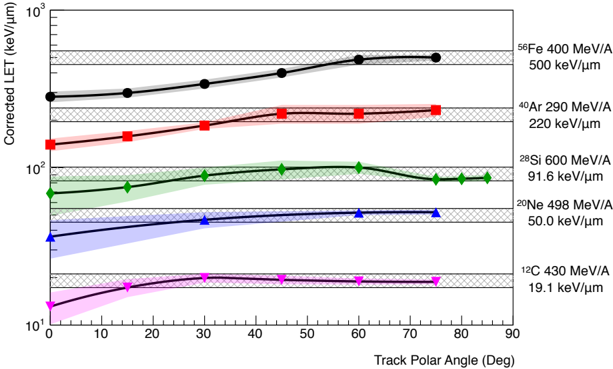
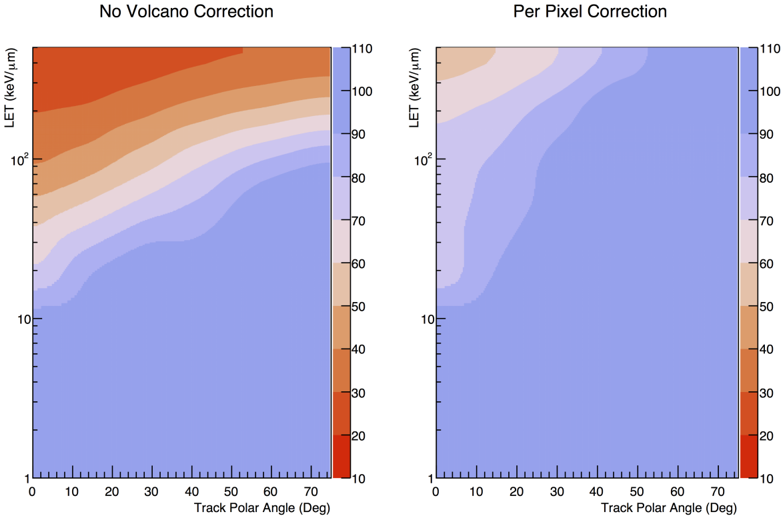
We investigate energy measurements in Timepix hybrid detectors in hole collection mode above pixel input energy depositions of about 2.2 MeV or 600,000 electron/hole pairs in Silicon. Measurement of the detector response well above this regime is important for our application measuring the heavy ion exposure of NASA astronauts. We find that high input charges produce a double pulse structure in the Timepix front end which creates a taxonomy of different clusters which are observed at accelerators, but not in typical operation on orbit. We investigate the LET response of the Timepix to different heavy ion species and find that for a given polar angle the so called 'volcano effect' can be compensated with a simple power law model. We also characterize the pixel response of the Timepix using mono-energetic stopping protons and derive a per pixel calibration method for correction of the pixel response up to about 8 MeV. We conclude that with an appropriate calibration procedure the Timepix can correctly measure the LET values in excess of 500 keV μm -1 in Silicon for tracks with a polar angle exceeding 60 o , corresponding to the entirety of the cosmic ray spectrum up to Nickel.
Overview
The claims and statistics of this paper haven’t been checked yet.
Free: it reads the open-access text and checks the first 5 claims that cite a source we can check. Create a free account to check every claim.
Integrity signals
Registry
Cites
Statistics
Figures
Verification
Claims the paper makes
The claims and statistics of this paper haven’t been checked yet.
Free: it reads the open-access text and checks the first 5 claims that cite a source we can check. Create a free account to check every claim.
Claims other papers make about this one
Each is checked against this paper’s own text: does it say what the citing paper says it does?
The source backs part of the claim, not all of it — or backs it for a different population, condition or comparison.
In the citing paper
“Each Timepix is calibrated over a wide energy range from a minimum detectable threshold of 5-keV X-rays through to heavy ions of 500 keV µm−1 to ensure performance measuring the GCR environment45–47.”
From Space radiation measurements during the Artemis I lunar mission (2024) · cites this paper as [47]
Experimental — accuracy not yet measured
Self-check
Percentages, sums and reported differences re-computed from the paper’s own numbers.
The self-check needs the paper’s full text.
Citations
Cites
Agostinelli, S., Allison, J., Amako, K., Apostolakis, J., Araujo, H., Arce, P., Asai, M., Axen, D., Banerjee, S., Barrand, G., et al. (2003) · Nuclear Instruments and Methods in Physics Research Section A: Accelerators, Spectrometers, Detectors and Associated Equipment · doi:10.1016/s0168-9002(03)01368-8 · Cited by 25,106
Allison, J., Amako, K., Apostolakis, J., Arce, P., Asai, M., Aso, T., Bagli, E., Bagulya, A., Banerjee, S., Barrand, G., et al. (2016) · Nuclear Instruments and Methods in Physics Research Section A: Accelerators, Spectrometers, Detectors and Associated Equipment · doi:10.1016/j.nima.2016.06.125 · Cited by 4,194
Llopart, X., Ballabriga, R., Campbell, M., Tlustos, L., & Wong, W. (2007) · Nuclear Instruments and Methods in Physics Research Section A: Accelerators, Spectrometers, Detectors and Associated Equipment · doi:10.1016/j.nima.2007.08.079 · Cited by 1,046
Heavy ion carcinogenesis and human space exploration
Durante, M., & Cucinotta, F. A. (2008) · Nature Reviews Cancer · doi:10.1038/nrc2391 · Cited by 578
Precise energy calibration of pixel detector working in time-over-threshold mode
Jakubek, J. (2011) · Nuclear Instruments and Methods in Physics Research Section A: Accelerators, Spectrometers, Detectors and Associated Equipment · doi:10.1016/j.nima.2010.06.183 · Cited by 279 · cited 2×
“The detector was calibrated using bench-top x-ray sources following the procedure of Jakubek [19] and 5 MeV monoenergetic protons following Kroupa et al. [18].”
MethodAsic developments for radiation imaging applications: The medipix and timepix family
Ballabriga, R., Campbell, M., & Llopart, X. (2018) · Nuclear Instruments and Methods in Physics Research Section A: Accelerators, Spectrometers, Detectors and Associated Equipment · doi:10.1016/j.nima.2017.07.029 · Cited by 167
ELEMENTAL COMPOSITION AND ENERGY SPECTRA OF GALACTIC COSMIC RAYS DURING SOLAR CYCLE 23
George, J. S., Lave, K. A., Wiedenbeck, M. E., Binns, W. R., Cummings, A. C., Davis, A. J., de Nolfo, G. A., Hink, P. L., Israel, M. H., Leske, R. A., et al. (2009) · The Astrophysical Journal · doi:10.1088/0004-637x/698/2/1666 · Cited by 130
Timepix-based radiation environment monitor measurements aboard the International Space Station
Stoffle, N., Pinsky, L. S., Kroupa, M., Hoang, S. M., Idárraga, J., Amberboy, C., Rios, R. R., Hauss, J., Keller, J., Bahadori, A. A., et al. (2015) · Nuclear Instruments and Methods in Physics Research Section A Accelerators Spectrometers Detectors and Associated Equipment · doi:10.1016/j.nima.2015.02.016 · Cited by 91
Self-citation10 years of the Medipix2 Collaboration
Campbell, M. (2010) · Nuclear Instruments and Methods in Physics Research Section A Accelerators Spectrometers Detectors and Associated Equipment · doi:10.1016/j.nima.2010.06.106 · Cited by 86
A semiconductor radiation imaging pixel detector for space radiation dosimetry
Kroupa, M., Bahadori, A. A., Campbell-Ricketts, T., Empl, A., Hoang, S. M., Idárraga, J., Rios, R. R., Semones, E., Stoffle, N., Tlustos, L., et al. (2015) · Life Sciences in Space Research · doi:10.1016/j.lssr.2015.06.006 · Cited by 84
Self-citation
Cited by
ICRU Report 98, Stochastic Nature of Radiation Interactions: Microdosimetry
Braby, L. A., Conte, V., Dingfelder, M., GOODHEAD, D. T., Pinsky, L. S., Rosenfeld, A. B., Sato, T., Waker, A. J., Guatelli, S., Magrin, G., et al. (2023) · Journal of the ICRU · doi:10.1177/14736691231211380 · Cited by 78
Self-citationSpace radiation measurements during the Artemis I lunar mission
George, S. P., Gaza, R., Matthiä, D., Laramore, D., Lehti, J., Campbell-Ricketts, T., Kroupa, M., Stoffle, N., Marsalek, K., Przybyla, B., et al. (2024) · Nature · doi:10.1038/s41586-024-07927-7 · Cited by 47
“Dose rates were similar for all instruments (Fig.”
Self-citationHigh-energy per-pixel calibration of timepix pixel detector with laboratory alpha source
Sommer, M., Granja, C. D. S., Kodaira, S., & Ploc, O. (2021) · Nuclear Instruments and Methods in Physics Research Section A Accelerators Spectrometers Detectors and Associated Equipment · doi:10.1016/j.nima.2021.165957 · Cited by 25
Self-citationNabha, R., Hoey, O. V., Granja, C. D. S., Parisi, A., Saint‐Hubert, M. D., Struelens, L., Oancea, C., Sterpin, E., Zach, V., Štursa, J., et al. (2022) · Radiation Physics and Chemistry · doi:10.1016/j.radphyschem.2022.110349 · Cited by 26
Medipix detectors in radiation therapy for advanced quality-assurance
Rosenfeld, A. B., Alnaghy, S., Petasecca, M., Cutajar, D. L., Lerch, M., Pospı́šil, S., Giacometti, V., Schulte, R. W., Rosso, V., Würl, M., et al. (2019) · Radiation Measurements · doi:10.1016/j.radmeas.2019.106211 · Cited by 19
Timepix3: Temperature Influence on Radiation Energy Measurement with Si Sensor
Urban, M., Nentvich, O., Marek, L., Hudec, R., & Sieger, L. (2023) · Sensors · doi:10.3390/s23042201 · Cited by 18
Status of LET assessment with active and passive detectors in ion beams
Christensen, J. B., Muñoz, I. D., Bilski, P., Conte, V., Olko, P., Bossin, L., Vestergaard, A., Agosteo, S., Rosenfeld, A. B., Tran, L. T., et al. (2024) · Radiation Measurements · doi:10.1016/j.radmeas.2024.107252 · Cited by 21
Timepix-based detectors in mixed-field charged-particle radiation dosimetry applications
Pinsky, L. S., & Pospíšil, S. (2019) · Radiation Measurements · doi:10.1016/j.radmeas.2019.106229 · Cited by 14
Self-citationFélix‐Bautista, R., Hamad, Y., Yáñez-González, T., Ochoa‐Parra, P., Granja, C. D. S., Martišíková, M., Mairani, A., & Gehrke, T. (2024) · Physics in Medicine and Biology · doi:10.1088/1361-6560/ad5267 · Cited by 10
“…signal readout in the form of an unexpected ‘double pulse’ response, where a significantly shortened first signal (i.e. strongly reduced ToT/energy deposition) is followed by a second pulse that can cause a second independent ToT signal in that pixel (Kroupa et al 2014, George et al 2018).”
BackgroundHolik, M., Ahmadov, G., Broulím, J., Zich, J., Berikov, D., Mora, Y., Kopatch, Y. N., Nuruyev, S., Abbaszada, N., & Zhumadilov, К. (2019) · Journal of Instrumentation · doi:10.1088/1748-0221/14/06/c06022 · Cited by 10
Oancea, C., Resch, A. F., Barna, S., Magrin, G., Grevillot, L., Hladik, D., Marek, L., Jakubek, J., & Granja, C. D. S. (2024) · Journal of Instrumentation · doi:10.1088/1748-0221/19/11/c11002 · Cited by 8
“These advancements were necessary to overcome limitations in previous versions of the Timepix chips, including the "volcano effect" [18] and the underestimation of deposited energy from highly energetic particles.”
BackgroundBarbero, M. S., Slipukhin, I., Cecchetto, M., Prelipcean, D., de Aguiar, Y. Q., Biłko, K., Emriskova, N., Waets, A., Coronetti, A., Kastriotou, M., et al. (2024) · IEEE Transactions on Nuclear Science · doi:10.1109/tns.2024.3396737 · Cited by 7
“…to those found in other facilities with standard energies, namely, RADEF and Kernfysisch Versneller Instituut (KVI), which is calculated by (2), where SEE is the number of events and φ is the test fluence, following the SEE testing standards, and represented by their Weibull fit [26], [27].”
BackgroundRahmanian, S., Slaba, T. C., George, S., Braby, L. A., Bhattacharya, S., Straume, T., & Maria, S. R. S. (2024) · Life Sciences in Space Research · doi:10.1016/j.lssr.2024.10.006 · Cited by 10
Self-citationThe importance of time-resolved personal Dosimetry in space: The ISS Crew Active Dosimeter
Gaza, R., Johnson, A. S., Hayes, B., Campbell-Ricketts, T., Rakkola, J., Abdelmelek, M. F., Zeitlin, C. J., George, S., Stoffle, N., Castro, A., et al. (2023) · Life Sciences in Space Research · doi:10.1016/j.lssr.2023.08.004 · Cited by 15
Self-citationManna, A., Pirovano, E., Aberle, O., Amaducci, S., Barbagallo, M., Castelluccio, D. M., Colonna, N., Camprini, P. C., Cosentino, L., Dietz, M., et al. (2023) · Journal of Instrumentation · doi:10.1088/1748-0221/18/04/p04024 · Cited by 6
Ethernet Embedded Readout Interface for Timepix2—Katherine readout for Timepix2
Burian, P., Broulím, P., Bergmann, B. L., & Tlustos, L. (2020) · Journal of Instrumentation · doi:10.1088/1748-0221/15/01/c01037 · Cited by 6
Self-citationBackground rates in several hard X-ray photon counting pixel array detectors
Baron, A. Q. R., & Ishikawa, D. (2023) · Nuclear Instruments and Methods in Physics Research Section A Accelerators Spectrometers Detectors and Associated Equipment · doi:10.1016/j.nima.2023.168101 · Cited by 5
Prelipcean, D., Lerner, G., Slipukhin, I., Lucsanyi, D., Sandberg, H., Storey, J. W., Holgado, P. M., Romero-Maestre, A., Morilla, Y., & Alía, R. G. (2024) · Applied Sciences · doi:10.3390/app14020624 · Cited by 6
First tests with Timepix2 and heavy ions
George, S., TURECEK, D., Wheeler, S., Kodaira, S., & Pinsky, L. S. (2019) · Nuclear Instruments and Methods in Physics Research Section A Accelerators Spectrometers Detectors and Associated Equipment · doi:10.1016/j.nima.2019.162725 · Cited by 4
Self-citationParticle Measurements in Space
Kroupa, M., Barney, J., Gula, A., Maldonado, C. A., Campbell-Ricketts, T., & George, S. (2023) · Springer eBooks · doi:10.1007/978-3-031-35241-6_11 · Cited by 4
Self-citationExtending the time-over-threshold calibration of Timepix3 for spatial-resolved ion spectroscopy
Mihai, R. E., Bergmann, B. L., & Smolyanskiy, P. (2025) · Journal of Instrumentation · doi:10.1088/1748-0221/20/05/p05040 · Cited by 3
Characterizing the response of Timepix solid state detectors to dust impacts
Nouzák, L., Broulím, J., Fontanese, J., Mašek, K., Horányi, M., & Sternovsky, Z. (2024) · Icarus · doi:10.1016/j.icarus.2024.116155 · Cited by 2
Hladik, D., Jakubek, J., Sykorova, K., Cerna, T. S., Doubravová, D., Urban, M., & Polansky, Š. (2024) · Journal of Instrumentation · doi:10.1088/1748-0221/19/01/c01007 · Cited by 2
“While capturing high-energy particles, two primary factors significantly influence precision: cluster shape and the so-called “volcano effect” [14].”
BackgroundItoh, N., Allaire, H., Ikeda, T., Nagasawa, S., Okada, S., Takahashi, T., Takamine, A., Toyama, Y., Uchida, Y., & Ueno, H. (2025) · Nuclear Instruments and Methods in Physics Research Section A Accelerators Spectrometers Detectors and Associated Equipment · doi:10.1016/j.nima.2025.170244 · Cited by 1
Leroy, C., & Papadatos, C. (2022) · Nuclear Instruments and Methods in Physics Research Section A Accelerators Spectrometers Detectors and Associated Equipment · doi:10.1016/j.nima.2022.167567 · Cited by 1
Measurement of charge deposition from heavy ions with the charge integrating JUNGFRAU detector
Fröjdh, E., George, S., Kodaira, S., Lopez-Cuenca, C., Mozzanica, A., Pinsky, L. S., Redford, S., & Schmitt, B. (2020) · Journal of Instrumentation · doi:10.1088/1748-0221/15/05/c05044 · Cited by 1
Self-citationAdvancements in modeling conformally doped X-MSND radiation imagers
Laramore, D., Sharma, S., Bellinger, S. L., Henson, L. C., Ochs, T. R., McGregor, D. S., Pinsky, L. S., Bahadori, A. A., & McNeil, W. J. (2022) · Nuclear Instruments and Methods in Physics Research Section A Accelerators Spectrometers Detectors and Associated Equipment · doi:10.1016/j.nima.2022.166799 · Cited by 1
Self-citationA Comparative Study of Regression Methods for Solving the Timepix Calibration Task
Broulím, J., Prokop, M., Nouzák, L., & Smrčka, P. (2025) · Sensors · doi:10.3390/s25216714
Prelipcean, D., Emriskova, N., Barbero, M. S., Slipukhin, I., Lucsanyi, D., Lerner, G., & Alía, R. G. (2026) · IEEE Transactions on Nuclear Science · doi:10.1109/tns.2026.3707839
“However, then one faces the known Timepix3 saturation e ff ects for energy depositions above 600 keV per pixel [43], [44], [45], [46], [47], [48], [49], [50] (or, 2 MeV per cluster [11] for the Timepix3 RadMon for charged hadrons at perpendicular irradiation).”
Metadata
- Authors
- George, S. P., Kroupa, M., Wheeler, S., Kodaira, S., Kitamura, H., Tlustos, L., Campbell-Ricketts, T., Stoffle, N. N., Semones, E., & Pinsky, L.
- Affiliations
- Johnson Space Center (US)
- National Institute of Radiological Sciences (JP)
- European Organization for Nuclear Research (CH)
- University of Houston (US)
- Venue
- Journal of Instrumentation
- Publisher
- IOP Publishing
- Published
- 2018-11-19
- Volume
- 13
- Issue
- 11
- Pages
- P11014-P11014
- ISSN
- 1748-0221 (ISSN-L)
- OpenAlex
- W2900636036
- Semantic Scholar
- be9372b34340d96eef0ac26728385d9e6678dc04
- Cited by
- 29
- References
- 21
- Citations by year
- 2026: 1 · 2025: 3 · 2024: 9 · 2023: 6 · 2022: 3 · 2021: 1 · 2020: 2 · 2019: 4
- FWCI
- 0.93
- Type
- journal article
- Language
- en
- Open access
- hybrid
- doi.org
- Licence
- cc-by
- iopscience.iop.org/info/page/text-and-data-mining (tdm)
- creativecommons.org/licenses/by/3.0/ (vor)
- Locations
- Journal of Instrumentation (publishedVersion, cc-by)
- CERN Document Server (European Organization for Nuclear Research) (submittedVersion, cc-by)
- Institutional Repositories DataBase (IRDB) (submittedVersion, cc-by-nc-nd)
- Funders
- Brookhaven National Laboratory
- Topics
- Physical Sciences › Physics and Astronomy › Nuclear and High Energy Physics › Particle Detector Development and Performance
- Physical Sciences › Physics and Astronomy › Radiation › Radiation Detection and Scintillator Technologies
- Physical Sciences › Physics and Astronomy › Radiation › Radiation Therapy and Dosimetry
- Keywords
- Timepix, silicon detectors, energy calibration, cosmic ray exposure, astronaut radiation protection, polar angle dependence, hybrid pixel detectors
About these checks
Registry, retraction, Cites and statistics results are computed, not judged, with one exception: a printed reference that no index lists is read once by a model before it counts as a citation error. Claims are extracted by a model and kept only when their quote appears verbatim in the text; each cited source is then checked, with a model’s help, for whether it says what the claim relies on. Those verdicts can be wrong — read the claim’s quote and the cited source before relying on one.
Statistics and arithmetic are recomputed, not judged.
Confidence bands are shown only for fields calibrated on our annotated test set. None is calibrated yet, so no band is shown.
What counts as a claim ›How we measure confidence ›How we check this ›
Are you an author, or do you see a problem with this page? Request a review
Data sources
Bibliographic data: Semantic Scholar, OpenAlex, Crossref.
Contains information from the Semantic Scholar Academic Graph Datasets, made available under the ODC Attribution License (ODC-BY 1.0).
Semantic Scholar’s data is described in: Kinney, R., et al. (2023). The Semantic Scholar Open Data Platform. arXiv:2301.10140.
