

Meeting GHG reduction targets requires accounting for all forest sector emissions
Open accessThe DOI matches its Crossref record; 38 of the 38 references it cites were found in a registry or an index.
Abstract
Atmospheric greenhouse gases (GHGs) must be reduced to avoid an unsustainable climate. Because carbon dioxide is removed from the atmosphere and sequestered in forests and wood products, mitigation strategies to sustain and increase forest carbon sequestration are being developed. These strategies require full accounting of forest sector GHG budgets. Here, we describe a rigorous approach using over one million observations from forest inventory data and a regionally calibrated life-cycle assessment for calculating cradle-to-grave forest sector emissions and sequestration. We find that Western US forests are net sinks because there is a positive net balance of forest carbon uptake exceeding losses due to harvesting, wood product use, and combustion by wildfire. However, over 100 years of wood product usage is reducing the potential annual sink by an average of 21%, suggesting forest carbon storage can become more effective in climate mitigation through reduction in harvest, longer rotations, or more efficient wood product usage. Of the ∼10 700 million metric tonnes of carbon dioxide equivalents removed from west coast forests since 1900, 81% of it has been returned to the atmosphere or deposited in landfills. Moreover, state and federal reporting have erroneously excluded some product-related emissions, resulting in 25%–55% underestimation of state total CO 2 emissions. For states seeking to reach GHG reduction mandates by 2030, it is important that state CO 2 budgets are effectively determined or claimed reductions will be insufficient to mitigate climate change.
Overview
The claims and statistics of this paper haven’t been checked yet.
Free: it reads the open-access text and checks the first 5 claims that cite a source we can check. Create a free account to check every claim.
Integrity signals
Registry
Cites
Statistics
Figures


Verification
Claims the paper makes
The claims and statistics of this paper haven’t been checked yet.
Free: it reads the open-access text and checks the first 5 claims that cite a source we can check. Create a free account to check every claim.
Claims other papers make about this one
Each is checked against this paper’s own text: does it say what the citing paper says it does?
The source backs part of the claim, not all of it — or backs it for a different population, condition or comparison.
In the citing paper
“GHG mitigation efficacy of AR depends on regional contexts, such as local climate conditions (18, 26), forest plantation management strategies (3, 19, 27–30), tree species (28, 31), and wood product types and their life cycle activities [e.g., manufacturing processes, use phase, substitution benefits, and end of life (EOL)] (18, 19, 29, 30).”
From Climate-smart forestry through innovative wood products and commercial afforestation and reforestation on marginal land (2023) · cites this paper as [30]
Experimental — accuracy not yet measured
Self-check
Percentages, sums and reported differences re-computed from the paper’s own numbers.
The self-check needs the paper’s full text.
Citations
Cites
Barker, T., Bashmakov, I., Bernstein, L., Bogner, J., Bösch, P., Dave, R., Davidson, O. R., Fisher, B. S., Grubb, M. J., Gupta, S., et al. (2007) · Wageningen University & Research Publications · Cited by 9,211
Barker, T. J., Bashmakov, I., Bernstein, L., Bogner, J. R., Bosch, P. C., Dave, R., Davidson, O., Fisher, B. S., Grubb, M. J., Gupta, S. K., et al. (2007) · Socio-Environmental Systems Modeling · Cited by 9,160
Le Quéré, C., Andrew, R. M., Friedlingstein, P., Sitch, S., Hauck, J., Pongratz, J., Pickers, P. A., Korsbakken, J. I., Peters, G. P., Canadell, J. G., et al. (2018) · Earth System Science Data · doi:10.5194/essd-10-2141-2018 · Cited by 1,645
Reconciling Carbon-cycle Concepts, Terminology, and Methods
Chapin, F. S., Woodwell, G. M., Randerson, J. T., Rastetter, E. B., Lovett, G. M., Baldocchi, D. D., Clark, D. A., Harmon, M. E., Schimel, D. S., Valentini, R., et al. (2006) · Ecosystems · doi:10.1007/s10021-005-0105-7 · Cited by 1,176 · cited 1×
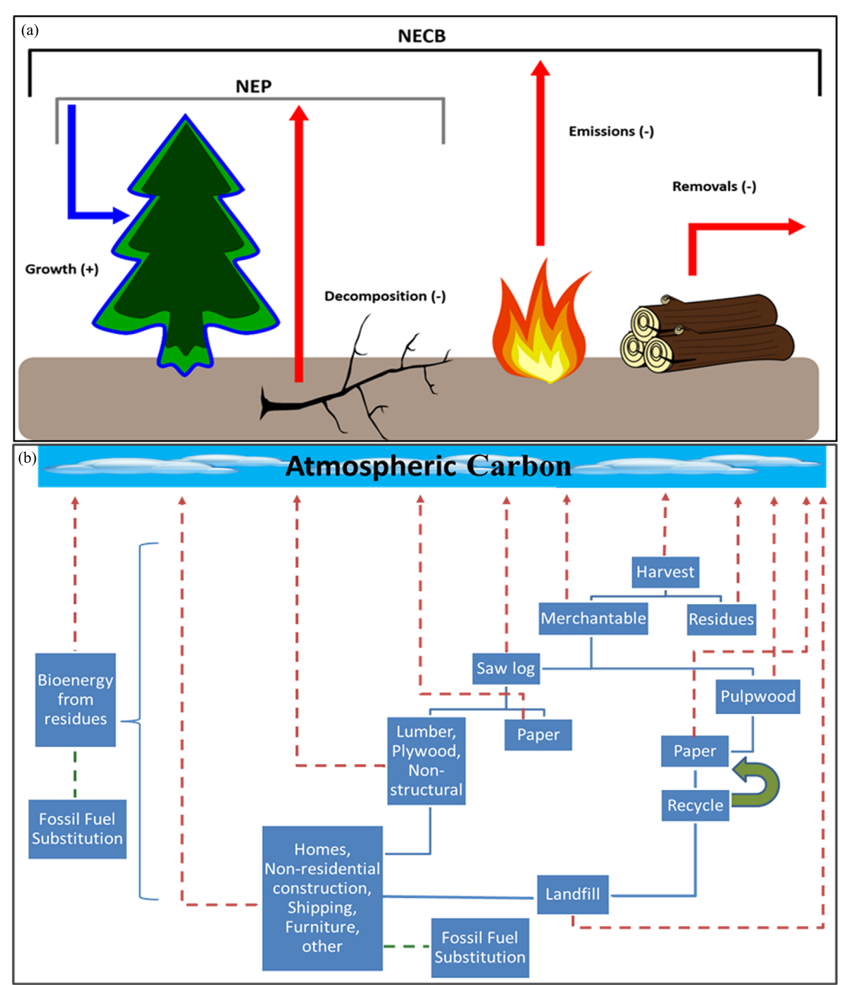
“In addition to NEP, disturbances from harvest and wildfire influence estimates of net ecosystem carbon balance (NECB=NEP minus losses Chapin et al 2006; figure 1(a)).”
BackgroundSelf-citationMEASURING NET PRIMARY PRODUCTION IN FORESTS: CONCEPTS AND FIELD METHODS
Clark, D. A., Brown, S., Kicklighter, D. W., Chambers, J. Q., Thomlinson, J. R., & Ni, J. (2001) · Ecological Applications · doi:10.1890/1051-0761(2001)011[0356:mnppif]2.0.co;2 · Cited by 994 · cited 3×
“For the biomass and NPP observations, we performed Monte Carlo simulations of the mean and standard deviations for NPP (Hudiburg et al 2011) derived for each plot using three alternative sets of allometric equations.”
MethodUnexpectedly large impact of forest management and grazing on global vegetation biomass
Erb, K.-H., Kastner, T., Plutzar, C., Bais, A. L. S., Carvalhais, N., Fetzel, T., Gingrich, S., Haberl, H., Lauk, C., Niedertscheider, M., et al. (2018) · Nature · doi:10.1038/nature25138 · Cited by 727 · cited 1×
“Global vegetation stores of carbon are 50% of their potential including western forests because of harvest activities (Erb et al 2017).”
BackgroundGlobal importance of large‐diameter trees
Lutz, J. A., Furniss, T. J., Johnson, D. J., Davies, S. J., Allen, D., Alonso, A., Anderson‐Teixeira, K. J., Andrade, A., Baltzer, J., Becker, K. M. L., et al. (2018) · Global Ecology and Biogeography · doi:10.1111/geb.12747 · Cited by 589 · cited 1×
“Allowing forests to reach their biological potential for growth and sequestration, maintaining large trees (Lutz et al 2018), reforesting recently cut lands, and afforestation of suitable areas will remove additional CO2 from the atmosphere.”
BackgroundMeta-analysis of greenhouse gas displacement factors of wood product substitution
Sathre, R., & O’Connor, J. (2010) · Environmental Science & Policy · doi:10.1016/j.envsci.2009.12.005 · Cited by 537 · cited 3×
“Our wood bioenergy substitution credits (Sathre and O’Connor 2010) include wood waste from harvest, mill residues, and wood products displacement of more fossil fuel intensivematerials.”
BackgroundInfluentialSmith, J. E., Heath, L. S., Skog, K. E., & Birdsey, R. A. (2006) · doi:10.2737/ne-gtr-343 · Cited by 384 · cited 1×
“In Forest-GHG, a fraction of each year’s new harvest is allocated to residential (single-family,multi-family, and mobile homes) and non-residential construction (Smith et al 2006).”
Background
Cited by
Getting the message right on nature‐based solutions to climate change
Seddon, N., Smith, A., Smith, P., Key, I., Chausson, A., Girardin, C., House, J., Srivastava, S., & Turner, B. (2021) · Global Change Biology · doi:10.1111/gcb.15513 · Cited by 1,073
“A high proportion of harvested wood is used for paper, card and short- lived products such as MDF furniture, which soon end up in landfill or incineration, releasing carbon back to the atmosphere so that the net result could even be a carbon loss (Hudiburg et al., 2019; Lewis, Wheeler, et al., 2019).”
InfluentialForster, E. J., Healey, J. R., Dymond, C., & Styles, D. (2021) · Nature Communications · doi:10.1038/s41467-021-24084-x · Cited by 169
Cowie, A., Berndes, G., Bentsen, N. S., Brandão, M., Cherubini, F., Egnell, G., George, B. H., Gustavsson, L., Hanewinkel, M., Harris, Z. M., et al. (2021) · GCB Bioenergy · doi:10.1111/gcbb.12844 · Cited by 165
“Several authors (Brack, 2017; Hudiburg et al., 2019; Norton et al., 2019) propose changing the UNFCCC accounting rules by which biomass is treated as having zero emissions at the point of combustion.”
BackgroundMildrexler, D. J., Berner, L. T., Law, B. E., Birdsey, R. A., & Moomaw, W. R. (2020) · Frontiers in Forests and Global Change · doi:10.3389/ffgc.2020.594274 · Cited by 168
“If harvested, life cycle assessment shows that 65% of the wood harvested in Oregon over the past 115 years has been emitted to the atmosphere, 16% is in landfills and only 19% remains in wood products (Hudiburg et al., 2019).”
BackgroundSelf-citationFocus on the role of forests and soils in meeting climate change mitigation goals: summary
Moomaw, W. R., Law, B. E., & Goetz, S. J. (2020) · Environmental Research Letters · doi:10.1088/1748-9326/ab6b38 · Cited by 143
“In this focus collection, Hudiburg et al (2019) developed an accurate, transparent, and transferable accounting method of all forest-derived carbon for Washington, Oregon and California.”
MethodResultSelf-citation
Metadata
- Authors
- Hudiburg, T. W., Law, B. E., Moomaw, W. R., Harmon, M. E., & Stenzel, J. E.
- Affiliations
- University of Idaho (US)
- Oregon State University (US)
- Tufts University (US)
- Corresponding author
- Hudiburg, Tara W
- Venue
- Environmental Research Letters
- Publisher
- IOP Publishing
- Published
- 2019-08-23
- Volume
- 14
- Issue
- 9
- Pages
- 095005
- ISSN
- 1748-9326 (ISSN-L)
- OpenAlex
- W2969412382
- Cited by
- 78
- References
- 38
- Citations by year
- 2026: 5 · 2025: 9 · 2024: 10 · 2023: 15 · 2022: 15 · 2021: 20 · 2020: 4
- FWCI
- 5.02
- Type
- journal article
- Language
- en
- Open access
- gold
- doi.org
- Licence
- cc-by
- creativecommons.org/licenses/by/3.0/ (vor)
- iopscience.iop.org/info/page/text-and-data-mining (tdm)
- Locations
- Environmental Research Letters (publishedVersion, cc-by)
- DOAJ (DOAJ: Directory of Open Access Journals) (submittedVersion)
- Funders
- Division of Environmental Biology (1553049)
- National Institute of Food and Agriculture (2013-67003-20652)
- Topics
- Life Sciences › Agricultural and Biological Sciences › Forestry › Forest Management and Policy
- Physical Sciences › Environmental Science › Environmental Engineering › Environmental Impact and Sustainability
- Life Sciences › Agricultural and Biological Sciences › Forestry › Forest ecology and management
- Keywords
- forest carbon sequestration, life cycle assessment, forest inventory data, wildfire emissions, forest carbon storage, climate change mitigation
About these checks
Registry, retraction, Cites and statistics results are computed, not judged, with one exception: a printed reference that no index lists is read once by a model before it counts as a citation error. Claims are extracted by a model and kept only when their quote appears verbatim in the text; each cited source is then checked, with a model’s help, for whether it says what the claim relies on. Those verdicts can be wrong — read the claim’s quote and the cited source before relying on one.
Statistics and arithmetic are recomputed, not judged.
Confidence bands are shown only for fields calibrated on our annotated test set. None is calibrated yet, so no band is shown.
What counts as a claim ›How we measure confidence ›How we check this ›
Are you an author, or do you see a problem with this page? Request a review
Data sources
Bibliographic data: Semantic Scholar, OpenAlex, Crossref.
Contains information from the Semantic Scholar Academic Graph Datasets, made available under the ODC Attribution License (ODC-BY 1.0).
Semantic Scholar’s data is described in: Kinney, R., et al. (2023). The Semantic Scholar Open Data Platform. arXiv:2301.10140.
