

Growth of Black Soldier Fly (Hermetia illucens) Larvae Fed on Spent Coffee Ground
Open accessThe DOI matches its Crossref record; 14 of the 14 references it cites were found in a registry or an index.
Abstract
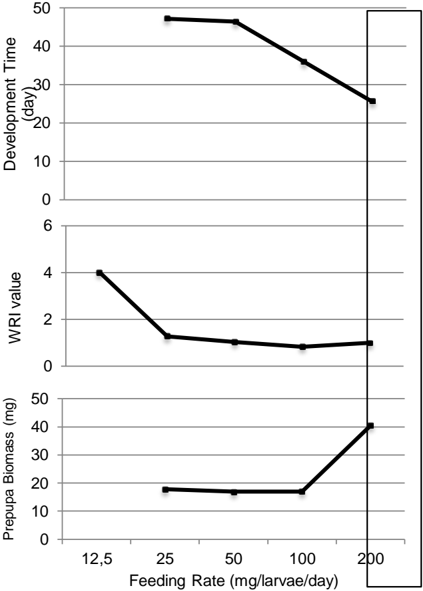
Hermetia illucens or Black Soldier Fly (BSF) is one of the bioconversion agents that can convert any kind of organic wastes. In this research, BSF larvae was used as a bioconversion agent on spent coffee ground, the main waste in coffee industry. This study aimed to determine the effect of spent coffee ground as feed on larval growth and the ability of BSF larvae in converting this spent based on ECD (Efficiency of Conversion Digestive) and WRI (Waste Reduction Index). The 7-day old larvae was nourished on spent coffee grounds with different feeding rate (200, 100, 50, 25, dan 12,5 mg/larvae/day). The results showed that larvae with feeding rate at 200 mg/larvae/day had shortest development time (25.6 ± 2.19 days), highest ECD value (5 ± 0.49%), highest pupae biomass (14,8 ± 2,15 mg), highest grow rate (1,41 ± 0,17 mg/day), but low WRI (0,997 ± 0,11). Additional proximate analysis exhibited that pupae contain total protein up to 33,45%. We concluded that BSF larvae has slow growth rate but can convert spent coffee ground.
Overview
The claims and statistics of this paper haven’t been checked yet.
Free: it reads the open-access text and checks the first 5 claims that cite a source we can check. Create a free account to check every claim.
Integrity signals
Registry
Cites
Statistics
Figures
Verification
Claims the paper makes
The claims and statistics of this paper haven’t been checked yet.
Free: it reads the open-access text and checks the first 5 claims that cite a source we can check. Create a free account to check every claim.
Claims other papers make about this one
Each is checked against this paper’s own text: does it say what the citing paper says it does?
The cited source says what the claim attributes to it.
In the citing paper
“Furthermore, studies have shown that Black Soldier Fly (BSF: Hermetia illucens) larvae can grow and develop on fresh SCG [34,35].”
From Spent Coffee Grounds Applied as a Top-Dressing or Incorporated into the Soil Can Improve Plant Growth While Reducing Slug Herbivory (2023) · cites this paper as [35]
Self-check
Percentages, sums and reported differences re-computed from the paper’s own numbers.
The self-check needs the paper’s full text.
Citations
Cites
The Consumption and Utilization of Food by Insects
Waldbauer, G. P. (1968) · Advances in Insect Physiology · doi:10.1016/s0065-2806(08)60230-1 · Cited by 1,950 · cited 2×
“Larvae ability to convert feed into its biomass was calculated by ECD (Efficiency Conversion of Digestive Feed) with the equation below [7]:”
BackgroundMethodProduction, Composition, and Application of Coffee and Its Industrial Residues
Mussatto, S. I., Machado, E. M. S., Martins, S., & Teixeira, J. A. (2011) · Food and Bioprocess Technology · doi:10.1007/s11947-011-0565-z · Cited by 1,010 · cited 3×
“Jakarta [2] Mussatto SI, Machado EMS, Martins S and Teixeira JA 2011 Production, Composition, and Application of Coffee and Its Industrial Residues Food Bioproces Technol 4 661-672 [3] Gomes T, Pereira JA, Ramalhosa E, Casal S.”
BackgroundConversion of organic material by black soldier fly larvae: establishing optimal feeding rates
Diener, S., Zurbrügg, C., & Tockner, K. (2009) · Waste Management & Research: The Journal for a Sustainable Circular Economy · doi:10.1177/0734242x09103838 · Cited by 820 · cited 8×
“Remarks : ECI = efficiency conversion of ingestive feed AD = approximate digestibility B = larvae final biomass (mg) T = total feed (mg) R = residue (mg) Larvae ability to reduce feed (organic matter) was calculated by WRI (Waste Reduction Index) with the equation below [5]:”
BackgroundMethodResultInfluentialSpent coffee grounds: A review on current research and future prospects
Campos-Vega, R., Loarca-Piña, G., Vergara-Castañeda, H. A., & Oomah, B. D. (2015) · Trends in Food Science & Technology · doi:10.1016/j.tifs.2015.04.012 · Cited by 679
Development of black soldier fly (Diptera: Stratiomyidae) larvae fed dairy manure
Myers, H. M., Tomberlin, J. K., Lambert, B. D., & Kattes, D. (2008) · Environmental Entomology · doi:10.1093/ee/37.1.11 · Cited by 338
GOBBI, P., MARTÍNEZ-SÁNCHEZ, A., & ROJO, S. (2013) · European Journal of Entomology · doi:10.14411/eje.2013.061 · Cited by 233
Development of Black Soldier Fly (Diptera: Stratiomyidae) Larvae Fed Dairy Manure
Myers, H. M., Tomberlin, J. K., Lambert, B. D., et al. (2008) · Environmental Entomology · doi:10.1603/0046-225x(2008)37[11:dobsfd]2.0.co;2 · Cited by 205
Black Soldier Fly (Hermetia illucens) as an Alternative Protein Source for Animal Feed
Wardhana, A. H. (2017) · Indonesian Bulletin of Animal and Veterinary Sciences · doi:10.14334/wartazoa.v26i2.1327 · Cited by 161
Effects of Protein and Carbohydrate on an Insect Herbivore: The Vista from a Fitness Landscape
Gall, M. L., & Behmer, S. T. (2014) · Integrative and Comparative Biology · doi:10.1093/icb/icu102 · Cited by 122
Hahn, D. A. (2005) · Journal of Insect Physiology · doi:10.1016/j.jinsphys.2005.06.011 · Cited by 81 · cited 2×
“Previous study on BSF larvae growth fed by mixed waste (vegetable, fruits, and human leftover food), the growth rate reached 1,53-1,8 mg/day [9].”
Background
Research works printed but not linked: 2
- Pusat Data dan dan Sistem Informasi Pertanian, 2015, Outlook Kopi Sekretariat Jenderal Kementerian Pertanian
- Kusumah MS, 2016, Sebagai Sumber Pakan Ikan Skripsi Sarjana Rekayasa Pertanian ITB
Cited by
Sustainable Waste Management at Household Level with Black Soldier Fly Larvae (Hermetia illucens)
Mahmood, S., Zurbrügg, C., Tabinda, A. B., Ali, A., & Ashraf, A. (2021) · Sustainability · doi:10.3390/su13179722 · Cited by 75
“For more accurate quantification of actually digested food by BSFL, its “approximate digestibility”, commonly known as assimilation efficiency (AD), was calculated [36,37].”
MethodResultFischer, H., Romano, N., & Sinha, A. K. (2021) · Insects · doi:10.3390/insects12040332 · Cited by 59
“It has been similarly reported that spent coffee may not support optimal growth of BSFL and one of the contributors was higher amounts of indigestible fiber [31,32].”
BackgroundArnone, S., Mei, M. D., Petrazzuolo, F., Musmeci, S., Tonelli, L., Salvicchi, A., Defilippo, F., Curatolo, M., & Bonilauri, P. (2022) · Environmental Science and Pollution Research · doi:10.1007/s11356-022-20250-w · Cited by 58
“These values were higher than the very low content obtained on the low nutrient spent coffee grounds (7 g/100gDM) (Permana and Ramadhani Eka Putra 2018) and on mixed sewage sludge (8.6–17.0 g/100gDM)”
BackgroundInfluentialA comprehensive dynamic growth and development model of Hermetia illucens larvae
Padmanabha, M., Kobelski, A., Hempel, A.-J., & Streif, S. (2020) · PLoS ONE · doi:10.1371/journal.pone.0239084 · Cited by 53
Horgan, F. G., Floyd, D., Mundaca, E. A., & Crisol-Martínez, E. (2023) · Agriculture · doi:10.3390/agriculture13020257 · Cited by 38
Romano, N., Fischer, H., Kumar, V., Francis, S., & Sinha, A. K. (2021) · International Journal of Tropical Insect Science · doi:10.1007/s42690-021-00532-5 · Cited by 39
Laksanawimol, P., Anukun, P., & Thancharoen, A. (2024) · PeerJ · doi:10.7717/peerj.17129 · Cited by 34
“Likewise, the presence of toxic phenolic compounds in SCG could impact the larval growth ( Permana & Ramadhani Eka Putra, 2018 ; Sideris et al., 2021 ).”
BackgroundSideris, V., Georgiadou, M., Papadoulis, G. T., Mountzouris, K. C., & Tsagkarakis, A. E. (2021) · Insects · doi:10.3390/insects12050475 · Cited by 31
Pilot scale production of Hermetia illucens (L.) larvae and frass using former foodstuffs
Gligorescu, A., Macavei, L. I., Larsen, B. F., Markfoged, R., Fischer, C. H., Koch, J. D., Jensen, K., Heckmann, L., Nørgaard, J. V., & Maistrello, L. (2022) · Cleaner Engineering and Technology · doi:10.1016/j.clet.2022.100546 · Cited by 30
Hutabarat, D. J. C., & Mangindaan, D. W. (2024) · Agriculture · doi:10.3390/agriculture14020205 · Cited by 25
Guillaume, J., Mezdour, S., Marion‐Poll, F., Terrol, C., & Schmidely, P. (2023) · Journal of Insects as Food and Feed · doi:10.3920/jiff2022.0103 · Cited by 26
Navajas-Porras, B., Delgado-Osorio, A., Hinojosa-Nogueira, D., Pastoriza, S., Almécija‐Rodríguez, M. D. C., Rufián‐Henares, J. Á., & Fernández-Bayo, J. D. (2024) · Food Research International · doi:10.1016/j.foodres.2024.115151 · Cited by 21
Moo, C. Y., & Hasan, H. A. (2022) · Tropical Life Sciences Research · doi:10.21315/tlsr2022.33.1.11 · Cited by 29
Kuppusamy, G., Kong, C. K., Segaran, G. C., Tarmalingam, E., Herriman, M., Ismail, M. F., Khan, T. M., Low, L. E., & Goh, B. H. (2020) · Biology · doi:10.3390/biology9090274 · Cited by 18
“45%) in BSF pupae fed with spent coffee grounds [29].”
BackgroundRuschioni, S., Duca, D., Tulli, F., Zarantoniello, M., Cardinaletti, G., Corsi, L., Olivotto, I., Basili, D., Naspetti, S., Truzzi, C., et al. (2024) · Animals · doi:10.3390/ani14040609 · Cited by 15
Permana, A. D., Fitri, L. L., & Julita, U. (2020) · Jurnal Biodjati · doi:10.15575/biodjati.v5i2.9049 · Cited by 13
Self-citationWeko, M. R., Bao, F., Ega, M. E., Mia, H., Una, K. S. I., Viana, M., Wale, L., Nalle, C. L., Burithnaban, Y. M., Lema, A. T., et al. (2023) · BIOTROPIA · doi:10.11598/btb.2023.30.3.1903 · Cited by 13
Influences of artificial light on mating of black soldier fly (Hermetia illucens)—a review
Awal, M. R., Rahman, M. M., Choudhury, M. A. R., Hasan, M. M., Rahman, M. T., & Mondal, M. F. (2022) · International Journal of Tropical Insect Science · doi:10.1007/s42690-022-00786-7 · Cited by 13
Damanik, N. F., Putra, R. E., Kinasih, I., & Permana, A. D. (2023) · HAYATI Journal of Biosciences · doi:10.4308/hjb.31.2.317-327 · Cited by 12
“It (Permana et al. 2018) This study This study (Meneguz et al. 2018) (Meneguz et al. 2018) (Permana et al. 2022) This study (Permana et al. 2022) This study (Gao et al. 2019) (Gustika 2022; unpublished data) (Permana et al. 2021) (Manurung et al. 2016) HAYATI J Biosci of H. illucens larvae on a…”
BackgroundMethodInfluentialSelf-citationKarthikeyani, T., Sivasubramanian, K., Maheswari, M., Chitra, N., Saravanan, S., Jothimani, P., & Karthika, S. (2024) · International Journal of Environment and Climate Change · doi:10.9734/ijecc/2024/v14i23959 · Cited by 13
Use of Black Soldier Fly Larvae for Bioconversion of Tomato Crop Residues
Parra-Pacheco, B., Aguirre-Becerra, H., Feregrino‐Pérez, A. A., Chandrakasan, G., González-Lara, H., & García‐Trejo, J. F. (2025) · Sustainability · doi:10.3390/su17083578 · Cited by 9
“For example, in research using ground coffee to feed BSFL, a 5% ECD was obtained, whereas, in this study, this value was higher in all doses and substrates [65].”
Muhlison, W., Purnamasari, L., Sucipto, I., Saputra, T. W., & Ahmad, N. K. N. (2021) · TECHNO JURNAL PENELITIAN · doi:10.33387/tjp.v10i2.2803 · Cited by 9
The nutritional value of black soldier flies (Hermetia illucen) as poultry feed
Mahmud, A. T. B. A., Santi, Rahardja, D. P., Bugiwati, R., & Sari, D. (2020) · IOP Conference Series Earth and Environmental Science · doi:10.1088/1755-1315/492/1/012129 · Cited by 6
“[12] The ability of Hermetia illucens larvae to eat various types of organic matter and convert it to fat or calories is due to the presence of lipase and amylase enzymes in the digestive system.”
BackgroundBio-treatment of Cheese Whey by Black Soldier Fly Larvae (Hermetia illucens) reared in Algeria
Hanafi, T., Meziane, K. Z., Megateli, S., Moussaoui, B., Guemou, L., & Reghioui, B. (2024) · Journal of Agriculture and Applied Biology · doi:10.11594/jaab.05.01.10 · Cited by 2
Guillaume, J. (2024) · theses.fr (ABES) · doi:10.70675/9d0092eaz6d91z432az9addz0eeb245957aa · Cited by 1
Sucaticona, R. S., Gómez, Y. M. A., & Rodríguez, E. D. P. (2021) · Revista de Iniciación Científica · doi:10.33412/rev-ric.v7.1.3063 · Cited by 1
Handojo, L. A., Permana, A. D., Kresnowati, M. T. A. P., Utomo, T. P., Sumampouw, G. A., Lugito, G., Anderson, R., Fauzani, I. D., Deyanti, N. P., Amara, S., et al. (2025) · ASEAN Journal of Chemical Engineering · doi:10.22146/ajche.20345
Self-citationGrowth of Black Soldier Fly (Hermetia Illucens) Larvae Fed with Various Agriwastes
Lembak, R. (2025) · Aloysian Interdisciplinary Journal of Social Sciences, Education, and Allied Fields · doi:10.5281/zenodo.15501056
Duarte, P., Ameixa, O. M. C. C., Neto, R. C., Lourenço, F., Coelho, M., Gaspar, R., Assunção, M. F. G., Rocha, H. R., Palma, M., & Viegas, I. (2026) · Comparative Biochemistry and Physiology Part B Biochemistry and Molecular Biology · doi:10.2139/ssrn.7038292
Metadata
- Authors
- Permana, A. D., & Ramadhani Eka Putra, J. E. N.
- Affiliations
- Bandung Institute of Technology (ID)
- Corresponding author
- Permana, Agus Dana
- ORCID
- Permana, Agus Dana
- Venue
- IOP Conference Series: Earth and Environmental Science
- Publisher
- IOP Publishing
- Published
- 2018-11-19
- Volume
- 187
- Pages
- 012070
- ISSN
- 1755-1315 (ISSN-L)
- OpenAlex
- W2900928704
- Semantic Scholar
- db4714451200e0104c3a9129eb9d9cf3143236dc
- Cited by
- 26
- References
- 13
- Citations by year
- 2026: 1 · 2025: 1 · 2024: 5 · 2023: 5 · 2022: 4 · 2021: 6 · 2020: 4
- FWCI
- 28.72
- Type
- conference paper
- Language
- en
- Open access
- diamond
- doi.org
- Licence
- cc-by
- iopscience.iop.org/info/page/text-and-data-mining (tdm)
- creativecommons.org/licenses/by/3.0/ (vor)
- Locations
- IOP Conference Series Earth and Environmental Science (publishedVersion, cc-by)
- Topics
- Life Sciences › Agricultural and Biological Sciences › Insect Science › Insect Utilization and Effects
- Life Sciences › Agricultural and Biological Sciences › Insect Science › Forensic Entomology and Diptera Studies
- Life Sciences › Agricultural and Biological Sciences › Plant Science › Insect Pest Control Strategies
- Keywords
- Hermetia illucens, black soldier fly larvae, spent coffee grounds, coffee industry waste, larval growth, biotransformation, waste reduction index, feeding rate, organic waste management
About these checks
Registry, retraction, Cites and statistics results are computed, not judged, with one exception: a printed reference that no index lists is read once by a model before it counts as a citation error. Claims are extracted by a model and kept only when their quote appears verbatim in the text; each cited source is then checked, with a model’s help, for whether it says what the claim relies on. Those verdicts can be wrong — read the claim’s quote and the cited source before relying on one.
Statistics and arithmetic are recomputed, not judged.
Confidence bands are shown only for fields calibrated on our annotated test set. None is calibrated yet, so no band is shown.
What counts as a claim ›How we measure confidence ›How we check this ›
Are you an author, or do you see a problem with this page? Request a review
Data sources
Bibliographic data: Semantic Scholar, OpenAlex, Crossref.
Contains information from the Semantic Scholar Academic Graph Datasets, made available under the ODC Attribution License (ODC-BY 1.0).
Semantic Scholar’s data is described in: Kinney, R., et al. (2023). The Semantic Scholar Open Data Platform. arXiv:2301.10140.
