

Solving quantum statistical mechanics with variational autoregressive networks and quantum circuits
Open accessThe DOI matches its Crossref record; 52 of the 52 references it cites were found in a registry or an index.
Abstract
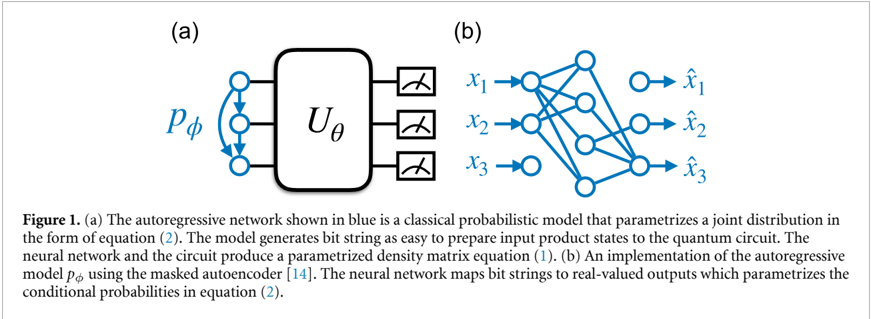
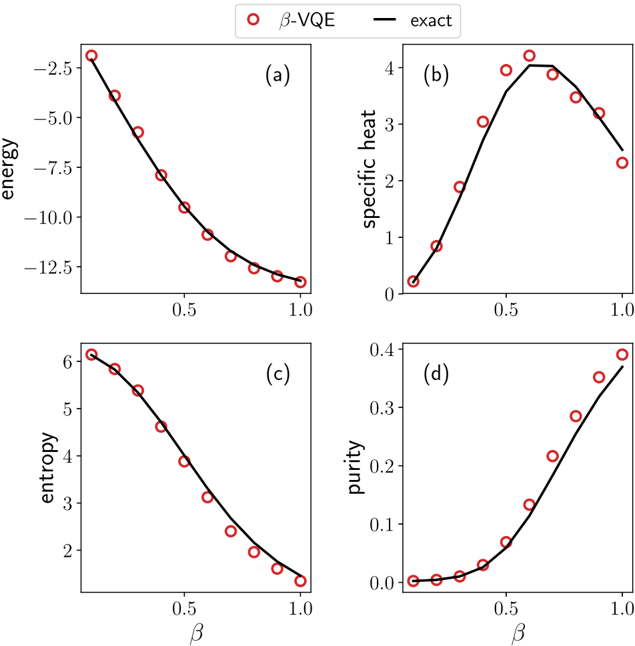
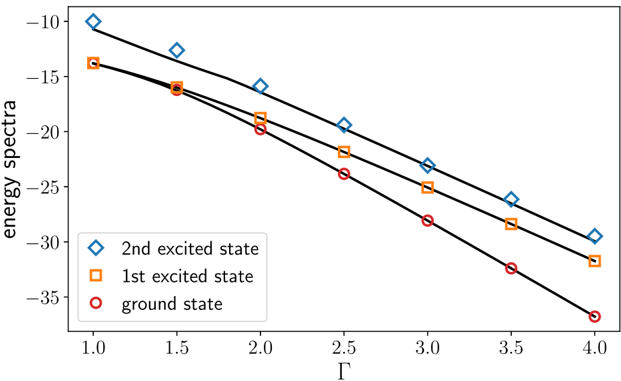
We extend the ability of an unitary quantum circuit by interfacing it with a classical autoregressive neural network. The combined model parametrizes a variational density matrix as a classical mixture of quantum pure states, where the autoregressive network generates bitstring samples as input states to the quantum circuit. We devise an efficient variational algorithm to jointly optimize the classical neural network and the quantum circuit to solve quantum statistical mechanics problems. One can obtain thermal observables such as the variational free energy, entropy, and specific heat. As a byproduct, the algorithm also gives access to low energy excitation states. We demonstrate applications of the approach to thermal properties and excitation spectra of the quantum Ising model with resources that are feasible on near-term quantum computers.
Overview
The claims and statistics of this paper haven’t been checked yet.
Free: it reads the open-access text and checks the first 5 claims that cite a source we can check. Create a free account to check every claim.
Integrity signals
Registry
Cites
Statistics
Figures
Verification
Claims the paper makes
The claims and statistics of this paper haven’t been checked yet.
Free: it reads the open-access text and checks the first 5 claims that cite a source we can check. Create a free account to check every claim.
Claims other papers make about this one
Each is checked against this paper’s own text: does it say what the citing paper says it does?
The source backs part of the claim, not all of it — or backs it for a different population, condition or comparison.
In the citing paper
“One can thus infer a classical model of the cost function, and minimise it, to offload more work from the quantum processor to the classical supervising system [85, 86].”
From Variational quantum algorithms (2021) · cites this paper as [86]
Experimental — accuracy not yet measured
Self-check
Percentages, sums and reported differences re-computed from the paper’s own numbers.
The self-check needs the paper’s full text.
Citations
Cites
Auto-Encoding Variational Bayes
Kingma, D. P., & Welling, M. (2013) · arXiv · doi:10.48550/arxiv.1312.6114 · Cited by 20,067 · cited 1×
“Popular generative models include autoregressive models [14, 16, 17], variational autoencoders [18], generative adversarial networks [19], and flow-based models [20].”
(2016) · Cited by 11,679
Quantum supremacy using a programmable superconducting processor
Arute, F., Arya, K., Babbush, R., Bacon, D., Bardin, J. C., Barends, R., Biswas, R., Boixo, S., Brandao, F. G. S. L., Buell, D. A., et al. (2019) · Nature · doi:10.1038/s41586-019-1666-5 · Cited by 7,720
WaveNet: a generative model for raw audio
Oord, A. V. D., Dieleman, S., Zen, H., Simonyan, K., Vinyals, O., Graves, A., Kalchbrenner, N., Senior, A., & Kavukcuoglu, K. (2016) · arXiv · doi:10.48550/arxiv.1609.03499 · Cited by 4,911 · cited 3×
“The autoregressive models have reached state-of-the-art performance in modeling realistic data and found real-world applications in synthesizing natural speech and images [16, 17].”
BackgroundA variational eigenvalue solver on a photonic quantum processor
Peruzzo, A., McClean, J., Shadbolt, P., Yung, M.-H., Zhou, X.-Q., Love, P. J., Aspuru-Guzik, A., & O’Brien, J. L. (2014) · Nature Communications · doi:10.1038/ncomms5213 · Cited by 4,552
Generative Adversarial Networks
Goodfellow, I. J., Pouget-Abadie, J., Mirza, M., Xu, B., Warde-Farley, D., Ozair, S., Courville, A., & Bengio, Y. (2014) · arXiv · doi:10.48550/arxiv.1406.2661 · Cited by 4,477
Simple Statistical Gradient-Following Algorithms for Connectionist Reinforcement Learning
Williams, R. J. (1992) · Machine Learning · doi:10.1007/bf00992696 · Cited by 3,416 · cited 2×
“Next, the gradients of the neural network parameters can be evaluated using the REINFORCE algorithm [45]”
Hardware-efficient variational quantum eigensolver for small molecules and quantum magnets
Kandala, A., Mezzacapo, A., Temme, K., Takita, M., Brink, M., Chow, J. M., & Gambetta, J. M. (2017) · Nature · doi:10.1038/nature23879 · Cited by 2,982
Quantum Computation and Quantum Information: 10th Anniversary Edition
Nielsen, M. A., & Chuang, I. L. (2011) · Cited by 2,724
Mitarai, K., Negoro, M., Kitagawa, M., & Fujii, K. (2018) · Physical Review A · doi:10.1103/physreva.98.032309 · Cited by 1,639
Research works printed but not linked: 14
- Brand ao F G and Kastoryano M J 2019 Commun. Math. Phys. 365 1 · DOI
- Zhu D, Johri S, Linke N M, Landsman K A, Nguyen N H, Alderete C H, Matsuura A Y, Hsieh T H and Monroe C 2019 (arXiv:1906.02699) · arXiv
- Motta M, Sun C, Tan A T K, O'rourke M J, Ye E, Minnich A J, Brandáo F G S L and Chan G K L 2019 (arXiv:1901.07653) · arXiv
- Pan F, Zhou H J and Zhang P 2019 (arXiv:1906.10935) · arXiv
- O'Malley P J et al 2016 Phys. Rev. X 6 031007
- Colless J I, Ramasesh V V, Dahlen D, Blok M S, Kimchi-Schwartz M E, McClean J R, Carter J, De Jong W A and Siddiqi I 2018 Phys. Rev. X 8 011021
- Hempel C et al 2018 Phys. Rev. X 8 31022
- Luo X Z, Liu J G, Zhang P and Wang L 2019 (arXiv:1912.10877) · arXiv
- Nakanishi K M, Fujii K and Todo S 2019 (arXiv:1903.12166) · arXiv
- Baydin A G, Pearlmutter B A, Radul A A and Siskind J M 2015 J. Mach. Learn. 18 1-43 (http://jmlr.org/papers/v18/16-107.html)
- Wiliams R J 1992 Mach. Learn. 8 229
- Yoshioka N, Nakagawa Y O, Mitarai K and Fujii K 2019 (arXiv:1908.09836) · arXiv
- Li S H, Dong C X, Zhang L and Wang L 2019 (arXiv:1910.00024) · arXiv
- Han Z Y, Wang J, Fan H, Wang L and Zhang P 2018 Phys. Rev. X 8 031012
Cited by
Variational quantum algorithms
Cerezo, M., Arrasmith, A., Babbush, R., Benjamin, S. C., Endo, S., Fujii, K., McClean, J. R., Mitarai, K., Yuan, X., Cincio, L., et al. (2021) · Nature Reviews Physics · doi:10.1038/s42254-021-00348-9 · Cited by 3,385
“More recently, there has been a proposal to generate mixed states which uses the autoregressive model [60].”
BackgroundA quantum convolutional neural network on NISQ devices
Wei, S., Chen, Y., Zhou, Z., & Long, G. (2022) · AAPPS Bulletin · doi:10.1007/s43673-021-00030-3 · Cited by 192
Differentiable quantum architecture search
Zhang, S.-X., Hsieh, C.-Y., Zhang, S., & Yao, H. (2022) · Quantum Science and Technology · doi:10.1088/2058-9565/ac87cd · Cited by 158
Yao.jl: Extensible, Efficient Framework for Quantum Algorithm Design
Luo, X.-Z., Liu, J.-G., Zhang, P., & Wang, L. (2020) · Quantum · doi:10.22331/q-2020-10-11-341 · Cited by 157
“It can be samples of classical data for quantum machine learning tasks [62] or an ensemble of pure quantum states for thermal state simulation [51].”
BackgroundMethodSelf-citationNeural predictor based quantum architecture search
Zhang, S.-X., Hsieh, C.-Y., Zhang, S., & Yao, H. (2021) · Machine Learning: Science and Technology · doi:10.1088/2632-2153/ac28dd · Cited by 88
Metadata
- Authors
- Liu, J.-G., Mao, L., Zhang, P., & Wang, L.
- Affiliations
- Chinese Academy of Sciences (CN)
- Tsinghua University (CN)
- Corresponding author
- Wang, Lei
- Venue
- Machine Learning: Science and Technology
- Publisher
- IOP Publishing
- Published
- 2021-02-03
- Volume
- 2
- Issue
- 2
- Pages
- 025011
- ISSN
- 2632-2153 (ISSN-L)
- OpenAlex
- W3039811809
- Cited by
- 57
- References
- 35
- Citations by year
- 2026: 5 · 2025: 7 · 2024: 17 · 2023: 9 · 2022: 12 · 2021: 5
- FWCI
- 2.75
- Type
- journal article
- Language
- en
- Open access
- gold
- doi.org
- Licence
- cc-by
- creativecommons.org/licenses/by/4.0 (vor)
- iopscience.iop.org/info/page/text-and-data-mining (tdm)
- Locations
- Machine Learning Science and Technology (publishedVersion, cc-by)
- arXiv (Cornell University) (submittedVersion)
- arXiv (Cornell University)
- Funders
- Key Research Program of Frontier Sciences, CAS (QYZDB-SSW-SYS032)
- National Natural Science Foundation of China (11747601)
- Topics
- Physical Sciences › Computer Science › Artificial Intelligence › Quantum Computing Algorithms and Architecture
- Physical Sciences › Physics and Astronomy › Atomic and Molecular Physics, and Optics › Quantum many-body systems
- Physical Sciences › Physics and Astronomy › Atomic and Molecular Physics, and Optics › Quantum Mechanics and Applications
- Keywords
- quantum statistical mechanics, quantum circuits, hybrid quantum-classical algorithms, variational free energy, thermal entropy, specific heat, quantum Ising model, near-term quantum devices
About these checks
Registry, retraction, Cites and statistics results are computed, not judged, with one exception: a printed reference that no index lists is read once by a model before it counts as a citation error. Claims are extracted by a model and kept only when their quote appears verbatim in the text; each cited source is then checked, with a model’s help, for whether it says what the claim relies on. Those verdicts can be wrong — read the claim’s quote and the cited source before relying on one.
Statistics and arithmetic are recomputed, not judged.
Confidence bands are shown only for fields calibrated on our annotated test set. None is calibrated yet, so no band is shown.
What counts as a claim ›How we measure confidence ›How we check this ›
Are you an author, or do you see a problem with this page? Request a review
How to cite
Cite CoChat for the checks on this page, and the paper for its own findings.
- This page
- CoChat. (2026). Citation check: Solving quantum statistical mechanics with variational autoregressive networks and quantum circuits. https://app.cochat.ai/papers/10.1088/2632-2153/aba19d
- The paper
- Liu, J.-G., Mao, L., Zhang, P., & Wang, L. (2021). Solving quantum statistical mechanics with variational autoregressive networks and quantum circuits. Machine Learning: Science and Technology. https://doi.org/10.1088/2632-2153/aba19d
Data sources
Bibliographic data: Semantic Scholar, OpenAlex, Crossref.
Contains information from the Semantic Scholar Academic Graph Datasets, made available under the ODC Attribution License (ODC-BY 1.0).
Semantic Scholar’s data is described in: Kinney, R., et al. (2023). The Semantic Scholar Open Data Platform. arXiv:2301.10140.
