

The DOI matches its Crossref record; 1 of the 1 references it cites were found in a registry or an index.
A Prospective, Randomized, Controlled Study to Evaluate the Effectiveness of a Fabric-Based Wireless Electroceutical Dressing Compared to Standard-of-Care Treatment Against Acute Trauma and Burn Wound Biofilm Infection
Abstract
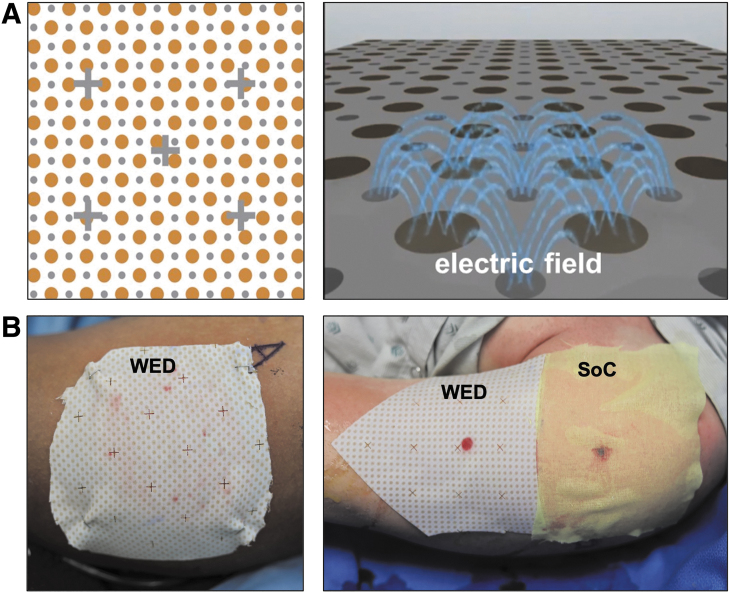
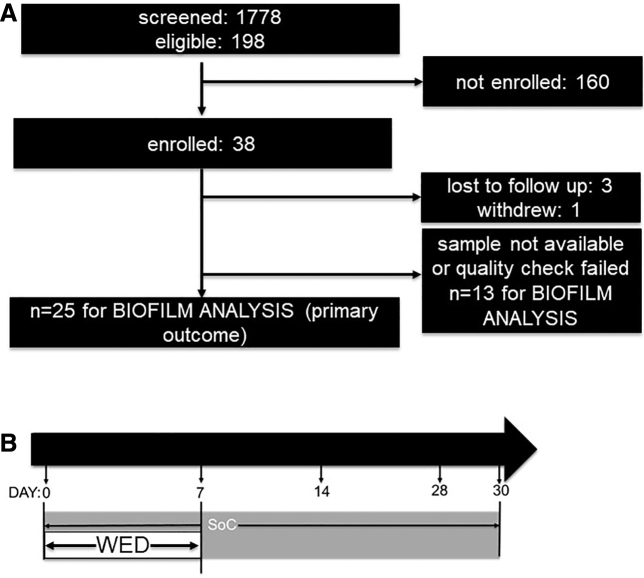
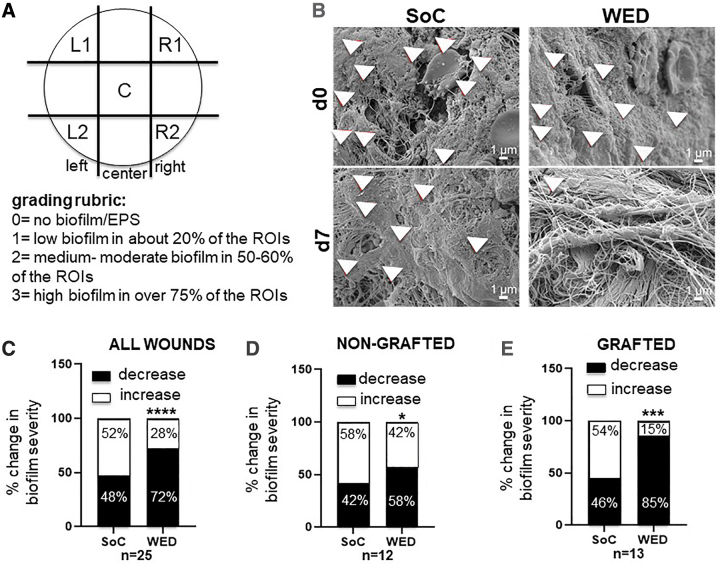
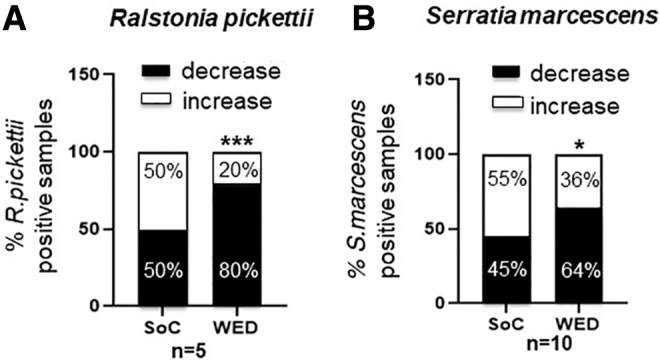
Objective: Despite advances in the use of topical and parenteral antimicrobial therapy and the practice of early tangential burn wound excision to manage bacterial load, 60% of the mortality from burns is attributed to bacterial biofilm infection. A low electric field (∼1 V) generated by the novel FDA-cleared wireless electroceutical dressing (WED) was previously shown to significantly prevent and disrupt burn biofilm infection in preclinical studies. Based on this observation, the purpose of this clinical trial was to evaluate the efficacy of the WED dressing powered by a silver–zinc electrocouple in the prevention and disruption of biofilm infection. Approach: : A prospective, randomized, controlled, single-center clinical trial was performed to evaluate the efficacy of the WED compared with standard-of-care (SoC) dressing to treat biofilms. Burn wounds were randomized to receive either SoC or WED. Biopsies were collected on days 0 and 7 for histology, scanning electron microscopy (SEM) examination of biofilm, and for quantitative bacteriological analyses. Results: In total, 38 subjects were enrolled in the study. In 52% of the WED-treated wounds, little to no biofilm could be detected by SEM. WED significantly lowered or prevented increase of biofilm in all wounds compared with the pair-matched SoC-treated wounds. Innovation: WED is a simple, easy, and rapid method to protect the wound while also inhibiting infection. It is activated by a moist environment and the electrical field induces transient and micromolar amounts of superoxide anion radicals that will prevent bacterial growth. Conclusion: WED decreased biofilm infection better compared with SoC. The study was registered in clinicaltrials.gov as NCT04079998.
Overview
The claims and statistics of this paper haven’t been checked yet.
Run the check — free, no account needed. It reads the open-access text and checks the sources it cites.
Integrity signals
Registry
Cites
Statistics
Figures


Verification
Claims the paper makes
The claims and statistics of this paper haven’t been checked yet.
Run the check — free, no account needed. It reads the open-access text and checks the sources it cites.
Claims other papers make about this one
Each is checked against this paper’s own text: does it say what the citing paper says it does?
In the citing paper
“Recognizing that human expert raters are the standard for assessing BFI in SEM images,26 we conducted a comparison between the results of SEM-ML analysis and those from human assessments using data from randomly selecting 60 images from a total set of 240 images.”
From SEMTWIST Quantification of Biofilm Infection in Human Chronic Wound Using Scanning Electron Microscopy and Machine Learning (2025) · cites this paper as [26]
Self-check
Percentages, sums and reported differences re-computed from the paper’s own numbers.
The self-check needs the paper’s full text.
Citations
Cites
Mixed‐species biofilm compromises wound healing by disrupting epidermal barrier function
Roy, S., Elgharably, H., Sinha, M., Ganesh, K., Chaney, S., Mann, E., Miller, C., Khanna, S., Bergdall, V. K., Powell, H. M., et al. (2014) · The Journal of Pathology · doi:10.1002/path.4360 · Cited by 208 · cited 3×
“14,15 At this time however, silver continues to be the preferred SoC treatment until novel therapies can be tested and accepted as superior alternatives.”
BackgroundMethodSelf-citation
Research works printed but not linked: 57
- 10.1097/prs.0000000000008142 · DOI · Paper page
- 10.1002/14651858.CD006478.pub2 · DOI
- 10.1080/08927014.2018.1563686 · DOI
- 10.1016/j.burns.2018.05.014 · DOI
- Mondal R, , Foote M, , Canada A, et al. Efficient silver release from ion exchange silver dressings in biologically relevant media. Wounds, 2020; 32(1):22–29.
- 10.1097/gox.0000000000002390 · DOI
- 10.1111/j.1600-0463.2007.apm_646.x · DOI
- 10.1016/j.burns.2014.09.009 · DOI
- 10.1002/14651858.CD002106.pub3 · DOI
- 10.1097/bcr.0000000000000406 · DOI
- 10.1097/PRS.0b013e3182589d63 · DOI
- 10.1016/j.burns.2016.03.029 · DOI
- 10.1002/path.4360 · DOI · Paper page
- 10.1111/iwj.12142 · DOI
- 10.1089/ars.2020.8086 · DOI
- 10.1038/nrmicro2415 · DOI · Paper page
- 10.1038/nature15709 · DOI
- 10.1016/j.cell.2016.12.014 · DOI
- 10.1016/j.tim.2012.10.004 · DOI
- 10.1371/journal.ppat.1001264 · DOI
- 10.1371/journal.ppat.1000213 · DOI
- 10.1128/aac.03132-14 · DOI
- 10.1128/AAC.38.12.2803 · DOI
- 10.1177/039139880803100906 · DOI
- 10.1007/BF01569830 · DOI
- 10.1128/AAC.41.9.1876 · DOI
- 10.1128/AAC.40.9.2012 · DOI
- 10.1371/journal.pone.0119531 · DOI
- 10.1371/journal.pone.0089239 · DOI
- 10.1097/00003086-200508000-00011 · DOI
- 10.1159/000097901 · DOI
- 10.1586/erd.12.70 · DOI
- 10.1089/wound.2011.0351 · DOI
- 10.1002/bit.25818 · DOI
- 10.1055/s-0032-1321799 · DOI
- 10.1016/S0070-2153(03)58001-2 · DOI
- 10.1093/oxfordjournals.rpd.a006375 · DOI
- 10.1002/bem.20479 · DOI
- 10.1089/wound.2013.0442 · DOI
- Sequin EK. Effects of Induced Electric Fields on Tissues and Cells. Doctoral dissertation. Columbus OH: The Ohio State University; 2014.
- 10.1109/TITB.2010.2042605 · DOI
- 10.1038/nature04925 · DOI
- 10.1097/sla.0000000000002504 · DOI
- Gallagher JJ Branski LK Williams-Bouyer N et al. Chapter 12 - Treatment of Infection in Burns. In: Total Burn Care (Fourth Edition). (Herndon DN. ed.) W.B. Saunders: London 2012; pp. 137–156.e2. · DOI
- 10.1100/tsw.2008.158 · DOI
- 10.1242/jcs.109.1.199 · DOI
- 10.1089/wound.2018.0915 · DOI
- 10.1038/s41598-021-00910-6 · DOI
- 10.1089/wound.2014.0615 · DOI
- 10.1038/s41598-018-37891-y · DOI
- 10.1371/journal.pone.0070360 · DOI
- 10.2307/healhumarigh.17.1.31 · DOI
- 10.1056/nejm200109203451210 · DOI
- Nair HKR, , Chong SYS, , Eruthayaraj A. Use of a unique bioelectric dressing in chronic wound healing. Wounds Asia, 2020; 3(3):40–44.
- 10.1097/BCR.0b013e31823356e4 · DOI
- 10.1016/j.jccw.2013.07.001 · DOI
- 10.5546/0/bupv-pavd · DOI
Cited by
Sorted by citations
Singh, S., Muniz De Oliveira, F., Wang, C., Kumar, M., Xuan, Y., DeMazumder, D., Sen, C. K., & Roy, S. (2025) · Advances in Wound Care · doi:10.1089/wound.2024.0291 · Cited by 6
Self-citation
Metadata
- Authors
- Chan, R. K., Nuutila, K., Mathew-Steiner, S. S., Diaz, V., Anselmo, K., Batchinsky, M., Carlsson, A., Ghosh, N., Sen, C. K., & Roy, S.
- Venue
- Advances in Wound Care
- Publisher
- SAGE Publications
- Published
- 2023-11-03
- Volume
- 13
- Issue
- 1
- Pages
- 1-13
- ISSN
- 2162-1918
- 2162-1934
- PMC
- PMC10654645
- Cited by
- 24
- References
- 1
- Language
- en
About these checks
Registry, retraction, Cites and statistics results are computed, not judged, with one exception: a printed reference that no index lists is read once by a model before it counts as a citation error. Claims are extracted by a model and kept only when their quote appears verbatim in the text; each cited source is then checked, with a model’s help, for whether it says what the claim relies on. Those verdicts can be wrong — read the claim’s quote and the cited source before relying on one.
Statistics and arithmetic are recomputed, not judged.
Confidence bands are shown only for fields calibrated on our annotated test set. None is calibrated yet, so no band is shown.
What counts as a claim ›How we measure confidence ›How we check this ›
Are you an author, or do you see a problem with this page? Request a review
