

CBT-based Online Self-help Training to Reduce Fear and Distress After Cancer (CAREST Randomized Trial): 24 Months Follow-up Using Latent Growth Models and Latent Class Analysis
Open accessThe DOI matches its Crossref record; 62 of the 62 references it cites were found in a registry or an index.
Abstract
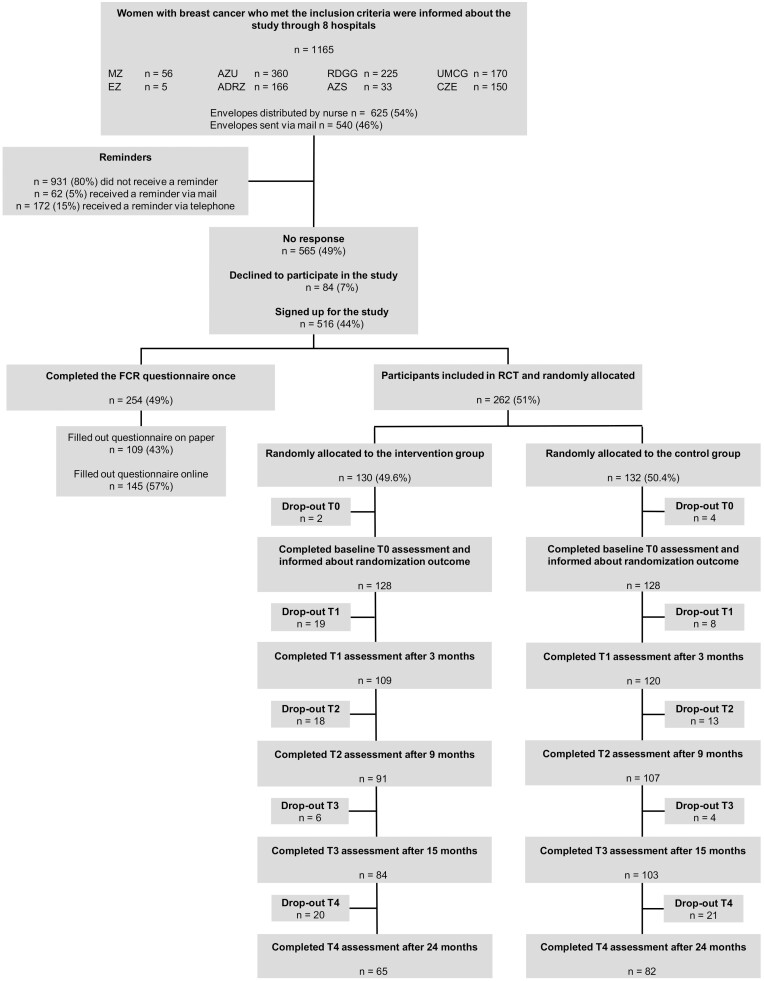
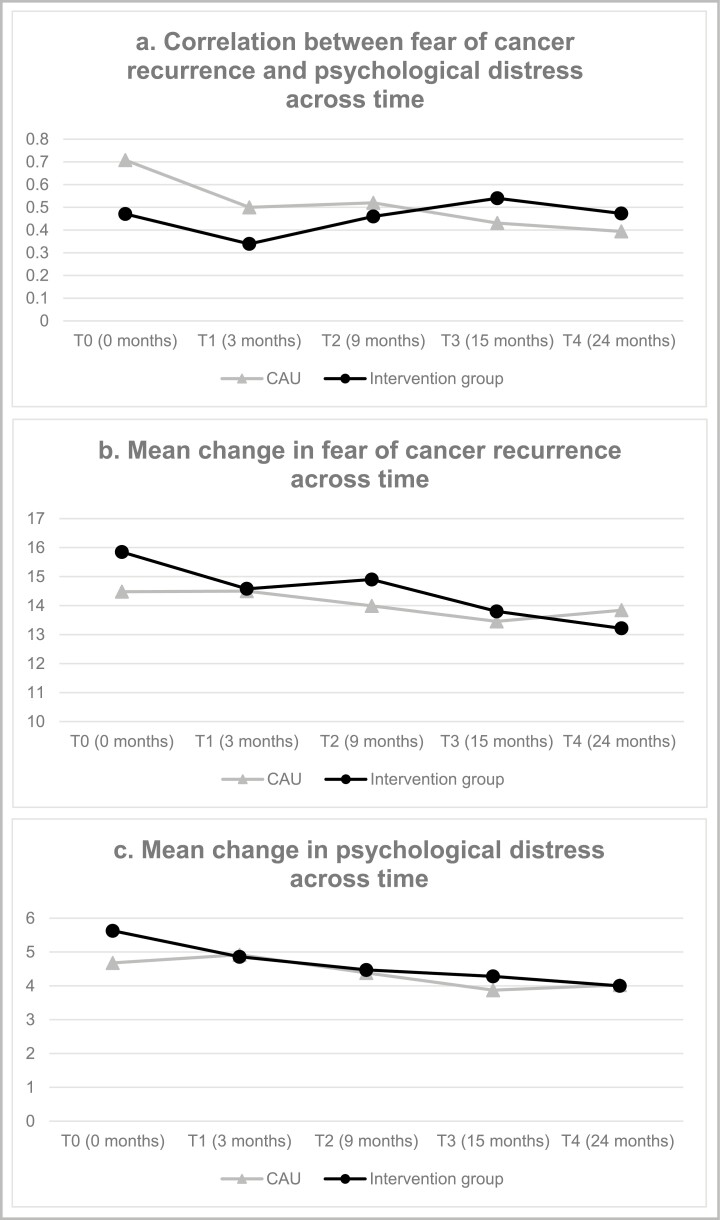
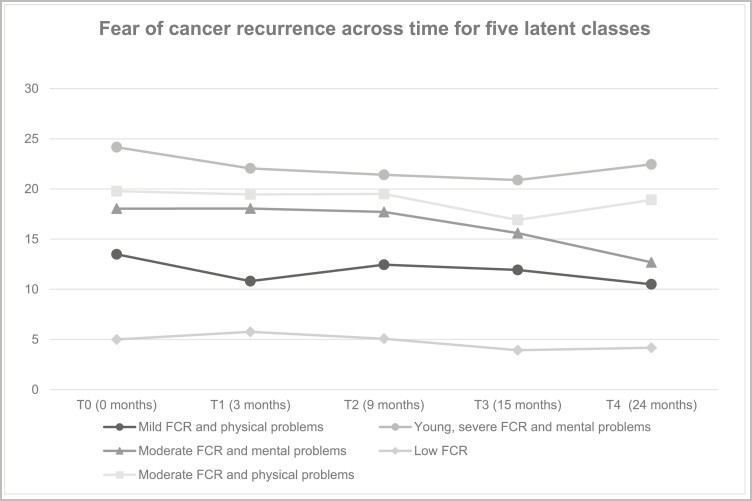
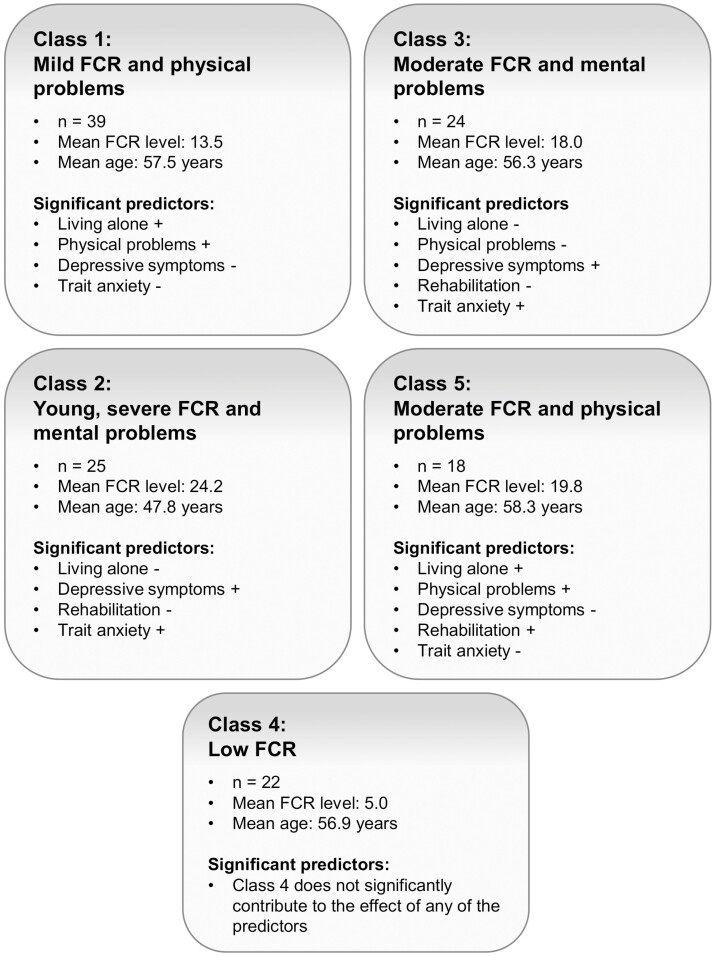
Background: Psychological distress (PD) and fear of cancer recurrence (FCR) are common consequences of surviving cancer. Online self-help training could help many cancer survivors deal with PD and FCR at low costs. Purpose: To evaluate the long-term effectiveness of the CAncer REcurrence Self-help Training (CAREST trial) to reduce PD and FCR. Moreover, to evaluate the relation between FCR and PD across time and identify subgroups representing different change trajectories in FCR over time and their predictors. Methods: This multicenter randomized controlled trial included 262 female breast cancer survivors, assigned to online self-help training or care as usual. Participants completed questionnaires at baseline and four times during the 24-month follow-up. The primary outcomes were PD and FCR (Fear of Cancer Recurrence Inventory). Latent growth curve modeling (LGCM) and repeated measures latent class analysis (RMLCA) were performed, both according to the intention-to-treat principle. Results: LGCM showed no differences between the average latent slope in both groups for both PD and FCR. The correlation between FCR and PD at baseline was moderate for the intervention group and strong for the CAU group and did not significantly decrease over time in both groups. RMLCA revealed five latent classes and several predictors of class membership. Conclusions: We did not find a long-term effect of the CBT-based online self-help training in reducing PD or FCR, nor in their relation. Therefore, we recommend adding professional support to online interventions for FCR. Information about FCR classes and predictors may contribute to improvement of FCR interventions.
Overview
The claims and statistics of this paper haven’t been checked yet.
Free: it reads the open-access text and checks the first 5 claims that cite a source we can check. Create a free account to check every claim.
Integrity signals
Registry
Cites
Statistics
Figures
Verification
Claims the paper makes
The claims and statistics of this paper haven’t been checked yet.
Free: it reads the open-access text and checks the first 5 claims that cite a source we can check. Create a free account to check every claim.
Claims other papers make about this one
Each is checked against this paper’s own text: does it say what the citing paper says it does?
The cited source says what the claim attributes to it.
In the citing paper
“CAREST trial demonstrated no effect of CBT‐based online self‐help training to reduce FCR in breast cancer survivors compared with CAU (after 3 and 9 months) [40] and two years on [66].”
Self-check
Percentages, sums and reported differences re-computed from the paper’s own numbers.
The self-check needs the paper’s full text.
Citations
Cites
R: A Language and Environment for Statistical Computing
R Core Team (2025) · doi:10.32614/r.manuals · Cited by 352,181
lavaan : An R Package for Structural Equation Modeling
Rosseel, Y. (2012) · Journal of Statistical Software · doi:10.18637/jss.v048.i02 · Cited by 27,955
A Simple Sequentially Rejective Multiple Test Procedure
(1979) · Scandinavian Journal of Statistics · doi:10.2307/4615733 · Cited by 21,526 · cited 1×
“Since we assessed multiple predictors, we adjusted the significance level using the Bonferroni–Holm correction [43].”
MethodCONSORT 2010 Statement: updated guidelines for reporting parallel group randomised trials
the CONSORT Group, Schulz, K. F., Altman, D. G., & Moher, D. (2010) · BMC Medicine · doi:10.1186/1741-7015-8-18 · Cited by 13,371
Power analysis and determination of sample size for covariance structure modeling.
MacCallum, R. C., Browne, M. W., & Sugawara, H. M. (1996) · Psychological Methods · doi:10.1037/1082-989x.1.2.130 · Cited by 10,418
A test of missing completely at random for multivariate data with missing values
Little, R. J. A. (1988) · Journal of the American Statistical Association · doi:10.1080/01621459.1988.10478722 · Cited by 8,963
Internet-based cognitive behaviour therapy for symptoms of depression and anxiety: A meta-analysis
SPEK, V., CUIJPERS, P., NYKLÍČEK, I., RIPER, H., KEYZER, J., & POP, V. (2007) · Psychological Medicine · doi:10.1017/s0033291706008944 · Cited by 1,586
Andrews, G., Cuijpers, P., Craske, M. G., McEvoy, P., & Titov, N. (2010) · PLoS ONE · doi:10.1371/journal.pone.0013196 · Cited by 1,311 · cited 2×
“Online interventions are promising, because they are easily accessible, have low costs, offer convenience and greater privacy, and patients can work at their own pace [22, 23].”
BackgroundTwelve frequently asked questions about growth curve modeling
Curran, P. J., Obeidat, K., & Losardo, D. (2010) · Journal of Cognition and Development · doi:10.1080/15248371003699969 · Cited by 1,246 · cited 1×
“In general, for growth models a sample size of at least 100 is preferred [28].”
Background
Research works printed but not linked: 1
- IBM Corp. IBM SPSS Statistics for Windows, Version 23.0 Armonk, NY: IBM Corp. 2014.
Cited by
Yao, H., Xiong, M., Cheng, Y.-P., Zhang, Q., Luo, Y., Ding, X., & Zhang, C. (2024) · Frontiers in Psychology · doi:10.3389/fpsyg.2024.1411647 · Cited by 38
Li, Y., Zhang, Z., Ma, X., Zhang, X., & Li, S. (2023) · Frontiers in Psychology · doi:10.3389/fpsyg.2023.1241129 · Cited by 16
Savard, J., Filion, C., Brearty, C. M., Caplette‐Gingras, A., Chiquette, J., & Dorval, M. (2024) · Cancer Medicine · doi:10.1002/cam4.6889 · Cited by 11
“On the contrary, van Helmond et al. did not find any significant short-and long-term effect of a self-help training specifically targeting FCR. 27,28 However, positive results have been found when using a blended intervention, that is, a combination of online and face- to-face interventions.”
BackgroundLiu, W., Gao, F., Ma, N., Zhang, H., Chui, P. L., & Che, C. C. (2025) · Breast Cancer · doi:10.1007/s12282-025-01711-9 · Cited by 11
Zibaite, S., Tripathee, S., Moffat, H., Elsberger, B., & Maclennan, S. (2024) · PLOS ONE · doi:10.1371/journal.pone.0312769 · Cited by 5
Metadata
- Authors
- van Helmondt, S. J., Lodder, P., van Woezik, R., de Vries, J., & van der Lee, M. L.
- Affiliations
- Tilburg University (NL)
- Helen Dowling Instituut (NL)
- Department of Medical and Clinical Psychology, Tilburg University , PO Box 90153, 5000 LE Tilburg , The Netherlands
- Corresponding author
- van Helmondt, Sanne Jasperine
- ORCID
- Venue
- Annals of Behavioral Medicine
- Publisher
- Oxford University Press (OUP)
- Published
- 2023-04-20
- Volume
- 57
- Issue
- 9
- Pages
- 787-799
- ISSN
- 0742-5554 (ISSN-L)
- 0883-6612
- 1532-4796
- PMC
- PMC10441870
- OpenAlex
- W4366463794
- Cited by
- 10
- References
- 62
- Citations by year
- 2026: 2 · 2025: 3 · 2024: 3 · 2023: 2
- FWCI
- 1.22
- Type
- journal article
- Language
- en
- Open access
- hybrid
- doi.org
- Licence
- Locations
- Annals of Behavioral Medicine (publishedVersion, cc-by)
- PubMed Central (publishedVersion, cc-by)
- Research portal (Tilburg University) (publishedVersion, cc-by)
- PubMed (publishedVersion)
- Data Archiving and Networked Services (DANS) (submittedVersion, other-oa)
- Funders
- Pink Ribbon (2012.WO43.C158)
- Topics
- Health Sciences › Medicine › Oncology › Cancer survivorship and care
- Social Sciences › Psychology › Applied Psychology › Digital Mental Health Interventions
- Health Sciences › Medicine › Pediatrics, Perinatology and Child Health › Childhood Cancer Survivors' Quality of Life
- Keywords
- fear of cancer recurrence, psychological distress, breast cancer survivors, cognitive behavioral therapy, long-term effectiveness, change trajectories
- MeSH terms
- Latent Class Analysis, Breast Neoplasms, Fear, Female, Follow-Up Studies, Humans, Neoplasm Recurrence, Local
About these checks
Registry, retraction, Cites and statistics results are computed, not judged, with one exception: a printed reference that no index lists is read once by a model before it counts as a citation error. Claims are extracted by a model and kept only when their quote appears verbatim in the text; each cited source is then checked, with a model’s help, for whether it says what the claim relies on. Those verdicts can be wrong — read the claim’s quote and the cited source before relying on one.
Statistics and arithmetic are recomputed, not judged.
Confidence bands are shown only for fields calibrated on our annotated test set. None is calibrated yet, so no band is shown.
What counts as a claim ›How we measure confidence ›How we check this ›
Are you an author, or do you see a problem with this page? Request a review
How to cite
Cite CoChat for the checks on this page, and the paper for its own findings.
- This page
- CoChat. (2026). Citation check: CBT-based Online Self-help Training to Reduce Fear and Distress After Cancer (CAREST Randomized Trial): 24 Months Follow-up Using Latent Growth Models and Latent Class Analysis. https://app.cochat.ai/papers/10.1093/abm/kaac078
- The paper
- van Helmondt, S. J., Lodder, P., van Woezik, R., de Vries, J., & van der Lee, M. L. (2023). CBT-based Online Self-help Training to Reduce Fear and Distress After Cancer (CAREST Randomized Trial): 24 Months Follow-up Using Latent Growth Models and Latent Class Analysis. Annals of Behavioral Medicine. https://doi.org/10.1093/abm/kaac078
Data sources
Bibliographic data: Semantic Scholar, OpenAlex, Crossref.
Contains information from the Semantic Scholar Academic Graph Datasets, made available under the ODC Attribution License (ODC-BY 1.0).
Semantic Scholar’s data is described in: Kinney, R., et al. (2023). The Semantic Scholar Open Data Platform. arXiv:2301.10140.
