

The DOI matches its Crossref record; 181 of the 184 references it cites were found in a registry or an index.
Current challenges and best-practice protocols for microbiome analysis
Open accessAbstract
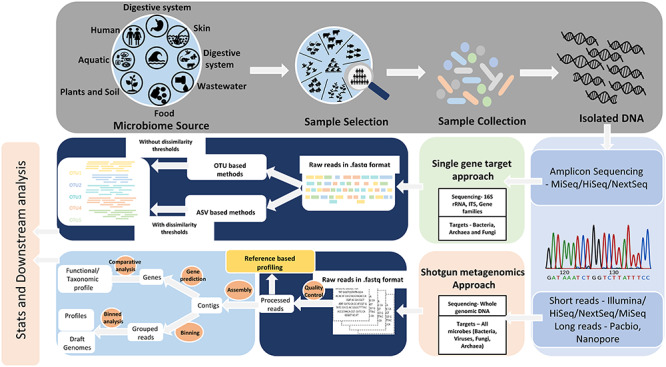
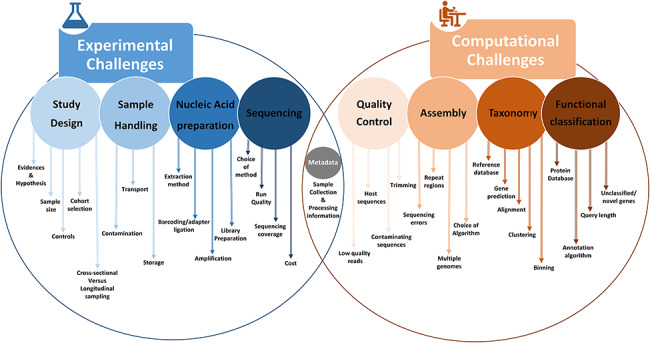
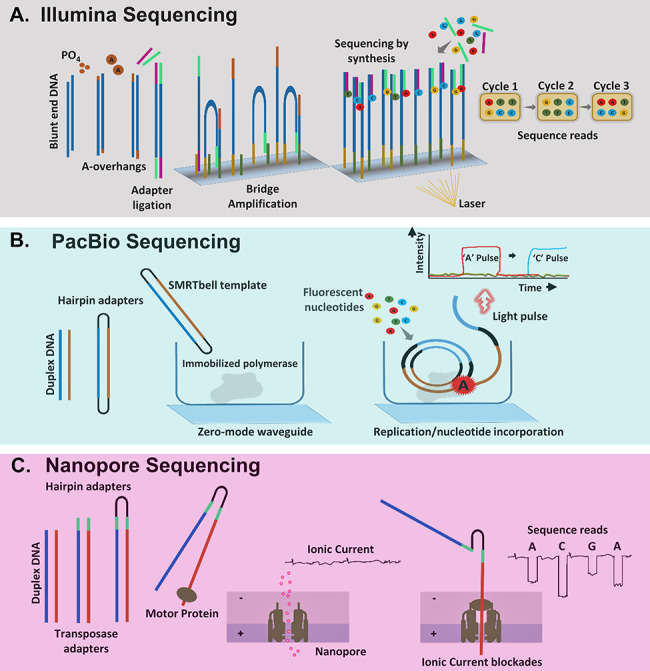
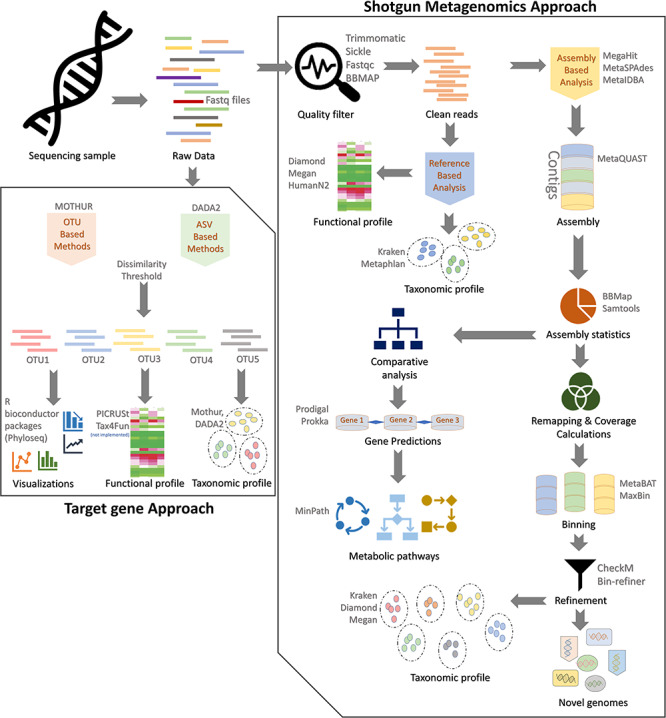
Analyzing the microbiome of diverse species and environments using next-generation sequencing techniques has significantly enhanced our understanding on metabolic, physiological and ecological roles of environmental microorganisms. However, the analysis of the microbiome is affected by experimental conditions (e.g. sequencing errors and genomic repeats) and computationally intensive and cumbersome downstream analysis (e.g. quality control, assembly, binning and statistical analyses). Moreover, the introduction of new sequencing technologies and protocols led to a flood of new methodologies, which also have an immediate effect on the results of the analyses. The aim of this work is to review the most important workflows for 16S rRNA sequencing and shotgun and long-read metagenomics, as well as to provide best-practice protocols on experimental design, sample processing, sequencing, assembly, binning, annotation and visualization. To simplify and standardize the computational analysis, we provide a set of best-practice workflows for 16S rRNA and metagenomic sequencing data (available at https://github.com/grimmlab/MicrobiomeBestPracticeReview).
Overview
The claims and statistics of this paper haven’t been checked yet.
Run the check — free, no account needed. It reads the open-access text and checks the sources it cites.
Integrity signals
Registry
Cites
Statistics
Figures
Verification
Claims the paper makes
The claims and statistics of this paper haven’t been checked yet.
Run the check — free, no account needed. It reads the open-access text and checks the sources it cites.
Claims other papers make about this one
Each is checked against this paper’s own text: does it say what the citing paper says it does?
The cited source says what the claim attributes to it.
In the citing paper
“In contrast to 16S rRNA sequencing, whole-genome shotgun metagenomic sequencing provides more comprehensive taxonomic and functional characterization, encompassing broader genomic content and enabling higher-resolution bacterial community profiling.”
From Microbiome meets immunotherapy: unlocking the hidden predictors of immune checkpoint inhibitors (2025) · cites this paper as [146]
Self-check
Percentages, sums and reported differences re-computed from the paper’s own numbers.
The self-check needs the paper’s full text.
Citations
Cites
Trimmomatic: a flexible trimmer for Illumina sequence data
Bolger, A. M., Lohse, M., & Usadel, B. (2014) · Bioinformatics · doi:10.1093/bioinformatics/btu170 · Cited by 65,548
Fast and accurate short read alignment with Burrows-Wheeler transform
Li, H., & Durbin, R. (2009) · Bioinformatics · doi:10.1093/bioinformatics/btp324 · Cited by 58,607
Fast gapped-read alignment with Bowtie 2
Langmead, B., & Salzberg, S. L. (2012) · Nature Methods · doi:10.1038/nmeth.1923 · Cited by 56,400
DADA2: High–resolution sample inference from Illumina amplicon data
Callahan, B. J., McMurdie, P. J., Rosen, M. J., Han, A. W., Johnson, A. J. A., & Holmes, S. P. (2016) · Nature Methods · doi:10.1038/nmeth.3869 · Cited by 35,698
Reproducible, interactive, scalable and extensible microbiome data science using QIIME 2
Bolyen, E., Rideout, J. R., Dillon, M. R., Bokulich, N. A., Abnet, C. C., Al-Ghalith, G. A., Alexander, H., Alm, E. J., Arumugam, M., Asnicar, F., et al. (2019) · Nature Biotechnology · doi:10.1038/s41587-019-0209-9 · Cited by 23,742
phyloseq: An R Package for Reproducible Interactive Analysis and Graphics of Microbiome Census Data
McMurdie, P. J., & Holmes, S. (2013) · PLoS ONE · doi:10.1371/journal.pone.0061217 · Cited by 21,942
Schloss, P. D., Westcott, S. L., Ryabin, T., Hall, J. R., Hartmann, M., Hollister, E. B., Lesniewski, R. A., Oakley, B. B., Parks, D. H., Robinson, C. J., et al. (2009) · Applied and Environmental Microbiology · doi:10.1128/aem.01541-09 · Cited by 19,549
Prokka: rapid prokaryotic genome annotation
Seemann, T. (2014) · Bioinformatics · doi:10.1093/bioinformatics/btu153 · Cited by 18,937
Fast and sensitive protein alignment using DIAMOND
Buchfink, B., Xie, C., & Huson, D. H. (2015) · Nature Methods · doi:10.1038/nmeth.3176 · Cited by 14,201
Prodigal: prokaryotic gene recognition and translation initiation site identification
Hyatt, D., Chen, G.-L., LoCascio, P. F., Land, M., Larimer, F. W., & Hauser, L. (2010) · BMC Bioinformatics · doi:10.1186/1471-2105-11-119 · Cited by 12,692
Research works printed but not linked: 3
- Bowtie, 2010, Chapter 11:Unit, 11, 17
- al, 2018, Metagenomics
- Mitra, 2019, Evolutionary Genomics. Methods in Molecular Biology
Cited by
Sorted by citations
Omnipose: a high-precision morphology-independent solution for bacterial cell segmentation
Cutler, K. J., Stringer, C., Lo, T. W., Rappez, L., Stroustrup, N., Peterson, S. B., Wiggins, P. A., & Mougous, J. D. (2022) · Nature Methods · doi:10.1038/s41592-022-01639-4 · Cited by 389
Human microbiome: an academic update on human body site specific surveillance and its possible role
Dekaboruah, E., Suryavanshi, M. V., Chettri, D., & Verma, A. K. (2020) · Archives of Microbiology · doi:10.1007/s00203-020-01931-x · Cited by 361
Open challenges for microbial network construction and analysis
Faust, K. (2021) · The ISME Journal · doi:10.1038/s41396-021-01027-4 · Cited by 316
Current understanding of the Alzheimer’s disease-associated microbiome and therapeutic strategies
Seo, D.-O., & Holtzman, D. M. (2024) · Experimental & Molecular Medicine · doi:10.1038/s12276-023-01146-2 · Cited by 259
Yang, C., Chowdhury, D., Zhang, Z., Cheung, W. K., Lü, A., Bian, Z., & Zhang, L. (2021) · Computational and Structural Biotechnology Journal · doi:10.1016/j.csbj.2021.11.028 · Cited by 242
Metadata
- Authors
- Bharti, R., & Grimm, D. G.
- Affiliations
- Weihenstephan-Triesdorf University of Applied Sciences (DE)
- Corresponding author
- Grimm, Dominik G
- Venue
- Briefings in Bioinformatics
- Publisher
- Oxford University Press (OUP)
- Published
- 2019-12-18
- Volume
- 22
- Issue
- 1
- Pages
- 178-193
- ISSN
- 1467-5463 (ISSN-L)
- 1477-4054
- PMC
- PMC7820839
- OpenAlex
- W2995649573
- Cited by
- 592
- References
- 184
- Citations by year
- 2026: 91 · 2025: 129 · 2024: 101 · 2023: 107 · 2022: 80 · 2021: 74 · 2020: 10
- FWCI
- 3.61
- Type
- journal article
- Language
- en
- Open access
- hybrid
- doi.org
- Licence
- Locations
- Briefings in Bioinformatics (publishedVersion, cc-by)
- Europe PMC (PubMed Central) (publishedVersion, cc-by)
- PubMed Central (publishedVersion, cc-by)
- PubMed (publishedVersion)
- mediaTUM – the media and publications repository of the Technical University Munich (Technical University Munich) (submittedVersion)
- mediaTUM – the media and publications repository of the Technical University Munich (Technical University Munich) (submittedVersion, other-oa)
- Topics
- Life Sciences › Biochemistry, Genetics and Molecular Biology › Molecular Biology › Genomics and Phylogenetic Studies
- Physical Sciences › Environmental Science › Ecology › Microbial Community Ecology and Physiology
- Life Sciences › Biochemistry, Genetics and Molecular Biology › Molecular Biology › Gut microbiota and health
- Keywords
- microbiome analysis, 16S rRNA gene sequencing, shotgun metagenomics, long-read metagenomics, best practice protocol, sample processing, sequencing quality control, metagenome assembly, metagenome binning, functional annotation, data visualization, experimental design
- MeSH terms
- Animals, Humans, RNA, Ribosomal, 16S, Practice Guidelines as Topic, Sequence Analysis, DNA, Metagenomics, DNA Barcoding, Taxonomic, Microbiota
About these checks
Registry, retraction, Cites and statistics results are computed, not judged, with one exception: a printed reference that no index lists is read once by a model before it counts as a citation error. Claims are extracted by a model and kept only when their quote appears verbatim in the text; each cited source is then checked, with a model’s help, for whether it says what the claim relies on. Those verdicts can be wrong — read the claim’s quote and the cited source before relying on one.
Statistics and arithmetic are recomputed, not judged.
Confidence bands are shown only for fields calibrated on our annotated test set. None is calibrated yet, so no band is shown.
What counts as a claim ›How we measure confidence ›How we check this ›
Are you an author, or do you see a problem with this page? Request a review
